When John identifies a strategic exit point, he will send you an alert with specific trade information as to what security to sell, when to sell it, and at what price. Most often, it will be to TAKE PROFITS, but on rare occasions, it will be to exercise a STOP LOSS at a predetermined price to adhere to strict risk management discipline.Read more
Let's face it. Cancer is still kicking our collective butts.
Despite all the fancy lab coats and high-tech gadgets, cancer remains the second-leading cause of death in the U.S. It's like that annoying party guest who just won't leave, no matter how many hints you drop.
This year alone, more than 2 million Americans are expected to hear those dreaded words: "You have cancer." And sadly, over 600,000 of our fellow citizens will lose their battle with this relentless foe in 2024.
Before you start thinking I'm all doom and gloom, let me flip the script for you. Where there's a problem, there's opportunity. And in this case, we're talking about a massive opportunity to put your investment dollars to work.
Back in 2020, America shelled out a whopping $200 billion on cancer treatments. By 2030, that number is projected to skyrocket to over $245 billion. That's a growth trajectory that’s worth our attention, don’t you think?
So, let's dive into the world of cancer-fighting stocks. There are some heavy hitters in this space that deserve your attention.
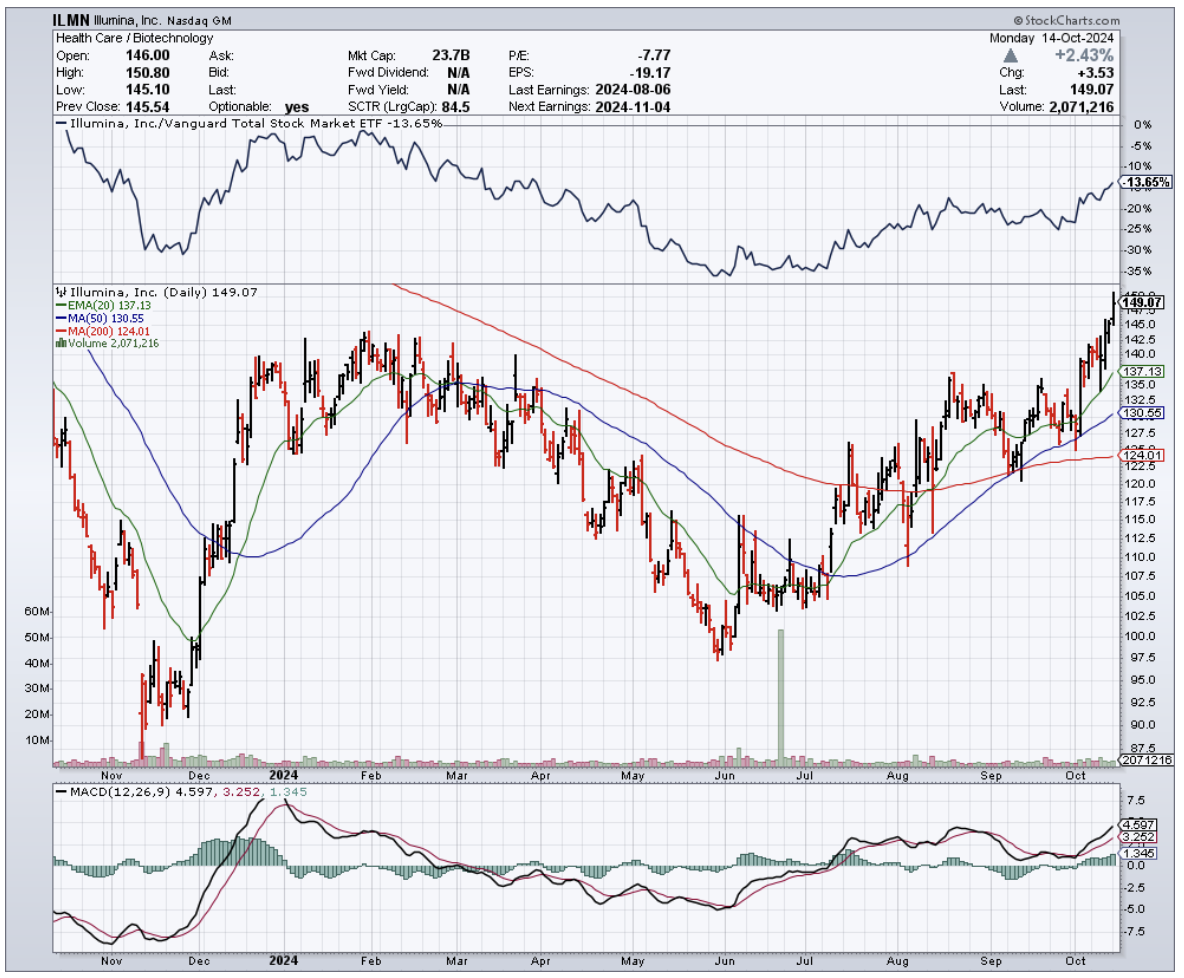
First up, we've got Illumina (ILMN), the gene-sequencing giant. These folks are like the Sherlock Holmes of the genetic world, helping researchers crack the cancer code.
With over 21,600 of their systems installed worldwide, Illumina is the go-to company for anyone looking to dive deep into our genetic makeup.
But here's the thing - Illumina isn't just about cancer. Their tech is used in everything from studying infectious diseases to figuring out if your unborn baby is likely to be the next Einstein.
And while they're tight-lipped about their exact market share, word on the street is they're still the big fish in the gene-sequencing pond.
In fact, let me throw some numbers at you. Illumina holds a whopping 80% market share among the seven main pure-play next-generation sequencing companies.
Even if we toss in some non-pure-play heavyweights like Thermo Fisher Scientific (TMO), Agilent Technologies (A), and Qiagen (QGEN), Illumina's still sitting pretty with roughly two-thirds of the global market.
And get this - despite the industry facing some macro headwinds, Illumina's market share has held steady over the past couple of years. Talk about staying power.
Speaking of big fish, Illumina recently spun off Grail (GRAL), but they've still got their fingers in that pie with a 14.5% stake.
Grail is all about liquid biopsy products – fancy talk for finding cancer through a simple blood test. It's a promising field, but Illumina's not the only player in town.
Enter the new kids on the block: Element Biosciences and Ultima Genomics. Backed by venture capital and hungry for a piece of the action, these upstarts are shaking things up. Element's focusing on accuracy, while Ultima's all about high-volume, low-cost sequencing.
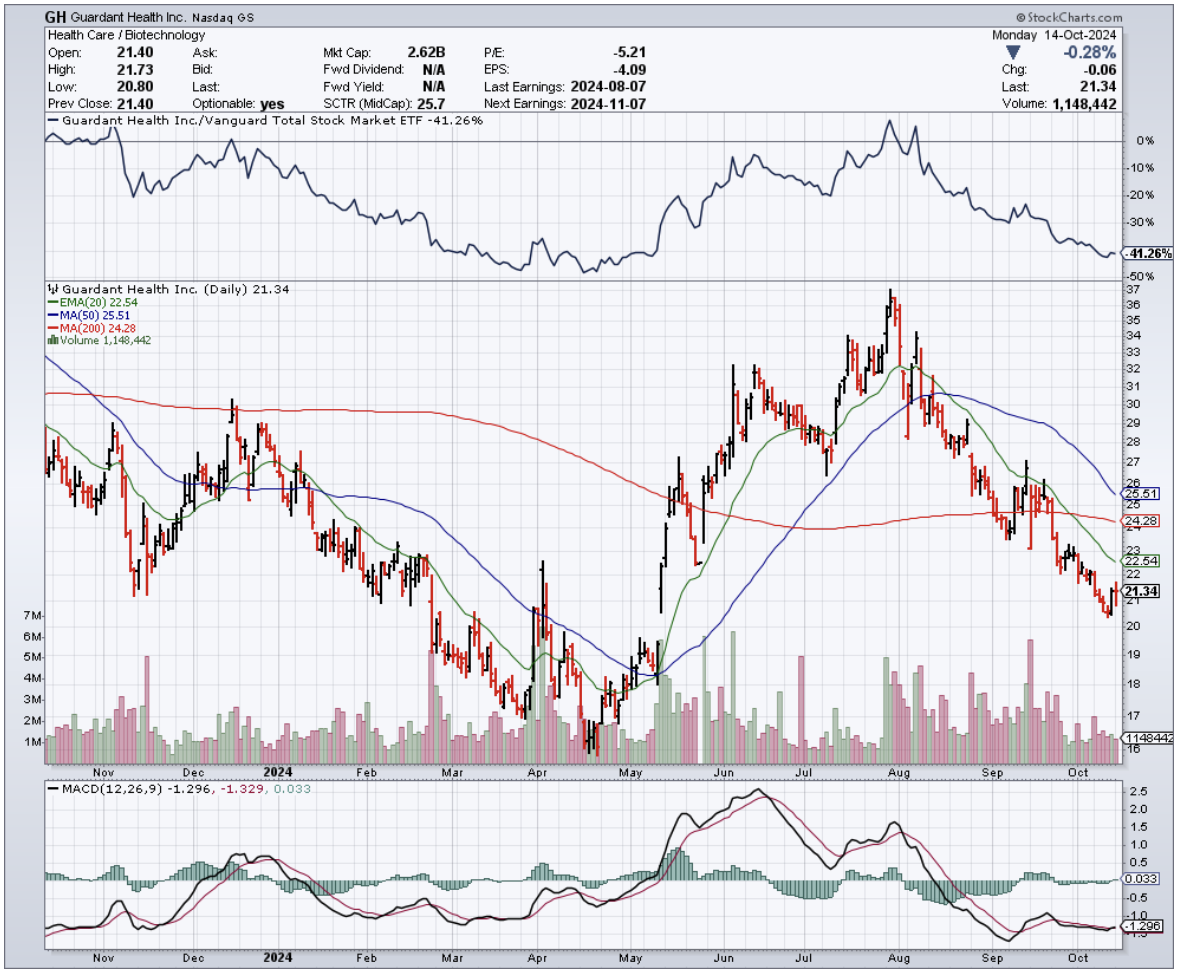
While we're on the topic of liquid biopsies, let's talk about Guardant Health (GH). These folks are the pioneers in finding tiny bits of tumor DNA floating around in your blood. Their Guardant360 product was the first FDA-approved liquid biopsy for all advanced solid tumors. That's like hitting a home run in your first major league at-bat.
But Guardant Health isn't resting on its laurels. They've got a whole suite of products, from tissue biopsies to tests that can tell if your cancer treatment is working. And get this – they're looking at a $30 billion annual market just in cancer treatment selection and recurrence monitoring.
But it doesn't end there. Early-stage cancer detection could add another $50 billion to that pot in the U.S. alone.
As if that wasn't enough, Guardant Health just got FDA approval for their Shield blood test for colorectal cancer screening in July 2024. Next stop? Lung cancer. These folks are aiming to create a test that can catch multiple cancers early.
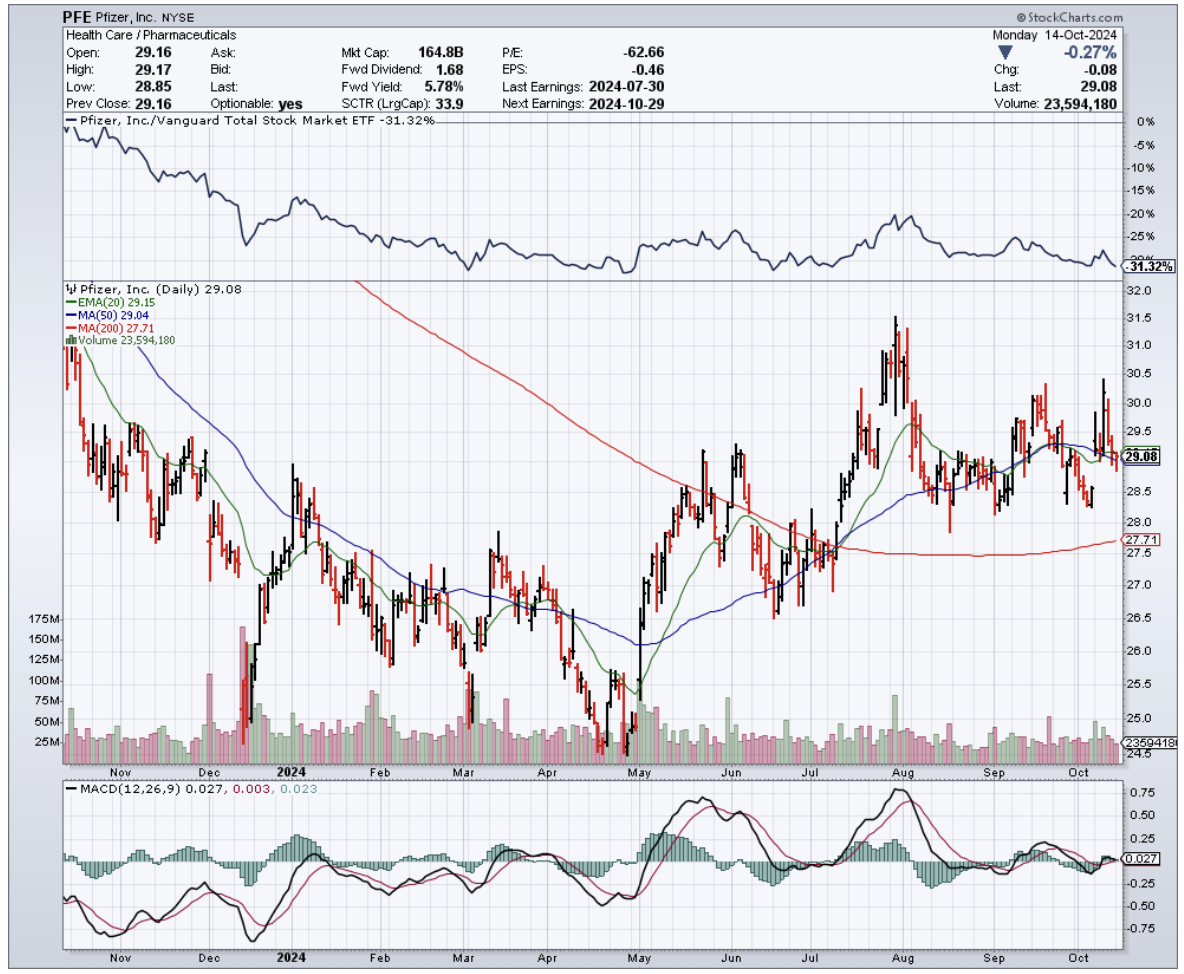
And let's not forget the big boys. Pfizer (PFE), the pharmaceutical giant, is throwing its considerable weight into the cancer fight.
They've already got three blockbuster cancer drugs – Ibrance, Xtandi, and Inlyta – each raking in over a billion dollars a year. And that's just the tip of the iceberg. Pfizer's got about 40 more cancer programs in clinical testing.
Still, Pfizer isn't just relying on its own lab coats. They're not afraid to open up their wallet either. In 2021, they snatched up Trillium Therapeutics to beef up their blood cancer portfolio. And in 2023, they added Seagen to their collection, giving them a leg up in antibody-drug conjugates for cancer treatment.
Now, I know what you're thinking. "But what if the cancer market dries up?" (As if!) Well, Pfizer's got that covered too. They're big players in the vaccine market, with their new respiratory syncytial virus vaccine, Abrysvo, looking set to bring in some serious cash.
So there you have it. The war on cancer is far from over, but these companies are leading the charge. And while they're fighting to save lives, they might just help fatten up your portfolio too. I suggest you add these names to your watchlist and buy the dip.
https://madhedgefundtrader.com/wp-content/uploads/2019/05/cropped-mad-hedge-logo-transparent-192x192_f9578834168ba24df3eb53916a12c882.png00april@madhedgefundtrader.comhttps://madhedgefundtrader.com/wp-content/uploads/2019/05/cropped-mad-hedge-logo-transparent-192x192_f9578834168ba24df3eb53916a12c882.pngapril@madhedgefundtrader.com2024-10-15 12:00:432024-10-15 12:23:38The Bright Side Of A Dark Diagnosis
Talk about a wake-up call for anyone still sleeping on AI.
The 2024 Nobel Prize in Physics just went to John Hopfield and Geoffrey Hinton, two guys who've been tinkering with artificial brains since before most of us knew what a smartphone was.
This isn't just some ivory tower pat on the back - it's a flashing neon sign pointing to where the real action is in the stock market.
Let's break it down. Hopfield, the Princeton brainiac, cooked up something called the Hopfield Network back in '82. Think of it as the great-granddaddy of today's neural networks.
It showed how these artificial neurons could play catch with patterns, storing and spitting them back out. Fast forward to now, and this is behind practically everything from your phone's face recognition to Wall Street's algorithmic trading.
Then there's Hinton, the guy they call the "Godfather of AI." He's the reason your Netflix knows what you want to watch before you do.
His work on deep learning and those back-propagation algorithms? That's what's powering the chatbots that are making customer service reps sweat and the AI that's reading X-rays faster than radiologists.
So, why should we care? Because this Nobel nod isn't just about science. It's about cold, hard cash. The global AI market? It's not just growing; it's exploding.
We're talking $207.9 billion in 2023, and it's gunning for $1.8 trillion by 2030. That's a 36.2% compound annual growth rate.
Need more proof? Chew on this: 85% of enterprises are already knee-deep in AI. That's up from 77% just two years ago.
And the money pouring into AI? Corporate bigwigs dumped $94 billion into it last year alone, a 13% jump from the year before.
But here's where it gets real for us regular folks - AI isn't just some back-office tech anymore. We're looking at 75 billion devices worldwide using AI. That's your phone, your car, maybe even your toaster. AI is everywhere, and it's only getting started.
So, where's the smart money going? Let’s take a look at some of the front runners.
First up, NVIDIA (NVDA). Its inclusion in this list is no surprise. After all, these guys are the picks and shovels of the AI gold rush. Their GPUs are the muscle behind AI computations. Q2 2024 numbers? Revenue hit $13.51 billion, more than doubling year-over-year. The stock's up 120% year-to-date.
Next is Alphabet (GOOGL). Google's parent company isn't just a search engine anymore. They're AI heavyweights, with Google Assistant in millions of homes and DeepMind pushing the boundaries of what's possible. Q2 2024 saw them rake in $74.6 billion, with their cloud segment (read: AI services) growing 22%. The stock's up 30% over the year.
As for Microsoft (MSFT), their OpenAI partnership and Azure integration are game-changers. Intelligent Cloud brought in $23.4 billion in Q4 2023, up 15% year-over-year. The stock? Up 35% year-to-date. Ballmer might be gone, but the money machine keeps humming.
Meanwhile, Amazon (AMZN) isn't just about two-day shipping anymore. Amazon Web Services is a beast, offering AI and machine learning services that are printing money. AWS pulled in $21.4 billion in Q2 2024. After a rough patch, the stock's bounced back, up 25% in six months.
Even old-school Intel (INTC) is getting in on the action. They're pushing hard into AI accelerators and neural network processors. Their Data Center and AI group brought in $4.0 billion in Q2 2024. The stock's up a modest 10% year-to-date, but they're just getting started.
But don't just stick to the big boys. Keep an eye on the up-and-comers.
Palantir Technologies (PLTR) is doing big things with big data and AI-driven decision-making. They saw a 49% jump in government contracts last year.
Then there's C3.ai (AI), pushing AI applications for enterprises. Their subscription revenues grew 34% last fiscal year.
Now, before you mortgage the house to buy AI stocks, remember - this isn't a get-rich-quick scheme. The AI market is definitely hot, but it's not without risks. Regulatory headwinds, ethical concerns, and good old-fashioned competition could throw some curveballs.
The smart play? Diversify. Mix some established tech giants with a sprinkle of AI pure-plays. And here's a pro tip: don't just stick to home turf. AI is a global game, and some of the most exciting innovations are happening beyond Silicon Valley.
In fact, it's turning into a full-blown international AI arms race. Some of the most mind-bending breakthroughs are popping up in places you might not expect.
For one, China's not messing around. They're gunning to be the world's AI superpower by 2030, and they're throwing everything but the kitchen sink at it.
Baidu (BIDU), China's answer to Google, is knee-deep in AI. Their autonomous driving platform, Apollo, is giving Tesla a run for its money. And let's not forget about their ChatGPT rival, ERNIE Bot. Baidu's stock? It's been a rollercoaster, but their AI chops are undeniable.
Then there's Alibaba (BABA). Jack Ma might be keeping a low profile these days, but Alibaba's AI game is loud and clear.
Their cloud computing arm is second only to Amazon in Asia, and they're pumping out AI solutions faster than you can say "e-commerce." From smart cities to healthcare AI, Alibaba's fingerprints are all over China's tech scene.
Hop over to South Korea, and you'll find Samsung (KRX: 005930) doing more than just making your phone. They're pouring billions into AI research, focusing on everything from smartphone chips to advanced semiconductors.
Their AI assistant, Bixby, might not be a household name like Siri, but don't count them out. Samsung's got the deep pockets and the tech savvy to be a major AI player.
In Japan, SoftBank Group (TYO: 9984) is making waves. Yeah, the same folks who had that WeWork debacle.
But here's the thing - their Vision Fund has its fingers in AI pies all over the world. From robotics to fintech, SoftBank's betting big on AI-driven startups. It's a high-risk, high-reward play, but that's Masayoshi Son's style.
Let's not forget Europe. DeepMind, now under Alphabet's umbrella, started life in London. But there's more brewing across the pond. Take ASML Holding (ASML) in the Netherlands.
They're not an AI company per se, but their extreme ultraviolet (EUV) lithography machines are crucial for making the advanced chips that power AI. Without ASML, a lot of AI dreams would still be just that - dreams.
In Germany, SAP (SAP) is bringing AI to enterprise software. They're not as flashy as some AI pure-plays, but they're embedding machine learning and AI into the backbone of how businesses operate. It's not sexy, but it's where the rubber meets the road for AI in the corporate world.
And let's give a nod to Israel, the "Startup Nation." They're punching well above their weight in AI.
Companies like Mobileye (MBLY), now part of Intel, are leading the charge in autonomous driving tech. Or take a look at Cognyte Software (CGNT), using AI for security analytics. These folks are turning Israel into an AI powerhouse.
Even in India, which you might think of more for IT outsourcing, AI is taking off.
Reliance Industries (NSE: RELIANCE) is pouring money into AI research, looking to transform everything from retail to telecom. And then there’s Tata Consultancy Services (NSE: TCS), quietly becoming an AI consulting giant.
Clearly, this AI boom isn't just about individual companies anymore. It's spawning entire ecosystems. Shenzhen, Tel Aviv, Bengaluru - these are the new AI breeding grounds.
For us, it means more opportunities. Forget just watching the Nasdaq. You've also got to eyeball exchanges from Shanghai to Frankfurt and navigate regulatory minefields from Beijing to Brussels.
And here's the kicker - this global race is innovation on steroids. It's not about the biggest tech giant anymore, but who can innovate fastest and scale smartest.
Bottom line? Those two eggheads didn't just scramble the stock market - they whisked up a global AI omelet. So, I suggest you do your homework, spread your bets, and maybe learn some Mandarin. After all, the AI world's your oyster, and it’s time to go pearl hunting.
https://www.madhedgefundtrader.com/wp-content/uploads/2024/10/Screenshot-2024-10-14-171230.png350617Douglas Davenporthttps://madhedgefundtrader.com/wp-content/uploads/2019/05/cropped-mad-hedge-logo-transparent-192x192_f9578834168ba24df3eb53916a12c882.pngDouglas Davenport2024-10-14 17:14:092024-10-14 17:14:09HOW TWO EGGHEADS SCRAMBLED THE STOCK MARKET
I know many people don’t talk about this, but they should.
Much of the insurance industry has been lapping up the profits, because of cataclysmic hurricanes, floods, earthquakes, tsunamis, and mudslides.
Why not do the same with tech?
Now there is a new insurance sub-sector that could become equally as expensive for companies protecting against cybersecurity risks.
The demand for cyber insurance is set to grow amid a series of high-profile cyber-attacks and this trend is unrelenting.
From my channel checks, the cyber insurance industry is set to expand at an 18% compound annual growth for the next 5 years.
Instead of physically robbing a bank and exposing oneself to the violent harm, cyber criminals are sitting behind computers in remote parts of the world digitally looting from their laptops.
Even if they do get caught, they are often in countries that have no extradition agreements with victims from the nation state.
The low risk nature of the heist and asymmetrical gains are almost like options trading.
Let’s see some of the instance of recent cyber fraud.
United Healthcare’s Change Healthcare medical billing processor, which links one third of Americans to health-insurance payments, suffered a cyber-attack in February, crippling the payments systems of a significant number of hospitals.
The May attack on Ticketmaster compromising 560 million customer records was another win for the cyber bullies.
An estimated $8 trillion was lost globally to cybercrime in 2023, a significant increase vs. the $600 billion estimated in 2018.
This industry pays and a time will come when Fortune 500 companies will become the main target.
Some of these far flung places that have major cyber hacking operations are little known places in South East Asia where they took in over $200 billion last year.
Malware, generative AI, and deepfakes have been integrated into their operations while opening up new underground markets and cryptocurrency solutions for their money laundering needs.
As a result cyber frauds have continued to intensify from East and Southeast Asia.
This is just the tip of the iceberg, but the message is clear.
If funds are illegal taken, it is almost impossible to recover them when they are funneled into China then laundered into a 3rd party jurisdiction.
Much of this type of cybercrime is now professionalized.
Ultimately, cybersecurity insurance is a variable that is set to mushroom in the coming years.
Cybercriminals are not only in the widely active East Asia, but many more from Eastern Europe and Africa, and each region is imitating each other as they see strategies succeed.
Ironically, according to the data, the only companies that feel it is worth paying up for cybercrime insurance and companies in North America and Europe.
If this starts to become a drag on the earnings, it could really drag down some smaller companies.
As what is usual for bigger companies, these types of costs are usually passed down to the end consumer and their pricing power allows big tech to do it.
Many have not heard of insurance in tech, and it might be the new tail risk to monitor moving forward in tech, because the monetary rewards for starting a hacking ring in a foreign country is too great to ignore.
I predict that in the next few years, one big tech name will fall due to a run on its security integrity creating a new massive windfall into cybersecurity firms.
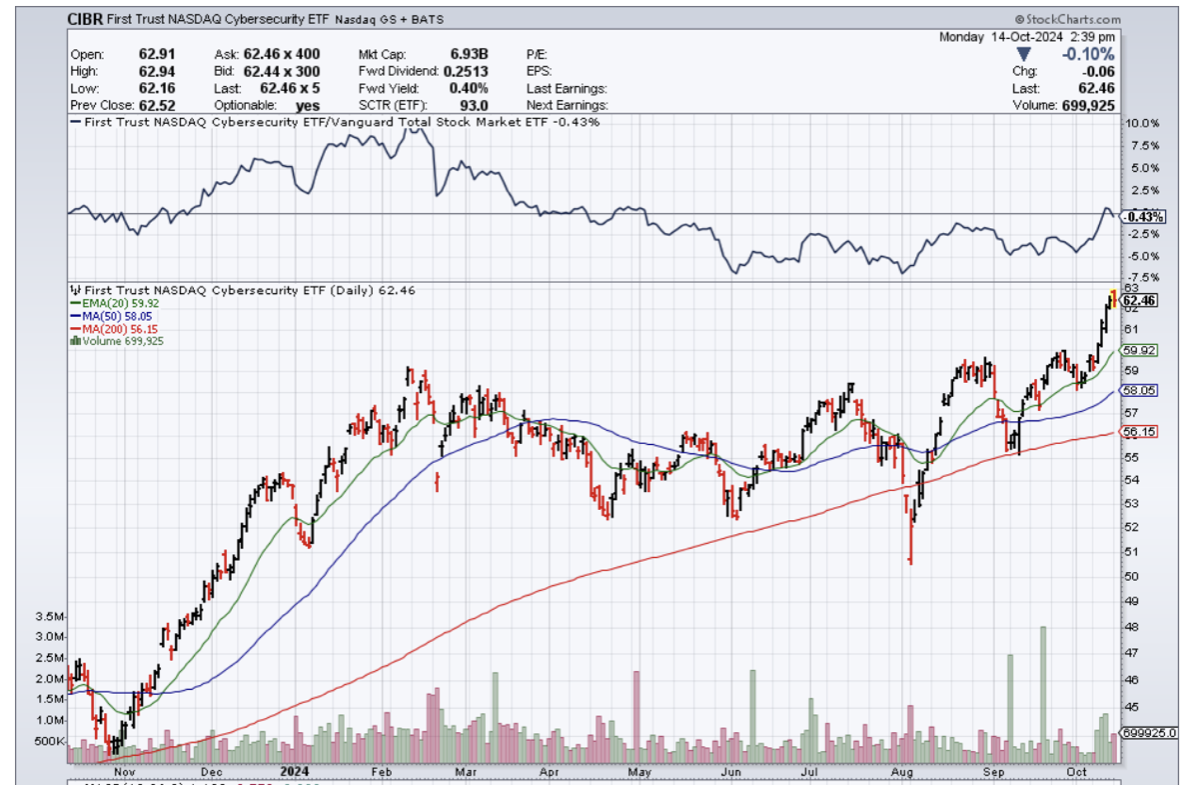
Readers should not fall asleep at the wheel and invest in First Trust Nasdaq Cybersecurity ETF (CIBR).
https://madhedgefundtrader.com/wp-content/uploads/2019/05/cropped-mad-hedge-logo-transparent-192x192_f9578834168ba24df3eb53916a12c882.png00april@madhedgefundtrader.comhttps://madhedgefundtrader.com/wp-content/uploads/2019/05/cropped-mad-hedge-logo-transparent-192x192_f9578834168ba24df3eb53916a12c882.pngapril@madhedgefundtrader.com2024-10-14 14:02:382024-10-14 15:23:41Great Potential For A Tech Sub-Sector
“Rule No. 1: Never lose money.” – Said Warren Buffett
https://www.madhedgefundtrader.com/wp-content/uploads/2024/07/warren-buffet.png320270april@madhedgefundtrader.comhttps://madhedgefundtrader.com/wp-content/uploads/2019/05/cropped-mad-hedge-logo-transparent-192x192_f9578834168ba24df3eb53916a12c882.pngapril@madhedgefundtrader.com2024-10-14 14:00:252024-10-14 15:20:38October 14, 2024 - Quote of the Day
Earnings: United Airlines, J.B. Hunt Transport Services, Citigroup, State Street, Goldman Sachs Group, Walgreens Boots Alliance, Johnson & Johnson, Bank of America, PNC Financial Services Group, United Health Group, Charles Schwab.
WEDNESDAY, OCT 16
2:00 a.m. UK Inflation Rate
8:30 a.m. Export Price Index (September)
8:30 a.m. Import Price Index (September)
Earnings:PPG Industries, Steel Dynamics, Discover Financial Services, CSX, Prologis, Morgan Stanley, Abbott Laboratories, U.S. Bancorp, Citizens Financial Group, Synchrony Financial.
THURSDAY, OCT 17
8:15 a.m. Euro Area Rate Decision
8:30 a.m. Continuing Jobless Claims (10/05)
8:30 a.m. Initial Claims (10/12)
8:30 a.m. Philadelphia Fed Index (October)
8:30 a.m. Retail Sales (September)
9:15 a.m. Capacity Utilization (September)
9:15 a.m. Industrial Production (September)
9:15 Manufacturing Production (September)
10 a.m. NAHB Housing Market Index (October)
Earnings:Intuitive Surgical, Netflix, KeyCorp, M & T Bank Corp., Elevance Health, Truist Financial, Huntington Bancshares, Blackstone.
FRIDAY, OCT 18
8:30 a.m. Building Permits preliminary (September)
8:30 a.m. Housing Starts (September)
Earnings:Schlumberger NV, Procter & Gamble, Fifth Third Bancorp, Regions Financial, American Express, Ally Financial.
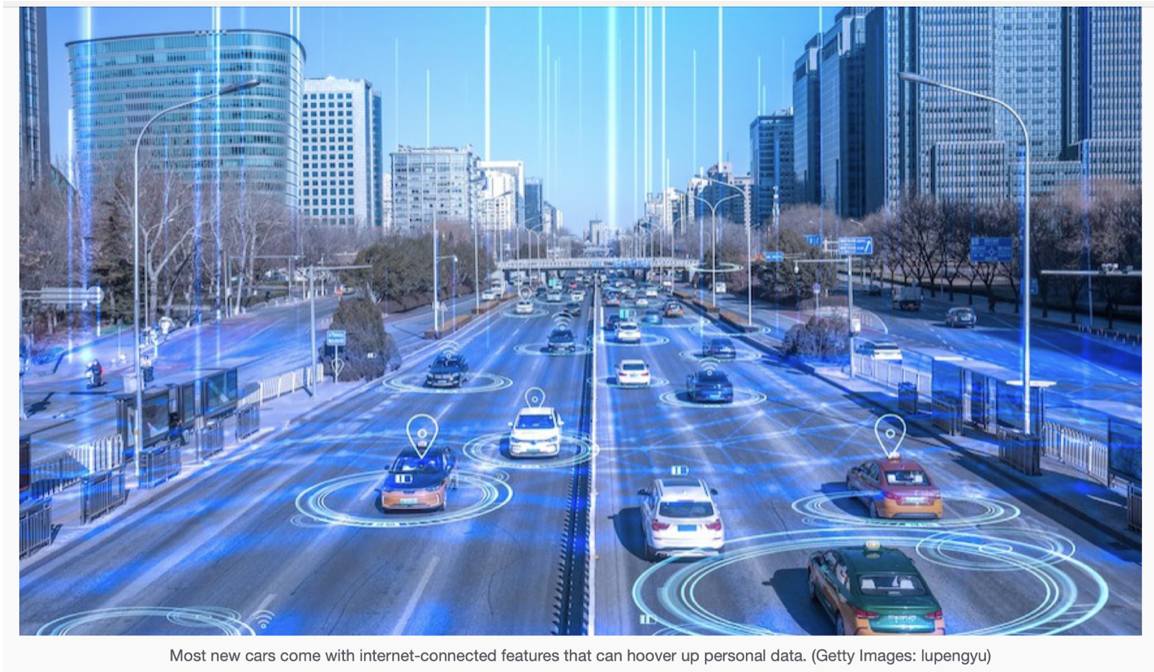
Driving your car is no longer a private experience – data is being shared with x, y, and z when you purchase new car brands.
Do you want companies/people to know your location when you are driving?
Do you want companies/people to know the way you drive?
Do you speed?Do you brake heavily?Do you tailgate?
More data than you can imagine is being recorded and shared with third parties in new cars produced today.
Microphones, sensors, and other internet-connected features mean cars have become all-seeing data harvesting machines dubbed “smartphones on wheels.”
Most consumers are unaware of this as car makers are not very upfront about data collection and often keep the fine print in their privacy policies vaguely worded.
Hyundai, Kia, and Tesla seem to be the worst culprits at selling data on to third parties, according to Choice Magazine.
A Choice investigation found that Kia and Hyundai, which have the same parent company, collect voice recognition data from inside their cars and sell this to the artificial intelligence (AI)software training company Credence.
Kia and Hyundai drivers – have you consented to your voice being used to train AI models?
If you are a Tesla owner, you really need to be aware of this. Images and videos from cameras inside Teslas, which have been shared with third parties, have shown Tesla customers in the nude, as well as images of crashes and road-rage incidents.
The privacy policies seem to be incredibly vague. In other words, they provide no clear guidelines on what data is being collected, how it’s being collected, and where the data is going.
Perhaps it is ambiguous for good reason – it clearly keeps the customer on the back foot while the car company and third parties are in control.
The findings by Choice investigation are like those of the US-based Mozilla Foundation, which last year found 25 car brands collected customer data ranging from facial expressions to sexual activity and where and how people drive.
Cars are no longer just transport getting you from A to B.The inbuilt technology is invasive and being shared with third parties we are not aware of.
One Queensland man backed out of purchasing a Toyota Ute earlier this year after he learned about the company’s data collection practices.Toyota collects and shares vehicle location and driver behaviour data, including scoring a driver’s acceleration, braking, and cornering behaviour during each trip.
The privacy policies that you find totally bewildering have often given car brands the option of sharing data with insurers.
Get back in control – what can you do?
If you use an app for your car, head into the app’s settings and look for any sort of data sharing options, usually named “data privacy” or data usage.”
Where possible, opt out of sharing any data with third parties and see if you can disable GPS location tracking when not in use for navigation.
Do you connect your phone to the car’s infotainment system?Be cautious.Limit the permissions you grant the car's system.
I would expect the process of deleting any data collected is unique to most car models and types.
Check out the free online resource Privacy4Cars.It offers step-by-step delete instructions for thousands of vehicles.
The website covers the UK, EU, US, and Canada.Some Australian models may not be included.The site is not perfect, but it’s better than nothing.
Governments and car buyers – their reactions.
Last month, the US moved to ban a vast array of Chinese-made cars over fears the Chinese government could spy on their drivers.
Data gathered by Chinese-made cars is the same as other car brands, but there could be a higher potential for misuse.
A double level of surveillance – commercial and government – seems rather invasive. George Orwell’s book 1984 is a stark reminder of what is happening in our modern world.Orwell certainly was a visionary and gave us all something to think about – even though we might not have given his concepts much attention at the time.
About three in four Australians disagree or strongly disagree with video or audio recordings from inside a car being collected by car companies, according to a nationally representative Choice survey conducted in June 2024.
Support services for domestic violence victims are also increasingly concerned.
Domestic violence perpetrators are using connected cars to track those who are trying to escape them.
We need to remember a car is now “a computer on wheels.”
California recently introduced legislation requiring car makers selling internet-connected cars to do more to protect domestic abuse survivors, including enabling drivers to easily turn off location access from inside the vehicle.
Last year, a woman unsuccessfully sued Tesla, alleging the company failed to act after she repeatedly complained that her husband was stalking and harassing her using the car maker’s technology, despite a restraining order.
While there are obviously some apparent negative elements to driving “a computer on wheels,” it is also clear that the utilization of data in vehicles, including both connected and autonomous vehicles, provides consumers with benefits through improvements in safety, performance, and navigation as well as supporting general user experience and servicing improvements.
Car makers and privacy laws need to be monitored closely.Make sure you read the fine print and ask questions.
MARKET UPDATE
S&P 500
The rally is still on track, with no signs of exhaustion yet.
Next target = ~5,930
Support = ~5790/5760
GOLD
Uptrend still intact.
Next target = ~$2,770/$2,800
Support = ~$2,630/$2605
BITCOIN
Potential for a good upside rally after Bitcoin formed a wave ii correction, which completed an (a b c) corrective move.
Next target = ~ $68,000/$73,800
Support = ~ $60,500/$58,800
QI CORNER
This graphic compares the countries and regions with the highest nominal GDP per capita in 2024 to those in 2014, based on data from the International Monetary Fund.
When John identifies a strategic exit point, he will send you an alert with specific trade information as to what security to sell, when to sell it, and at what price. Most often, it will be to TAKE PROFITS, but on rare occasions, it will be to exercise a STOP LOSS at a predetermined price to adhere to strict risk management discipline.Read more
https://www.madhedgefundtrader.com/wp-content/uploads/2016/02/Alert-e1457452190575.jpg135150Mad Hedge Fund Traderhttps://madhedgefundtrader.com/wp-content/uploads/2019/05/cropped-mad-hedge-logo-transparent-192x192_f9578834168ba24df3eb53916a12c882.pngMad Hedge Fund Trader2024-10-14 10:24:512024-10-14 10:29:43Trade Alert - (TSLA) October 14, 2024 - TAKE PROFITS - SELL
Legal Disclaimer
There is a very high degree of risk involved in trading. Past results are not indicative of future returns. MadHedgeFundTrader.com and all individuals affiliated with this site assume no responsibilities for your trading and investment results. The indicators, strategies, columns, articles and all other features are for educational purposes only and should not be construed as investment advice. Information for futures trading observations are obtained from sources believed to be reliable, but we do not warrant its completeness or accuracy, or warrant any results from the use of the information. Your use of the trading observations is entirely at your own risk and it is your sole responsibility to evaluate the accuracy, completeness and usefulness of the information. You must assess the risk of any trade with your broker and make your own independent decisions regarding any securities mentioned herein. Affiliates of MadHedgeFundTrader.com may have a position or effect transactions in the securities described herein (or options thereon) and/or otherwise employ trading strategies that may be consistent or inconsistent with the provided strategies.