

“Market players are starting to become desensitized to the Armageddon, end-of-the-world stories,” said Jim Paulsen, chief investment strategist at Wells Capital Management.


“Market players are starting to become desensitized to the Armageddon, end-of-the-world stories,” said Jim Paulsen, chief investment strategist at Wells Capital Management.
(GOOGL), (MSFT), (AMZN), (IBM), (IONQ), (RGTI)
You know, it's funny – just when I thought I had a handle on regular AI, the universe throws us this quantum curveball.
It’s like we’re living through the Heisenberg Uncertainty Principle of investing: the more we know, the more we realize how unpredictable the future can be.
But that’s the game we’re in. Always moving, always changing, and always presenting new opportunities for those of us willing to look.
So, what's the deal with Quantum AI? Well, we're talking about a market that was worth a cool $239.4 million in 2023, with a compound annual growth rate of 32.40% from 2023 to 2033.
That means by the time we hit 2033, this market could be worth $3.9 billion. That's no chump change. And if you're wondering where the action's going to be, keep your eyes on the Asia Pacific region. They're gearing up to grow faster than my enthusiasm for a bull market.
Now, I know some of you are scratching your heads, wondering what the heck Quantum AI actually is. Let me break it down for you.
Let me break it down. We've been using computers to crunch numbers and solve problems for decades, right?
Well, Quantum AI is like giving those computers a turbo boost and a PhD in theoretical physics. It's basically the lovechild of quantum computing and artificial intelligence.
Here's how it works: traditional computers use bits, tiny on-off switches that are either 0 or 1. Quantum computers, however, use qubits. These qubits are like the magicians of the computing world—they can be 0, 1, or both at the same time.
Think of it as being able to be in New York and Tokyo simultaneously. This quantum superposition allows quantum computers to solve complex problems faster than ever.
When you apply this quantum horsepower to AI, you get a machine that can process data and run algorithms at speeds that make your latest smartphone look like a rotary dial phone. We're talking about tackling problems that would take classical computers centuries to solve.
But why should we care about this? Well, this isn't some far-off science fiction fantasy. Quantum AI is already starting to revolutionize industries faster than you can update your stock portfolio.
Take healthcare, for instance. Quantum AI could help us discover new drugs faster than a hypochondriac can Google their symptoms. It could simulate molecular structures so quickly that we might find cures for diseases we thought were incurable.
In finance, Quantum AI could create risk assessment models that make our current ones look like child's play. It could optimize investment portfolios better than a room full of Ivy League analysts running on caffeine.
For those interested in logistics, we're looking at supply chain optimizations that could make same-day delivery seem slow.
And in cybersecurity, Quantum AI could develop encryption methods so advanced that current security measures would seem like leaving your front door wide open.
Now, here's where things get particularly interesting. Google (GOOGL) — you know, that little search engine company — just invested a significant sum in a Boston-based company called QuEra Computing, a quantum computing firm spun out of Harvard and MIT.
They're keeping the exact amount under wraps, but it's described as "very meaningful." When Google starts writing checks, it's time to pay attention. Let me tell you what I know about this collaboration so far.
QuEra is doing something innovative with their approach to quantum computing. They're using rubidium atoms—yes, the stuff found in fireworks—and controlling them with lasers to create qubits.
Why is this a big deal? Well, it's like the difference between trying to build an ice sculpture in the desert versus in a freezer.
Traditional quantum computers use superconducting qubits that require ultra-cold temperatures to function—colder than outer space, in fact. It's expensive and not exactly practical.
But QuEra's method? It's more like your average Joe. It works at room temperature, no drama, no fuss.
This means you could potentially have a quantum computer that doesn't need its own liquid helium spa to keep cool. It's quantum computing for the masses, not just for labs with billion-dollar budgets.
Now, Google throwing its weight behind QuEra is like Warren Buffett deciding to mentor a promising startup. It's not just about the money - though I'm sure that doesn't hurt. It's about the brainpower.
You've got Google's quantum eggheads teaming up with QuEra's scientists. This is the kind of collaboration that could lead to breakthroughs faster than you can say "Schrödinger's cat."
But Google's not the only player in this quantum sandbox. The usual tech suspects are all over this like white on rice.
IBM (IBM), Microsoft (MSFT), and Amazon (AMZN) are heavily invested in quantum research. Don't overlook the newcomers either—IonQ (IONQ) is doing fascinating work with trapped ions, and Rigetti Computing (RGTI) is advancing superconducting processors.
So, what does all this mean for you? Now, I'm not telling you to go all-in on quantum stocks tomorrow. The truth is, like any new frontier, Quantum AI brings a bit of unpredictability, but that’s often where the biggest opportunities lie.
Still, if you're not at least considering how these players might fit into your portfolio, you might as well be investing in typewriter companies in the age of computers. I suggest you add these names to your watchlist and buy the dip.

Mad Hedge Technology Letter
October 18, 2024
Fiat Lux
Featured Trade:
(AMD GAINING MARKET SHARE)
(AMD), (NVDA)

If you thought that AI chips had reached the high water mark, then you are entirely wrong.
Nvidia has been one of the only games in town, and that is a strong sign of a first-mover advantage.
In fact, the ecosystem could benefit if several chip companies could rise to the occasion to infuse that extra bit of supply.
Nvidia is on record, saying they can’t meet demand.
Well, we have finally reached the next phase of the AI chip story, and that is the next company stepping up to the plate.
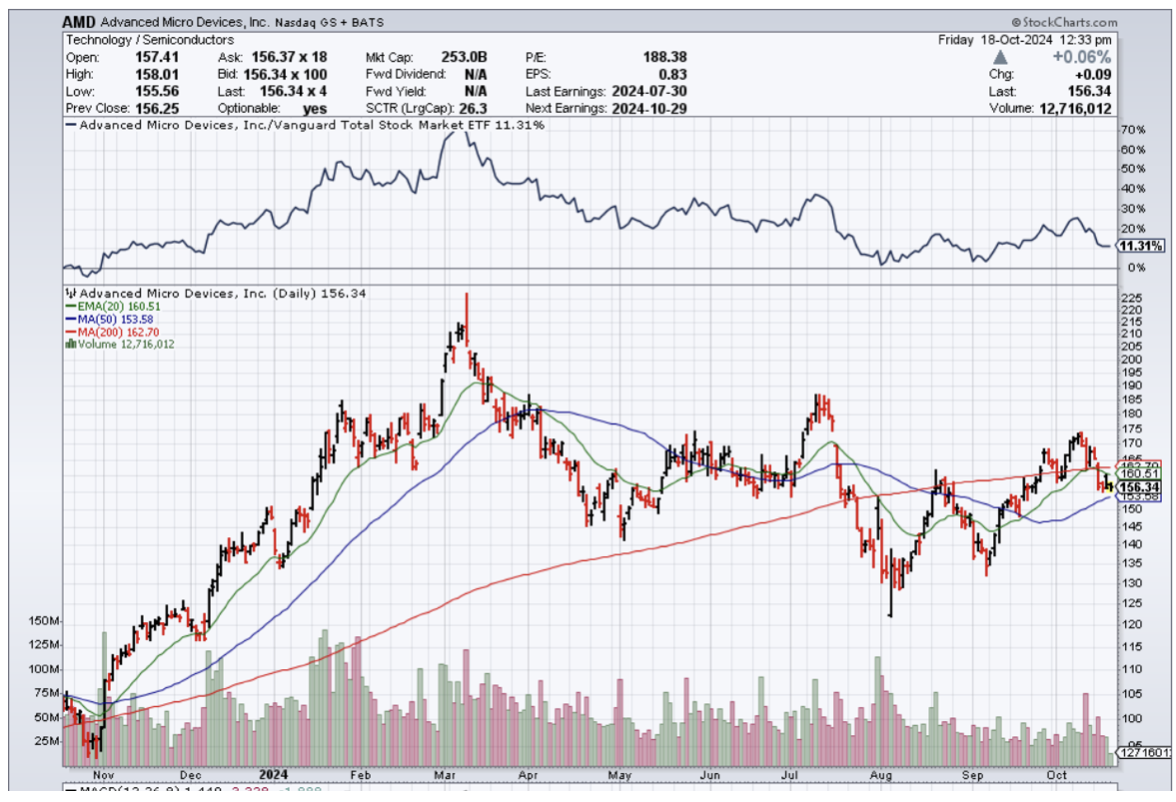
AMD (AMD) has been working furiously to get into the AI GPU game, and it appears as if their harvest is just around the corner.
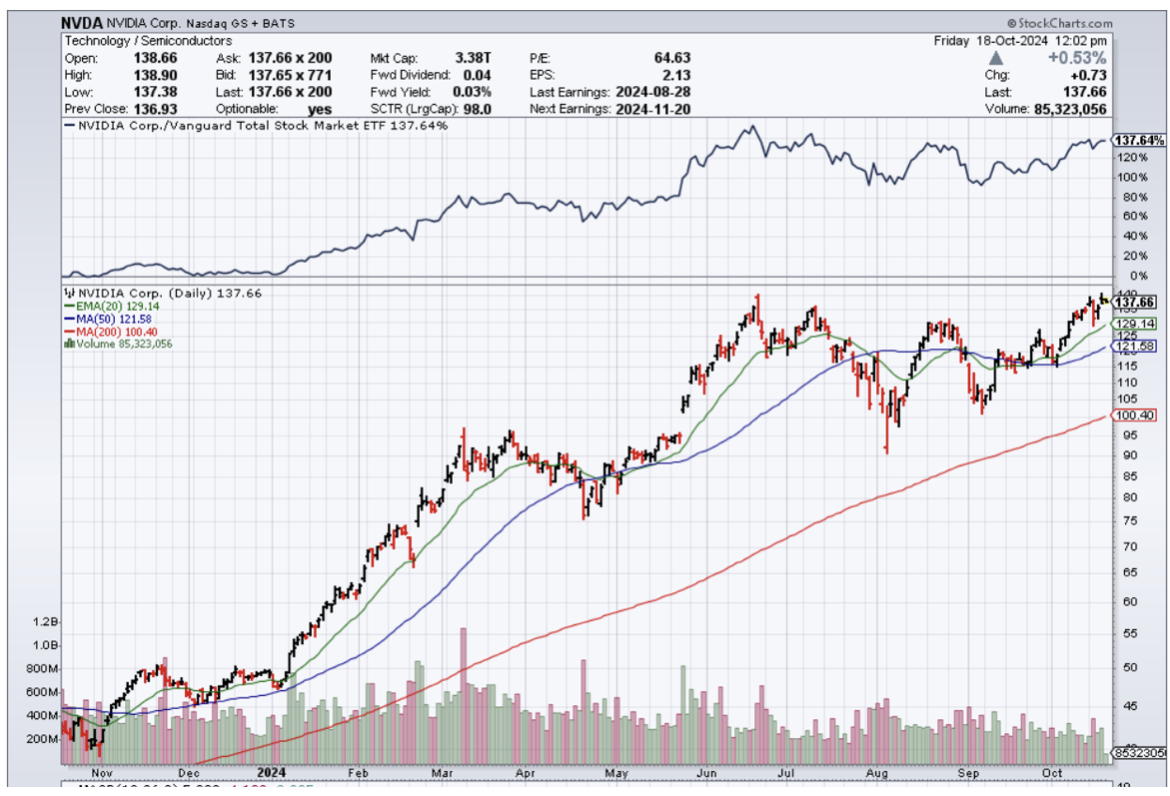
For the past 18 months, Nvidia (NVDA) has dominated the GPU industry with a ball-busting market share of up to 98%.
Nvidia's H100 GPU set the benchmark for AI training and AI inference.
The H100 is still a sizzling product today, and Nvidia continues to struggle with supply constraints because demand is so high from leading AI companies like OpenAI, Amazon, Microsoft, and more.
Those supply challenges have opened the door for competitors like Advanced Micro Devices to swoop out of nowhere. The company announced its own data center GPU called the MI300X at the end of 2023, which was specifically designed to compete with the H100. So far, it has lured in some of Nvidia's top customers, including Microsoft, Oracle, and Meta Platforms.
AMD forecasts the MI300 series will propel its GPU revenue to a record $4.5 billion in 2024 - an estimate that has already been raised twice.
Nvidia still is the champion - it started shipping its new H200 GPU earlier this year, which is capable of performing AI inference at nearly twice the speed of the H100.
Nvidia is now focused on its latest Blackwell chip architecture, which paves the way for the biggest leap in performance so far. The new GB200 NVL72 system is capable of performing AI inference at a whopping 30x the pace of the equivalent H100 system.
AMD is preparing to ship another new GPU next year called the MI350X, offering a staggering leap in performance of 35x compared to CDNA 3 chips like the original MI300X.
Advanced Micro Devices has explicitly said the MI350X will compete directly with Nvidia's Blackwell chips.
Nvidia plans to ramp up shipments of Blackwell GPUs during its fiscal 2025 fourth quarter.
A 114% increase year over year in data center revenue is what it looks like on the balance sheet for AMD.
Developing artificial intelligence (AI) software wouldn't be possible without data centers and the powerful graphics processing chips (GPUs) inside them.
This is where we stand – at the beginning of an AI-induced supercycle in technology stocks.
AMD is clearly the 2nd horse in the race that will pick up market share on Nvidia.
This could easily turn into a duopoly of GPU chip companies, and readers would be ignorant to not apply this knowledge a trading regimen.
Wait for a substantial dip to buy into AMD shares.
You’ll regret it if you don’t, especially long-term.

“A simple rule dictates my buying: Be fearful when others are greedy, and be greedy when others are fearful.” – Said American Investor Warren Buffett

When John identifies a strategic exit point, he will send you an alert with specific trade information as to what security to sell, when to sell it, and at what price. Most often, it will be to TAKE PROFITS, but, on rare occasions, it will be to exercise a STOP LOSS at a predetermined price to adhere to strict risk management discipline. Read more
When John identifies a strategic exit point, he will send you an alert with specific trade information as to what security to sell, when to sell it, and at what price. Most often, it will be to TAKE PROFITS, but, on rare occasions, it will be to exercise a STOP LOSS at a predetermined price to adhere to strict risk management discipline. Read more
When John identifies a strategic exit point, he will send you an alert with specific trade information as to what security to sell, when to sell it, and at what price. Most often, it will be to TAKE PROFITS, but on rare occasions, it will be to exercise a STOP LOSS at a predetermined price to adhere to strict risk management discipline. Read more

(POWER PRODUCERS WILL BE ONE OF THE BIG INVESTMENTS OF THE FUTURE)
October 18, 2024
Hello everyone.
The bullish argument for nuclear power generation.
Vistra (VST) $127.27, Constellation Energy (CEG) $271.20, Talen Energy (TLN)$171.68, Cameco Corp. (CCJ)$56.67
There are strong trends in both energy supply and demand that support the fundamentals of existing nuclear power producers.
Beginning with the supply argument, nuclear power plants are a highly valuable and scarce asset.
Nuclear power plants are valuable because nuclear is the only source of carbon-free energy that is reliable enough to be considered "base load energy." Other sources of reliable energy are either dirty (fossil fuels), are not yet reliable (solar, wind), or are not abundant (hydro, geothermal).
The US has agreed to phase out coal and other dirty power sources over time. Coal used to account for one-third of power generation but now accounts for roughly 10%. This supply gap has largely been filled by natural gas and crude oil (see below chart). Nuclear was previously vilified as a dangerous source of electricity; however, politicians on both sides have become much more pro-nuclear in recent years as an increasingly attractive alternative. This has led to several nuclear plant extensions, talks of restarts, and new tax incentives.
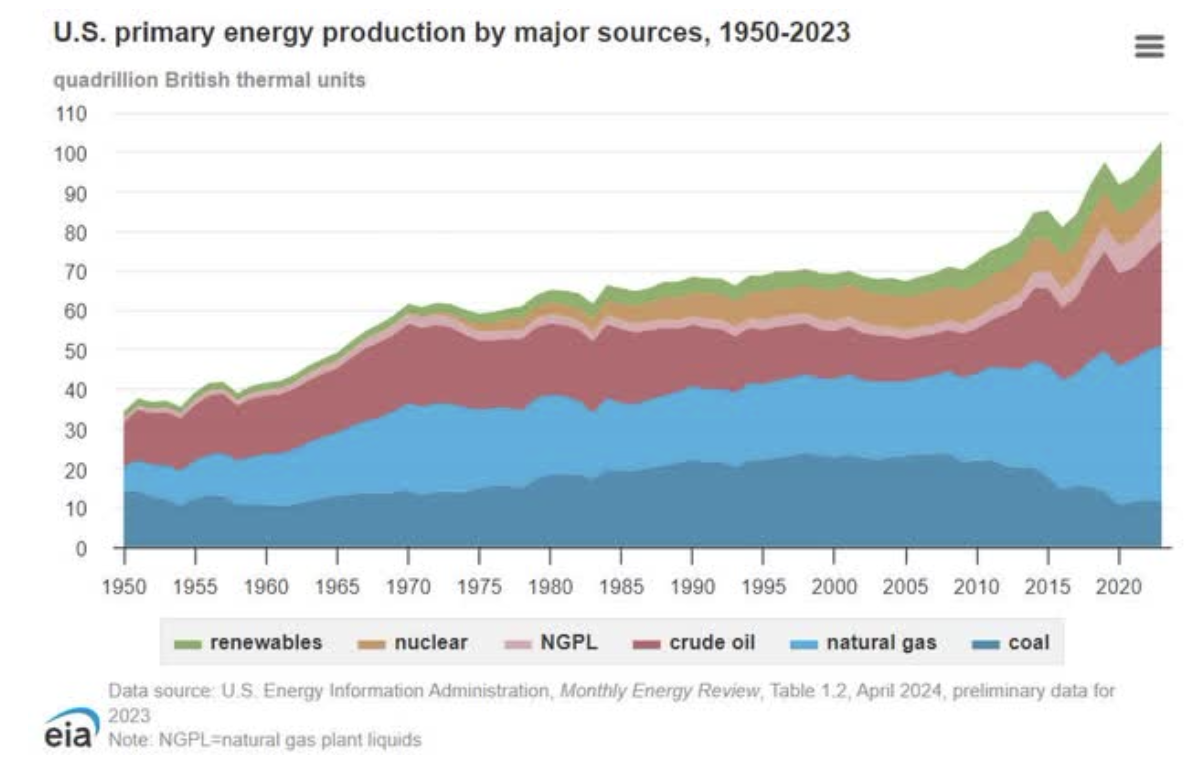
Nuclear power is scarce because it is extremely costly and timely to build. Almost all US nuclear reactors were built between 1967 and 1990. Regulatory costs skyrocketed after the Three Mile Island accident in 1979. The Vogtle electric plant in Georgia was the only new nuclear plant added in the last 30 years. Vogtle took 15 years and $30 billion to build. Nuclear power plants just aren't economically viable relative to the cost of building new natural gas plants. However, this makes existing plants, like the one Talen owns, more valuable.
Moving on to the demand argument, electricity demand growth is accelerating as the US adopts electric cars and builds more data centers.
Electricity demand has historically grown in line with population growth; however, recent technology shifts have accelerated the demand on the grid. Artificial intelligence applications are more compute-intensive and, therefore, require more electricity. For example, ChatGPT uses as much as 30x more electricity per query than Google search. Research from the Boston Consulting Group projects data center energy use in the US will 3x from 130 terawatt hours in 2022 to 390 terawatt hours by 2030.
JPMorgan analysts are seeing “structural tailwinds, including manufacturing onshoring, broader electrification trends (transportation, heating, and more), as well as data center development underpinning a paradigm shift in power demand.”
Additionally, analysts see that with half of its gas generation in the Texas ERCOT grid, Vistra can also help fill a potential 40-gigawatt supply gap in the Lone Star State by 20230.
Vistra (VST) is JPMorgan’s top pick, with a price target of $178.
Vistra Energy (VST) Daily Chart
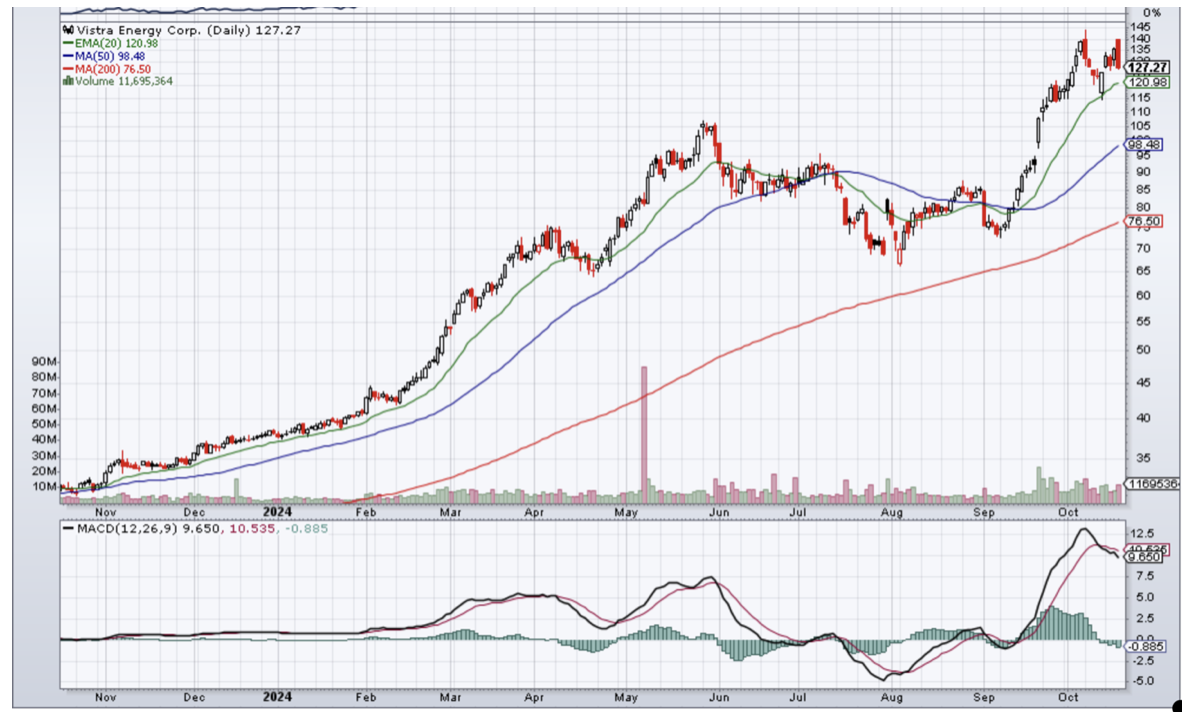
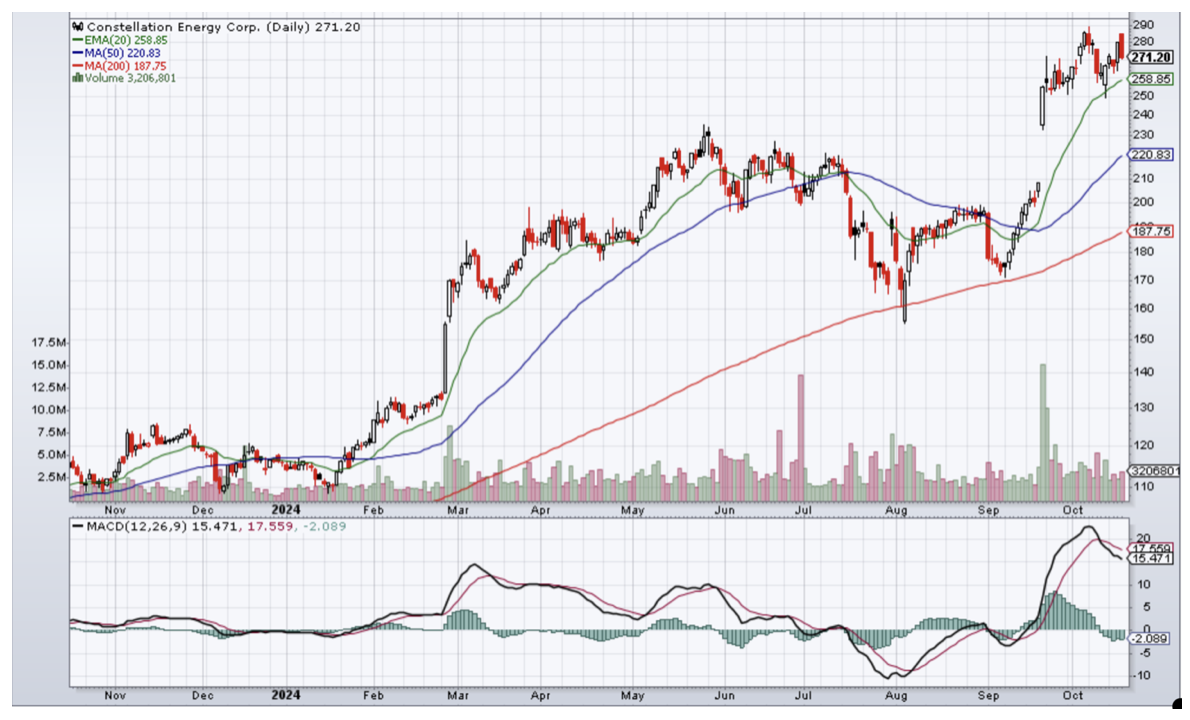
Constellation Energy (CEG) is another favourite of JPMorgan in this sector, and the investment bank believes Constellation’s industry-leading nuclear fleet is well-positioned to continue capturing long-term power contracts with data centre developers at premium prices. Its decision to restart Three Mile Island after signing a power purchase agreement with Microsoft was an industry milestone.
JPMorgan’s price target for Constellation is $342.
Constellation Energy (CEG) Daily chart
Finally, JPMorgan analysts see Talen’s multidecade agreement with Amazon Web Services to power a data centre campus with electricity generated at the Susquehanna nuclear plant in Pennsylvania could help send the stock higher if it delivers the full 960 megawatts of power to AWS.
Over the next 10 years, AWS has contracted to purchase as much as 1 gigawatt of power per year for a price nearly double the rate of the wholesale power price. Amazon is willing to pay a premium to source reliable carbon-free energy for a large data center, and it will also benefit from certain tax credits associated with the project.
Finally, there may be additional opportunities for per-share value growth above and beyond the AWS deal. Talen believes there are additional opportunities to co-locate data centers next to its other power plants. Talen's capital allocation strategy of creatively monetizing existing assets while returning capital to shareholders should continue to work.
It is important to remember that there is a wide moat around the business simply because a new nuclear power plant of Susquehanna's scale cannot be replicated at a cost anywhere near the current enterprise value of Talen.
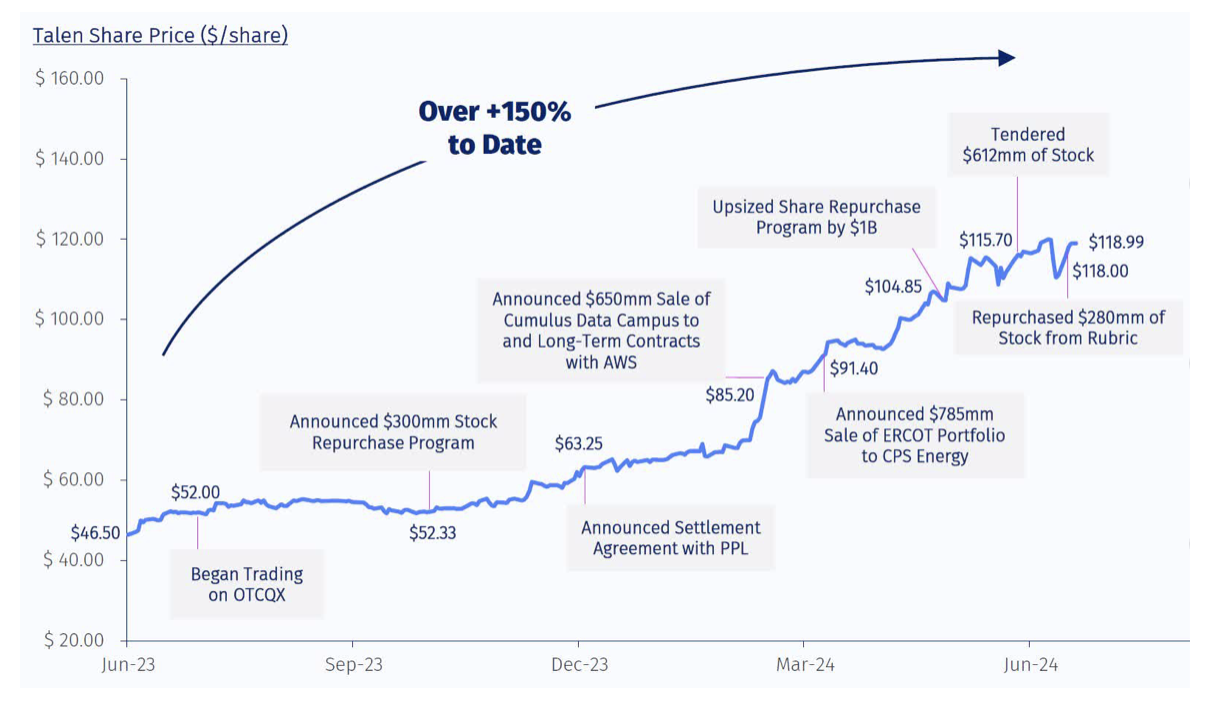
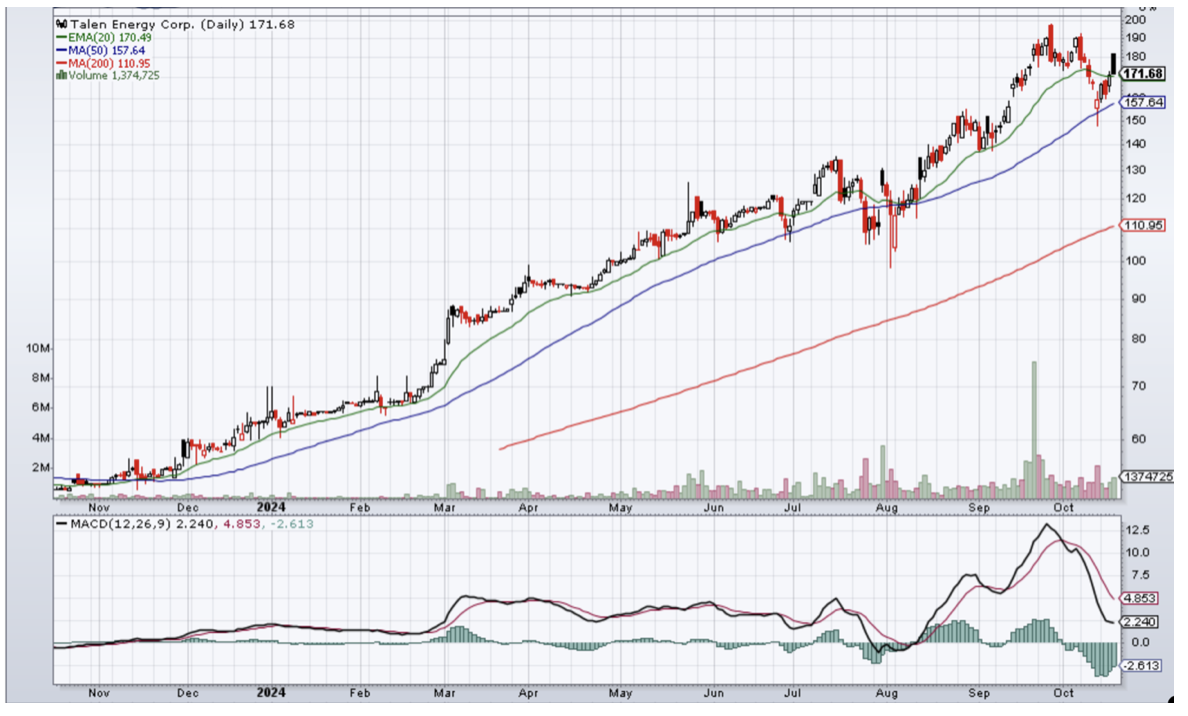
JPMorgan’s price target for Talen is $268.
Talen Energy (TLN)
Cameco Corp. (CCJ) is a great nuclear power play stock to own for the long term, too. I have been recommending this stock since early 2024.
Cameco Corp. (CCJ) Daily Chart
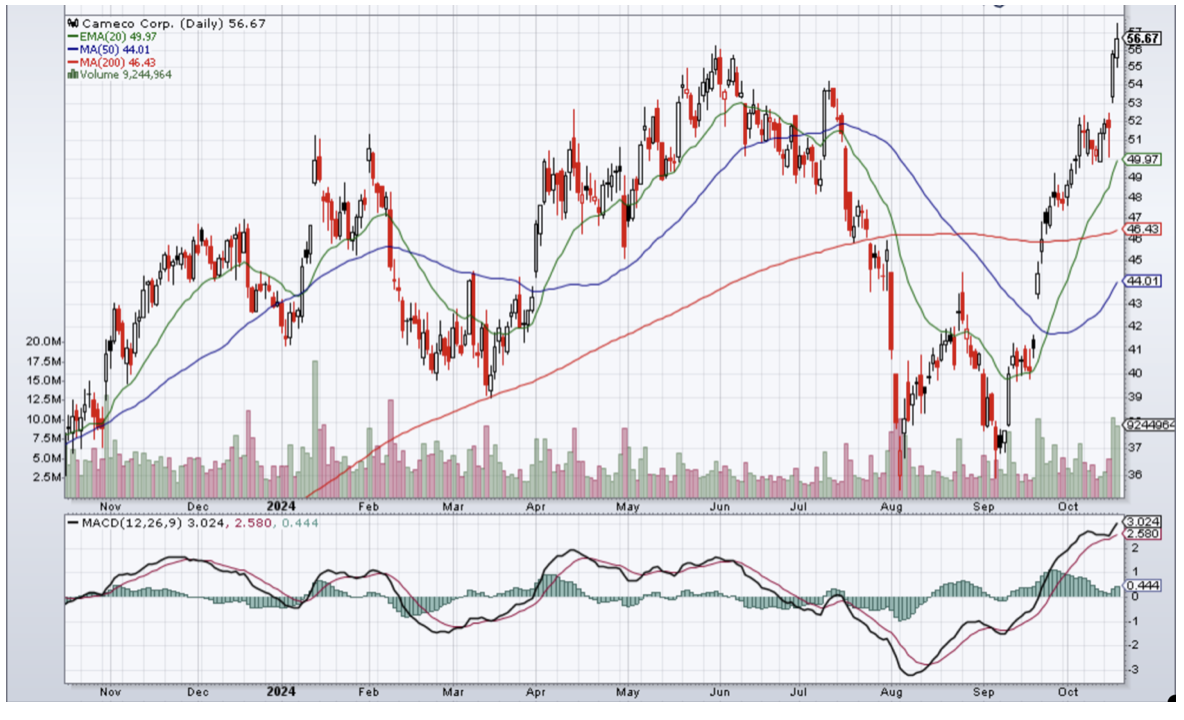
I would recommend owning at least two of the power produces illustrated here. Scaling in is the strategy you should use.
Earnings Results
Netflix: Earnings yesterday beat on the top and bottom lines. Ad-tier memberships jumped 35% quarter over quarter. Revenue for the full year of 2025 is expected to be between $43 billion and $44 billion. Advertising is expected to become a primary growth driver from 2026 onwards.
I recommended Netflix on January 17, 2024, when it was $480.00. I also recommended you either start scaling into the stock or add weight in Jacquie’s Post on October 10.
Goldman Sachs (GS) and JPMorgan (JPM) also reported great earnings. I also recommended these stocks, or to add weight if you held them, in Jacquie’s Post on October 10.
QI CORNER
SOMETHING TO THINK ABOUT


TRIVIA CORNER
Answers in Monday’s Post.

Cheers
Jacquie
When John identifies a strategic exit point, he will send you an alert with specific trade information as to what security to sell, when to sell it, and at what price. Most often, it will be to TAKE PROFITS, but, on rare occasions, it will be to exercise a STOP LOSS at a predetermined price to adhere to strict risk management discipline. Read more

