
Global Market Comments
October 30, 2023
Fiat Lux
Featured Trade:
(MARKET OUTLOOK FOR THE WEEK AHEAD, or THE TRAPPED MARKET)
(TSLA), (NVDA), (GOOGL), (AMZN), (NLY)


Global Market Comments
October 30, 2023
Fiat Lux
Featured Trade:
(MARKET OUTLOOK FOR THE WEEK AHEAD, or THE TRAPPED MARKET)
(TSLA), (NVDA), (GOOGL), (AMZN), (NLY)
I should have stayed in Ukraine.
At least that way I would know which direction the fire was coming from, the east. Back here in the US markets, the fire seemed to be coming from every direction all at once.
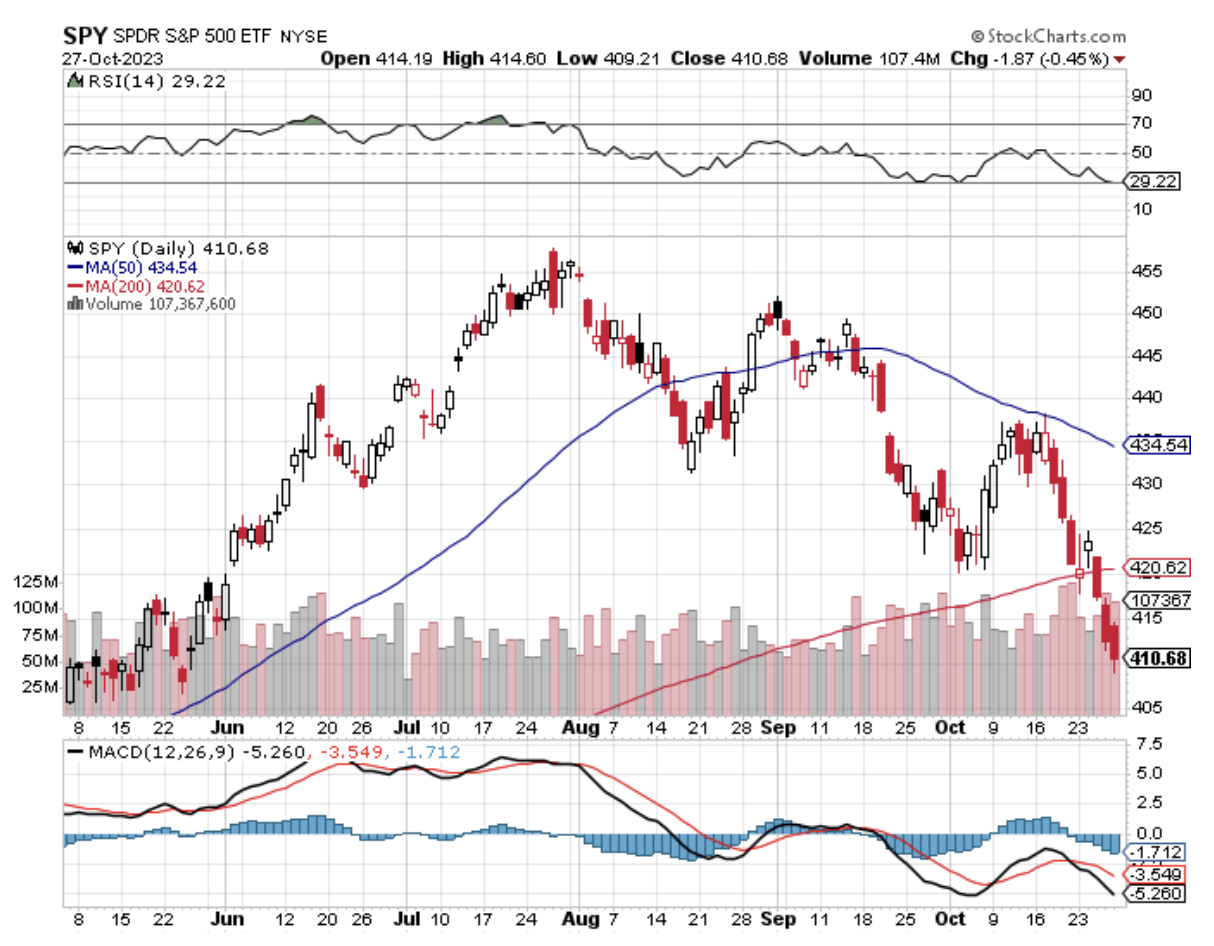
Good news was bad news and bad news even worse. An S&P 500 down 2.5% certainly left a bruise. The geopolitical outlook in the idle East is getting worse by the day.
But where others find nothing but despair, I see opportunity. Despite all the doom and gloom, all the elements of a yearend rally are setting up nicely. And it could be a sharp one as the time for it to play out is ever shrinking.
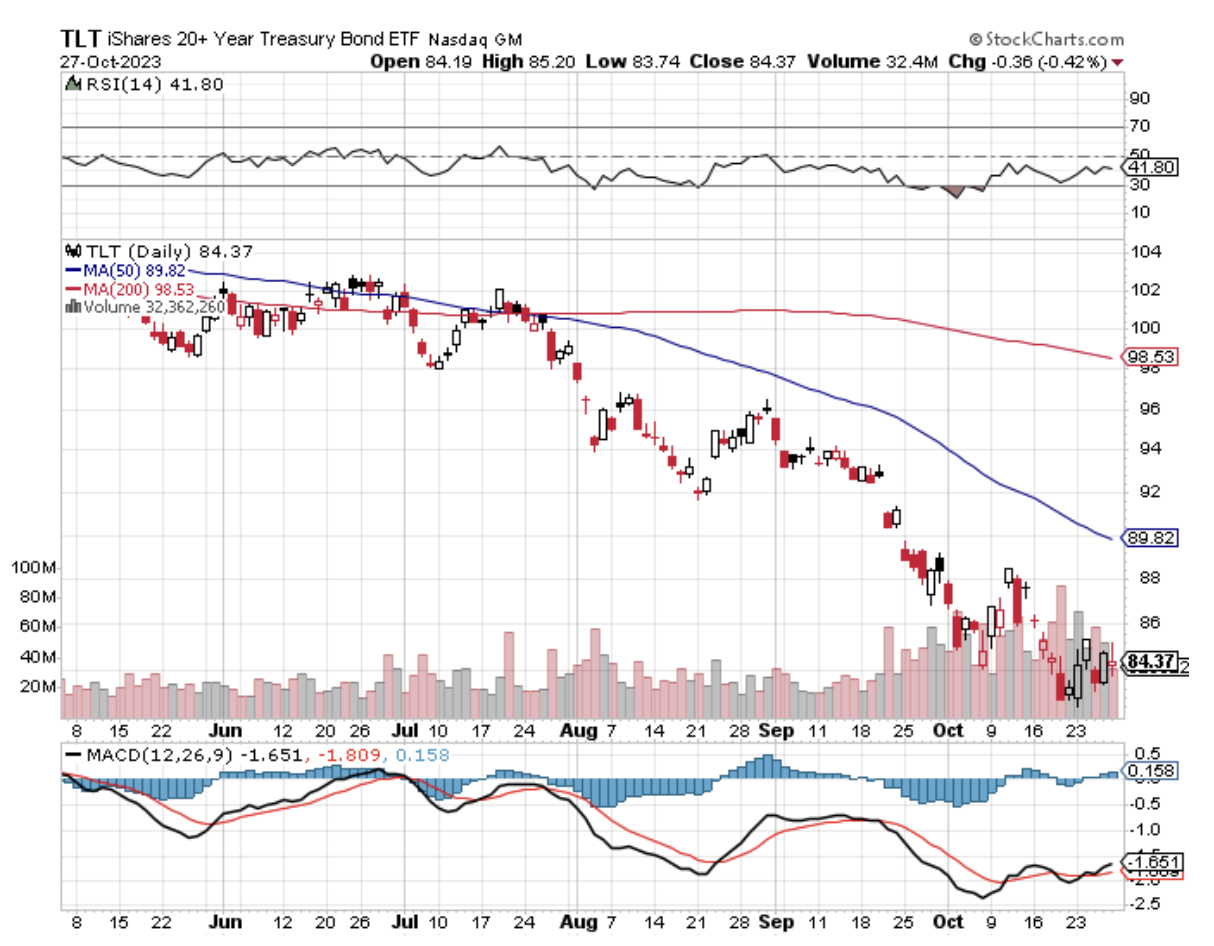
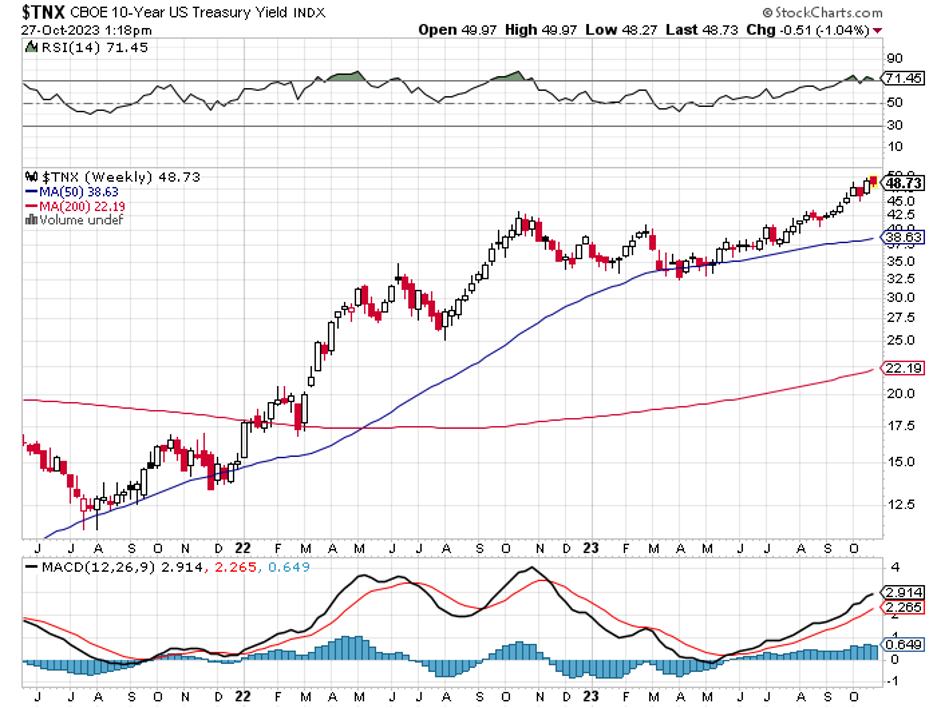
Hedge fund quantitative, momentum, and systemic shorts are at all-time highs, creating lots of buying power. AI has gone silent. Key earnings events will be done with the Apple announcement on Thursday, November 2. Ten-year bonds have repeatedly tried but failed to break the 5.00% yield.
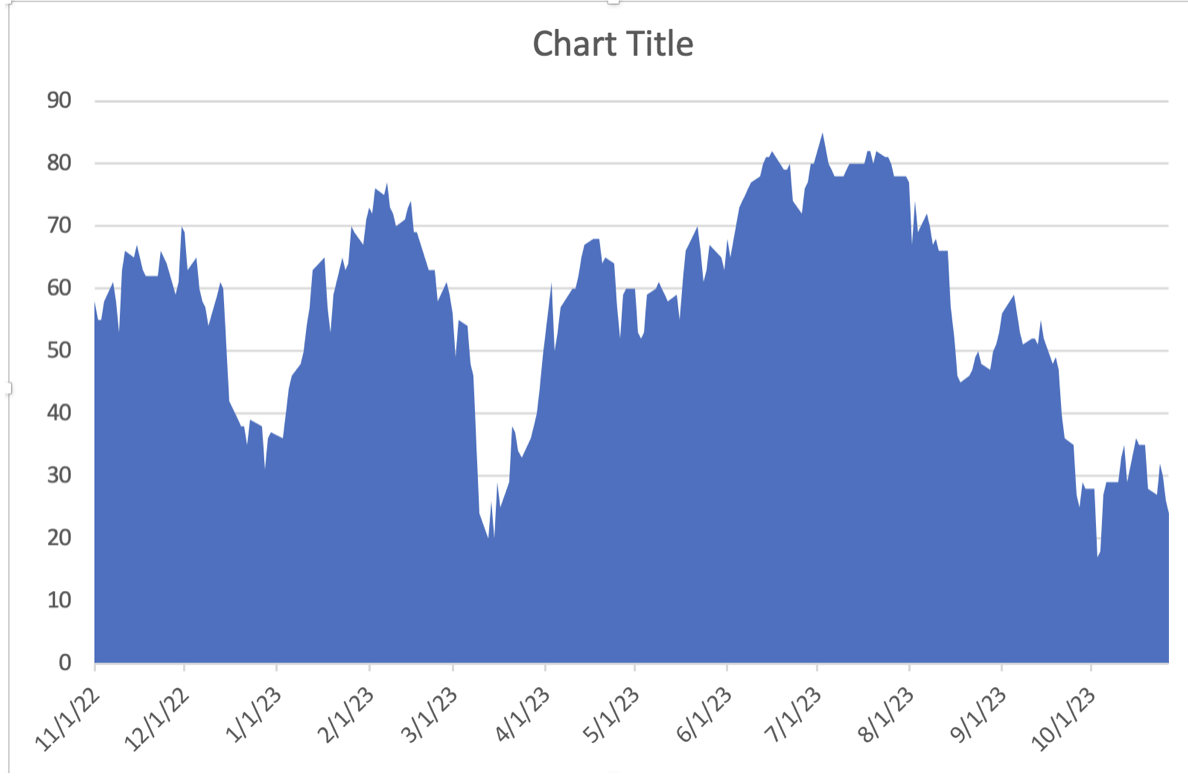
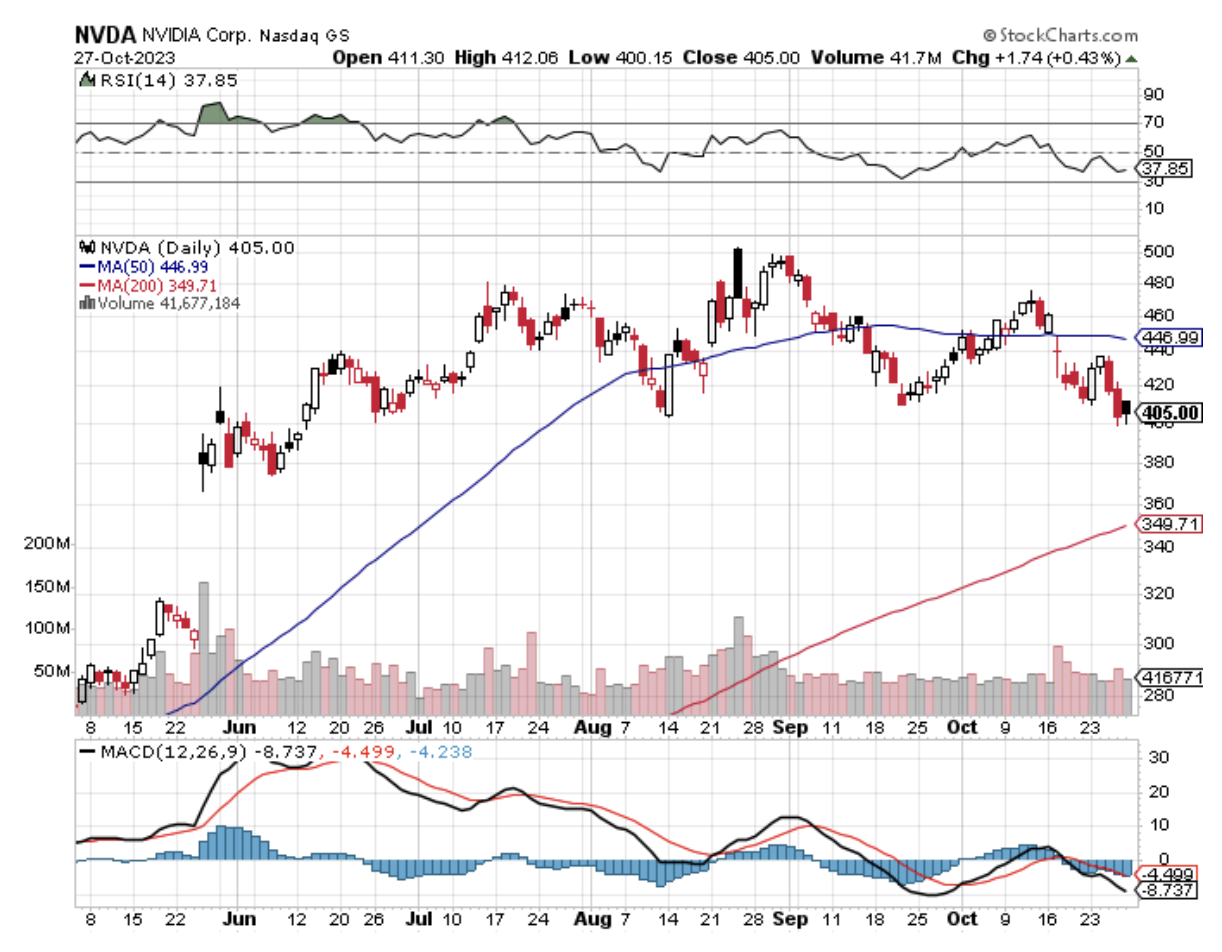
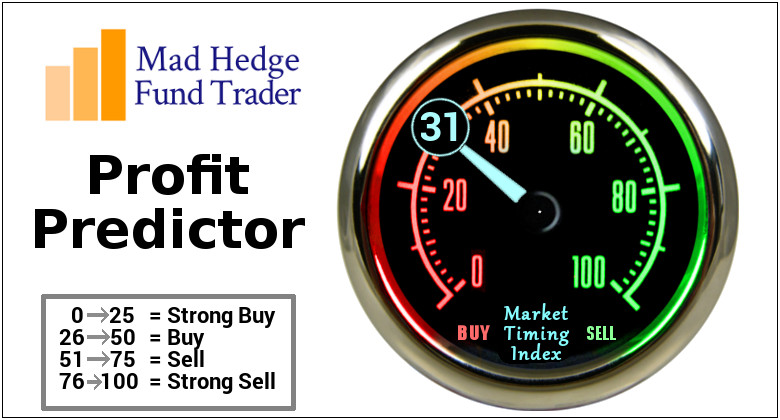
Major tech stocks like (TSLA), (NVDA), (GOOGL), and (AMZN) have seen 20% corrections. The Mad Hedge AI Market Timing Index is unable to close below $20 and has been chopping a lot of wood under $30. If a new House speaker cuts a deal to avoid a government shutdown before November 17, it could be off to the races.
The smart thing to do here is to build up a list of stocks higher leverage to falling interest rates. All stocks benefit from falling rates but some much more than others.
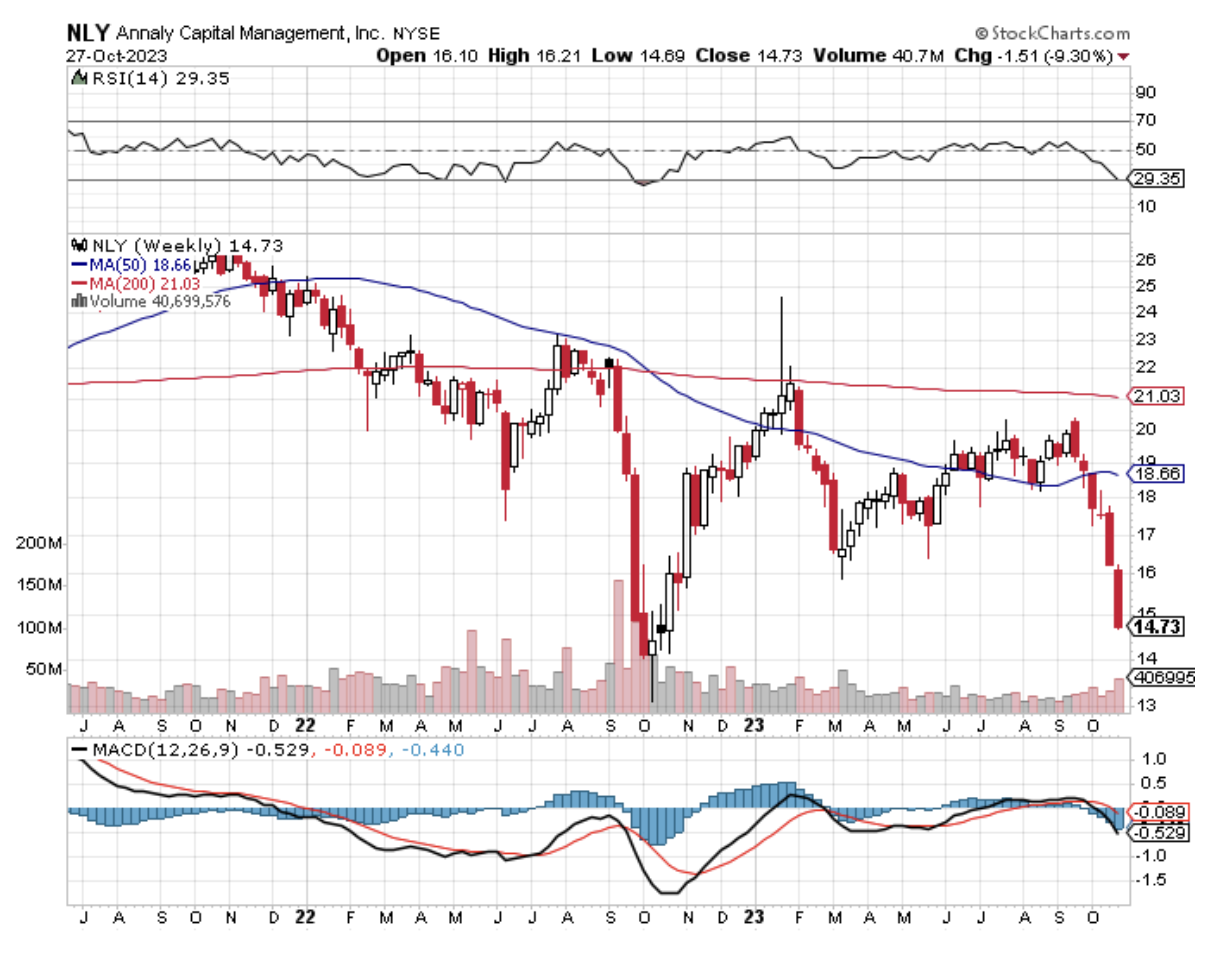
One of my favorites is Annaly Capital Management (NLY), one of the largest mortgage real estate investment trusts (REITS). The company borrows money, primarily via short-term repurchase agreements, and reinvests the proceeds in asset-backed securities.
The company’s shares are unusually sensitive to rising overnight interest rates, and its shares are down 50% in a year. A monster rally in the stock is brewing. Oh, and it has a 17% dividend, which will likely get cut but still remain extremely high.
Finally, I want to bid a sad farewell to my old friend and fellow iconoclast Byron Wien. Byron was late of Blackstone and much earlier from Morgan Stanley.
Byron was famed for his “Ten Surprises” which he published each New Year and with which I used to assist him in the early years. This was a list of possible developments which, if they occurred, would have a disproportionate effect on the market.
Byron was 90 and will be missed. One of his favorite pieces of advice was to never retire and Byron was working right up until last week.
Hmmmm. Sounds like good advice to me.
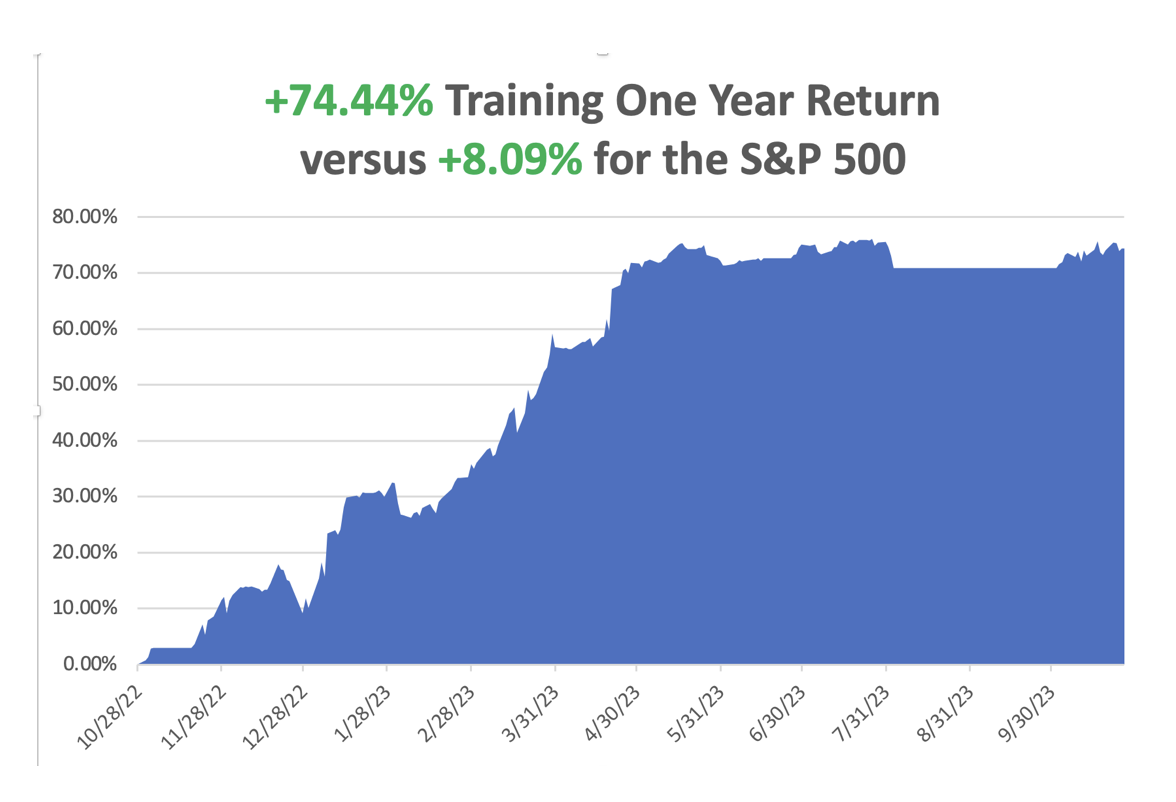
So far in October, we are up +3.56%. My 2023 year-to-date performance is still at an eye-popping +64.36%. The S&P 500 (SPY) is up +7.89% so far in 2023. My trailing one-year return reached +74.44% versus +8.09% for the S&P 500.
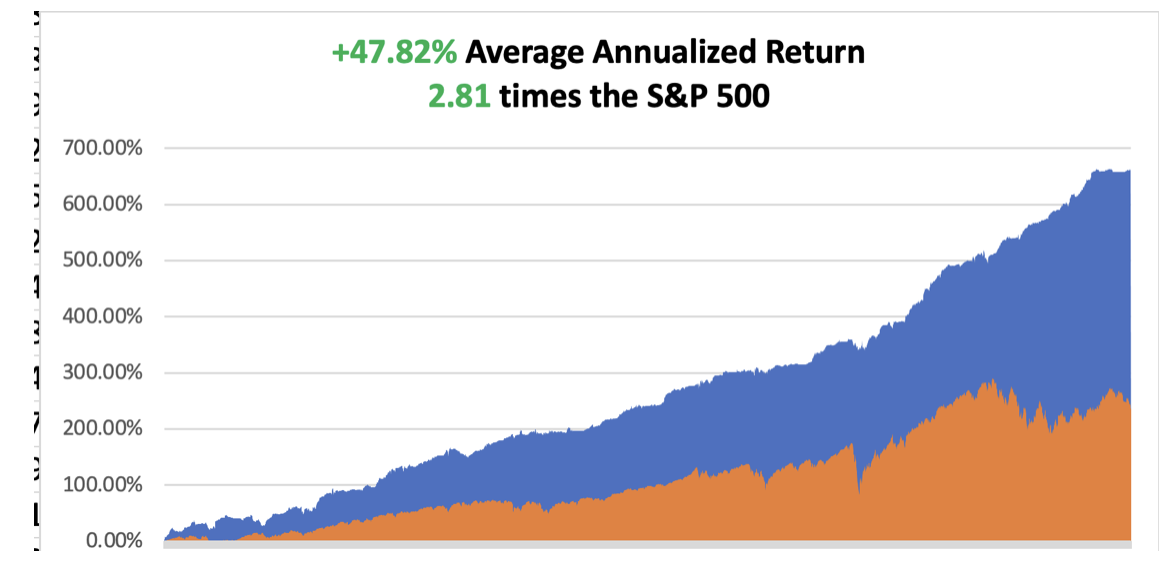
That brings my 15-year total return to +661.55%. My average annualized return has fallen back to +47.89%, some 2.81 times the S&P 500 over the same period.
Some 44 of my 49 trades this year have been profitable.
Car Payment Delinquencies Hit Record Rate, with repossessions rising. With interest rate hikes making newer loans more expensive, millions of car owners are struggling to afford their payments. It’s a clear indication of distress at a time when the economy is sending mixed signals, particularly about the health of consumer spending. Usually, a recession indicator but not this time.
US Government Wraps up Fiscal 2023 with a $1.7 Trillion Deficit, up 23% from the previous year, which ended on October 31. It’s a major reason why bonds have been under such pressure since July. But the purchasing power of the total US national debt of $32 trillion fell by $260 billion last year, thanks to the torrid 8.1% inflation rate.
US Core PCE Jumps 0.3% in September, the most in four months. It’s the Fed’s favorite inflation indicator. Drugs, travel, and used cars saw the big price increases. Resilient household demand paired with a pickup in inflation underscores momentum heading into the fourth quarter
Ukraine War has Become a Big Generator at US Defense Companies. Companies such as Lockheed Martin (LMT), General Dynamics (GD), and others expect that existing orders for hundreds of thousands of artillery rounds, hundreds of Patriot missile interceptors, and a surge in orders for armored vehicles expected in the months ahead will underpin their results in coming quarters. Buy the sector on dips
Don’t Expect a Real Estate Crash Anytime Soon, with supplies at 40-year lows. Yes, 8% mortgages are a buzz kill, but 95% of homeowners with mortgages date back to the 3.0% era. No one wants to give up their free lunch. If you’re a mortgage originator, it’s another story.
Existing Home Sales Hit 13-Year Low at 1.13 million, down 8% YOY. The Median Home Price was up 2.8% to $394,300. This is 17% of the peak rate we saw in 2021 when overnight rates were still zero.
Pending Home Sales Rise 1.1% in September to 72.6, but are down 13% YOY. On a signed contract basis. But the absolute level is the lowest in two years. High mortgage rates are the buzz kill. Affordability is at a record low.
Adjustable Rate Mortgages Make a Big Comeback, with 5/1 ARMS costing only 6.99% compared to 8.0% for the conventional 30-year fixed, a 23-year high. Mortgage originations are now down 22% YOY.
US Economy Red Hot at 4.9% Growth Rate, the highest in two years. Unfortunately, the stock market sees a major slowdown in the current quarter. Consumer spending was the big driver.
Tech Selloff has Taken NVIDIA down to a 25 Times Earnings Multiple, the same as Walmart and Target, despite 50% earnings growth for the foreseeable future. This is just at the start of an AI super cycle. Get ready to start loading the boat.
My Ten-Year View
When we come out the other side of the recession, we will be perfectly poised to launch into my new American Golden Age, or the next Roaring Twenties. The economy decarbonizing and technology hyper accelerating, creating enormous investment opportunities. The Dow Average will rise by 800% to 240,000 or more in the coming decade. The new America will be far more efficient and profitable than the old.
Dow 240,000 here we come!
On Monday, October 30 at 8:30 AM EST, the Dallas Fed Manufacturing Index is out.
On Tuesday, October 31 at 2:30 PM, the S&P Case Shiller National Home Price Index is released.
On Wednesday, November 1 at 8:30 AM, the JOLTS Job Openings Report is published.
On Thursday, November 2 at 8:30 AM, the Weekly Jobless Claims are announced.
On Friday, November 3 at 2:30 PM, the October Nonfarm Payroll Report is published. At 2:00 PM the Baker Hughes Rig Count is printed.
As for me, one of the benefits of being married to a British Airways stewardess in the 1970s was unlimited free travel around the world. Ceylon, the Seychelles, and Kenya were no problem.
Usually, you rode in first class, which was half empty, as the British Empire was then rapidly fading. Or you could fly in the cockpit where, on long flights, the pilot usually put the plane on autopilot and went to sleep on the floor, asking me to watch the controls.
That’s how I got to fly a range of larger commercial aircraft, from a Vickers Viscount VC-10 to a Boeing 747. Nothing beats flying a jumbo jet over the North Pole on a clear day, where the unlimited view ahead is nothing less than stunning.
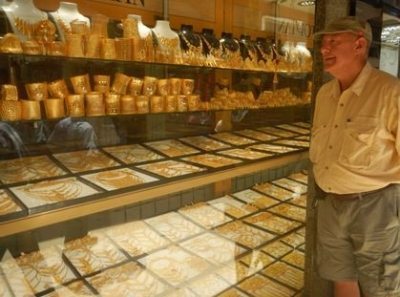
When gold peaked in 1979 at $900 an ounce, up from $34, The Economist magazine asked me to fly from Japan to South Africa and write about the barbarous relic. That I did with great enthusiasm, bringing along my new wife, Kyoko.
Sure enough, as soon as I arrived, I noticed long lines of South Africans cashing in their Krugerands, which they had been saving up for years in the event of a black takeover.
There was only one problem. My wife was Japanese.
While under the complicated apartheid system, the Chinese were relegated to second class status along with Indians, Japanese were treated as “honorary whites” as Japan did an immense amount of trade with the country.
The confusion came when nobody could tell the difference between Chinese and Japanese, not even me. As a result, we were treated as outcasts everywhere he went. There was only one hotel in the country that would take us, the Carlton in Johannesburg, where John and Yoko Lennon stayed earlier that year.
That meant we could only take day trips from Joberg. We traveled up to Pretoria, the national capital, to take in the sights there. For lunch, we went to the best restaurant in town. Not knowing what to do, they placed us in an empty corner and ignored us for 45 minutes. Finally, we were brought some menus.
The Economist asked me to check out the townships where blacks were confined behind high barbed wire fences in communities of 50,000. I was given a contact in the African National Conference, then a terrorist organization. Its leader, Nelson Mandela, had spent decades rotting away in an island prison.
My contact agreed to smuggle us in. While blacks were allowed to leave the townships for work, whites were not permitted in under any circumstances.
So, we were somewhat nonplussed Kyoko and I were asked to climb into the trunk of an old Mercedes. Really? We made it through the gates and into the center of the compound. On getting out of the trunk, we both burst into nervous laughter.
Some honeymoon!
After meeting the leadership, we were assigned no less than 11 bodyguards as whites in the townships were killed on sight. The favored method was to take a bicycle spoke and sever your spinal cord.
We drove the compound inspecting plywood shanties with corrugated iron roofs, brightly painted and packed shoulder to shoulder. The earth was dry and dusty. People were friendly, waving as we drove past. I interviewed several. Then we were smuggled out the same way we came in and hastily dropped on a corner in the city.
Apartheid ended in 1990 when the ANC took control of the country, electing Nelson Mandela as president. A massive white flight ensued which brought people like Elon Musk’s family to Canada and then to Silicon Valley.
Everyone feared the blacks would rise up and slaughter the white population.
It never happened.
Today, South Africa offers one of the more interesting investment opportunities on the continent. The end of apartheid took a great weight off the shoulders of the country’s economy. Check out the (EZA), which nearly tripled off of the 2020 bottom.
Kyoko passed away in 2002 at age 50.
Stay Healthy,
John Thomas
CEO & Publisher
The Diary of a Mad Hedge Fund Trader
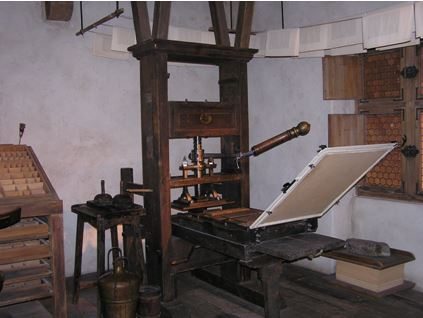
"Freedom of the press is only true if you own a press," said A.J. Liebling, a famed journalist for the New Yorker.

Seven AI Stocks to Invest in and Why
Artificial Intelligence (AI) has transformed industries, revolutionizing the way businesses operate and the services they offer. As AI continues to advance, it presents significant investment opportunities for those looking to capitalize on its growth. In this article, we will explore these seven AI stocks to invest in and delve into the reasons behind their promising outlook.
NVIDIA Corporation (NASDAQ: NVDA)
NVIDIA is a tech giant at the forefront of AI innovation. The company specializes in graphics processing units (GPUs), which are essential for AI applications, particularly in the fields of deep learning and data analytics. NVIDIA's GPUs are widely used in AI training and inference, making them a critical component of AI infrastructure.
Why invest in NVIDIA:
Alphabet Inc. (NASDAQ: GOOGL)
Alphabet, the parent company of Google, is a powerhouse in the AI industry. Google has been investing heavily in AI research and development, integrating AI into its various products, including Google Search, YouTube, and Google Assistant.
Why invest in Alphabet:
Amazon.com, Inc. (NASDAQ: AMZN)
Amazon, the e-commerce and cloud computing giant, has made significant investments in AI to enhance its customer experience, logistics, and data analysis. The company's AI-driven recommendation systems are a key factor in driving sales and customer loyalty.
Why invest in Amazon:
Microsoft Corporation (NASDAQ: MSFT)
Microsoft, a tech giant, has made significant strides in AI development, integrating AI into its software products and cloud services. The company's Azure cloud platform offers a wide array of AI services for businesses.
Why invest in Microsoft:
Tesla, Inc. (NASDAQ: TSLA)
Tesla, led by Elon Musk, is a trailblazer in AI within the automotive industry. Tesla's electric vehicles are equipped with advanced driver-assistance features and a full self-driving package, which relies on AI and machine learning.
Why invest in Tesla:
International Business Machines Corporation (NYSE: IBM)
IBM, a stalwart in the tech industry, is undergoing a transformation by focusing on AI and hybrid cloud solutions. The company's Watson AI platform is a prominent player in enterprise AI applications.
Why invest in IBM:
Salesforce.com, Inc. (NYSE: CRM)
Salesforce, a cloud-based customer relationship management (CRM) company, has embraced AI to enhance its services and help businesses make data-driven decisions. Salesforce Einstein is an AI-driven feature that augments the CRM platform.
Why invest in Salesforce:
Reasons for Investing in AI Stocks
Considerations for Investing in AI Stocks
While AI stocks offer promising opportunities, it's crucial to consider the following factors before making investment decisions:
Conclusion
Investing in AI stocks can be a smart move for those looking to capitalize on the continued growth of artificial intelligence. The seven companies mentioned in this article, including NVIDIA, Alphabet, Amazon, Microsoft, Tesla, IBM, and Salesforce, are at the forefront of AI innovation in various industries. However, it's crucial to conduct thorough research, assess your risk tolerance, and align your investments with your financial goals. As AI continues to evolve and shape the business landscape, investing in the right AI stocks can offer long-term growth potential and diversification in your investment portfolio.
 Midjourney prompt: “7”
Mad Hedge Technology Letter
October 27, 2023
Fiat Lux
Featured Trade:
(CRYPTO IS BACK AT IT AGAIN)
(MSTR), (BTC)
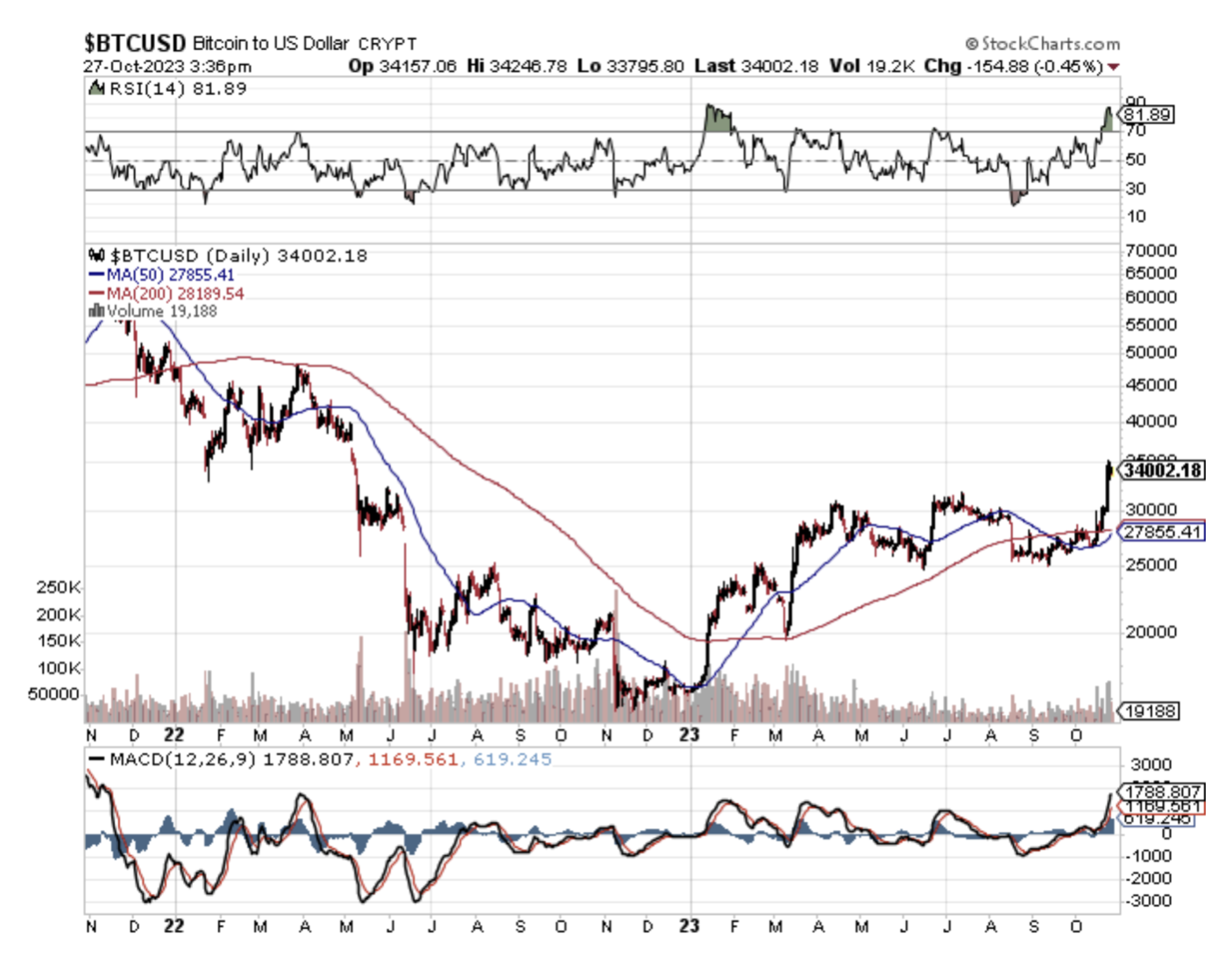
Cryptocurrency prices have been on a tear lately as bitcoin continues to rally on hopes a spot bitcoin exchange-traded fund will launch soon.
Last week Bitcoin had a 24-hour time period where it exploded 13% to the upside as the digital gold wakes up from its slumber.
Lately, it certainly is odd to see US treasury yield surpassing any type of volatility that crypto can offer proving that volatility is more about a time and place dynamic rather than a certain asset class.
The volatility meant that Bitcoin passed $35,000 for the first time since May 2022 even though it has pulled back a little today.
The rally could be fueled in part by investors who were betting against the crypto asset scrambling to cover short positions as well.
Bitcoin led cryptocurrency prices higher over the past two weeks after the SEC declined to challenge its court loss against Grayscale Investments (GBTC) and its effort to convert its Grayscale Bitcoin Trust into a spot bitcoin ETF on Oct. 13.
A U.S. appeals court ordered the SEC to review Grayscale's ETF application. The regulator could still reject the spot bitcoin application, but it would need a new justification to do so.
Institutional demand for a spot bitcoin ETF is stronger than ever before. For many institutions, it is a matter of when — not if — the SEC will approve a spot bitcoin ETF.
A spot bitcoin ETF would provide a regulated and accessible vehicle for bitcoin exposure, and also mark a major vote of institutional confidence.
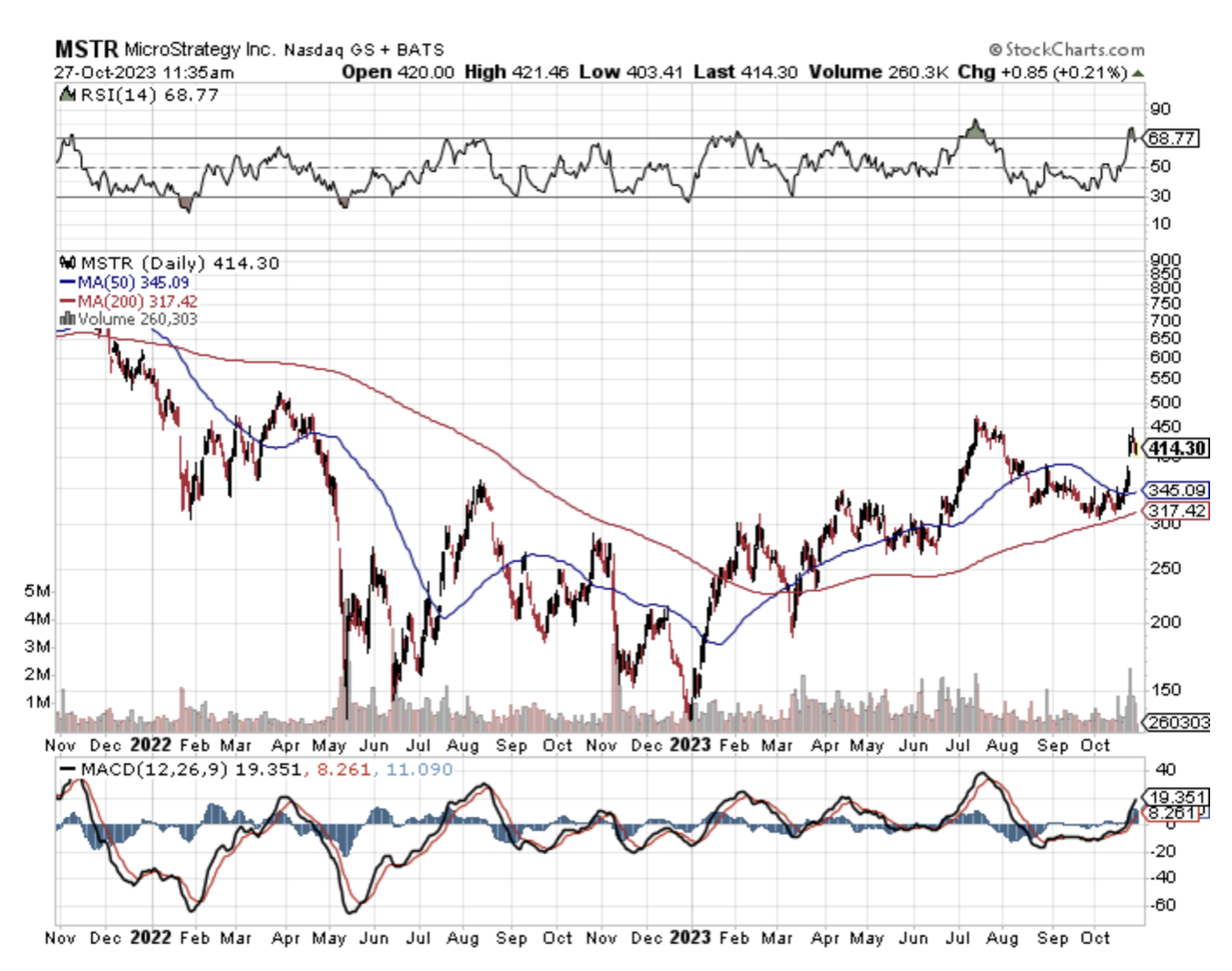
MicroStrategy (MSTR) added 21% and the computer software company holds 158,245 bitcoin with an average purchase price of $29,582.
Sooner or later, unless regulation totally wipes out Bitcoin, crypto is likely to find itself finagling its way into 401K’s.
The longer it lingers around, institutional pockets, which are deep, will find a way to onboard it into its business model.
For many years, institutional money has stayed away from crypto primarily because it is built on nothing and most conservative investors want to see cash flow.
At least an asset like gold bullion, there is a physical nature of what one buys.
Yet, as the world becomes more digitized and globalized, institutional money is starting to take the bait.
To Bitcoin’s credit, the absolute collapse of volatility in the past few years has been an interesting talking point because too much volatility used to be the problem for this asset class.
There is a chance that as we begin to start a new economic cycle because of a Fed pivot, that $16,000 per Bitcoin at the end of December 2022 could register the low of the next cycle.
Bitcoin is more appealing as a risk-reward proposition now than it was exactly a year ago as the Fed embarked on an epic tightening cycle.
Throw into the mix that the quality of global government has cratered to a generational low and it makes sense for institutional backers from Blackrock to front-run the next bull market in crypto as capital looks to de-risk from fiat currencies.
This could finally end up being the run-up to $100,000 per bitcoin that everyone expected during the last bitcoin spike.
Readers can play this in the equity market by buying MSTR.

(AN AUSTRALIAN VET MAKES A DIFFERENCE IN UKRAINE)
October 27, 2023
Hello everyone,
There is something that nearly always gets left behind during hard times or in wartime.
Animals.
Thousands of animals have been brought back to Animal Shelters in Australia because owners can no longer afford to keep them. Most people don’t seem to think about the long-term costs of keeping an animal, and just assume it will all work out in the end. The animal seemed like a good idea during the pandemic, but now is an expense that many Australians can no longer carry.
In wartime, animals are thought of last or not at all. That’s why in war-torn areas, like Ukraine, animals have been abandoned and are now just roaming the streets or are left chained to a post. Some have terrible injuries: gunshot wounds, broken bones, and are malnourished.

One Australian vet is now making a difference to those animals’ lives.
Dr. Lachlan Campbell, a Sunshine Coast vet has flown to Ukraine on two occasions to assist the animals there. Early in October, on his second visit, he travelled to Kramatorsk – less than an hour drive from Bakhmut. Whilst there, he has treated animals and built shelters for pets displaced by the war in preparation for winter.


He teamed up with the British animal charity, Nowzad, and worked with a team of four (from dawn to dusk) to build animal shelters. He commented that the “shelters we built are enough to house 80 dogs in warmth and more comfort – and off chains – which some have been on for up to four years”. He and his team provided quality food, parasite preventatives, and toys for the animals. Dr. Campbell pointed out the building materials for the shelters were transported all the way from the UK by semi-trailer.
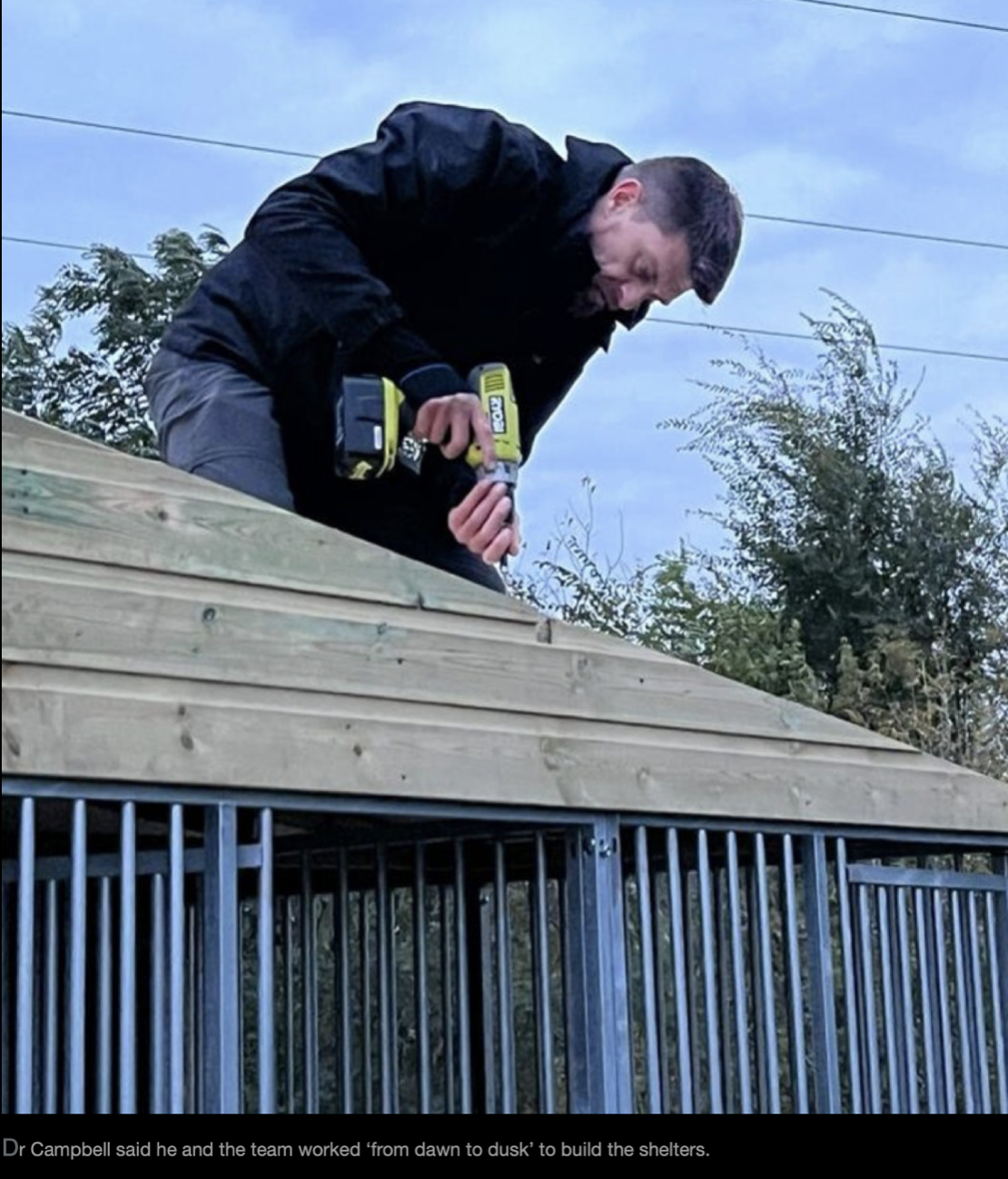
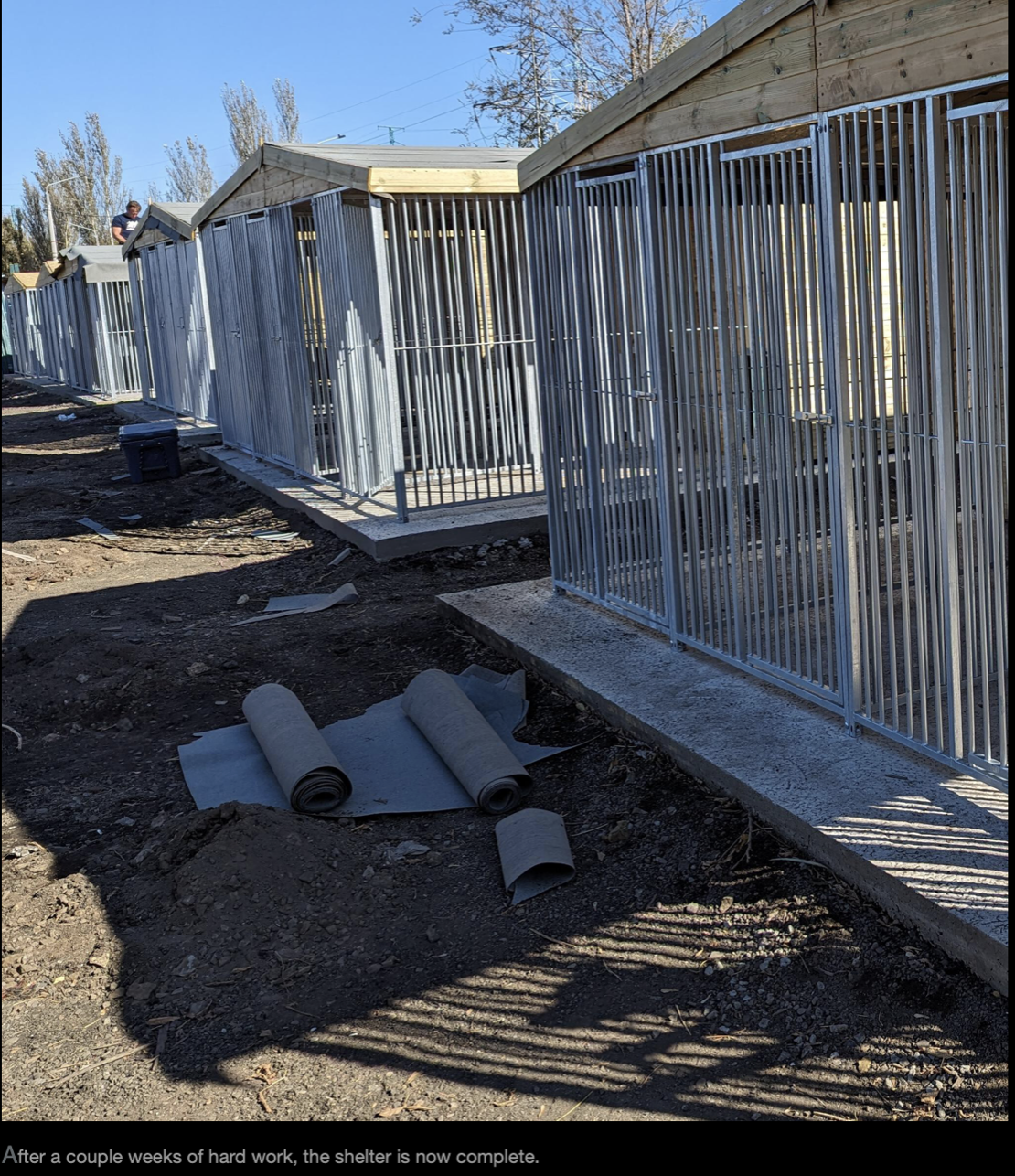
He reported that air raid sirens sounded as frequently as six to eight times a day. He said he also wore body armour and helmets if they were required. He had some near misses with a missile hitting within metres of the shelter Dr Campbell had been building.
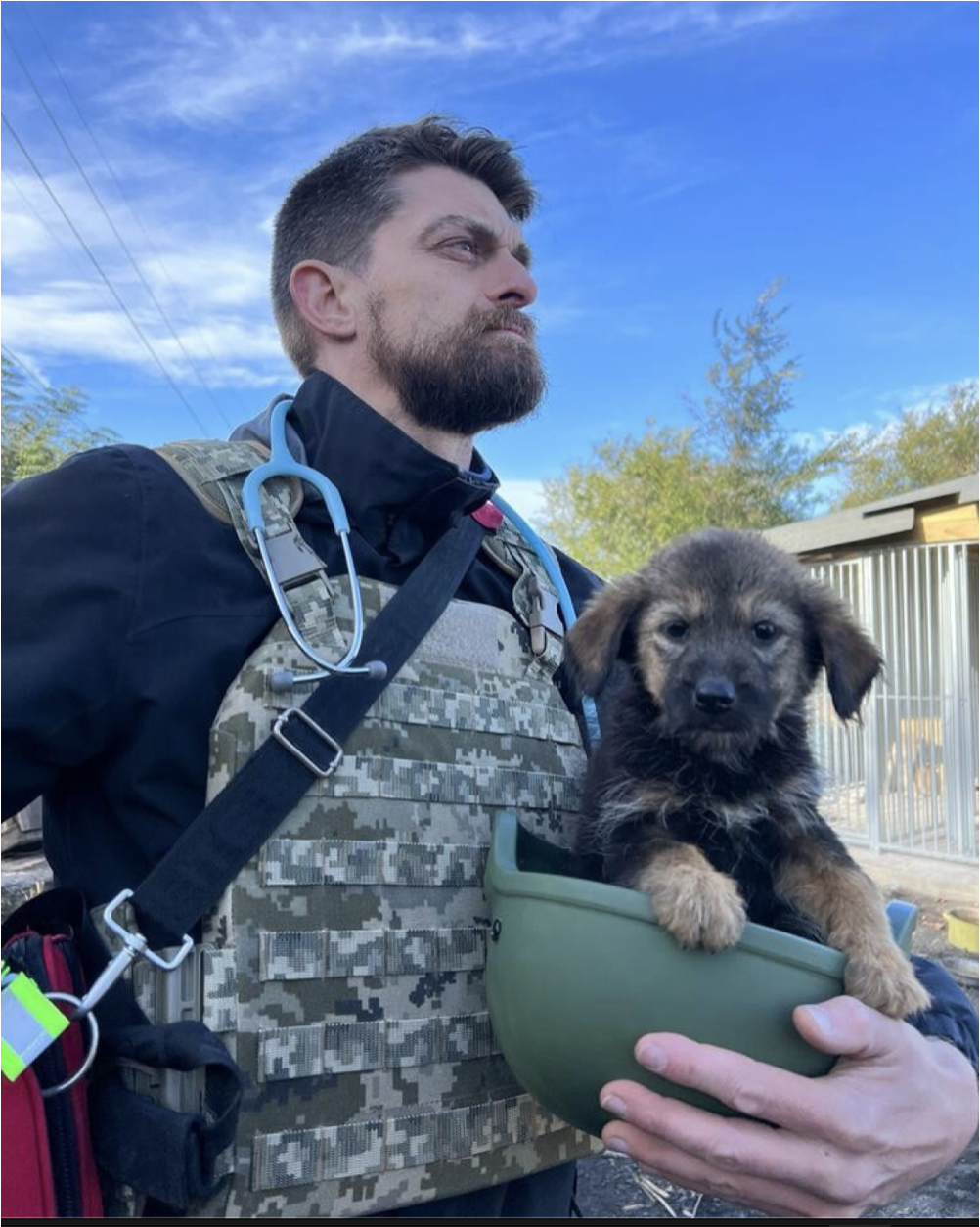
During his most recent trip, Dr Campbell vaccinated, microchipped, and treated around 100 cats and dogs for diseases.
In Australia, Dr. Campbell works as a veterinarian at Vets Central on the Sunshine Coast in Queensland.
Nowzad opened its first animal clinic in Kabul, Afghanistan, in 2007, and have since opened an additional donkey/horse sanctuary in Afghanistan.
Market Update
We are in correction mode.
If we get a very good break of 4100 on the S&P, we could fall to 3800.
There is still a chance we could rally in November/December.
In other news
The Australian Prime Minister, Anthony Albanese, is in the U.S. on a State visit to the White House. Australia’s relationship with China was one of the talking points. Albanese’s State visit is intended to deepen an alliance that’s increasingly viewed as a critical counterweight to China’s influence in the Pacific. It’s the ninth and most high-profile meeting between the two leaders, which is intended to facilitate closer ties on climate change, technology, and national security. The United States also plans to provide nuclear-powered submarines to Australia in the coming years, part of a collaboration with the United Kingdom.
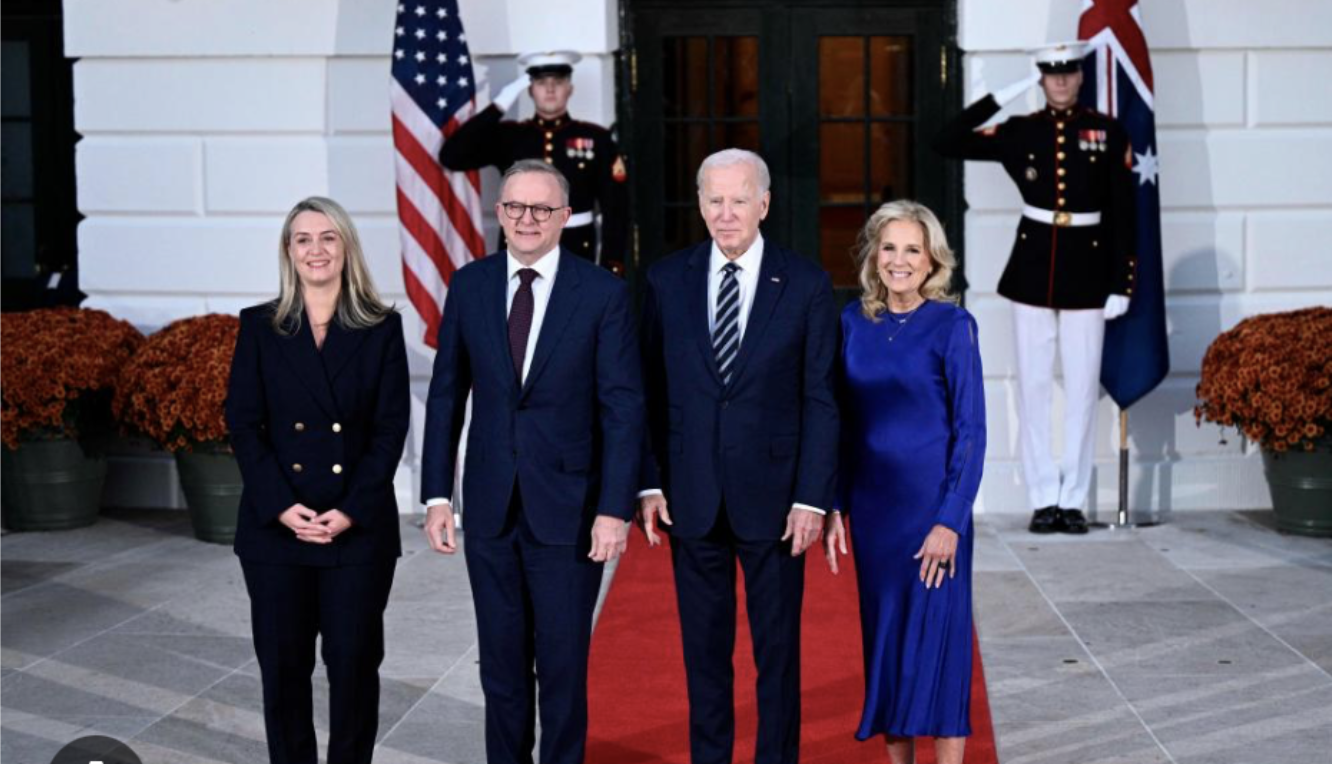
The Australian government is sending military aircraft and defence personnel to the Middle East to be on standby in the event the situation “gets worse”.
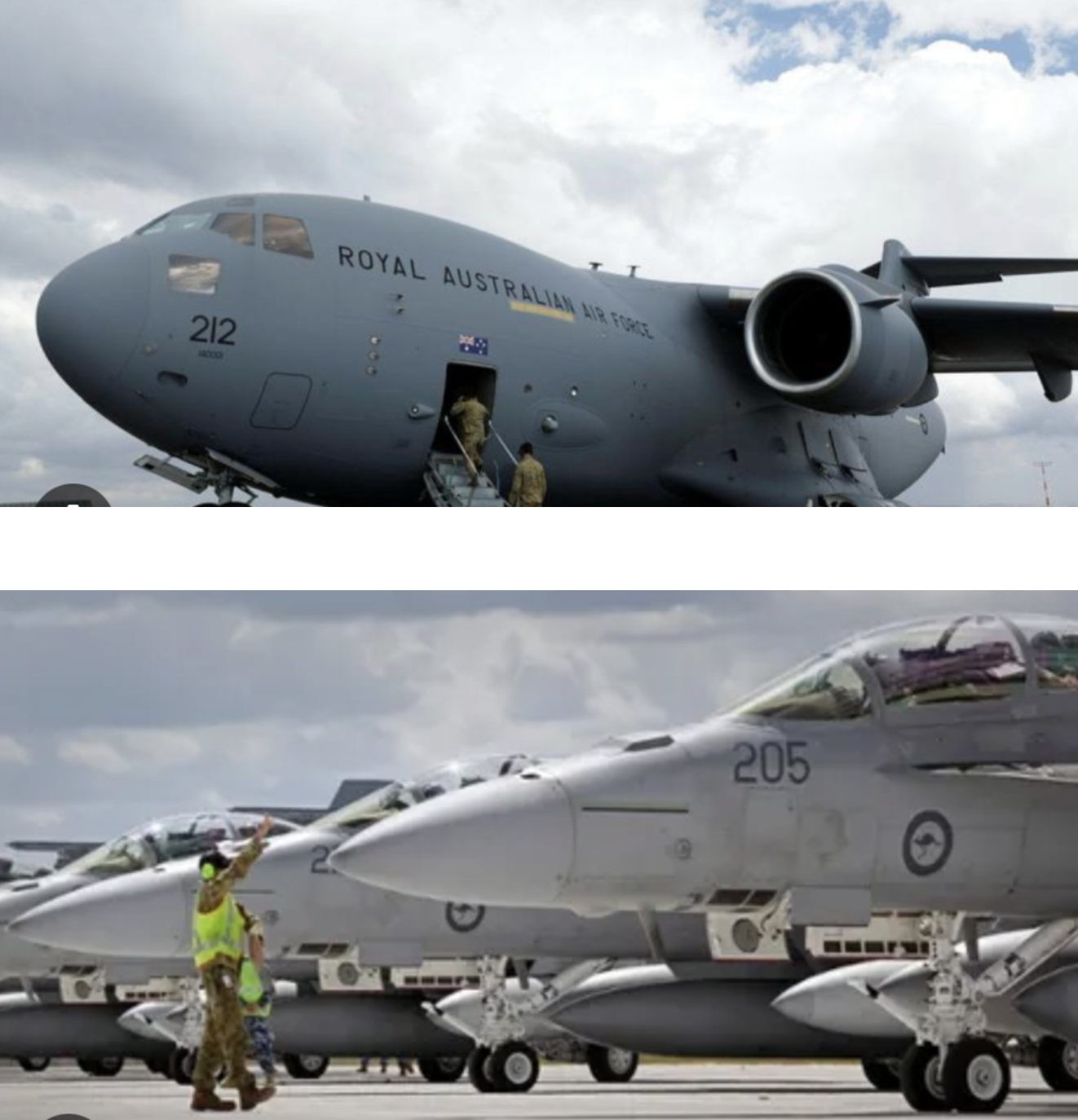
Australian fighter jets and defense personnel arrive in The Middle East.
Happy weekend to you all.
Cheers,
Jacquie
Global Market Comments
October 27, 2023
Fiat Lux
Featured Trade:
(SIX REASONS WHY GOLD WILL CONTINUE RISING),
($GOLD), (GLD), (IAU), (NEM), (GOLD), ($TNX),
(A CONVERSATION WITH THE BOOTS ON THE GROUND)

If you are a current gold investor, you have to love the latest monthly statistics just published by the World Gold Council.
After years of a death by a thousand cuts inflicted by endless redemptions of gold ETFs and ETNs, recent reports showed a sudden influx into the barbarous relic.
North American ETFs led the charge, with some 28.8 metric tonnes valued at $1.3 billion pouring into the funds.
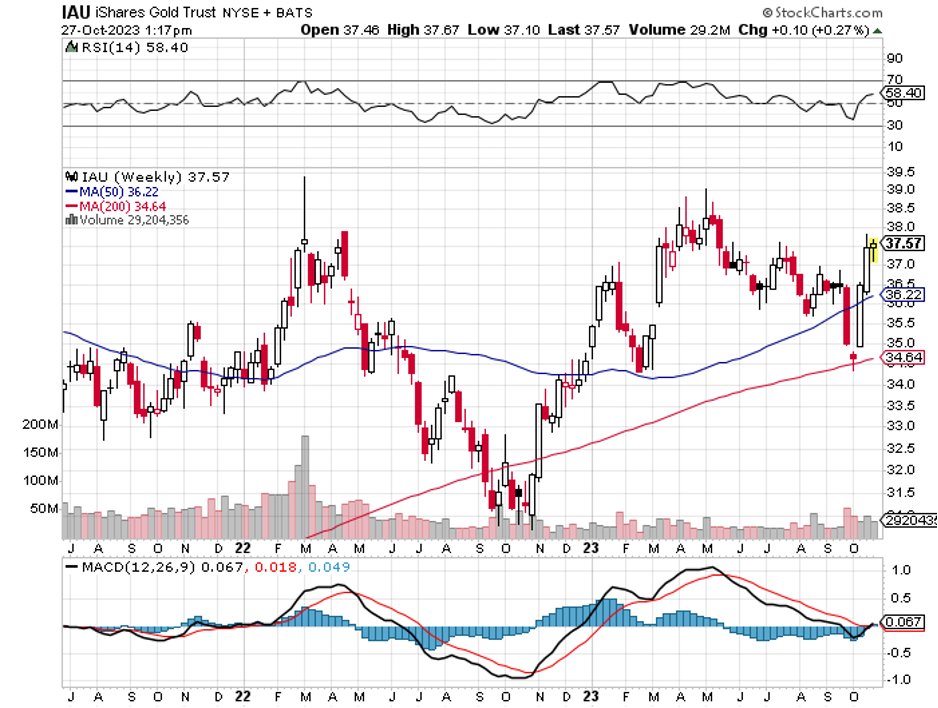
The SPDR Gold Shares (GLD) took in the most, 22.4 tonnes worth $1.03 billion, followed by the IShares Gold Trust (IAU), which added 4.6 tonnes worth $266 million.
Europe followed with 6.4 tonnes worth $321 million.
Asia was a net seller of 2 tonnes worth $80 million as investors pulled money out of precious metals and placed it in Bitcoin, Ethereum, and other cryptocurrencies.
Global gold-based ETFs collectively hold 2,295 metric tonnes of gold valued at and have picked up 143.5 tonnes so far this year.
For those used to using American measurements of precious metals, there are 32,150.7 troy ounces in one metric tonne.
The figures augur well for continued cash inflows and higher gold prices.
My experience is that sudden directional shifts of fund flows like this are NOT one-offs. They continue for months, if not years.
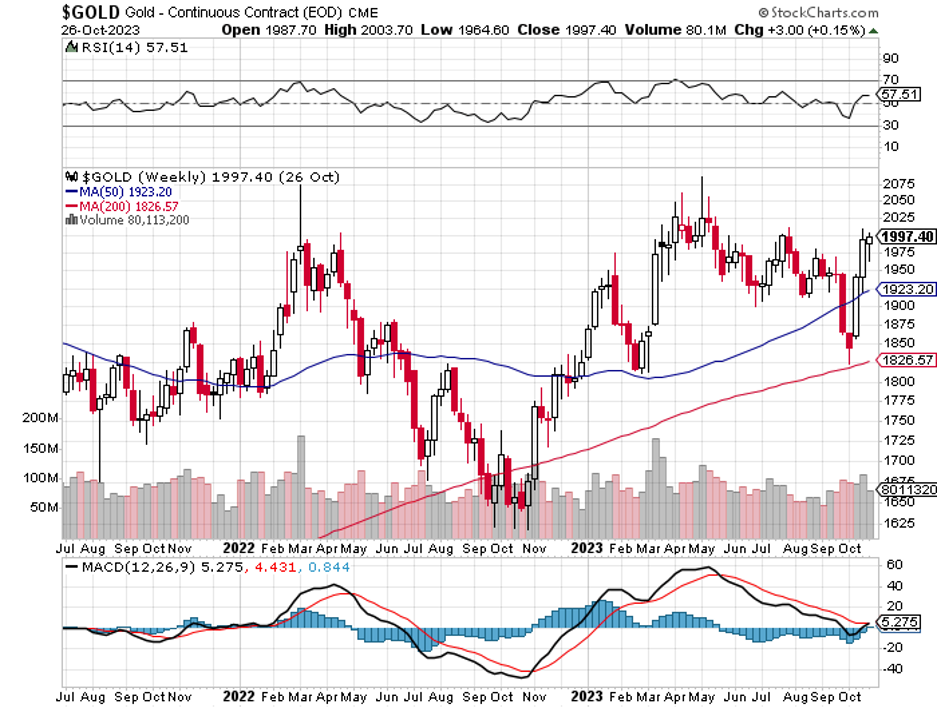
Of course, the trigger for these large inflows was the yellow metal’s decisive breakout on big volume from a two-year trading range.
Not only did now longs pile into the market, there was frantic short covering as well.
Too many options traders had gotten comfortable selling short gold call options just above the $1,800 level.
Once key upside resistance was shattered, gold tacked on another $50 very quickly. Bearish traders were smartly spanked.
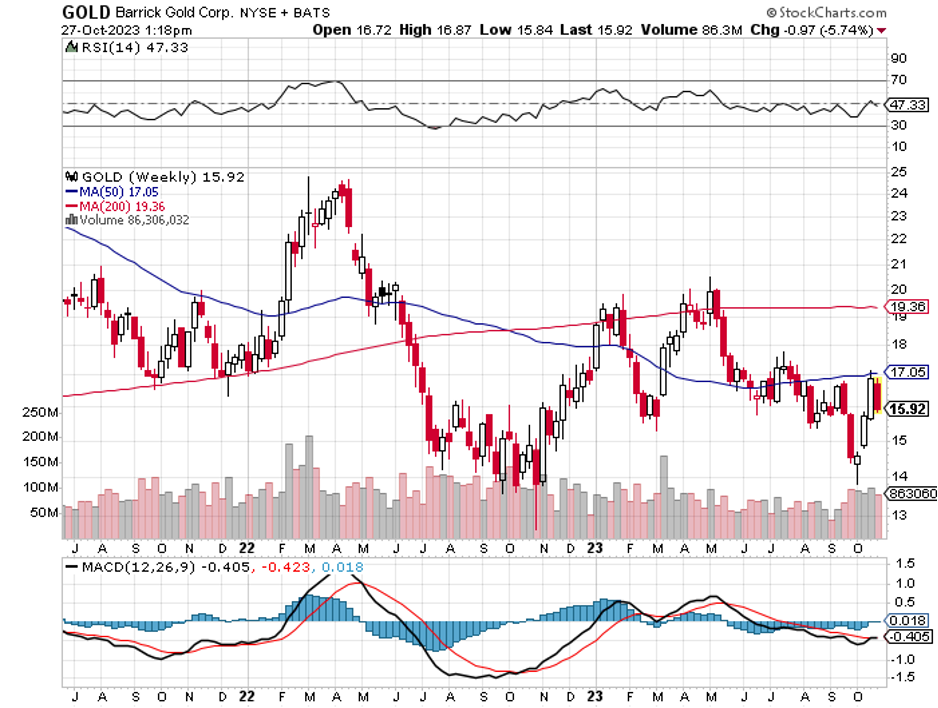
Gold plays that did well, including Van Eck Vectors Gold Miners ETF (GDX), Barrick Gold (ABX), Newmont Mining (NEM), and Global X Silver Miners ETF (SIL), turned profitable.
There are six reasons why gold has gone off to the races.
1) Ten-year Treasury bond yields are peaking out at 5.0%. The opportunity cost of holding gold is about to drop sharply.
2) Falling interest rates guarantee a weaker US dollar, another big pro gold development.
3) The last of the pandemic stimulus is fading fast.
4) The new conflict in the Middle East has poured the fat on the fire.
5) General concerns about the increasing instability in Washington have driven nervous investors into EVERY flight to safety play.
6) The collapse of trust in crypto has propelled a lot of assets back into gold.
Inflation has historically been the great driver of all hard asset prices.
After such a meteoric move, I would expect gold to consolidate here around this level for a while to digest the recent action. It may drift sideways, or fall slightly.
That’s when I’ll pick up my next basket of longs.

I have spent many hours speaking at length with the generals who are running our wars in the Middle East, like David Petraeus, and James E. Cartwright.
To get the boots-on-the-ground view, I attended the graduation of a friend at the Defense Language Institute (DLI) in Monterey, California, the world's preeminent language training facility.
As I circulated at the reception at the once top-secret installation, I heard the same view repeated over and over in the many conversations swirling around me. While we can handily beat armies, defeating an idea is impossible.
With the planet's fastest-growing population (Muslims are expected to double from one to two billion by 2050), terrorists can breed replacements faster than we can kill them. The US will have to maintain a military presence in the Middle East for another 100 years.
The goal is not to win, but to keep the war at a low cost, slow burn, over there, and away from the Americans.
I have never met a more determined, disciplined, and motivated group of students. There were seven teachers for 16 students, some with PhDs and all native Arabic speakers. The Defense Department calculates the cost of this 63-week, total immersion course at $200,000 per student.
They are taught not just the language, but also the history, culture, and politics of the region as well. I found myself discussing at length the origins of the Sunni/Shiite split in the 7th century, the rise of the Mughals in India in the 16th century, and the fall of the Ottoman Empire after WWI. This was with a 19-year-old private from Kentucky whose previous employment had been at Walmart! I doubt most Americans his age could find the Middle East on a map.
Students graduated with near-perfect scores. If you fail a class, you get sent to Afghanistan, unless you are in the Air Force, which kicks you out of the service completely.
As we feasted on hummus and other Arab delicacies, I studied the pictures on the wall describing the early history of the DLI in WWII, and realized that I knew several of the former graduates, now long gone.
The school was founded in 1941 to train Japanese Americans in their own language to gain an intelligence advantage in the Pacific war.
General 'Vinegar Joe' Stillwell said their contribution shortened the war by two years. General Douglas MacArthur believed that an army had never before gone to war with so much advanced knowledge about its enemy.
To this day, the school's motto is 'Yankee Samurai'.
My old friends at the Foreign Correspondents' Club of Japan will remember well the late Al Pinder. He spent the summer of 1941 photographing every eastern-facing beach in Japan. He? successfully smuggled the photographs out hidden in a chest full of Japanese sex toys.
He then spent the rest of the war working for the OSS in China. I know this because I shared a desk in Tokyo with Al for nearly ten years. His picture is there in all his youth, accepting the Japanese surrender in Korea with DLI graduates.
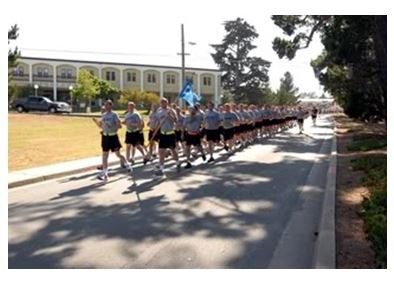


I Guess I Should Have Studied Harder

