
Mad Hedge Technology Letter
July 14, 2023
Fiat Lux
Featured Trade:
(BAD TECH EARNINGS ARE PRICED IN)
(AAPL), (TSLA), (AMZN), (FB)

Mad Hedge Technology Letter
July 14, 2023
Fiat Lux
Featured Trade:
(BAD TECH EARNINGS ARE PRICED IN)
(AAPL), (TSLA), (AMZN), (FB)

There are many so-called “experts” and “economists” dumping on the upcoming tech earnings season.
I got it – they won’t be the best ever.
No need to beat a dead horse when it’s down.
They say that the optimism of a soft landing for the economy is dissipating as stubbornly high inflation keeps central banks hawkish.
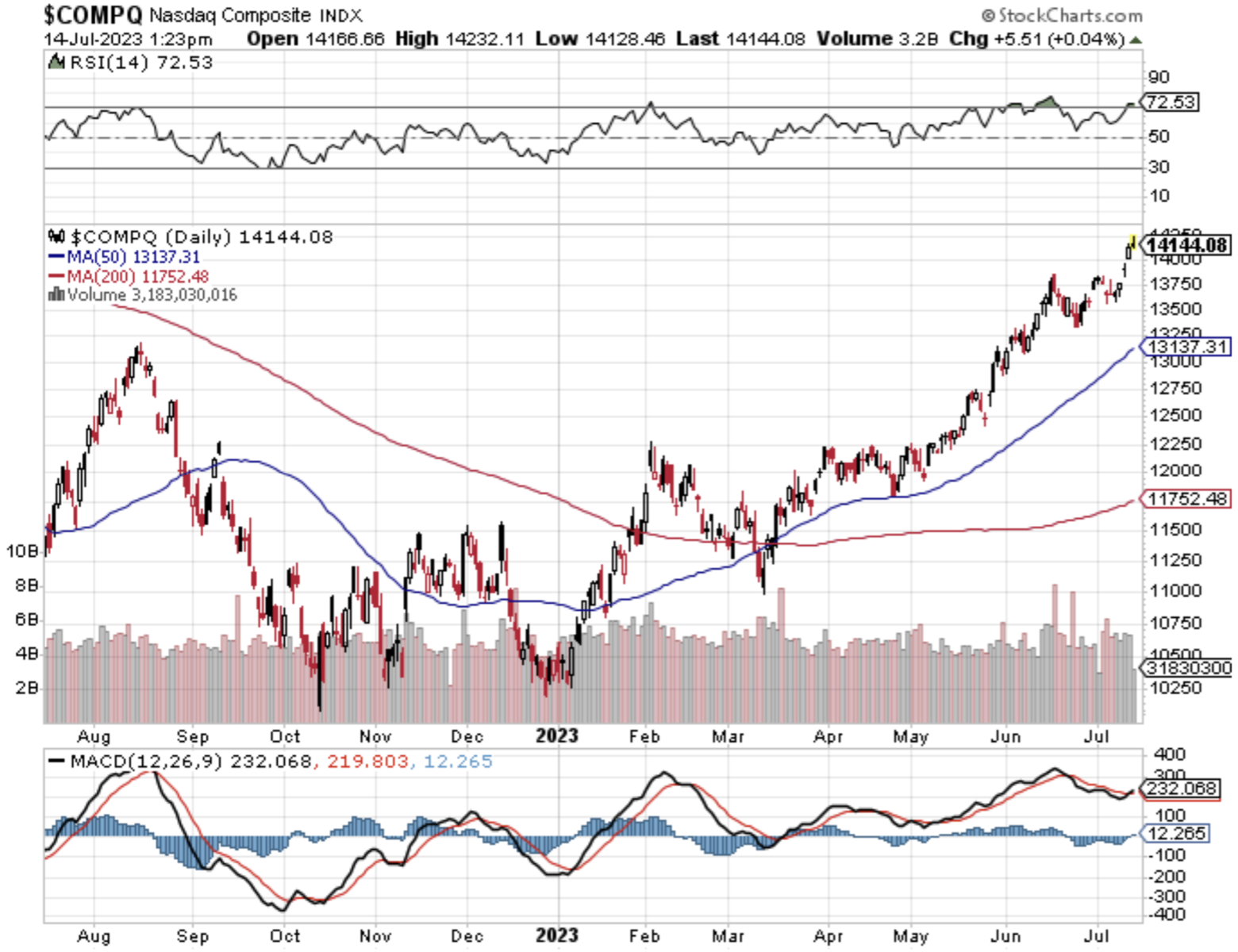
It’s hard to believe that tech stocks have been on a tear in 2023 during a period of hawkishness.
Higher for longer luckily has not affected tech stocks yet, yet many are saying this earnings season could be the straw that breaks the camel’s back.
I must admit, at the intro level such as venture capitalism and start-ups, the rate environment has been nothing short of catastrophic.
Investors aren't giving money for just ideas anymore.
The good news is that at the incubator level, nobody cares because these paltry numbers don’t move the stock market and are decades away from going public.
It doesn’t matter to the tech market that the next Amazon or Facebook has a tough time borrowing with these sky-high rates.
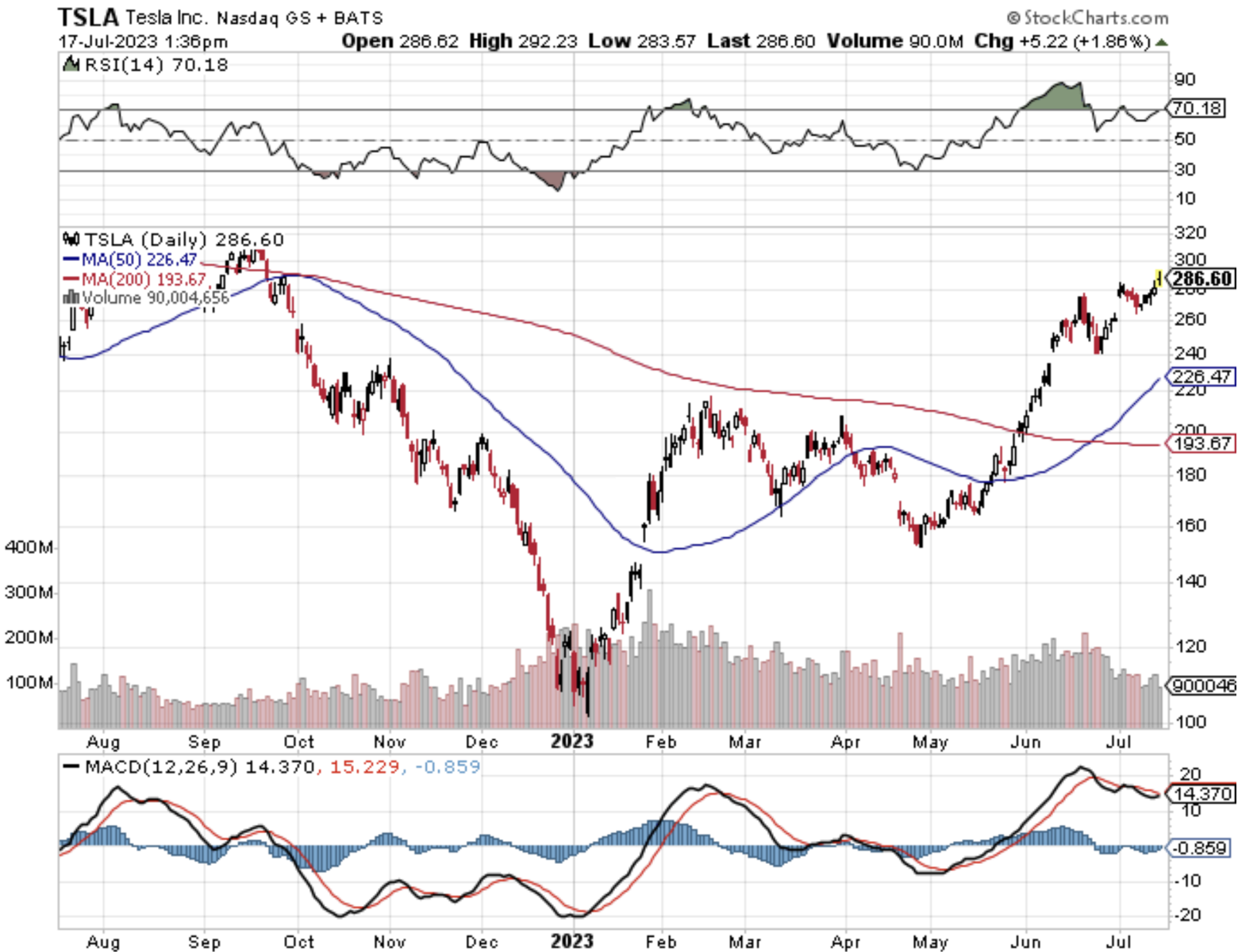
Nobody cares because most people hold Apple and Tesla stock.
I am also willing to call B.S. on the negativity for the upcoming tech earnings season and will say it should be just fine.
I am not diminishing the belt-tightening going on inside the offices, it certainly is happening.
Tech companies are hunkering down, which is true because the low-lying fruit has been plucked off the branch.
42% of respondents from a recent survey said the biggest negative for the earnings season will be the impact of further tightening of financial conditions.
I would say that if that is the biggest risk out there to respondents, then tech shares will certainly end the year higher from today.
There’s also a widespread belief that earnings per share (EPS) will fall off a cliff and then rebound to growth in the final three months of the year, according to data by Bloomberg Intelligence.
This seems like the perfect setup for tech executives to lower the bar.
While the tech rally was boosted by the hype around artificial intelligence, over 70% of survey participants say the impact of AI on tech earnings is overblown.
Amid the gloom, the biggest positive drivers for equities will be any signs of easing inflation and cost cutting, according to the majority of those surveyed.
Ultimately, it has already been baked into the pie that margins will come under pressure as companies lose the ability to keep raising prices when inflation cools and as growth slows.
That doesn’t mean there will be anything more than a technical and orderly pullback which I have been championing for.
A result like that would be healthy for tech stocks.
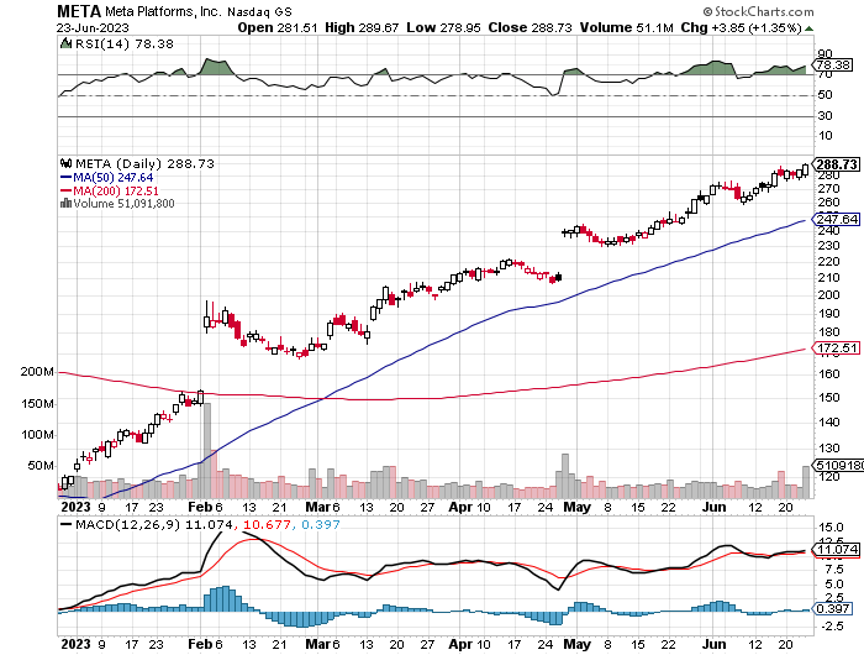
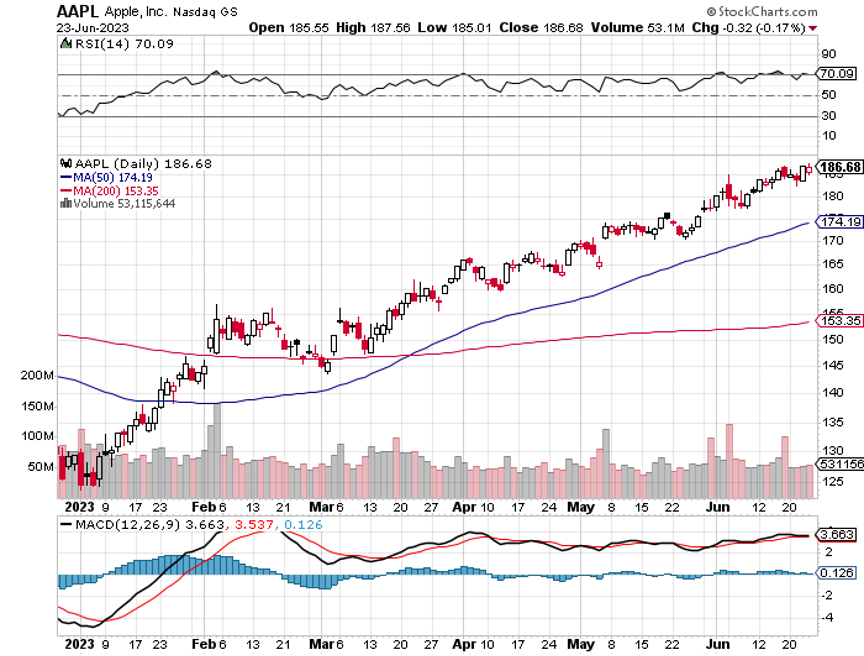
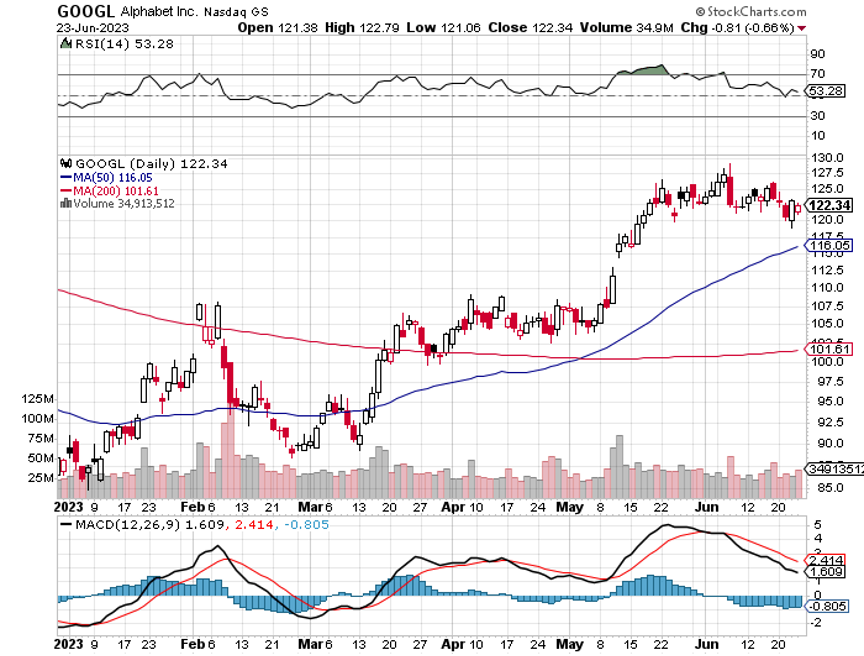
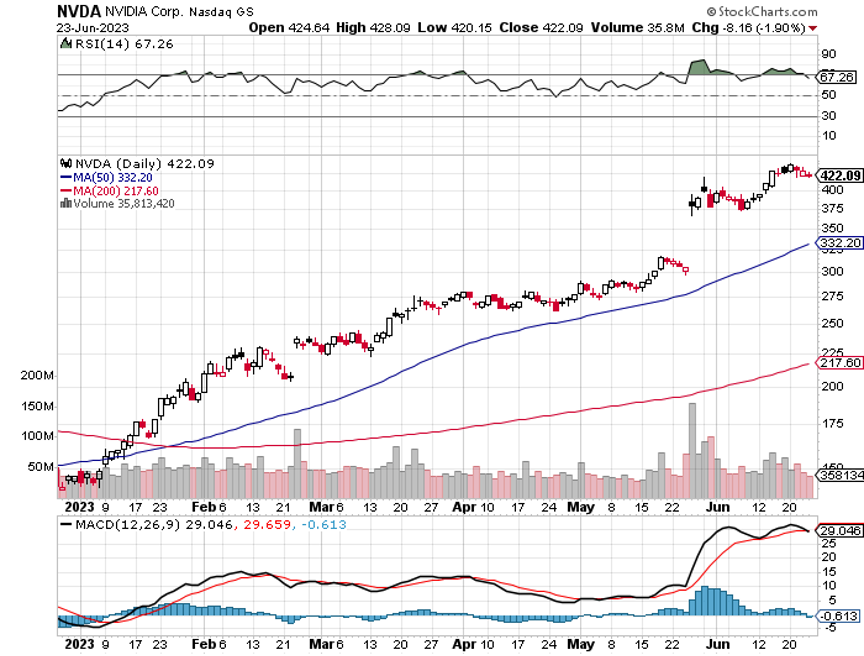
Tech shares simply cannot go up in a straight line forever, but they keep defying gravity in the first 7 months of the year.
Even if the big 7 tech stocks signal some downshifting revenue trajectories, it won’t be more than a few days' drop in shares signifying a marvelous opportunity to finally get into some of these premium names that rarely offer optimal entry points.
Expect nothing special from this earnings season and buy any garden variety dip from premium tech stocks.

Global Market Comments
July 12, 2023
Fiat Lux
Featured Trades:
(WHAT THE NEXT RECESSION WILL LOOK LIKE),
(FB), (AAPL), (NFLX), (GOOGL), (KSS), (VIX), (MS), (GS),
(TESTIMONIAL)

CLICK HERE to download today's position sheet.
Mad Hedge Biotech and Healthcare Letter
July 11, 2023
Fiat Lux
Featured Trade:
(A CALCULATED GAMBLE)
(PFE), (CRBU), (AAPL), (NTLA), (CRSP)

There has been a lot of chin-wagging about whether we're on a collision course with a recession or on the upswing. I get it. It's as confusing as figuring out why Warren Buffet didn't invest in Apple (AAPL) sooner.
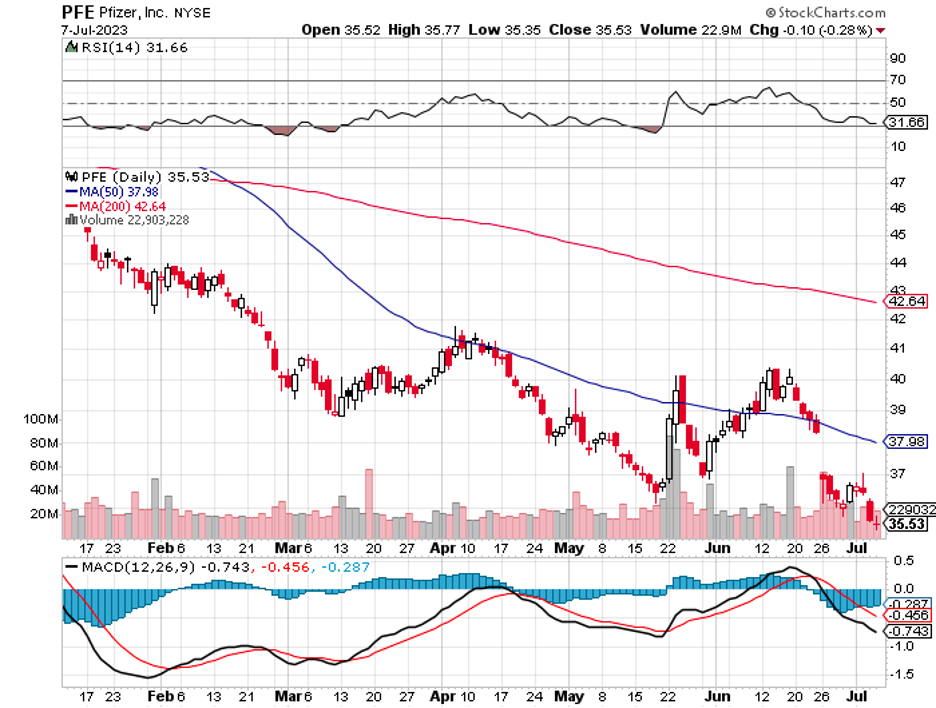
Still, there are stocks that, recession or not, will let you sleep like a baby. In the biotechnology and healthcare sector, Pfizer (PFE) stands out as one of those stocks. In bear markets, it fares well because, well, let's face it, health trumps wealth every time.
Now, you might look at Pfizer's recent earnings and think it's taken a bit of a tumble. No growth in revenue or EPS in the first quarter of 2023? That’s definitely worrisome. But hold your horses. Let's peel back the layers a bit to see the full picture.
Pfizer has been raking in the dough from its COVID-19 potions, especially its vaccine Comirnaty and therapy Paxlovid. With the COVID gold rush subsiding, the company reported a 29% dip in revenue in Q1, clocking in at $18.3 billion.
Remember, context is key. Strip out the COVID-19 products, and revenue has actually nudged up 5% YoY.
It’s the same story with the company's forecast.
Revenues are predicted to be between $67 billion and $71 billion, a drop of 29% to 33%. But subtract the COVID dollars and cents, and Pfizer's set to grow between 7% to 9%.
What's Pfizer doing with its COVID-19 windfall? It's not buying beachfront properties, that's for sure.
Instead, it has a staggering 101 programs in the pipeline, including 38 in phase 3 trials. This year, the company also had four new approvals, from new uses for Paxlovid and Prevnar 20 to a vaccine for older folks and a nasal spray for migraines.
But the market's jittery about the predicted revenue drop, causing the stock to tumble 21% this year. That just makes it a bargain.
Pfizer's trading at less than 8 times earnings makes it the frugal shopper's dream.
To sweeten the pot, Pfizer's upped its quarterly dividend by 2.5% to $0.41 a pop. That gives a yield of about 4%, twice the average of the S&P 500. More impressively, it's been doing this for 14 consecutive years.
However, Pfizer's not resting on its laurels.
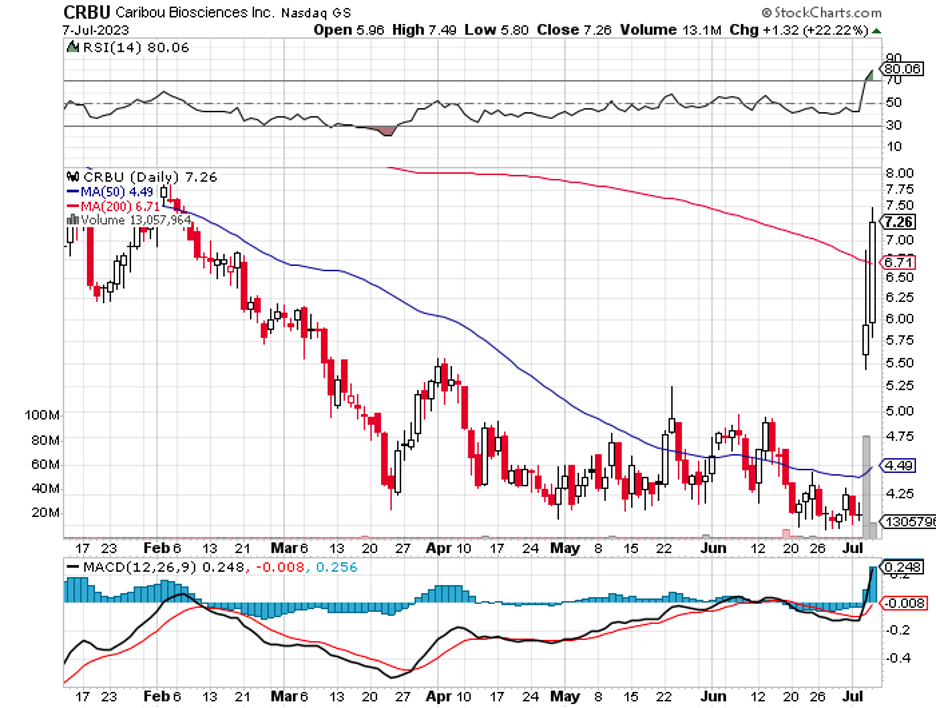
Its latest move? A 7% stake in Caribou Biosciences (CRBU), a firm that's pushing the boundaries of gene-editing tech and cell therapies for cancer. It's like investing in a tech startup but with a biological twist.
Caribou's stock has taken a wild ride since it went public in 2021, peaking at over $30 and dipping to a recent low of $4. After Pfizer's buy-in, it jumped 46% to $5.94. A small stake of $25 million, but it's a clear sign that gene editing is back in the spotlight.
Moreover, Caribou's no one-trick pony.
It's testing treatments based on the Nobel Prize-winning CRISPR technology. This precision tool allows doctors to zero in on problematic DNA and tweak it. The potential for treatments for cancer and genetic disorders is mind-boggling.
Caribou currently has a pair of potential game-changers simmering in the preliminary stages.
First up is their experimental treatment, CB-010, aiming a direct hit at blood cancer lymphoma. This therapy manipulates immune cells to lock onto the cancer.
Picture them as bounty hunters of the body, genetically tweaked to bring down the cancerous bad guys.
To date, we've got a trio of these CAR-T therapies courtesy of other pharmaceutical giants in the game, but they all work on modifying the patient's immune cells. Unfortunately, not every patient’s cells are ripe for the CAR-T transformation.
This is where Caribou switches things up.
The biotech’s CAR-T therapy is akin to a supermarket for immune cells – off-the-shelf and ready for action. Through some nifty gene editing, immune cells from healthy volunteers are modified and packed for delivery.
In theory, these should pack more punch. And it seems they do, judging by Caribou's initial guinea pigs – six lymphoma patients who saw their cancer vanish without a trace after a rendezvous with Caribou's CAR-T.
Obviously, they’re not promising an everlasting disappearance, but a couple of these folks kept their cancer at bay for at least a year.
While Caribou isn't alone in the off-the-shelf CAR-T quest, they've put up a stellar performance so far against the likes of Intellia Therapeutics (NTLA) and CRISPR Therapeutics (CRSP).
Caribou’s pipeline also features another off-the-shelf CAR-T contender battling the blood disorder known as multiple myeloma. This therapy, dubbed CB-011, is what specifically caught Pfizer's eye. Basically, Pfizer’s investment has earned it the right to haggle for a license if another suitor comes courting for Caribou's star player.
But Caribou's act doesn't end here.
It has a growing ensemble featuring CB-012, a CAR-T cell therapy focused on recurrent or stubborn acute myeloid leukemia, and CB-020, another CAR-T variant for various stubborn tumors.
Pre-Pfizer deal, Caribou boasted a cash reservoir of $291 million, promising smooth sailing until around 2025.
Caribou promises an action-packed second half of 2023, with an update on CB-010's phase 1 trial safety and efficacy, a dose-escalation report for CB-011's phase 1 trial, and a new drug application for CB-012 targeting relapsed/refractory acute myeloid myeloma.
As with all biotechs in the clinical stage, though, it's a bit of a gamble. With some key milestones expected later this year, investors are watching with bated breath to see if the company can deliver.
If the dice roll the right way, Caribou could be a jackpot for Pfizer – and for savvy investors.
So if you're looking for a stock that has the potential to thrive despite market uncertainties, with a dash of excitement and a sprinkle of future possibilities, Pfizer could be your ticket.
Not only is it a reliable dividend payer, but its recent ventures show it's also not afraid to swing for the fences.


Global Market Comments
July 5, 2023
Fiat Lux
Featured Trades:
(THURSDAY, JULY 27, 2023 CORTINA d’AMPEZZO, ITALY STRATEGY LUNCHEON)
(HOW TO EXECUTE A VERTICAL BULL CALL SPREAD),
(AAPL)

CLICK HERE to download today's position sheet.
Global Market Comments
June 27, 2023
Fiat Lux
Featured Trades:
(LAST CHANCE TO ATTEND THE THURSDAY, JULY 6 NEW YORK STRATEGY LUNCHEON)
(A BUY WRITE PRIMER), (AAPL)

CLICK HERE to download today's position sheet.
Global Market Comments
June 26, 2023
Fiat Lux
Featured Trades:
(MARKET OUTLOOK FOR THE WEEK AHEAD, or IS THERE A COUP UNDERWAY IN RUSSIA?),
(AAPL), (GOOGL), (MSFT), (GE), (MU), (AMZN)

CLICK HERE to download today's position sheet.
I just received a call from the Marine Corps to go on emergency standby. This is not something the Corps does lightly.
The word is that there may be a coup d'etat underway in Russia and the entire US military has gone to a heightened alert status.
The Wagner group is Marching on Moscow with the intent of overthrowing the government, or at least the military. Putin took off in a plane which then disappeared radar, meaning he has either been shot down, or is flying low level to keep his destination secret.
This thing could go nuclear very easily, but only in Russia. It also could mean the end of the Ukraine War. There is nothing to do here as intelligence pours in over the weekend. We have ample satellites overhead and human intel on the ground.
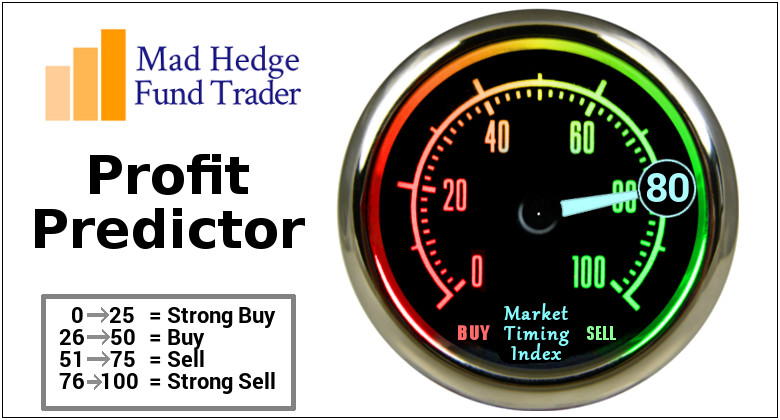
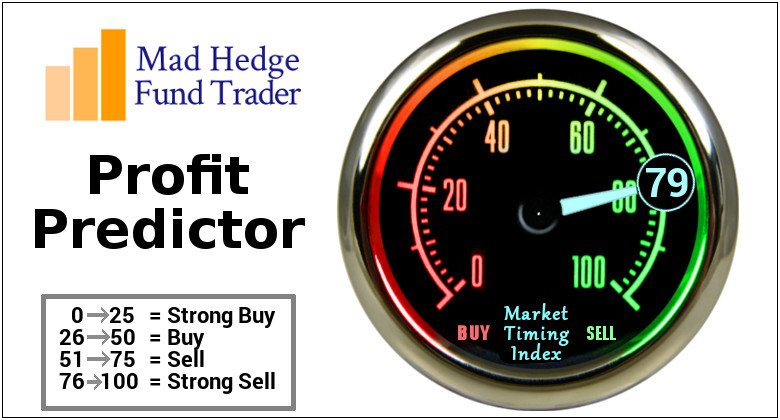
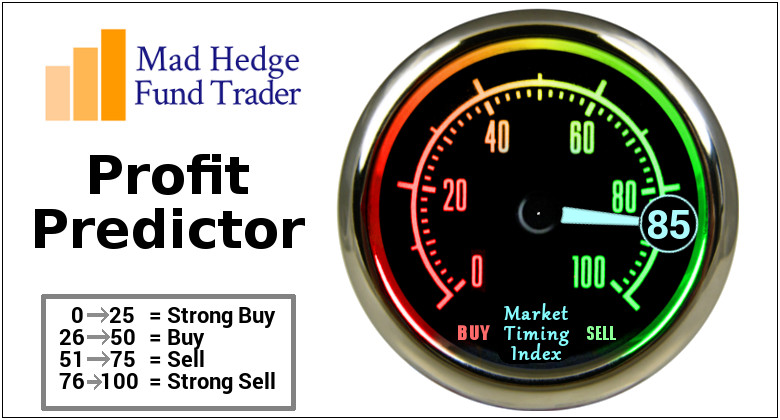
Expect market volatility today. The markets are ripe for a black swan-inducted selloff, which a Mad Hedge Market Timing Index at 82 was screaming at us.
I will be monitoring the situation closely.
My view that the markets were topping was vindicated last week. The “Magnificent Seven” which gained a record 25% in market capitalization in only eight weeks led the downturn, as they always do. But the AI surge that prompted the fastest equity creation in history is only just getting started.
This is against a backdrop of savage cost-cutting by Big Tech, which has had the effect of boosting earnings by an impressive 7% in only three months. My cleaning lady, gardener, dry cleaner, and shoe shine boy have started giving me stock tips yet, as they did in 2000, 2008, and 2020….but they are thinking about it.
While attention is focused elsewhere, one should not underestimate the importance of India Prime Minister Modi’s meeting with Joe Biden in Washington.
It signifies a major geopolitical shift out of the Russian orbit into the US one. Decades ago, India obtained all its weapon systems and nuclear power plants from Russia and was a major trading partner.
Now partnering up with Apple (AAPL), Google (GOOGL), Microsoft (MSFT), and General Electric (GE) is a much more attractive option. It is gaining a $2.7 billion factory from Micron Technology (MU) and presents a major market for its products. Amazon (AMZN) is investing $13 billion in cloud infrastructure there. The subcontinent graduates some 2.5 million STEM graduates a year and they need to be put to work in the global economy. It shows how limited Russia’s future really is. It’s a major win for the US.
So far in June, we are up +0.47%. My 2023 year-to-date performance is still at an eye-popping +62.52%. The S&P 500 (SPY) is up only a respectable +14.00% so far in 2023. My trailing one-year return reached +96.63% versus +21.52% for the S&P 500.
That brings my 15-year total return to +659.71%. My average annualized return has blasted up to +48.56%, another new high, some 2.59 times the S&P 500 over the same period.
Some 42 of my 46 trades this year have been profitable. Only 23 of my last 24 consecutive trade alerts have been profitable.
The Mad Hedge December 6-8 Summit Replays are Up. Listen to all 28 speakers opine on the best strategies, tactics, and instruments to use in these volatile markets. It is a true smorgasbord of investment strategies. Find the best one to suit your own goals. The product discounts offered last week are still valid. Start, stop, and pause the videos at your leisure. Best of all, access to the videos is FREE. Access them all by clicking here and then choosing the speaker of your choice. We look forward to working with you.The next summit is scheduled for September 12-14.
$2 Billion Fled Stock Market Last Week, according to a Bank of America survey, in what it calls a “Baby Bubble.” The markets are showing all the signs of an interim top, with either a 10% correction or a three-month flat line ahead of us. Time to strap on those Buy Writes for long-term shareholders.
Short Bets on US stocks Hit $1 trillion, the highest since April 2022. Shorts have so far lost $101 billion in 2023, with much of this hedged. The market is way overdue for a correction so these guys may finally be right. Even a broken clock is right twice a day.
Germany Signs Massive US Natural Gas Contract, in a major move to end reliance on Russian natural gas. Venture Global LNG will supply EnBW with 1.5 million tons a year of LNG starting in 2026. The 20-year sales and purchase agreement is Germany’s first binding deal with a US developer since the government announced ambitious plans to begin importing the super-chilled fuel. The move does a lot to eliminate the glut of gas in the US currently plaguing producers. Buy (UNG) LEAPS on dips. When China comes back on line, watch out!
Volatility Index ($VIX) Hits the $12 Handle, in a new multiyear low. At the high for the year in the S&P 500, complacency is running rampant. Time to add some downside hedges.
Copper Should be a “Critical Metal”, says billionaire Robert Friedland. A looming structural shortage is the reason, with the world going to an all-electric auto fleet and doubling of the electrical grid to accommodate it. Buy more (FCX) LEAPS on dips.
Leading Economic Indicators Down 0.7% for the 15th consecutive negative month. We are approaching the bottom of the trough in this cycle. I’ll focus on the half of the economy that is growing.
Distressed Commercial Property Debt is Exploding, up 10% to Q1 to $64 billion. Another $155 billion is waiting in the wings. This will go away when interest rates start to drop in six months.
My Ten-Year View
When we come out the other side of the recession, we will be perfectly poised to launch into my new American Golden Age, or the next Roaring Twenties. The economy decarbonizing and technology hyper-accelerating, creating enormous investment opportunities. The Dow Average will rise by 800% to 240,000 or more in the coming decade. The new America will be far more efficient and profitable than the old.
Dow 240,000 here we come!
On Monday, June 26 at 8:30 AM EST, the Dallas Fed Manufacturing Index is out.
On Tuesday, June 27 at 6:00 PM, S&P Case-Shiller National Home Price Index is published.
On Wednesday, June 28 at 7:30 AM, the Fed Governor Jay Powell speaks.
On Thursday, June 29 at 8:30 AM, the Weekly Jobless Claims are announced. The Final Report for Q1 US GDP is printed.
On Friday, June 30 at 8:30 AM, Personal Income and Spending is announced.
As for me, when I first met Andrew Knight, the editor of The Economist magazine in London 45 years ago, he almost fell off his feet. Andrew was well known in the financial community because his father was a famous WWII Battle of Britain Spitfire pilot from New Zealand.
At 34, he had just been appointed the second youngest editor in the magazine’s 150-year history. I had been reporting from Tokyo for years, filing two stories a week about Japanese banking, finance, and politics.
The Economist shared an office in Tokyo with the Financial Times, and to pay the rent I had to file an additional two stories a week for them as well. That’s where I saw my first fax machine, which then was as large as a washing machine even though the actual electronics would fit in a notebook. It cost $5,000.
The Economist was the greatest calling card to the establishment one could ever have. Any president, prime minister, CEO, central banker, or war criminal was suddenly available for a one-hour chart about the important affairs of the world.
Some of my biggest catches? Presidents Gerald Ford, Jimmy Carter, Ronald Reagan, George Bush, and Bill Clinton, China’s Zhou Enlai and Deng Xiaoping, Japan’s Emperor Hirohito, terrorist Yasir Arafat, and Teddy Roosevelt’s oldest daughter, Alice Roosevelt Longworth, the first woman to smoke cigarettes in the White House in 1905.
Andrew thought that the quality of my posts was so good that I had to be a retired banker at least 55 years old. We didn’t meet in person until I was invited to work the summer out of the magazine’s St. James Street office tower, just down the street from the palace of then Prince Charles.
When he was introduced to a gangly 25-year-old instead, he thought it was a practical joke, which The Economist was famous for. As for me, I was impressed with Andrew’s ironed and creased blue jeans, an unheard-of concept in the Wild West where I came from.
The first unusual thing I noticed working in the office was that we were each handed a bottle of whisky, gin, and wine every Friday. That was to keep us in the office working and out of the pub next door, the former embassy of the Republic of Texas from pre-1845. There is still a big white star on the front door.
Andrew told me I had just saved the magazine.
After the first oil shock in 1973, a global recession ensued, and all magazine advertising was cancelled. But because of the shock, it was assumed that heavily oil-dependent Japan would go bankrupt. As a result, the country’s banks were forced to pay a ruinous 2% premium on all international borrowing. These were known as “Japan rates.”
To restore Japan’s reputation and credit rating, the government and the banks launched an advertising campaign unprecedented in modern times. At one point, Japan accounted for 80% of all business advertising worldwide. To attract these ads the global media was screaming for more Japanese banking stories, and I was the only person in the world writing them.
Not only did I bail out The Economist, I ended up writing for over 50 business and finance publications around the world in every English-speaking country. I was knocking out 60 stories a month, or about two a day. By 26, I became the highest paid journalist in the Foreign Correspondents’ Club of Japan and a familiar figure in every bank head office in Tokyo.
The Economist was notorious for running practical jokes as real news every April Fool’s Day. In the late 1970s, an April 1 issue once did a full-page survey on a country off the west coast of India called San Serif.
It warned that if the West coast kept eroding, and the East coast continued silting up, the country would eventually run into India, creating serious geopolitical problems.
It wasn’t until someone figured out that the country, the prime minister, and every town on the map were named after a type font that the hoax was uncovered.
This was way back, in the pre-Microsoft Word era, when no one outside the London Typesetter’s Union knew what Times Roman, Calibri, or Mangal meant.
Andrew is now 84 and I haven’t seen him in yonks. My business editor, the brilliant Peter Martin, died of cancer in 2002 at a very young 54, and the magazine still awards an annual journalism scholarship in his name.
My boss at The Economist Intelligence Unit, which was modeled on Britain’s MI5 spy service, was Marjorie Deane, who was one of the first women to work in business journalism. She passed away in 2008 at 94. Today, her foundation awards an annual internship at the magazine.
When I stopped by the London office a few years ago I asked if they still handed out the free alcohol on Fridays. A young writer ruefully told me, “No, they don’t do that anymore.”
Sometimes, change is for the worse, not the better.
Good Luck and Good Trading
John Thomas
CEO & Publisher
The Diary of a Mad Hedge Fund Trader


Global Market Comments
June 23, 2023
Fiat Lux
Featured Trades:
(JUNE 21 BIWEEKLY STRATEGY WEBINAR Q&A),
(AAPL), (ABNB), (GLD), (BA), (CAT), (DE), (X), (PYPL), (SQ), (MSFT), (GD), (GE), (INDA), (META) (GOOGL), (CCI), (NVDA), (ABNB), (SNOW), (PLTR), (TSLA)

CLICK HERE to download today's position sheet.
Legal Disclaimer
There is a very high degree of risk involved in trading. Past results are not indicative of future returns. MadHedgeFundTrader.com and all individuals affiliated with this site assume no responsibilities for your trading and investment results. The indicators, strategies, columns, articles and all other features are for educational purposes only and should not be construed as investment advice. Information for futures trading observations are obtained from sources believed to be reliable, but we do not warrant its completeness or accuracy, or warrant any results from the use of the information. Your use of the trading observations is entirely at your own risk and it is your sole responsibility to evaluate the accuracy, completeness and usefulness of the information. You must assess the risk of any trade with your broker and make your own independent decisions regarding any securities mentioned herein. Affiliates of MadHedgeFundTrader.com may have a position or effect transactions in the securities described herein (or options thereon) and/or otherwise employ trading strategies that may be consistent or inconsistent with the provided strategies.