Mad Hedge Biotech and Healthcare Letter
February 10, 2022
Fiat Lux
Featured Trade:
(A HEALTHCARE ENIGMA TO ADD TO YOUR WATCHLIST)
(GILD), (JNJ), (PFE), (ABBV), (LLY), (MRK), (BMY),
(AMGN), (MRNA), (AZN), (REGN), (BNTX), (NVAX)

Mad Hedge Biotech and Healthcare Letter
February 10, 2022
Fiat Lux
Featured Trade:
(A HEALTHCARE ENIGMA TO ADD TO YOUR WATCHLIST)
(GILD), (JNJ), (PFE), (ABBV), (LLY), (MRK), (BMY),
(AMGN), (MRNA), (AZN), (REGN), (BNTX), (NVAX)
The top names in the biopharmaceutical world based on their market capitalization include Johnson & Johnson (JNJ), Pfizer (PFE), AbbVie (ABBV), Eli Lilly (LLY), Merck (MRK), Bristol Myers Squibb (BMY), Amgen (AMGN), and Gilead Sciences (GILD).
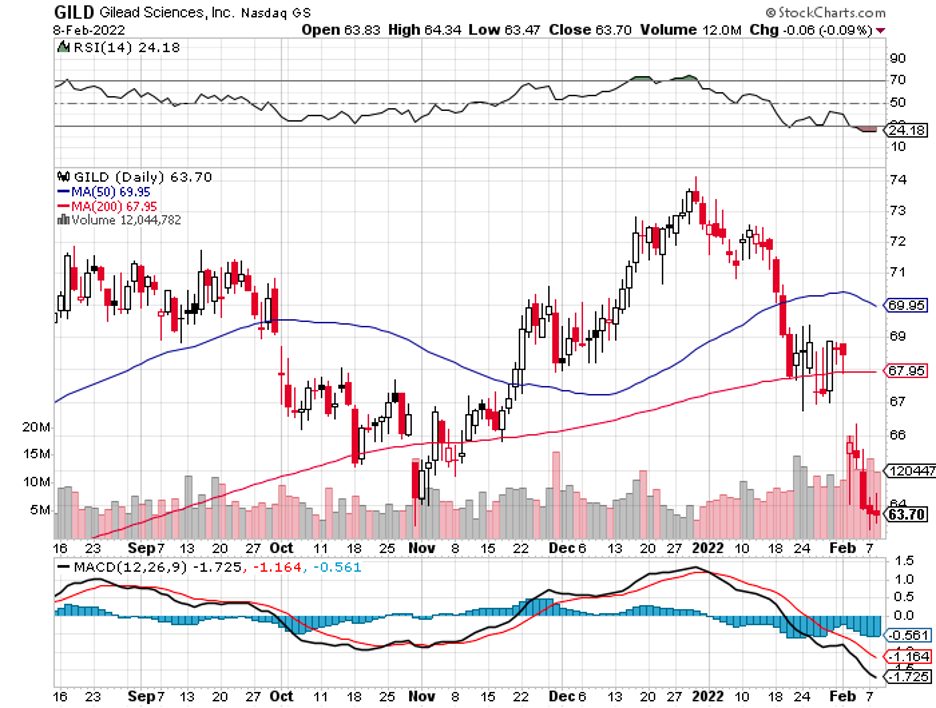
Among these names, Gilead is often viewed as an enigma, given its history and the challenge in predicting its share price trajectory.
Over the past months, Gilead has been testing the patience of investors. In fact, the company is projected to experience a fall in revenues this year from $27 billion in 2021 to $24.05 billion in 2022.
The latest news that added to their anxiety was the pause on clinical trials for its cancer therapy, Magrolimab.
This came after its short-lived dominance in the Hepatitis C segment.
At that time, the sales of its leading drug Sovaldi skyrocketed from $140 million in 2013 to a jaw-dropping $10.2 billion by 2014.
Meanwhile, another Hepatitis C treatment, Harvoni, single handedly raked in $13.8 billion in sales in 2015, pushing the entire company’s revenues to an impressive $32.6 billion.
Unfortunately for Gilead, it became the victim of its own staggering success.
Its Hepatitis C treatments, Sovaldi and Harvoni, were incredibly effective and managed to cure the patients within months. The demand for these drugs fell because the patient pool gradually ran dry.
By 2019, the Hepatitis C franchise of the company had declined and managed to scrape $2.9 billion in combined sales.
Since then, though, the company has been struggling to regain investors' faith.
Nevertheless, these recent developments are not enough reasons to panic. If anything, Gilead has simply become even more attractively priced due to the fallout.
In 2020, Gilead managed to report its first year-on-year increase in revenues since its glory days in 2015.
As the COVID-19 pandemic started to take hold of the world, it was Gilead’s Veklury (Remdesivir) that secured the first-ever Emergency Use Authorization from the FDA.
While Veklury was eventually overshadowed by COVID-19 vaccines from Pfizer, Moderna (MRNA), JNJ, and AstraZeneca (AZN), as well as other treatments and antibody cocktails from Eli Lilly, Regeneron (REGN), and Merck, Gilead’s candidate managed a comeback by the fourth quarter of 2021 after experts declared it to be effective against the Omicron strain.
In effect, Veklury had a major impact on the company’s 2021 performance, recording $5.6 billion in annual sales.
Although this is not as illustrious or groundbreaking as its Hepatitis C treatments, the reemergence of Gilead as a frontrunner in the pandemic is proof that the company has not lost its knack for discovering and developing a winning formula for blockbuster treatments.
Another avenue that Gilead has been exploring is actively acquiring assets to expand its portfolio.
One notable move in that direction is its $11.9 billion acquisition of Kite Pharma, a leader in the cell therapy space, in 2017. Thus far, this agreement has yielded two drugs: Yescarta and Tecartus.
Since oncology is one of Gilead’s major areas of concentration, the commercialization of these two treatments conveys a promising future.
While both are yet to become blockbusters, the field of cell therapy has been rapidly expanding and turning into a critical therapeutic option for certain patient categories.
Yescarta is projected to rake in $1.5 billion in revenues if it receives the FDA green light for large B-cell lymphoma
Considering that its last trial data showed off a 60% improvement with Yescarta compared to standard of care in terms of halting the disease’s progression or even death, there’s a huge possibility that Gilead will be delivering good news soon.
As for Tecartus, this treatment received approval for acute lymphoblastic leukemia last year and is aiming to expand to cover mantle cell lymphoma by July 2022.
With its list price of $373,000, this CAR-T therapy is projected to reach blockbuster status in the following months as well.
Another oncology drug anticipated to reach blockbuster status soon is metastatic triple-negative breast cancer treatment Trodelvy, which Gilead gained access to following a $21 billion deal with Immunomedics in 2020.
Given its current approved indications and the queued trials to expand its coverage, Trodelvy is projected to reach $4.7 billion in peak sales.
Going back to the 2022 revenue forecast for Gilead, I think the change is from the company’s anticipated decline in Veklury sales.
Since Pfizer, BioNTech (BNTX), Novavax (NVAX), and Moderna have been actively working on Omicron-focused vaccines and treatments, Gilead expects its Veklury revenues to shrink as well.
Overall, Gilead still presents an excellent opportunity for long-term investors.
Despite its setbacks, the company has proven that it still holds the knack of rolling out remarkable and effective best-in-class treatments.
Moreover, its pipeline is filled with promising candidates poised to deliver in the years to come. So, don’t be too quick to write off Gilead just yet.
Mad Hedge Biotech and Healthcare Letter
February 1, 2022
Fiat Lux
Featured Trade:
(A SHIFT IN NEUROSCIENCE BIOTECH)
(BIIB), (AXSM), (PFE), (BMY), (MRK), (NVS), (ABBV), (GSK), (JNJ), (LLY), (RHHBY), (TAK)
Industry experts typically describe mergers and acquisitions as the life force that propels the biotechnology and healthcare sector forward.
Based on that description, it’s safe to say that the segment’s health has plummeted, considering the sluggishness observed last year.
In 2021, the M&A of this industry had fallen to one of its lowest recorded levels in history.
During this period, the deals only amounted to $108 billion for the entire year. This number was approximately 40% of the total recorded in 2019.
Despite the sluggishness in 2021 and the relatively slow start in 2022, this year is still projected to push the would-be buyers into more aggressive action.
After all, several key products are facing patent expiration before this decade ends.
The list includes Big Pharma players like Pfizer (PFE), Bristol Myers Squibb (BMY), Merck (MRK), and Novartis (NVS).
This means that a massive deal might be on the horizon, pretty much when AbbVie (ABBV) executed its jaw-dropping $63 bill acquisition of Allergan in 2019 following its problems with generics competing against its blockbuster drug Humira.
Aside from patent protection concerns, another factor in play is the intense competition in lucrative research sectors such as immunology, neurology, rare diseases, and oncology.
Add to this the constant pressure of Congress to pull down drug prices, and it becomes apparent why companies—big or small—turn to mergers and acquisitions for survival.
Simply put, biotech and healthcare companies have no other choice but to be aggressive in looking for external innovation to secure the continuous transformation of their businesses.
On that note, I think there could be major acquisitions to be announced in 2022.
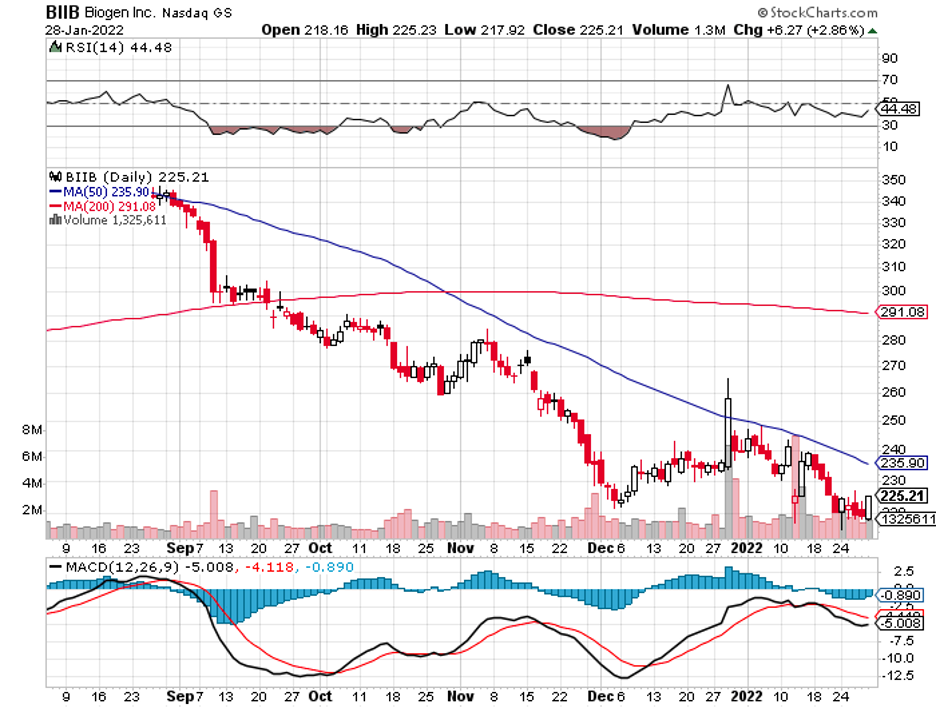
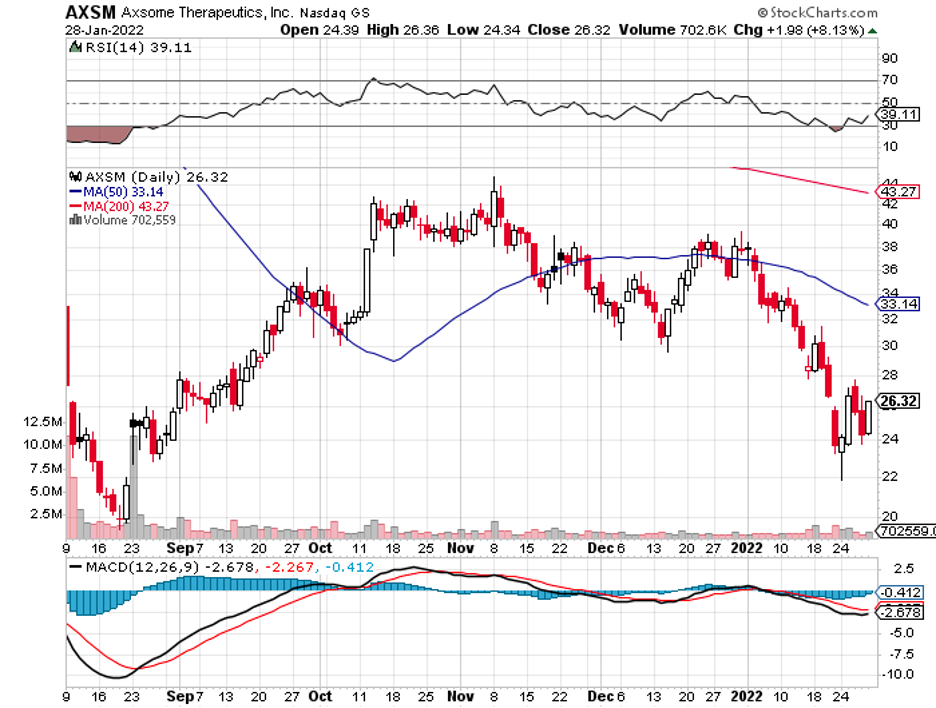
One deal I’m looking forward to is Biogen’s (BIIB) potential acquisition of Axsome Therapeutics (AXSM).
To remain competitive in the neuro stage, Biogen must keep up with the times—and a deal with Axsome might just be the solution.
Axsome’s size and price, with a market capitalization of $992 million, appear to be just the right fit for Biogen to gobble up.
More importantly, its portfolio is an excellent fit for Biogen. Both focus on neurological diseases, making their pipelines complementary to each other.
So far, Axsome has several leading candidates in the clinical stages.
One is AXS-05, which is a treatment for major depressive disorder (MDD).
Apart from MDD, this candidate is under late-stage review to target Alzheimer’s disease agitation.
In addition, Axsome is looking to advance AXS-05 in late-stage trials for smoking cessation therapy.
Needless to say, AXS-05 would go hand in hand with Biogen’s own approved, albeit controversial, Alzheimer’s drug Aduhelm.
Another promising candidate is AXS-07, a potential competitor of Pfizer and Novartis’ migraine medication. This drug has been submitted for FDA approval and might be launched by the second quarter of 2022.
There’s also AXS-12, which is a narcolepsy treatment candidate, and AXS-14, which is geared towards fibromyalgia. Both candidates are slated for FDA review by the third or fourth quarter of 2022.
For over 20 years, even the biggest and most powerful drug companies have stayed away from working on treatments specifically for the brain and central nervous system (CNS).
That’s not surprising considering the sheer number of failed programs in neuroscience, pushing drugmakers to believe that we still don’t have sufficient data on the subject, so the money might be better spent elsewhere.
Nowadays, though, the CNS landscape is starting to shift.
GlaxoSmithKline (GSK) recently embarked on reviving its CNS program by striking a $700 million deal with a smaller biotechnology company called Alector.
Meanwhile, Pfizer and Novartis reached an agreement with Biohaven Pharmaceuticals for the latter’s migraine treatment and Parkinson’s drug.
Aside from these, Johnson & Johnson (JNJ), Eli Lilly (LLY), Roche (RHHBY), and Takeda (TAK) are anticipated to secure CNS-centered deals soon.
Despite the lower number of M&A deals last year, the volume of strategic collaborations in the neuroscience sector climbed by about 50% in 2021 compared to its 2020 performance.
By 2022, this space is projected to become even more investable, considering the number of biotechnology companies focusing on CNS. Watch out for blockbuster deals in this sector.
Mad Hedge Biotech and Healthcare Letter
January 20, 2022
Fiat Lux
Featured Trade:
(A NO-BRAINER DIVIDEND CONTENDER UP FOR GRABS)
(AMGN), (ABBV), (GILD), (REGN), (JNJ)
To say that biotechnology stocks haven’t been performing well as of late is an understatement.
Over the past 12 months, the SPDR S&P Biotech Exchange Traded Fund (XBI) has recorded an over 30% loss and is anticipated to reach its 52-week low soon.
Investors have been pulling back from biotechnology stocks for several reasons like threats of drug pricing reforms in the US, the ever-increasing interest rates, and of course, the lure of rapid-growth assets such as cryptocurrencies.
Nevertheless, all is still not lost for the biotechnology sector.
The industry, in its entirety, continues to move forward with unprecedented innovations.
These groundbreaking discoveries, in turn, offer a myriad of untapped, top-value markets that will bode well for long-term investors.
This means that savvy investors would do well to make the most of this broad selloff in a highly promising segment.
One way to determine quality names in this volatile sector is to choose dividend-paying stocks.
After all, dividends are excellent sources of passive income. Apart from that, these can easily boost your portfolio if you plan to reinvest your money.
Basically, regardless of your investment strategy, choosing dividend-paying businesses can be really helpful in reaching your goals.
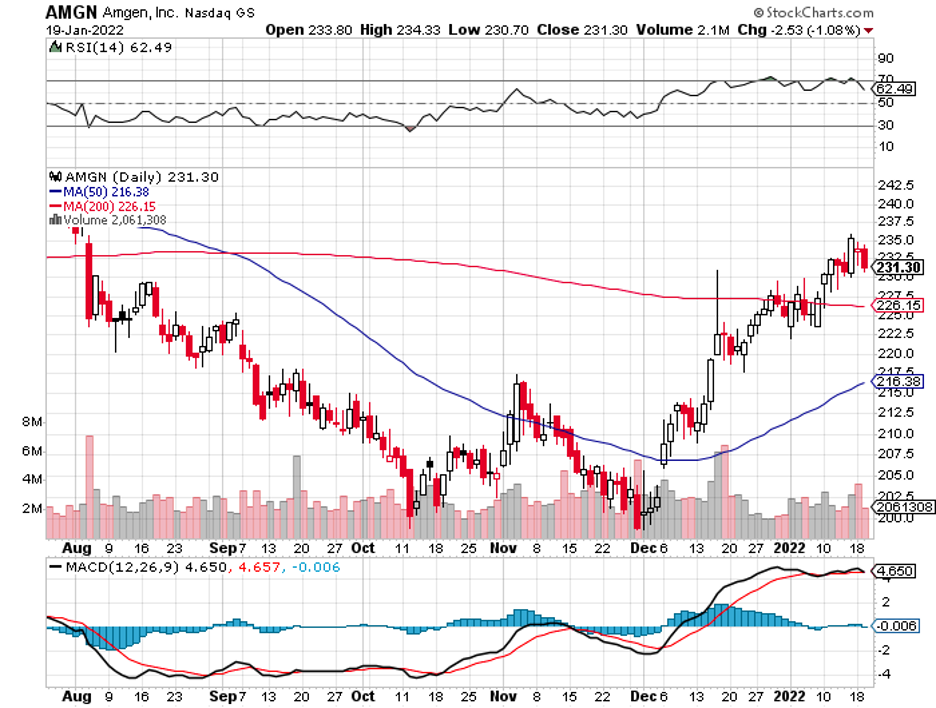
Among the names in the biotech industry, one that looks promising these days is Amgen (AMGN).
While Amgen’s dividend yield isn’t as high as the likes of AbbVie (ABBV) and Gilead Sciences (GILD), this pioneering biotechnology company is still a promising investment.
Recently, Amgen reported another dividend increase of 10.2%, indicating a rise from $1.76 to reach $1.94 per quarter, with the subsequent dividend expected to be payable by March 2022.
This results in an annual dividend of $7.76 and a respectable dividend yield of 3.41%.
More impressively, Amgen has been paying out dividends since 2011 and boosted its dividend not only annually but with an 11.97% in CAGR over the past 5 years.
Given the company’s history and growth trajectory, Amgen’s earnings growth rate annually in the next 5 years is estimated to be 6%, while its yearly dividend hike rate is projected at 7%.
At first glance, it’s easy to dismiss Amgen’s current standing.
In the third quarter of 2021, the company’s total revenue only reached $6.7 billion, indicating a measly 4% rise year-over-year.
A potential reason for this underwhelming growth is the pending patent cliff for some of its key products and the threat of biosimilars taking over Amgen’s target markets.
For example, cancer medication Neulasta reported a 25% decline in its sales year-over-year to contribute only $415 million in the third quarter.
Needless to say, this kind of disheartening top-line growth is partly responsible for the stock’s sluggish performance in the market lately.
However, other products in the company’s portfolio have reported much better performances than Neulasta.
There’s osteoporosis treatment Prolia, which rose by 15% year-over-year to contribute $803 million in the same period.
Even cholesterol drug Repatha showed off a 33% growth to record $272 million, while arthritis medication Otezla’s sales climbed by 13% to rake in $609 million.
On top of these, Amgen has also succeeded in developing new products that can easily provide additional revenue streams.
One of the most promising recently approved products is advanced non-small-cell lung cancer (NSCLC) treatment Lumakras, which received the US FDA green light last year.
Although there are many approved drugs for this condition, Lumakaras is the first and only treatment that targets specific mutations among non-squamous NSCLC patients.
This translates to 13% of patients suffering from that particular condition.
This is a massive market for Amgen.
Back in 2019, lung cancer was identified as the leading cause of cancer deaths in the United States.
At that time, the total was 139,603 individuals, which made up 23% of all the deaths attributed to the condition. Among the lung cancer deaths, 84% were identified to be of the NSCLC category.
So, if you put everything in perspective, the 13% patient population that Amgen exclusively holds equates to a big opportunity.
In addition, the European Union already approved Lumakras as well. This opens up yet another massive market for the treatment.
In the third quarter of 2021, Lumakras only delivered $36 million in sales. With the recent approvals and broadening of markets, this drug’s revenue is projected to rise quickly.
Aside from these products, Amgen has been working on expanding its pipeline. To date, the company has over 20 ongoing Phase 3 clinical trials.
Moreover, Amgen has decided to take a page out of the books of biosimilar developers.
As the company witnessed its own products get pummeled by biosimilars in the market, Amgen has opted to cannibalize sales of a wide range of treatments that lost their patent exclusivities.
This strategy has already delivered rewards, with the company reporting at least $2 billion in annual sales from its biosimilars in 2021.
For 2022, Amgen has three more biosimilars under development and is looking into poaching the likes of Regeneron’s (REGN) Eylea and Johnson & Johnson’s (JNJ) Stelara as well.
Despite the pandemic, Amgen has managed to extend its dividend growth streak to reach 11 consecutive years. This makes this biotechnology company an impressive Dividend Contender.
Overall, I consider this company a solid buy and an excellent long-term investment. It’s not simply an undervalued pick for value investors but also an outstanding choice for dividend investors.
Global Market Comments
January 11, 2022
Fiat Lux
Featured Trades:
(THE BARBELL PLAY WITH BERKSHIRE HATHAWAY),
(BRKA), (BRKA), (BAC), (KO), (AXP), (VZ), (BK) (USB), (TLT), (AAPL), (MRK), (ABBV), (CVX), (GM), (PCC), (BNSF)
Mad Hedge Biotech and Healthcare Letter
January 6, 2022
Fiat Lux
Featured Trade:
(A WONDERFUL COMPANY AT A FAIR PRICE)
(ABBV), (BRK.B), (GILD), (AMGN), (PFE)
Another year, another set of challenges and opportunities for investors. How can you make sure that you’re starting the year right?
If you’re looking to dip your toe in the biotechnology and healthcare sector, it won’t hurt to look at what the experts, such as Warren Buffett, are doing.
With a 55-year track record of 21% in annual returns for its Berkshire (BRK.B) investors, I’d say the Oracle of Omaha definitely knows his craft.
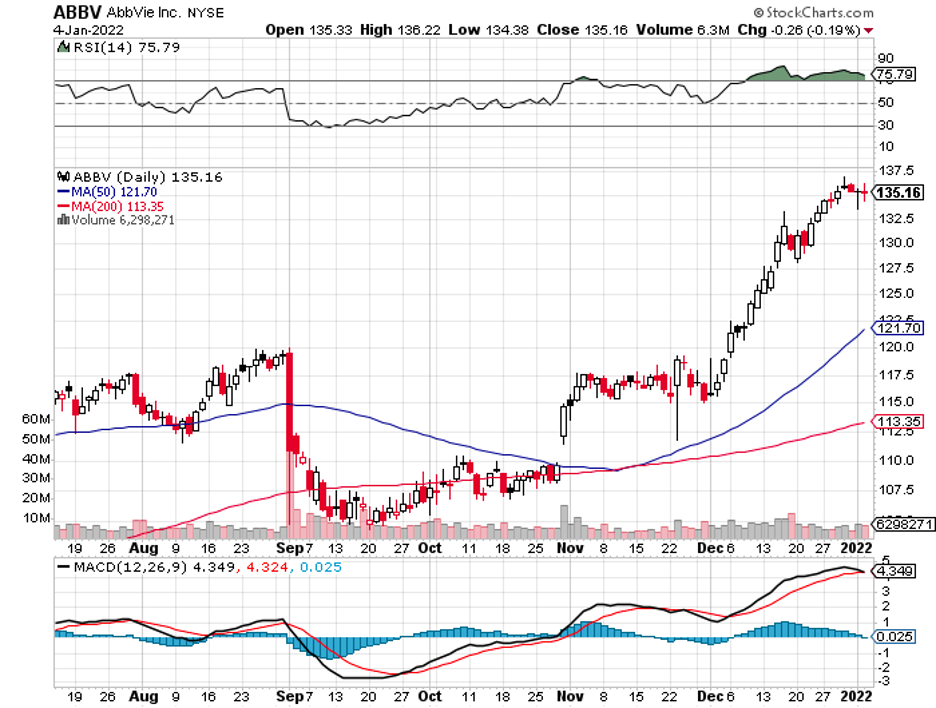
One of his most famous pieces of advice is to buy “wonderful companies at fair prices,” and I think this pearl of wisdom perfectly fits Buffett’s favored high-yield aristocrat: AbbVie (ABBV).
More interestingly, AbbVie is currently undervalued primarily due to overblown fears of patent loss for its top-selling drug Humira in 2023 and another in 2026 for Imbruvica.
Admittedly, the anxiety of investors is not entirely unfounded.
After all, AbbVie must replenish roughly $20 billion worth of annual revenue from Humira alone in the following years as the drug loses its patents and faces declining sales.
Obviously, losing revenue from a primary growth driver could be a massive problem for any company.
It could even lead to stagnating numbers in the next couple of years — a situation that the likes of Gilead Sciences (GILD), despite its $90.58 market capitalization, have become all too familiar.
Nevertheless, AbbVie isn’t simply twiddling its thumbs, waiting for the inevitable patent loss to happen.
The company has been busy preparing for the Humira and Imbruvica patent cliffs. In fact, it has been working to diversify its portfolio steadily.
One of the steps it undertook was to leverage its cash flow and $238.35 billion market capitalization to boost its R&D.
This led to AbbVie holding one of the industry’s most robust pipelines to date.
Some of the most promising products in its portfolio are Humira successors Skyrizi and Rinvoq.
Together, these two treatments are estimated to generate more than $15 billion in sales by 2025.
And AbbVie isn’t done yet.
Following its wildly successful formula in Humira, AbbVie is also looking into expanding the indications for the drug’s successors.
So far, Rinvoq has been able to deliver on this promise. Recently, this Humira successor has received FDA approval as a second-line treatment for psoriatic arthritis.
With this second indication, more and more investors are starting to believe that AbbVie has yet another blockbuster in the making.
Let’s look at the market for Rinvoq’s latest indication.
In the US alone, there are approximately 1 million to 2 million patients of psoriatic arthritis. For simplicity’s sake, let’s just say that there are 1.5 million patients in the US.
Generally, the first-line of treatment typically fails for 20% of psoriatic arthritis patients. That leads to roughly 300,000 patients who would be in need of second-line treatment.
For the sake of accuracy, it’s vital to point out that there are already a number of psoriatic arthritis treatments available in the US, such as Otezla and Enbrel from Amgen (AMGN). Moreover, JAK inhibitors are still facing potential restrictions from the FDA, thanks to the issue with Pfizer (PFE).
So, we can conservatively say that AbbVie’s Rinvoq might only be able to capture an estimated 7% of the psoriatic arthritis market share.
This translates to approximately 21,000. The annual list price for Rinvoq is at $63,000.
Taking into consideration the negotiation tactics of health insurers for price adjustments, the drug might go down to an annual list price of $44,000 instead.
Based on these conservative assumptions, Rinvoq would rake in sales of over $900 million—falling only slightly below the $1 billion blockbuster mark.
While this only hits less than 2% of AbbVie’s anticipated $56.2 billion annual revenue, this trajectory is a massive success for Rinvoq.
Bear in mind that this Humira successor has been on track to generate over $1.5 billion in sales in 2021.
Hence, adding $900 million from its psoriatic arthritis indication would offer a whopping more than 60% jump in its annual revenue.
Considering its history and trajectory, AbbVie is expected to continue to outshine its rivals in the industry.
Actually, the growth consensus for this stock is at 4% to 6.5%.
While that does not sound very impressive, it’s important to remember that the long-term growth rate for the whole industry is only 4%.
That easily puts AbbVie ahead of at least 63% of its peers in terms of growth.
Aside from the fact that this blue-chip stock is an excellent way to enjoy a solid 4.3% yield these days, the company is proving to be effective in ensuring that it delivers market-beating returns in the long run.
Needless to say, AbbVie qualifies as a classic “wonderful company at a fair price.”
Mad Hedge Biotech and Healthcare Letter
December 23, 2021
Fiat Lux
Featured Trade:
(A BIOTECH STOCK POISED FOR REDEMPTION)
(VRTX), (ABBV), (CRSP), (MRNA)