Mad Hedge Biotech and Healthcare Letter
February 11, 2025
Fiat Lux
Featured Trade:
(SPLICING THROUGH SKEPTICISM)
(CSRP), (VRTX), (AMZN), (TSLA)


Mad Hedge Biotech and Healthcare Letter
February 11, 2025
Fiat Lux
Featured Trade:
(SPLICING THROUGH SKEPTICISM)
(CSRP), (VRTX), (AMZN), (TSLA)
When I pioneered fracking technology in Texas years ago, skeptics said we were crazy. Today's skeptics are saying the same thing about CRISPR Therapeutics (CRSP), and they're just as wrong.
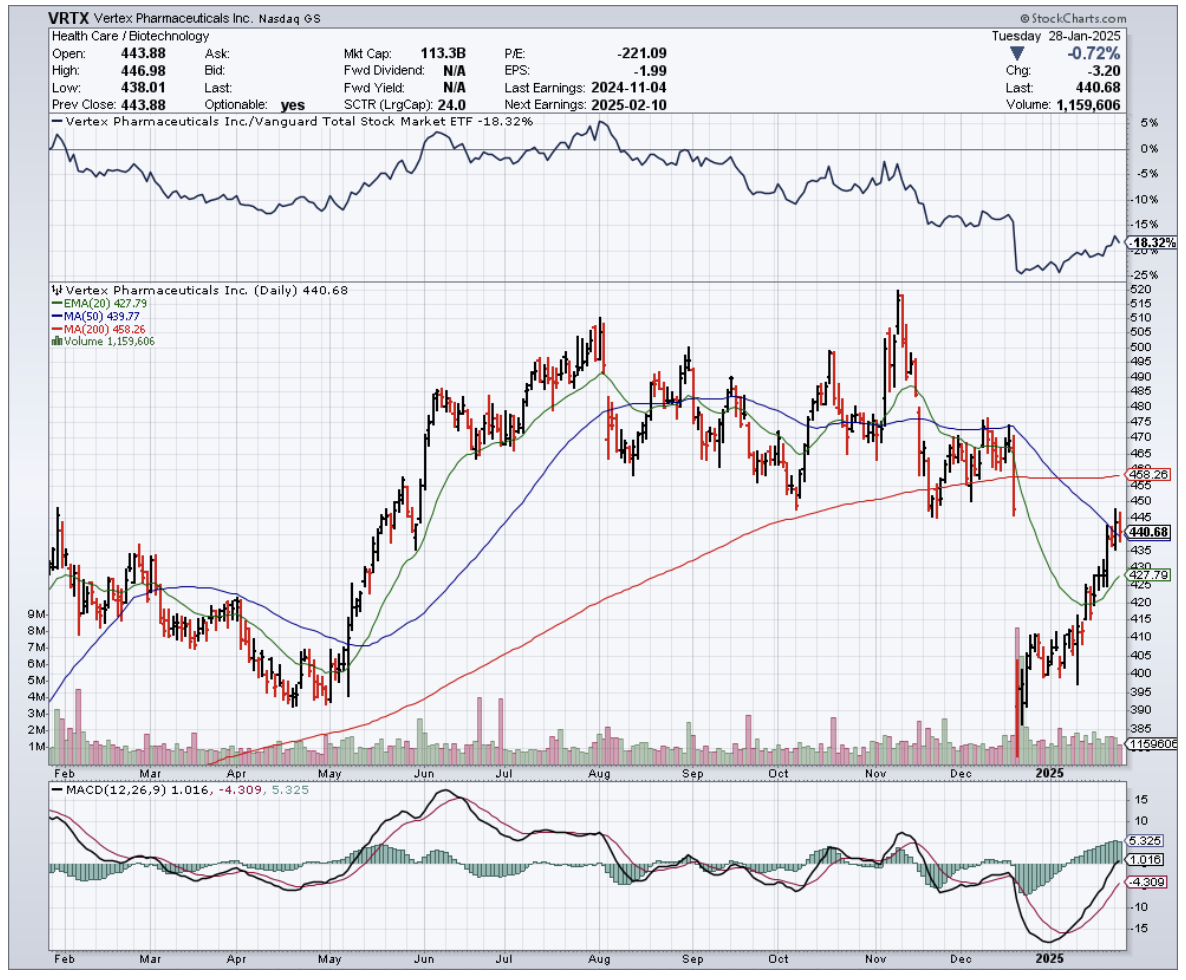
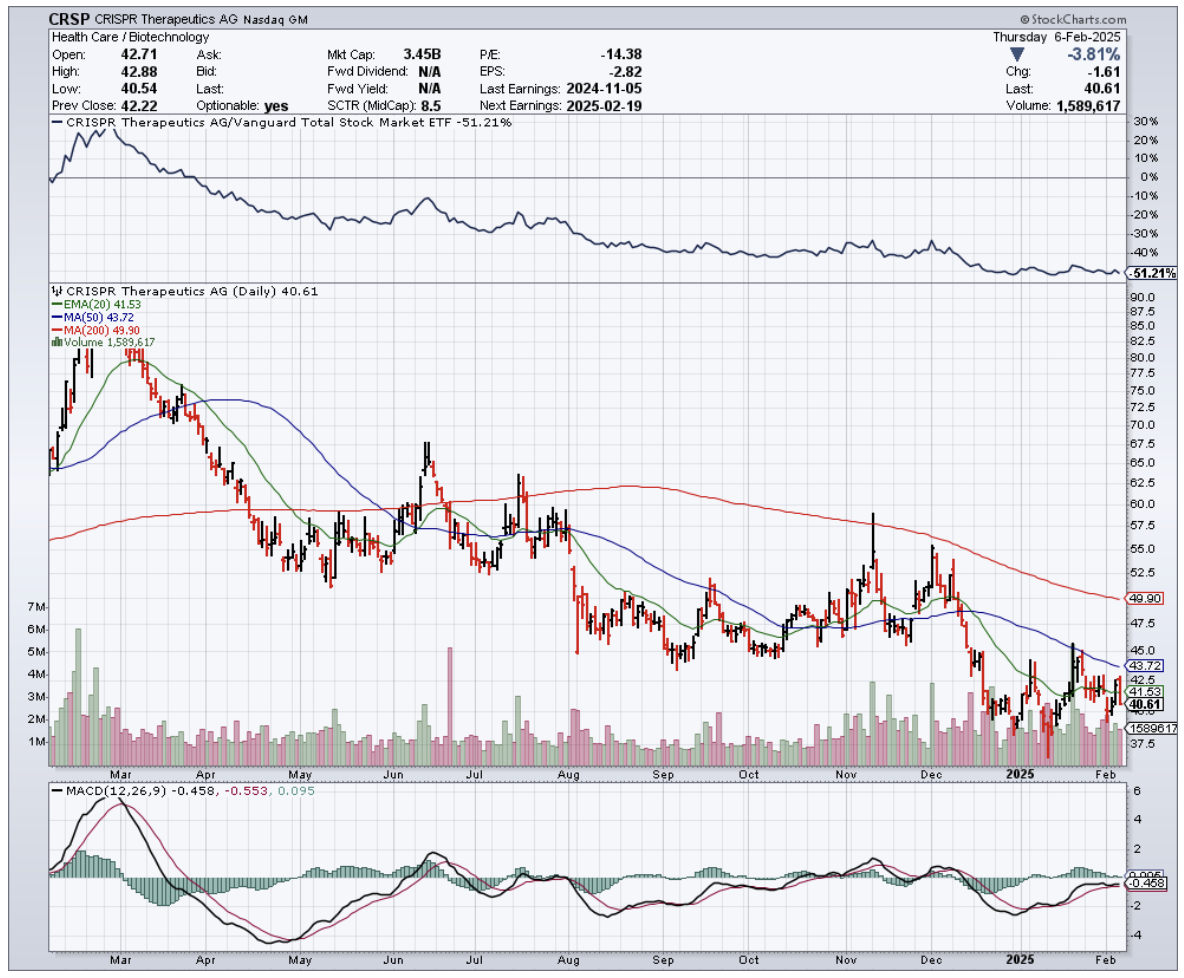
Here's a company sitting on a $1.9 billion cash fortress, burning through a mere $100 million per quarter – giving them enough runway to circle the Earth 19 times – and yet the stock has drifted down to $40, shedding 15% since my last analysis when it was perched at $48.
Talk about the market missing the forest for the trees.
Remember when everyone thought Amazon (AMZN) was just a bookstore? Well, CRISPR Therapeutics isn't just another biotech company – it's the Tesla (TSLA) of gene editing, with Vertex Pharmaceuticals (VRTX) riding shotgun.
And just like Tesla wasn't just about making electric cars, CRISPR isn't just about Casgevy, their FDA-approved treatment for Sickle Cell Disease (SCD) and Transfusion-Dependent Beta Thalassemia (TDT).
Speaking of Casgevy, let's tackle the elephant in the room. Yes, patient enrollment has been slower than a government committee deciding on lunch options. They've collected cells from over 50 patients by year-end, up from 20 in mid-October.
Not exactly setting speed records, but here's what the market is missing: the Centers for Medicare and Medicaid Services just inked a deal with Vertex/CRISPR that could be a game-changer.
Why? Because 50-60% of SCD patients are on Medicaid.
But wait, there's more happening behind the scenes. The company has been quietly building an empire across 5 clinical programs and 10 preclinical programs.
Let's break down what's cooking in their kitchen.
The Casgevy rollout has expanded from 35 treatment centers in October to over 50 by year-end.
Eight jurisdictions have given them the green light, including Saudi Arabia – a market where SCD is about as common as sand.
The UK just signed on for reimbursement, first for TDT in August 2024, and now for SCD.
Their CAR-T program isn't just targeting blood cancers anymore. They've expanded into autoimmune diseases like Systemic sclerosis (SSc) and Idiopathic inflammatory myopathy (IIM).
We're talking about potential treatments for 2.5 million SSc patients globally (125,000 in the US) and 1 million IIM patients (50,000 in the US).
That's not just a market – it's an ocean.
They're even taking shots at liver cancer and cardiovascular diseases. Their latest trial for Heterozygous familial hypercholesterolemia could be a lifeline for patients with this genetic cholesterol disorder.
And speaking of cash runways, their $1.9 billion war chest means they can keep this scientific symphony playing for 19 quarters without passing around the collection plate.
In biotech terms, that's like having enough food to last through three winters.
Institutions are noticing, too. Cathie Wood just backed up the truck, dropping $10 million more into CRISPR, making it her 9th largest holding at $350 million. Her ARK funds now own over 9% of the company.
When smart money moves like this, I pay attention.
Here's the kicker: While most analysts raise their ratings as speculative stocks climb (a strategy that makes as much sense as buying umbrella futures during a drought), I'm doing the opposite.
After all, the fundamentals are stronger than ever, but the price is lower.
Looking ahead to 2025, we've got more potential catalysts than a chemistry textbook. Phase 1/2 trial data for CTX 112 is coming in Q2/Q3, CTX 131 in Q3/Q4, and updates on their Type 1 Diabetes program in the second half of the year.
Remember, this is the same company that has Vertex Pharmaceuticals – the biotech equivalent of having Warren Buffett as your investment advisor – as a partner.
They're not just getting financial support; they're getting a masterclass in how to commercialize breakthrough treatments.
The verdict? Load up on shares while the market gives us this gift wrapped in fear and uncertainty.
Twenty years ago, they called us crazy for thinking we could extract oil from solid rock. Today, they're just as skeptical about editing genes.
History has a funny way of repeating itself.
Mad Hedge Technology Letter
February 10, 2025
Fiat Lux
Featured Trade:
(SILICON VALLEY GHOST CITY)
(AMZN), (GOOGL), (MSFT), (DEEPSEEK)
This AI infrastructure build-out is starting to smell more and more like the Chinese ghost city phenomenon.
Yeh, I said it.
It is starting to feel more like that type of “growth”, and that is not good for the future of tech stocks.
If the AI build-out becomes something trending closer to a Chinese ghost city, then we can expect a sharp pullback in tech stocks.
When that abrupt pullback will be is the hard question to answer, but each day we inch closer to that scenario.
There are 65 million empty homes in China that were built by developers and registered as “growth.” This type of parallel growth or paper growth can’t be ignored, and the concrete producers and wiring folks made large fortunes off that whole racket.
Sam Altman, head of OpenAI, is starting to seem more like one of these construction contractors selling 65 million appliances and calling it a success while the apartments are unused and investors get fleeced.
Wasteful spending by corporations swept into the dustbin of history. Looks more like it by the day.
When tech managers are asked about the specific numbers about what kind of revenue we can expect from the AI investment, they tell us to “spend now and ask questions later.”
That is a massive red flag, and I am calling out the whole movement now.
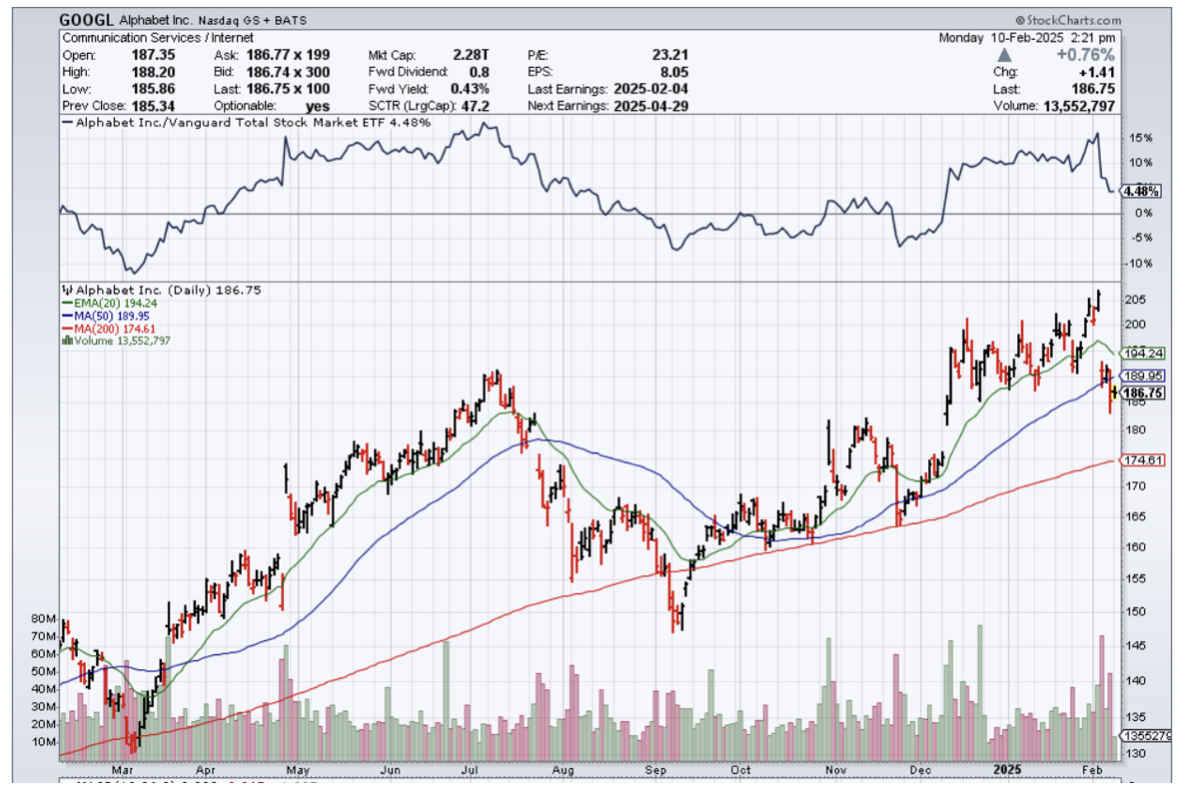
That being said, I bought the dip in mid-January on the Deepseek news, and I am riding that technical reversion to profits as it stands.
If there are no short-term pullbacks, we will end the month up over 15% YTD.
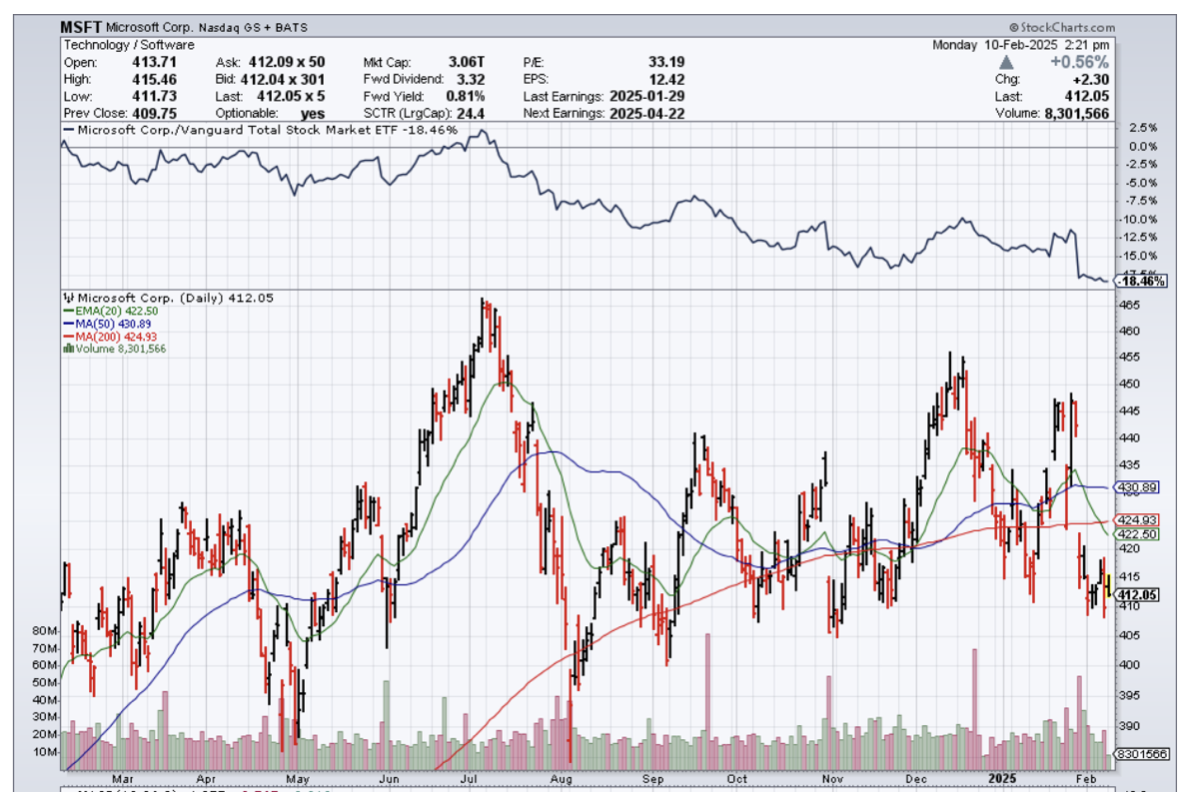
Meta (META), Microsoft (MSFT), Amazon (AMZN), and Google parent Alphabet (GOOGL) are expecting to spend a cumulative $325 billion in capital expenditures and investments in 2025, driven by a continued commitment to building out artificial intelligence infrastructure.
Taken together, this marks a 46% increase from the roughly $223 billion those companies reported spending in 2024.
The Chinese startup Deepseek rattled markets last week after it debuted open-source AI models competitive with OpenAI’s for a fraction of the price. Tech stocks sold off across the board as the model cast doubt on the rationale behind tech giants’ mammoth spending on artificial intelligence infrastructure.
But the DeepSeek surprise didn't seem to impact tech companies' big spending plans.
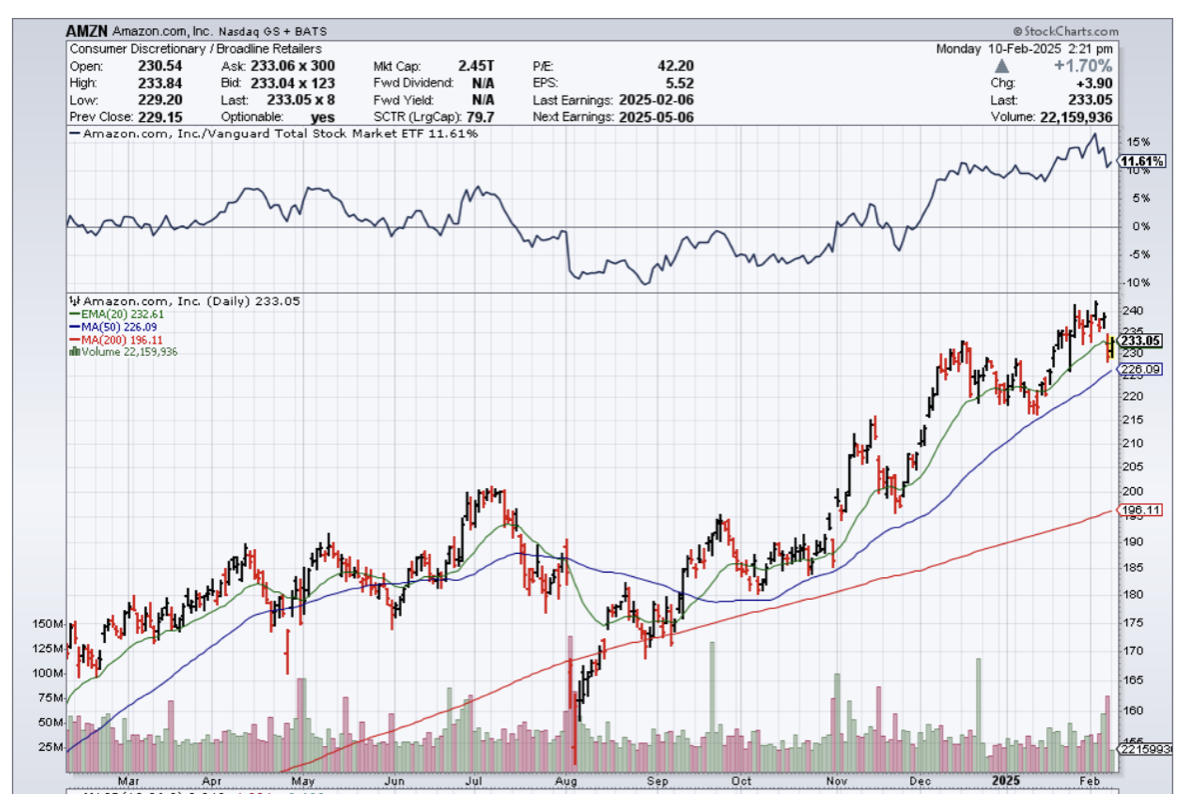
Amazon is by far the biggest spender on capital investments of the group, with its $78 billion for 2024 far eclipsing Microsoft's $56 billion and Alphabet's $53 billion.
Looking ahead, Amazon said in a post-earnings call Thursday evening that its spending of $26.3 billion in its most recent quarter is "reasonably representative" of its 2025 investment plans, suggesting investments will total roughly $105 billion this year.
Late last month, Meta confirmed that it would spend $60 billion-$65 billion in 2025, a massive bump from its prior guidance to investors of $38 billion-$40 billion in investment for the year.
Google said on Tuesday that it expects to spend $75 billion this year.
In the short-term, I expect earnings reports to be met with a selloff producing optimal buying opportunities.
These dips are bought by traders then take profits – rinse and repeat.
It’s not guaranteed that tech will go up in a straight line, so it’s better to use the volatility in your favor for some profits.
Mad Hedge Technology Letter
February 5, 2025
Fiat Lux
Featured Trade:
(AMAZON DOESN’T NEED WORKERS)
(AMZN), (AAPL)

Mad Hedge Technology Letter
January 31, 2025
Fiat Lux
Featured Trade:
(AMAZON CUTS OFF THE OUTSIDE)
(AMZN), (UPS)

Global Market Comments
January 31, 2025
Fiat Lux
Featured Trade:
(JANUARY 29 BIWEEKLY STRATEGY WEBINAR Q&A),
(META), (AMZN), (NVDA), (AMD) (GS), (SPY), (TSLA), (SBUX), (CCJ), (ADBE), (LMT), (GD), (RTX), (NVDA)


Below please find subscribers’ Q&A for the January 29 Mad Hedge Fund Trader Global Strategy Webinar, broadcast from Salt Lake City, UT.
Q: Are AI stocks going to crash?
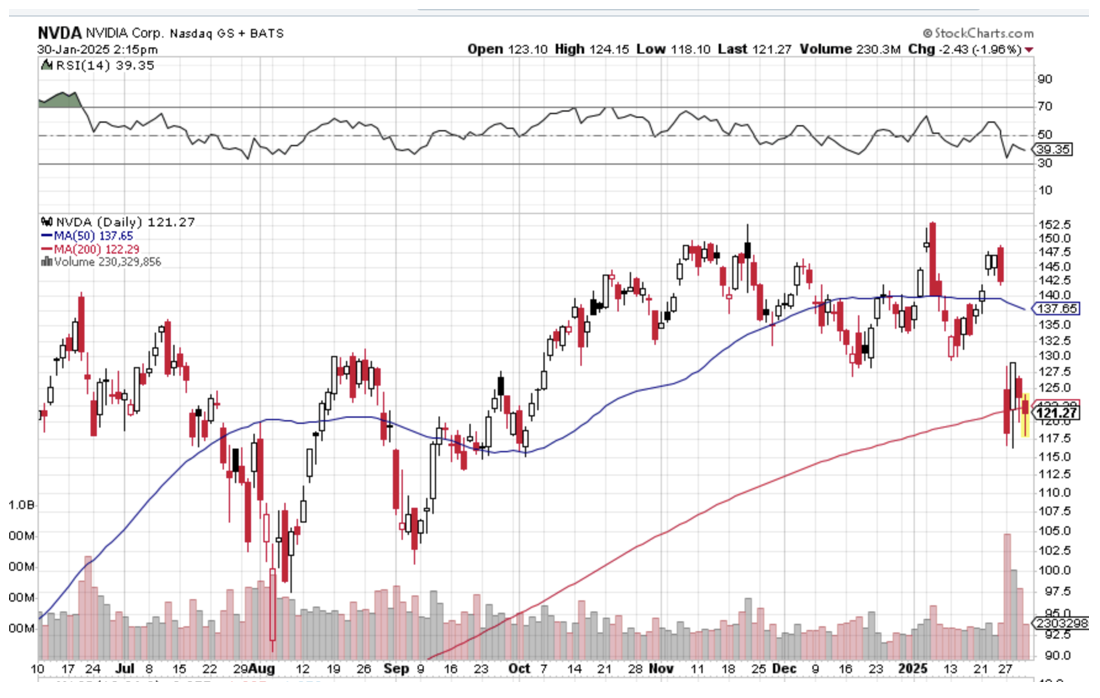
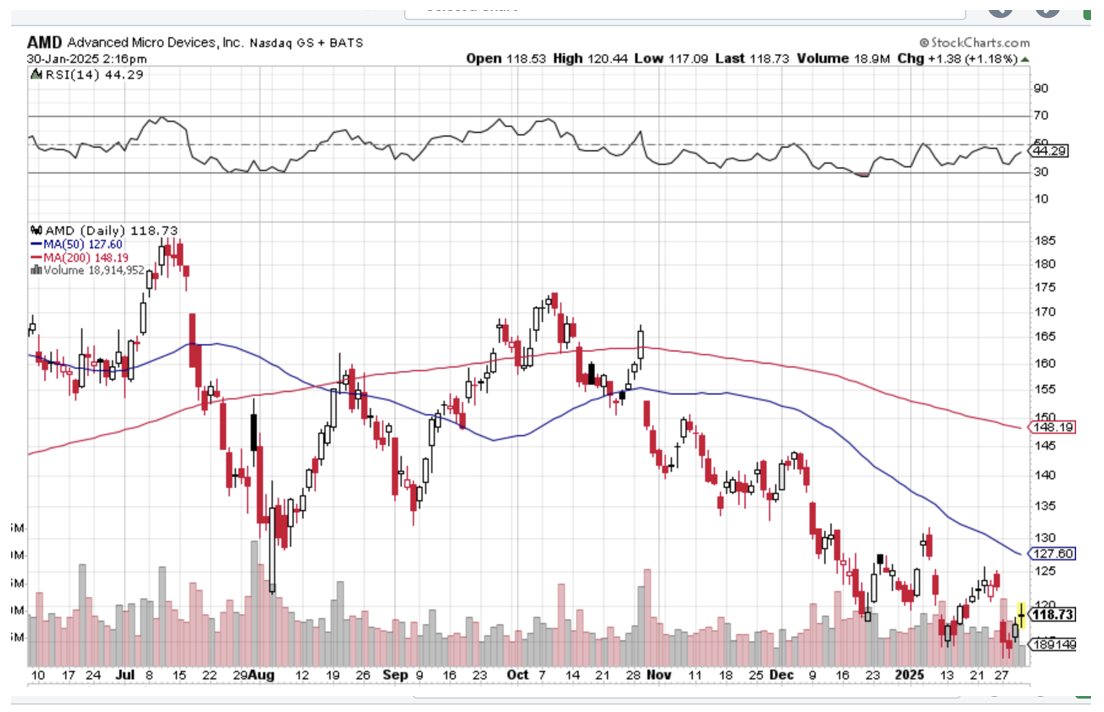
A: Some already have, and others haven’t. It’s really about single-stock-picking the chip area and the pure AI plays, which have been enormously overextended. If you boil it down to a single sentence, if you offer AI for free, AI users like (META) and (AMZN) do really well, while AI producers, like (NVDA) and (AMD) get crushed. I’ve been warning for months that these things were getting too high. The end result is that in two weeks the price earnings multiple for Nvidia has gone from 40 to 25. You know, at 25, it really is quite attractive. It'll be even more attractive at 20 or even 15 if we get that low. I'll show you where we hit that on the charts. Don't forget their earnings are still growing at tremendous rates—we'll talk about that in a second.
Q: What stocks are good to invest in now?
A: Watch the banks. Watch the financials. They’ve hardly sold off. I was begging for Goldman Sachs (GS) to tank. It didn't—we only got a $10 drop. It's just not letting people in, which means higher highs for all the banks and financials are coming. That has become the no-brainer one-way trade of 2025. You know, I had an enormous number of bank LEAPS expire in my personal account on the January 17 option expiration. I'm waiting to get back in now. So that is the play.
Q: What's happening with Starbucks (SBUX)? Are they investable?
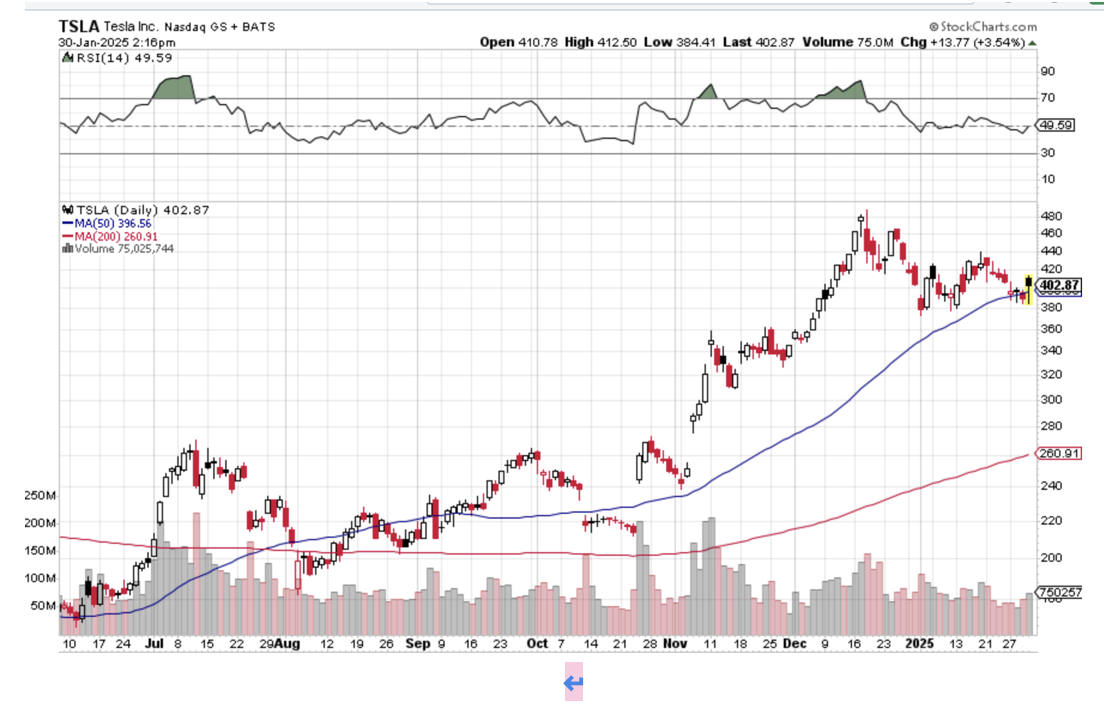
A: Starbucks was a disaster area until the summer when they brought in new management, which has a fantastic track record. The stock has since gone up 30%. You're kind of late to get in on this one. I don't really follow the stock anyway. Selling cups of coffee is not a high-margin business. I'd rather stick with the Tesla’s (TSLA) and Nvidia’s (NVDA) of the world where the value added is very high
Q: What will happen with Bitcoin in the new administration?
A: It's the same with everything. Higher highs first, lower lows later. If you're a Bitcoin investor now at 100,000, the big question is what happens when Donald Trump leaves office in four years? Does it go back to 5,000? We really don't know so, why touch Bitcoin when you can get 10 to 1 returns on all these other great companies which make stuff that you can actually touch and feel? Plus, you can leverage up with the LEAPS, and no one's going to steal your account, which happens frequently with Bitcoin holdings.
Q: Do you think tariffs are a good idea for the economy?
A: No, tariffs shrink global trade, they shrink globalization. It's a race to see if we can make other countries more poor than they can make us. It's an economy-shrinking strategy. It was a major contributor to causing the Great Depression in the 1930’s. That's why we abandoned tariffs 80 years ago with the end of World War II. I mean, the last cause of the 1930’s tariffs was World War II. That was a major contributing factor. So do I like tariffs? No. It turns out it's a great defensive strategy. If someone's making a fortune off you, they tend not to blow you up. So I think that's a big mistake and I will be an anti-tariff person to my grave. There are special situations like Chinese EVs, for example, where they're using a huge cost advantage to flood the emerging markets with cheap EVs. If that happened to the US, it would crash the US economy. In that one case, I'm in favor of tariffs. By the way, their EVs are using technology they basically stole from Tesla.
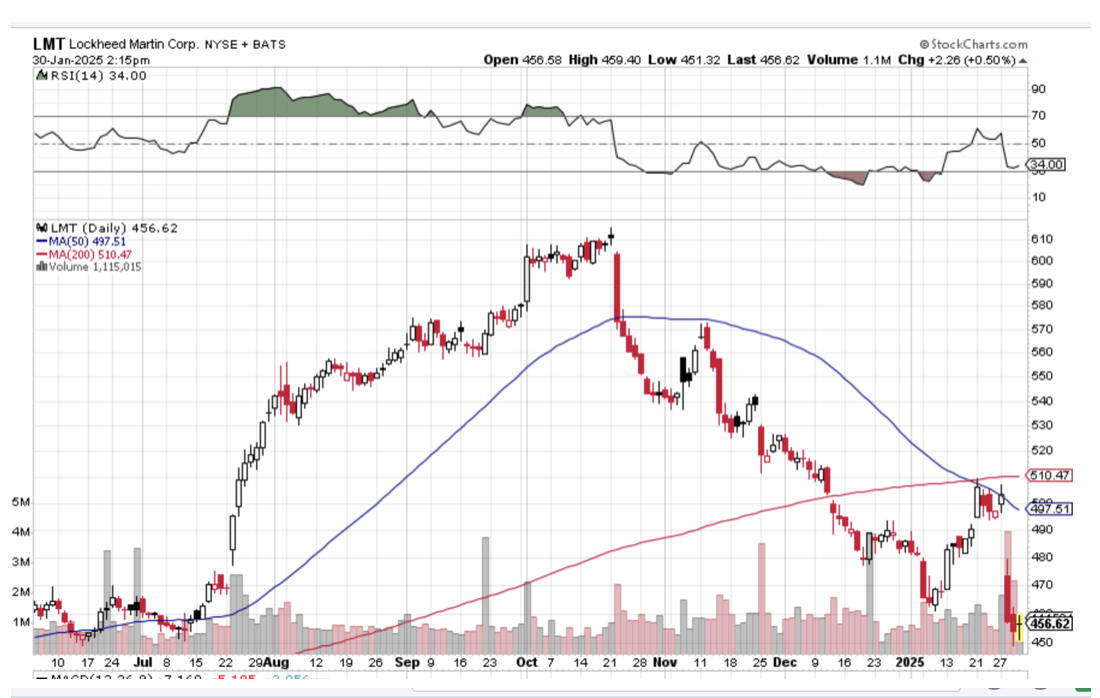
Q: What are your thoughts on defense stocks? With so many wars occurring all over the world.
A: Don't touch defense stocks with a 10-foot poll if the government is in favor of cost-cutting, the largest cost after Social Security is defense. We had a defense budget of about $824 billion in 2024. We have a 2.8 million man military and that cutting there and running down our weapons stocks would mean that you don't want to buy Lockheed Martin (LMT), General Dynamics (GD), Raytheon (RTX), all the big suppliers of weapons to the Ukraine war, for example, which looks like it's going to get cut off completely. They cut off all humanitarian aid to Ukraine last week. And of course, I was personally involved in delivering some of that humanitarian aid to Ukraine in the recent past. Yeah, defense looks bad if people really get serious about cost-cutting.
Q: Do you see the Fed dropping interest rates later this year?
A: That is possible. I tend to think we don't go into recession this year. It's a next year or year after type of thing. But markets can discount recession in six months to a year in advance like they did in 2007 and 2008. I don't think we get any more interest rate cuts. We'll just have to see what policies the new government implements, and how inflationary they are. And if they are inflationary, interest rates are going up, not down. That is why everybody's sitting on their hands right now and doesn't know what to do. Uncertainty at an eight-year high. You know, the government often talks one game but does the opposite. So, there’s nothing to do but wait and see.
Q: Well, what happened to the US housing market in 2025?
A: Nothing, you know volumes are shrinking. The last two years were the lowest volume sales in housing market history since the numbers were collected, and higher interest rates for longer. It's just more bad news. You know, something like 40% of all of the sales now are all cash. Prices are still going up again on paper, but there's almost no trade happening at these higher prices. And of course, the Millennials have been almost completely shut out of the market—the largest generation in history by the way—because they don't have enough money. They can't earn enough money; especially when AI is wiping out all the entry-level jobs, as it has been doing for two years in Silicon Valley.
Q: Here's a good question. How much time do we need to spend researching a company before we make an investment there?
A: Well, not that much, really. You can spend an hour or two reading the annual report, browsing through the most recent financial statement, and doing some news searches and you'll have a better read than most individual investors are going to have on a single stock. Then you start to see trends on what makes a good company, what makes a bad company, and over time, you get a feel for a company—when to get in, when to get out. That's one way. Or you can listen to the Mad Hedge Fund Trader, who's been doing this for 55 years and watching the same stocks. You wonder why you always have the same stocks up here and it's because I've been following these guys for forever or more. So you really get a handle on when they're doing well and when they're doing awful.
Q: Should we sell Nvidia (NVDA) stock for now?
A: No, I was telling people to cut positions the next time it ran to $150, which it did a few weeks ago. Now we're probably entering buy territory more than sell territory. Nvidia will come back. I just don't know where the bottom is for now, and it depends on your own investing style. If you're a five-year investor, you can forget about all this volatility, if you're a day trader, yeah, you probably should sell Nvidia now because you could buy it back $10 cheaper.
Q: Do you expect a new high after the Fed meeting?
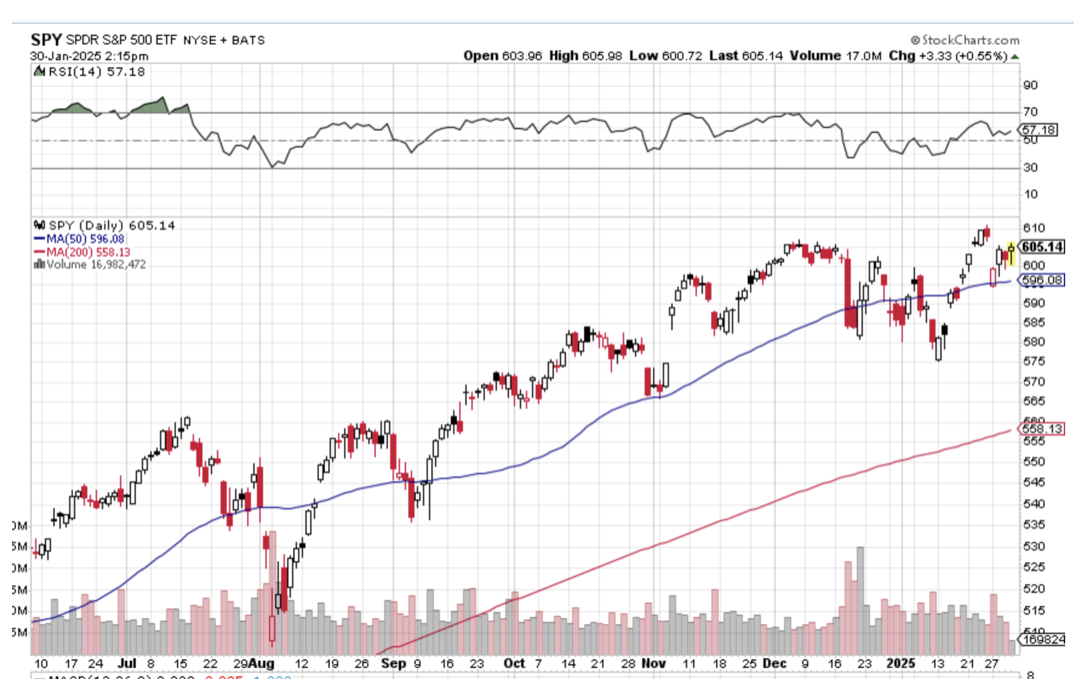
A: No, I don't. I think we're stuck in a range for the S&P 500 for the next six months. After that, we may get a move. Depending on what effect government policies have on the economy.
Q: What about an alert for Adobe (ADBE)?
A: I didn't put out the alert to buy Adobe. The Adobe alert is part of the Mad Hedge Technology Letter service, and if you want to get purely tech trade alerts, go to the Mad Hedge website, go to the store, and you can see the technology letter is offered for sale up there. Here is the link: https://hi290.infusionsoft.app/app/orderForms/techletter
Q: What is the right size of account for doing this kind of trading?
A: We literally have college students trading with $500 accounts. We have lots of individuals trading with $5,000 accounts—that way you can buy 10 $400 positions and still have some room. We only recommend you put 10% of your cash in any one trade. A lot of retired people will keep a large portion of their money in an index like the S&P 500 (SPY) and take 10% of their money and use it to do our trade alerts, which then adds an extra return to the index position. So, the answer is different for different people.
Q: Do I see a meaningful correction like 20% or 30% in the next six months?
A: No, I really don't, but that could be 2026 business. When we get a big correction, we get a recession. Again, it's dependent on government policies and we have no idea what those are right now. People can only guess. I'm not in the guessing business. I'm in the sure thing business.
Q: Can you explain how to complete the trade alerts you send out?
A: What all the professionals do is they put out a spread of orders. If I put out an order to buy something at $9.00, you put in a bid at $9.00, $9.10, $9.20, $9.30, and $9.40. By the close, some or all of those will get done. Often they all get done by the end of the day when the high-frequency traders have to dump their positions because they're not allowed to carry overnight positions. You make them good-until-canceled orders. So if you get a low opening the next morning, you'll get entirely filled at the $9.00 level, and this is what my clients in Australia do. They only do overnight good-until-cancelled orders since the market's open from 11:30 PM until 6:00 AM in the morning, Australia time. They tend to make more money than any of my other clients because they only enter overnight GTC orders. So, people trying to outsmart the market on an intraday basis generally don't do very well.
Q: Should I sell the Cameco Corporation (CCJ) stock I bought on the nuclear trade?
A: No, I think (CCJ) recovers. I was looking at it yesterday. Elimination of the electricity trade is complete nonsense. I think the nuclear thing is real. It'll come back. And in fact, I bought Vistra Energy (VST) yesterday, so use this extreme sell-off to get into the nuclear trade if you missed it the first time around.
To watch a replay of this webinar with all the charts, bells, whistles, and classic rock music, just log in to www.madhedgefundtrader.com, go to MY ACCOUNT, click on GLOBAL TRADING DISPATCH, TECHNOLOGY LETTER, or JACQUIE'S POST, then WEBINARS, and all the webinars from the last 12 years are there in all their glory.
Good Luck and Good Trading,
John Thomas
CEO & Publisher
The Diary of a Mad Hedge Fund Trader
Mad Hedge Biotech and Healthcare Letter
January 30, 2025
Fiat Lux
Featured Trade:
(A CRITICAL PAIN POINT)
(VRTX), (AMZN)
Last week, while having dinner with an old friend who's an emergency room physician in San Francisco, I heard a story that stopped me cold. She had just lost another patient to an opioid overdose - the fourth one that month.
"We desperately need alternatives," she said, pushing away her plate. "Something that works without killing people."
She's not wrong. More than 80,000 Americans died from opioid overdoses in 2022 alone - that's about 75% of all drug overdose deaths in the country.
To put that in perspective, that's more than double the number of people who die in car accidents each year. In New York alone, opioid-related deaths have quadrupled between 2010 and 2020.
You can see where this is going. There's a massive market opportunity here for any company that can crack the code of non-addictive pain management.
We're talking about a potential market worth tens of billions of dollars. The holy grail? A drug that works as well as opioids without the devastating addiction potential.
Enter Vertex Pharmaceuticals (VRTX) and their sodium channel inhibitor VX-548, now known as suzetrigine. The company has been quietly plugging away at this problem, and I've been watching them like a hawk.
For those who've been following my previous coverage, you'll remember I wrote about their interesting (though modest) results in post-surgical patients a few months ago.
And here's where it gets fascinating. Vertex has been running multiple trials because - as any doctor will tell you - pain isn't just pain.
It comes in more flavors than Ben & Jerry's ice cream: acute, chronic, neuropathic, cancer-related, post-surgical, and don't even get me started on phantom limb pain.
Just before the holiday break, they dropped their latest results for suzetrigine in sciatica patients.
Now, I have to tell you something that might sting a bit. The drug worked - but so did the placebo. Both groups saw their pain decrease by statistically similar amounts.
Vertex argues the placebo response was unusually high and that a larger Phase III trial should smooth things out.
Maybe they're right - but I've seen enough clinical trials to know that placebo effects in pain studies can be trickier than a Wall Street hedge fund manager.
The FDA is expected to make a decision by the end of this month on suzetrigine for moderate-to-severe acute pain.
Despite the recent speed bump in the sciatica trial, I'm still keeping my eye on the bigger picture here. Vertex isn't a one-trick pony.
Their cystic fibrosis (CF) portfolio is absolutely crushing it. They just got FDA approval for Alyftrek ahead of schedule.
They've expanded Trikafta's approval down to patients as young as two years old, which is huge for their market potential. Plus, they’ve been aggressively pushing into international markets over the past months.
Now, let's talk numbers. Suzetrigine revenue is projected to hit $5 billion by 2035. That's not chump change, even if we hit some bumps along the way.
Trading at a P/S multiple of almost 10, Vertex isn't cheap - but then again, neither was Amazon (AMZN) in 1997.
Still, this biotech’s pipeline goes beyond pain management. We're looking at treatments for diabetic peripheral neuropathy, IgA nephropathy, type 1 diabetes, and even gene editing therapy.
So, here's the bottom line: Yes, the market got spooked by the Phase II data. Yes, there are risks. But remember - the FDA is under enormous pressure to approve non-opioid painkillers.
With 80,000 Americans dying yearly from opioid overdoses, they need solutions more than my trader friends need their morning coffee.
I'll keep watching this one closely. The pain management market is like a sleeping giant, and despite the recent hiccup, Vertex might just have the alarm clock.
or long-term investors, this could be one of those "I wish I bought it back then" moments.
Watch this space. The opioid crisis isn't going anywhere, but neither is Vertex's determination to solve it.
Sometimes the biggest opportunities come disguised as disappointments.