Global Market Comments
October 3, 2018
Fiat Lux
Featured Trade:
(TAKING A LOOK AT GENERAL ELECTRIC LEAPS), (GE),
(TEN SURPRISES THAT WOULD DESTROY THIS MARKET),
(USO), (AMZN), (MCD), (WMT), (TGT)


Global Market Comments
October 3, 2018
Fiat Lux
Featured Trade:
(TAKING A LOOK AT GENERAL ELECTRIC LEAPS), (GE),
(TEN SURPRISES THAT WOULD DESTROY THIS MARKET),
(USO), (AMZN), (MCD), (WMT), (TGT)
Mad Hedge Technology Letter
October 3, 2018
Fiat Lux
Featured Trade:
(OUR HOME RUN ON SQUARE),
(SQ), (V), (AMZN), (GRUB), (SPOT), (MSFT), (CRM), (AAPL)
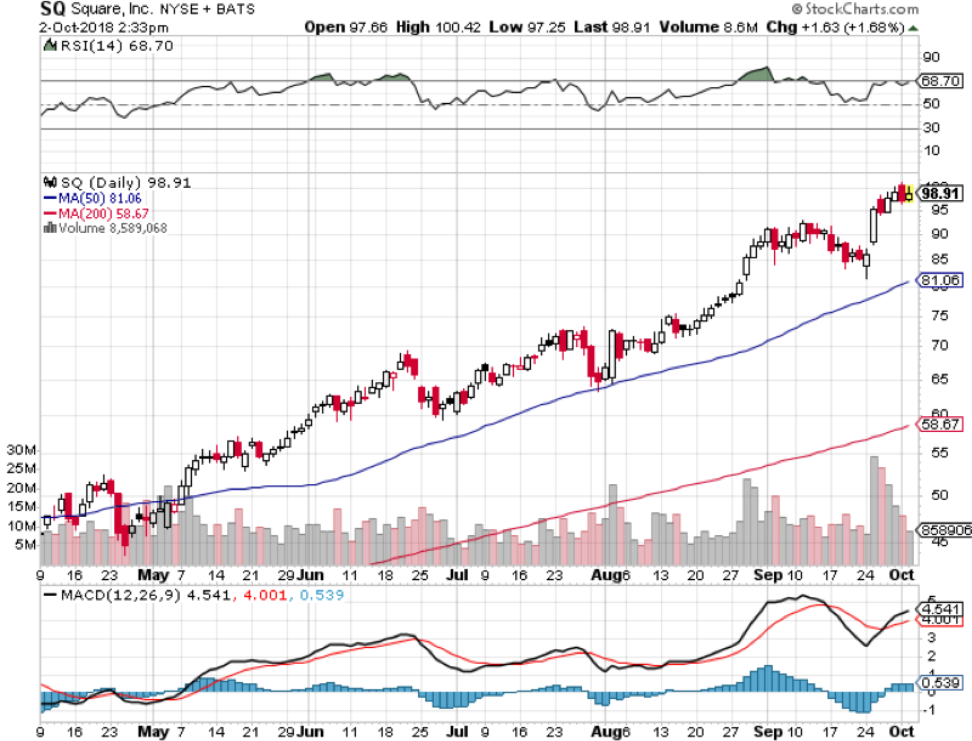
Pat yourself on the back if you pulled the trigger on Square (SQ) when I told you so because the stock has just lurched over an intra-day level of $100.
It was me aggressively pushing readers into buying this gem of a fin-tech company at $49. To read that story, please click here (you must be logged in to www.madhedgefundtrader.com).
Since then, the price action has defied gravity levitating higher each passing day immune to any ill-effects.
The Teflon-like momentum boils down to the company being at the cross-section of an American fin-tech renaissance and spewing out supremely innovative products.
At first, Square nurtured the business by targeting the low hanging fruit– small and medium size enterprises in dire need of a strong injection of fin-tech infrastructure.
It largely stayed away from the big corporations that adorn billboards across the Manhattan skyline.
That was then, and this is now.
Square is going after the Goliath’s fueling a violent rise in gross payment volume (GPV).
Modifying themselves for larger institutions is the next leg up for Square.
They recently inaugurated Square for Restaurants for larger full-service restaurants.
Business owners do not need technical backgrounds to operate the software and integrating Caviar into this program emphasizes the feed through all of Square’s software.
Dorsey has built an ecosystem that has morphed into a one-stop shop for comprehensively running a business.
Migrating into business with the premium corporations offers an opportunity to augment higher margin business.
This is the lucrative path ahead for Square and why investors are festively lining up at the door to get a piece of the action.
The downside with an uber-growth company like Square are lean profits, but they have managed to eke out three straight quarters of marginal spoils.
However, the absence of profits can be stomached considering the total addressable market is up to $350 billion.
Grabbing a chunk of that would mean profits galore for this too hot to handle company.
Expenses are always a head spinner for Silicon Valley firms and attracting a dazzling array of engineers to spin out breathtaking profits can’t be done on the cheap.
The Cash app download figures are sizzling and is one of the most popular apps in the app store.
Square’s marketing strategy is also turning a corner getting out their name leading to sale conversions.
These are just several irons in the fire.
The last two years has seen this stock double each year, could we be in for another double next year?
If measured by growth, then I see why not.
Growth is the ultimate acid test deciding whether this stock will be dragged down into the quick sand or let loose to run riot.
Other second-tier tech firms in the middle of a sweet growth spot pack a potent punch like Spotify (SPOT) and Grubhub (GRUB) which are growing annual sales around 50-60%.
Material profits are also irrelevant for the aforementioned tech juggernauts.
Square is expanding at the same fervent pace too, and the hyper-growth only makes payment processors like Visa (V) quasi-jealous of such staggering numbers.
And when Square trots out numbers to the public like that with (GPV) shooting out the roof, the stock does nothing but go gangbusters.
Either way, Square has popularized making credit card payments through smartphones and that in itself was a tough nut to crack amongst tough nuts.
Square also has a line-up of impressive point-of-sales products such as Caviar.
In fact, merchant sellers are adopting an average of 3.4 Square software apps with invoices, loans, marketing, and payroll software being the most beloved.
Square also offers other software that can handle back office tasks and manage inventory.
The software and services business is on pace to register over $1 billion in sales in 2019.
The breadth of functions that can boost a company’s execution highlights the quality of software Dorsey has produced.
I always revert back to one key ingredient that all tech companies must wildly indulge in to fire up the stock price – innovation.
Innovation in bucket loads is something all the brilliant tech firms crave such as Microsoft (MSFT), Amazon, and Salesforce (CRM).
Overperformance starts from the top and trickles down to the people they hand pick to manage and run the businesses.
Jack Dorsey is right up there with the best of them and his influence cannot be denied or ignored.
His stewardship over his other company Twitter (TWTR) is sometimes worrisome because of a pure scheduling conflict, but it’s obvious which company is having a better year.
Square steers clear of the privacy and regulatory minefields handcuffing Twitter.
And it could be safely assumed that Dorsey enjoys his afternoons more at Square than his mornings across the street at Twitter where he is bombarded by heinous problems up the wazoo.
When you conjure up an up-and-coming company that could rattle the establishment, Square is one of the first companies that comes to mind.
Some analysts even argue this company deserves to be lifted into the vaunted Fang group.
I would say they are on their merry way but they just aren’t big enough to command a spot on the Fang roster.
I have immense conviction this stock will be a deep influencer of our time, and its diversified software offerings add limitless dimensions underpinning massive revenue streams.
In Q2, the subscription revenue grew 127% YOY underscoring the success the software team is having, crafting productive apps applicable to business owners.
Business owners can even take out a loan through Square Capital which issues micro-loans to small business owners.
In need of financing? Ring up Dorsey’s company for a few quid.
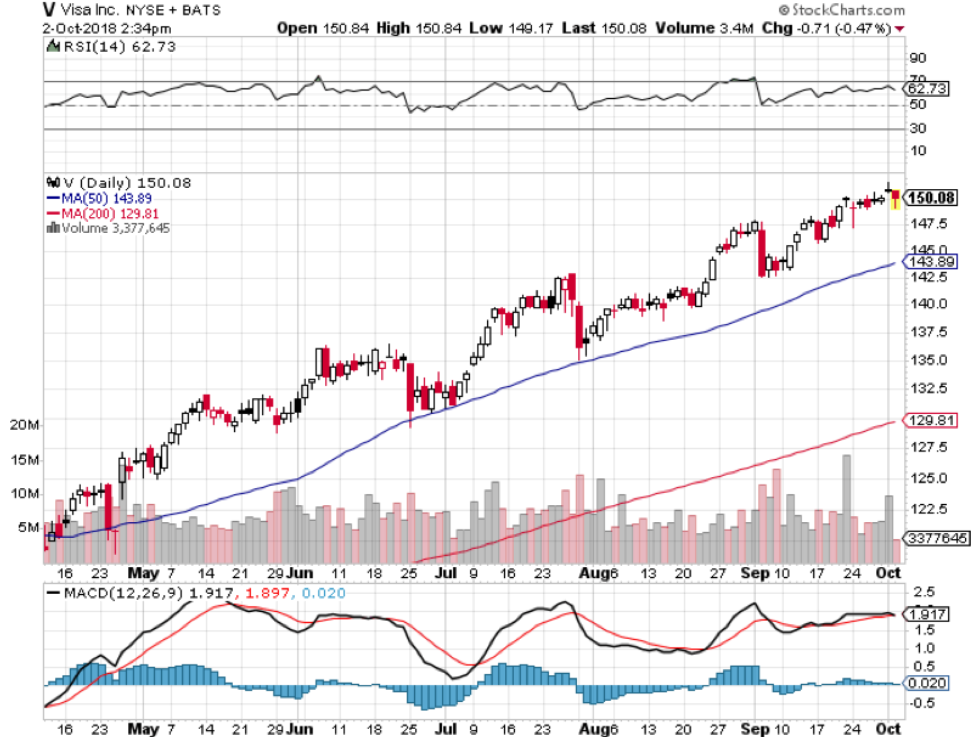
Starkly contrasting Square in the payment processors space is Visa (V).
Visa is not a hyper-growth company going ballistic, but a stoic behemoth unperturbed.
The 3.283 billion visa cards that adorn its insignia represents scintillating brand awareness and efficiency.
When Tim Cook was asked if Apple (AAPL) plans to disrupt Visa, he smirked and said, “People love their credit cards.”
This is a prototypical steady as she goes-type of company.
They do not offer micro-loans to small businesses or dabble with any of the murky sort of products that can be found on the edge of the risk curve.
They are a safe and steady pure payment processor.
Its network can digest 65,000 transactions per second and is universally cherished as a brand around the world.
All of this led to an operating margin of 66% in 2017.
Square has identified other parts of the payment process to snatch and do not directly compete with Visa.
They partner with Visa and pay them a processing fee.
Subsequently, Square is paid a merchant fee after the payment is approved.
Visa has a monopoly and a moat around their business as wide as can be.
Square is a different type of beast – growing uncontrollably and hell-bent on spawning a revolutionary fin-tech paradigm shift.
The question is can Square eventually turn payment heavyweights like Visa on its head?
The path is fraught with booby traps and as Square generates the projected sales and bolsters its revenue, it could start to encroach on these legacy processors too.
Yet, it’s too early to delve into that threat yet.
Enjoy the ride with Square and better to lay off this potent stock until a better entry point presents itself.
This stock will go higher. Giddy-up!
Amazon’s reign doesn’t touch everything – there are still nooks and crannies of the business world it still doesn’t dominate.
Hard to believe, right?
As Amazon (AMZN) branches off into every known and unknown crevice of the economy to excavate fresh growth drivers, it’s hard to fathom where they won’t be in the future.
Supermarkets are one of the most innovative parts of technology right now, and even with Amazon’s grocery prize of Whole Foods, they are yet to rule over a broad-based grocer empire.
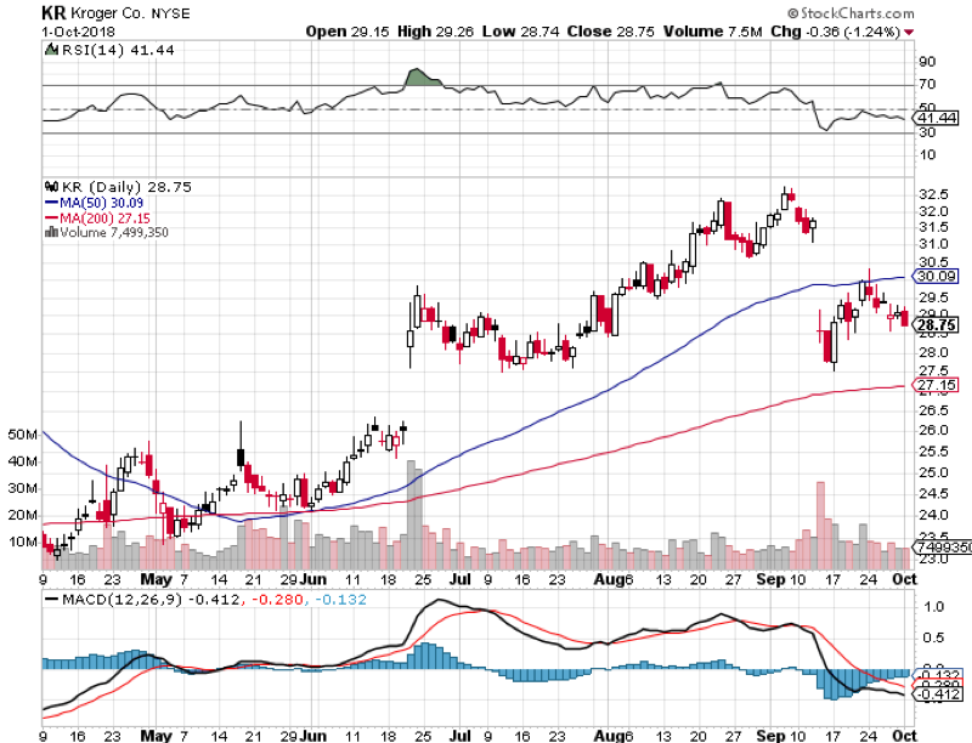
It might behoove you to discover that Kroger (KR) is on the brink of constructing a high-tech, cutting edge supermarket business that could juice up their crusade against Amazon.
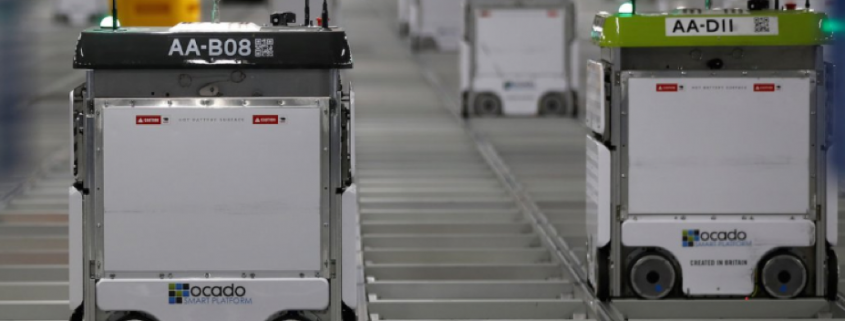
In May, Kroger decided on partnering up with British-based online grocer Ocado (LON: OCDO) to build out a full-fledged, automated warehouse acting as the launching pad to their high-tech supermarket aspirations.
Kroger just announced they will identify 3 of the 20 new warehouse sites by the end of 2018 and the search is “making good progress.” These three warehouses should be functional within a year.
This is the best investment Kroger has ever made in the history of the company.
The deal also gave Kroger a 5% stake in Ocado which has no brick and mortar stores.
Even more brilliant, the deal bans Ocado from selling the technology to other American competitors.
Ocado has been voted the best online U.K. grocer by Consumers' Association magazine Which? every year since 2010.
The company went public on the London Stock Exchange in 2010 and its share price has had a banner year.
Shares were trading at £245 just 11 months ago.
The stock has been a battleground company with massive short interest because a contingent of investors believe this is just a simple grocer company.
Some investors value Ocado as a high-tech company and it is obvious which group has won out as this online grocer saw shares catapult to a tad below £1200 only to slightly retrace and consolidate.
Ocado shares are still hovering around £900 giving credence to this high-tech grocer amidst a country that is bereft of technology companies.
Softbank’s buy of Arm Holdings was the crown jewel of British tech companies to be pocketed and taken off the public markets.
Imagination Technologies was also a blockbuster name that went private after Apple infamously announced it would stop incorporating Imagination Technologies’ system-on-a-chip accounting for over half of total revenue.
Shares cratered by 70% and the company was picked up on the cheap like hawks swooping on prey by private equity fund Canyon Bridge, who is backed by the Chinese communist government.
Ocado is the torch bearer for Britain now and the smorgasbord of deals signed with France, Sweden, Canada and America indicate their intent to be a major tech player.
The breathtaking short-squeeze has put bears on alert shying away from their oversized sell button as they have been epically burnt on this trade.
This love them or hate them online grocer plans to license out its industry leading proprietary technology to revolutionize legacy supermarkets such as Kroger.
The stellar performance by Amazon has fueled its competition’s ambition to up its game in any way possible, boding well for the consumer who will benefit from better services and lower prices.
Ocado’s 20 automated warehouses dotted around America will take three years to complete.
Simply put, Ocado is best in show at building these supermarket automated warehouses and could receive a windfall of revenue around the world as grocers from all corners of the world revolutionize logistical processes.
Of the 260,000 orders they receive per week in Britain, error rates have plummeted to a subterranean level of less than 1%.
The whole process is closely monitored by algorithms, scanning, identifying and optimizing each step of the process.
Ocado’s algorithms are quite masterful – they have been programmed to even sort a bag of groceries so the eggs aren’t squashed at the bottom of the order by a sack of potatoes.
The insides are placed for perfection like the interior of Château de Malmaison straddling the suburbs of Paris, France.
These ideally placed items can travel up to 20 miles in Ocado’s boxes.
This might be fine for a land-challenged country like Britain, but distances are grotesquely larger in America, and making sure perishables arrive fit as a fiddle offers complexities to Ocado’s engineering team.
To root out any bugs, Ocado’s phalanx of engineers create digital clones of a functional warehouse mimicking the location-specific conditions and operations to eradicate any faulty processes that crop up.
This has allowed Ocado to refine different models adding to the team’s scope of versatility.
Each set of geographies will present unique challenges and adapting to local needs of each grocer will be a key to harness profitability.
Ultimately, Ocado is not new to this – they have been cultivating this type of technology for 15 years.
Drench Ocado’s model with more technology and it has become faster, more efficient, and systematically accurate.
Humans have been shipped out in favor of a bagging robot that separates out the orders needing to be placed in certain crates.
Humans are redeployed up the value chain of work and retrained as management delegates the lower grade tasks to be taken over by machines.
Ocado’s delivery vehicles are tricked out with telemetry systems, an automated communications process by which measurements and other data are collected remotely in order to ameliorate the delivery time schedules.
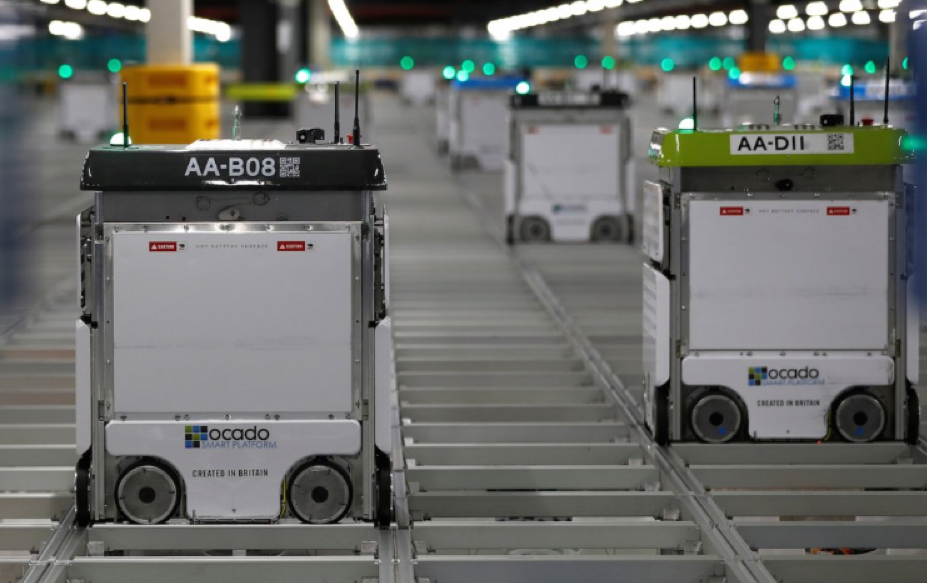
Betting the ranch on enhancing the technology, Ocado has rolled out a freshly designed robot that can stack and sort boxes in stacks of up to 21 boxes high.
And here is the kicker – the artificially intelligence-based technology has outsized cross-over effect applicable to a myriad of industries that require warehouses as a main input in an operation which could spawn massive layers of potential profits.
The deep commitment to innovation is costly and investors will always be anxious about the margin story, but that should not be reason to jump ship.
There is no seat at the table if a company is not armed and wielding the best technology current engineering can create.
Top-class engineers aren’t cheap, and like their brethren in Silicon Valley, engineers continue to be tech firm’s largest cost but their best asset.
Machine learning is also deployed across the customer service support platforms to ensure any complaints do not repeat.
Eventually, Ocado hopes to automate everything and once self-driving technologies become customary, they will do away with the human driver too.
They have already carried out tests showing their capabilities of functioning with this technology and did a stint of 2 weeks with little problem.
This May was the first time Ocado netted a nations big fish supermarket business with 1,300-store strong ICA Sweden.
ICA has carved out Swedish market share approaching a third.
Ocado is capitalizing on the new sense of urgency from legacy supermarkets to pivot towards technology to bolster profits.
Online supermarkets were once discarded but now seek to seize 15% of the grocery market share on the way to 20%.
Assuming that 10% is the peak is wrong especially with Ocado’s supermarket warehouse technology.
Most recently, Instacart partnered with German discount supermarket Aldi to offer delivery service.
Ocado has absolutely started to spread its wings by licensing its robot-laden supermarket warehouse technology and this is just the beginning.
More deals will be in the pipeline and consumers will much rather shop for groceries online now.
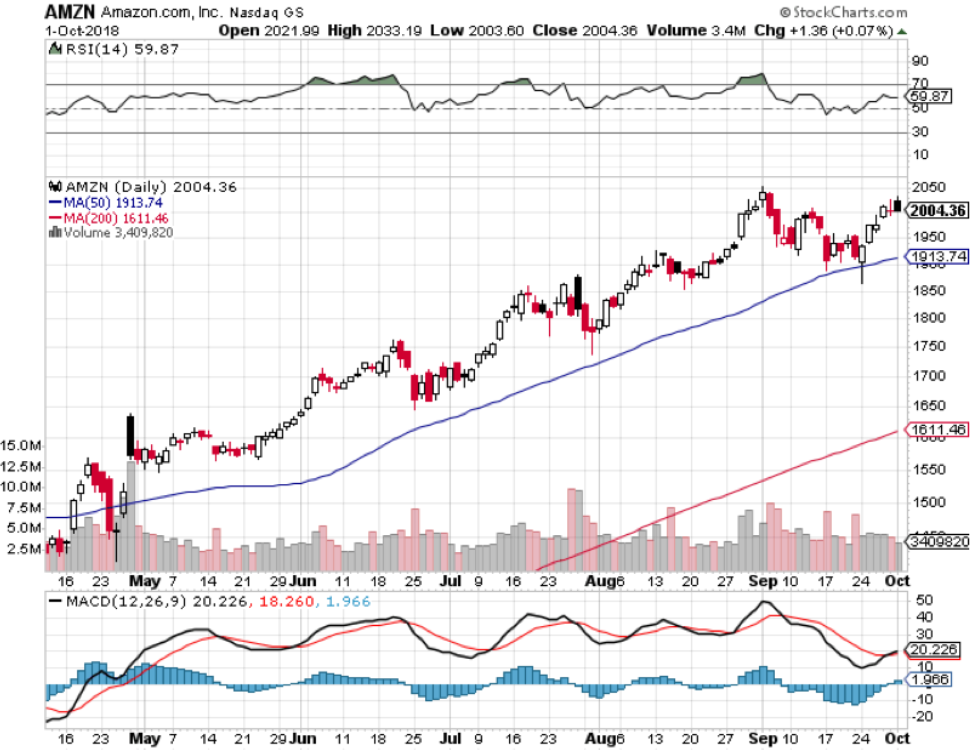
To admire the scope of Ocado’s pioneering expertise, this is their revolutionary warehouse system controlled by air traffic control technology with R2-D2-like robots careening around on a grid set-up fulfilling orders – click here to watch the video.
Mad Hedge Technology Letter
October 2, 2018
Fiat Lux
Featured Trade:
(TAKE A LOOK AT ENGLAND’S AMAZON),
(LON: OCDO), (KR), (AMZN)
(WE'RE MAKING SOME CHANGES HERE AT THE MAD HEDGE FUND TRADER)

Global Market Comments
October 1, 2018
Fiat Lux
Featured Trade:
(THE MARKET OUTLOOK FOR THE WEEK AHEAD,
or DON’T NOMINATE ME!),
(AMZN), (NVDA), (AAPL), (MSFT), (GLD), (ABX), (GOLD),
(JOIN US AT THE MAD HEDGE LAKE TAHOE, NEVADA,
CONFERENCE, OCTOBER 26-27, 2018)

I have a request for all of you readers. Please do not nominate me for justice of the Supreme Court.
I have no doubt that I could handle the legal load. A $17 copy of Litigation for Dummies from Amazon would take care of that.
I just don’t think I could get through the approval process. There isn’t a room on Capitol Hill big enough to house all the people who have issues with my high school background.
In 1968, I ran away from home, hitchhiked across the Sahara Desert, was captured by the Russian Army when they invaded Czechoslovakia, and had my front teeth knocked out by a flying cobblestone during a riot in Paris. I pray what went on in Sweden never sees the light of day.
So, I’m afraid you’ll have to look elsewhere to fill a seat in the highest court in the land. Good luck with that.
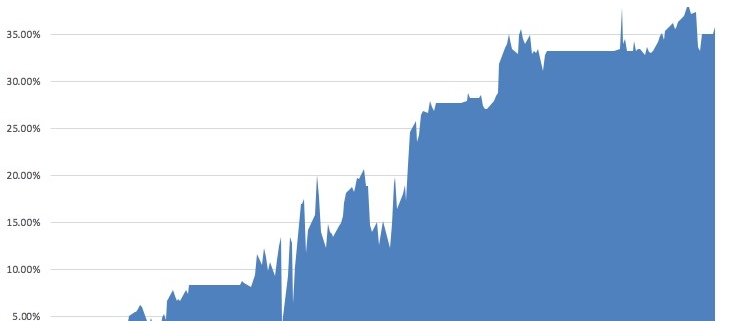
The most conspicuous market action of the week took place when several broker upgrades of major technology stocks. Amazon (AMZN) was targeted for $2,525, NVIDIA (NVDA) was valued at $400, and JP Morgan, always late to the game (it’s the second mouse that gets the cheese), predicted Apple (AAPL) would hit a lofty $270.
That would make Steve Jobs’ creation worth an eye-popping $1.3 trillion.
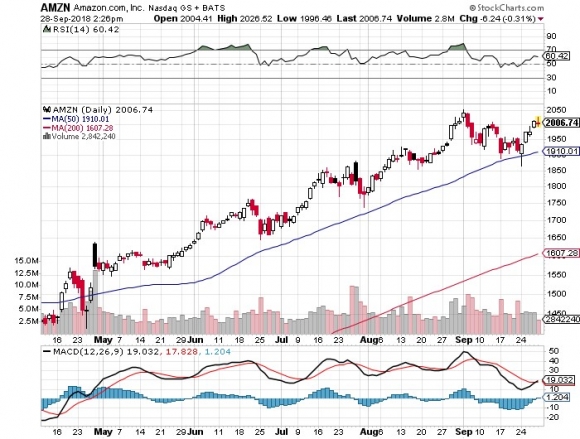
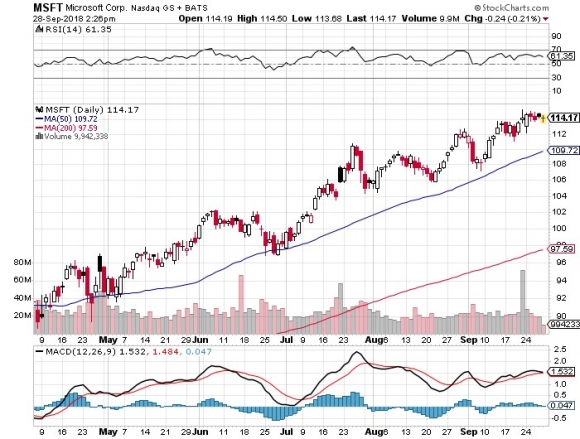
The Mad Hedge Market Timing Index dove down to a two-month low at 46. That was enough to prompt me to jump back into the market with a few cautious longs in Amazon and Microsoft (MSFT). The fourth quarter is now upon us and the chase for performance is on. Big, safe tech stocks could well rally well into 2019.
Facebook (FB) announced a major security breach affecting 50 million accounts and the shares tanked by $5. That prompted some to recommend a name change to “Faceplant.”
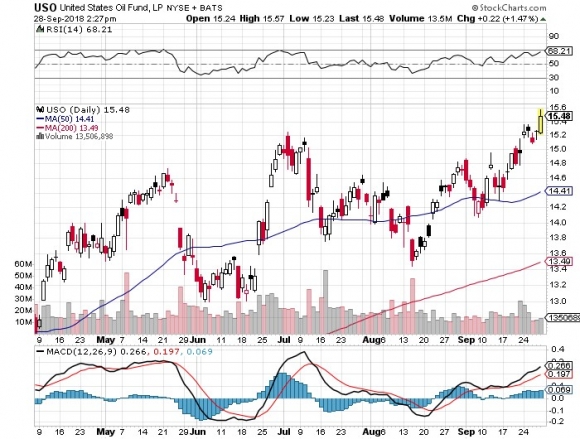
The economic data is definitely moving from universally strong to mixed, with auto and home sales falling off a cliff. Those are big chunks of the economy that are missing in action. If you’re looking for another reason to lose sleep, oil prices hit a four-year high, topping $80 in Europe.
The trade wars are taking specific bites out of sections of the economy, helping some and damaging others. Expect to pay a lot more for Christmas, and farmers are going to end up with a handful of rotten soybeans in their stockings.
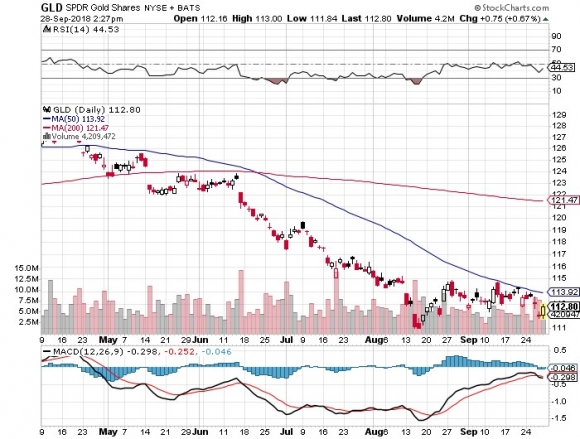
Barrick Gold (ABX) took over Randgold (GOLD) to create the world’s largest gold company. Such activity usually marks long-term bottoms, which has me looking at call spreads in the barbarous relic once again.
With inflation just over the horizon and commodities in general coming out of a six-year bear market, that may not be such a bad idea. Copper (FCX) saw its biggest up day in two years.
The midterms are mercifully only 29 trading days away, and their removal opens the way for a major rally in stocks. It makes no difference who wins. The mere elimination of the uncertainty is worth at least 10% in stock appreciation over the next year.
At this point, the most likely outcome is a gridlocked Congress, with the Republicans holding only two of California’s 52 House seats. And stock markets absolutely LOVE a gridlocked Congress.
Also helping is that company share buybacks are booming, hitting $189 billion in Q2, up 60% YOY, the most in history. At this rate the stock market will completely disappear in 20 years.
On Wednesday, we got our long-expected 25 basis-point interest rate rise from the Federal Reserve. Three more Fed rate hikes are promised in 2019, after a coming December hike, which will take overnight rates up to 3.00% to 3.25%. Wealth is about to transfer from borrowers to savers in a major way.
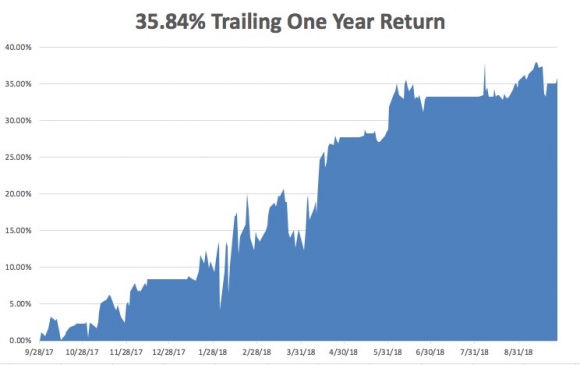
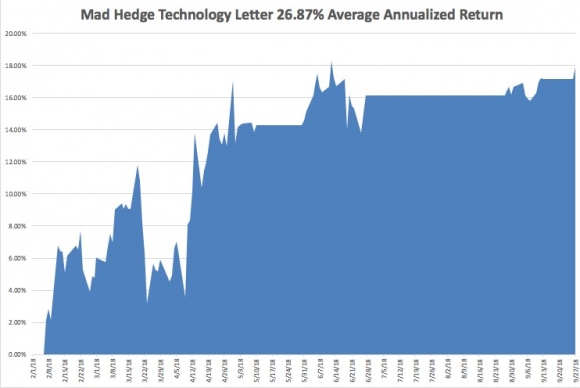
The performance of the Mad Hedge Fund Trader Alert Service eked out a 0.81% return in the final days of September. My 2018 year-to-date performance has retreated to 27.82%, and my trailing one-year return stands at 35.84%.
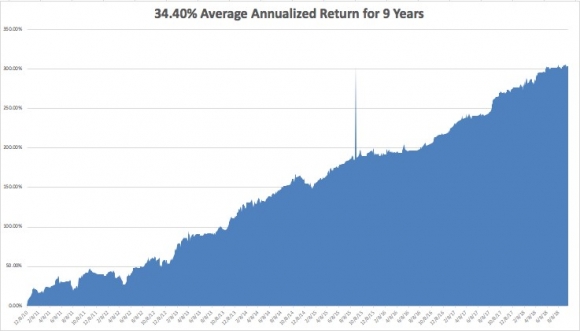
My nine-year return appreciated to 304.29%. The average annualized return stands at 34.40%. I hope you all feel like you’re getting your money’s worth.
This coming week will bring the jobspalooza on the data front.
On Monday, October 1, at 9:45 AM, we learn the August PMI Manufacturing Survey.
On Tuesday, October 2, nothing of note takes place.
On Wednesday October 3 at 8:15 AM, the first of the big three jobs numbers is out with the ADP Employment Report of private sector hiring. At 10:00 AM, the August PMI Services is published.
Thursday, October 4 leads with the Weekly Jobless Claims at 8:30 AM EST, which rose 13,000 last week to 214,000. At 10:00 AM, September Factory Orders is released.
On Friday, October 5, at 8:30 AM, we learn the September Nonfarm Payroll Report. The Baker Hughes Rig Count is announced at 1:00 PM EST.
As for me, it’s fire season now, and that can only mean one thing: 1,000 goats have appeared in my front yard.
The country hires them every year to eat the wild grass on the hillside leading up to my house. Five days later there is no grass left, but a mountain of goat poop and a much lesser chance that a wildfire will burn down my house.
Ah, the pleasures of owning a home in California!
Good luck and good trading.


Global Market Comments
September 28, 2018
Fiat Lux
Featured Trade:
(WHAT WILL TRIGGER THE NEXT BEAR MARKET?)
(JPM), (SNE), (TLT), (ELD), (AMZN),
(WEDNESDAY, OCTOBER 17, 2018, HOUSTON
GLOBAL STRATEGY LUNCHEON)

To paraphrase Leo Tolstoy in Anna Karenina, all bull markets are alike; each bear market takes place for its own particular reasons.
Now that the wreckage of the past financial crises is firmly in our rearview mirror, it is time for us to start pondering the causes of the next one. I’ll give you a hint: It will all boil down to excessive debt…again.
Global quantitative easing has been going on for a decade now, keeping interest rates far too low for too long. The unintended consequences will be legion, and the day of atonement may be a lot closer than you think.
The 1991 bear market was prompted by the Savings & Loan Crisis, where too many unsophisticated financial institutions in a newly unregulated world dreadfully mismatched asset and liabilities.
Every time I drive by a former Home Savings and Loan branch, with its unmistakable quilt decorations and accents, I remember those frightful days. Back then, when I looked at buying a home in San Francisco, the seller burst into tears when the price I offered would have generated a negative equity bill due for him.
The 2000 Dotcom crash can easily be explained by the monstrous amounts of debt provided to stock speculators. The 2008 crash was produced by massive, unregulated, and largely unknown lending to the housing sector through complex derivatives that virtually no one understood, especially the buyers.
So, here we are in 2018 nearly a decade out of the last crisis. Potential disasters are lurking everywhere under the surface while blinder constrained investors blithely power ahead. Once they metastasize, they rapidly feed into each other, creating a domino effect. They always do.
Emerging Market Debt
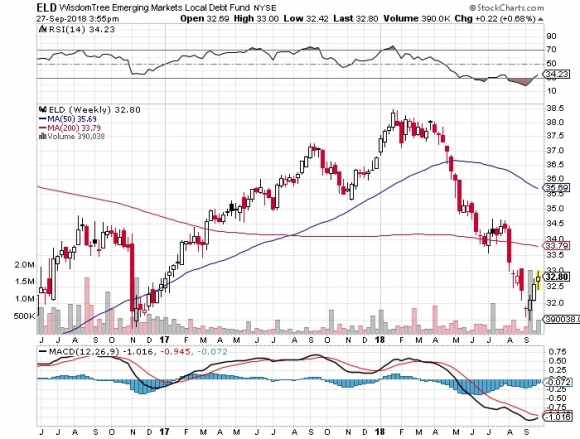
Lacking domestic capital markets with any real depth, companies in emerging economies prefer to borrow in U.S. dollars. When the dollar is weak that’s great because it means liabilities on the balance sheet shrink when brought back into the home currency. When the greenback is strong, the opposite happens. Dollar debt can grow so large that it can wipe out a company’s total equity.
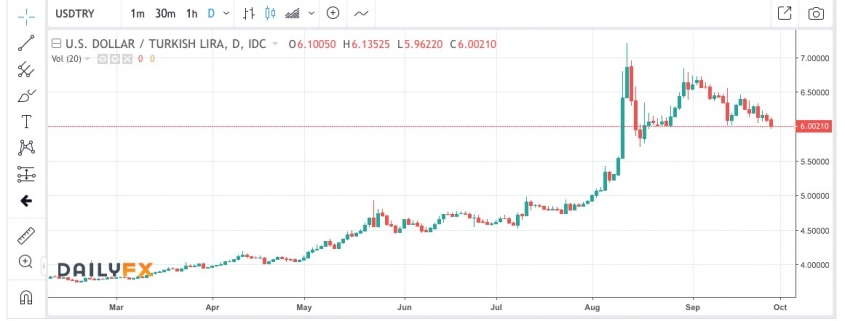
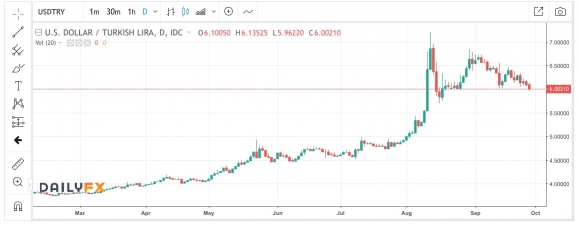
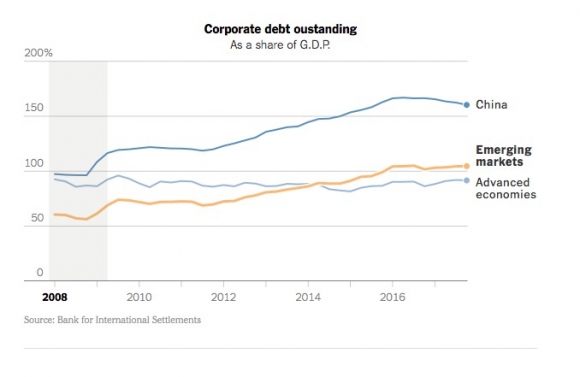
This is already happening in a major way in Turkey, where the lira has plunged 50% in the past year, effectively doubling their debt. And once it starts, a global contagion kicks in as all emerging companies become suspect. This is not a small problem. Emerging market debt has rocketed from 55% to 105% of GDP since 2008.
The Rise of Junk Borrowers
In recent years there has been a massive expansion in borrowing by marginal credits. This is taking place because fixed income investors are willing to accept a large increase in the amount of risk for only a small marginal rise in interest rates.
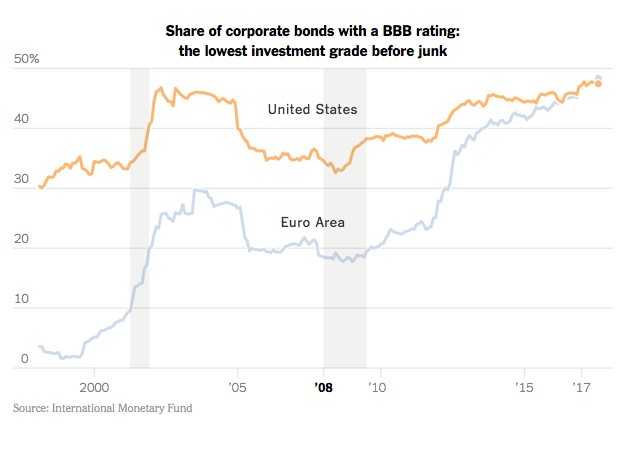
There is now $1.4 trillion in low grade BBB bonds outstanding, with one-third of this one downgrade away from junk. There has also been a dramatic rise in “covenant lite” issuance, which minimizes the rights of bond holders in the event of default. When the next round of trouble arrives, you can expect this market to shut down completely, as it did in 2008.
Student Loans
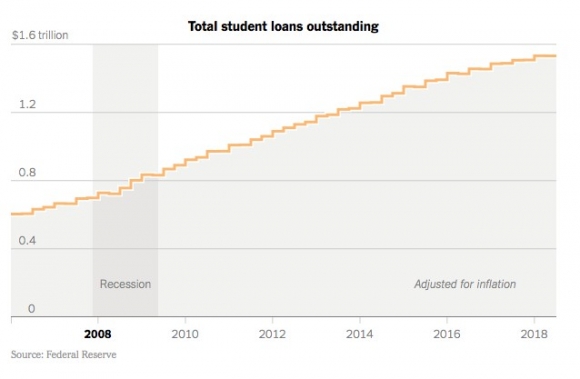
These have been the sharpest rising form of borrowing over the past decade, doubling to $1.5 trillion. Some 10% are now in default. This acts as a major drag on the economy as heavily indebted students don’t borrow, buy homes or cars, or really participate in the economy in any way, banned by lowly FICO scores. This is why millennials in general have been slow to enter the housing market for the first time.
Shadow Banking
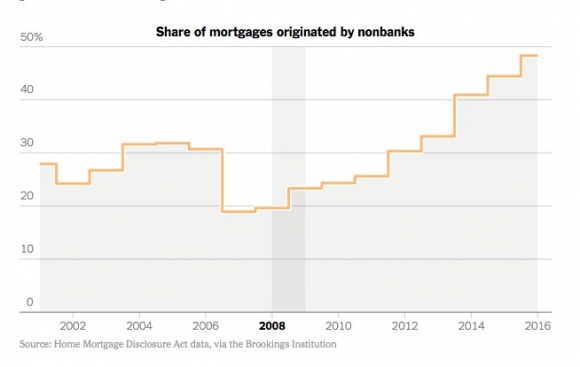
Would you like to know today’s equivalent of subprime the lending that took the financial system down in 2008? That would be shadow banking, or off the books, unreported lending by hedge funds, private equity funds, and mortgage companies. Again, this is all in pursuit of high interest rates in a low interest rate world.
Yes, liars’ loans are back, just not to the extent we saw 10 years ago…yet. I’m waiting for my cleaning lady to get offered a great refi package again, just as she was in the run-up to the last crisis. How many of these loans are out there? No one has any idea, especially the Fed. As a result, nearly 50% of all mortgage lending is now from unregulated nonbank sources.
The Outlier
Remember when Sony (SNE) was almost put out of business by a hack attack from North Korea? What if they had done this to JP Morgan (JPM)? That would have created a chain reaction of defaults throughout the financial system that would have been impossible to stop. When this happened in 2008, it took the Fed three months to reopen markets such as commercial paper. If big bankers need a reason to lie awake at night, this is it.
I’m not saying that markets can’t go higher before they go lower. In fact, I dove back into Amazon (AMZN) only this morning.
However, as an Australian farmer told me on my last trip down under, “Be careful when you cross the field, mate. Deadly snakes abound.” Add up all the above and it will turn into a giant headache for investors everywhere.
Mad Hedge Technology Letter
September 26, 2018
Fiat Lux
Featured Trade:
(DID SIRIUS OPEN UP PANDORA'S BOX?),
(SPOT), (P), (SIRI), (AAPL), (AMZN)