Featured Trade:
(WHY THE DOW IS GOING TO 120,000),
(X), (IBM), (GM), (MSFT), (INTC), (DELL), ($INDU), (NFLX), (AMZN), (AAPL), (GOOGL),
(THE MAD HEDGE CONCIERGE SERVICE HAS AN OPENING),
(TESTIMONIAL)
For years, I have been predicting that a new Golden Age was setting up for America, a repeat of the Roaring Twenties. The response I received was that I was a permabull, a nut job, or a conman simply trying to sell more newsletters.
Now some strategists are finally starting to agree with me. They too are recognizing that a ganging up of three generations of investment preferences will combine to drive markets higher during the 2020s, much higher.
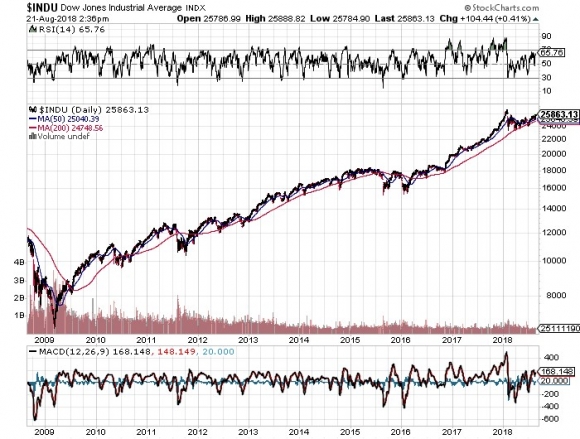
How high are we talking? How about a Dow Average of 120,000 by 2030, up another 465% from here? That is a 20-fold gain from the March 2009 bottom.
It’s all about demographics, which are creating an epic structural shortage of stocks. I’m talking about the 80 million Baby Boomers, 65 million from Generation X, and now 85 million Millennials. Add the three generations together and you end up with a staggering 230 million investors chasing stocks, the most in history, perhaps by a factor of two.
Oh, and by the way, the number of shares out there to buy is actually shrinking, thanks to a record $1 trillion in corporate stock buybacks.
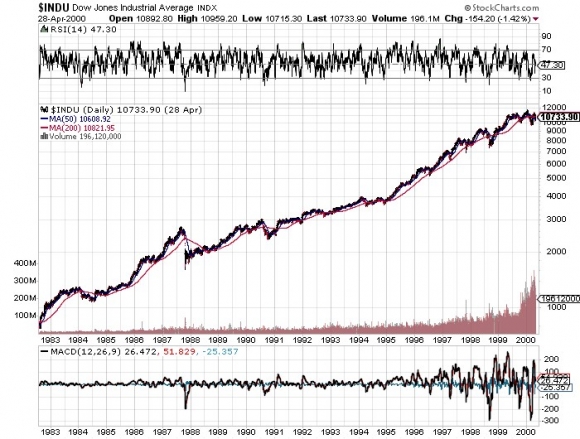
I’m not talking pie in the sky stuff here. Such ballistic moves have happened many times in history. And I am not talking about the 17th century tulip bubble. They have happened in my lifetime. From August 1982 until April 2000 the Dow Average rose, you guessed it, exactly 20 times, from 600 to 12,000, when the Dotcom bubble popped.
What have the Millennials been buying? I know many, like my kids, their friends, and the many new Millennials who have recently been subscribing to the Diary of a Mad Hedge Fund Trader. Yes, it seems you can learn new tricks from an old dog. But they are a different kind of investor.
Like all of us, they buy companies they know, work for, and are comfortable with. During my Dad’s generation that meant loading your portfolio with U.S. Steel (X), IBM (IBM), and General Motors (GM).
For my generation that meant buying Microsoft (MSFT), Intel (INTC), and Dell Computer (DELL).
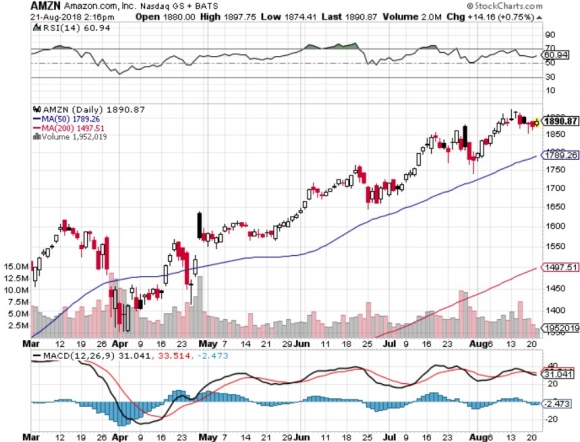
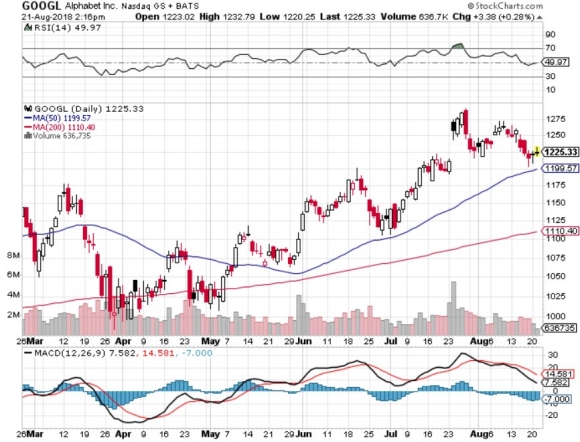
For Millennials that means focusing on Netflix (NFLX), Amazon (AMZN), Apple (AAPL), and Alphabet (GOOGL).
That’s why these four stocks account for some 40% of this year’s 7% gain. Oh yes, and they bought a few Bitcoin along the way too, to their eternal grief.
There is one catch to this hyper-bullish scenario. Somewhere on the way to the next market apex at Dow 120,000 in 2030 we need to squeeze in a recession. That is increasingly becoming a topic of market discussion.
The consensus now is that an impending inverted yield curve will force a recession sometime between August 2019 to August 2020. Throwing fat on the fire will be a one-time only tax break and deficit spending that burns out sometime in 2019. These will be a major factor in U.S. corporate earnings growth dramatically slowing down from 26% today to 5% next year.
Bear markets in stocks historically precede recessions by an average of seven months so that puts the next peak in top prices taking place between February 2019 to February 2020.
When I get a better read on precise dates and market levels, you’ll be the first to know.
To read my full research piece on the topic please click here to read “Get Ready for the Coming Golden Age.”
Dow 1982-2000 Up 20 Times in 18 Years
Dow 2009-Today Up 4.3 Times in 9 Years So Far
https://www.madhedgefundtrader.com/wp-content/uploads/2018/08/John-on-mechanical-bull-story-1-image-3-e1534972073238.jpg313250MHFTRhttps://madhedgefundtrader.com/wp-content/uploads/2019/05/cropped-mad-hedge-logo-transparent-192x192_f9578834168ba24df3eb53916a12c882.pngMHFTR2018-08-23 01:08:052018-08-22 21:23:50Why the Dow is Going to 120,000
Mad Hedge Technology Letter August 22, 2018 Fiat Lux
Featured Trade: (WHAT’S IN STORE FOR TECH IN THE SECOND HALF OF 2018?), (GOOGL), (AMZN), (FB), (UTX), (UBER), (LYFT), (MSFT), (MU), (NVDA), (AAPL), (SMH)
Tech margins could be under pressure the second half of the year as headwinds from a multitude of sides could crimp profitability.
It has truly been a year to remember for the tech sector with companies enjoying all-time high probability and revenue.
The tech industries’ best of breed are surpassing and approaching the trillion-dollar valuation mark highlighting the potency of these unstoppable businesses.
Sadly, it can’t go on forever and periods of rest are needed to consolidate before shares relaunch to higher highs.
This could shift the narrative from the global trade war, which is perceived as the biggest risk to the current tech market to a domestic growth issue.
Healthy revenue beats and margin growth have been essential pillars in an era of easy money, non-existent tech regulation, and insatiable demand for everything tech.
Tech has enjoyed this nine-year bull market dominating other industries and taking over the S&P on a relative basis.
The lion’s share of growth in the overall market, by and large, has been derived from the tech sector, namely the most powerful names in Silicon Valley.
Late-stage bull markets are fraught with canaries in the coal mine offering clues for the short-term future.
Therefore, it is a good time to reassess the market risks going forward as we stampede into the tail end of the financial year.
The shortage of Silicon Valley workers is not a new phenomenon, but the dearth of talent is going from bad to worse.
Proof can be found in the controversial H-1B visa program used to hire foreign tech workers mainly to Silicon Valley.
A few examples are Alphabet (GOOGL), which was granted 1,213 H-1B approvals in 2017, a 31% YOY rise.
Alphabet’s competitor Facebook (FB) based in Menlo Park, Calif., was granted 720 H-1B approvals in 2017, a 53% YOY jump from 2016.
This lottery-based visa for highly skilled foreign workers underscores the difficulty in finding local American talent suitable for a role at one of these tech stalwarts.
Amazon (AMZN) made one of the biggest jumps in H-1B approvals with 2,515 in 2017, a 78% YOY surge.
The vote of non-confidence in hiring Americans shines an ugly light on American youth who are not applying themselves to the domestic higher education system as are foreigners.
For the lucky ones that do make it into the hallways of Silicon Valley, a great salary is waiting for them as they walk through the front door.
Reportedly, the average salary at Facebook is about $250,000 and Alphabet workers take home around $200,000 now.
Pay packages will continue to rise in Silicon Valley as tech companies vie for the same talent pool and have boatloads of capital to wield to hire them.
This is terrible for margins as wages are the costliest input to operate tech companies.
United Technologies Corp. (UTX) chief executive Gregory Hayes chimed in citing a horrid “labor shortage in the U.S. and in Europe.”
He followed that up by saying the company will have to grapple with this additional cost pressure.
Certain commodity prices are spiraling out of control and will dampen profits for some tech companies.
Uber and Lyft, ridesharing app companies, are sensitive to the price of oil, and a spike could hurt the attractiveness to recruit potential drivers.
The perpetually volatile oil market has been trending higher since January, from $47 per barrel and another spike could damage Uber’s path to its IPO next year.
Will Uber be able to lure drivers into its ecosystem if $100 per barrel becomes the new normal?
Probably not unless every potential driver rolls around in a Toyota Prius.
If oil slides because of a global recession instigated by the current administration aim to rein in trade partners, then Uber will be hard hit abroad because it boasts major operations in many foreign megacities.
A recession means less spending on Uber.
Either result will be negative for Uber and ridesharing companies won’t be the only companies to be hit.
Other victims will be tech companies incorporating transport as part of their business model, such as Amazon which will have to pass on more delivery costs to the customer or absorb the blows themselves.
Logistics is a massive expense for them transporting goods to and from fulfillment centers. And they have a freshly integrated Whole Foods business offering two-hour free delivery.
Higher transport costs will bite into the bottom line, which is always a contentious issue for Amazon shareholders.
Another red flag is the deceleration of the global smartphone market evident in the lackluster Samsung earnings reflecting a massive loss of market share to Chinese foes who will tear apart profit margins.
Even though Samsung has a stranglehold on the chip market, mobile shipments have fell off a cliff.
Damaging market share loss to Chinese smartphone makers Xiaomi and Huawei are undercutting Samsung products. Chinese companies offer better value for money and are scoring big in the emerging world where incomes are lower making Chinese phones more viable.
The same trend is happening to Samsung’s screen business and there could be no way back competing against cheaper, lower quality but good enough Chinese imitations.
Pouring gasoline on the fire is the Chinese investigation charging Micron (MU), SK Hynix, and Samsung for colluding together to prop up chip prices.
These three companies control more than 90% of the global DRAM chip market and China is its biggest customer.
The golden days are over for smartphone growth as customers are not flooding into stores to buy incremental improvements on new models.
Customers are staying away.
The smartphone market is turning into the American used car market with people holding on to their models longer and only upgrading if it makes practical sense.
Chinese smartphone makers will continue to grab global smartphone market share with their cheaper premium versions that western companies rather avoid.
Battling against Chinese companies almost always means slashing margins to the bone and highlights the importance of companies such as Apple (AAPL), which are great innovators and produce the best of the best justifying lofty pricing.
The stagnating smartphone market will hurt chip and component company revenues that have already been hit by the protectionist measures from the trade war.
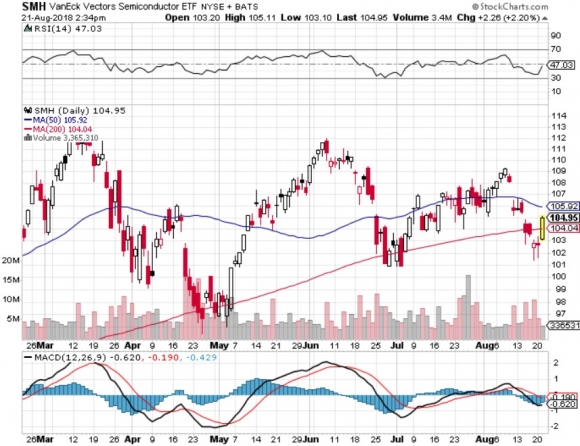
They could turn into political bargaining chips and short-term pressures will slam these stocks.
This quarter’s earnings season has seen a slew of weak guidance from Facebook, Nvidia (NVDA) mixed in with great numbers from Alphabet and Amazon.
Beating these soaring estimates is not a guarantee anymore as we move into the latter part of the year.
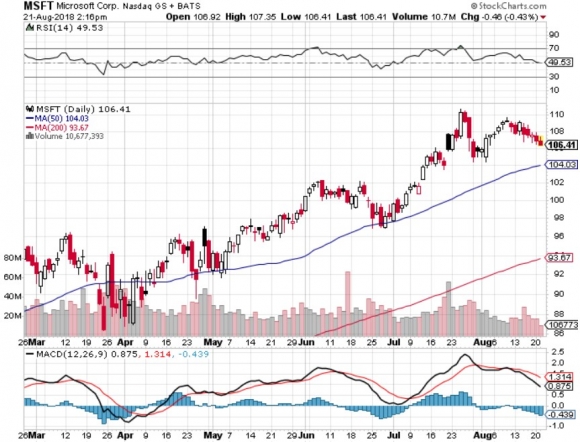
Migrating into the highest quality names such as Amazon and Microsoft (MSFT) with bulletproof revenue drivers would be the sensible strategy if tech’s lofty valuations do not scare you off.
Tech has had its own cake and ate it too for years. But on the near horizon, overdelivering on earnings results will be an arduous chore if outside pressures do not relent.
It’s been fashionable in the past for market insiders to call the top of the tech market, but precisely calling the top is impossible.
The long-term tech story is still intact but be prepared for short-term turbulence.
“By giving people the power to share, we're making the world more transparent,” – said cofounder and CEO of Facebook Mark Zuckerberg.
https://madhedgefundtrader.com/wp-content/uploads/2019/05/cropped-mad-hedge-logo-transparent-192x192_f9578834168ba24df3eb53916a12c882.png00MHFTRhttps://madhedgefundtrader.com/wp-content/uploads/2019/05/cropped-mad-hedge-logo-transparent-192x192_f9578834168ba24df3eb53916a12c882.pngMHFTR2018-08-22 03:05:032018-08-22 06:23:58What’s in Store for Tech in the Second Half of 2018?
Warren Buffett is right, retail is a tough game in the face of the Amazon (AMZN) threat.
I wouldn't want to face off with them either.
Technology has been the biggest catalyst fueling a tectonic shift in the retail climate with large cap technology players usurping market share decimating competition.
The rise of e-commerce platforms has been nothing short of spectacular.
Management has also used technology to modernize the global supply chain, in-house operations, and ramp up the hyper-targeting of prime customers.
The treasure trove of big data collected has been the key to pinpointing the weaknesses and finding solutions.
Amazon knew all of this before everybody else. And, Jeff Bezos has already annihilated a large swath of the retail community that will never return.
Walmart was one of the first retailers to wipe out the small brick-and-mortar shops, and Amazon is attempting to do what Walmart did to others in the past.
Luckily, the sleeping giant of Walmart (WMT) has awoken and is laying the groundwork to launch a full-frontal assault on Amazon.
Better late than never.
More than 90% of Walmart's customers live within a 15-minute drive of one of their stores, but why drive 15 minutes with exorbitant gas prices when Amazon says you don't have to?
Once a laggard, Walmart is now instilling its newfound e-commerce operation with a new sense of zeal and purpose, offering Amazon a real threat and copying its best ideas such as two-day free shipping.
Someone must stand up to Amazon. And Walmart with its massive embedded base of loyal and fervent customers and revenue is the ideal challenger.
Currently, Amazon has extracted more than 49% of the U.S. e-commerce market in 2018.
Walmart trails Amazon by a wide margin, and the investment into developing its e-commerce business will boost the 3.7% e-commerce market share.
If Walmart maintains the drive to enhance tech operations, its e-commerce division could double its market share to more than 7.5% from its low base.
This is entirely manageable as it would only need to convert a small percentage of current non-digital customers into using its digital portals whose quality has remarkedly improved the past few years.
Redesigning the official website was timely as the new interface is sleeker, more functional than past versions, and just plain better.
There is even a tinge of Amazon in the design borrowing the best parts of its foe's design and integrating it into a modern look.
The statement of intent is there, and Amazon won't have a frictionless pathway to profits anymore.
Walmart CEO Doug McMillon has been the main man to ramp up the tech side of the business and has injected a fresh batch of youth into the management style.
Online purchases only comprise less than 20% of sales and that runway is still long and wide for a company that has only barely scratched the surface of its tech strategy.
Most tech companies are in the first innings of a long game, but Walmart is even further behind meaning there is ample room to grow.
Even McMillon believes that Walmart will morph into a certain "kind of technology company" going forward.
Not only is it beefing up its digital commerce strategy, but physical stores are getting makeovers to extract additional marginal revenue from each customer.
Walk into your nearest Walmart and you might notice it looks completely different than your father's Walmart.
It is also dabbling a bit with augmented reality to boost the in-store customer experience.
Walmart has installed an avalanche of self-checkout kiosks at the front of the store to ease and quicken customer payment.
The use of big data analytics is now aiding decisions on how to best create the optimal shopping environment for its customers.
In-store pickup automated machines called towers help customers in picking up their goods if they choose to drive to the physical store, thereby enhancing the customer service quality.
Walmart is no longer playing defense and sticking to what it knows.
It is on the front foot and should be.
Walmart announced e-commerce sales spiked 40% YOY in Q, and the man responsible for this execution is Marc Lore.
Who is Marc Lore?
Marc Lore is the chief executive officer of Walmart eCommerce U.S., and the showdown against Amazon is a personal gripe for him.
Lore joined Walmart when his e-commerce company Jet.com was snapped up for $3.3 billion in 2016.
This was more of a talent and expertise grab that Walmart needed at the time to learn the ropes of the e-commerce business to better understand how to respond to Amazon.
Before Jet.com and Walmart, Lore was on the books at Bezos' Amazon.com where his feud began.
Lore joined Amazon by way of his e-commerce company Quidsi, which he cofounded and which was bought by Amazon for $545 million in 2011.
Following Amazon's purchase, Lore and Bezos did not always see eye to eye on how Quidsi would operate inside the confines of Amazon, creating long-lasting tension that has turning into bad blood.
Quidsi specialized in certain genres such as baby products and household goods. After Amazon sucked all the knowledge and life out of Quidsi, it fired the remaining 260 employees at its New Jersey headquarters and closed down the firm.
Bezos cited "unprofitability" for shuttering Quidsi, and the thinly veiled parting shot at Lore registered deeply inside the back of his mind.
Lore reinvented himself and launched a new e-commerce business called Jet.com.
After being absorbed by Walmart, Lore was repositioned to the top of Walmart's e-commerce division leading the helm.
Lore understands how to take on Amazon after working inside its Seattle headquarters for years after the Quidsi integration and knows how to beat the company at its own game.
He is the perfect person to help Walmart infuse success into its e-commerce division. Walmart is the optimal platform for Lore to get revenge against Jeff Bezos.
A win-win proposition.
Walmart e-commerce business is on track to rise 40% in 2018.
A few changes he set off right away were the expansion of Walmart's online selection adding more than 1,100 brands, setting up a creative discount program attracting more shoppers into physical stores, cooperating with Google to integrate voice-activated shopping mechanisms, and signing up a new in-house brand called Bonobos to design an exclusive portfolio of brands mirroring Amazon's 76 private labels on its platform.
Lore even took a page out of Amazon's playbook and made two-day free shipping possible for millions of products through its website.
Warren Buffett has said in the past that not investing in Amazon and not investing more in Walmart when he had the chance were two of his most regrettable mistakes.
It could be true that this time around Buffett jumped the gun in unloading his Walmart shares. I agree that retail can be scary, but not all retail is created equal.
For some particular retailers such as Walmart, the future doesn't look so bad.
I agree with Buffett that Walmart has more than tough competitors, but if Walmart emphasizes its digital first strategy via mobile and desktop, there is a lot of wiggle room to harvest gains from these positive changes.
Walmart has been used to growing 1% to 2% in U.S. same-store sales per year, and it was habitually assumed as a constant.
The growth of 4.5% proves that tech investments are paying dividends and even though margins are pressured, it's a must to stay competitive.
If Walmart can lure in growth investors who believe in the evolving tech narrative, it would expand the variety of investors interested in Walmart.
Walmart has a lot going for them and sometimes that gets lost around all the hoopla about the Amazon threat.
Walmart has the mind-boggling scale retailers dream of and migrating its own customers online is the key to unlocking new value.
Certainly, these customers will purchase more products after algorithms identify the products customers desire to buy.
Margins will suffer somewhat from this new strategy, but growing pains and reinvestment are sorely needed to turn around the ship.
Luckily, this legacy retailer is on the right path and has hit on the right strategy.
Once the technology is running efficiently, the average revenue per user will start to rise as with for all top-tier technology companies because of leveraged scale making it possible to boost profits.
In addition, there is potential digital ad business to nurture along if Walmart can shift a decent number of legacy customers to mobile or desktop platforms.
The future doesn't look so bleak for Walmart, neither does its share price.
"We will compete with technology, but win with people." - said CEO of Walmart Doug McMillon.
https://madhedgefundtrader.com/wp-content/uploads/2019/05/cropped-mad-hedge-logo-transparent-192x192_f9578834168ba24df3eb53916a12c882.png00MHFTRhttps://madhedgefundtrader.com/wp-content/uploads/2019/05/cropped-mad-hedge-logo-transparent-192x192_f9578834168ba24df3eb53916a12c882.pngMHFTR2018-08-20 01:05:212018-08-20 01:05:21Is Walmart the Next Amazon?
That's right, Amazon (AMZN) will join Facebook (FB) and Alphabet (GOOGL) as the last member of the triumvirate dominating the global digital ad industry.
That is what all signs are pointing to.
In a survey conducted by PricewaterhouseCoopers (PwC), the global digital ad industry increased by 21% YOY to $88 billion in 2017.
Of that growth, Facebook and Alphabet commanded 90% of it.
Mobile ad growth exploded last year because of the migration to smartphones increasing by 36.2% YOY in 2017.
Mobile ad revenue accounted for 56.7% of the digital ad dollars.
Search ad growth decelerated from 48% to 46% market share, but overall revenue climbed 18% to $40.6 billion reflecting the preference for older generations to use desktop search as their go-to platform.
Younger generations prefer dynamic video advertising, which suits mobile devices and tablets.
This segment grew 33% to $11.9 billion and is set to eat into search ad market share going forward.
This all bodes well for Amazon, which can take advantage of these various channels to pump through more ads that companies are clamoring to buy on Amazon's e-commerce platform.
Video ads would be ripe for Amazon Prime Video too, Amazon's on-demand media content service.
By 2021, Amazon's digital ad profits will eclipse its cloud profits solidifying Amazon as the best American tech company because of its multitude of premium profit drivers.
As time goes by, the quality of Amazon's company ascends with no restraints.
The Mad Hedge Technology Letter rates Amazon as the best publicly traded tech stock and that will not change anytime soon.
Amazon's digital ad revenue shot up 129% YOY to $2.2 billion.
This growth rate would make any investor drool.
Amazon might want to shift this business over from the "other" line item on its earnings report because it is blossoming into a main engine of growth and profit.
As Facebook and Alphabet have demonstrated, the digital ad game is a high profit, zero sum game, and Amazon is in perfect position to capitalize going forward.
Amazon's e-commerce business is the foolproof platform that can attract digital ad dollars in droves.
Not only are customers already buying products on Amazon.com, but they are usually purchasing numerous items highlighting the suitability of Amazon populating relevant ads to its customers.
Amazon's strategy to sell high-volume, good value for money products fits nicely into the digital ad strategy with plenty of opportunity for ad buyers to roll out ad campaigns to the masses.
Amazon continues to augment its digital ad tech team creating new tools and has now started directly approaching brands directly racking up digital ad sales.
Amazon's gain is Facebook and Alphabet's loss.
If Amazon goes full steam into the ad tech game, it could do what it has done to brick-and-mortar retail - deflate prices.
This is a worrying sign for Facebook, which is already on the ropes after realizing its business model has some major holes.
Alphabet's strategic position is superior to Facebook's, but it is very much still a one-trick ad tech pony.
The attempt to reintegrate a censored version of its Google search into China makes sense when other FANGs are coming for their lunch stateside.
This epitomizes the current tech climate - evolve now or die.
Amazon is working on a new video ad product that it will place in its search results.
This new product is currently in beta testing mode.
These video ads will be 90 seconds or less and will direct customers to a custom landing page or directly to an official website where they can purchase the item.
The video ad will only be shown for users of iPhones and iPads initially.
Amazon is requiring companies to pay a minimum of $35,000 for this new type of ad campaign. Some of its prominent ad buyers such as Procter and Gamble are already testing out this service to curate the perfect video ads to place inside Amazon search.
At first, the inventory for these video ads will be restricted.
Amazon Media Group is the in-house sales team responsible for selling these new products.
For example, in Germany, the habitual Amazon customer carries out a systematic routine to buy Amazon products.
First, customers will perform astute research on potential products and analyze different price points to gain a comprehensive picture of the market using their smartphone.
The customer later adds the desired items into the shopping cart.
At a later date, the customer purchases the item on a different device, and in many instances, mobile is used just to research products when the customer is out and about.
This multi-leg buying process gives Amazon multiple chances where it can fit in some video ads for the customers.
It is true that the minimum $35,000 will make it harder for small businesses to compete, but this is tailor-made for larger companies to offer a compelling case to customers while leveraging their brand awareness.
It is entirely possible that Amazon will surpass $8 billion in digital ad revenue in 2018 and then blow by $16 billion by 2020.
Of that $16 billion in revenue, $12 billion could be booked as operating profit showing off the juicy margins that make this industry so attractive for the neutral observer.
Yes, Amazon has the largest and best product search engine in the world, and it's time to start leveraging this asset to drive monetization growth.
Specifically, the ability for customers to click on an ad and be shuttled over to Amazon.com for final purchase.
This is the x-factor missing out on Facebook and Google search models.
Amazon has the capability to cherry-pick revenue from each part of the process up until the delivery to the door.
This opens a slew of extra revenue down the road as it enhances the shopping experience because Amazon has full control over the whole process.
This runs parallel with Amazon changing how its ad tech operates to accommodate the emphasis on generating huge growth numbers in ad volume and sales.
Small ad buyers usually work through an agency to integrate with Amazon while larger ad buyers work with Amazon's in-house team.
In the next few weeks, sponsored websites outside of Amazon's ecosystem will start advertising to shoppers who are able to click a link directly moving the buyer back to Amazon.com.
The sponsored ad route is a direct shot at Google search and Facebook.
Unsurprisingly, Amazon converts sales at a 350% higher rate than Google, underscoring the effectiveness of digital ads for Amazon.
When customers are already on the Internet to shop, shoppers could do a lot worse than clicking on a direct link funneling them to Amazon.com.
Posting baby photos on Facebook is not likely to convert users into product buyers.
Neither is checking your Gmail account, translating foreign language on Google Translate, or using Google Search to populate results usually not related to shopping.
These methods fail to convert an Internet surfer to product buyers to the detriment of Facebook and Google search.
Amazon has the perfect business model for selling digital ads.
This robust ad business will spur Amazon shares more than $2,000, and the quality of the sum of the parts keeps rising.
Execution is the only roadblock. And as most of us know, Amazon is one of the most innovative and cleanly executed companies in the world with visionary strategists.
Featured Trade:
(WHY BONDS CAN'T GO DOWN),
(TLT), (TBT), ($TNX), (TUR), (TSLA),
(HOW TO MAKE MORE MONEY THAN I DO),
(AMZN), (LRCX), (ABX), (AAPL), (TSLA), (NVDA)
By now, most of you have figured out that I love calling readers every day and milking them for ideas on how to improve my service.
Often, they think I am an imposter, a telephone salesman, a machine, or an algorithm. It's only after listening for a few seconds that they recognize my voice from the biweekly strategy webinars and realize that it's the real me.
I don't do this to get renewals, because everyone renews anyway. Where else do you get a 62% annual return with no serious drawdowns?
No, I do it because the information I pick up from subscribers is golden. Some of my best Trade Alerts are inspired by reader questions.
One of my favorite Einstein quotes is that "There are no stupid questions, only stupid answers."
In fact, I have discovered that a lot of subscribers are making much more money from my service than I do.
I'll tell you how they do it.
First, let me remind readers that every Trade Alert I send out includes recommendation for a call or put option spread, a single stock, or an ETF.
The trading performance charts that we published are based on the options spread positions only.
WARNING: What worked swimmingly over the past 10 years is no guarantee that it will work next year, but I thought you'd like to know anyway.
1) Raise the Strike Prices
Move the strike prices up by a dollar. So instead of buying the Barrick Gold (ABX) September $15-$16 deep in-the-money vertical bull call spread, you pick up the $16-$17 call spread instead.
Generally, you make a profit that is 50% greater on this higher spread than with the original recommendation. But you are also taking on higher risk.
When 90% or more of our Trade Alerts are successful this has been a pretty good bet to make.
2) Buy the Call Options Only
Instead of buying the call spread, you buy the call option only in half the size.
When it works, your upside is unlimited. When it doesn't, you just write off the total value of your investment.
This is a great approach when the stocks I recommend take off like a rocket and double or more, as have Apple (AAPL), Amazon, (AMZN), Tesla (TSLA), Lam Research (LRCX), and NVIDIA (NVDA).
Option spread buyers leave a lot of money on the table with this scenario, but get lower performance volatility.
I have observed that many of my Australia readers pursue this approach, as they are fighting a 14-hour time zone disadvantage with the New York Stock Exchange. Not many civilians want to trade at 4:00 AM no matter how much it pays.
The payoff is that they earn about double what I do trading the same stocks.
3) Buy a 2X or 3X Leveraged ETF
This is moving out even further off the risk curve.
Almost every one of the 101 S&P 500 sectors have listed for them 2X and 3X bull and bear ETF's. In theory, the best-case scenario for one of these funds is that they will rise three times as fast as the underlying basket.
In theory, I said.
By the time you take out management fees, tracking error, and execution costs, and wide spreads, you are more likely to get 2.5 times the basket appreciation, if not 2X.
I normally steer investors away from 3X funds. But 401k traders, who are not allowed to deal in stock options, swear by them.
4) Trade Futures
This is a favorite of foreign exchange, precious metals, and bond traders. A futures contract can deliver up to 100 times the performance of the underlying currency, metal, or Treasury bond.
Get a good entry point, run a tight stop loss, and the potential gains can be astronomical.
Every year we get a couple of followers who earn 1,000% profits using our market timing for entry and exit point, and they always do it through the futures markets. Yes, that is a 10X return.
This is also a much higher risk, but higher return strategy. Your broker will present greater disclosure requirements and need a higher clearance level.
But potentially retiring in a year is ample bait for many professionals to go through with this.
5) Read the Research
I know a lot of you only buy this service only for our industry beating Trade Alert service.
But my decade-long experience in watching readers succeed, or fail, in their executions is that the more research they read, the more money they make.
Don't try to skim though with a minimal effort.
It's really very simple. The more work you put into this, the more profit you take out.
Understanding fully what is happening in the markets, indeed the entire global economy, will give you the confidence you need to take on bigger positions and make A LOT more money.
There is no free lunch. There is no Holy Grail.
Having said all that, good luck and good trading.
Looks Like I Got Another One
https://madhedgefundtrader.com/wp-content/uploads/2019/05/cropped-mad-hedge-logo-transparent-192x192_f9578834168ba24df3eb53916a12c882.png00MHFTRhttps://madhedgefundtrader.com/wp-content/uploads/2019/05/cropped-mad-hedge-logo-transparent-192x192_f9578834168ba24df3eb53916a12c882.pngMHFTR2018-08-15 01:06:012018-08-15 01:06:01How to Make More Money Than I Do
Legal Disclaimer
There is a very high degree of risk involved in trading. Past results are not indicative of future returns. MadHedgeFundTrader.com and all individuals affiliated with this site assume no responsibilities for your trading and investment results. The indicators, strategies, columns, articles and all other features are for educational purposes only and should not be construed as investment advice. Information for futures trading observations are obtained from sources believed to be reliable, but we do not warrant its completeness or accuracy, or warrant any results from the use of the information. Your use of the trading observations is entirely at your own risk and it is your sole responsibility to evaluate the accuracy, completeness and usefulness of the information. You must assess the risk of any trade with your broker and make your own independent decisions regarding any securities mentioned herein. Affiliates of MadHedgeFundTrader.com may have a position or effect transactions in the securities described herein (or options thereon) and/or otherwise employ trading strategies that may be consistent or inconsistent with the provided strategies.