
• support@madhedgefundtrader.com
  • Member Login
Mad Hedge Fund Trader
  • Home
  • About
  • Store
  • Luncheons
  • Testimonials
  • Contact Us
  • Click to open the search input field Click to open the search input field Search
  • Menu Menu

Tag Archive for: (CI)

Mad Hedge Fund Trader

The Big Medicare Play with Humana

Biotech Letter

Sometimes, markets are right, and sometimes, they are wrong. With regard to the healthcare industry these days, they have definitely got it wrong. For they are overweighting the political risk to this group presented by the 2020 presidential election.

Even if the most extreme leftist candidate, Elizabeth Warren, wins, she will still have to get the plans through congress. And after the experience of the last three years, you can bet the next congress will be a pretty moderate bunch.

Just as President Trump found it impassable to kill Obamacare, even with an all-Republican Congress, Warren will find it equally difficult to get the most expensive form of Medicare for all passed into law.

Take this view, and all of a sudden, the healthcare industry becomes wildly cheap. In fact, it is one of the lowest valued, highest earning sectors in the entire stock market.

Shares of managed care companies have certainly struggled this year. For instance, Anthem (ANTM) went down 5.1%, Cigna (CI) sunk 13.2%, UnitedHealth Group (UNH) declined by 2.2%, and Humana (HUM) fell 0.3%.

Due to the country’s turbulent political climate courtesy of the impending 2020 elections, investors are anxious over Medicare for All, which has the capacity to shut down the entire industry altogether.

As expected, these fears have weighed heavily on health insurance stocks and these companies are anticipated to experience a rollercoaster of emotions in the next year and a half. However, there could be convincing reasons for Humana to stand out from the rest.

Zeroing in on “population health management” along with “social determinant of health,” the company has been working on boosting its dominance on nonclinical services to deliver better health results. This is because approximately 80% of health outcomes are linked to nonclinical issues. Hence, this initiative could lead to improved products for customers and cost savings.

This is why Medicare Advantage, which allows private insurers to collaborate with Medicare for care coverage, turned into the “crown jewel” of Humana’s growth strategies. Basically, this plan appears and functions like a private health plan but is actually a government-sponsored program.

To date, Humana is the second biggest Medicare Advantage provider growing its membership by 15% during the second quarter of both 2018 and 2019.

As of 2018, the company holds a 17% share of the 20.4 million people enrolled in the Medicare Advantage program, with plans comprising roughly a quarter of the managed care’s medical membership. This accounts for almost three times the industry average, which indicates a positive growth for Humana as Medicare is projected as the fastest-growing sector of the insurance industry in terms of spending.

Actually, basic math could easily illustrate Humana’s upward trajectory as well. The number of Americans eligible for a Medicare plan is increasing by roughly 3% annually. Based on data from the Congressional Budget Office, the number of Medicare recipients opting for Medicare Advantage is estimated to climb from 34% of those eligible for Medicare in 2018 to 42% by 2028. Clearly, this increase offers a lot of room for growth, and Humana is smack dab in the center of it.

Although UnitedHealth actually has more members in the said program at the moment, no other managed care company is as intensive and focused as Humana. In fact, 73% of Humana’s consolidated revenue comes from its Medicare Advantage membership earnings alone. This makes the company a Medicare Advantage pure play.

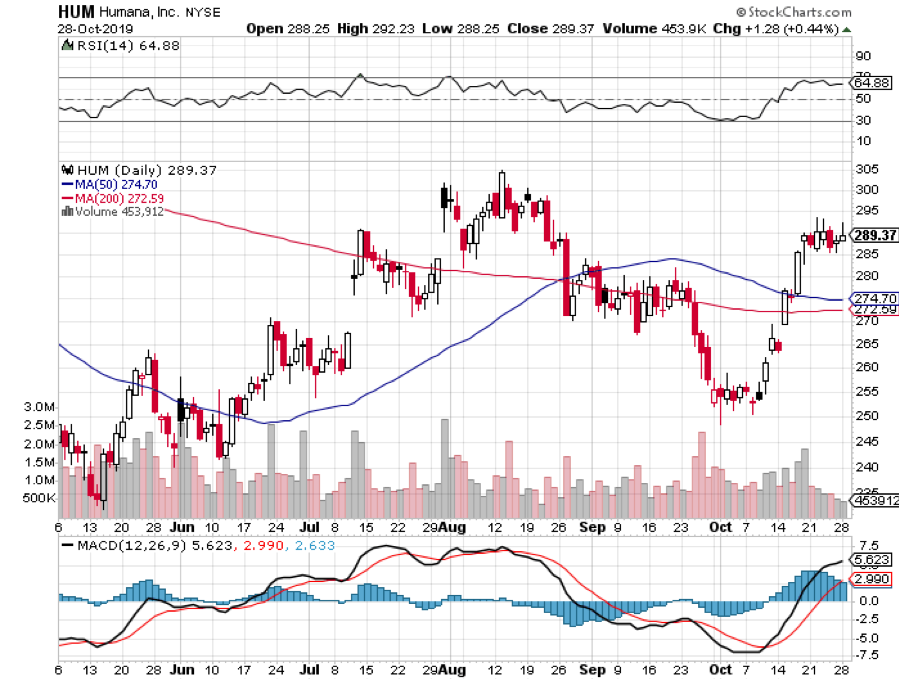
Holding its position as one of the leaders in this private option available within the Medicare community, Humana has established a stronghold in this ever-evolving and constantly turbulent industry. So far, the stock’s price target is projected to hit $315. Long-term investors could also finally expect to shake off healthcare fear jitters and big rewards from 2021 onwards if the elections result in Democratic leadership.

Looking at Humana’s earnings history, it can be seen that it has grown from $7.75 per share in 2015 to $14.55 by 2018. For this year, the company’s projected earnings is expected to reach $17.50 a share. However, the possibility of a federal tax on health insurers could pose a threat to the company’s growth.

Humana is well-poised for advancement on the back of its strategic plans involving its Medicare business and promising initiatives. In the past years, Humana has been deploying excess capital and hiking its dividend. Just in February 2019, the company increased its dividend by 10% to reach 55 cents a share.

As part of its repurchase strategy, Humana allocated $3 billion for its buyback plans. These moves further indicate the financial capacity of the company and could hopefully reinvigorate investor confidence.


https://www.madhedgefundtrader.com/wp-content/uploads/2019/10/humana.png 222 899 Mad Hedge Fund Trader https://madhedgefundtrader.com/wp-content/uploads/2019/05/cropped-mad-hedge-logo-transparent-192x192_f9578834168ba24df3eb53916a12c882.png Mad Hedge Fund Trader2019-10-29 08:00:052019-10-29 09:15:17The Big Medicare Play with Humana
Mad Hedge Fund Trader

October 17, 2019

Diary, Newsletter, Summary

Global Market Comments
October 17, 2019
Fiat Lux

Featured Trade:

(UPDATING THE MAD HEDGE LONG TERM MODEL PORTFOLIO),
(USO), (XLV), (CI), (CELG), (BIIB), (AMGN), (CRSP), (IBM), (PYPL), (SQ), (JPM), (BAC), (EEM), (DXJ), (FCX), (GLD)

https://madhedgefundtrader.com/wp-content/uploads/2019/05/cropped-mad-hedge-logo-transparent-192x192_f9578834168ba24df3eb53916a12c882.png 0 0 Mad Hedge Fund Trader https://madhedgefundtrader.com/wp-content/uploads/2019/05/cropped-mad-hedge-logo-transparent-192x192_f9578834168ba24df3eb53916a12c882.png Mad Hedge Fund Trader2019-10-17 07:04:062019-10-17 07:11:17October 17, 2019
Mad Hedge Fund Trader

October 15, 2019

Biotech Letter

Mad Hedge Biotech & Healthcare Letter
October 15, 2019
Fiat Lux

Featured Trade:

(CASHING IN ON ECONOMIES OF SCALE WITH CIGNA)
(CI), (ESRX), (AET)

https://madhedgefundtrader.com/wp-content/uploads/2019/05/cropped-mad-hedge-logo-transparent-192x192_f9578834168ba24df3eb53916a12c882.png 0 0 Mad Hedge Fund Trader https://madhedgefundtrader.com/wp-content/uploads/2019/05/cropped-mad-hedge-logo-transparent-192x192_f9578834168ba24df3eb53916a12c882.png Mad Hedge Fund Trader2019-10-15 06:02:222019-10-15 06:33:45October 15, 2019
Mad Hedge Fund Trader

Cashing in on Economies of Scale with Cigna

Biotech Letter

The future of health care will be no doubt driven by massive economies of scale that crush costs and balloon profit margins and there has been no better practitioner of that philosophy than Cigna Corp. (CI)

The company recently reported a robust quarterly blowout. The managed care service provider disclosed that it recorded $4.30 in earnings per share for the second quarter, crushing the Wall Street estimate of $3.74 per share. Total profits were recorded to be $34.4 billion, also topping previous estimates of $33.2 billion.

Among the revenue components of Cigna, pharmacy sales were identified as major pushers as it reached $26.3 billion -- a huge jump from the $750 million recorded during the same period in 2018. This is primarily due to the acquisition of pharmacy benefit manager Express Scripts for $67 billion in December last year. Cigna’s premiums also went up 8.9% year-over-year to reach $9.8 billion. Meanwhile, fees grew 76% to $2.39 billion. 

The move to merge with Express Scripts (ESRX) has allowed Cigna to secure long-term growth as the company transformed into a one-stop-shop for clients’ healthcare needs. It can now cater to demands ranging from drug sales up to insurance coverage. Since it brings together both medical services and pharmacy benefits under one roof, Cigna has become a more attractive option for its ability to provide better treatments and lower expenses.

With this deal, Cigna gained a competitive position to become one of the major movers in the healthcare insurance industry. So far, the combined company is projected to generate a minimum free cash flow of $6 billion by 2021.

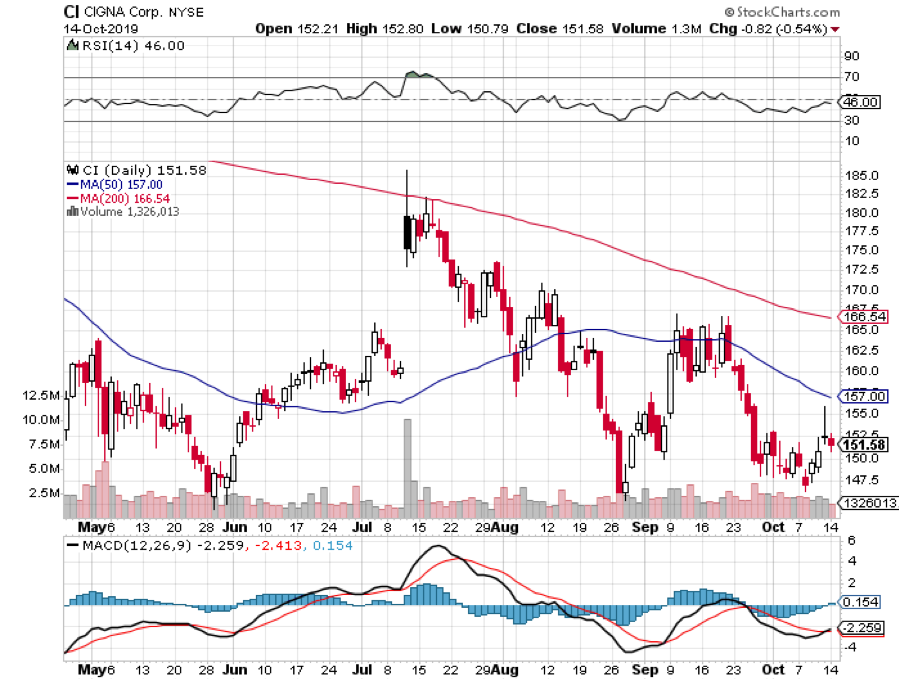
However, one major obstacle in Cigna’s growth is the uncertainty arising from the current political climate in the United States ahead of the 2020 election. Cigna’s share price almost perfectly inversely tracks with the polling numbers of Elisabeth Warren, who has essentially promised to nationalize the company. The better she does the worse Cigna does, and that has given us our entry point.

At the moment, health insurers remain uncertain of some aspects of their business due to potential regulatory changes that could plunge them into debt.

To address this, Cigna is following the footsteps of fellow healthcare giants like Aetna Inc (AET) which sold its group life and disability unit to Hartford Financial Services Group for $1.45 billion in 2017.

While Cigna hopes that the merger with Express Scripts could help mitigate the effects of future government policy changes, the company is still actively seeking other alternatives.

One of its plans is to sell its group benefits insurance unit, which has an estimated value of $6 billion, to other insurers with an already established division and are looking to scale. The sale could include the life and accidental death as well as dismemberment coverage clusters of Cigna. This move will allow the company to focus more on healthcare.

Given its revenue trajectory in the first half of 2019 though, the company’s outlook indicates a continuing momentum into year-end. In fact, Cigna’s total revenues this year are projected to rise somewhere between $136 and $137 billion compared to the $132.5 and $134.5 billion range predicted earlier. This indicates a 180% increase year-over-year.

Meanwhile, its earnings per share are expected to reach $16.90 compared to the earlier earnings guidance of $16.65, representing a 17% rise year-over-year. The company’s medical clients are estimated to increase by roughly 200,000 as well, achieving 97% to 98% customer retention in its health services sector in 2020.

Cigna’s expansion to establish an international presence is also a promising move towards diversification. In the first quarter of 2019, the company acquired OnePath Life Insurance from the ANZ Bank in New Zealand. This deal allows Cigna to gain access to an existing client base and offer an expanded set of services.

Aside from achieving international operations expansion, this acquisition also reassures Cigna’s investors of the company’s capacity to effectively deploy capital to drive long-term growth.

So far, Cigna has provided strong reasons for it to be a “BUY.” In terms of its growth rate, the company’s revenues showed a CAGR of 11% from the year 2010 up to 2018. However, it rose by 194% in the first half of this year, courtesy of its Express Scripts merger. Its recent acquisitions also demonstrated consistent top-line growth and the ability to effectively distribute its products and services.

Apart from its top-line growth, Cigna has also managed to maintain its bottom-line profitability. This is clear in the annual earnings growth it recorded since 2009 and its efforts to maintain operating profitability via controlled medical care and other operating costs.


https://www.madhedgefundtrader.com/wp-content/uploads/2019/10/cigna.png 391 364 Mad Hedge Fund Trader https://madhedgefundtrader.com/wp-content/uploads/2019/05/cropped-mad-hedge-logo-transparent-192x192_f9578834168ba24df3eb53916a12c882.png Mad Hedge Fund Trader2019-10-15 06:00:182019-10-15 06:27:49Cashing in on Economies of Scale with Cigna
Mad Hedge Fund Trader

February 22, 2019

Diary, Newsletter, Summary

Global Market Comments
February 22, 2019
Fiat Lux

Featured Trade:

(FEBRUARY 20 BIWEEKLY STRATEGY WEBINAR Q&A),
(NVDA), (MU), (AMD), (LRCX), (GLD), (FXE), (FXB), (AMZN),
(PLAY IT SAFE WITH ANTHEM), (ANTM), (CI)

https://madhedgefundtrader.com/wp-content/uploads/2019/05/cropped-mad-hedge-logo-transparent-192x192_f9578834168ba24df3eb53916a12c882.png 0 0 Mad Hedge Fund Trader https://madhedgefundtrader.com/wp-content/uploads/2019/05/cropped-mad-hedge-logo-transparent-192x192_f9578834168ba24df3eb53916a12c882.png Mad Hedge Fund Trader2019-02-22 01:08:132019-02-21 17:00:32February 22, 2019
Mad Hedge Fund Trader

February 20 Biweekly Strategy Webinar Q&A

Diary, Newsletter

Below please find subscribers’ Q&A for the Mad Hedge Fund Trader February 20 Global Strategy Webinar with my guest and co-host Bill Davis of the Mad Day Trader. Keep those questions coming!

Q: If there is a China trade deal, should I buy China stocks, specifically Alibaba?

A: To a large extent, both Chinese and US stocks have already fully discounted a China trade deal, so buying up here could be very risky. The administration has been letting out a leak a day to support the stock market, so I don’t think there will be much juice left when the announcement is actually made. The current high levels of US stocks make everything risky.

Q: Is it time to buy NVIDIA (NVDA)?

A: The word I’m hearing from the industry is that you don’t want to buy the semiconductor stocks until the summer when they start discounting the recovery after the next recession (which is probably a year off from this coming summer). The same is true for Micron Technology (MU), Advanced Micro Devices (AMD), and Lam Research (LRCX).

However, if you’re willing to take some heat in order to own a stock that’s going to triple over the next three years, then you should buy it now. If you’re a long-term investor, these are the entry points you die for. Looking at the charts it looks like it is ready to take off.

Q: Should I be shorting the euro (FXE), with the German economy going into recession?

A: No. We’re at a low for the euro so it’s a bad time to start a short. It’s interest rates that drive the euro more than economies. With the U.S. not raising interest rates for six months, maybe a year, and maybe forever, you probably want to be buying the currencies more than selling them down here.

Q: Would you buy the British pound (FXB) on Brexit fears?

A: I would; my theory all along has been that Brexit will fail and the pound will return to pre-Brexit levels—30% higher than where we are at now. I have always thought that the current government doesn’t believe in Brexit one iota and are therefore executing it as incompetently as possible.

They have done a wonderful job, missing one deadline after the next. In the end, Britain will hold another election and vote to stay in Europe. This will be hugely positive for Europe and would end the recession there.

Q: What do we need to do for the market to retest the highs?

A: China trade deal would do it in a heartbeat. If this happens, we will get the 5% move to the upside initially. Then we’re looking at a double top risk for the entire 10-year bull market. That’s when the short players will start to come in big time. You’d be insane to new positions in stocks here. There is an easy 4,500 Dow points to the downside, and maybe more.

Q: Do you think earnings growth will come in at 5%, or are they looking to be zero or negative?

A: Zero is looking pretty good. We know companies like to guide conservative then surprise to the upside; however, with Europe and China slowing down dramatically, that could very well drag the U.S. into recession and our earnings growth into negative numbers. The capital investment figures have been falling for three months now. US Durable Goods fell by 1.2% in January.

This explains why companies have no faith in the American economy for the rest of this year. This was a big reason why Amazon (AMZN) abandoned their New York headquarters plans. They see the economic data before we do and don’t want to expand going into a recession.

Q: When will rising government debt start to hurt the economy?

A: It already is. Foreign investors have been pulling their bids for fear of a falling US dollar. They have also become big buyers of gold (GLD) in order to avoid anything American, so we have a new bull market there. In the end, the biggest hit is with business confidence.

Nothing good ever comes from exploding US deficits and companies are not inclined to invest going into that. That is a major factor behind the sudden deterioration in virtually all data points over the past month.

Good Luck and Good Trading
John Thomas
CEO & Publisher
The Diary of a Mad Hedge Fund Trader

https://www.madhedgefundtrader.com/wp-content/uploads/2019/02/John-micron.png 358 293 Mad Hedge Fund Trader https://madhedgefundtrader.com/wp-content/uploads/2019/05/cropped-mad-hedge-logo-transparent-192x192_f9578834168ba24df3eb53916a12c882.png Mad Hedge Fund Trader2019-02-22 01:06:072019-07-09 04:07:13February 20 Biweekly Strategy Webinar Q&A
MHFTR

June 21, 2018

Diary, Newsletter

Global Market Comments
June 21, 2018
Fiat Lux

SPECIAL BIOTECH ISSUE

Featured Trade:
(HERE COMES THE NEXT REVOLUTION),
(CVS), (AET), (BRK.A), (AMZN), (JPM), (CI),

(BIIB), (CELG), (REGN)

https://madhedgefundtrader.com/wp-content/uploads/2019/05/cropped-mad-hedge-logo-transparent-192x192_f9578834168ba24df3eb53916a12c882.png 0 0 MHFTR https://madhedgefundtrader.com/wp-content/uploads/2019/05/cropped-mad-hedge-logo-transparent-192x192_f9578834168ba24df3eb53916a12c882.png MHFTR2018-06-21 01:07:422018-06-21 01:07:42June 21, 2018
MHFTR

Here Comes the Next Revolution

Diary, Free Research, Newsletter, Research

Technology and biotechnology are the two seminal investment themes of this century.

And while many tech companies have seen share prices rise 100-fold or more since the millennium, biotech and its parent big pharma have barely moved the needle.

That is about to change.

You can thank the convergence of big data, supercomputing, and the sequencing of the human genome, which overnight, have revolutionized how new drugs are created and brought to market.

So far, only a handful of scientists and industry insiders are in on the new game. Now it's your turn to get in on the ground floor.

The first shot was fired in December 2017 when CVS (CVS) bought Aetna (AET) for an eye-popping $69 billion, puzzling analysts. A flurry of similar health care deals followed, with Berkshire Hathaway (BRK.A), Amazon (AMZN) with its Verily start-up, and J.P. Morgan (JPM) joining the fray.

March followed up with a Cigna (CI) bid for Express Scripts, a pharmacy benefits manager. Apple (AAPL) has suddenly launched a bunch of health care-based apps designed to accumulate its own health data pool.

What's it all about? Or better yet, is there a trade here?

No, it's not a naked bid for market share, or an attempt to front run the next change in health care legislation. It's much deeper than that.

In short, it's all about you, or your data to be more precise.

We have all seen those clever TV ads about IBM's (IBM) Watson mainframe computer knowing what you want before you do. In reality we are now on the third generation of Watson, known as Summit, now the world's fastest super computer.

Summit can process a mind-numbing 4 quadrillion calculations per second. This is computing muscle power that once was associated with a Star Trek episode.

Financed by the Department of Defense to test virtual nuclear explosions and predict the weather, Summit has a few other tricks up its sleeve. It can, for example, store every human genome and medical record of all 330 million people in the United States, process that data instantly, and spit out miracle drugs almost at whim.

You know all those lab tests, X-rays, MRI scans, and other tests you've been accumulating over the years? They add up to some 30% of the world daily data creation, or some 4 petabytes (or 4,000 gigabytes) a day. That's a lot of zeroes and ones.

Up until a couple of years ago, this data just sat there. It was like having a copy of the Manhattan telephone book (if it still exists) but not knowing anyone there. Thanks to Summit we now not only have a few friends in Manhattan, we know everyone's most intimate details.

I have been telling readers for years that if you can last only 10 more years you might be able to live forever, as all major human diseases will be cured during this time. Summit finally gives us the tools to achieve this.

Imagine the investment implications!

The U.S. currently spends more than $3 trillion on health care, or about 15% of GDP, and costs are expected to rise another 6% this year. To modernize this market, you will need to create from scratch four more Apples or six more Facebooks (FB) in terms of market capitalization. You can imagine what getting in early is potentially worth.

Crucial to all of this was Craig Venter's decoding of his own DNA in 2000 for the first time, which cost about $1 billion. Today, you and I can get 23andMe, Ancestry.com or Family Tree DNA to do it for $100, with most of the work done in China.

Of course, key to all of this is getting the medical data for every U.S. citizen on line as fast as possible. The Obama administration began this effort seven years ago. Remember those gigantic overstuffed records rooms at your doctor's office? You don't see them anymore.

But we have a long way to go, and 20% of the U.S. population who don't HAVE any medical records, including all of the uninsured, will be a challenge.

To give you some idea of the potential and convince that I have not gone totally MAD let me tell you about Amgen's (AMGN) sudden interest in Iceland. Yes, Iceland.

There, a struggling, young start-up named deCode sequenced the DNA of the entire population of the country, about 160,000 individuals. It tried to monetize its findings but it was early and lost money hand over fist. So, the company sold out to Amgen in 2012 for $415 million.

Until then targeting molecules for development was based on a hope and a prayer, and only a hugely uneconomic 5% of drugs made it to market. Using artificial intelligence (yes, those NVIDIA graphics processors again) to pretest against the deCode DNA data based it was able to increase that hit rate to 75%.

It's not a stretch to assume that a 15-fold increase in success rates leads to a 15-fold improvement in profitability, or thereabouts.

Word leaked out setting off a gold rush for equivalent data pools that led to the takeover boom described above. And what happens when the pool of data explodes from 160,000 individuals to 330 million? It boggles the mind.

As a result, the health care industry is now benefiting from a "golden age" of oncology. Average life expectancy for chemotherapies is increasing by months at a time for specific cancers.

All of this is happening at a particularly fortuitous time for drug, health care, and biotech companies, which are only just now coming out of a long funk.

Traders seemed to have picked up on this new trend in May, which is why I slapped on a long position in the iShares Nasdaq Biotechnology ETF (IBB) (click here for a full description).

Like many companies in the sector it is coming off of a very solid one-year double bottom and is going ballistic today.

The area is ripe for rotation. Other names you might look at include Biogen (BIIB), Celgene (CELG), and Regeneron (REGN).

If you have grown weary of buying big cap technology stocks at new all-time highs, try adding a few biotech and pharmaceutical stocks to spice this up. The results may surprise you.

As for living forever, that will be the subject of a future research piece. The far future.


https://madhedgefundtrader.com/wp-content/uploads/2019/05/cropped-mad-hedge-logo-transparent-192x192_f9578834168ba24df3eb53916a12c882.png 0 0 MHFTR https://madhedgefundtrader.com/wp-content/uploads/2019/05/cropped-mad-hedge-logo-transparent-192x192_f9578834168ba24df3eb53916a12c882.png MHFTR2018-06-21 01:06:182018-06-21 01:06:18Here Comes the Next Revolution
Page 4 of 41234

tastytrade, Inc. (“tastytrade”) has entered into a Marketing Agreement with Mad Hedge Fund Trader (“Marketing Agent”) whereby tastytrade pays compensation to Marketing Agent to recommend tastytrade’s brokerage services. The existence of this Marketing Agreement should not be deemed as an endorsement or recommendation of Marketing Agent by tastytrade and/or any of its affiliated companies. Neither tastytrade nor any of its affiliated companies is responsible for the privacy practices of Marketing Agent or this website. tastytrade does not warrant the accuracy or content of the products or services offered by Marketing Agent or this website. Marketing Agent is independent and is not an affiliate of tastytrade. 

Legal Disclaimer

There is a very high degree of risk involved in trading. Past results are not indicative of future returns. MadHedgeFundTrader.com and all individuals affiliated with this site assume no responsibilities for your trading and investment results. The indicators, strategies, columns, articles and all other features are for educational purposes only and should not be construed as investment advice. Information for futures trading observations are obtained from sources believed to be reliable, but we do not warrant its completeness or accuracy, or warrant any results from the use of the information. Your use of the trading observations is entirely at your own risk and it is your sole responsibility to evaluate the accuracy, completeness and usefulness of the information. You must assess the risk of any trade with your broker and make your own independent decisions regarding any securities mentioned herein. Affiliates of MadHedgeFundTrader.com may have a position or effect transactions in the securities described herein (or options thereon) and/or otherwise employ trading strategies that may be consistent or inconsistent with the provided strategies.

Copyright © 2026. Mad Hedge Fund Trader. All Rights Reserved. support@madhedgefundtrader.com
Scroll to top