• support@madhedgefundtrader.com
  • Member Login
Mad Hedge Fund Trader
  • Home
  • About
  • Store
  • Luncheons
  • Testimonials
  • Contact Us
  • Click to open the search input field Click to open the search input field Search
  • Menu Menu

Tag Archive for: (MRK)

Mad Hedge Fund Trader

Special Cancer Issue - Part 1

Biotech Letter

Multiple times every year, leading oncology researchers gather to share and discuss the latest developments in the field. During these events, biotech companies actively seek ways to snatch top billing, hoping to amp up their value not only within the industry but also to the public.

Needless to say, company stock prices tend to fluctuate dramatically based on the data and whether or not the companies lived up to the hype of their studies. Hence, these events have turned into must-attend conferences among the healthcare industry leaders and even institutional investors.

For everyday investors though, it’s too impractical to even consider the possibility of attending these grand shindigs. This is why we’re sharing with you a list of companies that are currently making strides or are anticipated to dominate the cancer research and treatment market in 2019 and in the years to come.

Bristol-Myers Squibb (BMY)

As always, no other field has been watched more intensely than the lung cancer market -- an area considered as the most lucrative in the immuno-oncology circle. In the recently concluded European Society for Medical Oncology Congress in Barcelona, all eyes were on the up-and-coming Opdivo/Yervoy combo of Bristol-Myers Squibb (BMY).

In the recent data it presented, Bristol disclosed that the combination of its cancer drugs Opdivo and Yervoy provided promising results to melanoma patients. According to their study, over 50% of melanoma patients survived after five years which is a huge leap from the 5% survival rate recorded over the same period prior to the introduction of immunotherapies.

With the company’s recent moves to beef up its cancer portfolio, the Opdivo/Yervoy combo is anticipated to turn into a strong competitor of Roche Holding Ltd. Genussscheine’s (ROG) Tecentriq. This combo also reinvigorates the ongoing rivalry between Bristol and Merck & Co. (MRK), with Opdivo/Yervoy aiming to dethrone the latter’s major moneymaker Keytruda.

However, this isn’t exactly the first time Bristol showed interest in dominating the oncology market. Wielding the power of its $81.05 billion market value, Bristol has signified its aggressive stance in pushing for the expansion of its cancer department.

The most highly publicized news from this front came in January this year courtesy of its announcement involving a $74 billion merger with Celgene Corporation (CELG). Now, it appears that we’re seeing the first of Bristol’s efforts to bolster its cancer drug lineup.

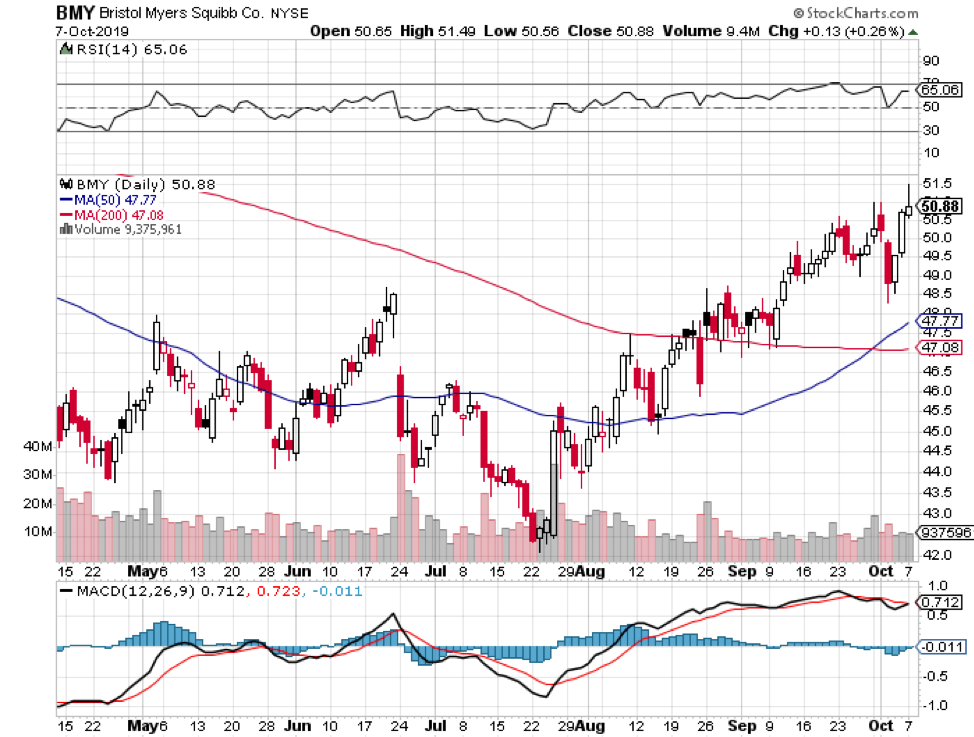
Although Bristol has been underperforming compared to its competitors for the majority of 2019, the stock has actually surpassed its rivals by roughly 5% in September. Following its 52-week low in July, the company has performed steadily higher to currently trading 6.5% below its 2019 high.

Hence, traders should be vigilant as a dip to a short-term trendline in the next weeks could offer a suitable entry point to eventually take advantage of the upside momentum.

Amgen (AMGN)

Another oncology frontrunner is Amgen (AMGN). The biotech giant recently presented its data on experimental treatments AMG 510 and AMG 160, which target some forms of colorectal cancer. So far, AMG 510 has provided higher response rates at 3% for patients across all levels of dosage.

These drugs form part of the rising trend of precision medicines, which zero in on particular gene mutations. This method is anticipated to be able to ward off cancer cells regardless of the organ where the disease originated.

In September, Amgen shared that the drug managed to shrink tumors by almost 50% during the trial period for advanced non-small lung cancer patients. Meanwhile, the drug’s disease control rate was recorded at 92%, with patients capable of tolerating AMG 510 without any dose-limiting toxicities.

These results prompted the FDA to send AMG 510 for “fast track” review. Aside from their own study, Amgen is also looking at a possible combination with Merck’s Keytruda in an effort to bolster its foothold in the lung cancer front.

If Amgen succeeds in the application of AMG 510 to colorectal cancer patients, the drug will be the first-ever approved treatment to target a mutated form of a gene commonly referred to as KRAS. This particular mutation called KRASG12C is prevalent in approximately 13% of non-small cell lung cancers, 3% to 5% of colorectal cancers, and almost 2% of solid tumor cancers.

In terms of revenue, the success of AMG 510 could lead to annual sales of $3 billion in the United States alone and $6.4 billion internationally. Aside from Amgen, Mirati Therapeutics Inc. (MRTX) has been actively pursuing treatments that aim to treat KRAS mutations as well.

Incyte Corporation (INCY)

At first blush, Incyte (INCY) is regarded as simply another young company striving to make a name for itself in the massive biotech market. Despite the success of bone marrow disorder drug Jakafi, a lot of investors still believe that the company only managed to stumble its way to growth. In fact, even those who actually started to invest in this biopharma firm still somehow see it as a company with an extremely limited potential. 

Unfortunately for these investors, they’re missing out on a crucial detail. Although Incyte’s trajectory isn’t exactly moving at a blistering pace, the steady revenue growth of the company in 2019 is a strong indicator of meaningful profits in the succeeding years.

This growth would eventually land the company in the watchlist of every biotech investor, with the company stock already gaining 18% this year alone to boost its $16.10 billion market value.

One of the most exciting developments from Incyte is its bile duct cancer research which led to a potential oncology blockbuster drug Pemigatinib. So far, 36% of its test patients saw their tumors shrink with a preliminary median overall survival of 21.1 months.

Despite the promising results though, the company cautions on the modesty of its projected revenue as Pemigatinib specifically targets cholangiocarcinoma, which is a rare type of bile duct cancer. Incyte plans to submit the drug for review to the FDA before the year ends.

For now, Incyte is focused on the commercialization and development of its existing moneymakers. Aside from Jakafi, the company is also making waves in the rheumatoid arthritis market with Olumiant. Its myeloid leukemia treatment Iclusig is another potential golden goose on the rise as well.

So far, Incyte’s share price has been trading at approximately $15 range since April. The past two months showed a pullback though, with the stock finding key support from the lower trendline of the trading range at $72. For investors who intend to open a long position within these levels, you should set your take-profit order somewhere near $88. However, simply cut your losses if Incyte stock fails to hold $72 support.
 

https://madhedgefundtrader.com/wp-content/uploads/2019/05/cropped-mad-hedge-logo-transparent-192x192_f9578834168ba24df3eb53916a12c882.png 0 0 Mad Hedge Fund Trader https://madhedgefundtrader.com/wp-content/uploads/2019/05/cropped-mad-hedge-logo-transparent-192x192_f9578834168ba24df3eb53916a12c882.png Mad Hedge Fund Trader2019-10-22 08:00:042019-10-22 07:55:20Special Cancer Issue - Part 1
Mad Hedge Fund Trader

Why I'm Avoiding Pfizer Like the Plague

Diary, Newsletter

You would think that the company that makes Viagra would be booming with all these baby boomers around.

It’s not.

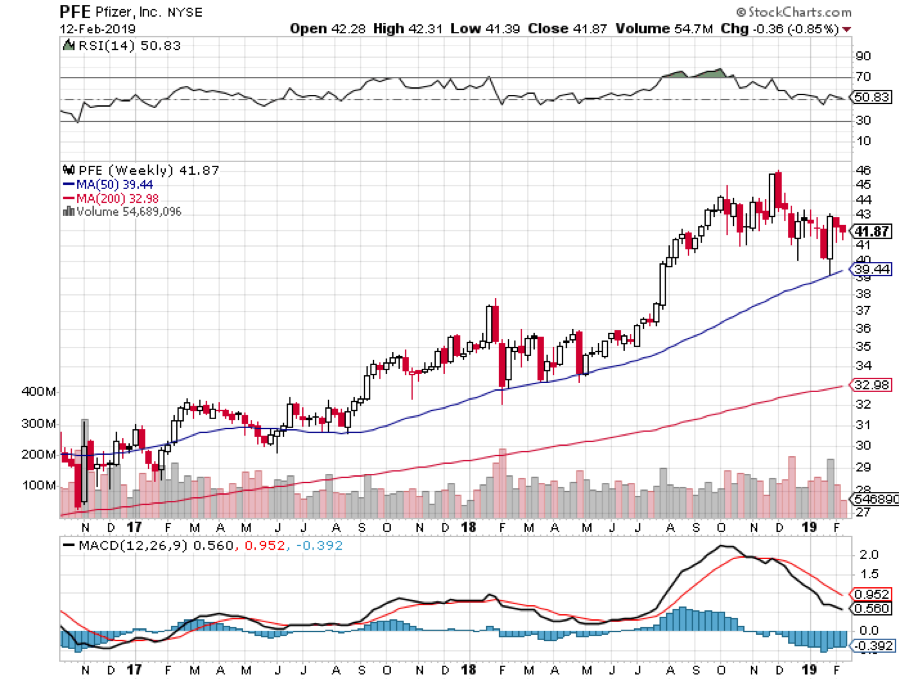
As we come into the tag ends of the Q1 earnings season, it is hard to ignore the pitiful performance put on by Pfizer (PFE). Its fourth-quarter earnings were totally overshadowed by its disappointing outlook and underperforming shares.

The 168-year-old drug maker can expect sustainable growth in some of its product franchises, such as prostate cancer drug Xtandi, blood clot medication Eliquis, metastatic breast cancer drug Ibrance, and arthritis medicine Xeljanz.

However, generic competitors against Pfizer mainstays like Pristiq, an anti-depressant drug, and Viagra are threatening to trigger a massive decline in the former’s sales. With generic companies hot on its heels, Pfizer faces incredible pressure in terms of pricing and lower gross margins.

Expiring patents known as the loss of exclusivities (LOE) are also projected to contribute to their red ink by approximately $2.6 billion. In particular, Pfizer is expected to lose exclusive rights to its blockbuster drugs Lyrica in June 2019 and Chantix in the next few years. To date, their LOEs already cost Pfizer $2.1 billion in sales in 2017 and an additional $1.8 billion in 2018.

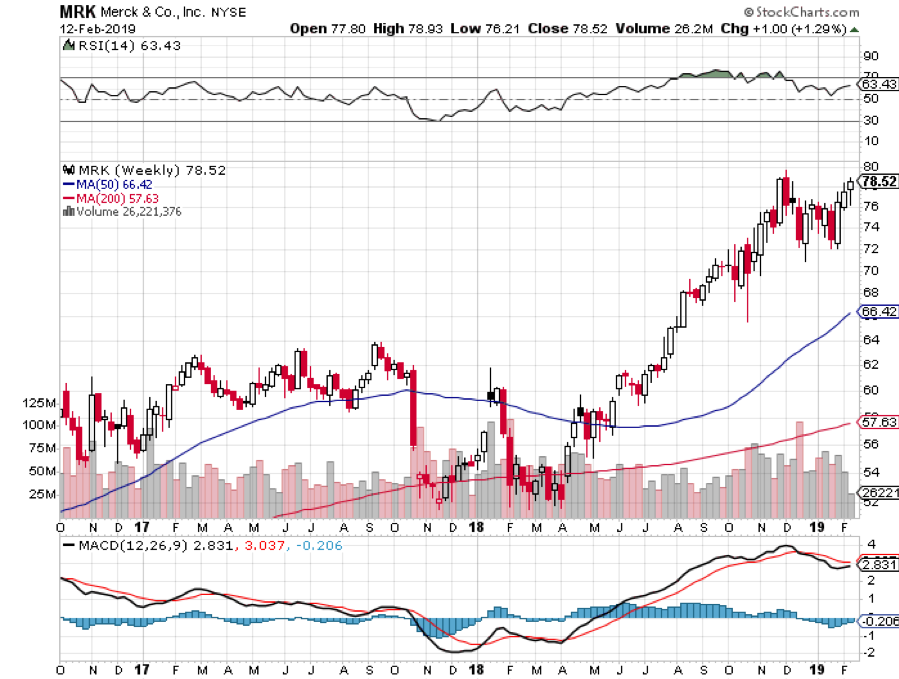
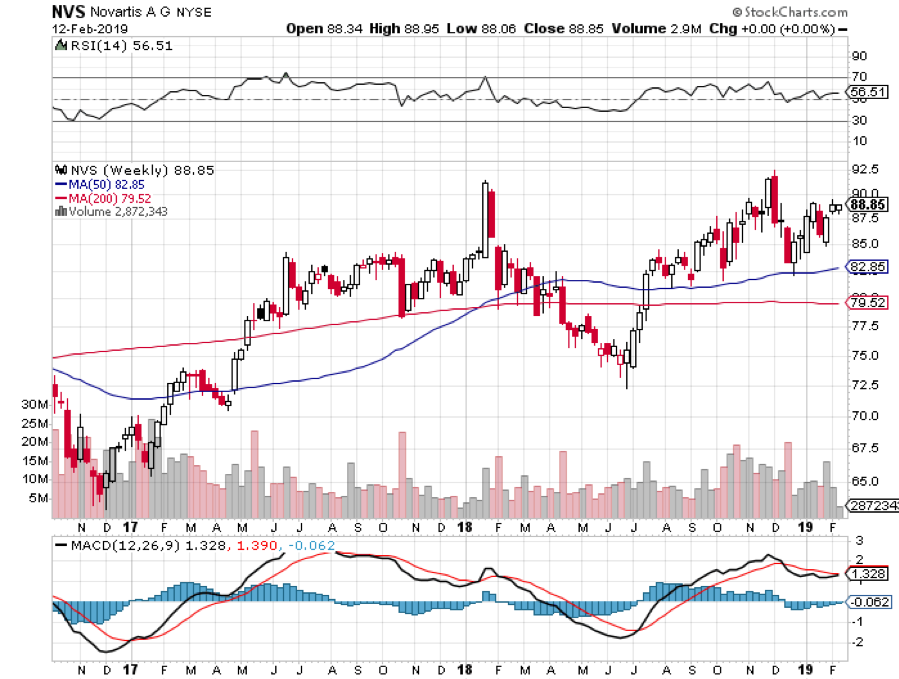
Pfizer is doing better than its competitors. In the past 12 months, Pfizer EPS stood at $1.86, which showed a 47.16% decline year-over-year. By comparison, major competitor Merck & Co., Inc. (MRK) EPS was at $0.69, suffering from a 281.58% decline year-over-year while Novartis (NVS) faced a 38.8% decline with an EPS of $0.52.

Pfizer’s recorded annual revenues of $53.4 billion, which puts it ahead of its major competitors Novartis ($51 billion) and Merck & Co., Inc. ($41.7 billion).

Bleak 2019 but promising 2022. That’s a long time to hold your breath.

As far as 2019 is concerned, the pharma heavyweight does not present any growth potential in both their top and bottom lines, with their midpoints offering slightly lower revenue and earnings compared with that in 2018.

Pfizer is projected to deliver a flat year-over-year performance regardless of the major headwinds primarily due to the strong sales of its remaining products. The company continues to remain confident as it awaits roughly 25 to 30 drug approvals up to year 2022.

Among these pending potential blockbuster products, 15 are expected to be approved by 2020. In addition, Xtandi, Ibrance, and Xeljanz/XR are slated for line extensions. With regard to long-term growth, Pfizer is well positioned to make headway on innovative medical breakthroughs in the next five years or so.

Pfizer is anticipated to reap the rewards of its $93 million investment in NextCure, which is a biopharmaceutical company focused on discovering and developing next-generation immuno-oncology-based drugs.

Pfizer has also been implementing various cost-cutting and productivity measures since 2017 in an effort to offset the effects of rising expenses and push for bottom line growth (read firing people).

Their efforts include investing in new market creation strategies as well as seizing opportunities to streamline their operations and cutting down organizational layers to eliminate (or at least reduce) bureaucracy.

These initiatives are anticipated to reach completion by 2019 and are expected to bring in approximately $1.4 billion in savings by 2020.

Given the challenges ahead, Pfizer seems to offer a promising future as seen in their efforts to curb their losses. While it remains to be seen if the company can come up with any notable acquisition to jumpstart their promised progress as early as 2020, Pfizer’s current products along with its pipeline candidates appear to be capable of delivering solid growth in succeeding years. Meanwhile, Pfizer is intent on providing a growing dividend to its shareholders.

In a nutshell, Pfizer’s current status is not ideal for investors interested in immediate profits. However, those who are patient enough to wait for a few more years could be in line to receive a dividend that could yield 3.5%.

Leave this one to the index funds and ETFs. There are better fish to fry in the space.


https://www.madhedgefundtrader.com/wp-content/uploads/2019/02/pfizer.png 368 591 Mad Hedge Fund Trader https://madhedgefundtrader.com/wp-content/uploads/2019/05/cropped-mad-hedge-logo-transparent-192x192_f9578834168ba24df3eb53916a12c882.png Mad Hedge Fund Trader2019-02-14 02:08:392019-07-09 04:07:40Why I'm Avoiding Pfizer Like the Plague
Mad Hedge Fund Trader

December 19, 2018

Tech Letter

Mad Hedge Technology Letter
December 19, 2018
Fiat Lux

Featured Trade:

(HOW TECH IS EATING INTO HEALTHCARE COSTS)
(VEEV), (CRM), (GSK), (AZN), (MRK), (NVS), (DBX), (OKTA), (TWLO)

https://madhedgefundtrader.com/wp-content/uploads/2019/05/cropped-mad-hedge-logo-transparent-192x192_f9578834168ba24df3eb53916a12c882.png 0 0 Mad Hedge Fund Trader https://madhedgefundtrader.com/wp-content/uploads/2019/05/cropped-mad-hedge-logo-transparent-192x192_f9578834168ba24df3eb53916a12c882.png Mad Hedge Fund Trader2018-12-19 08:22:542018-12-19 08:26:31December 19, 2018
Mad Hedge Fund Trader

How Tech is Eating into Healthcare Costs

Tech Letter

It’s undeniable that American healthcare costs are a big part of a family’s monthly expenses.

Rising deductibles and out-of-network fees are a few of the out-of-pocket costs that can singe a hole in the average joes’ pocket.

It was only in 2016 when healthcare insurance costs eclipsed more than $10,000 a year per person, and over the past 12 months, 68% of people surveyed admitted that future healthcare costs would probably consume a larger part of their earnings.

The result is that healthcare companies are making money hand over fist.

Is there something that I deduce from this lucrative part of the economy that has the potential to feed into the tech sector?

The tidal wave of money spilling into the healthcare industry has also given impetus to these firms hoping to buttress their networks and IT with modern tech infrastructure to take advantage of the efficiencies on offer.

Building the best cloud services geared towards specific industries has been a winning formula and the generated momentum will continue into the next calendar year.

Prime models can be seen all over the tech ecosphere and they will be big winners of 2019.

One example is Twilio (TWLO) who has quietly risen the bar for communication cloud products.

A panoply of small companies can now offer professionalized email, text message, automated voice mail services amongst other services that do the work of 100 employees.

Recently, I touched on a cloud company named Okta (OKTA) responsible for managing the facilitation of passwords.

This identity management company was formed by a group of former Salesforce executives.

In my book, a Salesforce (CRM) credential is a golden stamp of approval for newly formed cloud-companies seeking to develop new cloud products in broad industries.

Why?

Salesforce’s client relationship management platform (CRM) is ubiquitous and the most popular enterprise software.

The way they develop their model is by launching and acquiring new e-commerce and marketing services - which lure in customers into its walled gardens.

Salesforce also applies its artificial intelligence platform Einstein to harness customer relationships and help businesses carry out decisions based on data alone instead of testosterone and emotion.

This all means that Salesforce executives have their finger on the pulse of the cloud landscape and know how to build a cloud business from scratch which is valuable.

They know what certain industries require to mushroom and can deploy resources in the quickest way possible while surrounding themselves by hordes of software engineers who can be poached for a certain fee.

The framework being in place is a massive bounty for these executives who just line up the dots then motor on to an industry confirmed by the data.

And remember that 99.9% of people do not have access to this proprietary data.

Consequently, they know more about corporate America than most Fortune 500 CEOs.

Marrying up the healthcare industry to the cloud was just a matter of time.

Veeva Systems (VEEV) is a cloud-computing company focused on pharmaceutical and life sciences industry applications.

Founder and CEO of Veeva Systems Peter Gassner cut his teeth at Salesforce serving as Senior Vice President of Technology.

His job was building the salesforce.com platform including product, marketing and developer relations.

Gassner has effectively transplanted the Salesforce platform model and applied it to the life sciences industry and has done a great job doing it.

The Veeva Commercial Cloud includes a CRM platform that aids drug company’s management of clients.

The Veeva Vault is a tool that tracks industry regulations, clinical trials, and recommends actionable habits in the cloud.

Veeva's CRM platform is powered by the Salesforce1 app development platform and is integrated into the broader Salesforce Marketing and Service Clouds.

The first mover advantage has offered all the low-hanging fruit for Veeva.

The lack of competition surely never lasts but the extra time to pad their lead is only a positive to its business model.

Veeva has already lured in some of the health industries biggest names such as GlaxoSmithKline (GSK), AstraZeneca (AZN), Merck & Co. (MRK), and Novartis (NVS).

These heavy hitters are meaningfully tied to its ecosystem, and it is safe to say that these relationships are only scratching the surface and have the potential to expand as Veeva installs more add-on tools into its platform.

The popularity shows up in the numbers with Veeva’s 3-year sales growth rate hovering around 30%.

Even better, the profitability of Veeva is indicative of the strength in its business model. They are simply at the right place at the right time to capture the momentum from the digital crossover in the healthcare industry.

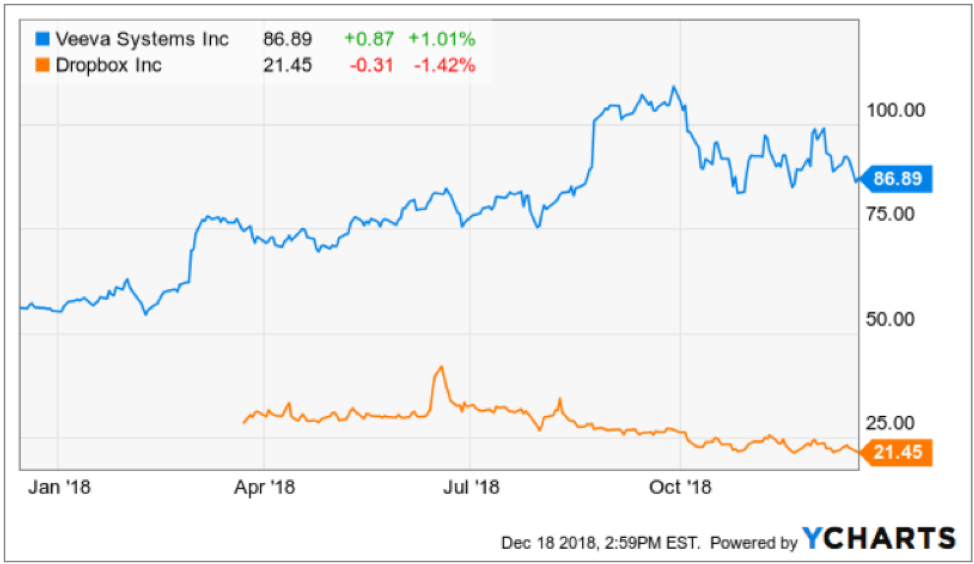
Many similar names like Dropbox (DBX) are enormous loss-making enterprises but Veeva has shrugged off this stereotype that many cloud companies of its size can’t be profitable.

The effect of being strategically placed in a position to cherry pick the lucrative healthcare industry has also seeped into the strong profit margins of Veeva able to grow it to over 32%.

Touching more on the profitability, EPS has kicked into gear sequentially rising 80%, and the long-term outperformance is backed up with a 3-year EPS growth rate of 41%.

This cloud company is incredibly profitable for its size, and part of that is the absence of competition which increases pricing power.

Dropbox does not have that luxury of favorable pricing schemes which cripple profitability and leads to attrition and just as harmful – a price war.

Veeva’s forecasts for next year blew past Wall Street’s estimates and the company is modeling for EPS of $1.58 and revenue around $856 million in 2019.

Gassner has even publicly acknowledged that he expects 2019 revenue to come in between $1 billion and $1.1 billion which is a full year ahead of schedule.

The bullish guidance is a clue that the overall cloud story is alive and kicking, and there is absolutely no weakness whatsoever.

Making this story even more compelling is that in the last five years, profits are up six-fold, revenue is up four-fold, and the number of new products is up three-fold.

As we advance into 2019, I believe Veeva is a buy-on-the-dip candidate because of its favorable market position, rapidly expanding margins, and its low enterprise value of $11 billion which deems it, as I daresay, a lucrative buyout target for larger industry cloud players like Salesforce.

The tech industry has a habit of coming full circle become of its network effect of capital, talent, and management.

I would be interested in dipping my toe into any of Salesforce’s offspring because these models are built to scale and are waiting on the doorstep to seize revenue from industry migrating to digital.

Okta did it, and Veeva Systems made the leap of faith too, confirming that the Salesforce method is a path to untold profits for cloud-based software companies.

When the market can finally digest the macro rigmaroles, shares for this innovative and hyper-growth cloud company is set to take off.


https://madhedgefundtrader.com/wp-content/uploads/2019/05/cropped-mad-hedge-logo-transparent-192x192_f9578834168ba24df3eb53916a12c882.png 0 0 Mad Hedge Fund Trader https://madhedgefundtrader.com/wp-content/uploads/2019/05/cropped-mad-hedge-logo-transparent-192x192_f9578834168ba24df3eb53916a12c882.png Mad Hedge Fund Trader2018-12-19 08:21:362018-12-19 08:21:02How Tech is Eating into Healthcare Costs
MHFTR

September 25, 2018

Diary, Newsletter, Summary

Global Market Comments
September 25, 2018
Fiat Lux

Featured Trade:
(AI AND THE NEW HEALTH CARE),
(GOOGL), (XLP), (XLV), (MRK), (BMY), (PFE),
(MONDAY, OCTOBER 15, 2018, ATLANTA, GA,
GLOBAL STRATEGY LUNCHEON)

https://madhedgefundtrader.com/wp-content/uploads/2019/05/cropped-mad-hedge-logo-transparent-192x192_f9578834168ba24df3eb53916a12c882.png 0 0 MHFTR https://madhedgefundtrader.com/wp-content/uploads/2019/05/cropped-mad-hedge-logo-transparent-192x192_f9578834168ba24df3eb53916a12c882.png MHFTR2018-09-25 01:08:152018-09-24 20:44:24September 25, 2018
Page 26 of 26«‹242526

Legal Disclaimer

There is a very high degree of risk involved in trading. Past results are not indicative of future returns. MadHedgeFundTrader.com and all individuals affiliated with this site assume no responsibilities for your trading and investment results. The indicators, strategies, columns, articles and all other features are for educational purposes only and should not be construed as investment advice. Information for futures trading observations are obtained from sources believed to be reliable, but we do not warrant its completeness or accuracy, or warrant any results from the use of the information. Your use of the trading observations is entirely at your own risk and it is your sole responsibility to evaluate the accuracy, completeness and usefulness of the information. You must assess the risk of any trade with your broker and make your own independent decisions regarding any securities mentioned herein. Affiliates of MadHedgeFundTrader.com may have a position or effect transactions in the securities described herein (or options thereon) and/or otherwise employ trading strategies that may be consistent or inconsistent with the provided strategies.

Copyright © 2026. Mad Hedge Fund Trader. All Rights Reserved. support@madhedgefundtrader.com
Scroll to top