
• support@madhedgefundtrader.com
  • Member Login
Mad Hedge Fund Trader
  • Home
  • About
  • Store
  • Luncheons
  • Testimonials
  • Contact Us
  • Click to open the search input field Click to open the search input field Search
  • Menu Menu

Tag Archive for: (MRNA)

Mad Hedge Fund Trader

The Market Outlook for the Week Ahead, or Gamblers Have Entered the Market

Diary, Newsletter

At long last, the 10% correction I have been predicting is happening. No, it wasn’t caused by the usual reasons, like a bad economic data point, an earnings disappointment, or a geopolitical event.

The market delivered the worst week since October because gamblers have entered the stock market. Perish the thought!

It turns out that if a million kids buy ten shares each of a $4 stock, they can wipe out even the largest hedge funds on their short positions. It also turns out they can wipe out their brokers, with infinite capital calls triggered by massive order flows.

If Chicago’s Citadel had not stepped in with a $1 billion bailout, Robin Hood would have gone under last week. Citadel buys Robin Hood’s order flow and is their largest customer. That’s where systemic risk enters the picture.

And it’s not like there was really any systemic risk. Markets have an inordinate fear of the unknown, and no one has ever seen a bunch of kids in a chat room like Redditt wipe out major hedge funds.

Fortunately, there are only a dozen small illiquid stocks that could be subject to such ‘buyers raids”. So, the spillover to the main market is very limited, probably no more than a week or two.

And the regulations to reign in such a practice are already in place. Whenever a broker gets more business than it can handle, it will simply shut it down. Robin Hood did that on Friday when it has limited purchases in 20 stocks to a single share, including Starbucks (STBX), Moderna (MRNA), and General Electric (GE).

What all this does is set up an excellent buying opportunity for you and me, of which there have been precious few in recent months. By ramping up the Volatility Index to $38, it is almost impossible to lose money on front month call options spreads. We are the real winners of the (GME) squeeze.

Stocks would have to fall another 10%-20% on top of existing 10%-20% declines, and that is not going to happen in 13 trading days to the February 19 options expiration with $20 trillion about to hit the economy and the stock markets. That breaks down to $10 trillion in stimulus and $10 trillion worth of global quantitative easing.

My own long, hard-won experience is that a (VIX) at $38 earns you about 20% a month in profits. Options prices are so elevated that scoring winners now is like shooting fish in a barrel. So, join the party as fast as you can.

On Friday, I was taking profits on exiting positions and shipping out new trade alerts in the best quality names as fast as I could write them. Where is that easy, laid back retirement I was hoping for!

Keep at the barbell portfolio. The big tech names are finishing up a six-month sideways “time” corrections. Their earnings are catching up with valuations at a prolific rate. The domestic recovery names have just given back 10%-20% and are ripe for another leg up. All of these are good candidates for 2023 options LEAPS.

After all, if an insurrection and the sacking of the capitol can’t take the market down more than 1%, GameStop (GME) is certainly not going to take it down more than 10%.

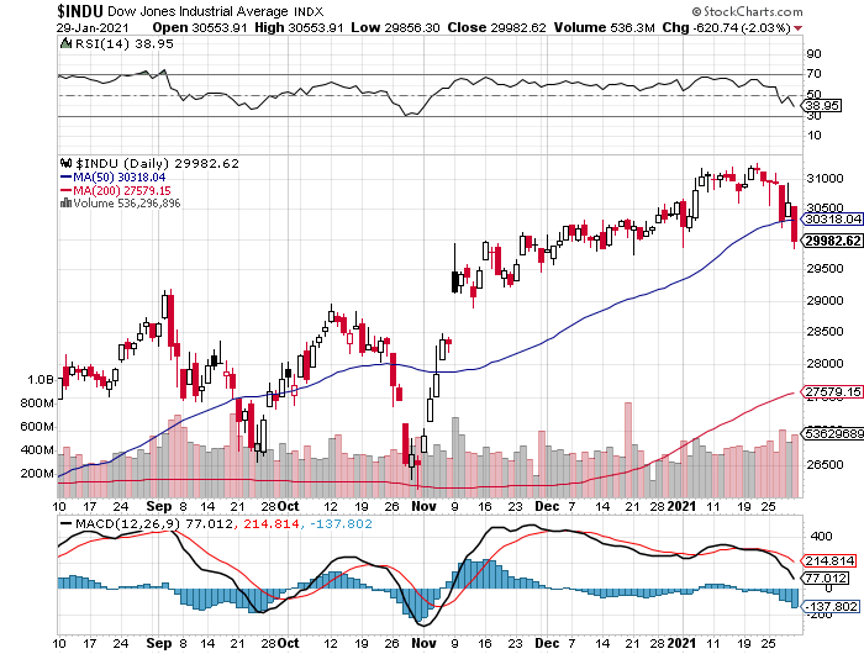
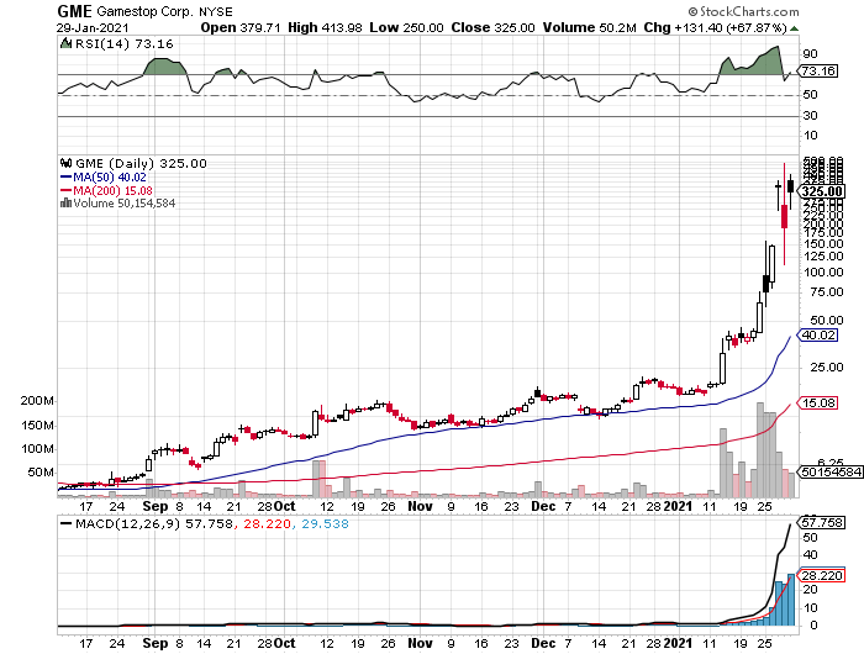
GameStop (GME) posted record volatility, up from $4 a month ago to $483. Even the biggest hedge funds can’t stand up to a million kids buying ten shares each at market. All single name shorts in the market are getting covered by hedge funds in fear of getting “Gamestopped”, producing a 700-point Dow rally.

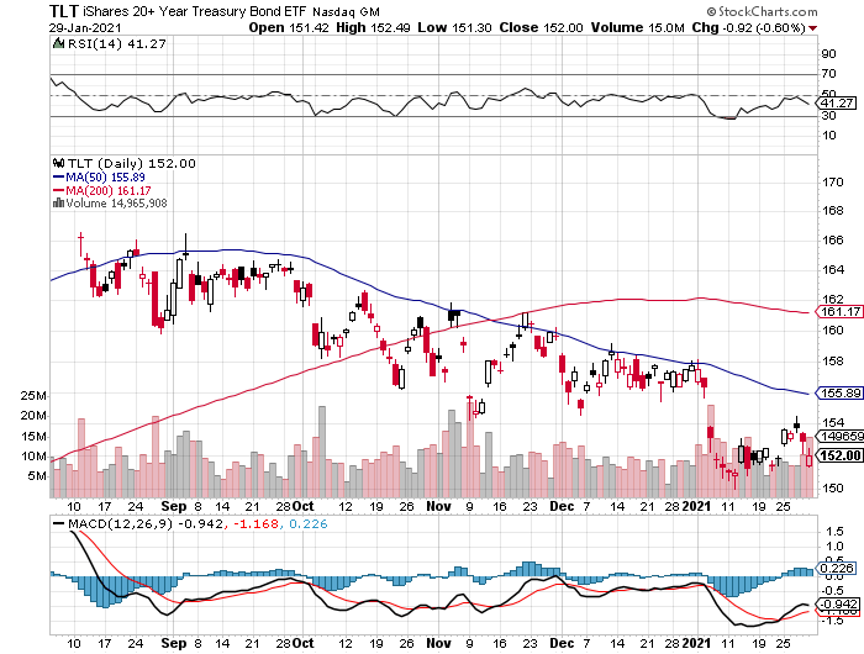
Several brokers banned trading in the name and the SEC is all over this like a wet blanket. Trading is halted due to an excess of sell orders. The problem is that funds are selling real stocks to cover the losses we own, like JP Morgan (JPM) and Tesla (TSLA) and short (TLT).

In the meantime, the action has moved over the American Airlines (AA), which has soared by 50%. AMC Entertainment Holdings (AMC) saw a 400% pop, but I haven’t seen anyone rushing back into theaters to watch Wonder Woman. Blame Jay Powell for flooding the financial system with mountains of cash seeking a home. There is so much money in circulation that traders are invented asset classes to put it into. This can’t last. Buy the dip.

Here are the best short squeeze targets with the greatest outstanding short interests. GameStop (GME) tops the list with an eye-popping 139% short interest, followed by Bed Bath & Beyond (BBBY) (67%) and Ligand Pharmaceutical (LGND) (64%). National Beverage (FIZZ), The Macerich Company (MAC), and Fubo TV (FUBO) bring up the rear. These are all failed companies in some form or another, which is why hedge funds had such large short positions.

New Home Sales disappointed in December, up only 1.6% to 842,000 units. This is on a signed contract basis only. Affordability is the big issue caused by high prices. Who buys a house at Christmas anyway?

Case Shiller soared by 9.5% in November, the fastest home price appreciation in history. Phoenix (13.8%), Seattle (12.7%), and San Diego (12.3) were the big movers. Blame a long-term structural housing shortage, a huge demographic push from Millennials, near-zero interest rates, and a flight from the cities to larger suburban homes. The Pandemic is keeping millions of homes off the market.

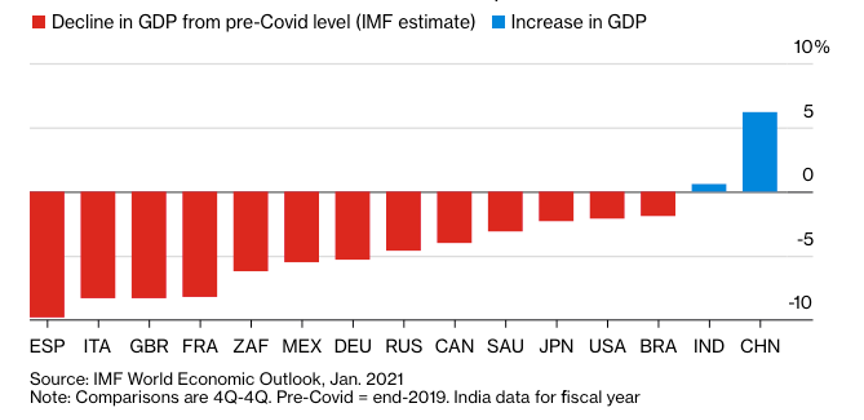
US GDP
may reach pre-pandemic high by end of 2021, it the vaccine gets distributed to every corner of the nation and aggressive stimulus packages pass congress. Growth should come in at a minimum of 5% or higher this year, wiping out last year’s disaster. Keeping interest rates near zero will be a big help, as Treasury Secretary Yellen is determined to do. China and India are already there.

Share Buybacks have returned, the catnip of share prices. Q4 saw a jump to $116 billion from $102 billion in Q2, and this year, banks now have free reign to buy back their own shares. That’s still below the $182 billion seen in Q4 2019. It can only mean that share prices are rising further.

California
lifts stay-at-home regulations, enabling restaurants to open after a nearly two-month shutdown. It’s the first ray of hope that the pandemic will end by summer. It will if Biden hits his 1.5 million vaccinations a day target.

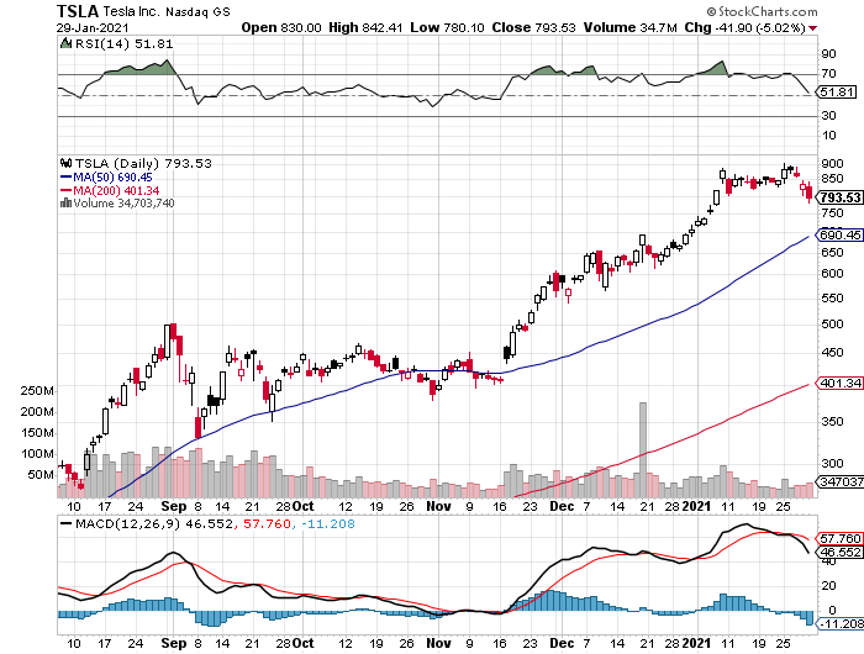
Tesla posts sixth consecutive profit quarter, taking the stock down $60 in the aftermarket momentarily on a classic “buy the rumor, sell the news” move. The once cash-starved company now has an eye-popping $19.4 billion in reserves. Revenues reached a massive $10.7 billion, better than expected. Gross margins reached 19.2%. Looking for 50% annual growth for several years. Shanghai, Berlin, and Austin will make their first deliveries this year. Cash flow is at $19.4 billion, enough to build six more factories. No short sellers left here. It’s a perfect entry point for a LEAP. Buy the March 2023 $1,150-$1,200 call spread for a ten bagger.

Space X
rocket carries 143 spacecraft into space. The Falcon 9 rocket set a new record with new satellites launched at once. Yes, you too can put 200kg into orbit for only $1 million. Many are from small tech startups selling various types of data. Elon Musk’s hobby, now worth $20 billion according to its government contracts, could be his next IPO. Don’t pass on this one!

When we come out the other side of pandemic, we will be perfectly poised to launch into my new American Golden Age, or the next Roaring Twenties. With interest rates still at zero, oil cheap, there will be no reason not to. The Dow Average will rise by 400% to 120,000 or more in the coming decade. The American coming out the other side of the pandemic will be far more efficient and profitable than the old. Dow 120,000 here we come!

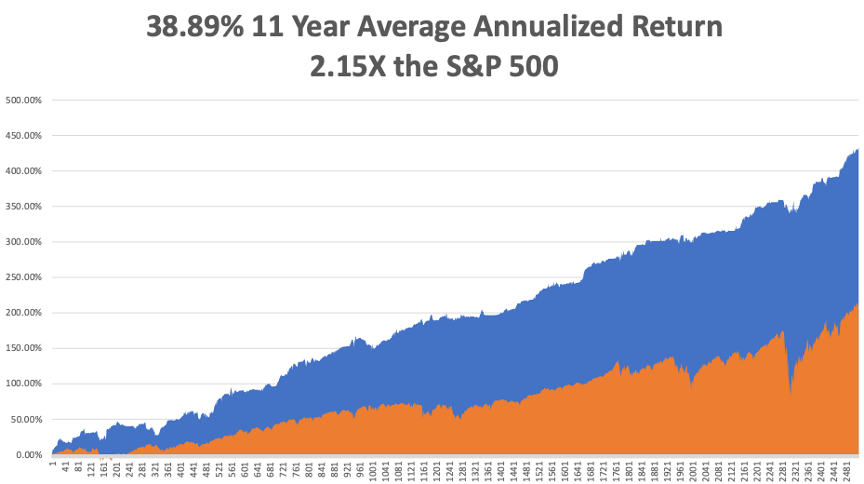
My Mad Hedge Global Trading Dispatch earned a blockbuster 10.21% in January, versus a Dow Average that is now down in 2021. This is my third double-digit month in a row.

I used the market selloff to take substantial profits in my short (TLT) holdings and buy new longs in Boeing (BA) and Morgan Stanley (MS). I rolled the strikes down on my JP Morgan (JPM) long by $10.

That brings my eleven-year total return to 432.76%, some 2.15 times the S&P 500 over the same period. My 11-year average annualized return now stands at a nosebleed new high of 38.85%, a new high.

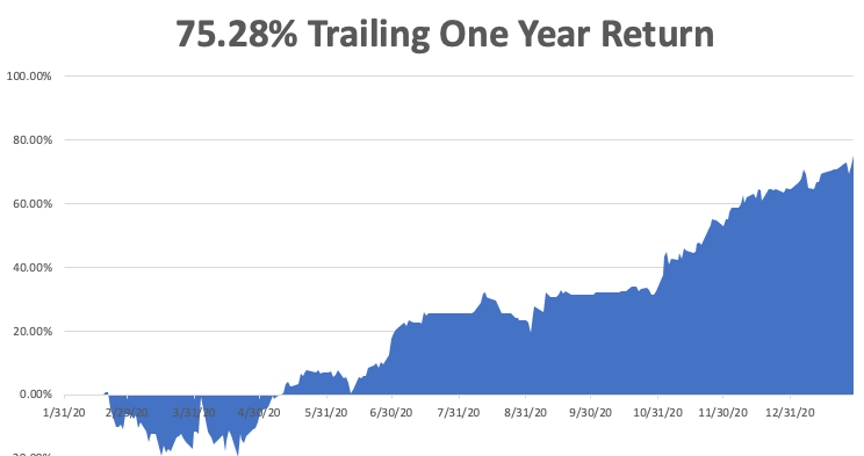
My trailing one-year return exploded to 75.28%, the highest in the 13-year history of the Mad Hedge Fund Trader. We have earned 91.43% since the March 20 2020 low.

We need to keep an eye on the number of US Coronavirus cases at 26 million and deaths at 440,000, which you can find here. We are now running at a staggering 3,800 deaths a day.

The coming week will be all about the monthly jobs data.

On Monday, February 1 at 9:45 AM EST, the Markit Manufacturing PMI for January is out. Caterpillar (CAT) announces earnings.

On Tuesday, February 2 at 7:00 AM, Total Vehicle Sales for January are published. Alphabet (GOOG) and Amgen (AMGN) report.

On Wednesday, February 3 at 8:15 AM, the ADP Private Employment Report is published. QUALCOMM (QCOM) reports.

On Thursday, February 4 at 9:30 AM, Weekly Jobless Claims are printed. Gilead Sciences (GILD) reports.

On Friday, February 5 at 9:30 AM, the January Nonfarm Payroll Report is announced. At 2:00 PM, we learn the Baker-Hughes Rig Count.

As for me, I am often kept awake at night by painful arthritis and a collection of combat injuries and I usually spend this time thinking up new trade alerts.

However, the other night, I saw a war movie just before I went to bed, so of course, I thought about the war. This prompted me to remember the two happiest people I have met in my life.

My first job out of college was to go to Hiroshima Japan for the Atomic Energy Commission and interview survivors of the first atomic bomb 29 years after the event. There, I met Kazuko, a woman in her late forties who was attending college in Fresno, California in 1941 and spoke a quaint form of English from the period. Her parents saw the war and the internment coming, so they brought her back to Hiroshima to be safe.

Her entire family was gazing skyward when a sole B-29 bomber flew overhead. One second before the bomb exploded, a dog barked and Kazuko looked to the right. Her family was permanently blinded, and Kazuko suffered severe burns on the left side of her neck, face, and forearms. A white summer yukata protected the rest of her, reflecting the nuclear flash. Despite the horrible scarring, she was the most cheerful person I had ever met and even asked me how things were getting on in Fresno.

Then there was Frenchie, a man I played cards with at lunch at the Foreign Correspondents Club of Japan every day for ten years. A French Jew, he had been rounded up by the Gestapo and sent to the Bergen-Belson concentration camp late in the war. A faded serial number was still tattooed on his left forearm. Frenchie never won at cards. Usually, I did because I was working the probabilities in my mind all the time, but he never ceased to be cheerful no matter how much it cost him.

The happiest people I ever met were atomic bomb and holocaust survivors. I guess, if those things can’t kill, you nothing can, and you’ll never have a reason to be afraid again. That is immensely liberating.

Stay healthy.

John Thomas
CEO & Publisher
The Diary of a Mad Hedge Fund Trader


https://www.madhedgefundtrader.com/wp-content/uploads/2021/02/john-thomas-snow-car.png 292 388 Mad Hedge Fund Trader https://madhedgefundtrader.com/wp-content/uploads/2019/05/cropped-mad-hedge-logo-transparent-192x192_f9578834168ba24df3eb53916a12c882.png Mad Hedge Fund Trader2021-02-01 11:02:082021-02-01 11:14:45The Market Outlook for the Week Ahead, or Gamblers Have Entered the Market
Mad Hedge Fund Trader

January 28, 2021

Biotech Letter

Mad Hedge Biotech & Healthcare Letter
January 28, 2021
Fiat Lux

FEATURED TRADE:

(WATCH OUT FOR THESE BUYOUT STOCKS)
(TBIO), (MRNA), (PFE), (BNTX), (SNY), (BLUE), (BMY)

https://madhedgefundtrader.com/wp-content/uploads/2019/05/cropped-mad-hedge-logo-transparent-192x192_f9578834168ba24df3eb53916a12c882.png 0 0 Mad Hedge Fund Trader https://madhedgefundtrader.com/wp-content/uploads/2019/05/cropped-mad-hedge-logo-transparent-192x192_f9578834168ba24df3eb53916a12c882.png Mad Hedge Fund Trader2021-01-28 13:02:542021-01-29 10:37:32January 28, 2021
Mad Hedge Fund Trader

Watch Out for These Buyout Stocks

Biotech Letter

Many predictions this 2021 probably won’t pan out. However, here’s a pretty safe bet: we will see a number of biotechnology company acquisitions this year.

Although it’s not easy to accurately forecast which biotechnology companies will be involved in these deals, there is a handful that qualifies as prime acquisition targets.

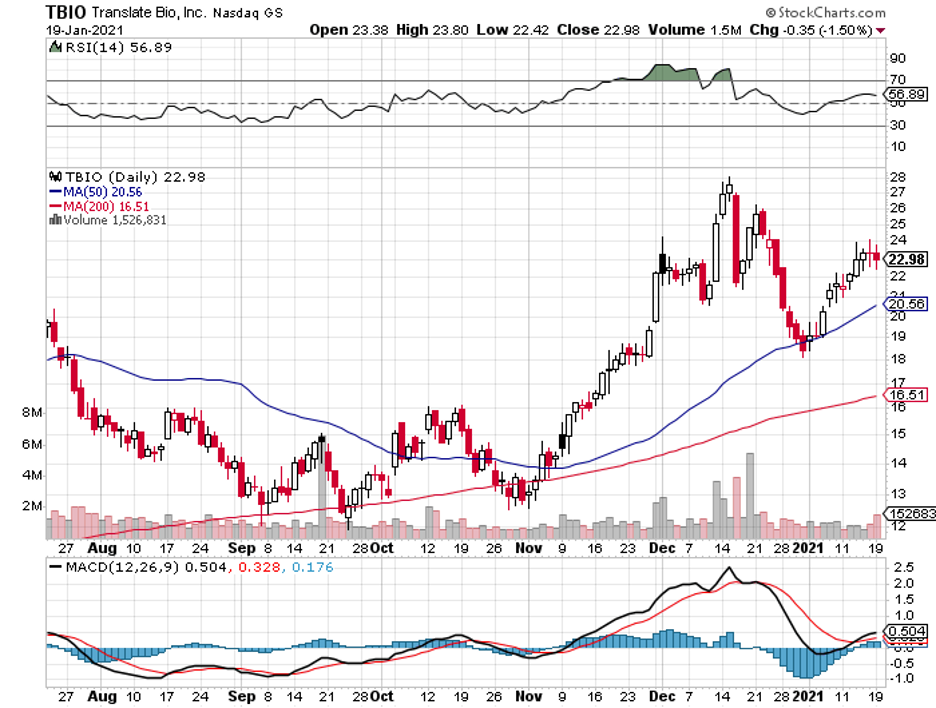
One of the top biotech buyout candidates in my radar this year is Translate Bio (TBIO).

Thanks to the massive success of the COVID-19 programs of Moderna (MRNA), Pfizer (PFE), and BioNTech (BNTX), a spotlight has been cast on the benefits of the messenger RNA (mRNA) technology.

That’s why I wouldn’t be surprised if bigger players in the healthcare industry decide to scoop up smaller players to stake a claim in this quickly growing space.

Among all the small-cap biotechs in play, Translate Bio is easily one of the top prospects.

Before Moderna and BioNTech hogged the spotlight with their mRNA-based COVID-19 vaccines, Translate Bio was actually one of the strong contenders in the race. Unfortunately, it failed to keep up with its peers and is now lagging well behind the leaders.

On the flip side, the attention that mRNA technology has been getting these days seemed to have strengthened the confidence of investors in the technology – an effect that Translate Bio greatly benefited from in the past months.

Despite its lagging performance in the COVID-19 race, Translate Bio has been making significant progress with its work with partner Sanofi (SNY) on their own candidate, MRT5500. If all goes well, then the product should be out by the first quarter of 2021.

Apart from that, the two have been focusing on different vaccine candidates for other viral and bacterial diseases.

Translate Bio’s pipeline also includes treatments targeting another lucrative market using the same MRT platform technology as MRT5500: cystic fibrosis (CF).

The company’s CF treatment has been causing excitement among investors because instead of offering invasive therapy, this option offers patients an inhaled version of the mRNA drug as treatment.

Moreover, the MRT platform technology of Translate Bio could be expanded to cover more than just CF – a promising diversification that encouraged big investors like Sanofi to continuously pour money into collaborations with this Massachusetts-based biotech.

As mRNA technology gains more traction, Sanofi might even reevaluate its relationship with Translate Bio and decide that it wants more than just a collaboration.

With the smaller biotech company’s modest market capitalization of only a little over $1.7 billion, an acquisition could be on the table sooner rather than later.

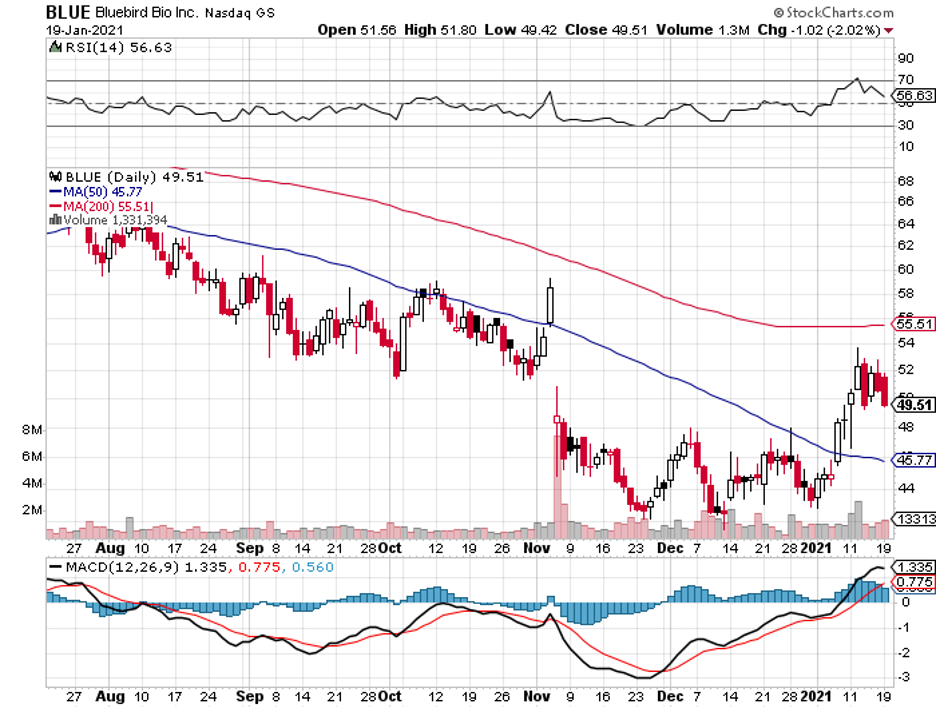
Another potential buyout candidate is Bluebird bio (BLUE).

Unlike its contemporaries in the biotech space, Bluebird shares plunged by nearly 50% in 2020.

Although the company offers a promising upside potential, it can’t seem to generate sufficient enthusiasm to take part in the biotech sector’s rally last year.

In fact, Blue stock continued to hover near its 52-week low despite several gene and cell therapy tickers reaching all-time highs.

While that’s obviously bad news for Bluebird shareholders, I think this makes the company an even more attractive acquisition candidate.

I think it’s important to determine the reasons behind Bluebird’s abysmal 2020 performance.

The stock had a rocky start last year, with the COVID-19 pandemic exacerbating its overall meltdown.

One of Blue’s major roadblock was its failure to secure approval from the FDA for its multiple myeloma treatment, which it has been working on with Bristol Myers Squibb (BMY).

Then, it delayed its submission for approval of its sickle cell disease treatment LentiGlobin. This was initially set for the second half of 2021 but was pushed to late 2022.

The main takeaway from this streak of negative updates is that Blue still doesn’t have its act together when it comes to dealing with regulatory approval processes.

Regardless, the potential of this biotech’s pipeline remains impressive.

Apart from its work with Bristol and LentiGlobin, Bluebird has been working on a late-stage candidate for treatment of a rare metabolic disorder called cerebral adrenoleukodystrophy with Lenti-D.

Prior to its partnership with Bristol, Bluebird was actually partnered with Celgene.

When Celgene was bought by Bristol in 2019, the bigger company continued the collaboration with Blue and expanded the partnership to cover more genetic disorders and extend to oncology treatments.

Due to the setbacks, Bluebird’s market capitalization now hovers somewhere near $3 billion.

Given all these pipeline candidates and its future plans, I suspect it wouldn’t take long before a major player takes notice of this attractive valuation and puts this bird in a cage.

Overall, both Translate Bio and Bluebird are solid companies in the biotechnology space.

While the COVID-19 pandemic slowed down some of their progress, the products in their pipelines could yield substantial value to interested acquisition partners.


https://madhedgefundtrader.com/wp-content/uploads/2019/05/cropped-mad-hedge-logo-transparent-192x192_f9578834168ba24df3eb53916a12c882.png 0 0 Mad Hedge Fund Trader https://madhedgefundtrader.com/wp-content/uploads/2019/05/cropped-mad-hedge-logo-transparent-192x192_f9578834168ba24df3eb53916a12c882.png Mad Hedge Fund Trader2021-01-28 13:00:462021-01-30 23:25:21Watch Out for These Buyout Stocks
Mad Hedge Fund Trader

January 26, 2021

Biotech Letter

Mad Hedge Biotech & Healthcare Letter
January 26, 2021
Fiat Lux

FEATURED TRADE:

(EMERGING COVID-19 ALLIANCES)
(CVAC), (PFE), (MRNA), (TSLA), (NVAX), (JNJ), (SNY), (GSK), (BAYN)

https://madhedgefundtrader.com/wp-content/uploads/2019/05/cropped-mad-hedge-logo-transparent-192x192_f9578834168ba24df3eb53916a12c882.png 0 0 Mad Hedge Fund Trader https://madhedgefundtrader.com/wp-content/uploads/2019/05/cropped-mad-hedge-logo-transparent-192x192_f9578834168ba24df3eb53916a12c882.png Mad Hedge Fund Trader2021-01-26 12:04:242021-01-26 12:51:27January 26, 2021
Mad Hedge Fund Trader

Emerging COVID-19 Alliances

Biotech Letter

Tesla (TSLA) has been sizzling hot for months now, and it looks like its Midas touch has reached the biotechnology world.

It seems that almost everything linked to Tesla achieves success. That could indicate terrific news for a particular biotech: CureVac (CVAC).

CureVac, an under-the-radar biotech stock, is closing in on the leading COVID-19 vaccine developers today.

A differentiating factor it has from the likes of Pfizer (PFE), BioNTech (BNTX), and Moderna (MRNA) is its bonafide tie-in with Tesla. Although it sounds like quite a stretch for an electric car company to have any involvement with a biotech stock, the connection actually makes sense.  

Like Moderna and BioNTech, CureVac has also been working on utilizing messenger RNA (mRNA) technology to develop various vaccines and other treatments. If all goes well, this could even lead to finding a way to immunize people against cancer.

Where does Tesla come in?

It all started in 2019 when CureVac was awarded $34 million in funding by the Coalition for Epidemic Prepared Innovations (CEPI).

The goal was to create and eventually build a prototype of an mRNA “printer.” This high-tech tool would be used to produce mRNA doses in areas that suffer from viral outbreaks. It could be used by hospitals to create personalized medicines.

Having an mRNA printer would be groundbreaking in fighting off viral diseases, particularly in remote regions. As expected, this project faced many technology obstacles along the way.

Here’s where Tesla can offer a solution since one of the companies it acquired in the past years is Grohmann Engineering, which specializes in automated manufacturing.

This makes Tesla Grohmann Automation the logical partner for CureVac to turn for help in building its mRNA printer prototype.

What we know so far is that the two companies have been working closely on the project.

It’s only a matter of time before we find out if Tesla’s magic would once again blow our expectations out of the water and we are presented with yet another breakthrough.

Other than its alliance with Tesla in the mRNA race, CureVac has forged another partnership to transform itself into a stronger candidate in the COVID-19 vaccine competition.

CureVac has tapped into the global reach of Bayer (BAYN) to help it distribute its vaccine once it gains approval.

In terms of its own COVID-19 vaccine candidate, CureVac is anticipated to release positive results.

This is because its technology closely mirrors that used by Moderna and BioNTech, which strongly indicates that the efficacy levels could be just as good.

However, CureVac’s vaccine candidate offers a competitive advantage over the others: it doesn’t require cold storage.

This means it would be easier and more convenient to distribute it compared to Moderna’s and Pfizer’s.

It also requires a much smaller dose compared to Moderna’s COVID-19 vaccine candidate. This translates to cheaper manufacturing costs.

CureVac has secured a deal with the EU to deliver an initial 405 million doses for half of the year plus 300 million doses more in 2021 alone. It also agreed to produce 600 million doses in 2022.

Meanwhile, its alliance deal with Bayer indicates that it has secured a powerful distribution partner.

Therefore, we could expect CureVac to leverage Bayer’s global supply network to deliver its vaccines worldwide.

However, CureVac and Bayer are thinking way ahead of 2022.

The alliance formed by the two companies sees to it that the CureVac vaccine candidate would become the strongest contender in the post-pandemic years.

As per Bayer’s projection, the companies estimate 12 billion to 14 billion vaccine doses just to bring this pandemic under control.

Considering that COVID is expected to become an endemic disease, annual or even bi-annual vaccination programs would become the norm.

While Pfizer, Moderna, and AstraZeneca have been well ahead of the vaccine race, the door is still firmly open for other developers like Novavax (NVAX), Johnson & Johnson (JNJ), GlaxoSmithKline (GSK), Sanofi (SNY), and, of course, CureVac to launch their own COVID-19 vaccines. 

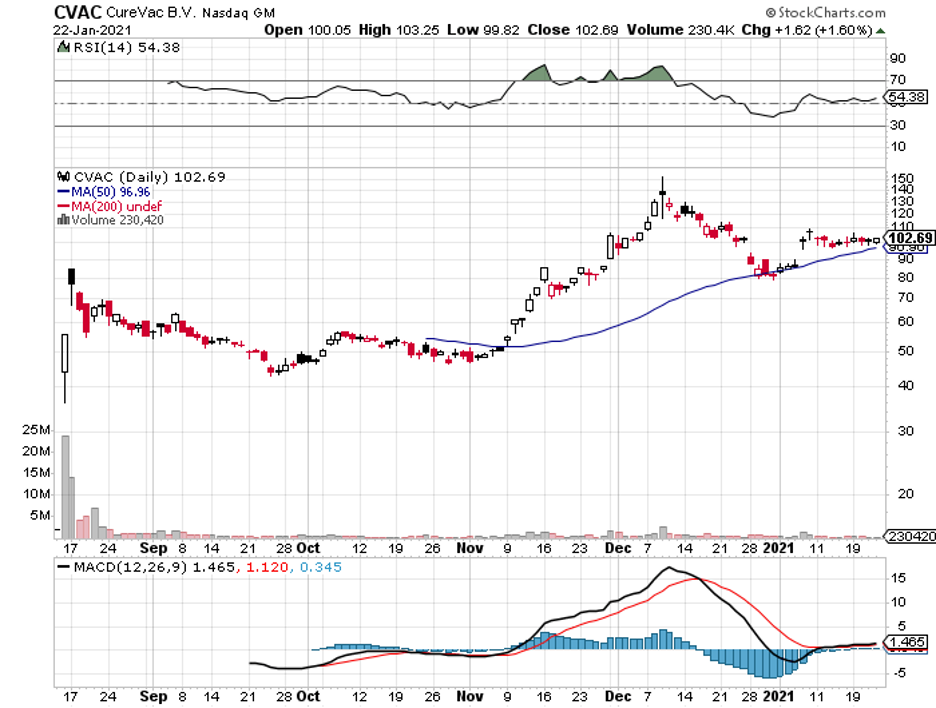
Only going public in August 2020, this German biotech company already has $18.2 billion in market capitalization.

Its public offering of 15.3 million shares sold at $16 each generated $245.3 million for the company back in August.

By early December 2020, CureVac shares were already being traded somewhere around $150 as investors quickly began to realize the value proposition.

If I am to look to invest in a COVID-19 vaccine developer at this point, CureVac would surely be one of my choices.

curevac

https://madhedgefundtrader.com/wp-content/uploads/2019/05/cropped-mad-hedge-logo-transparent-192x192_f9578834168ba24df3eb53916a12c882.png 0 0 Mad Hedge Fund Trader https://madhedgefundtrader.com/wp-content/uploads/2019/05/cropped-mad-hedge-logo-transparent-192x192_f9578834168ba24df3eb53916a12c882.png Mad Hedge Fund Trader2021-01-26 12:00:182021-01-27 20:09:34Emerging COVID-19 Alliances
Mad Hedge Fund Trader

January 21, 2021

Biotech Letter

Mad Hedge Biotech & Healthcare Letter
January 21, 2021
Fiat Lux

FEATURED TRADE:

(IS JOHNSON & JOHNSON THE BEST CORONAVIRUS STOCK?)
(JNJ), (MRNA), (PFE), (AZN), (NVAX)

https://madhedgefundtrader.com/wp-content/uploads/2019/05/cropped-mad-hedge-logo-transparent-192x192_f9578834168ba24df3eb53916a12c882.png 0 0 Mad Hedge Fund Trader https://madhedgefundtrader.com/wp-content/uploads/2019/05/cropped-mad-hedge-logo-transparent-192x192_f9578834168ba24df3eb53916a12c882.png Mad Hedge Fund Trader2021-01-21 14:02:222021-01-21 14:20:19January 21, 2021
Mad Hedge Fund Trader

Is Johnson & Johnson the Best Coronavirus Stock?

Biotech Letter

To date, some coronavirus vaccine stocks have managed to offer investors huge gains within short periods.

Moderna (MRNA) is a prime example, climbing to over 400% in 2020 as more and more investors bet on the biotech’s COVID-19 program.

Interestingly, Pfizer (PFE) fell by less than 1% during the same period despite the fact that both companies led the COVID-19 vaccine race.

Actually, it was Pfizer that eventually won the first Emergency Use Authorization.

Investing in COVID-19 vaccines brought about vastly different outcomes.

Now, let’s take a look at the next company to potentially enter the market: Johnson & Johnson (JNJ).

At the moment, JNJ’s candidate is in Phase 3 trials. What makes this trial interesting is the dosing regimen.

JNJ is evaluating two options in its Phase 3 trials.

The first option, called “Ensemble,” studies the effect of a single dose of its COVID-19 vaccine.

The second option, “Ensemble 2,” examines how the vaccine works when administered in two doses.

Results are expected to be released before January 2021 ends.

If all turns out positive, then JNJ will be the third company to cross the COVID-19 vaccine race finish line.

Both Moderna and Pfizer require two doses. Even its close-to-market competitors like AstraZeneca (AZN) and Novavax (NVAX) have developed two-dose products.

Needless to say, a proven safe and effective one-dose regimen would provide JNJ’s vaccine a significant competitive advantage.

Obviously, people would prefer the idea of a one-jab vaccine instead of getting two. More importantly, this regimen would make it easier to vaccinate more individuals.

For example, Moderna’s goal is to supply 1 billion doses in 2021. However, that will only cover half or 500 million people.

In comparison, JNJ’s promise of producing 1 billion doses per year will be sufficient to immunize 1 billion individuals.

Another advantage is JNJ vaccine’s storage requirement.

Unlike Pfizer and Moderna’s vaccines, JNJ’s candidate can be stored at refrigerator temperatures for at least 3 months.

Taking all these into consideration, JNJ’s vaccine is looking promising.

Now, let’s check out its revenue potential.

Taking cue from AstraZeneca, JNJ has announced its decision to offer its vaccine on a not-for-profit basis during the COVID-19 pandemic.

This means it plans to sell the product at cost.

Without any profit from this venture, we can’t count on the COVID-19 vaccine to add to the company’s earnings in the near future.

Post-pandemic, though, the company could eventually raise the price and start benefiting from its sales.

While there’s no definitive timeline, this could be around the later parts of 2021. Based on that prediction, JNJ could start benefiting from its COVID-19 vaccine sales by early 2022.

JNJ can easily become a leader in the coronavirus market if its one-dose vaccine gains regulatory approval from health agencies across the globe.

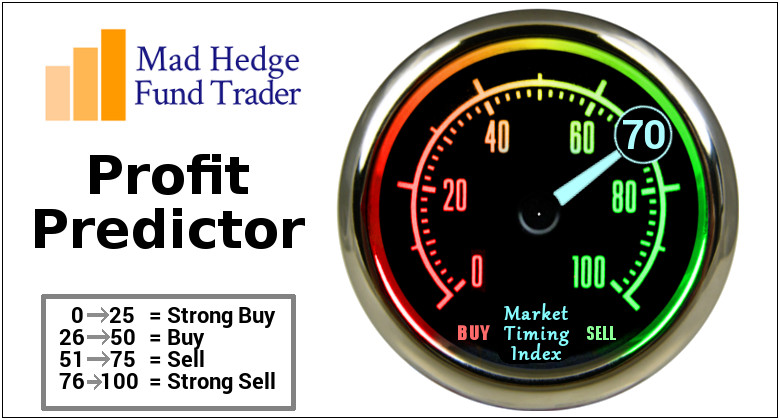
However, I don’t expect major gains in its share price even if it does happen.

From what I’ve observed so far with Moderna and Pfizer, the shares of clinical-stage biotechnology companies tend to soar while those of bigger biopharmaceutical counterparts do not.

That’s most likely because the smaller companies will rely heavily on the COVID-19 vaccine revenue while the more established companies, with their extensive range of commercialized products, won’t.

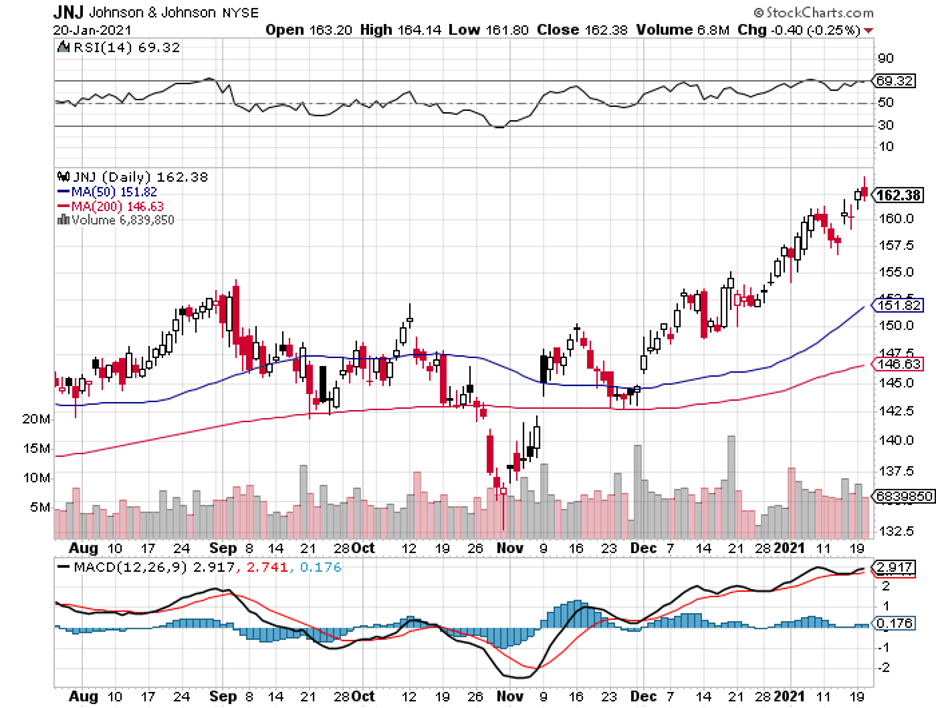
With the sheer size of JNJ, which has a market capitalization of over $427 billion, its shares seldom make huge moves. 

Still, JNJ continues to show incremental and steady growth in profits, revenue, and even share price.

In fact, the company is up by over 10% over the previous year. More importantly, investors can always count on the company for dividends.

So, I wouldn’t buy JNJ shares only for its COVID-19 vaccine candidate. It’s not the best idea to buy a stock because of a single product anyway.

But, I would definitely buy JNJ shares for its overall portfolio and its ever-reliable increasing dividend payouts.

jnj covid

https://madhedgefundtrader.com/wp-content/uploads/2019/05/cropped-mad-hedge-logo-transparent-192x192_f9578834168ba24df3eb53916a12c882.png 0 0 Mad Hedge Fund Trader https://madhedgefundtrader.com/wp-content/uploads/2019/05/cropped-mad-hedge-logo-transparent-192x192_f9578834168ba24df3eb53916a12c882.png Mad Hedge Fund Trader2021-01-21 14:00:552021-01-22 16:41:04Is Johnson & Johnson the Best Coronavirus Stock?
Mad Hedge Fund Trader

January 19, 2021

Biotech Letter

Mad Hedge Biotech & Healthcare Letter
January 19, 2021
Fiat Lux

FEATURED TRADE:

(CAN NOVAVAX EXTEND ITS WINNING STREAK?)
(NVAX), (MRNA), (PFE), (AZN), (BNTX), (BTC)

https://madhedgefundtrader.com/wp-content/uploads/2019/05/cropped-mad-hedge-logo-transparent-192x192_f9578834168ba24df3eb53916a12c882.png 0 0 Mad Hedge Fund Trader https://madhedgefundtrader.com/wp-content/uploads/2019/05/cropped-mad-hedge-logo-transparent-192x192_f9578834168ba24df3eb53916a12c882.png Mad Hedge Fund Trader2021-01-19 15:02:252021-01-20 09:47:17January 19, 2021
Mad Hedge Fund Trader

Can Novavax Extend Its Winning Streak?

Biotech Letter

Would you believe that there was a bigger winner than Bitcoin (BTC) in 2020?

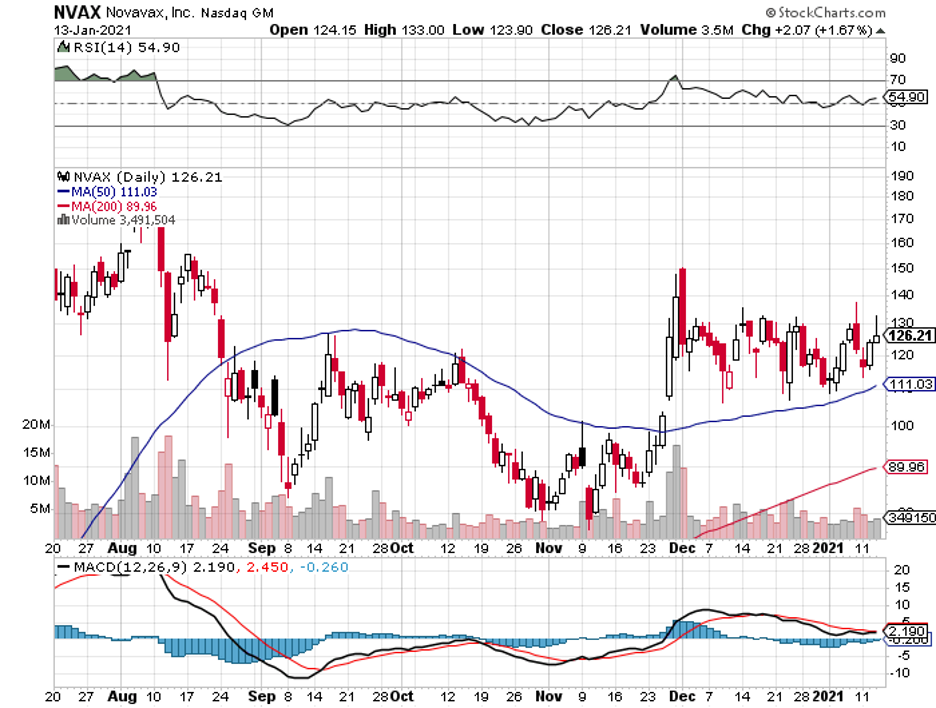
Amid the fanfare generated by COVID-19 vaccine developers like Moderna (MRNA) and Pfizer (PFE), there’s one biotechnology company that has quietly boosted its humble $4 share price to an impressive $128: Novavax (NVAX).

As incredible as that sounds, this isn’t the most unbelievable prediction for Novavax.

Despite recording a jaw-dropping 2,600% increase last year, this Maryland-based biotechnology company is projected to sustain the momentum in 2021 and beyond.

Let me share how Novavax can achieve a long-lasting winning streak.

Unlike Moderna and Pfizer, Novavax did not utilize RNA technology to develop NVX-CoV2373. Instead, the company opted for a more established approach.

The decision to pursue a more established technology could be viewed as a cost-cutting strategy for Novavax.

Doing so means dramatically lowering supply chain pressures, such as storage issues.

In effect, the Novavax vaccine would be the more convenient option that offers an equally potent result.

At this point, Novavax has yet to reveal its Phase 3 trial results. The tests, which involve trials in the UK, would prove to be the turning point for the company’s future.

Here’s a rough estimate of how the results could affect Novavax shares.

If the results show that NVX-CoV2373 is 90% effective, this would put the vaccine in the same league as Pfizer and Moderna. Consequently, shares will go up by 30% with this news.

Meanwhile, an efficacy result clocking in at less than 80% would have the stock falling by up to 20% primarily due to the strong competition in the COVID-19 market.

Approximately $40 billion in COVID-19 revenue is at stake this year.

While competitors Pfizer, Moderna, and AstraZeneca (AZN) have already had their vaccines approved for emergency use, Novavax still has a strong chance of getting a piece of the action.

Despite these candidates getting rolled out in other countries, Novavax’s NVAX-CoV2373 remains a heavy favorite among experts and analysts alike.

At this rate, NVX-CoV2373 could generate at least $4 billion of the $40 billion COVID-19 market in 2021.

Considering that Novavax has an $8 billion market capitalization, this alone more than justifies the company’s valuation.

Admittedly, Pfizer and Moderna hold the competitive advantage in being the first to market. It wouldn’t be surprising if both would end up gobbling up market share while Novavax awaits regulatory approval.

More importantly, both have achieved the coveted name recognition when it comes to COVID-19 vaccine so that could offer them power in the soon-to-be-crowded marketplace down the road.

However, both vaccine leaders have a considerable drawback.

Their vaccines require extremely delicate storage and transportation.

In fact, Pfizer and BioNTech’s (BNTX) BNT162b2 must be stored at minus 94 degrees—a requirement that not all countries, much less commercial distributors could adhere to.

This is where Novavax’s vaccine comes in.

NVX-CoV2373 can be stored and transported at refrigerated temperatures. This means it would be easier to distribute particularly in remote areas.

Any hiccups with storage or transportation involving the Moderna or Pfizer vaccines could offer Novavax an opening to generate vaccine sales that would otherwise no longer be available.

This scenario would translate to a more dominant presence of Novavax in the second half of 2021 until the early part of 2022.

Pfizer and Moderna may have been the first to market, but Novavax’s vaccine holds the potential to generate a sizable impact on sales over the long term.

In terms of revenue, the vaccine would be a significant boost for Novavax. It would transform from a zero product revenue to billions in a short period.

While Novavax has yet to announce the official pricing for the product, we can use its US price of $16 per dose as a benchmark for the rest of the contracts.

So far, Novavax has secured roughly orders for 300 million doses in the US alone. This would amount to $4.8 billion in sales—and all signs point to the number climbing higher this year.

Novavax has been ramping up its capacity to produce as many as 2 billion doses by mid-2021.

In comparison, Pfizer has a maximum capacity of 1.3 billion doses this year while Moderna would peak at 1 billion.

Evidently, Novavax holds an edge over the two companies in terms of capacity to fill orders.

Outside its COVID-19 efforts, Novavax has another potential blockbuster in its pipeline.

Although data is sparse, the company is expected to file for regulatory approval for its experimental flu vaccine called NanoFlu.

Oddly enough, NanoFlu was the reason that Novavax trounced the cryptocurrency surges in 2020.

Investors got all fired up following the promising showing of the flu vaccine candidate, with the stock gaining unprecedented attention when it reported remarkable results in a head-to-head study against the leading flu vaccine in the market today, Sanofi’s (SNY) FluZone Quadrivalent.

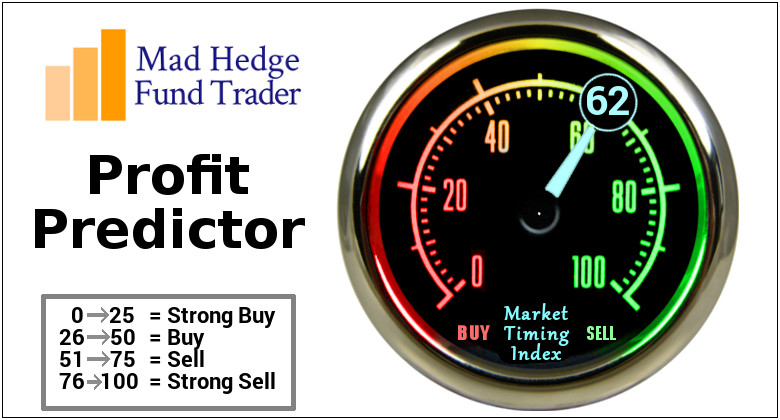
With all these in mind, Novavax’s earnings outlook is showing strong signs of even more stellar and stronger performance than that of Moderna this year.

So far, earnings per share for Novavax this year is estimated at $21 while Moderna’s is $10.

Another possible game-changer for Novavax is its plan to combine a flu-coronavirus vaccine to be marketed post-pandemic.

Before making any moves though, it’s important to invest in Novavax with all the facts out in the open.

Inasmuch as it’s a promising stock, this is still a risky investment. This means that only aggressive investors should consider buying this biotechnology stock.

In a number of ways, Novavax and Bitcoin share some similarities.

Both are speculative assets that could either skyrocket or sink. They’re extremely attractive to aggressive investors on the lookout for big wins but also unafraid of massive risks.

The main difference is that with Novavax, it’s simpler to understand the reason for its rise or fall.

The potential drivers for its success or failure appear to be less cryptic than those behind the cryptocurrency.

novavax vaccine

https://madhedgefundtrader.com/wp-content/uploads/2019/05/cropped-mad-hedge-logo-transparent-192x192_f9578834168ba24df3eb53916a12c882.png 0 0 Mad Hedge Fund Trader https://madhedgefundtrader.com/wp-content/uploads/2019/05/cropped-mad-hedge-logo-transparent-192x192_f9578834168ba24df3eb53916a12c882.png Mad Hedge Fund Trader2021-01-19 15:00:192021-01-21 21:44:09Can Novavax Extend Its Winning Streak?
Mad Hedge Fund Trader

January 14, 2021

Biotech Letter

Mad Hedge Biotech & Healthcare Letter
January 14, 2021
Fiat Lux

FEATURED TRADE:

(ARE THESE THE NEW NEUROSCIENCE TRAILBLAZERS?)
(LLY), (BIIB), (MRNA), (DNA)

https://madhedgefundtrader.com/wp-content/uploads/2019/05/cropped-mad-hedge-logo-transparent-192x192_f9578834168ba24df3eb53916a12c882.png 0 0 Mad Hedge Fund Trader https://madhedgefundtrader.com/wp-content/uploads/2019/05/cropped-mad-hedge-logo-transparent-192x192_f9578834168ba24df3eb53916a12c882.png Mad Hedge Fund Trader2021-01-14 14:02:392021-01-14 16:32:55January 14, 2021
Page 18 of 27«‹1617181920›»

tastytrade, Inc. (“tastytrade”) has entered into a Marketing Agreement with Mad Hedge Fund Trader (“Marketing Agent”) whereby tastytrade pays compensation to Marketing Agent to recommend tastytrade’s brokerage services. The existence of this Marketing Agreement should not be deemed as an endorsement or recommendation of Marketing Agent by tastytrade and/or any of its affiliated companies. Neither tastytrade nor any of its affiliated companies is responsible for the privacy practices of Marketing Agent or this website. tastytrade does not warrant the accuracy or content of the products or services offered by Marketing Agent or this website. Marketing Agent is independent and is not an affiliate of tastytrade. 

Legal Disclaimer

There is a very high degree of risk involved in trading. Past results are not indicative of future returns. MadHedgeFundTrader.com and all individuals affiliated with this site assume no responsibilities for your trading and investment results. The indicators, strategies, columns, articles and all other features are for educational purposes only and should not be construed as investment advice. Information for futures trading observations are obtained from sources believed to be reliable, but we do not warrant its completeness or accuracy, or warrant any results from the use of the information. Your use of the trading observations is entirely at your own risk and it is your sole responsibility to evaluate the accuracy, completeness and usefulness of the information. You must assess the risk of any trade with your broker and make your own independent decisions regarding any securities mentioned herein. Affiliates of MadHedgeFundTrader.com may have a position or effect transactions in the securities described herein (or options thereon) and/or otherwise employ trading strategies that may be consistent or inconsistent with the provided strategies.

Copyright © 2025. Mad Hedge Fund Trader. All Rights Reserved. support@madhedgefundtrader.com
Scroll to top