Mad Hedge Technology Letter
October 17, 2018
Fiat Lux
Featured Trade:
(THE SPOTIFY REGIME),
(SPOT), (AAPL), (NFLX), (MSFT), (AMZN), (GS)


Mad Hedge Technology Letter
October 17, 2018
Fiat Lux
Featured Trade:
(THE SPOTIFY REGIME),
(SPOT), (AAPL), (NFLX), (MSFT), (AMZN), (GS)

It’s not earth-shattering to concede that our attention spans have shrunk and as a result, there are unintended consequences.
The various smart devices and other technology vying for a slice of your precious attention have been accepted as the new normal.
Whether it’s binging on Netflix (NFLX) or gaming on a Microsoft Xbox (MSFT), consumers are absorbed obsessively staring into a screen most of the day.
As tech penetrates the core of our existence, the music industry has been the recipient of changes that were hard to fathom just a few years ago.
And as all businesses morph into pseudo-tech enterprises supported by data analytic teams, management is able to unearth some compelling data and utilize it to commercialize the audience.
Spotify (SPOT), the world’s leading music streaming platform, doesn’t monetarily reward music artists unless a stream surpasses a minimum of 30 seconds.
This is just one way that Spotify’s founder and CEO Daniel Ek has changed the music industry.
Think about the implications.
Gone are the elaborate instrumentals to warm listeners up before a catchy chorus hooks you forever.
Songs are entirely front loaded now with the end goal of persuading listeners to not swipe until the 30-second barrier is passed.
Whatever happens after that doesn’t matter – the song might as well go silent because Spotify will pay the artist.
According to Spotify data, Ed Sheeran’s “The Shape of You” is Spotify’s most-streamed song with 1.94 billion listens.
This is just one scant nugget of data in Spotify’s treasure trove of global music data that finely chronicles the state of the music industry and how consumers devour music.
Spotify CFO Barry McCarthy promptly explained the Spotify’s relationship with data and music at the Goldman Sachs’ (GS) Communacopia conference by saying, “The company with the most data wins. The company with the most data insights wins. The company with the engineering culture, software-driven business wins. And that’s the play we’re making.”
In the current tech climate, I will take software over hardware any day of the week.
Hardware sales are a one-off event until the next cycles bring an upgraded iteration which could take years to execute.
Software sales are an annual recurring revenue stream that is as sticky as the software's quality giving hope to company CFO’s of a perpetual income stream.
It doesn’t matter that Spotify isn’t profitable. The end goal isn’t to make money in an industry that is notoriously difficult to combat the royalty expenses eroding 70% of every $1 of revenue.
What has happened is that Spotify is too big to fail and it loves every second of it.
The music industry needs Spotify just as much as Spotify needs the music industry and this awkward partnership is far from a match made in heaven, but it works for the foreseeable future.
It helps that artists, for the most part, have bought into the data-based streaming model.
Music artists have turned into tech-like firms themselves.
Their new goal is to compile an audience then monetize like Spotify itself.
It speaks volumes of how the tech model has penetrated every corner of the world.
Apple (AAPL) is acutely aware of the potency a music streaming service offers and has been investing in Apple Music, its music streaming arm.
Rumors have been swirling that Apple absorbed the entire staff of a music analytics firm called Asaii including the owners, for a tad under $100 million.
This talent grab on the heels of the Shazam purchase indicates that Apple seeks a better understanding of how to curate music playlists and better serve music fans who own Apple devices.
Even though Apple has the second leading music streaming service, they have ceded the battle to Spotify.
CEO of Apple Time Cook is on record saying, “We’re not in it for the money.”
Indirectly, Cook means Apple Music is a loss-making division and he doesn’t care because it is just a small fragment of what makes Apple one of the best companies in the world.
Apple has also commissioned 24 television shows and 2 films costing them $1 billion.
A single billion is peanuts considering the eye-popping amount of Apple’s cash hoard. They can afford to take the long-term view and slowly enhance the ecosystem instead of Spotify whose eggs are all in one basket.
Apple is more concerned about offering iOS users the best experience possible and in return Cook hopes to count on them to use iOS devices for a lifetime.
Apple Music’s biggest weakness is its biggest strength.
In short, Apple music is tailored to the iOS operating system.
If you sign up, the app directs users to sign up for an Apple ID if you do not already have one.
Android lovers have little interest in signing up for Apple Music considering they do not have an Apple device and then must pay $9.99 per month after the introductory 3-month offer expires when Spotify is free. It’s not worth the extra hassle.
It is almost certain that Spotify will enact an Android operating system pivot to build a moat around its business and that is something Apple cannot do.
Spotify will start partnering with Samsung, Microsoft, and the Android-based Asian manufacturers to focus on monetizing the Android audience and make it even more inconvenient for listeners to access Apple Music.
Signing up for Spotify and listening to its ad-free subscription without creating an Apple ID is more appealing.
And after three months, users have the option to continue a free version of Spotify, albeit with digital ads popping up.
This leads me to the belief that there is definitely space for more than one player in the music streaming industry.
Amazon is another tech firm who has a music streaming service but are more concerned if they convert users into prime memberships.
If compiling the most music data wins out, then Spotify is in the lead with its 83 million paid users and 101 million free users.
Apple trails in second place with 50 million users which is still an extraordinary number of listeners and easily monetizable.
The way music streaming platforms works is that users are more likely to listen to the most popular artists and songs and not look for an adventure.
The app is merely there to locate the songs they already like or click on a recommendation produced by an algorithm.
It’s not like going out on a Friday night to experience some unknown singer in a grunge basement and becoming a new fan. Users know what they want, and they desire to access it. Such is the nature of internet search.
Spotify’s data shows that out of 3 million artists on the platform, 200,000 artists receive 70% of the music streams, clearly segmenting the haves and have-nots.
The rest of the 2.8 million are struggling to be discovered and cannot cut a wage off of Spotify’s platform.
Online music streaming products also align perfectly well with artificial intelligence-based voice activation technology.
These services will deeply integrate this technology into its services as they desire to ramp up the quality of services.
As for the music streaming business hopefuls, it's game over as the three major players have the leverage to put out any fires that crop up.
When you break it down, Spotify has a 180 million user audience growing at 30% YOY and is hellbent on becoming profitable.
As they enhance the platform’s tools and services, gradually expect more subscription-based products to entertain users.
And even if Spotify doesn’t become profitable as soon as they would like, the aggregate hoard of data will multiply in value.
Spotify is already the most prized music asset in the world with a market cap of $26 billion, about $10 billion higher than all global music revenues.
Yes, Spotify destroyed album artwork and its audio quality of 320 kilobits per second is no match for CD-quality audio. But this is the world we live in today and Daniel Ek’s Spotify is the 800-pound gorilla in the room.
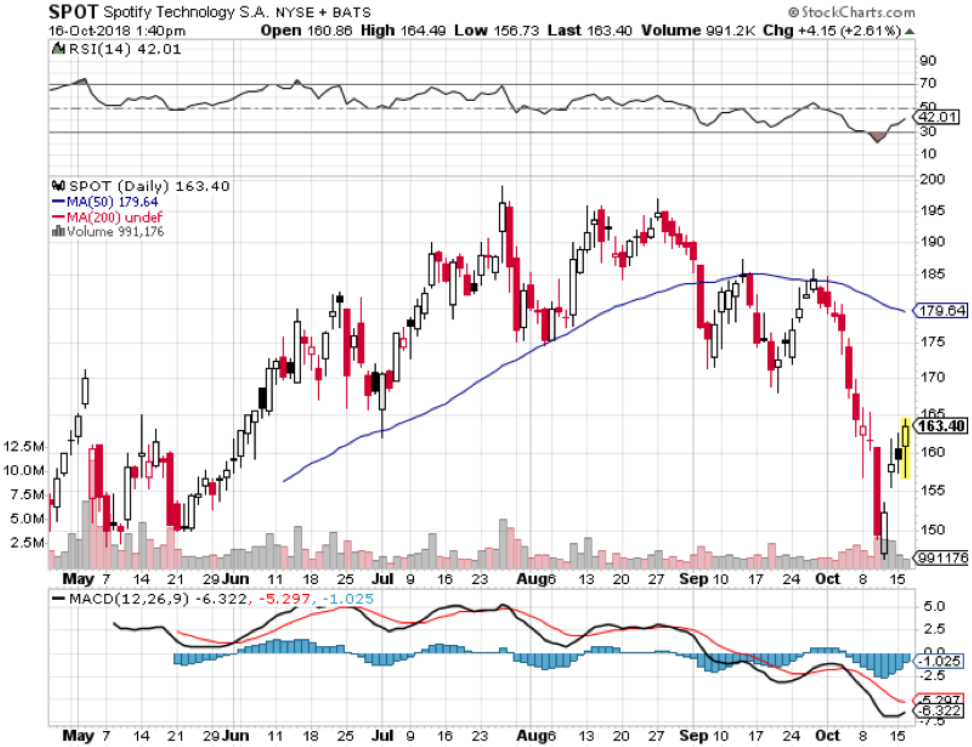
Spotify is a great long-term buy-and-hold asset. Take the latest weakness to add to your position.

Mad Hedge Technology Letter
October 16, 2018
Fiat Lux
Featured Trade:
(IS IT REALLY ESSENTIAL OR NOT?),
(AAPL), (GOOGL), (MSFT), (AMZN)

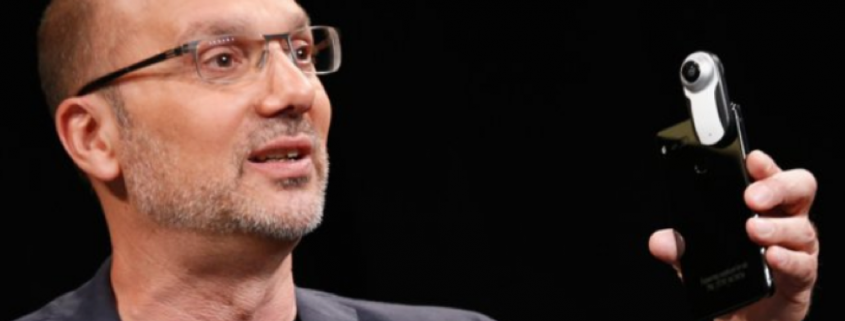
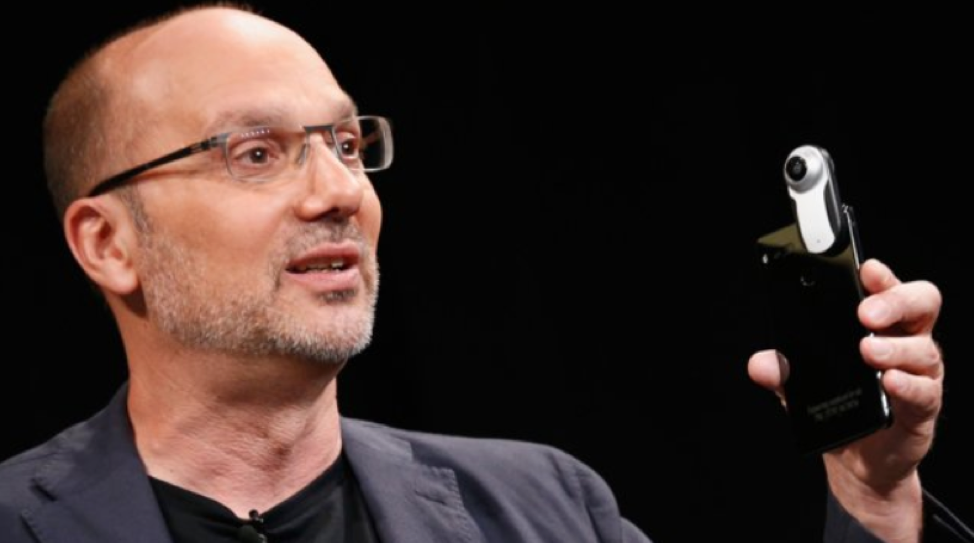
He is at it again.
No, not Elon Musk, but Andy Rubin – the Godfather of the Android operating system could create another ground-breaking shift in the world of technology.
Apple’s (AAPL) iOS system was the leader of the pack until Rubin’s timely intervention.
When Apple debuted the iPhone and, shortly after, the Apple app store, there was nothing remotely comparable at the time.
The roaring success of the iPhone and its app store could have been so much more to the global smartphone audience if it consumed everybody.
You could smell broad-based world domination, but it never materialized.
Android now has 85% of the global smartphone market share, and Apple has carved out the last 15% albeit in the high-income markets.
You can thank Microsoft (MSFT) for all of this – let me explain.
Android was hands down the best purchase ever made by Google for a paltry sum of just $50 million.
It was in 2005 when Android was bought by Google and Rubin’s work commenced overseeing the construction of a platform that could avoid licensing restrictions dragging down the industry.
Android was initially commissioned by Google to build a platform to stymie another potential Microsoft monopoly, but this time, in the mobile space.
Google didn’t want to be blown away by Microsoft as the pivot to mobile was picking up steam.
Google assumed that Microsoft had the best chance to execute the shift to mobile because of the universal acceptance of the Windows operating system.
And little did they know that Steve Jobs had a game changer up his sleeve when he rolled out the iPhone.
The premise was very simple for Android - offer supreme customer value, massively scale a global platform, and catalyze explosive growth.
Easier said than done.
In the end, Rubin was able to generate a blanketed adoption of the Android operating system in smartphones.
Apple has been, by and large, the victor of hardware because even though the Android system is more popular, the manufacturer of Android-based phones cuts across a broad swath of different international companies from Google itself to Samsung, LG, and the various Chinese makers.
Around half of Americans are proud to be an iPhone owner and Apple was able to ensure they were the only manufacturer of their proprietary iOS system harvesting all the profits.
Onlookers aren’t giving Android the credit it duly deserves in the global scheme of things.
Fortunately for Google and Rubin, Microsoft CEO Steve Ballmer fudged his opportunity while Palm, Symbian, and BlackBerry never stuck around either for recorded posterity. It could of easily have gone the other way.
Android has become so entrenched in non-iPhone smartphones that Google was fined $5 billion for being too dominant in Europe or for what regulators tout as illegally cementing their position. The battle is still going on in court with a final verdict coming shortly.
What does Rubin have on the menu this time?
After establishing his own private company to battle the tech Goliaths, he built an initial smartphone that was an unmitigated flop.
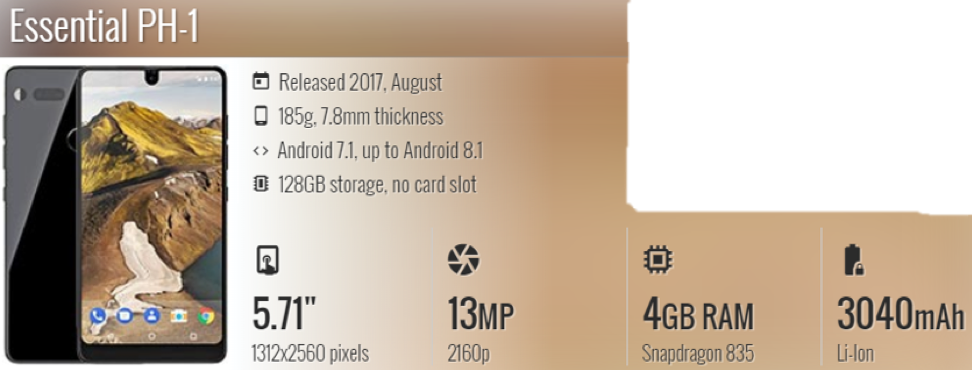
The Essential PH-1 smartphone offered a stock Android experience meant to appeal to the medium-tiered smartphone market.
The phone had solid hardware, enough juice in it to be competitive, a poor camera, and it did little to stand out from the crowd. There are many other cheaper substitutes with better brand recognition selling similar enough devices.
In general, it is a passable smartphone, but the initial price point was a reach in this ultra-competitive climate.
Sales were an outsized bust barely able to penetrate the American smartphone market.
Sprint offered the phone for $699 and registered 5,000 sales in the first month.
To put it into perspective, Apple routinely sells 40 or 50 million smartphones per quarter.
The Essential phone was discounted down to $499 in an attempt to salvage revenue. That didn’t work either.
You can now buy the phone on Amazon.com (AMZN) for $378.
All told, the phone did about 150,000 in sales and Rubin needed to rethink his vision.
Even as recently as this spring, takeover rumors swirled because of Essential’s stable of engineering firepower.
The vultures never swooped and Essential is back with a vengeance building their second phone - Essential Phone PH-2
To stem the tide and make their mark in the smartphone industry, Rubin decided Essential needed a fresh strategy requiring immense chutzpah.
Smartphones have essentially become commoditized in the mid-tier range and consumers look for the best specs at the lowest price point. Samsung has made a living picking off this type of buyer.
Rubin decided to align his future product with the technology that will change the world – artificial intelligence.
Artificial intelligence will be incorporated into the design for the phone to work for the user without him using it.
Yes, that’s right, the user will not have to even have his paws on the phone. The artificial intelligence will mimic the user’s behavior and carry out its functions and tasks alone.
Rubin said, “You can be off enjoying your life, having that dinner without touching your phone and you can trust your phone to do things on your behalf.”
This audacious strategy is a risky bet that consumers will be comfortable enough with artificial intelligence to allow them to venture out alone into this complicated world with no checks and balances from the user themselves.
Imagine some catastrophic scenario if the artificial intelligence taps into a user’s bank account and begins deploying hard-earned capital to exotic locations all over the world.
Smartphone competition has effectively made smartphones widely available for most of the world, but cultivating a smartphone company from scratch requires a dose of creative intuition.
Betting on the development of artificial intelligence is one of the few weapons in Rubin’s toolkit.
This could be Rubin’s last attempt at a smartphone and moving further out onto the risk curve means this could be a whale of a failure or a spectacular success. I can’t imagine his investors allowing him to produce another failed smartphone.
My bet is that consumers aren’t ready to absorb the type of levels of artificial intelligence that Rubin hopes to infuse into his new phone.
Even if he lays an egg, he will be back on another project in no time. That is the sort of slack you get by being the godfather of the Android operating system. Funding is as lush as a tropical forest.
Secretly, I want him to succeed because the world needs positive disruption to the Silicon Valley cohort of megacompanies from independent sources.
My bet is that a smartphone will not be the revolutionary new product the world is clamoring for. It’ll be something we have never seen before.
Please click here to visit Essential’s website.
Global Market Comments
October 15, 2018
Fiat Lux
Featured Trade:
(THE MARKET OUTLOOK FOR THE WEEK AHEAD, or OUR HARD LANDING BACK ON EARTH),
(SPY), (QQQ), (TLT), (VIX), (VXX), (MSFT), (JPM), (AAPL),
(DECODING THE GREENBACK),
(DUMPING THE OLD ASSET ALLOCATION RULES)

Truth be told, it’s the really boring, sedentary, go-nowhere markets that drive me nuts, cause me to tear my hair out, and urge me on to an early retirement.
The week started with such promise.
Sunday night I witnessed the first Space X landing of a rocket in California which I could clearly see from the top of Berkeley’s Grizzly Peak some 250 miles away. It was fascinating to see four separate jets steer the spacecraft earthward.
Financial markets had a different landing in mind, the hard kind, if not a crash.
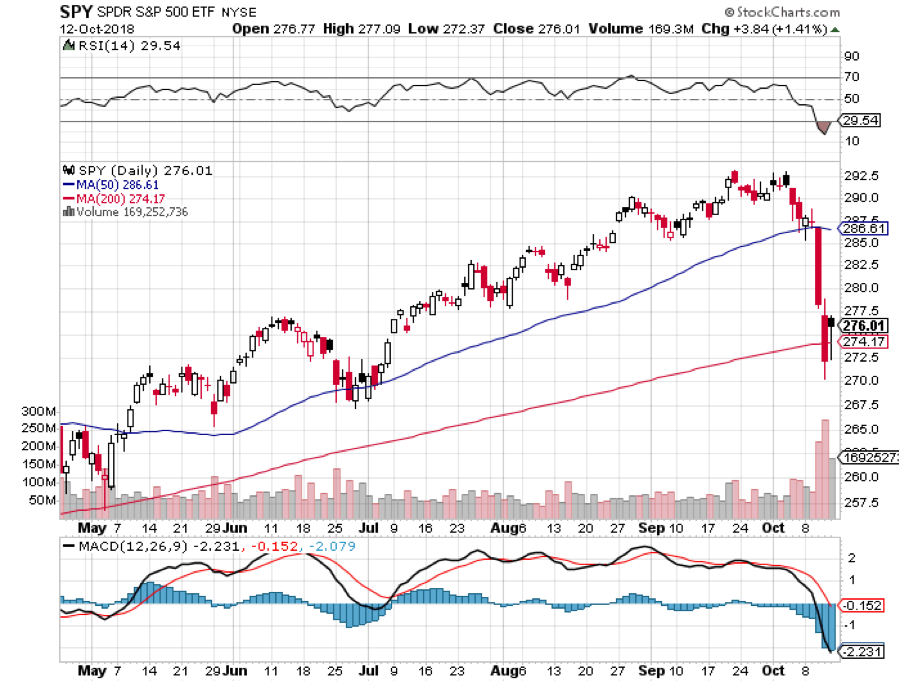
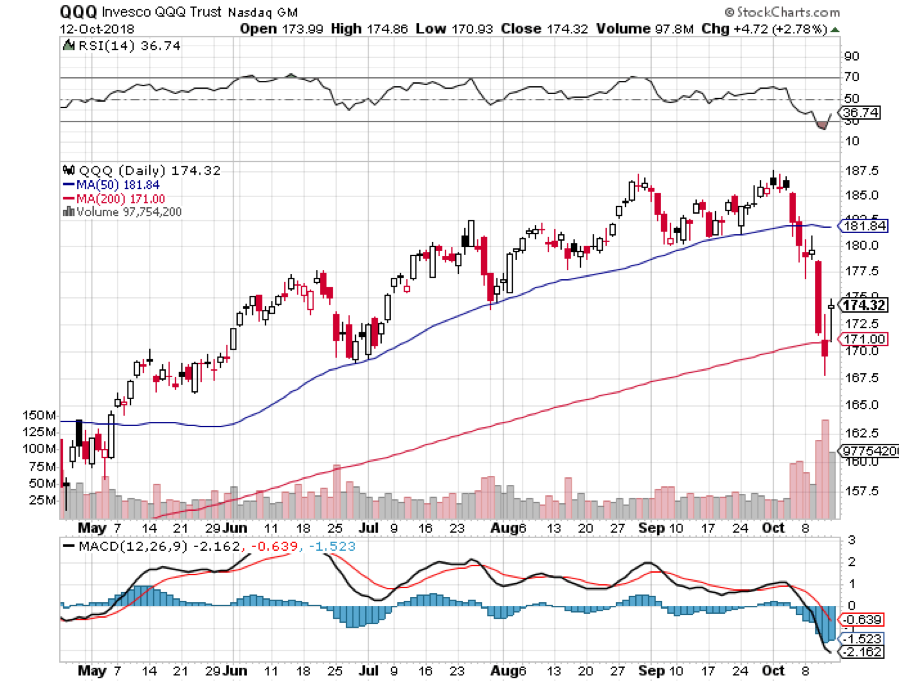
I absolutely love the market we had last week which saw the third biggest down day in history, volatility explode, and $2.6 trillion in stock market capitalization vaporize.
I had to blink when I saw NASDAQ (QQQ) down an incredible 350 points in one day. My Mad Hedge Market Timing Index hit an all-time low at 4.
No wonder insider selling hit $10.3 billion in August, another record. Maybe they know something we don’t.
Chinese Gamer Tencent Postponed their US IPO. It seems they noticed that market conditions had become unfavorable. I know investment bankers hate passing on an opportunity to ring the cash register. I used to be one.
There is no better feeling than being 100% cash going into one of these crashes and then having panicked investors puke their best quality positions to me at a market bottom.
On Thursday, I backed up the truck and issued four perfectly timed Trade Alerts, picking up Microsoft (MSFT), Apple (AAPL), and the S&P 500 (SPY), and covering my short position in the bond market (TLT).
In fact, I believe I had my best week of the year even though I only added modestly to my annual return. Look at the charts below and you’ll see that I suffered a 9% drawdown during the February meltdown. Maybe I’m getting wiser as I get older? One can only hope.
This time, I managed to limit my loss to a modest 2.5% and am nearly unchanged on the month despite the Dow Average at one point nearly giving up all its gains for 2018. This is also against a horrific backdrop of hedge fund performance that is now showing losses for 2018.
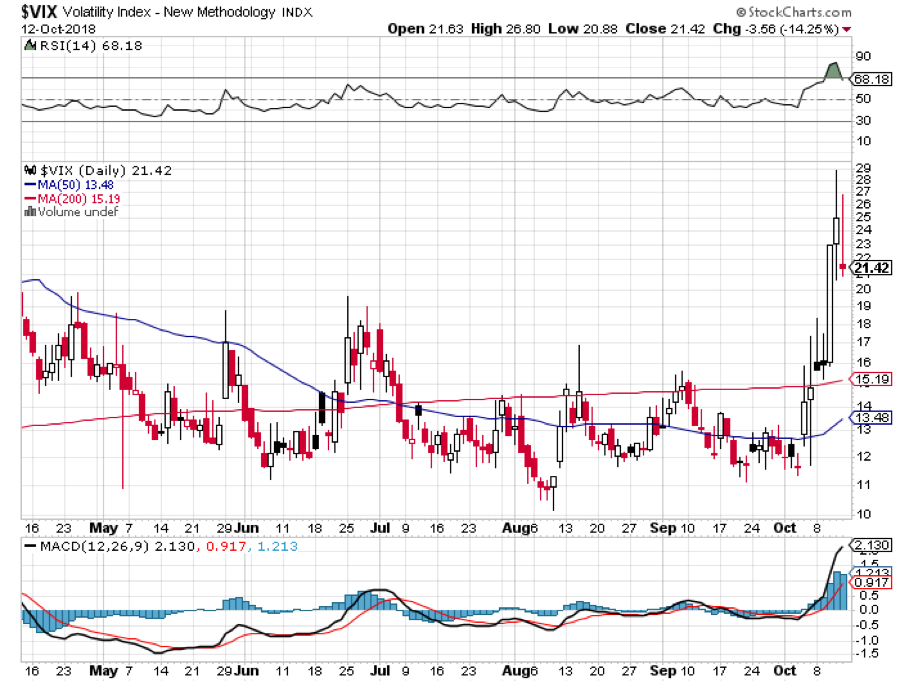
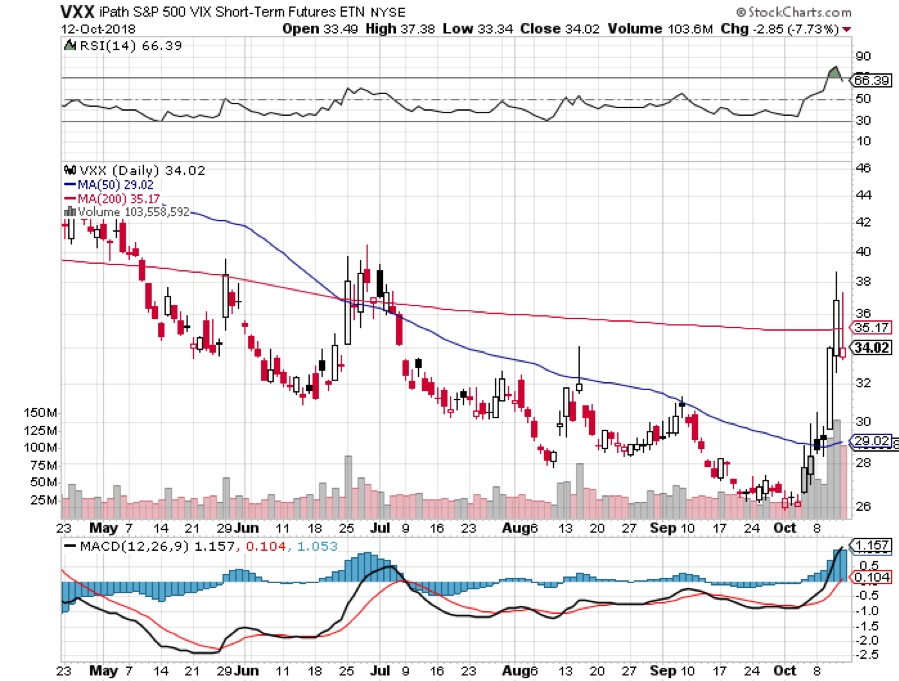
The Volatility Index (VIX) made a move for the ages, at one point kissing the $29 handle, up from $11 two weeks ago. During the 600-point swoosh down on Thursday, I couldn’t get any of my staff on the phone. The entire company was logged into their personal trading accounts, buying puts on the iPath S&P 500 VIX Short-Term Futures ETN (VXX) as fast as they could.
Which leads me to believe that the bottom is near. Earnings and valuation support start kicking in big time at these levels, and the blackout period for company share buybacks started ending with the bank earnings last Friday.
When you take a $1 trillion buyer out of the market, it has a huge effect no matter how strong the fundamentals are. Start buying those dips. Their return is similarly eventful. I’ve already started to invest my 95% cash position.
Further eroding confidence was the president’s statement that the Federal Reserve is crazy. So, now we know the president appoints crazy people to the most important financial positions in the country. White House control of interest rates ahead of elections. Why didn’t I think of that?
Sparking the Friday melt-up was a statement by JP Morgan (JPM) CEO Jamie Diamond saying that a 40-basis point rise in rates is no big deal. The bull market is on. His earnings beat all expectations.
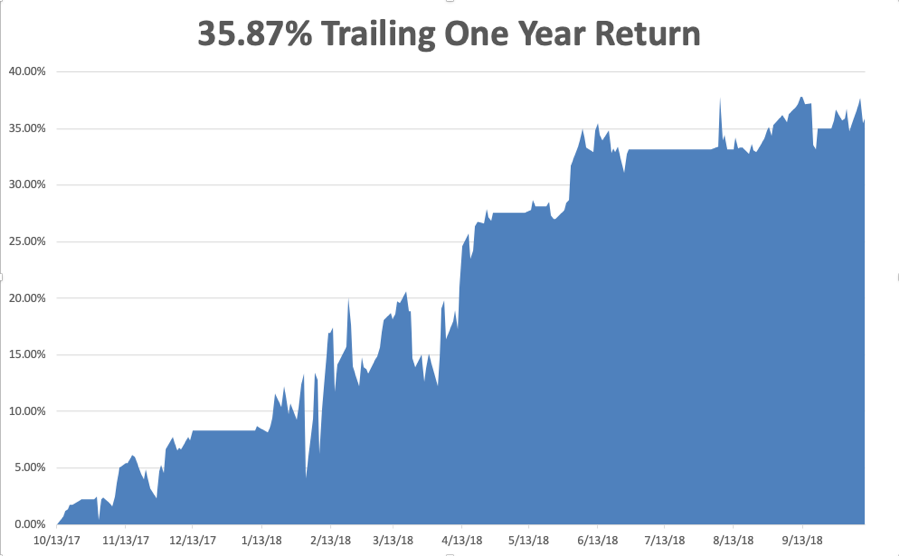
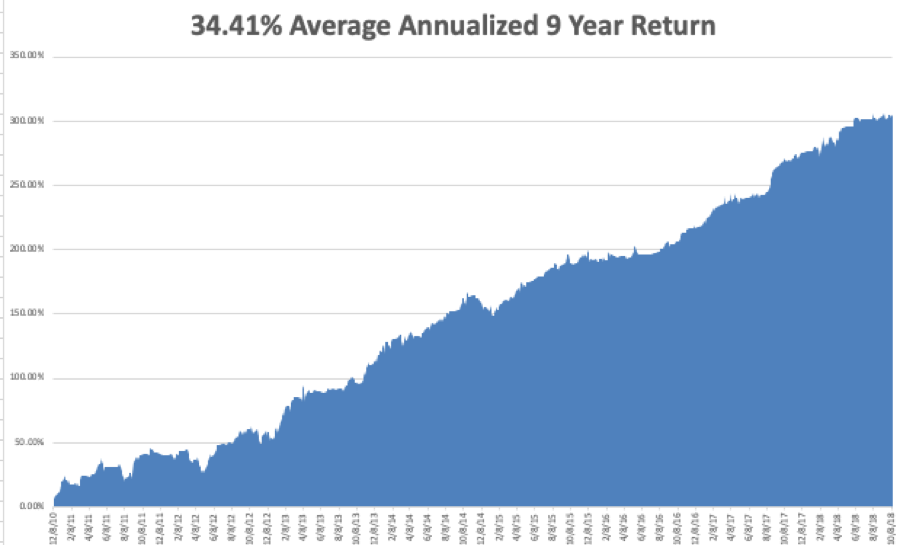
My 2018 year-to-date performance has bounced back to 27.56%, and my trailing one-year return stands at 35.87%. October is almost flat at -0.84%. Most people will take that in these horrific conditions.
My nine-year return appreciated to 304.03%. The average annualized return stands at 34.41%.
This coming week will be pretty sedentary on the data front.
Monday, October 15 at 8:30 AM brings us September Retail Sales.
On Tuesday, October 16 at 9:15 AM, September Industrial Production is announced.
On Wednesday, October 17 at 8:30 AM, September Housing Starts are published.
Thursday, October 18 at 8:30, we get Weekly Jobless Claims. At 10:00 we learne the September Index of Leading Economic Indicators.
On Friday, October 19, at 10:00 AM, the September Housing Starts are out. The Baker-Hughes Rig Count follows at 1:00 PM.
As for me, I will spend this week on my Southeastern US roadshow, giving strategy luncheons in Savannah, GA, Atlanta, GA, Miami, FL, and Houston, TX. I love meeting my readers mano a mano who are often a source of my best trading ideas. It looks like I’ll miss Hurricane Michael by three days.
Good luck and good trading.
John Thomas
CEO & Publisher
The Diary of a Mad Hedge Fund Trader

Mad Hedge Technology Letter
October 15, 2018
Fiat Lux
Featured Trade:
(FIVE STOCKS TO BUY AT THE BOTTOM),
(AAPL), (AMZN), (SQ), (ROKU), (MSFT)
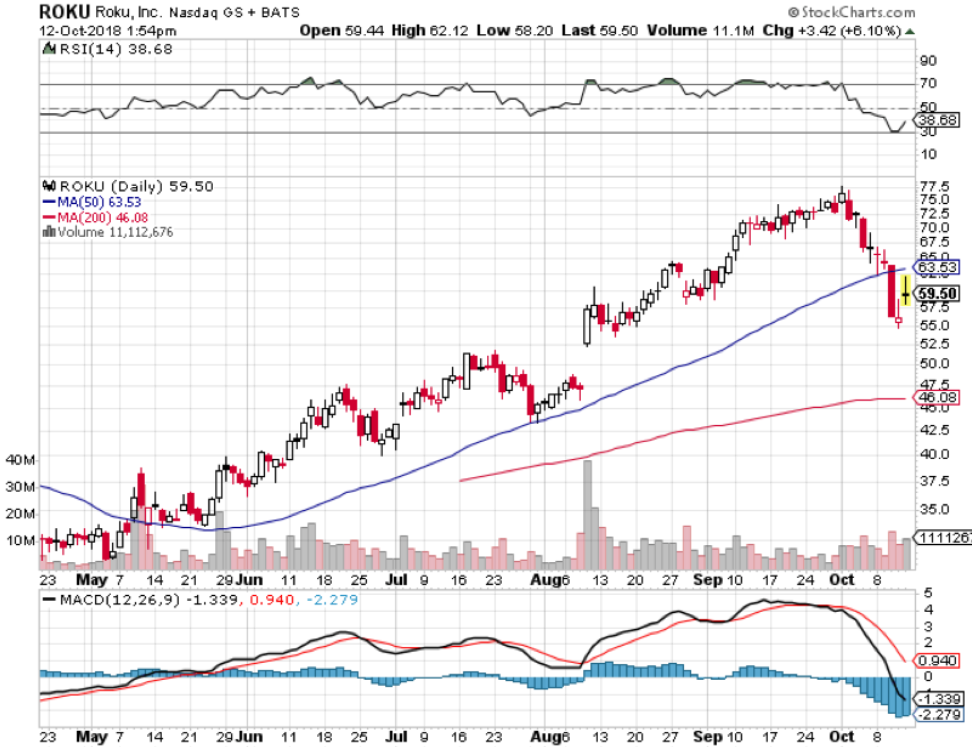
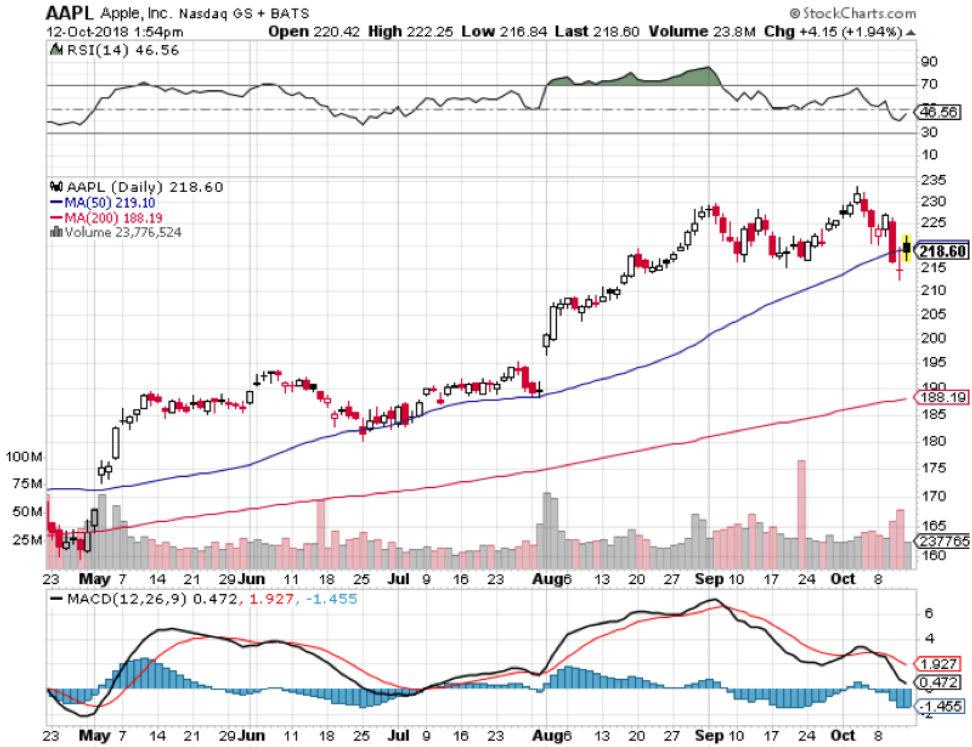
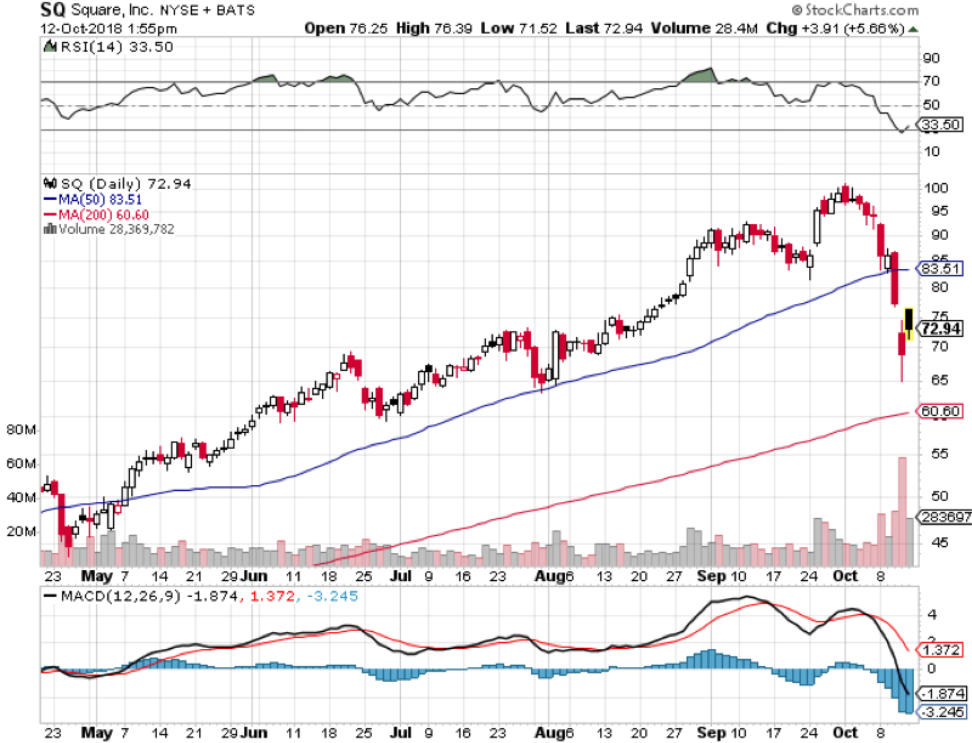
You don’t want to catch a falling knife, but at the same time, diligently prepare yourself to buy the best discounts of the year.
Interest rates triggered a tsunami wave of selling tearing apart the tech sector with a vicious profit-taking few trading days.
No doubt that asset managers are frantically locking in profits for the rest of the year and protecting ebullient performance from a year to remember.
This week shouldn’t deter investors from picking up bargains that were non-existent for most of the year because the bulk of the highest quality tech names churned higher with lurching momentum.
Here are the names of five of the best stocks to slip into your portfolio in no particular order once the madness subsides.
Apple
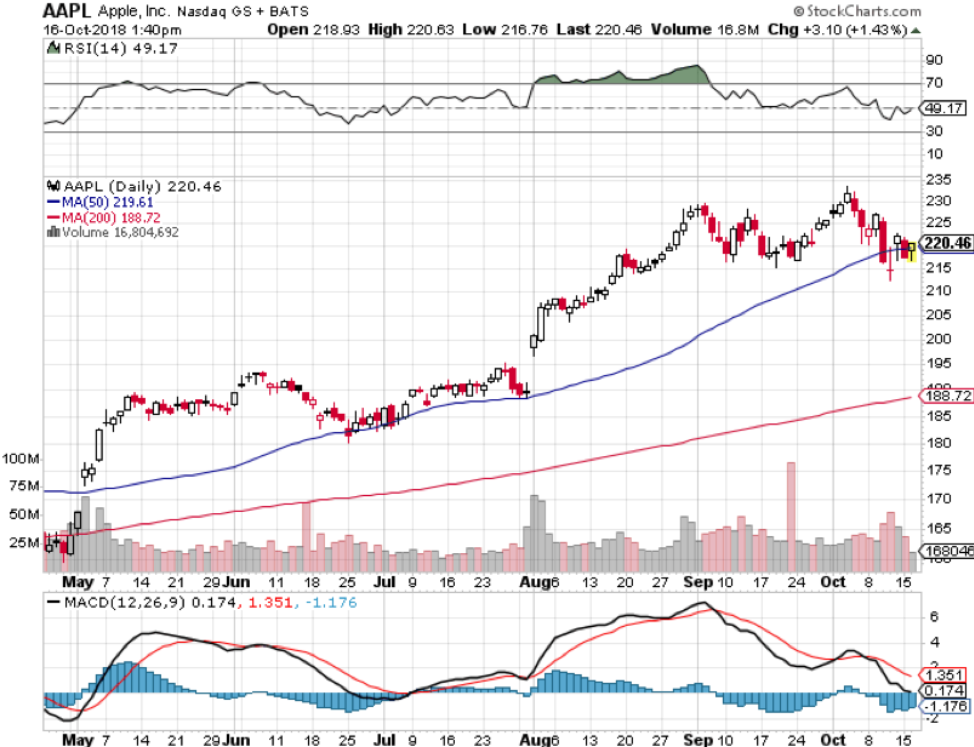
Steve Job’s creation is weathering the gale-fore storm quite well. Apple has been on a tear reconfirming its smooth pivot to a software-tilted tech company. The timing is perfect as China has enhanced their smartphone technology by leaps and bounds.
Even though China cannot produce the top-notch quality phones that Apple can, they have caught up to the point local Chinese are reasonably content with its functionality. That hasn’t stopped Apple from vigorously growing revenue in greater China 20% YOY during a feverishly testy political climate that has their supply chain in Beijing’s crosshairs.
The pivot is picking up steam and Apple’s revenue will morph into a software company with software and services eventually contributing 25% to total revenue.
They aren’t just an iPhone company anymore. Apple has led the charge with stock buybacks and will gobble up a total of $100 billion in shares by the end of the year. Get into this stock while you can as entry points are few and far between.
Amazon
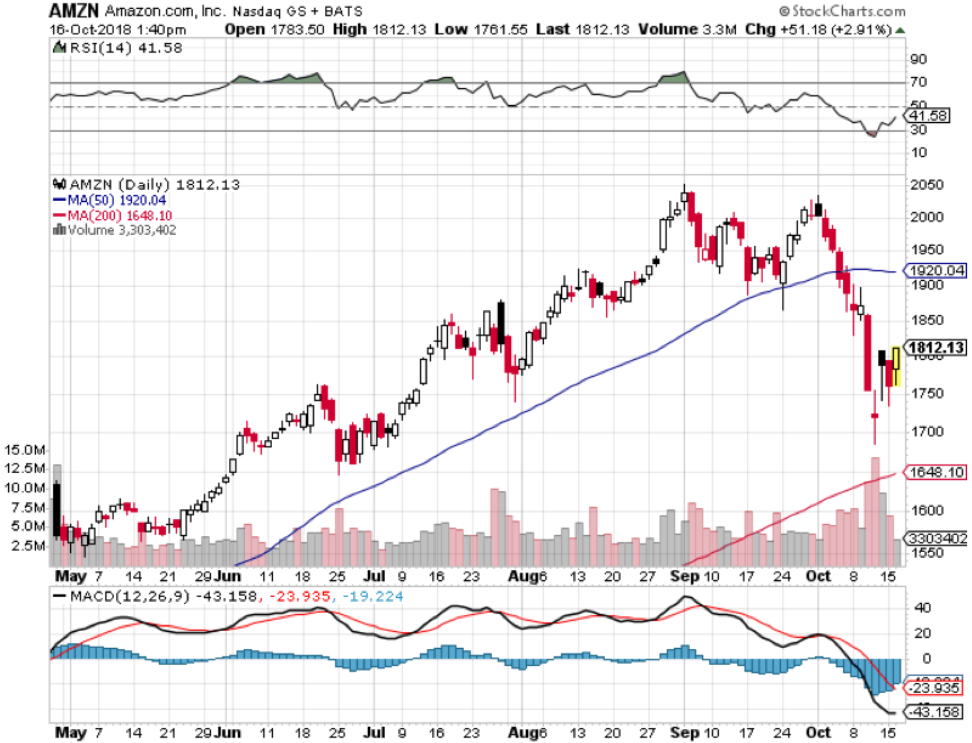
This is the best company in America hands down and commands 5% of total American retail sales or 49% of American e-commerce sales.
It became the second company to eclipse a market capitalization of over $1 trillion. Its Amazon Web Services (AWS) cloud business pioneered the cloud industry and had an almost 10-year head start to craft it into its cash cow. Amazon has branched off into many other businesses since then oozing innovation and is a one-stop wrecking ball.
The newest direction is the smart home where they seek to place every single smart product around the Amazon Echo, the smart speaker sitting nicely inside your house. A smart doorbell was the first step along with recently investing in a pre-fab house start-up aimed at building smart homes.
Microsoft
The optics in 2018 look utterly different from when Bill Gates was roaming around the corridors in the Redmond, Washington headquarter and that is a good thing in 2018.
Current CEO Satya Nadella has turned this former legacy company into the 2nd largest cloud competitor to Amazon and then some.
Microsoft Azure is rapidly catching up to Amazon in the cloud space because of the Amazon-effect working in reverse. Companies don’t want to store proprietary data to Amazon’s server farm when they could possibly destroy them down the road. Microsoft is mainly a software company and gained the trust of many big companies especially retailers.
Microsoft is also on the vanguard of the gaming industry taking advantage of the young generation’s fear of outside activity. Xbox related revenue is up 36% YOY, and its gaming division is a $10.3 billion per year business.
Microsoft Azure grew 87% YOY last quarter. The previous quarter saw Azure rocket by 98%. Shares are cheaper than Amazon and almost as potent.
Square
CEO Jack Dorsey is doing everything right at this fin-tech company blazing a trail right to the doorsteps of the traditional banks.
The various businesses they have on offer makes me think of Amazon’s portfolio because of the supreme diversity. The Cash App is a peer-to-peer money transfer program that cohabits with a bitcoin investing function on the same smartphone app.
Square has targeted the smaller businesses first and is a godsend for these entrepreneurs who lack the immense capital to create a financial and payment infrastructure. Not only do they provide the physical payment systems for restaurant chains, they also offer payroll services and other small loans.
The pipeline of innovation is strong with upper management mentioning they are considering stock trading products and other bank-like products. Wall Street bigwigs must be shaking in their boots.
The recently departed CFO Sarah Friar triggered a 10% collapse in share price on top of the market meltdown. The weakness will certainly be temporary, especially if they keep doubling their revenue every two years like they have been doing.
Roku
Benefitting from the broad-based migration from cable tv to online streaming and cord-cutting, Roku is perfectly placed to delectably harvest the spoils.
This uber-growth company offers an over-the-top (OTT) streaming platform along with the necessary hardware and picks up revenue by selling digital ads.
Founder and CEO Anthony Woods owns 21 million shares of his brainchild and insistently notes that he has no interest in selling his company to a Netflix or Apple.
Roku’s active accounts mushroomed 46% to 22 million in the second quarter. Viewers are reaffirming the obsession with on-demand online streaming content with hours streamed on the platform increasing 58% to 5.5 billion.
The Roku platform can be bought for just $30 and is easy to set-up. Roku enjoys the lead in the over-the-top (OTT) streaming device industry controlling 37% of the market share leading Amazon’s Fire Stick at 28%.
The runway is long as (OTT) boxes nestle cozily in only 40% of American homes with broadband, up from a paltry 6% in 2010.
They are consistently absent from the backbiting and jawboning the FANGs consistently find themselves in partly because they do not create original content and they are not an off-shoot from a larger parent tech firm.
This growth stock experiences the same type of volatility as Square. Be patient and wait for 5-7% drops to pick up some shares.
Global Market Comments
October 11, 2018
Fiat Lux
Featured Trade:
(REACHING PEAK TECHNOLOGY STOCKS),
(GOOGL), (MSFT), (NFLX), (FB), (AAPL),
(LOCKHEED MARTIN’S SECRET FUSION BREAKTHROUGH),
(LMT), (NOC), (BA)

I drove into San Francisco for a client dinner last night and had to wait an hour at the Bay Bridge toll gate. When I finally got into town, the parking attendant demanded $50. Dinner for two at Morton’s steakhouse? How about $400.
Which all underlines the fact that we have reached “Peak” San Francisco. San Francisco just isn’t fun anymore.
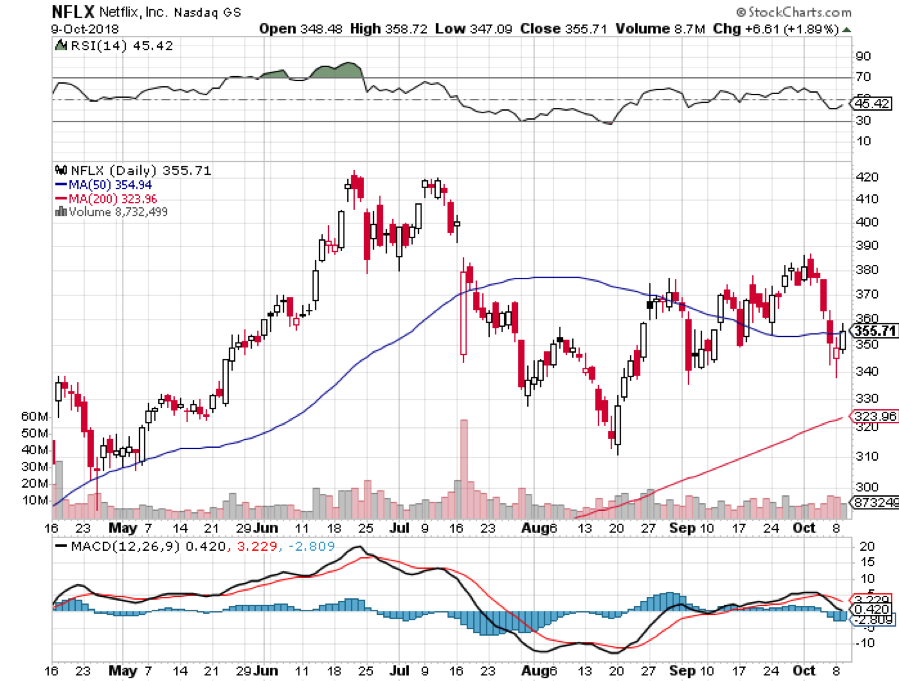
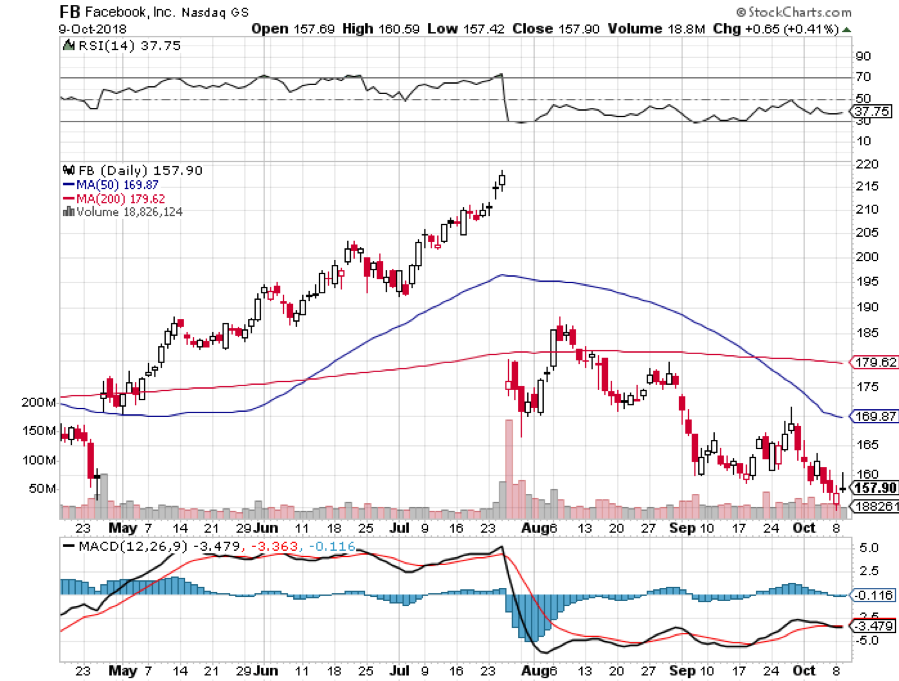
The problem for you is that if the City by the Bay has peaked, have its much-loved big cap technology stocks, like Facebook (FB), Alphabet (GOOGL), and Netflix (NFLX) peaked as well?
To quote the late manager of the New York Yankees baseball team, Yogi Berra, “Nobody goes there anymore because it’s too crowded.”
What city was the number one creator of technology jobs in 2017?
If you picked San Francisco, you would have missed by a mile. Anyone would be nuts to start up a new business here as rents and labor are through the roof.
Competition against the tech giants for senior staff is fierce. What, no fussball table, free cafeteria, or on-call masseuses? You must be joking!
You would be much better off launching your new startup in Detroit, Michigan. Better yet, hyper-connected low-waged Estonia where the entire government has gone digital.
In fact, Toronto, Canada is the top job creator in tech now, creating an impressive 50,000 jobs last year. Miami, FL and Austin, TX followed. Silicon Valley was at the bottom of the heap.
It’s been a long time since peach orchards dominated the Valley.
Signs that the Bay Area economy is peaking are everywhere. Residential real estate is rolling over now that the harsh reality of no more local tax deductions on federal tax returns is sinking in.
To qualify for a home loan to buy the $1.2 million median home in San Francisco, you have to be a member of the 1%, earning $360,000 a year or better.
Two-bedroom one bath ramshackle turn of the century fixer uppers are going for $1 million in the rapidly gentrifying nearby city of Oakland, only one BART stop from Frisco.
Most school districts have frozen inter-district transfers because they are all chock-a-block with students. And good luck getting your kid into a private school like University or Branson. There are five applicants for every place at $40,000 a year each.
The freeways have become so crowded that no one goes out anymore. It’s rush hour from 6:00 AM to 8:00 PM every day.
When you do drive it’s dangerous. The packed roads have turned drivers into hyper-aggressive predators, constantly weaving in and out of traffic, attempting to cut seconds off their commutes. And there is no drivers ed in China.
I took my kids to the city the other day for a Halloween “Ghost Tour” of posh Pacific Heights. It was lovely spending the evening strolling the neighborhood’s imposing Victorian mansions.
The ornate gingerbread and stained-glass buildings are stacked right against each other to keep from falling down in earthquakes. It works. The former abodes of gold and silver barons are now occupied by hoody-wearing tech titans driving new Teslas.
We learned of the young girl forced into a loveless marriage with an older wealthy stock broker in 1888. She bolted at the wedding and was never seen again.
However, the ghost of a young woman wearing a white wedding address has been seen ever since around the corner of Bush Street and Octavia Avenue. Doors slam, windows shut themselves, and buildings make weird creaking noises.
Then I came to a realization walking around Fisherman’s Wharf as I was nearly poked in the eye by a selfie stick-wielding visitor. The tourist areas on weekdays are just as crowded as they were on summer weekends 30 years ago, except that now the number of languages spoken has risen tenfold, as has the cost.
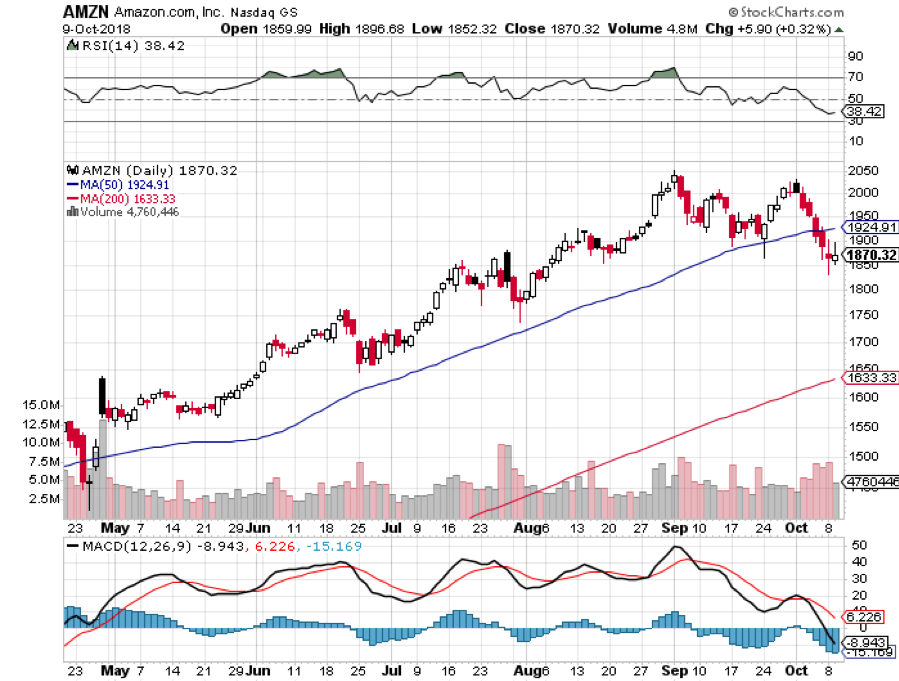
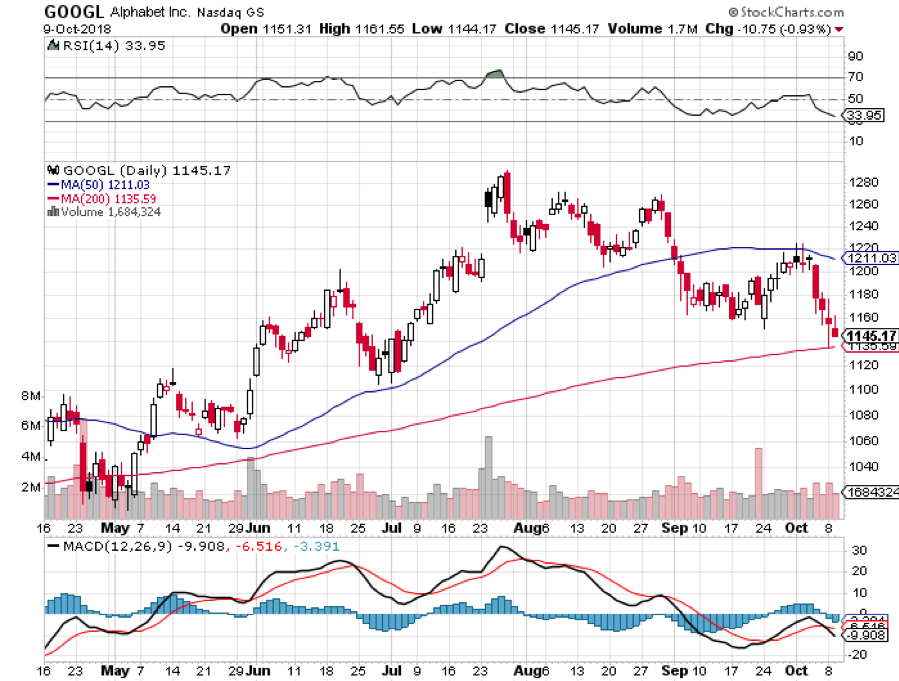
It started out to be a great year for technology stocks. Amazon (AMZN) alone managed to double off its February mini crash bottom, while others like Apple (AAPL) rocketed by 56%. But traders may have visited the trough once too often
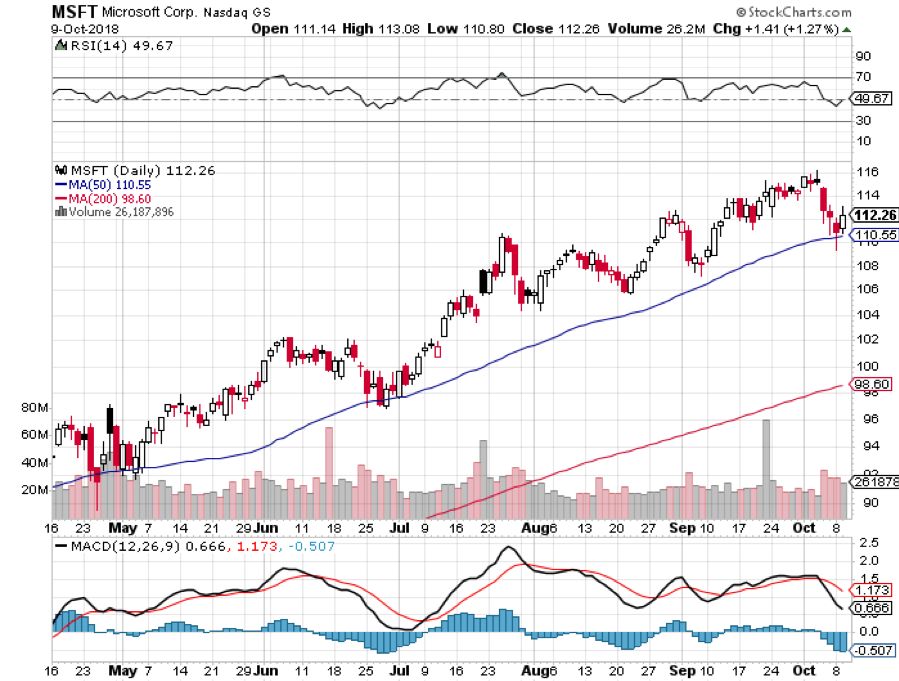
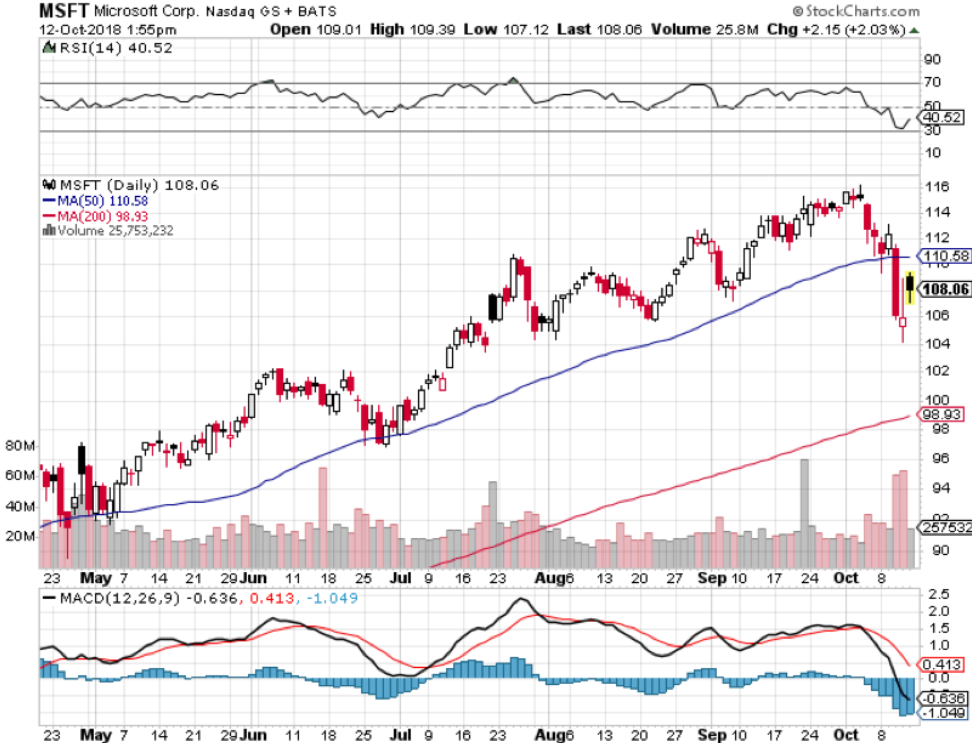
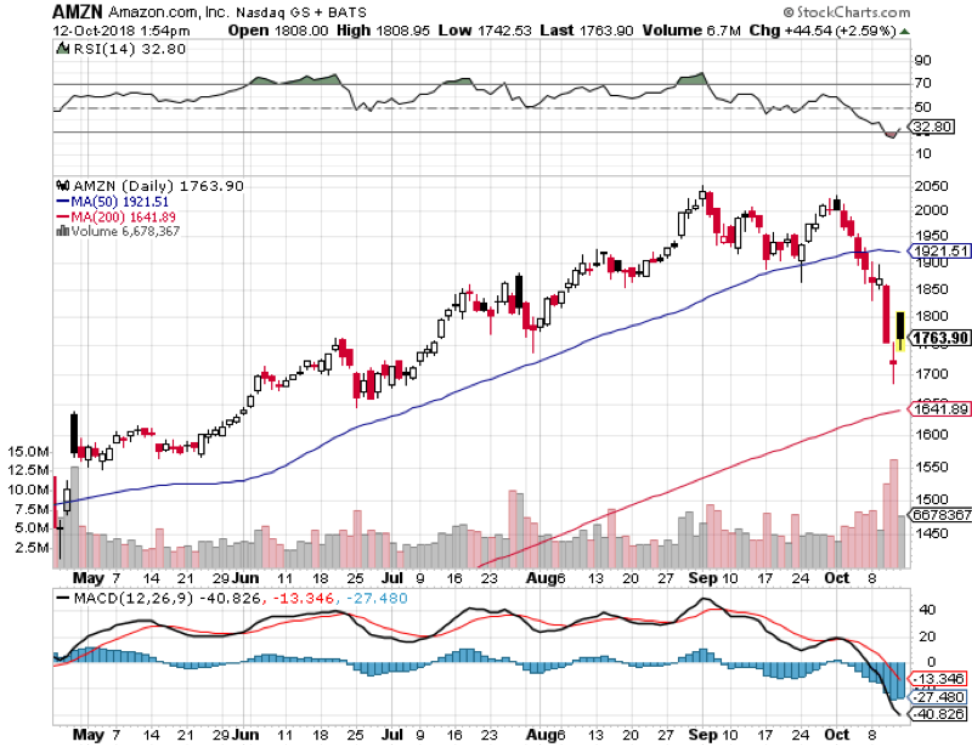
The truth is that technology stocks have not performed since June, right when the Mad Hedge Fund Trader dumped its entire portfolio. Only Microsoft (MSFT) and Amazon (AMZN) have managed to eke out new all-time highs since then, and only just.
The rest of tech has been moving either sideways in the most desultory way possible, or suffered cataclysmic declines like Facebook (FB) and Micron Technology (MU).
Of course, the trade wars haven’t helped. It’s amazing that big tech hasn’t already been hit harder given their intensely global business models.
Nor has rising interest rates. Big cap tech companies have such enormous cash balances that they are all net creditors to the financial system and actually benefit from higher interest rates. But dear money does slow the US economy and that DOES hurt their earnings prospects.
No, I’m not worried about tech for the long term. There is no analog company that can compete with a digital company anywhere in the world.
Accounting for 26% of the stock market capitalization and 50% of its profits, it’s only a question of when we get a major new up leg in share prices, not if.
The only unknown now is whether this next leg will take place before or after the next recession. Given the rate at which interest rates and oil prices are rising in the face of a slowing global economy, it’s looking like the recession may win the race.
As our tour ended, who did we see having dinner in the front window of one of the city’s leading restaurants? A young woman wearing a white wedding dress.
Yikes! Maybe the recession is sooner than I thought.