• support@madhedgefundtrader.com
  • Member Login
Mad Hedge Fund Trader
  • Home
  • About
  • Store
  • Luncheons
  • Testimonials
  • Contact Us
  • Click to open the search input field Click to open the search input field Search
  • Menu Menu

Tag Archive for: (TDOC)

Mad Hedge Fund Trader

Short Term Pain for Silicon Valley Tech

Tech Letter

The American tech sector has largely been overshadowed by the events across the world.

Many would question why that would even matter.

What does that even have to do with an American smartphone or devices that permeate our society?

We deal with American tech stocks for this newsletter, and not with moral outrage or foreign policy matters.

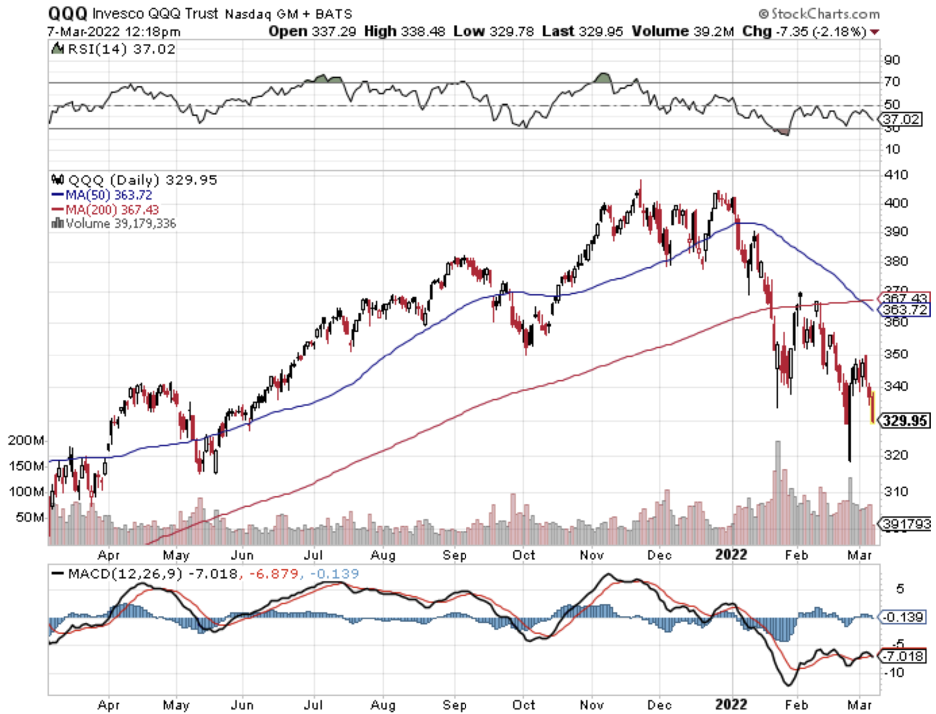
So we stay in our lane and deal with various exogenous stocks that come our way as it relates to the Nasdaq (QQQ).

I don’t get to pick these shocks – they come in fits and starts and in different sizes.

The end of omicron was almost to the point of visualization, but we roll into yet another macro crisis of many groups’ makings.

Tech doesn’t operate in a vacuum, and politics, more often than I would like to admit, sometimes do overlap a great deal.

The world has changed dramatically in the past 14 days and the knock-on effects mean that American tech companies and their trillion dollars business models are pulling out of Russia, a country with a population close to 150 million, in droves.

It is what it is, and life moves on.

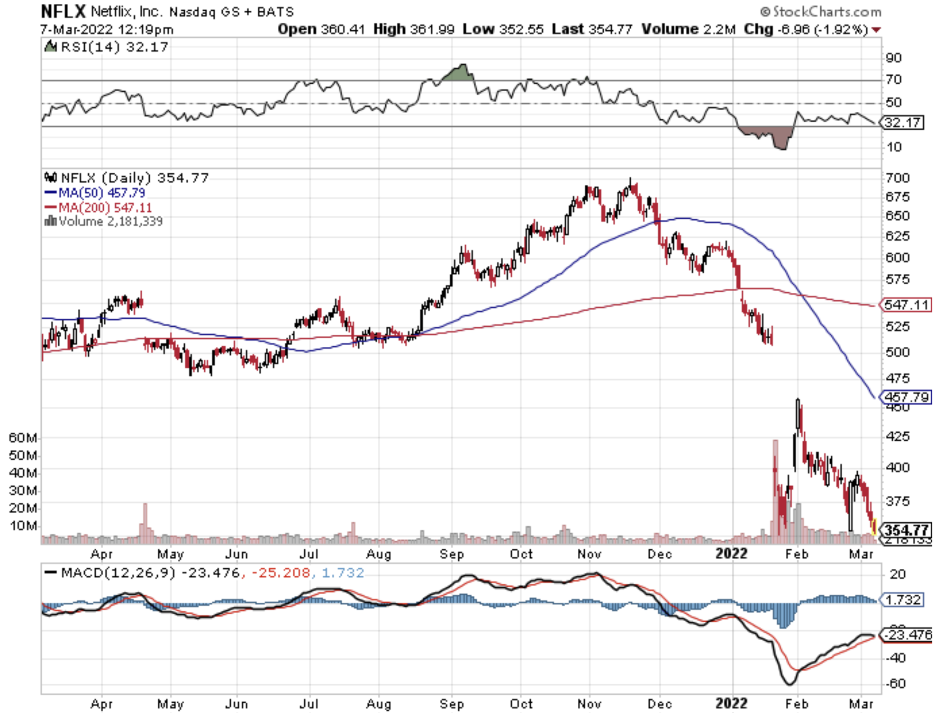
Netflix (NFLX) has been in operation in Russia since 2016 and the decision to vacate Russian business means they will lose around 1 million subscribers.

Most likely the worst tech company to work for right now in the world must be EPAM Systems (EPAM).

The internal chaos going on mainly stems from the 58,000 employees, with 14,000 of them in Ukraine and more than 18,000 staff in Belarus and Russia, according to company filings with the U.S. Securities and Exchange Commission.

EPAM’s stock is down 74% YTD in 2022 and is a stock that epitomizes the situation in Eastern Europe right now.

When workers refuse to work with each other, it’s hard to imagine that much gets done at all.

And this is just the tip of the iceberg.

The American tech withdrawals encompass all shapes and sizes.

Apple and Microsoft both said no bueno to selling products in Russia.

Game maker EA pulled the plug as well.

Google and Twitter have suspended advertising in Russia.

It’s a terrible time to monetize a YouTube channel in Russia because Google won’t pay you for it.

Likewise, Snap (SNAP) has pulled its marketing dollars from Russia too.

Another sonic boom hit Russian tech when Airbnb room-rental service suspended all operations in Russia and Belarus and has said its nonprofit subsidiary will offer free temporary housing to 100,000 Ukrainian refugees.

It's also waived host and guest fees for bookings in Ukraine, as people worldwide use Airbnb as a way to provide income directly to Ukrainians.

Adobe is halting sales of new Adobe products and services in Russia. In addition to making sure its products and services are not being used by sanctioned entities, Adobe is also cutting Russian government-controlled media outlets off from its cloud services.

What is emerging as quite black and white is that American technology companies hoping to apply their business model in autocratic states doesn’t integrate as well as first thought.

The weak rule of law along with all-powerful demagogue leaders make it hard to sustain any sort of business carve-out for the long term.

Eventually, many American companies are forced to abandon their ambitions in these marginal states.

The next question a tech investor must ask is will the American tech sector follow the lead from Russia and pull out from China.

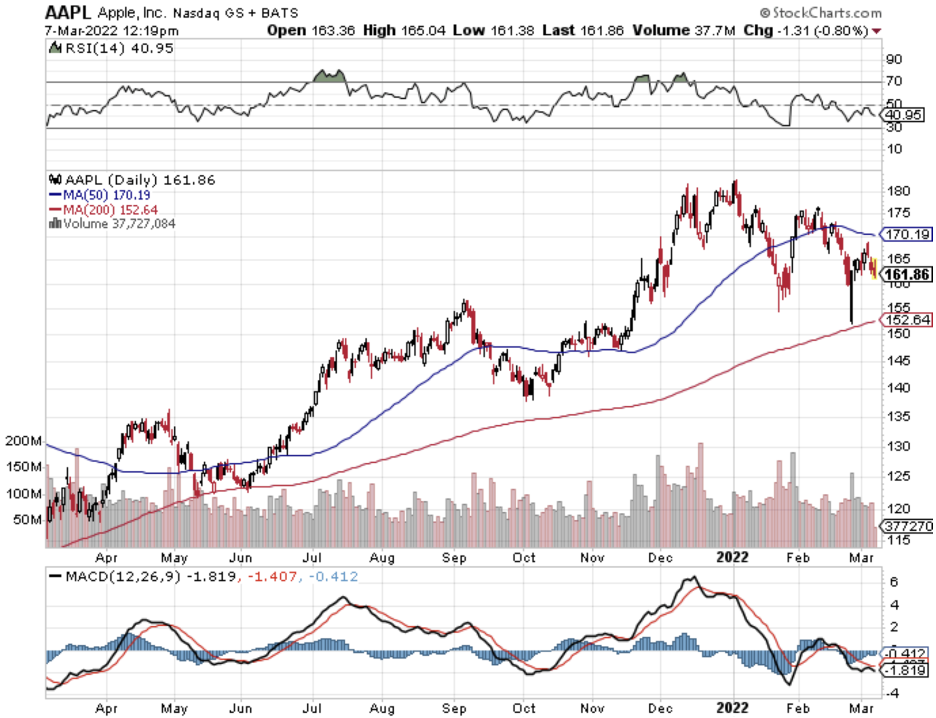
Obviously, this has major implications for companies like Apple, Micron, and a handful of American tech companies that are entrenched in the Chinese economy and society.

Many people think this will blow over and tech will come back front and center, but short-term, this is highly negative for American tech stocks.

The more this situation drags out, the higher risk American tech is more involved in this mess from a different gateway.

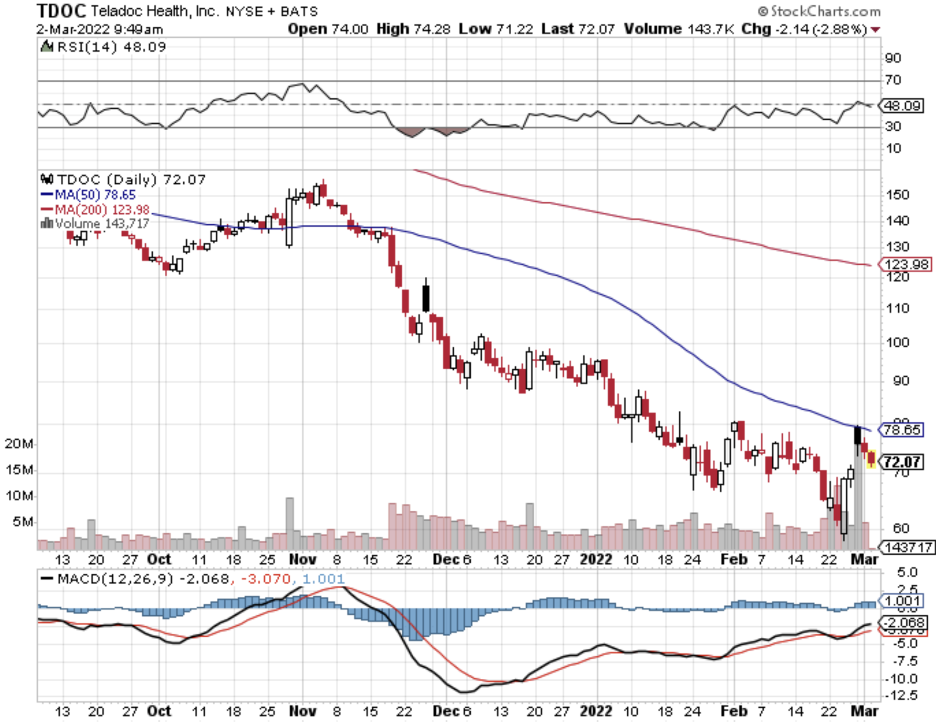
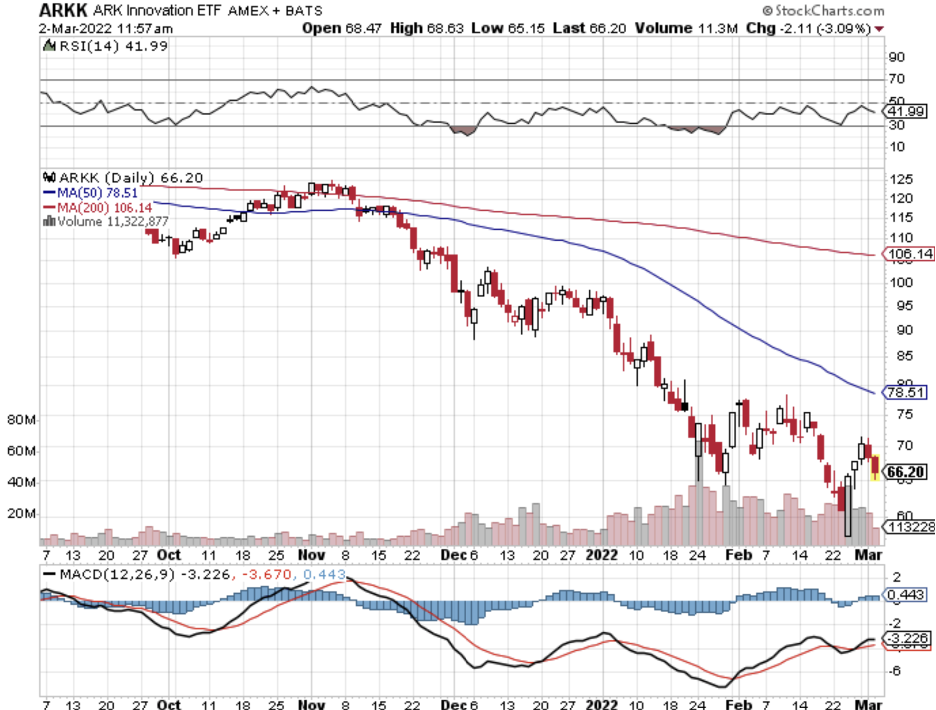
The tech portfolio has been outright short recently and it was the perfect call to sell the dead cat bounce in growth tech like Teladoc (TDOC) and ARKK funds (ARKK).
 

russia and tech


https://madhedgefundtrader.com/wp-content/uploads/2019/05/cropped-mad-hedge-logo-transparent-192x192_f9578834168ba24df3eb53916a12c882.png 0 0 Mad Hedge Fund Trader https://madhedgefundtrader.com/wp-content/uploads/2019/05/cropped-mad-hedge-logo-transparent-192x192_f9578834168ba24df3eb53916a12c882.png Mad Hedge Fund Trader2022-03-07 16:02:222022-03-16 01:38:59Short Term Pain for Silicon Valley Tech
Mad Hedge Fund Trader

March 2, 2022

Tech Letter

Mad Hedge Technology Letter
March 2, 2022
Fiat Lux

Featured Trade:

(WHEN IT RAINS – IT POURS)
(TDOC), (ARKK)

https://madhedgefundtrader.com/wp-content/uploads/2019/05/cropped-mad-hedge-logo-transparent-192x192_f9578834168ba24df3eb53916a12c882.png 0 0 Mad Hedge Fund Trader https://madhedgefundtrader.com/wp-content/uploads/2019/05/cropped-mad-hedge-logo-transparent-192x192_f9578834168ba24df3eb53916a12c882.png Mad Hedge Fund Trader2022-03-02 16:04:082022-03-02 22:26:22March 2, 2022
Mad Hedge Fund Trader

When It Rains - It Pours

Tech Letter

Don’t get gaslighted by believing that growth companies now are at a discount and primed to shoot higher.

This couldn’t be further from the truth.

Honestly, this is just the beginning of a hard slog to prove to investors they are worth their time of day.

Once investors get a sniff of top-line growth capitulating, investors cash out in droves and try to not be the last one holding the bag.

In many cases, the latest rout in tech stocks has been far more crippling to investor portfolios than what we saw during the stock market collapse of February and March 2020, just after Covid was hyped around the world.

Fintech has been a sub-sector of tech that has been blinded by the light.

The collapse in PayPal shares has been swift and bloody.

From its March 2020 low, shares more than tripled over the next 15 months as usage and revenues soared. And then, just as quickly, the shares collapsed as fintech competition became crowded.

The digital payments specialist has now lost two-thirds of its value since its mid-summer 2021 all-time high. The extraordinary loss has been stark, but it epitomizes the current environment for growth tech.

If investors learned anything from the dot-com sell-off a generation ago, everybody rushes for the exit at the same time to rotate into more attractive companies.

Simply, "can’t miss innovation" are bid up like no other on the way up in a bull market with low rates. Conversely, they overshoot to the downside in a bear market with rising rates.

Growth tech is going to have to shake off this stereotype if they want to perform in this new normal environment.

That’s not to say these are worth nothing, but there is always a time to shine and a time to rain.

Unfortunately for remote medical services company Teladoc (TDOC), it is time for the latter, which is why I strapped on a bear put spread with a 16-day horizon that TDOC will not rise above $79.

If anything, the case for best of breed is getting stronger, such as the likes of Microsoft (MSFT), Apple (AAPL), Alphabet (GOOGL).

On the trading front, we took profits on a bear put spread last month on TDOC with a February expiration after the omicron virus peaked in the short-term, meaning that no incremental investor would be interested in buying TDOC in the short term.

TDOC is part of a bigger tech growth portfolio helmed by Cathie Wood's ARKK Invest, and that portfolio has gotten slaughtered this year as Woods has no concept of market timing and indiscriminately buys tech at any price based on a zillion year time horizon.

She also said that she is seeing deflation two weeks ago in this market which is an outright breach of fiduciary duty to investors. Since her interview, Russia has invaded Ukraine and oil has spiked to $110 per barrel of crude.

Any novice investors should just wait for Wood to speak and then do the opposite, and there is in fact an ETF built for that very purpose.

TDOC is ARKK fund’s biggest holding, and they just underwent a relief rally as the market is betting that Jerome Powell will become more dovish. The latest rally is most likely a dead cat bounce.

This is a GOLDEN OPPORTUNITY to sell the hell out of TDOC, and ARKK funds for a no-brainer short-term trade of 16 days as the fresh inflation forecasts should start to trickle in and suppress growth tech again.

This is just the beginning of elevated inflation brought on by another foreign war, and the pockets of Americans are about to be hit by a wave of higher food and energy prices.

That spells trouble for underperforming growth tech and TDOC is the poster child for that.

Don’t buy this stock – if anything, sell the rallies like we are doing here. Growth tech is dead for the foreseeable future.


growth tech


https://madhedgefundtrader.com/wp-content/uploads/2019/05/cropped-mad-hedge-logo-transparent-192x192_f9578834168ba24df3eb53916a12c882.png 0 0 Mad Hedge Fund Trader https://madhedgefundtrader.com/wp-content/uploads/2019/05/cropped-mad-hedge-logo-transparent-192x192_f9578834168ba24df3eb53916a12c882.png Mad Hedge Fund Trader2022-03-02 16:02:012022-03-07 20:27:41When It Rains - It Pours
Mad Hedge Fund Trader

February 14, 2022

Tech Letter

Mad Hedge Technology Letter
February 14, 2022
Fiat Lux

Featured Trade:

(THE STRATEGIC WINNER OF TECH)
(NVDA), (TDOC), (ZM)

https://madhedgefundtrader.com/wp-content/uploads/2019/05/cropped-mad-hedge-logo-transparent-192x192_f9578834168ba24df3eb53916a12c882.png 0 0 Mad Hedge Fund Trader https://madhedgefundtrader.com/wp-content/uploads/2019/05/cropped-mad-hedge-logo-transparent-192x192_f9578834168ba24df3eb53916a12c882.png Mad Hedge Fund Trader2022-02-14 15:04:572022-02-14 19:07:46February 14, 2022
Mad Hedge Fund Trader

The Strategic Winner of Tech

Tech Letter

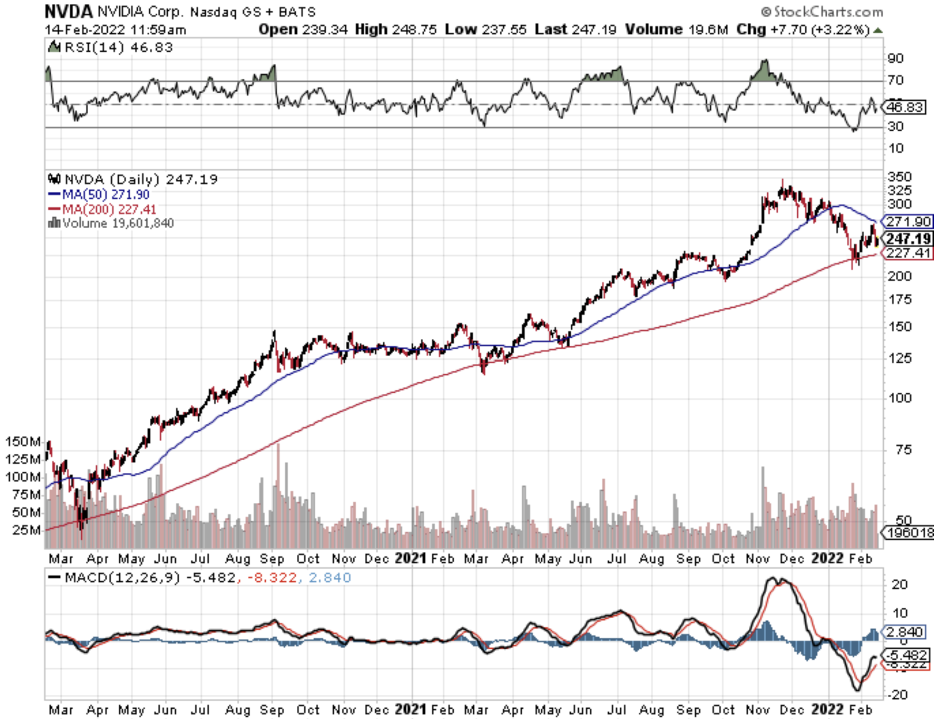
Nvidia (NVDA) is one of the best buy-the-dip tech candidates after the pullback from around $350.

This is one of the premier tech stocks of our generation and readers shouldn’t be fooled by the recent weakness.

NVDA simply has been dragged down with the rest of the best as technology still tries to find some footing after a rough January that was sideswiped by exogenous shocks out of NVDA’s control.

Tech growth stocks have been pigeonholed as one broad category, and even though NVDA boasts a sterling balance sheet that achieved $4.33 billion in profits in 2021, they are penalized with the general category of growth stock.

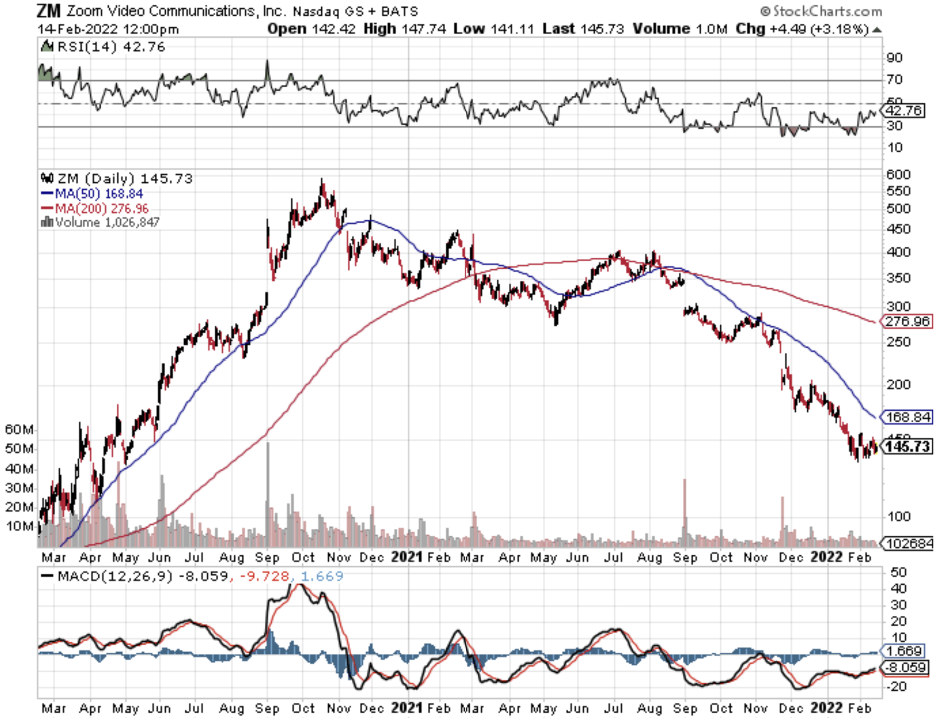
The rotation into energy and commodities has been swift, but make no mistake, this company is no Teladoc (TDOC) or Zoom Video (ZM), unequivocally not.

NVDA sits at the heart of every cutting-edge technology today by its production of high-quality CPUs and GPUs that are required for businesses as broad as data centers to the metaverse which includes gaming to automotive driving.

NVDAs stock accelerated too fast too soon which made them vulnerable to significant headline risk.

So headlines like war with Ukraine and Russia don’t really have much bearing over the trajectory of Nvidia’s business at all, but since index funds contain NVDA, NVDA gets heaped into the risk-off moves.

The stock further sold off after news leaked of the dead acquisition between British chip company ARM due to antitrust concerns.

At a broader level, semiconductor chips have possibly never been in such high demand, yet supply is painfully constrained.

The U.S. Commerce Department has recently emphasized the precarious nature of the global semiconductor supply chain in 2022.

However, the agency also expressed the possibility of new manufacturing capacity coming online as early as the second half of 2022, which may help somewhat in reducing the chip shortages.

With Intel, Taiwan Semiconductor Manufacturing, and Samsung having already planned huge investments in capacity expansion, we may see increased pricing pressures in the semiconductor industry in the next few years.

Even with new supply coming to market, the world and the semiconductor industry will fail to satisfy the world’s insatiable demand for chips which has forced many end products to delay finishing products for the foreseeable future.

How well is NVDA really doing?

In one word, fantastic.

Nvidia's revenues and free cash flow have more than doubled while gross margin and operating margin are up big.

This terrific growth has been mainly driven by increasing demand for the company's graphics cards and artificial intelligence (AI) processors in gaming and data center segments.

Nvidia currently accounts for almost 80% of the gaming GPU market. The company's GeForce RTX-powered laptops are being increasingly used not only in gaming but also in areas such as esports, digital content creation, and streaming.

Many of my key employees are using PC-based NVDA GPUs to support and service the company.

Nvidia saw its gaming revenues jump 72% year over year to $9 billion last quarter.

In the first nine months of fiscal 2021, the company's data center revenues soared by 53% year over year to $7.4 billion. Increasing revenue exposure to the data center segment is also helping improve the company's gross margin profile.

The next big business could be the car business.

The company offers a complete platform solution, which includes hardware, software, and infrastructure (servers, computing power, and data centers) required to support autonomous vehicles.

Many car shoppers are quickly realizing that cars are starting to appear like an iPad on wheels.

Lastly, Nvidia is also well placed to secure a big portion of the evolving metaverse opportunity, estimated to be around $30 trillion.

The company's high-throughput GPU chips, data center CPU, and next-generation Bluefield data processing unit will play a major role as the hardware technology needed to support the metaverse.

No matter what anyone says, it is hard to construct a case in which NVDA is one of the losers of future and tech.

Not only do they boast the metrics of a growth company, but their brand recognition almost falls into the top tier of tech companies.

The real tech people will tell you this stock is a long-term keeper and despite the high volatility, don’t let that dissuade you from betting big on NVDA.

nvda


https://madhedgefundtrader.com/wp-content/uploads/2019/05/cropped-mad-hedge-logo-transparent-192x192_f9578834168ba24df3eb53916a12c882.png 0 0 Mad Hedge Fund Trader https://madhedgefundtrader.com/wp-content/uploads/2019/05/cropped-mad-hedge-logo-transparent-192x192_f9578834168ba24df3eb53916a12c882.png Mad Hedge Fund Trader2022-02-14 15:02:172022-02-19 23:27:30The Strategic Winner of Tech
Mad Hedge Fund Trader

February 9, 2022

Tech Letter

Mad Hedge Technology Letter
February 9, 2022
Fiat Lux

Featured Trade:

(THE TELEHEALTH TRADE GETS CROWDED)
(TDOC), (AMZN)

https://madhedgefundtrader.com/wp-content/uploads/2019/05/cropped-mad-hedge-logo-transparent-192x192_f9578834168ba24df3eb53916a12c882.png 0 0 Mad Hedge Fund Trader https://madhedgefundtrader.com/wp-content/uploads/2019/05/cropped-mad-hedge-logo-transparent-192x192_f9578834168ba24df3eb53916a12c882.png Mad Hedge Fund Trader2022-02-09 16:04:042022-02-09 16:31:56February 9, 2022
Mad Hedge Fund Trader

The Telehealth Trade Gets Crowded

Tech Letter

The last thing anyone should do with their money now ­— invest in telehealth provider Teladoc (TDOC).

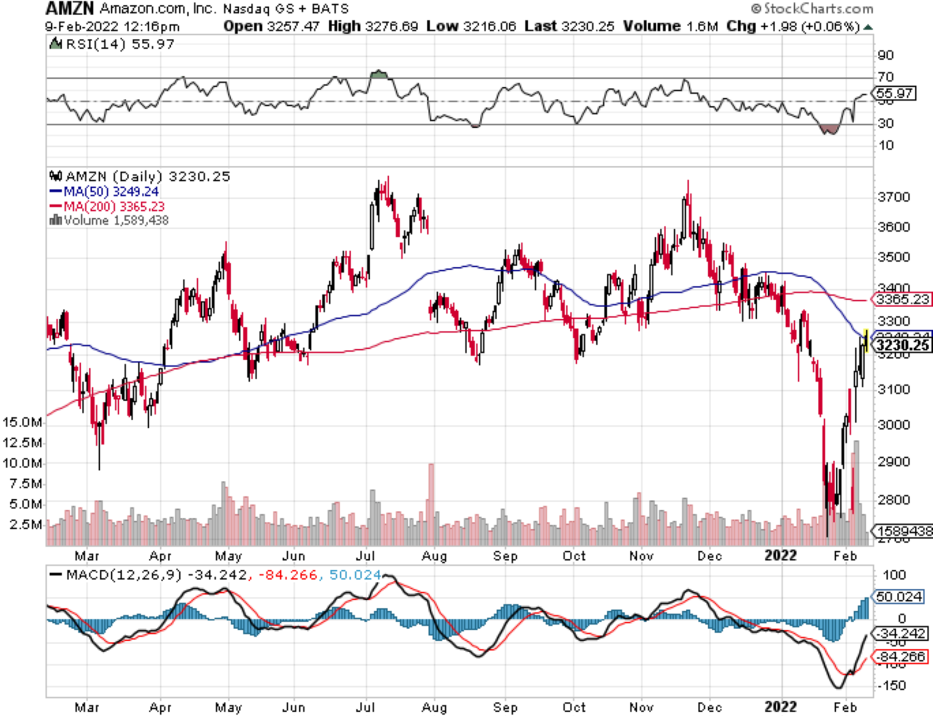
Infringing on Amazon’s (AMZN) moat is equal to a death sentence and TDOC will soon understand how punishing it can be competing with a monopolistic oligarch.

Amazon just announced that Amazon care is now available all over America.

This service offers both virtual care and in-person services.

The Amazon Care model is desperately needed in a country where pharma has gouged the average citizen.

This much-needed health solution from the ecommerce juggernaut is to address shortfalls in current offerings for healthcare and has TDOC squarely in their crosshairs.

The in-person services are rolling out in more than 20 new cities this year and that’s just not the end of it — Amazon says the expansion comes as it continues to invest in growing its clinical care team and its in-person care services.

Remember that TDOC rode the momentum of the hard lockdowns to become one of the few pandemic tech darlings of 2020.

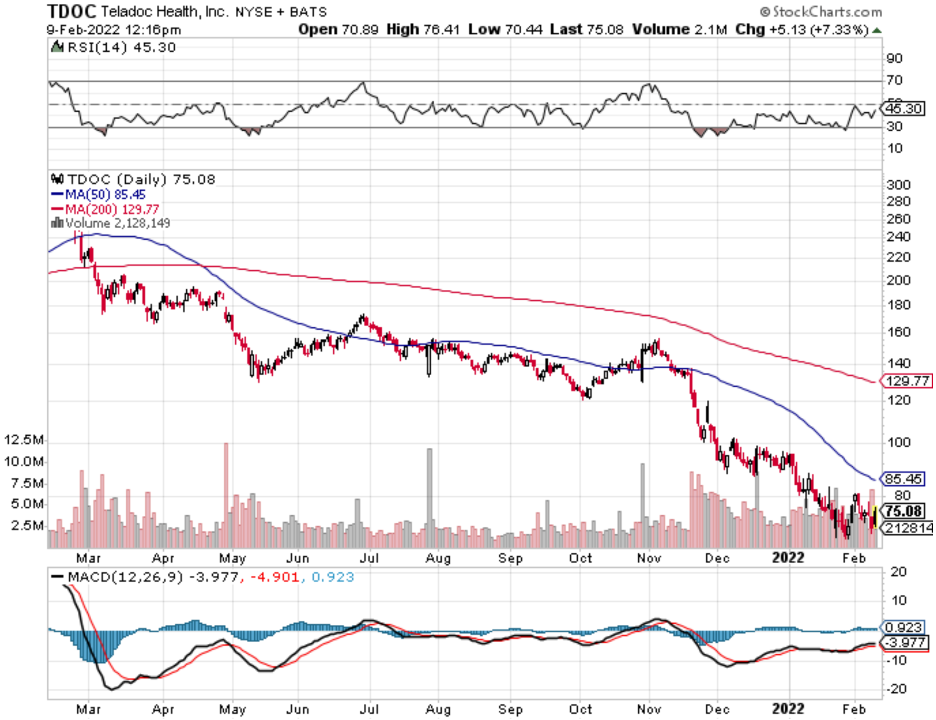
Fast forward to post-2020, TDOCs stock price is down by more than 70% over the past 12 months, and I hope that readers didn’t buy it at the peak!

Obviously, the telehealth company's rising sales serve as a bright spot, but sadly, the company is a one-trick pony like Facebook.

The one-trick ponies of the world are now receiving a discount when they used to receive a premium on their stock price.

The synergies of multi-industry tech firms are evident as shifting resources is way easier to do than hiring from scratch in a tight labor market. 

Granted, TDOCs numbers stand up quite nicely for now, in the third quarter, its revenue grew by 81% year over year to $522 million, and investors are likely to see more big growth when it reports on Q4 in February.

In 2020, its total membership topped 73 million people, for whom it facilitated a total of 10.6 million telehealth visits throughout the year.

However, we don’t operate in a vacuum and one’s competitive advantage can be lost in a blink of an eye.

The reality is that incremental growth will never return to its early pandemic pace when millions of people were seeking ways to get medical assistance without going to doctors' offices.

Teladoc is loss-making and margins are getting worse.

When we add AMZN into the mix, margins will most likely get squeezed more and expenses balloon further which is never a great marriage.

Next, insurmountable challenges could be around the corner and TDOC might be in front store window for a bigger company to purchase.

TODCs management is planning to increase its average annual revenue per subscriber by as much as 25% by offering a wider range of services, potentially including remote monitoring of a patient's medical sensors.

But the question is how much of that proposed 25% will be eaten by AMZN with its brand name and army of talented employees?

In addition, TDOC's costs of providing service are dropping, albeit slowly, but I would argue that AMZN can scale better than anyone in corporate America.

Over the past three years, Teladoc's cost of goods sold has fallen as a percentage of its revenue, and its quarterly gross profits have risen by 320%, but profitability is still years off.

If this becomes a battle between two loss-making telehealth companies that are burning cash, AMZN is really the last company I would want to try my luck out against.

This year will be the year where TDOC either sinks or swims and if it sinks, we will all know why.

Avoid TDOC for now.


telehealth


telehealth

https://madhedgefundtrader.com/wp-content/uploads/2019/05/cropped-mad-hedge-logo-transparent-192x192_f9578834168ba24df3eb53916a12c882.png 0 0 Mad Hedge Fund Trader https://madhedgefundtrader.com/wp-content/uploads/2019/05/cropped-mad-hedge-logo-transparent-192x192_f9578834168ba24df3eb53916a12c882.png Mad Hedge Fund Trader2022-02-09 16:02:042022-02-18 16:54:12The Telehealth Trade Gets Crowded
Mad Hedge Fund Trader

February 3, 2022

Biotech Letter

Mad Hedge Biotech and Healthcare Letter
February 3, 2022
Fiat Lux

Featured Trade:

(A ‘BORING’ BUSINESS RESISTING THE ‘AMAZON EFFECT’)
(CVS), (UNH), (ANTM), (TDOC), (AMZN), (BRK.A), (BRK.B), (JPM)

https://madhedgefundtrader.com/wp-content/uploads/2019/05/cropped-mad-hedge-logo-transparent-192x192_f9578834168ba24df3eb53916a12c882.png 0 0 Mad Hedge Fund Trader https://madhedgefundtrader.com/wp-content/uploads/2019/05/cropped-mad-hedge-logo-transparent-192x192_f9578834168ba24df3eb53916a12c882.png Mad Hedge Fund Trader2022-02-03 19:02:052022-02-03 19:17:25February 3, 2022
Mad Hedge Fund Trader

A 'Boring' Business Resisting the 'Amazon Effect'

Biotech Letter

The healthcare market is under attack.

Amazon (AMZN) is invading the healthcare sector, wielding its far-reaching online presence and countless distribution warehouses to dominate the market.

Leveraging its ability to offer quick shipping to practically all locations, Amazon has transformed into a grab-anything-and-everything-possible business.

Now, it has set its sights on the healthcare and prescription sector. In fact, it has been attempting to infiltrate this segment since 2018 when it acquired PillPack.

The only limitation of that deal was that customers still had to get prescriptions from their doctors to avail of the PillPack service.

However, Amazon’s not the only one seeing the potential of this sector.

Following the difficulties it encountered in cornering the market, the e-commerce giant collaborated with fellow Wall Street titans Berkshire Hathaway (BRK.A) (BRK.B) and JPMorgan (JPM). Together, the three companies launched a service they called “Haven.”

Unfortunately, the venture eventually fell apart, and they canceled the deal altogether.

Despite that unfortunate end, Amazon refuses to back down on its vision. Recently, it decided to take another stab at the venture with a rebranding, giving birth to AmazonCare.

The goal is to offer assistance to customers in booking doctor appointments and receiving prescriptions online.

Undeniably, any business endeavor with Amazon’s backing will make waves in any industry. Nonetheless, this new venture could still be a tough sell.

For now, the company's strength is hoping to use the “Amazon effect” to sway members into signing up and using AmazonCare as well.

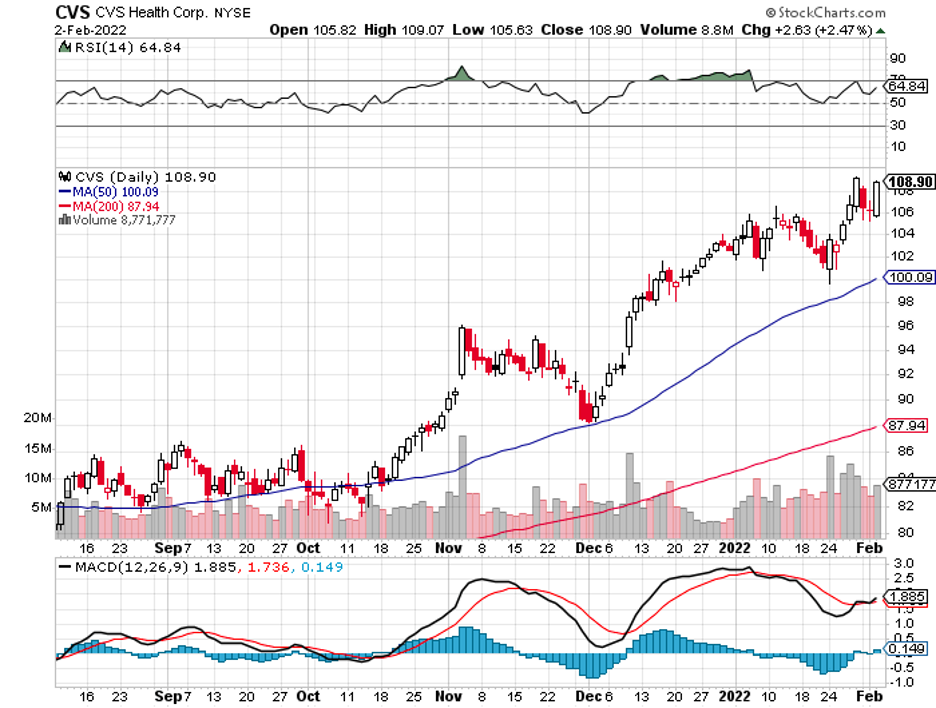
Surprisingly, Amazon finds itself facing an unlikely challenger in this pursuit: CVS (CVS).

Like Amazon, Berkshire, and JPMorgan, CVS has also recognized the potential of this market.

Unlike Amazon’s partners, CVS has decided to invest to become a frontrunner in terms of dominating the same sector and eventually taking advantage of this rapidly expanding total addressable market.

Instead of following the track of its fellow healthcare providers, such as UnitedHealth (UNH) and Anthem (ANTM), CVS has opted to change its angle of attack in the hopes of gaining more market share and reaping higher profits.

CVS is putting to good use its over 9,900 stores and distributions as means to establish better connections and rapport with customers.

After all, statistics indicate that approximately 80% of American citizens live less than 10 miles from a CVS branch.

This offers CVS a competitive advantage in terms of proximity to its customers. That is, it offers a unique convenience as it serves as the ever-present “corner stores” in practically every city.

Leveraging the locations, CVS has set up about 1,500 branches into “HealthHubs” by the end of 2021.

Basically, HealthHubs serve as emergency care clinics found inside CVS stores, providing customers with easy access to convenient and even cheaper after-hours health checkups.

Aside from this feature, a growing number of CVS stores are starting to get set up to be able to ship medicines or any other products ordered online, while other branches are being eyed as potential UPS drop-off points.

This setup will transform several branches into convenient “mini” distribution centers.

CVS has broken out of its “boring corner drugstore” image following its decision to target a more lucrative and massive healthcare sector.

It started the ball rolling when it acquired Aetna for $69 billion—a decision that so many investors disapproved of at that time.

Until recently, the market has largely ignored CVS because of the debt it incurred from the Aetna deal.

However, the tides had turned when investors finally realized that the drugstore giant had been efficiently and effectively executing a brilliant strategy all this time.

With Aetna under its wing, CVS has been granted access to a multitude of healthcare and managed care benefits availed by more than 23 million members. The sheer number of subscribers transformed the company into the third-biggest health insurer in the United States—next only to decades-long established providers Anthem and UnitedHealth.

Riding this momentum, CVS has been aggressive in revamping its image and expanding its services.

On top of its HealthHubs and Aetna advantages, CVS has recently paired up with Teladoc (TDOC) to leverage its virtual healthcare services to offer even more convenience to its customers.

This is another massive market since CVS already has roughly 35 million digital customers subscribed to its CVS app.

These users are all ordering products and other prescriptions from CVS. Integrating Teladoc’s services to the mix would be a surefire way of boosting its membership and adding a lucrative revenue stream.

Keep in mind that the global market for telehealth services is projected to expand somewhere between $300 billion to $700 billion by 2028—and that’s a conservative estimate.

CVS’ move to use Teladoc software is a positive indication of early technology adoption, positioning the drugstore chain at the forefront of a healthcare revolution.

Overall, CVS can only be described as a company striving to become a unique business that offers a range of products that no one else in the industry provides.

Although it’s improbable that it’ll sustain a monopoly in these services, CVS has been gradually transforming and growing into an almost unbeatable force in the industry by leveraging its strengths in an effective and logical method.

Moreover, it has evolved from a stodgy drugstore into an early tech adopter and a revolutionary business that can stand to challenge the likes of Amazon.


cvs healthcare

https://madhedgefundtrader.com/wp-content/uploads/2019/05/cropped-mad-hedge-logo-transparent-192x192_f9578834168ba24df3eb53916a12c882.png 0 0 Mad Hedge Fund Trader https://madhedgefundtrader.com/wp-content/uploads/2019/05/cropped-mad-hedge-logo-transparent-192x192_f9578834168ba24df3eb53916a12c882.png Mad Hedge Fund Trader2022-02-03 19:00:022022-02-15 22:41:17A 'Boring' Business Resisting the 'Amazon Effect'
Mad Hedge Fund Trader

January 24, 2022

Diary, Newsletter, Summary

Global Market Comments
January 24, 2022
Fiat Lux

Featured Trades:

(MARKET OUTLOOK FOR THE WEEK AHEAD,
or PARACHUTING WITHOUT A PARACHUTE),
(AAPL), (SPY), (MSFT), (TLT), (TBT), (TDOC), (NFLX), (DIS), (VALE), (FCX), (USO), (JPM), (WFC), (BAC), (TSLA), (AMZN), (NVDA)

https://madhedgefundtrader.com/wp-content/uploads/2019/05/cropped-mad-hedge-logo-transparent-192x192_f9578834168ba24df3eb53916a12c882.png 0 0 Mad Hedge Fund Trader https://madhedgefundtrader.com/wp-content/uploads/2019/05/cropped-mad-hedge-logo-transparent-192x192_f9578834168ba24df3eb53916a12c882.png Mad Hedge Fund Trader2022-01-24 09:04:462022-01-24 16:50:43January 24, 2022
Page 3 of 8‹12345›»

tastytrade, Inc. (“tastytrade”) has entered into a Marketing Agreement with Mad Hedge Fund Trader (“Marketing Agent”) whereby tastytrade pays compensation to Marketing Agent to recommend tastytrade’s brokerage services. The existence of this Marketing Agreement should not be deemed as an endorsement or recommendation of Marketing Agent by tastytrade and/or any of its affiliated companies. Neither tastytrade nor any of its affiliated companies is responsible for the privacy practices of Marketing Agent or this website. tastytrade does not warrant the accuracy or content of the products or services offered by Marketing Agent or this website. Marketing Agent is independent and is not an affiliate of tastytrade. 

Legal Disclaimer

There is a very high degree of risk involved in trading. Past results are not indicative of future returns. MadHedgeFundTrader.com and all individuals affiliated with this site assume no responsibilities for your trading and investment results. The indicators, strategies, columns, articles and all other features are for educational purposes only and should not be construed as investment advice. Information for futures trading observations are obtained from sources believed to be reliable, but we do not warrant its completeness or accuracy, or warrant any results from the use of the information. Your use of the trading observations is entirely at your own risk and it is your sole responsibility to evaluate the accuracy, completeness and usefulness of the information. You must assess the risk of any trade with your broker and make your own independent decisions regarding any securities mentioned herein. Affiliates of MadHedgeFundTrader.com may have a position or effect transactions in the securities described herein (or options thereon) and/or otherwise employ trading strategies that may be consistent or inconsistent with the provided strategies.

Copyright © 2025. Mad Hedge Fund Trader. All Rights Reserved. support@madhedgefundtrader.com
Scroll to top