Below please find subscribers' Q&A for the Mad Hedge Fund Trader May 23 Global Strategy Webinar with my guest and co-host Bill Davis of the Mad Day Trader.
As usual, every asset class long and short was covered. You are certainly an inquisitive lot, and keep those questions coming!
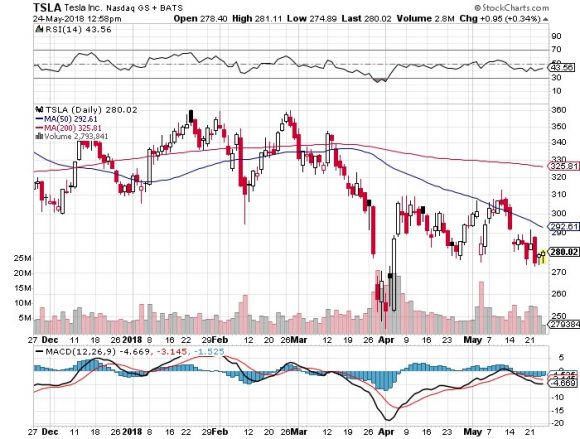
Q: Would you short Tesla here?
A: Tesla (TSLA) is on the verge of making the big leap to mass production, so they're in somewhat of an in-between time from a profit point of view, and the burden of proof is on them. Elon Musk is notorious for squeezing shorts. I would not want to bet him.
Musk has been successfully squeezing shorts for 10 years now, from the time the stock was at $16.50 all the way up to $392. So, I would not short Tesla. Buy the car but don't play in the stock; it's really a venture capital play that happens to have a stock listing because so many people are willing to back his vision of a carbon-free economy.
Q: What is your takeaway on the China trade war situation?
A: The Chinese said "no," and that is positive for economic growth. Anything that enhances international trade is good for growth and good for the stock market; anything that damages international trade is bad for corporate earnings and bad for the stock market. So, the China win in the trade war is essentially positive, but I don't think we'll see that reflected in stock prices until the end of the year.
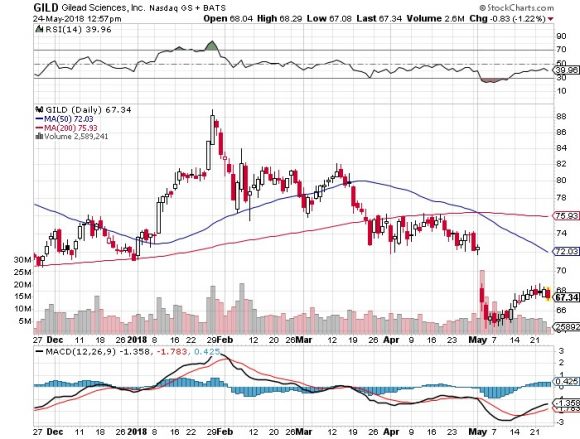
Q: What do you think about Gilead Sciences?
A: I don't really want to touch Gilead (GILD), or the entire sector, for that matter. We shouldn't be seeing such a poor performance at this point in the market. Health care has been dead for a long time, and you would have expected a rally based purely on fundamentals; they are delivering good earnings, it's just not reflected in the price action of the stocks. I think with no new money going into the market, there's nothing to push up other sectors; it's really become a "technology on and off" market. Health care doesn't fit anywhere in that world.
Q: Do you still like Nvidia?
A: I love Nvidia (NVDA). The chip sector still has another year to go. Nvidia has the high value-added product, and I'm looking for $300 dollars a share sometime this year/next year. The reason the stock hasn't really been moving is that it's over-owned; too many people know about the Nvidia story, which continues to go "gangbusters," so to speak. The chairman has also put out negative comments on short-term inventories, which have been a drag.
Q: Treasuries (TLT) are over 3%. Will they go over 3.5% by then end of this year?
A: I would say yes. Since that is only 50 basis points away from the current market, I would say it's a pretty good bet. So, if you get any good entry points you can do LEAPS going out to next year, betting that Treasuries will not only be below $116 by the end of the year, but they'll probably be below 110. And that would give you a very good high return LEAP with a yield of 50% in the next, say 8 months. By the way, if the Treasury yield rises to 4% that takes the (TLT) down to $98!
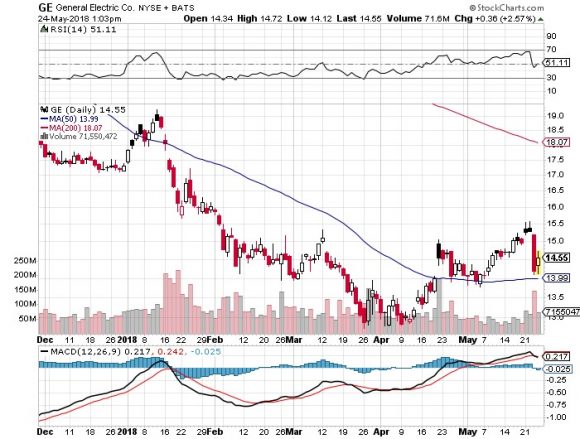
Q: Any chance General Electric will be acquired this year?
A: Absolutely not. General Electric (GE) worth far more if you break it up into individual pieces and sell them. Some parts are very profitable like jet engines and Baker Hughes, while other parts, like their medical insurance exposure, are awful.
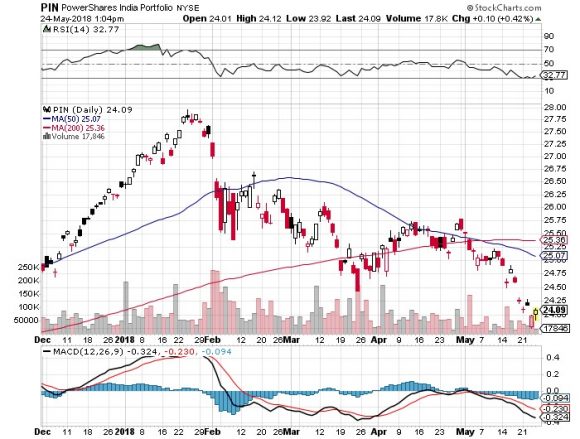
Q: What do you see about the India ETF?
A: The one I follow is the PowerShares India Portfolio ETF (PIN) and we love it long term. Short term, they can take some pain with the rest of the emerging markets.
Q: What should I do with my January 2019 Gold calls?
A: I would sell them. It's not worth hanging on to here with too many other better things to do in stocks.
Q: Would you continue to hold ExxonMobile?
A: I would not. If you were lucky enough to get in at the bottom on ExxonMobile (XOM). I would be taking profits here. I'm not sure how long this energy rally will last, especially if the global economic slowdown continues.
Q: Is Freeport-McMoRan (FCX) a buy?
A: Yes, but only buy the dip in the recent range, so you don't get stopped out when the price goes against you. Commodities are the best performing asset class this year and that should continue.
Q: How high is oil (USO) headed?
A: I think we're probably peaking out short of $80 a barrel currently unless we get a major geopolitical event. Then it could go up to $100 very quickly and trigger a recession.
Q: Are you looking to buy the Volatility Index here?
A: Buy the next dip, but the trick with (VIX) is buying after it sits on a bottom for about five days. You also want to buy it when stocks (SPY) are at the top of a range, like yesterday.
Q: How long do you think the market will be range-bound for?
A: My bet is at least three months, and possibly four or five. We should start to anticipate the outcome of the midterm congressional elections in September/October; that's when you get your upside breakout.
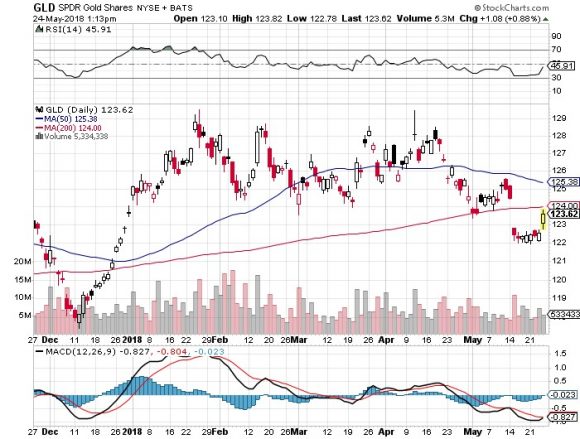
Q: Is Gold (GLD) not worth buying since Bitcoin has taken over market share from Gold buyers?
A: Essentially, yes. That's probably why you're not getting these big spikes in Gold like you're used to. Instead, you're getting them in Bitcoin. Bitcoin is clearly stealing Gold's thunder. That's a major reason why we haven't been chasing Gold this year.
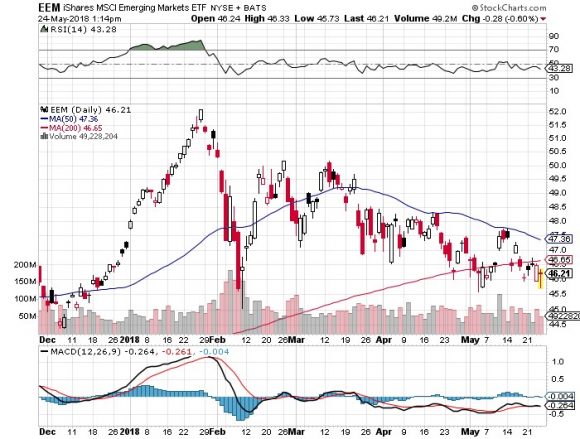
Q: After the emerging market sell-off, is it a good time to go in?
A: No, I think the emerging market (EEM) sell-off is being created by rising interest rates and a strong dollar. I don't see that ending anytime soon. In a year let's take another look in emerging markets. By then overnight Fed funds should be at 2.50% to 2.75%.
AT&T (T), Verizon (VZ), and the other telecom heavies are in the process of investing $30 billion to make sure that fifth-generation wireless, or 5G, will roll out on time in 2020.
What 5G will do is improve the functionality of IoT (Internet of Things) by 10 times at one-tenth the cost, bringing a 100X increase of functionality over price.
The last time I saw a leap that great was when Intel (INTC) brought out its groundbreaking 8008 8-bit microprocessor chip in 1972. I remember it like it was yesterday.
The news that gravitational waves were discovered, as well as wrinkles in the space-time continuum, was big news in my family. 5G will be of that order.
Of course, we knew it was coming. It was just a matter of when.
I have 11- and 13-year-old girls (I can't help it if the plumbing still works!). Whenever we drive somewhere, we carry out what Einstein called "thought experiments."
They will come up with scientific questions, and I then direct them into finding their own answers through a series of prodding and hopeful questions.
It is much like how the children of royalty were tutored during the Middle Ages.
So they asked, "When will we get driverless cars?" which they had heard about on TV.
I answered in about two years, but that I had friends who run Tesla (TSLA) who already have them now.
And you know the interesting thing they discovered? After two years of beta testing, the cars are starting to develop their own personalities.
Each car has highly advanced learning software. When the mapping software requires one to take a difficult sharp left turn, the vehicle may miss it the first time.
It will then make the next legal U-turn, and then nail that turn every time in the future.
The cars are all programmed to drive like little old ladies. It will never speed, break the law, and always lets other cars cut in front. Over time, some are becoming cautious, while others are getting more aggressive depending on each individual's driving experience.
In other words, experience is turning them into "people."
I asked my daughters, "What would the world be like if everyone had driverless cars?" which will occur in about 30 years, or during their middle age.
They pondered for a moment. Then my older daughter shouted out, "There won't be car accidents anymore!" "Right!" I answered.
"But what will that mean?" I asked.
They puzzled over this.
A few seconds passed. Then it came. "The people who fix cars won't have anything to do!"
"You got it," I replied.
In fact, about 1 million people in the car repair industry will lose their jobs. A small group of vintage car fanatics will survive, much like horse and buggy hobbyists do today.
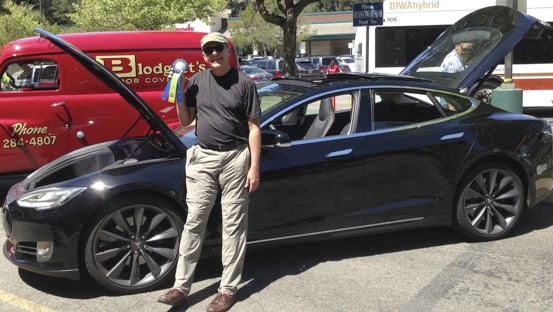
I pointed out that this is already happening because electric cars don't require any maintenance. You just rotate the tires every 6,000 miles (because electric batteries are so heavy).
I moved on. "Who else will lose their jobs when cars become self-driving?" They hit a brick wall. Then I asked "What else breaks when cars have accidents?"
A few seconds later it came. "People!"
"For sure," I shot back.
Actually, about 35,000 people die in car accidents every year in the United States, and another 500,000 are injured.
This means the demand for doctors, hospitals, and ambulances will go down. Say goodbye to another 1 million jobs.
"So, what else will self-driving cars do?" I was relentless.
My older girl was first: "If cars are driven by computers, it means they can drive closer together." I said, "That was true, but what was the consequence of that?"
The mountain scenery whizzed by. Then they got it.
"There won't be traffic jams anymore."
"Yes!" I blurted out. If a car can drive 70 miles per hour, but only needs to remain one car length behind the one in front of it, that effectively increases the capacity of freeways seven times.
We will never need to build another freeway again. Another 1 million jobs go down the drain.
"What else will self-driving cars do?" I carried on.
They hit a dead end. So, I gave a hint. "What do you see in cities?" After going through buildings, parks, roads, lots of cars, and bridges, I finally got the answer I wanted: "Parking lots."
I then posed the conundrum, "What's the connection between self-driving cars and parking lots?"
Now they were getting into the spirit of the thing. "They won't need them." I replied, "Absolutely."
Self-driving cars won't need to park. They'll just be able to drop you off and drive around the block until you are ready to go home.
This will be economical because after three decades of battery and solar improvements, energy will effectively be free, like air is today.
Oh, and at least 100,000 parking attendants might as well start joining the unemployment lines now.
It gets better.
Entrepreneurs now are developing apps for cars so they never need to park.
In an iteration of the sharing economy, and in a club or membership type format, your car will just drive person to person, selling rides, until you are ready to go home.
Think of it as Uber, without the drivers, that pays you.
Today, parking lots occupy about 15% of the land area of large cities. Self-driving cars will free up a lot of that space for other uses, such as housing and parks.
Then I asked the really big question. "What do all of these changes have in common?"
My 11-year-old picked up on this immediately. "A lot of people are going to lose their jobs!"
"For sure," I bubbled. Notice that every new technology improvement creates a lot of job losses. I went on.
"The trick for you girls is to always stay ahead of the technology curve so your job doesn't get lost, too." This is why I have been sending them to Java development school since they were 8 and 9.
They looked daunted.
And this is what 11- and 13-year-olds were able to figure out. Granted, they were MY kids.
Imagine what Google (GOOGL), Apple (AAPL), and Tesla are doing with this idea. It has become a hot bottom "next big thing." Silicon Valley is now rife with rumors of breakthrough developments and the poaching of staff.
The U.S. military and the Defense Advanced Research Projects Agency (DARPA) are involved in self-driving vehicles in a big way as well, holding regular contests with big prize money and the prospect of mammoth government contracts.
More and more generals and admirals are telling me that the wars of the future will be fought with software.
The bottom line is that things are happening much faster than we imagined possible only a few years ago.
Then my oldest daughter piped up.
"Dad, can I get my driver's license before all the cars are self-driving?" I said, "Sure. What kind of car do you want?"
"A red one."
My first car was a red 1957 Volkswagen Beetle.
On our next trip we will cover gravitational waves, Einstein's Theory of Relativity, and the significance of the clock tower in Bern, Switzerland.
By the way, these girls will be graduating from college in 2026 and 2027 and will be looking for jobs.
"Homo sapiens, the first truly free species, is about to decommission the natural selection, the force that made us," said E.O. Wilson, a Harvard University biology professor.
https://www.madhedgefundtrader.com/wp-content/uploads/2018/05/John-and-car-image.jpg312553MHFTRhttps://madhedgefundtrader.com/wp-content/uploads/2019/05/cropped-mad-hedge-logo-transparent-192x192_f9578834168ba24df3eb53916a12c882.pngMHFTR2018-05-25 01:05:362018-05-25 01:05:36Where 5G Connectivity Will Take Us
Featured Trade:
(MONDAY, JULY 16, 2018, PARIS, FRANCE, GLOBAL STRATEGY LUNCHEON), (WHY I'M SELLING SHORT THE STOCK MARKET),
(SPY), (TLT),
(TESTING TESLA'S SELF-DRIVING TECHNOLOGY),
(TSLA)
Featured Trade: (FRIDAY, JUNE 15, 2018, DENVER, CO, GLOBAL STRATEGY LUNCHEON) (GET READY FOR THE COMING GOLDEN AGE),
(SPY), (INDU), (FXE), (FXY), (UNG), (EEM), (USO),
(TLT), (NSANY), (TSLA)
I believe that the global economy is setting up for a new golden age reminiscent of the one the United States enjoyed during the 1950s, and which I still remember fondly.
This is not some pie in the sky prediction. It simply assumes a continuation of existing trends in demographics, technology, politics, and economics. The implications for your investment portfolio will be huge.
What I call "intergenerational arbitrage" will be the principal impetus. The main reason that we are now enduring two "lost decades" of economic growth is that 80 million baby boomers are retiring to be followed by only 65 million "Gen Xers."
When the majority of the population is in retirement mode, it means that there are fewer buyers of real estate, home appliances, and "RISK ON" assets such as equities, and more buyers of assisted living facilities, health care, and "RISK OFF" assets such as bonds.
The net result of this is slower economic growth, higher budget deficits, a weak currency, and registered investment advisors who have distilled their practices down to only municipal bond sales.
Fast forward six years when the reverse happens and the baby boomers are out of the economy, worried about whether their diapers get changed on time or if their favorite flavor of Ensure is in stock at the nursing home.
That is when you have 65 million Gen Xers being chased by 85 million of the "millennial" generation trying to buy their assets.
By then we will not have built new homes in appreciable numbers for 20 years and a severe scarcity of housing hits. Residential real estate prices will soar. Labor shortages will force wage hikes.
The middle-class standard of living will reverse a then 40-year decline. Annual GDP growth will return from the current subdued 2% rate to near the torrid 4% seen during the 1990s.
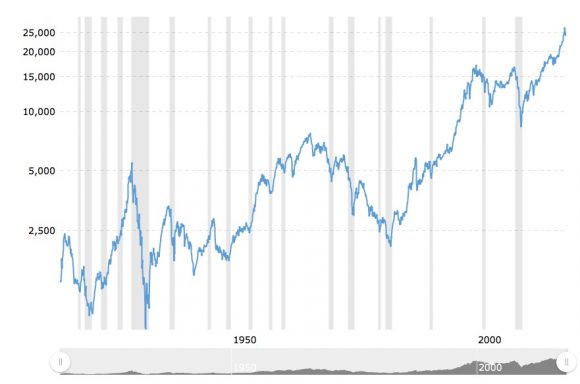
The stock market rockets in this scenario. Share prices may rise very gradually for the rest of the teens as long as tepid 2% growth persists. A 5% annual gain takes the Dow to 28,000 by 2019.
After that, after a brief dip, we could see the same fourfold return we saw during the Clinton administration, taking the Dow to 100,000 by 2030. If I'm wrong, it will hit 200,000 instead.
Emerging stock markets (EEM) with much higher growth rates do far better.
This is not just a demographic story. The next 20 years should bring a fundamental restructuring of our energy infrastructure as well.
The 100-year supply of natural gas (UNG) we have recently discovered through the new "fracking" technology will finally make it to end users, replacing coal (KOL) and oil (USO). Fracking applied to oilfields is also unlocking vast new supplies.
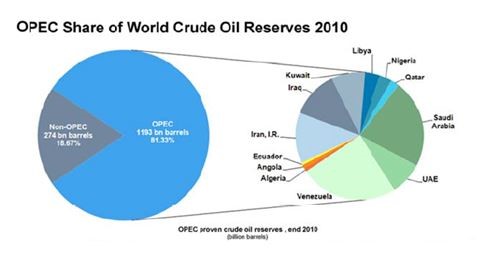
Since 1995, the United States Geological Survey estimate of recoverable reserves has ballooned from 150 million barrels to 8 billion. OPEC's share of global reserves is collapsing.
This is all happening while automobile efficiencies are rapidly improving and the use of public transportation soars.
Mileage for the average U.S. car has jumped from 23 to 24.7 miles per gallon in the past couple of years, and the administration is targeting 50 mpg by 2025. Total gasoline consumption is now at a five-year low.
Alternative energy technologies will also contribute in an important way in states such as California, accounting for 30% of total electric power generation by 2020, and 50% by 2030.
I now have an all-electric garage, with a Nissan Leaf (NSANY) for local errands and a Tesla Model S-1 (TSLA) for longer trips, allowing me to disappear from the gasoline market completely. Millions will follow. The net result of all of this is lower energy prices for everyone.
It will also flip the U.S. from a net importer to an exporter of energy, with hugely positive implications for America's balance of payments. Eliminating our largest import and adding an important export is very dollar bullish for the long term.
That sets up a multiyear short for the world's big energy consuming currencies, especially the Japanese yen (FXY) and the Euro (FXE). A strong greenback further reinforces the bull case for stocks.
Accelerating technology will bring another continuing positive. Of course, it's great to have new toys to play with on the weekends, send out Facebook photos to the family, and edit your own home videos.
But at the enterprise level this is enabling speedy improvements in productivity that are filtering down to every business in the U.S., lowering costs everywhere.
This is why corporate earnings have been outperforming the economy as a whole by a large margin.
Profit margins are at an all-time high. Living near booming Silicon Valley, I can tell you that there are thousands of new technologies and business models that you have never heard of under development.
When the winners emerge, they will have a big cross-leveraged effect on economy.
New health care breakthroughs will make serious disease a thing of the past, which are also being spearheaded in the San Francisco Bay area.
This is because the Golden State thumbed its nose at the federal government 10 years ago when the stem cell research ban was implemented. It raised $3 billion through a bond issue to fund its own research, even though it couldn't afford it.
I tell my kids they will never be afflicted by my maladies. When they get cancer in 20 years they will just go down to Wal-Mart and buy a bottle of cancer pills for $5, and it will be gone by Friday.
What is this worth to the global economy? Oh, about $2 trillion a year, or 4% of GDP. Who is overwhelmingly in the driver's seat on these innovations? The USA.
There is a political element to the new golden age as well. Gridlock in Washington can't last forever. Eventually, one side or another will prevail with a clear majority.
This will allow the government to push through needed long-term structural reforms, the solution of which everyone agrees on now, but for which nobody wants to be blamed.
That means raising the retirement age from 66 to 70 where it belongs and means-testing recipients. Billionaires don't need the maximum $30,156 annual supplement. Nor do I.
The ending of our foreign wars and the elimination of extravagant unneeded weapons systems cuts defense spending from $800 billion a year to $400 billion, or back to the 2000, pre-9/11 level. Guess what happens when we cut defense spending? So does everyone else.
I can tell you from personal experience that staying friendly with someone is far cheaper than blowing them up.
A Pax Americana would ensue.
That means China will have to defend its own oil supply, instead of relying on us to do it for them. That's why they have recently bought a second used aircraft carrier. The Middle East is now their headache.
The national debt then comes under control, and we don't end up like Greece.
The long-awaited Treasury bond (TLT) crash never happens. The Fed has already told us as much by indicating that the Federal Reserve will only raise interest rates at an infinitesimally slow rate of 25 basis points a quarter.
Sure, this is all very long-term, over-the-horizon stuff. You can expect the financial markets to start discounting a few years hence, even though the main drivers won't kick in for another decade.
But some individual industries and companies will start to discount this rosy scenario now.
Perhaps this is what the nonstop rally in stocks since 2009 has been trying to tell us.
Dow Average 1908-2018
Another American Golden Age is Coming
https://www.madhedgefundtrader.com/wp-content/uploads/2018/05/50s-photo-story-2-image-3.jpg237305MHFTRhttps://madhedgefundtrader.com/wp-content/uploads/2019/05/cropped-mad-hedge-logo-transparent-192x192_f9578834168ba24df3eb53916a12c882.pngMHFTR2018-05-15 01:06:182018-05-15 01:06:18Get Ready for the Coming Golden Age
Featured Trade:
(TRADING THE U.S. STEEL FIASCO),
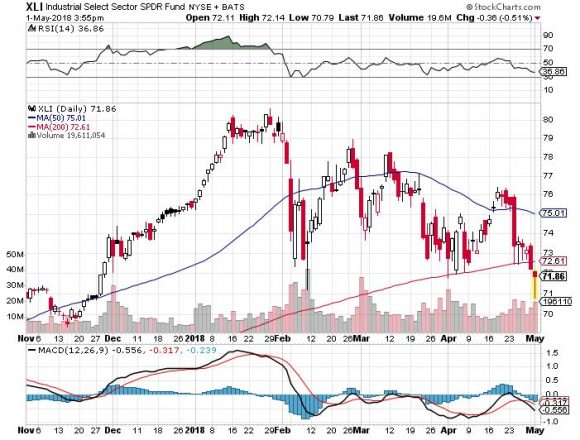
(X), (XLI), (TSLA), (BA)
(ANNOUNCING THE MAD HEDGE LAKE TAHOE, NEVADA, CONFERENCE, OCTOBER 26-27, 2018) (THE COOLEST TOMBSTONE CONTEST)
Talk about unintended consequences. Tamper with the free market and it will usually blow up in your face.
You would have thought that U.S. Steel was going to announce blockbuster earnings in the wake of the new 25% steel tariff imposed by the administration, right?
Wrong.
Instead, it has triggered a disaster of epic proportions. The reasons why provide a crash course on how fast the modern economy is evolving.
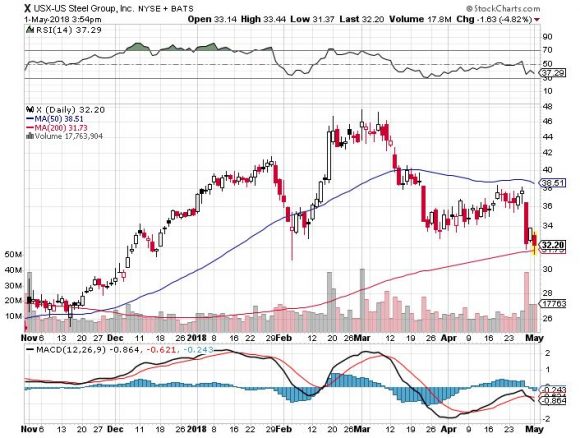
Of course, the stock market didn't like it, the shares crashing some 17.1% since the announcement. U.S. Steel, far and away the biggest beneficiary of administration policies, is now down on the year.
You may recall that we made a fortune when we bought U.S. Steel last summer at $21 a share, well before the run up into the passage of the tax package. The shares gained a mind-blowing 127%.
Not only did the company deliver a shocking disappointment on Q1 earnings, bringing in net profits of only 10 cents a share, it guided lower for Q2. Expectations had been far higher. Still, that is far better than the $180 million loss it brought in a year ago.
The CEO, David Burritt, cited unexpected "operational volatility." Take that to mean the chaos created by the steel tariffs. There is also trouble with its Great Lakes factory.
Flat rolled steel used to manufacture cars swung from an $88 million loss to a $23 million profit. But tubular steel used for pipelines incurred a $23 million loss.
What is really amazing is that the company made only a dime per share off an increase in total steel shipments YOY of 15.6%. Clearly, there is trouble in Pittsburgh.
And here is what U.S. Steel didn't expect. Instead of paying the extra 25% for imported steel, many customers are simply designing steel out of their products to cut costs rather than shifting to (X).
Three decades ago, this might have taken years to achieve. Thanks to advanced software applications this can now be accomplished in weeks. Companies are vastly more sensitive to costs than they were only a few years ago, and mere pennies can make all the difference.
It's only a matter of time before the entire auto industry shifts to carbon fiber, which has four times the strength of steel at one fifth the weight. That gives you a 20X improvement in performance and safety. Cost and mass manufacturing are the only issues.
Tesla (TSLA) is planning to make the jump in a couple of years. Boeing (BA) and the U.S. Air Force already have.
Where is U.S. Steel in a carbon fiber world? Try Chapter 11.
In the meantime, U.S. Steel consumers are scrambling to get exemptions from the punitive tariffs, creating a bureaucratic nightmare for all involved.
Wilber Ross's Commerce Department has been flooded with some 3,500 requests, each one of which takes months to review. The agency has boosted staff, but it is still overwhelmed. It looks like the only new American jobs the tariff will create will be government ones.
It turns out that many types of high grade steel, such as for razor blades and specialized carbon steel parts, aren't made in the U.S.
To prove that I learn something new every day, I discovered that even France is an important steel supplier. And I thought it was all about wine, cheese, and those cute black berets.
The net result for consumers has been uncertainty in the extreme. That purgatory has just been extended with the government's 30-day postponement of the tariffs announced yesterday.
If companies wait long enough the tariffs will simply disappear. They will certainly be declared illegal by the World Trade Organization.
The national security rationale for the steel tariffs was always completely bogus and will be laughed out of court. If steel really were a national security issue the Defense Department would have its own steel mill, as it already does with semiconductors.
The chips in U.S. weapons systems are 100% made in the USA to keep foreign back doors out of the design process.
Wars of the future will be bought with software, not M1 Abrams tanks or battleships. If fact, they already are.
As for the shares of U.S. Steel, I'm not touching them here. If the economic data continues to weaken as it has, you don't want to be anywhere near this sector.
The stock market already has reached that conclusion.
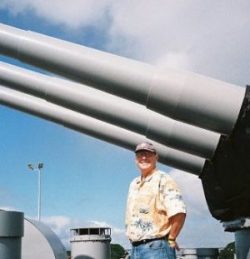
On the USS Missouri; Made in the USA
https://www.madhedgefundtrader.com/wp-content/uploads/2018/05/John-Thomas-on-USS-Missouri-story-1-image-4-e1525209087753.jpg259250MHFTRhttps://madhedgefundtrader.com/wp-content/uploads/2019/05/cropped-mad-hedge-logo-transparent-192x192_f9578834168ba24df3eb53916a12c882.pngMHFTR2018-05-02 01:08:252018-05-02 01:08:25Trading the U.S. Steel Fiasco
There is a very high degree of risk involved in trading. Past results are not indicative of future returns. MadHedgeFundTrader.com and all individuals affiliated with this site assume no responsibilities for your trading and investment results. The indicators, strategies, columns, articles and all other features are for educational purposes only and should not be construed as investment advice. Information for futures trading observations are obtained from sources believed to be reliable, but we do not warrant its completeness or accuracy, or warrant any results from the use of the information. Your use of the trading observations is entirely at your own risk and it is your sole responsibility to evaluate the accuracy, completeness and usefulness of the information. You must assess the risk of any trade with your broker and make your own independent decisions regarding any securities mentioned herein. Affiliates of MadHedgeFundTrader.com may have a position or effect transactions in the securities described herein (or options thereon) and/or otherwise employ trading strategies that may be consistent or inconsistent with the provided strategies.