Mad Hedge Technology Letter
November 29, 2023
Fiat Lux
Featured Trade:
(DEALING WITH A BLACK BOX)
(TSLA), (UBER), (LYFT)

Mad Hedge Technology Letter
November 29, 2023
Fiat Lux
Featured Trade:
(DEALING WITH A BLACK BOX)
(TSLA), (UBER), (LYFT)

Who is responsible when artificial intelligence harms someone?
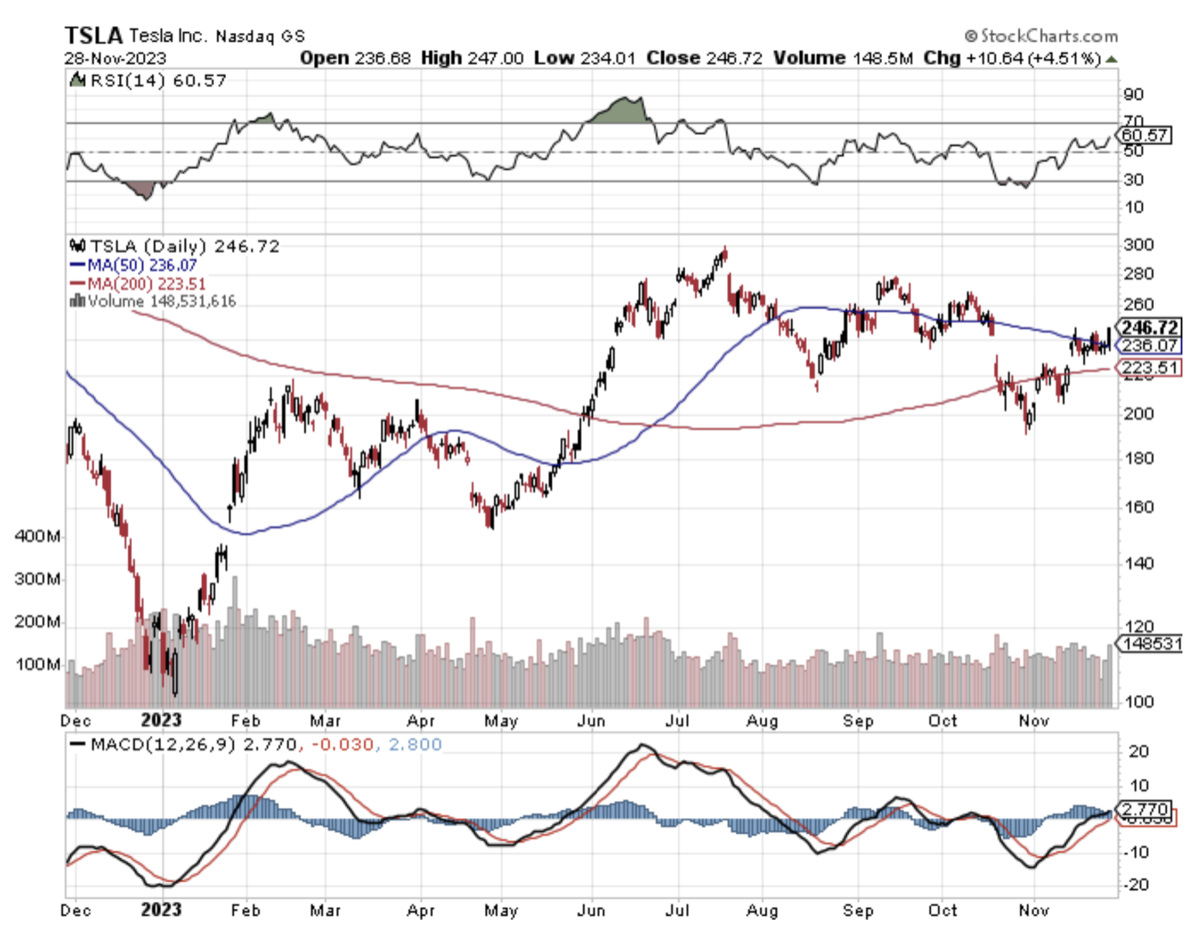
The California jury may soon have to make a decision. In December 2019, a man driving a Tesla (TSLA) with an AI navigation system killed two people in an accident. The driver faces up to 12 years in prison.
These events were bound to happen as teething pains are quite common with new technology especially one that is ambitious enough to transport machines in a human world.
Multiple federal agencies are investigating Tesla crashes, and The California Department of Motor Vehicles is investigating the use of AI-controlled driving functions.
Our current liability system used to determine liability and compensation for injuries is not AI-friendly.
Liability rules were designed for a time when humans caused most injuries.
However, with AI, errors can occur without direct human intervention. The liability system must be adjusted accordingly. Poor accountability won't just stifle AI innovation. It will also harm patients and consumers.
It's time to start thinking about accountability as AI becomes ubiquitous but remains under-regulated. AI-based systems have already contributed to injuries.
The right accountability approach is critical to unlocking the potential of AI. Uncertain regulations and the prospect of costly litigation will deter investment, development, and deployment of AI in industries ranging from healthcare to autonomous vehicles.
Currently, liability claims typically begin and end with the person using the algorithm. Of course, if someone abuses the AI system or ignores its warnings, that person should be held accountable.
But AI errors are often not the user's fault. Who can blame an emergency doctor for letting an AI algorithm miss papilledema — a swelling of part of the retina?
AI's failure to detect the disease could delay care and potentially cause the patient to lose their eyesight. Papilledema is difficult to diagnose without an ophthalmologist.
AI is constantly self-learning, which means it takes in information and looks for patterns in it. This is a "black box" that makes it difficult to understand which variables affect the outcome.
The key is to ensure that everyone involved - users, developers, and everyone else in the chain - has been vetted to keep AI safe and effective.
First, insurers should protect policyholders from AI injury litigation costs by testing and validating new AI algorithms before deploying them.
Car insurers have also been comparing and testing cars for years. An independent security system can provide AI stakeholders with a predictable system of accountability that adapts to new technologies and practices.
Second, some AI errors should be challenged in courts that specialize in uncommon cases. These tribunals may specialize in particular technologies or topics.
Third, proper regulatory standards from federal agencies can offset the excessive liability of developers and users. For example, some forms of medical device liability have been superseded by federal regulations and laws. Regulators should focus on standard AI development processes early on.
Regulation can make or break AI in the upcoming years and I lean towards the laissez-faire attitude of deregulation.
Too many regulations will stifle development and bring about undue costs.
No company will continue with loss-making operations unless they see a light at the end of the tunnel.
If allowed to develop with light regulation, AI will be that supercharger to tech stocks that investors dreamed of.
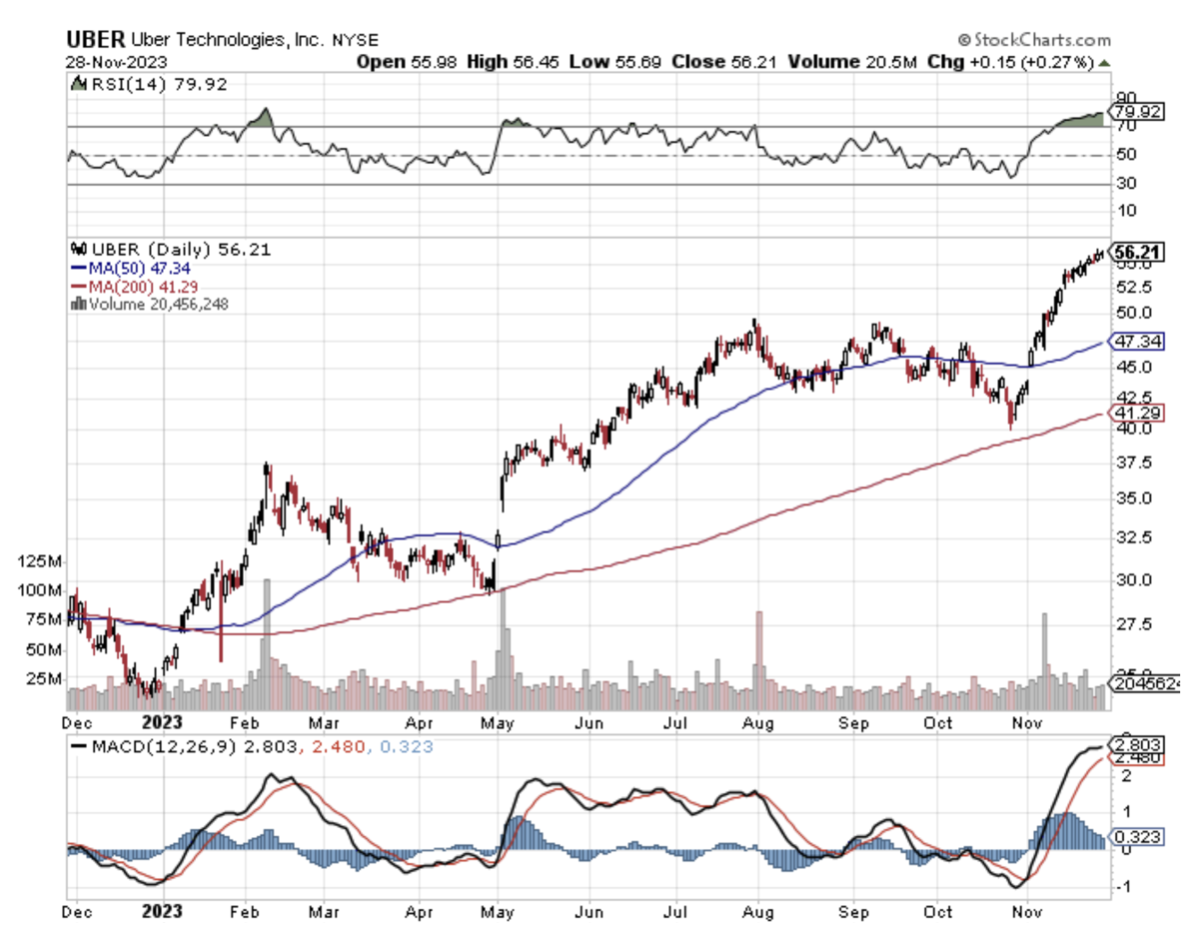
Transportation-based tech stocks such as Uber and Lyft will be one of the largest winners from the widespread implementation of driverless technology.
Also, throw in there the food delivery companies like DoorDash (DASH).
Another group with immense expense-saving possibilities is all the airline firms around the world because theoretically, self-driving technology will become good enough to deploy in short and long-haul flights.
Getting to the point of consumers and regulators fully trust self-driving technology is still a long and windy path, but I do believe we will arrive there.
When we do get there, the tech companies underwriting these benefits will feel a 10X boost to their share price.


Global Market Comments
November 24, 2023
Fiat Lux
Featured Trade:
(MY UPDATED PERSONAL ECONOMIC INDICATOR),
(HMC), (NSANY), (GM), (F), (TSLA)
(HERE IS YOUR TOP PERFORMING INVESTMENT FOR THE NEXT FIVE YEARS),
(ITB), (PHM), (KBH), (DHI)
(TESTIMONIAL)

There is no limit to my desire to get an early and accurate read on the US economy, which at the end of the day is what dictates the future of all of our trades and investments.
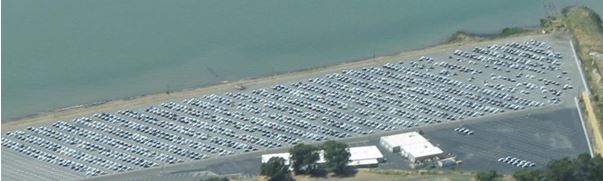
I flew over one of my favorite leading economic indicators only last weekend at the controls of a vintage Cessna 172.
Honda (HMC) and Nissan (NSANY) import millions of cars each year through their Benicia, California facilities, where they are loaded onto thousands of rail cars for shipment to points inland as far as Chicago.
In 2009, when the US car market shrank to an annualized 8.5 million units, I flew over the site and it was choked with thousands of cars parked bumper to bumper, rusting in the blazing sun, bereft of buyers.
Then, “cash for clunkers” hit (remember that?).
The lots were emptied in a matter of weeks, with mile-long trains lumbering inland, only stopping to add extra engines to get over the High Sierras at Donner Pass.
The stock market took off like a rocket, with the auto companies leading.
I flew over the site last weekend, and guess what?
The lots are empty.
U.S. new vehicle sales, including retail and non-retail transactions, are estimated to reach 1,354,600 units in August, a 15.4% jump from a year earlier, according to the joint report by J.D. Power and GlobalData. Consumers are estimated to spend $47.8 billion on new vehicles, the highest on record for the month of August, and 10.5% higher than last year, the report said.
Japanese cars are suddenly selling so fast that vehicles are being sold even before they land on the dock.
It is all further evidence that my increasingly optimistic view on the US economy is correct, that multiple crises this year are fully discounted, and that the stock market is poised for new highs.
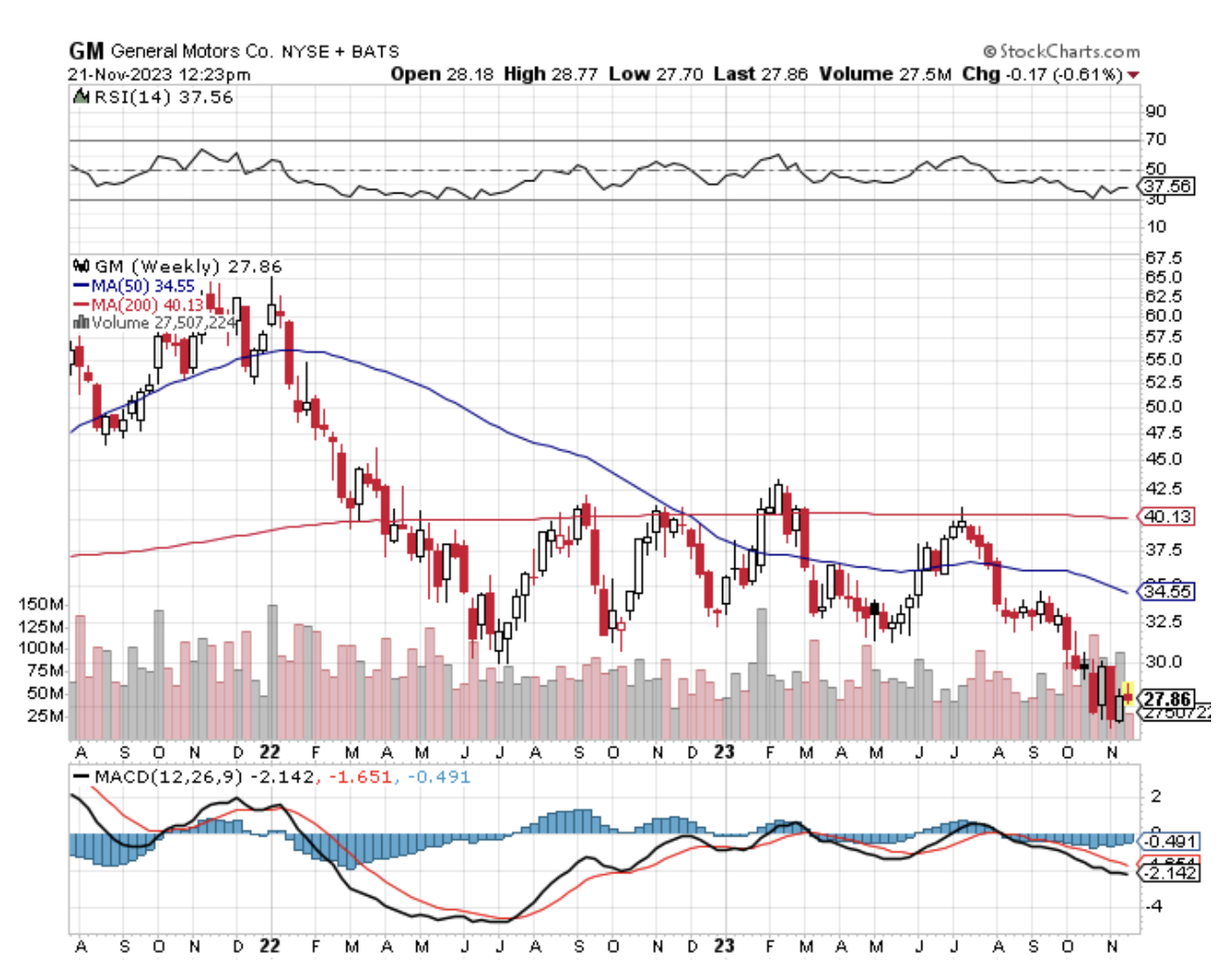
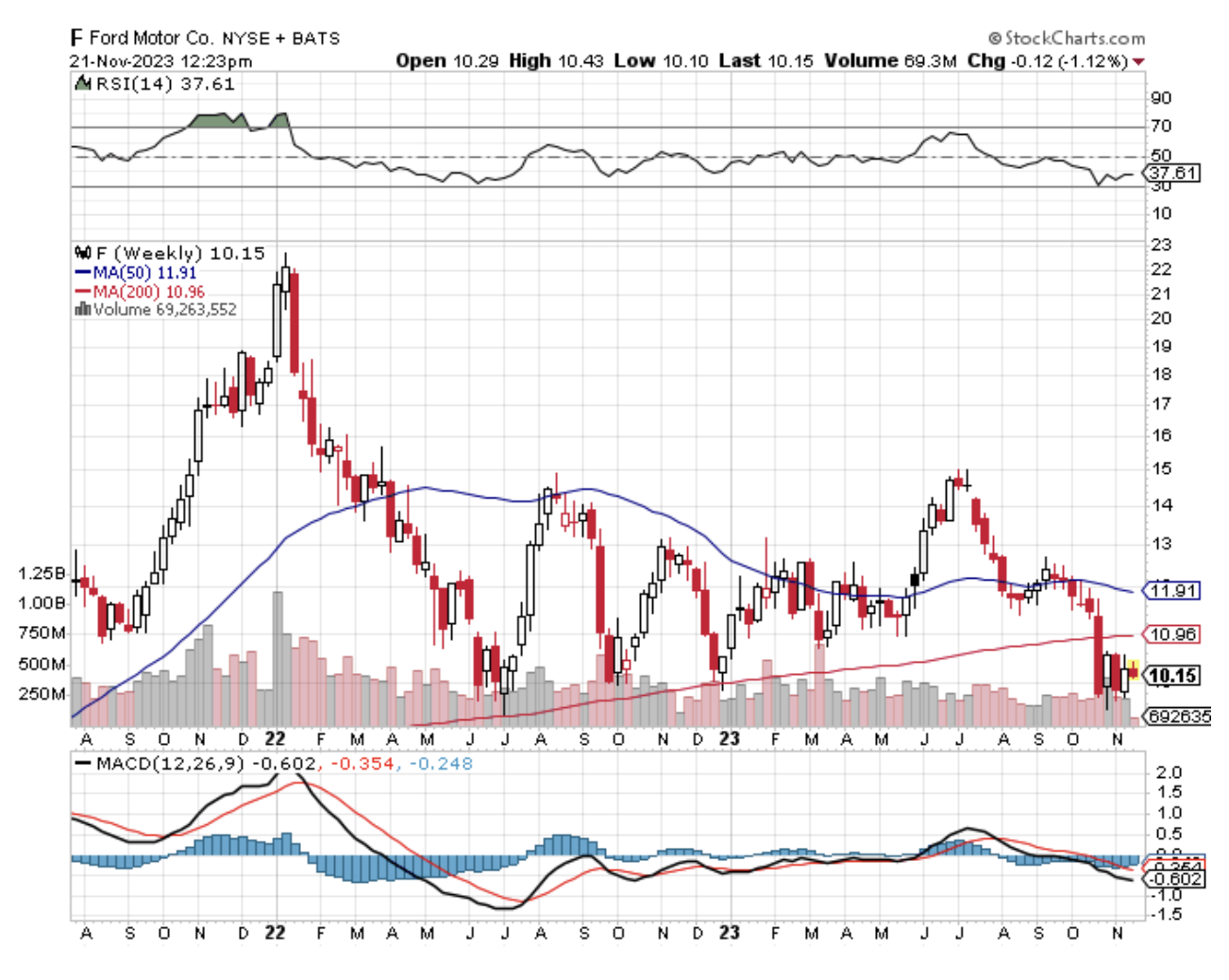
The conventional auto industry should lead to the upside, as it has already done, led by General Motors (GM) and Ford (F). But the move may not happen until the second half of 2024 when the market’s love affair with big tech stocks reaches the point of temporary exhaustion.
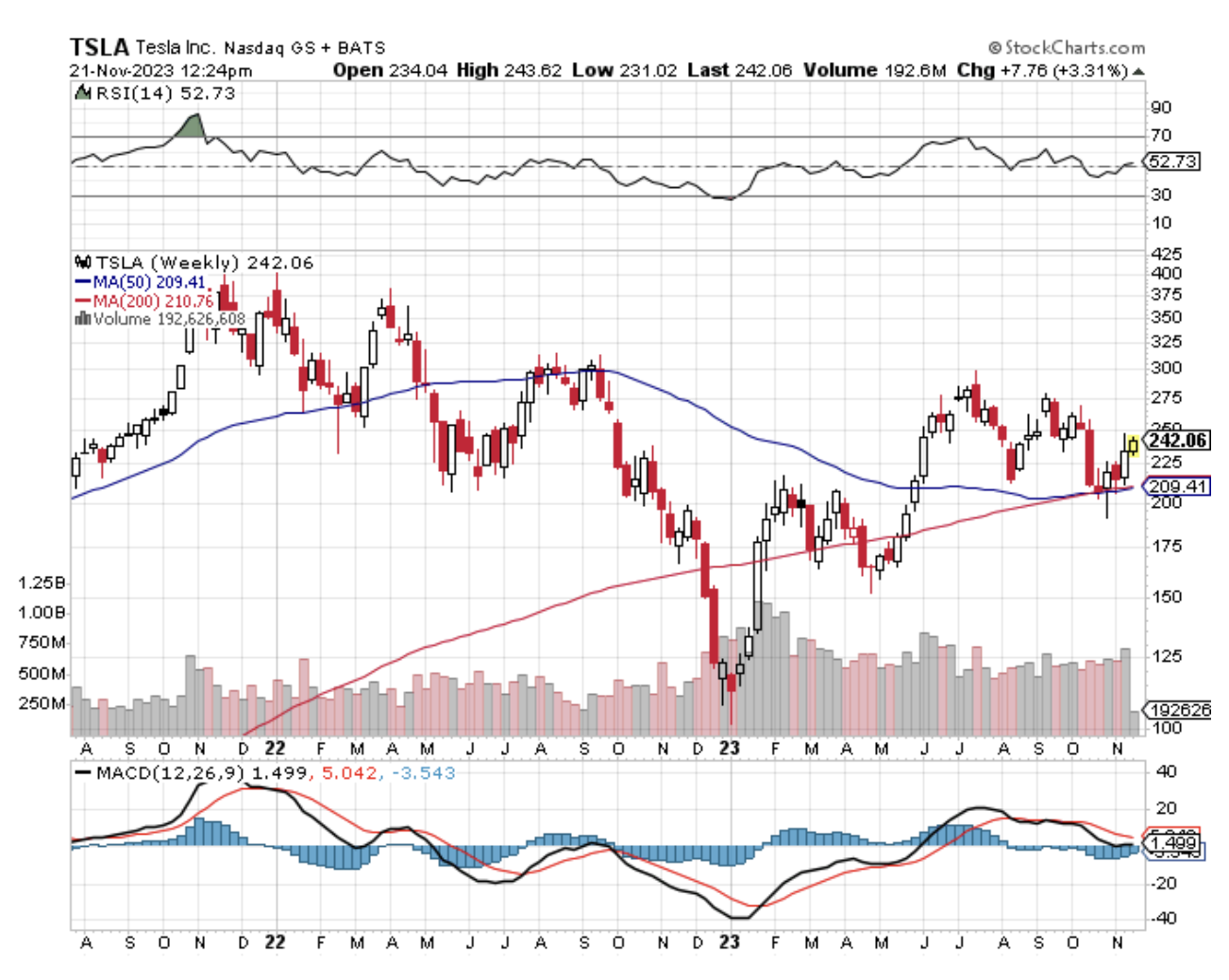
As for Tesla (TSLA), better to buy the car than the stock at these depressed prices. Once the EV price wars end, the stock should double again to new all-time highs.
This is a big deal because the auto industry directly and indirectly accounts for about 10% of the total US economy.
It is also the largest manufacturing employer, with the legacy Big Three accounting for 6 million jobs, 4.87% of the 124 million US total.
Not only do you have to include the big four automakers, but you also must include the vast number of parts suppliers, advertisers, and the national dealer networks.
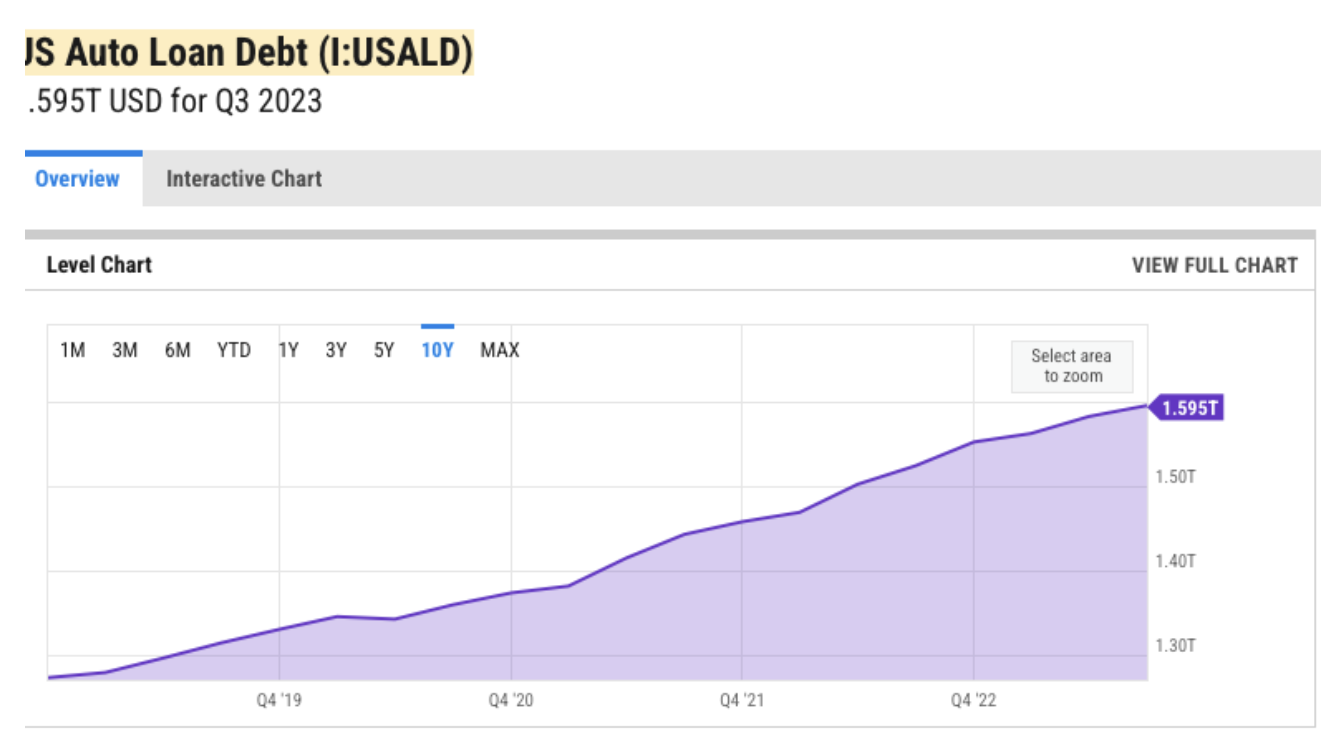
Since so many car purchases are financed with loans, it turns out that the industry is a great play on falling interest rates.
There are $1.6 trillion in subprime auto loans on lenders’ books now.
If you don’t believe me, check out the resale market price of your wheels at Kelly Blue Book (click here for the site)
You will see they have recently risen steadily in value.
It is all further evidence of the hard data/soft data conundrum, which I have written about extensively in the past.
Look no further than Consumer Sentiment, which has held up remarkably well for the past three consecutive months.
Sorry the photo below is a little crooked, but it's tough holding a camera in one hand and a plane's stick with the other, while flying through the never-ending turbulence of the San Francisco Bay’s Carquinez Straight.
Air traffic control at nearby Travis Air Force Base usually has a heart attack when I conduct my research in this way, with a few joyriding C-130s having more than one near miss in recent years.


Global Market Comments
November 17, 2023
Fiat Lux
Featured Trade:
(NOVEMBER 15 BIWEEKLY STRATEGY WEBINAR Q&A),
(TLT), (AMD), (SPY), (FXA), (WYNN), (MGM), (RCL), (CCL), (TSLA), (SCHW), (BLK), (JPM), (XHB), (TSLA), (FXI), (FCX)

Below please find subscribers’ Q&A for the November 15 Mad Hedge Fund Trader Global Strategy Webinar, broadcast from Incline Village, NV.
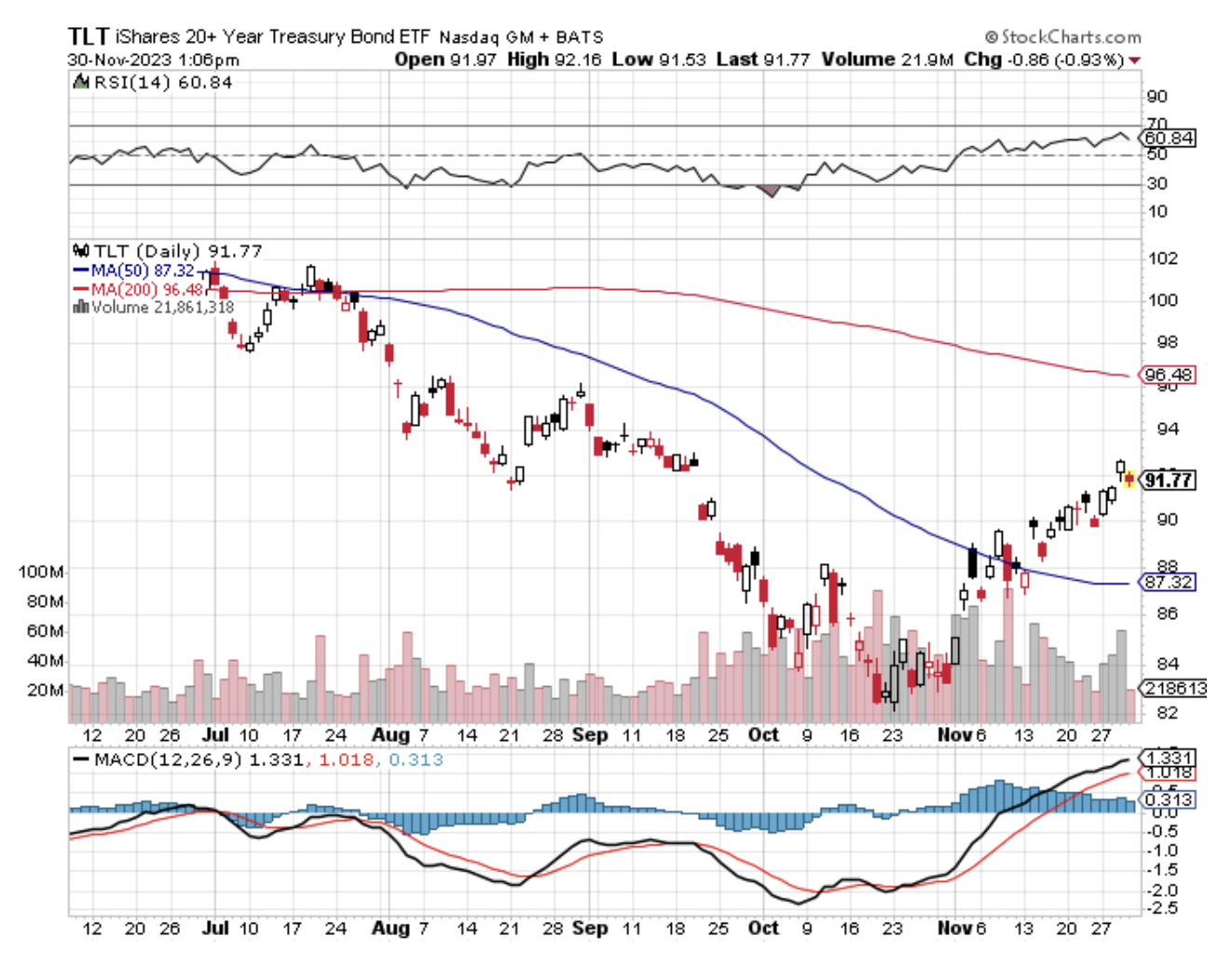
Q: I was a little surprised that you closed the (TLT) $79-$82 vertical bull call spread so early. Why not wait longer?
A: I took an 84% profit in only four trading days and skipped the last 16% which I would have had to wait another month to get. I was much better off putting on another position and making another 100%. In this kind of market, you want to take quick profits and then roll them into new positions as fast as you can. That’s where you make the big money, and that's what we’ve been doing. You have to strike when the iron is hot.
Q: November’s results are phenomenal!
A: Yes they are, 55 years of practice makes it easy.
Q: Thoughts on Advanced Micro Devices (AMD)?
A: It’s going higher. I think the whole semiconductor sector is the leading sector in the market; we have seen that with these gigantic 30-40% moves in the semis. That will continue, and then it will spread out to the rest of big tech (which it’s already done), and eventually, we get to the industrials and commodities in the second half of 2024 when the big economic growth returns. So that is the script for the coming year.
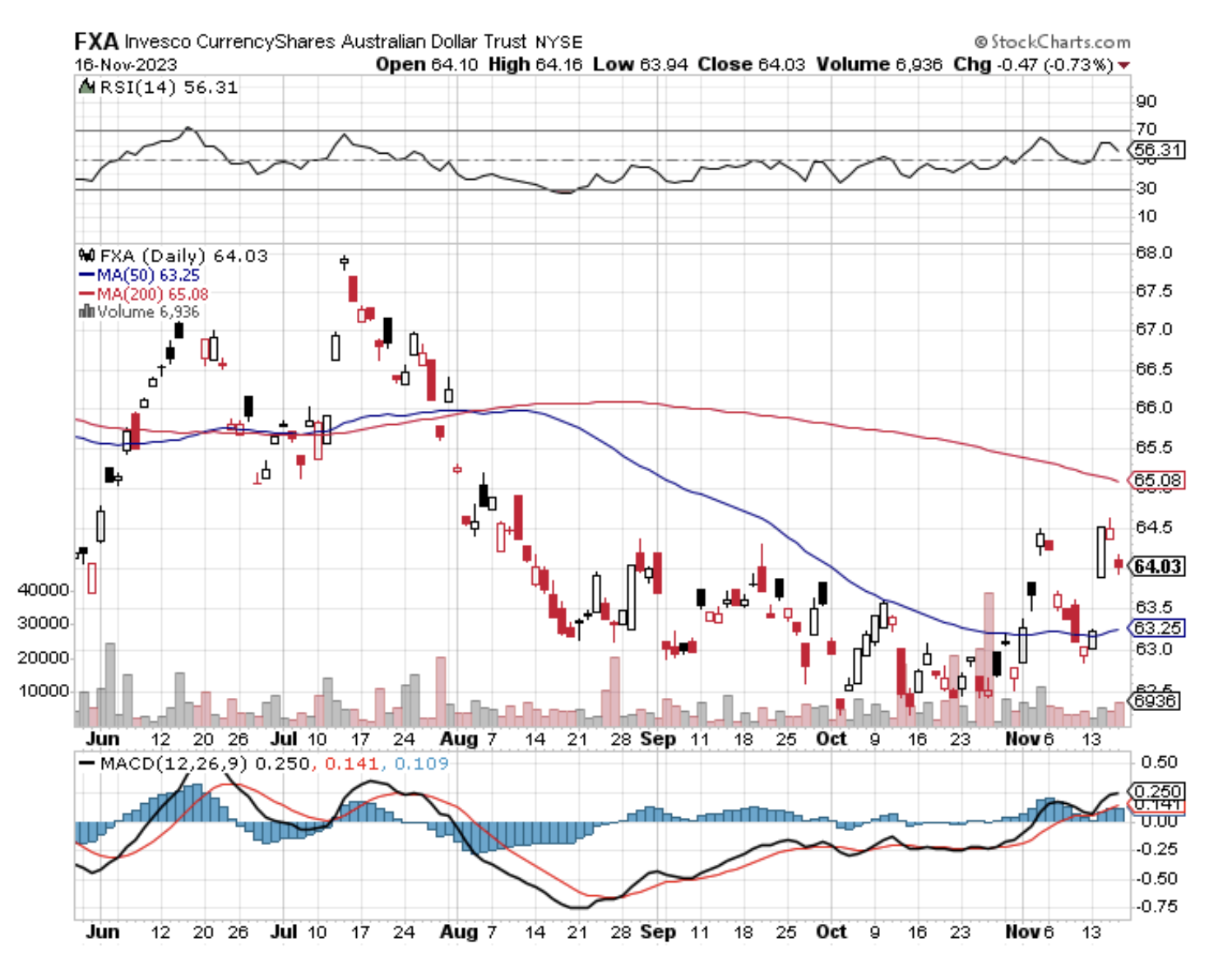
Q: Will the upcoming Fed interest rate cuts crash the dollar, and which emerging currency should I buy?
A: Yes and yes. It will crush the dollar–we could be entering a new decade of a falling U.S. dollar. The number one currency to buy is the Australian dollar (FXA). It has the most leverage for a global economic recovery. And you can see when we get to the currency section of today’s webinar that the currencies are already starting to move. Whatever currency has falling interest rates is always the weakest, and the U.S. dollar is about to become just that.
Q: What’s the deal with casino stocks lately like Wynn Resorts (WYNN) and MGM Resorts International (MGM)?
A: These companies took on massive amounts of debt during the pandemic to stay in business, so they are now highly sensitive to interest rates. If you look at the collapse of these stocks in the last four months, it is almost perfectly in sync with rising interest rates, and that’s why the stocks performed so poorly. By the way, the same is true for all the cruise companies like Royal Caribbean (RCL), and Carnival (CCL). The flip side of that is when interest rates start to go down these stocks do great, and they are falling interest rate plays, so you probably should be buying the casinos, the cruise lines, and the hotel stocks here because they are all suffering from massive debt loads, the cost of which is about to decline sharply.
Q: Should we roll up the expiration of LEAPS to 2026?
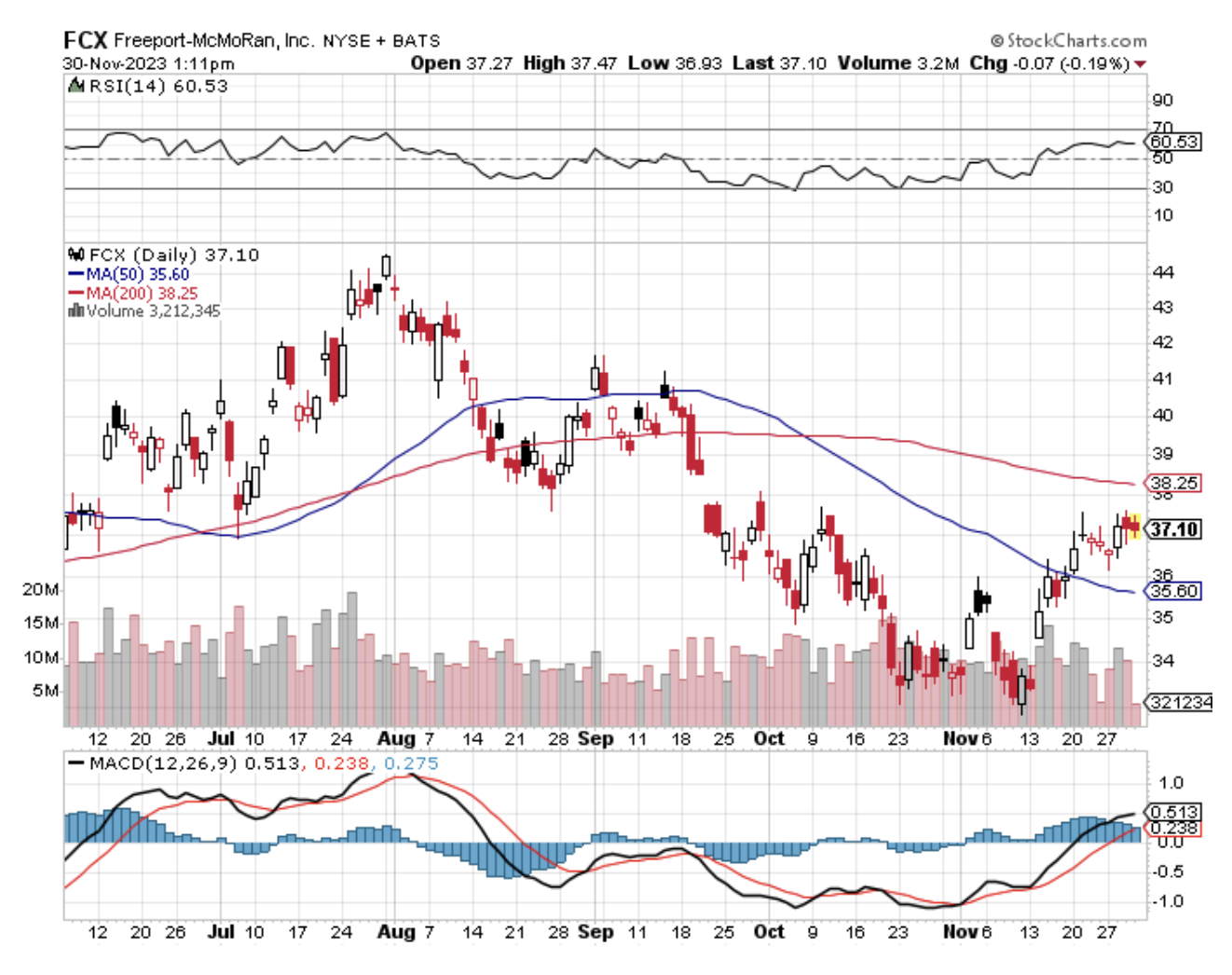
A: Probably not a bad idea, because we may get weakness in commodities for the next several months before we enter a massive new bull market. If you have the 2025, you’ll probably make money on that, but to be ultra-safe you could roll it forward to 2026. We know there’s a global copper shortage developing because of EVs, but right now EV sales are slow, so you don’t want to be piling onto the leverage plays on that too soon. That’s also why I am not in Tesla (TSLA) for the Moment.
Q: What will happen if the Fed cuts interest rates and there’s no recession? Won’t prices of everything from houses to butter go wild?
A: They won’t go wild, but they will go up at a 2% inflation rate, which is what the Fed wants. And house prices, which have been flat for the last year, will rise. And they may rise greater than the inflation rate of 2%; they may rise more like 5%. Falling interest rates mean falling mortgages; we’ve already seen mortgage rates drop from 8 to 7.4%. It's one of the sharpest drops in history, and more drops bring more first-time home buyers into the market. And don’t forget that the Fed could also raise interest rates down the road. If the economy gets too hot again, they may raise again, but I think we’ll see a lot of cuts first.
Q: Do you think financial stocks will go up or fall with potential rate decreases?
A: Banks always go up during falling interest rates because their cost of funds goes down and the default rate on their loans also goes down, so they get a hockey stick effect on earnings; that’s why you’re seeing such monster moves in stocks like JP Morgan (JPM) and the brokers (SCHW) as well as the money managers like BlackRock (BLK).
Q: Does the bull market keep going since unemployment still hasn’t made a dent, meaning consumers are fueling the rise in stocks?
A: Yes, consumer spending is still doing well. People seem to be getting the money from somewhere and it seems to be rising wages. But I expect wage gains to drop by half; people will still get wage increases, but not the peak levels that the UAW got in their deal with Detroit. Is a Goldilocks economy that is setting up, and the economy keeps growing We never do get a recession, and all risk assets rise as a result. That is the outlook!
Q: Bullish on Berkshire Hathaway (BRK/B)?
A: I completely agree, it’s one of the best-run companies in the world. 93-year-old Warren Buffet and 99-year-old Charlie Munger have delivered double the performance of the S&P 500 over the last three years.
Q: When does the IPO market come back to life, and which industries will benefit the most?
A: AI and Technology will benefit the most. There are several AI companies in the wings waiting to go public, and they will be the first out the door with the highest multiples, and then the IPO business will broaden out from there.
Q: Will a worsening Chinese property market blow up the U.S. Stock rally or is it just a fake risk I shouldn’t worry about?
A: The Chinese (FXI) real estate market is detached from the global economy. There is no international implication, and it’s also typical of emerging markets to overbuild and then have a financial collapse. Nobody I know has suffered anything in China in a long time, and if anything, they’re liquidating what little they have left. It doesn’t affect us at all. It’s interesting reading about it in the newspapers, and that’s about it.
Q: What are some stocks we should consider day trading these days?
A: None. Most people who try day trading lose money doing it; some people pull it off but they have many years of experience. Algorithms from big brokers have essentially taken over the day trading business with high-frequency trading. You do better on a one-month view, which I do on my front-month options. Most 2023 Stock Gains Happened in only eight days, up some 14% since January 1, and only seven stocks accounted for most of the increase. If you are a day trader, you most likely missed all of this because most of the moves were on gap openings.
Q: Home builders (XHB) have just had a great run, is this an area too short?
A: “Short” is a term you need to remove from your language! You don’t want to short a big bull move like this. If anything, wait until May when the summer seasonals start to favor short positions, and it depends on how high the market runs up until then. Don’t ever think about shorting the very beginning of a new bull market in stocks–not for housing, not for anything! And the outlook for housing over the long term looks fantastic; there’s still an overwhelming supply and demand in favor of the home builders. Some 85 million new Millennials need to buy first-time homes.
To watch a replay of this webinar with all the charts, bells, whistles, and classic rock music, just log in to www.madhedgefundtrader.com, go to MY ACCOUNT, select your subscription (GLOBAL TRADING DISPATCH, TECHNOLOGY LETTER, or Jacquie's Post), then click on WEBINARS, and all the webinars from the last 12 years are there in all their glory.
Good Luck and Stay Healthy,
John Thomas
CEO & Publisher
The Diary of a Mad Hedge Fund Trader

2023 Kherson Ukraine – Ha Ha Missed Me! It was a dud.


Mad Hedge Technology Letter
November 15, 2023
Fiat Lux
Featured Trade:
(CONSIDERING AT INVESTMENT IN FISKER THEN READ THIS)
(FSR), (TSLA)

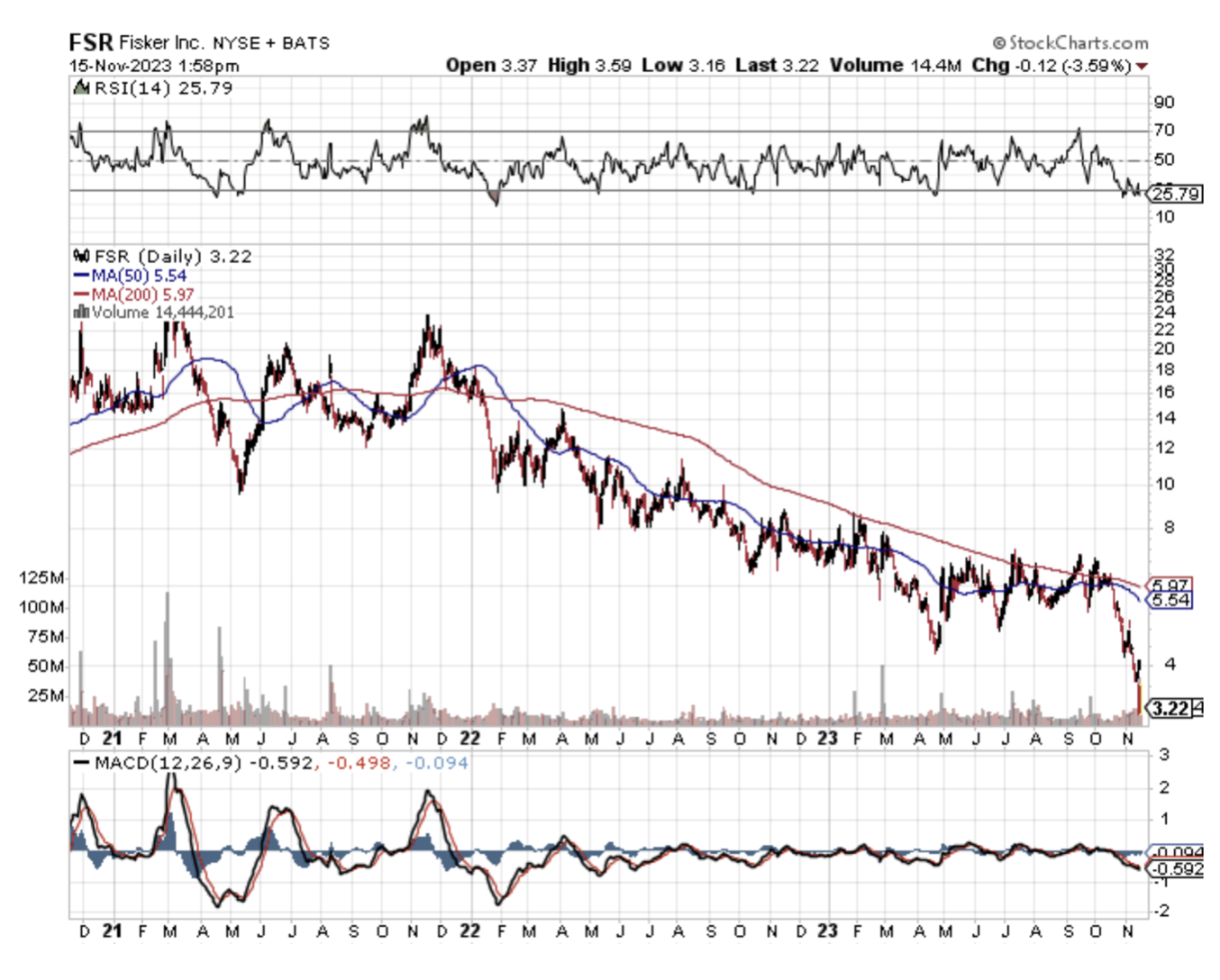
Removing the Chief Accounting Officer and delaying earnings on the day of earnings is a massive red flag for EV start-up Fisker (FSR).
Fisker said in a filing that it “determined that it has material weaknesses in the company’s internal control over financial reporting.”
Hiring the wrong person for one of the most important jobs at the company only to realize on the day of an earnings report is more than bad optics, and it certainly means there is probably a lot worse going on under the hood.
The blood bath in FSR shares continues today with the stock cratering over 2% which is on the heels of a 21% drop on Tuesday.
Fisker CFO Geeta Gupta-Fisker said the company is cutting its 2023 production guidance to a range of 13,000-17,000 units to enable the company’s “global delivery and logistics platform to scale” and not sit on inventory. Fisker’s challenges with delivery resulted in 4,725 vehicles produced, but only 1,097 delivered.
FSR has continued to over-promise and deliver which creates a toxic recipe for lower stock prices.
After peaking at over $28 per share in the summer of 2021, the stock has done nothing but slide into the abyss.
CEO Henrik Fisker said customers were waiting a long time for their vehicles and were getting “annoyed.”
Fisker’s production forecast stood at 20,000-23,000 units, which itself was reduced from a prior forecast of 32,000-36,000 in May, and again from 42,400 earlier this year.
It’s only time until the EV company starts reducing its forecasts even more and this constant expectation of changing expectations is due to bad management.
FSR lost $91 million in the past quarter and only has a tick above half a billion in cash.
Doing some basic math, it means that FSR will burn through their existing cash in 5 quarters if they lose around the same amount of cash each quarter moving forward. If this happens, they will need to tap the corporate debt market and pay extortionate rates of something between 17% and 20% considering they have a high chance of filing for bankruptcy.
Readers should keep in mind that FSR doesn’t sell a cheap car.
It’s quite expensive which will make it even harder to scale.
That’s bad news for a start-up that only delivers about 1,000 cars per quarter.
Performance and management seem like they aren’t up to snuff and on paper, the company isn’t hitting the metrics it needs to be taken seriously by investors.
From a pricing point of view, Fisker made pricing adjustments for its lone Ocean SUV, cutting its top trim Ocean Extreme by $7,500 to $61,499.
Ultimately, I see FSR’s competitive position, or lack thereof exacerbating as we move forward.
I don’t see how they catch up with the heavyweights as it relates to many critical factors in running a successful EV firm.
Low-interest rates or something similar to them will not be back for a long time and perhaps never.
This new rate environment doesn’t favor the start-ups the ones that already “made it” in a low-rate environment of the past.
FSR makes a good car, but not to the point where buyers will pass up other cheaper options.
If FSR is struggling to deliver more than 1,000 cars per quarter, it bodes ill for repeat purchases after so many buyers are waiting for cars that should have already been delivered.
Management not understanding the logistics of the situation is hard to fathom in 2023.
They might want to pick up the phone and call around to see what is going on.
If a buyer spends more than $70,000 for an EV from an untested brand like FSR, better get the car there on time.
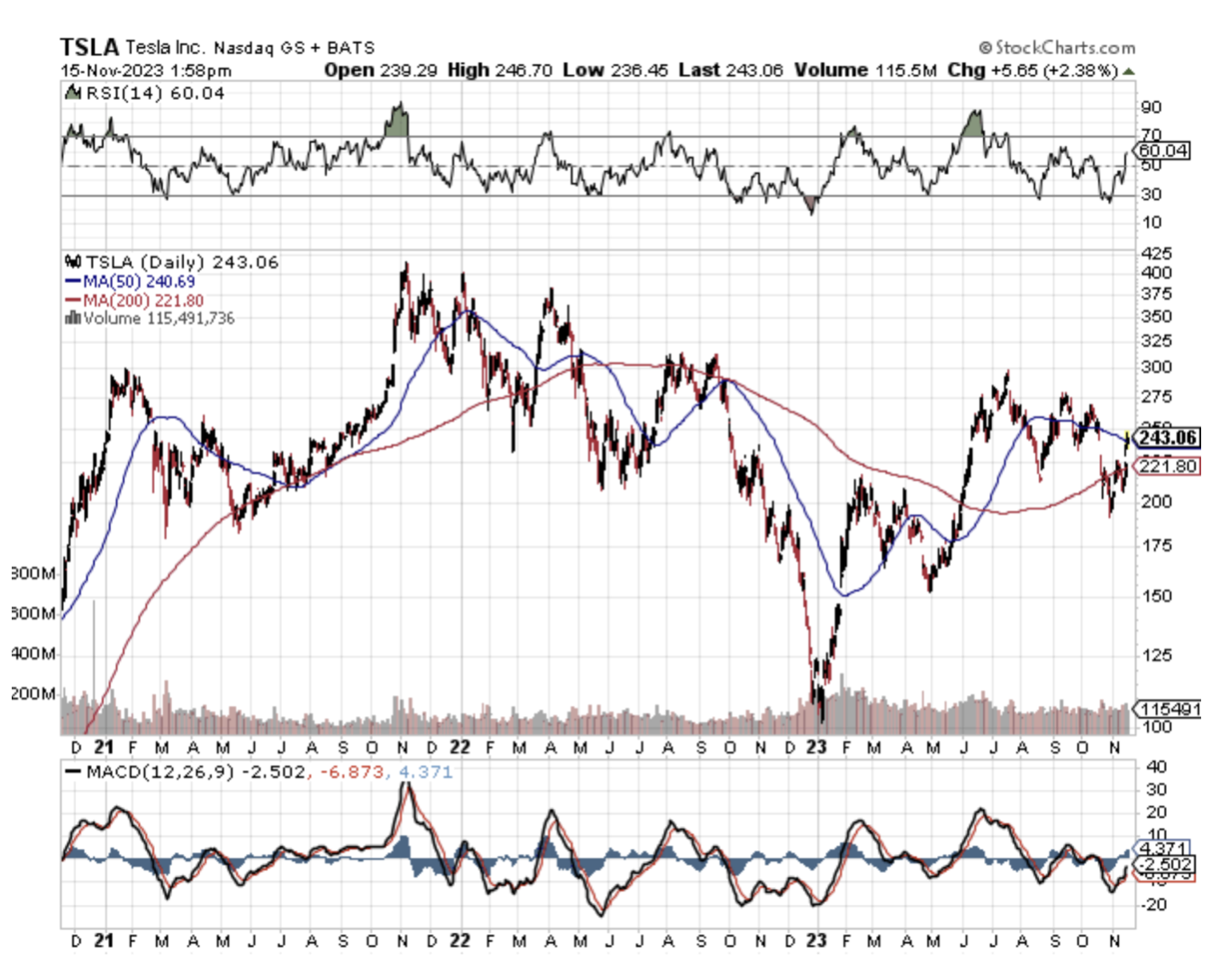
There is a reason why Tesla (TSLA) just caught a bid and shares went up 18% and the stock has doubled this year and it’s not because they have trouble delivering 1,000 cars.
I’ll take a hard pass on FSR for right now.


Global Market Comments
November 14, 2023
Fiat Lux
Featured Trade:
(WHY YOU WILL LOSE YOU JOB IN THE NEXT FIVE YEARS, AND WHAT TO DO ABOUT IT),
(INTU), (AMZN), (GOOGL), (TSLA), (BLK), (HRB)

Yes, it’s happening.
And if you lose your job to AI in five years you will be one of the lucky ones.
It’s possible that your job is already gone, they just haven’t told you yet.
The shocking conclusion I am getting from dozens of research fronts is that artificial intelligence and automation are accelerating far faster than anyone realizes.
It is all extraordinarily disruptive.
This will cause corporate profits to rocket and share prices to soar but at the price of higher nationwide political instability.
A big leap took place at the beginning of the year when suddenly it appeared that everything got a lot smarter.
My local Safeway has started using self-checkout scanners to enable customers to avoid the long lines still operated by humans.
I hate them because I can never get them to scan pineapples correctly.
Soon, Amazon (AMZN) opened a supermarket in Seattle where there is no checkout stand at all. You simply just pick up whatever products you want, and it will scan them all on the way out to the parking lot.
Once the software is perfected (it is self-learning), and the consumers are educated, 5 million checkout clerks will be joining the unemployment lines.
Uber has been testing self-driving taxis in Phoenix, AZ, with sometimes humorous results. It seems that other human-driven cars like crashing into them. There has been one fatality so far when the human safety driver was caught texting.
When they figure this out, probably in two years, 180,000 taxi drivers and 600,000 Uber and Lyft drivers will have to hit the road.
Some 3 million truck drivers will be right behind them.
Notice that I am only a couple of paragraphs into this peace and already 8,780,000 jobs are about to imminently disappear out of a total of 150 million in the US.
Two decades from now, only vintage car collectors or the very poor will be driving their cars if Tesla (TSLA) has anything to do with it.
I let my Model X drive me around most of the time. It has reaction time, night vision, and a 360-degree radar system that are far better than my 71-year-old senses.
However, all new Teslas now come equipped with the hardware to use it. They are all only one surprise overnight software upgrade away from the future.
And it's not just the low-end high school dropout jobs that are being thrown in the dustbin of history.
Automation is now rapidly moving up the value chain.
A rising share of online news is machine-generated and is targeting you based on your browsing history. You just didn’t know it.
It was a major influence in the last election.
Blackrock (BLK), the largest fund manager in the country, has announced that it is laying off dozens of stock analysts and turning to algorithms to manage its vast $8.6 trillion in assets under management.
As the April 15 tax deadline relentlessly approaches, you are probably totally unaware that an algorithm prepared your return, particularly if you use a low-end service like H & R Block (HRB) or Intuit’s (INTU) TurboTax.
Because of the simultaneous convergence of multiple technologies, half of all current jobs will likely disappear over the next 20 years.
If this sounds alarming, don’t worry.
We’ve been through all of this before.
From 1900 to 1950 farmers fell from 40% to 2% of the labor force. The food output of that 2% has tripled over the last 60 years, thanks to improved seed varieties and farming methods.
The remaining 38% didn’t starve.
They retrained for the emerging growth industries of the day, automobiles, aircraft, and radio.
But there had to be a lot of pain along the way.
More recently, some 30% of all job descriptions listed on the Department of Labor website today didn’t exist 20 years ago.
Yes, disruption happens fast.
And here’s where it gets personal.
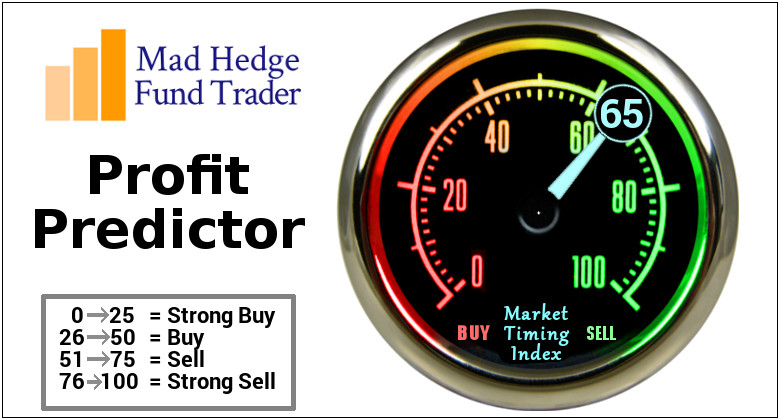
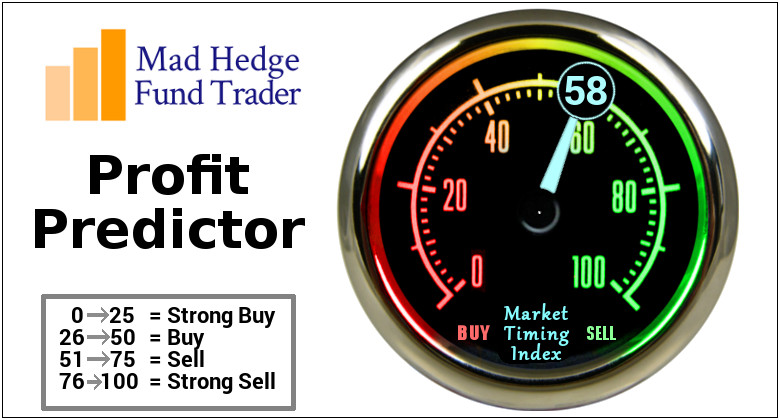
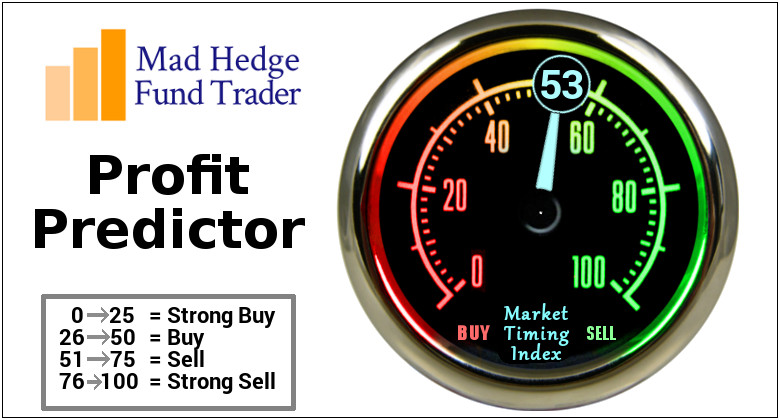
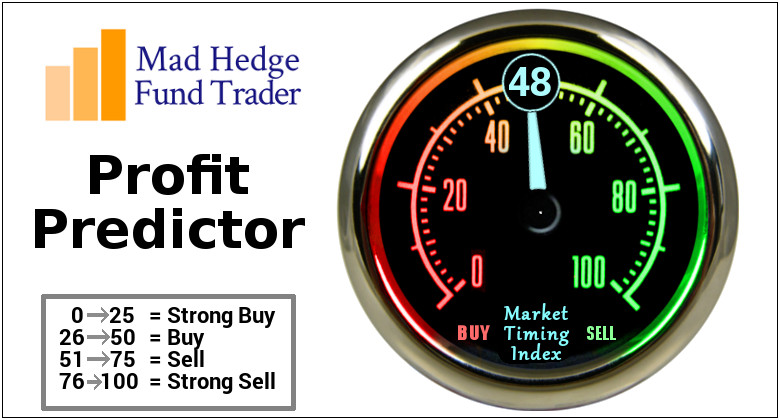
Since I implemented an AI-driven, self-learning Mad Hedge Market Timing algorithm to assist me in my own Trade Alert service six months ago, MY PERFORMANCE HAS ROCKETED, FROM A 21% ANNUAL RATE TO 51%!
As a result, YOU have been crying all the way to the bank!
The proof is all in the numbers (see chart below).
Those trading without the tailwind of algorithms today suddenly find the world a very surprising and confusing place.
They lose money too.
The investment implications of all of this are nothing less than mind-boggling.
Wages are almost always the largest cost for any business, especially the labor-intensive ones like retailing, fast food, and restaurants.
Reduce your largest expense by 90% or more, and the drop through to the bottom line will be enormous.
Stock markets have already noticed.
Maybe this is why price-earnings multiples are trading at a multi-decade high of 19.5X.
Perhaps, the markets know something that we mere humans don’t?
It also is the largest budgetary item in any government-supplied service.
I bet that half of the country’s 7 million teaching jobs will be gone in a decade, taken over by much cheaper online programs.
Today, my kids do their homework on their iPhones, complete class projects on Google Docs, and get a report card that is updated and emailed to me daily.
They’re probably to last generation to ever go to a physical school.
(That’s life. Just as the cost of driving them to school every day becomes free, they don’t have to go anymore).
You can always adopt a “King Canute” strategy and order the tide not to rise.
Or, you can rapidly adapt, as I did.
The choice is yours.


Legal Disclaimer
There is a very high degree of risk involved in trading. Past results are not indicative of future returns. MadHedgeFundTrader.com and all individuals affiliated with this site assume no responsibilities for your trading and investment results. The indicators, strategies, columns, articles and all other features are for educational purposes only and should not be construed as investment advice. Information for futures trading observations are obtained from sources believed to be reliable, but we do not warrant its completeness or accuracy, or warrant any results from the use of the information. Your use of the trading observations is entirely at your own risk and it is your sole responsibility to evaluate the accuracy, completeness and usefulness of the information. You must assess the risk of any trade with your broker and make your own independent decisions regarding any securities mentioned herein. Affiliates of MadHedgeFundTrader.com may have a position or effect transactions in the securities described herein (or options thereon) and/or otherwise employ trading strategies that may be consistent or inconsistent with the provided strategies.