Global Market Comments
August 7, 2019
Fiat Lux
Featured Trade:
(WHY I SOLD SHORT MACYS’),
(AMZN), (WMT), (M), (JWN), (KOL)
(TESTIMONIAL)


Global Market Comments
August 7, 2019
Fiat Lux
Featured Trade:
(WHY I SOLD SHORT MACYS’),
(AMZN), (WMT), (M), (JWN), (KOL)
(TESTIMONIAL)
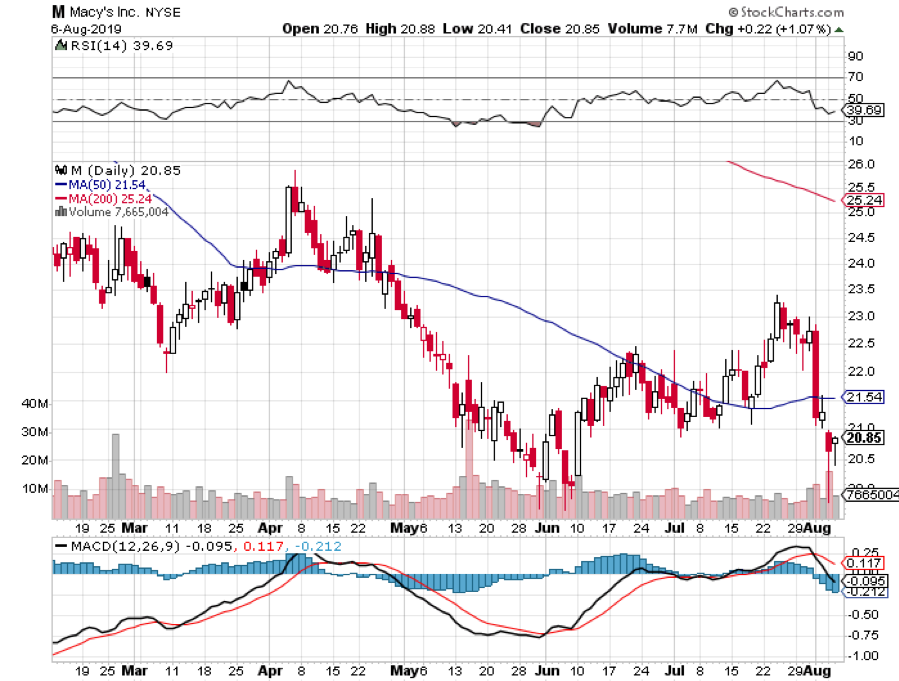
Sorry, the Trade Alert to sell short Macys’ (M) went out late yesterday. I was speaking to a retail expert and his list of things wrong with the marquee name was so long that I couldn't get off the phone. New Yorkers are going to have to find something else to do on Thanksgiving Day than attend their famous parade.
His bottom line? Retail is in a death spiral from which it will never recover. Trying on clothes in a shopping mall will soon become a thing of the past, going the way of the buggy whip, black and white TV, and six-track tapes.
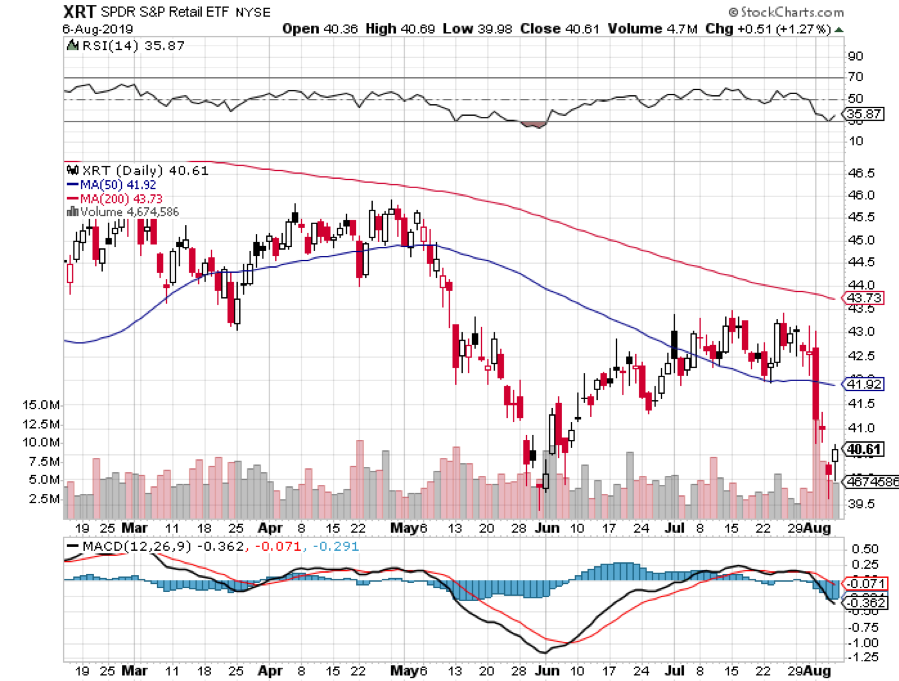
If you had to pick the biggest loser of our ongoing trade wars, which have just been ratcheted up in intensity, it would be the retail industry (XRT). Higher costs and tariffs can’t be passed on, minimum wages are rising in the big cities, lower selling prices are lower, and a massive inventory glut is NOT what money-making is all about.
The stocks have delivered as expected, providing one of the worst-performing sectors of 2019. Half of them probably won’t even make it until 2020.
In fact, Sears (S) and Macy’s (M) have announced more store closings nationwide. The overhead is killing them in a micro margin world.
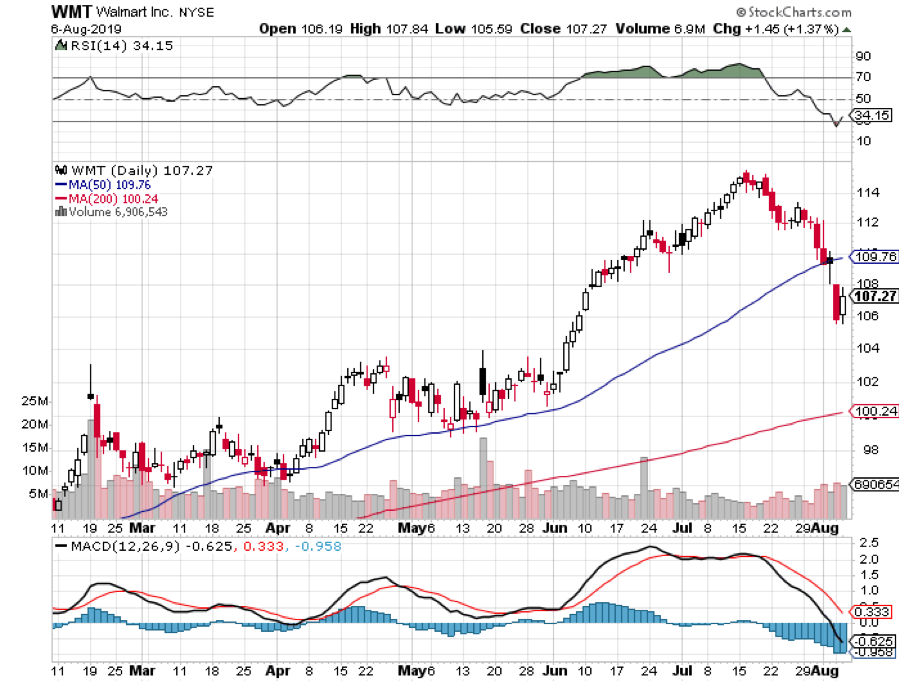
So, I stopped at a Walmart (WMT) the other day on my way to Napa Valley to find out why.
I am not normally a customer of this establishment. But I was on my way to a meeting where a dozen red long-stem roses would prove useful. I happened to know you could get these for $10 a dozen at Walmart.
After I found my flowers, I browsed around the store to see what else they had for sale. The first thing I noticed was that half the employees were missing their front teeth.
The clothing offered was out of style and made of cheap material. It might as well have been the Chinese embassy. Most concerning, there was almost no one there, customers OR employees.
The Macy’s downsizing is only the latest evidence of a major change in the global economy that has been evolving over the last two decades.
However, it now appears we have reached both a tipping point and a point of no return. The future is happening faster than anyone thought possible. Call it the Death of Retail.
I remember the first purchases I made at Amazon 20 years ago. Even though I personally knew the founder, Jeff Bezos, from my Morgan Stanley days, the idea sounded so dubious that I made my initial purchases with a credit card with only a low $1,000 limit. That way, if the wheels fell off, my losses would be limited.
And how stupid was that name Amazon, anyway? At least, he didn’t call it “Yahoo” because it was already taken.
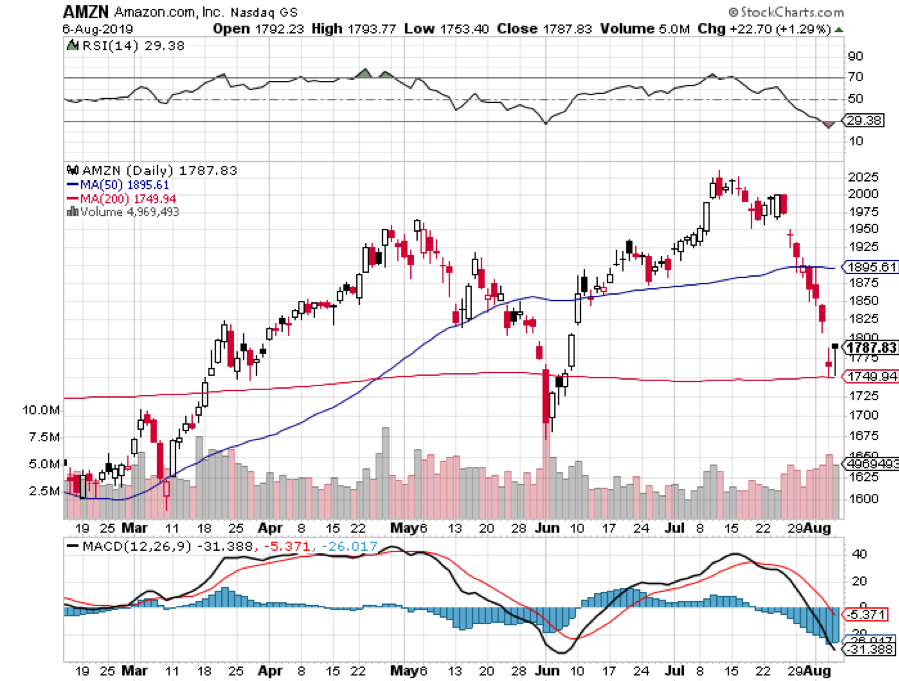
Today, I do almost all of my shopping at Amazon (AMZN). It saves me immense amounts of time while expanding my choices exponentially. And I don’t have to fight traffic, engage in the parking space wars, or wait in line to pay.
It can accommodate all of my requests, no matter how bizarre or esoteric. A WWII reproduction Army Air Corps canvas flight jacket in size XXL? No problem!
A used 42-inch Sub Zero refrigerator with a front-door icemaker and water dispenser? Have it there in two days, with free shipping at one fifth the $17,000 full retail price.
So I was not surprised when I learned this morning that Amazon accounted for 25% of all new online sales in 2018 in a market that is already growing at a breathtaking 20% YOY.
In 2000, after the great “Y2K” disaster that failed to show, I met with Bill Gates Sr. to discuss his foundation’s investments.
It turned out that they had liquidated their entire equity portfolio and placed all their money into bonds, a brilliant move coming mere months before the Dotcom bust and a 16-year bull market in fixed income.
Mr. Gates (another Eagle Scout) mentioned something fascinating to me. He said that unlike most other foundations their size, they hadn’t invested a dollar in commercial real estate.
It was his view that the US economy would move entirely online, everyone would work from home, emptying out city centers and rendering commuting unnecessary. Shopping malls would become low-rent climbing walls and paintball game centers.
Mr. Gates’ prediction may finally be occurring. Some counties in the San Francisco Bay area now see 25% of their workers telecommuting.
It is becoming common for staff to work Tuesday-Thursday at the office, and from home on Monday and Friday. Productivity increases. People are bending their jobs to fit their lifestyles. And oh yes, happy people work for less money in exchange for personal freedom, boosting profits.
The Mad Hedge Fund Trader itself may be a model for the future. We are entirely a virtual company with no office. Everyone works at home in four countries around the world. Oh, and we all use Amazon to do our shopping.
The downside to this is that whenever there is a snowstorm anywhere in the country, it affects our output. Two storms are a disaster, and at three, such as last winter, we grind to a virtual halt.
You may have noticed that I can work from anywhere and anytime (although sending a Trade Alert from the back of a camel in the Sahara Desert was a stretch), so was sending out an Alert while hanging on the cliff face of a Swiss Alp, but they both made money.
Moroccan cell coverage is better than ours, but the dromedary’s swaying movement made it hard to hit the keys.
The cost of global distribution is essentially zero. Profits go into a bonus pool shared by all. Oh, and we’re hiring, especially in marketing.
It is happening because the entire “bricks and mortar” industry is getting left behind by the march of history.
Sure, they have been pouring millions into online commerce and jazzed up websites. But they all seem to be poor imitations of Amazon with higher prices. It is all “Hour late and dollar short” stuff.
In the meantime, Amazon soared by 49% from December to the May high, and was one of the top performing stocks of 2018. There are now a cluster of Amazon analyst forecasts around the $3,000 mark.
And here is the bad news. Bricks and Mortar retailers are about to lose more of their lunch to Chinese Internet giant Alibaba (BABA), which is ramping up its US operations and is FOUR TIMES THE SIZE OF AMAZON!
There’s a good reason why you haven’t heard much from me about retailers. I made the decision 30 years ago never to touch the troubled sector.
I did this when I realized that management never knew beforehand which of their products would succeed, and which would bomb, and therefore were constantly clueless about future earnings.
The business for them was an endless roll of the dice. That is a proposition in which I was unwilling to invest. There were always better trades.
I confess that I had to look up the ticker symbols for this story as I never use them.
You will no doubt be enticed to buy retail stocks as the deal of the century by the talking heads on TV, Internet research, and maybe even your own brokers, citing how “cheap” they are.
Never confuse a low stock price with “cheap.”
It will be much like buying the coal industry (KOL) a few years ago, another industry headed for the dustbin of history. That was when “cheap” was on its way to zero for almost every company.
So the next time someone recommends that you buy retail stocks, you should probably lie down and take a long nap first. When you awaken, hopefully the temptation will be gone.
Or better yet, go shopping at Amazon. The deals are to die for.
To read “An Evening with Bill Gates Sr.”, please click here.
Global Market Comments
August 5, 2019
Fiat Lux
Featured Trade:
(MARKET OUTLOOK FOR THE WEEK AHEAD, or TAKING THE ELEVATOR DOWN),
($INDU), (SPY), (TLT), (IWM), (WMT), (FXB)


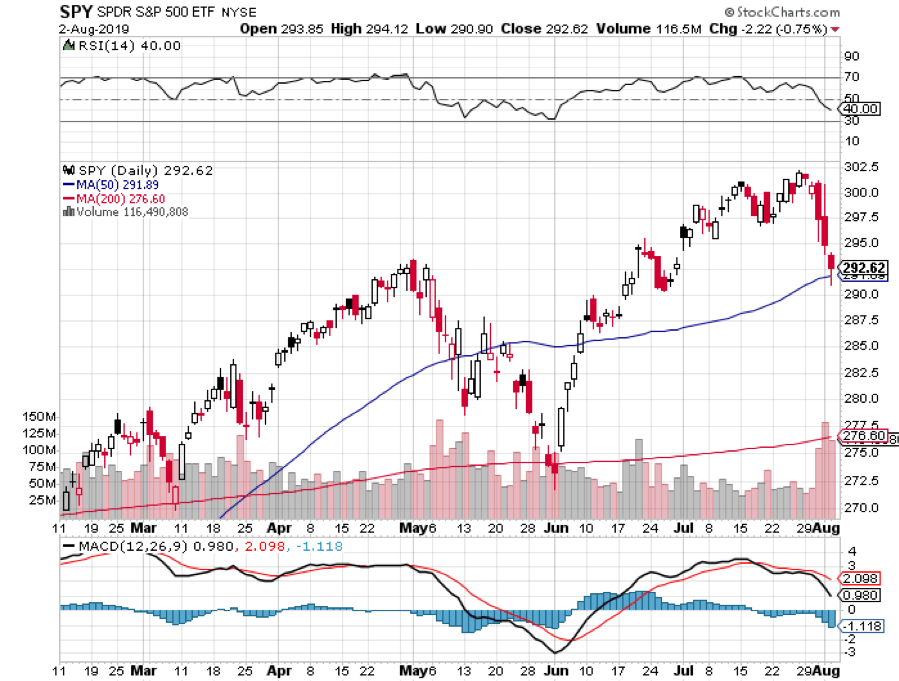
It is often said the markets take the escalator up and the elevator down. A thousand Dow points in three days? That’s like taking the elevator down from the 101st floor of the Empire State Building down to the basement in one shot.
Welcome to your new $30 billion tax, or about $90 per American per year. That will be the effect of the new 10% tariff increase on $300 billion worth of goods imported from China. Unfortunately, this comes on top of an existing $210 per American, bring the total bill due from the China trade war to $300 per person.
Clearly, the Chinese think they can get a better deal from the next president and are inclined to wait it out. This has been my base case since the trade war started 18 months ago.
It was one of the most frenetic, emotion-charged, and violent weeks of the year, with almost daily wild swings on a daily basis. This is the environment where hedge funds and newsletters like this one earn their pay.
The July Nonfarm Payroll Report came in at 164,000, keeping the headline unemployment report to 3.7%. Average hourly earnings grew by a hot 3.2% YOY. The previous two months were revised down by 41,000. Overall, it was a disappointing report.
Manufacturing has been especially weak all year, adding only 16,000 jobs in July and averaging 8,000 jobs a month all year. The headline charge into the services economy continues. Retail lost 3,600, the sixth consecutive monthly decline. The strength was in Professional Services, up 31,000, Health Care at 30,000, and Social Assistance at 20,000.
The broader U-6 “discouraged worker” structural unemployment rate dropped from 7.2% to 7.0%, a new cycle low.
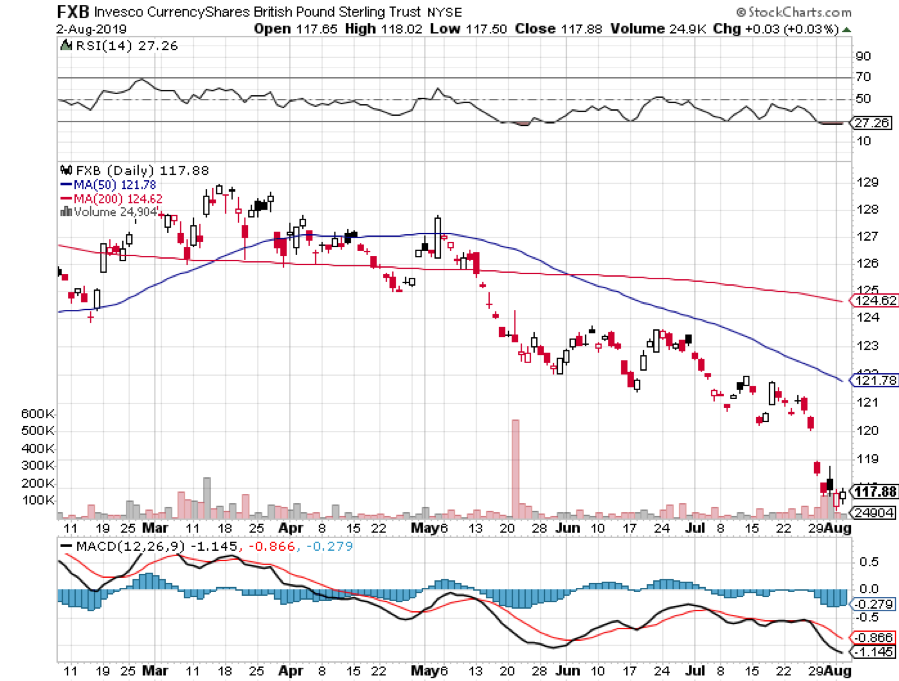
The British Pound (FXB) crashed by 1%, as the harsh reality of a hard Brexit looms. That’s because Boris Johnson, the pro Brexit activist, was named UK prime minister and filled his cabinet with anti-EC doormats. It virtually guarantees a recession there and will act as an additional drag on the US economy.
The end result may be a “Disunited Kingdom”, with Scotland declaring independence in order to stay in the EC, and Northern Ireland splitting off to create a united Emerald Island. The stock market there will crater and the pound will go to parity against the greenback.
Home Price Gains are Still Shrinking, from a 3.5% to a 3.4% annual gain in May, according to the S&P Corelogic Case Shiller National Home Price Index. The Median Home Price hit a new high of $285,700. That can’t buy you a parking space in San Francisco. This is removing a major leg from the economy.
Las Vegas saw the biggest increase at 6.4%, followed by Phoenix at 5.7% and Tampa at 5.1%. Shrinking price gains in the face of falling interest rates is a classic pre-recessionary indicator.
Apple hurdled a low bar, with an upward forward guidance delivering a 5% pop in the stock. Revenues rose 1% to $53.8 billion, while profits dropped 7%. The future looks bright on the eve of 5G iPhones. Hardware drops to less than half of sales for the first time. Services revenues jump to 21% of the total.
China is still a drag. Amazingly, Apple only bought $17 billion worth of its own stock last quarter against a commitment of $100 billion. So why are analyst “BUY” ratings at a decade low? Maybe it's because threats of retaliation in the China trade war are hanging over Apple like a sword of Damocles.
It took only three words to kill Wall Street. Confusion reigns. “Mid Cycle Adjustment” was how Fed governor Jay Powell described Wednesday’s 25 basis point interest rate cut, the first in 12 years, absolutely what the market didn’t want to hear. That implies that the Fed is “one and done,” and that there will be no more interest rate cuts in this economic cycle.
The president added insult to injury piling abuse on his own appointee, further eroding confidence in the independence of the Fed. A truly data dependent Fed wouldn’t have budged last week.
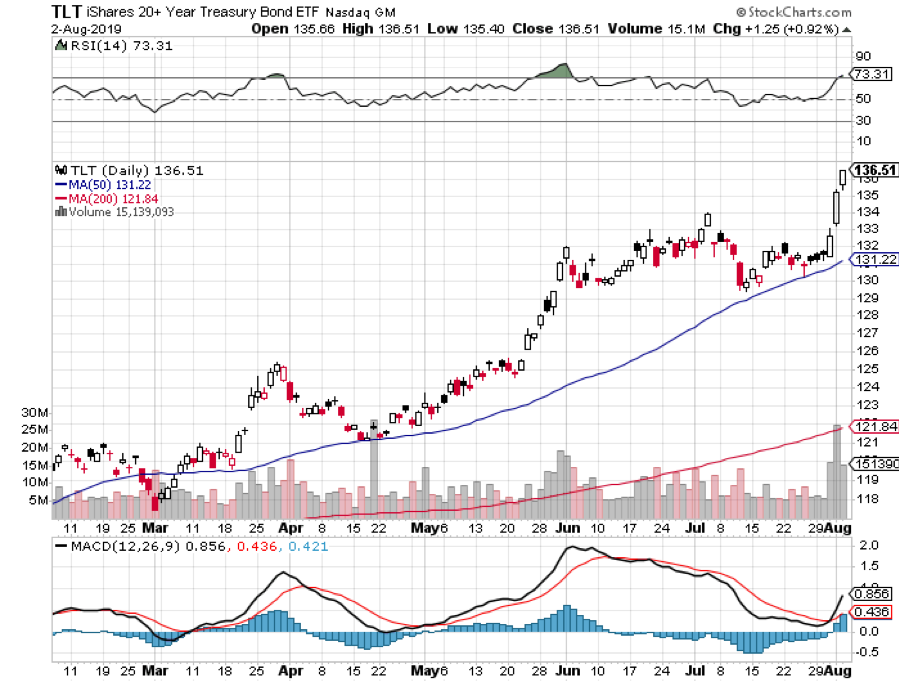
Bonds soared on “one and done.” Higher rates for longer give a new lease on life for the fixed income markets everywhere. Since 2008, major central bank balance sheets have exploded from $3 trillion to $16 trillion, and there is nowhere better for this mountain of money to go but the ten-year US Treasury bond.
Yields have smashed the four-year low at 1.82% and are headed to 1.40% by yearend. The market is wildly overbought for now on the back of an instant three-point rally, so keep buying those dips. Next up is the century low in rates.
Oil crashed 8% on increased global recession fears, in the worst plunge in four years and one of the biggest swan dives in history. The strong dollar doesn’t help either. I have recommended that investors avoid energy like the plague all year and it has worked like a charm. Long term, it’s going out of business anyway, so I don’t even want to trade it here.
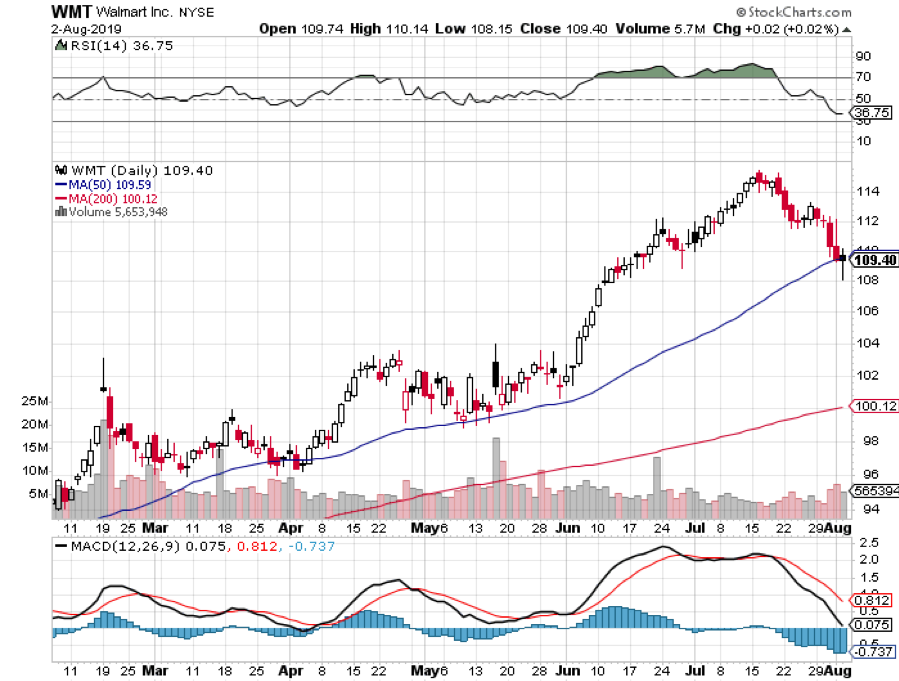
Retailers got destroyed on the China news, with stocks down 6%-12% across the board. Best Buy (BBY) did a 12% swan dive. This will be the stick that broke the camel’s back for a lot of retailers already hanging on by their fingernails. Some 42% of US apparel, 69% of footwear, and 84% of accessories come from China.
Squeezed by Amazon on one side and administration China policies on the other, this will spell the death of retail. It looks like we’re going to have to go barefoot this winter. Thank goodness there’s global warming. The death spiral was further confirmed by the weak jobs figures in retail this morning.
I went into the week 100% in cash, giving me the dry powder to pursue the short side aggressively. I always tell followers that cash is a position, that it has option value, and this was a classic example of how well that can work.
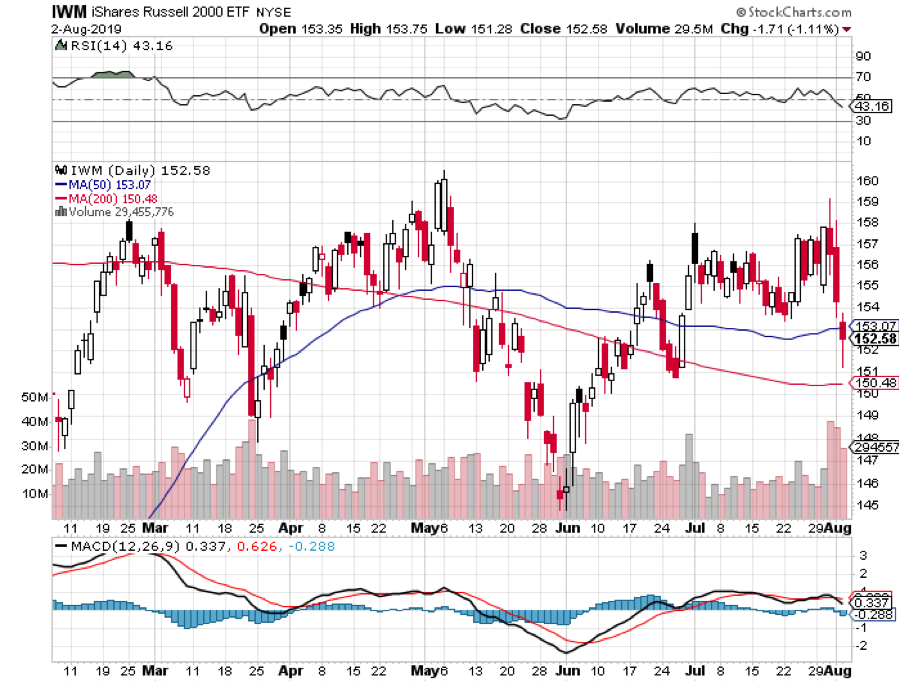
The second I heard about the China tariff increase, I went pedal to the metal and increased my shorts from 0% to 40%, against 60% cash. My current shorts include the S&P 500 (SPY), US Treasury bonds (TLT), the Russel 2000 (IWM), and the giant retailer (WMT).
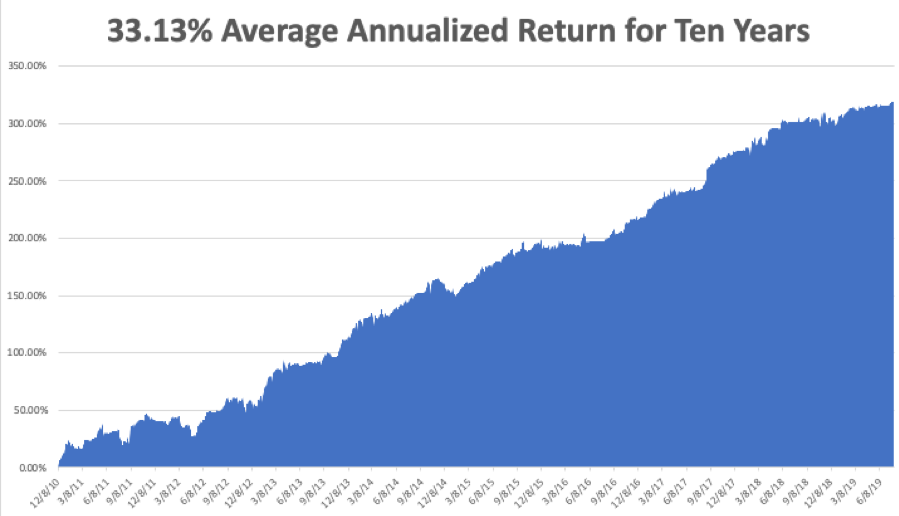
I see August as the best short selling opportunity of the year. I put out my first shorts the day after the Fed rate cut. My Global Trading Dispatch has hit a new all-time high of 320.30% and my year-to-date shot up at +20.16%. A robust earned a robust 1.83% so far in August, and 4.78% since I went back into the market from Zermatt, Switzerland three weeks ago.
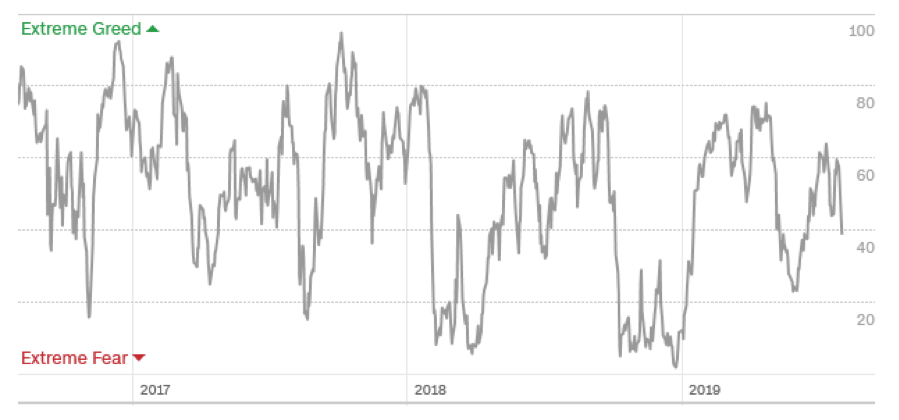
My ten-year average annualized profit bobbed up to +33.13%. My Mad Hedge Market Timing Index saw one of the sharpest declines in its history, plunging from 65 to 23 on only two days. We could even be back to “BUY” territory by the end of next week.
The coming week will be a feeble one on the data front. Believe it or not, it could be a quiet week.
On Monday, August 5 at 2:00 PM, the July ISM Non-Manufacturing PMI is out.
On Tuesday, August 6 at 2:00 PM, the June JOLTS Jobs Openings report is published.
On Wednesday, August 7, at 8:30 AM, June Consumer Credit is released.
On Thursday, August 8 at 8:30 AM, the Weekly Jobless Claims are printed.
On Friday, August 9 at 8:30 AM, July Core Purchasing Price Index is printed, an inflation indicator.
The Baker Hughes Rig Count follows at 2:00 PM.
As for me, believe it or not, I have not been to the beach this year. As a native Californian, that is near high treason. So I am loading up the old Tesla with an ice chest, boogie boards, and kids and headed to nearby Stinson Beach in Marin County. I’m going early to beat the traffic and will take my usual short cuts I learned while living there eons ago.
Surf’s up!
Good luck and good trading.
John Thomas
CEO & Publisher
The Diary of a Mad Hedge Fund Trader

Mad Hedge Technology Letter
July 29, 2019
Fiat Lux
Featured Trade:
(THE RACE TO THE BOTTOM),
(SCHW), (FB), (SQ), (WMT), (AMZN), (FFIDX), (BOX)

Gone are the days of brokers shouting from the trading pits, a bygone era where pimple-faced traders cut their teeth rubbing shoulders with the journeymen of yore.
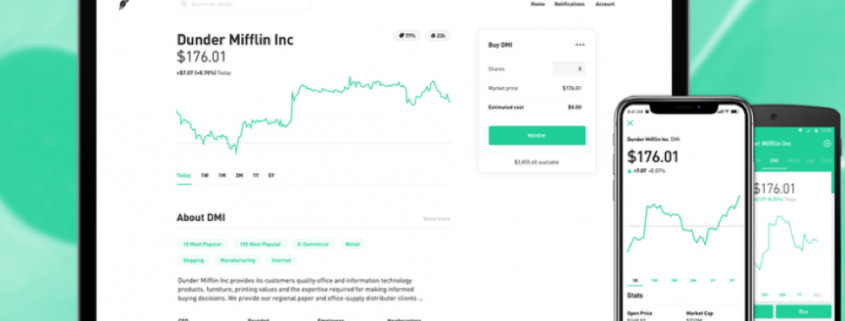
The stock brokerage industry is at an inflection point with the revolutionary online stock brokerage Robinhood on the verge of shaking up an industry that has needed shaking up for years.
A common thread revisited by this newsletter is the phenomenon of broker apps being low-quality tech.
A broker ultimately serves little or no value to the real players among the deal, usually extracting huge commissions.
Technology and now blockchain technology vie to completely remove this exorbitant layer from the business process.
Well, for the stock brokerage industry, that time is now.
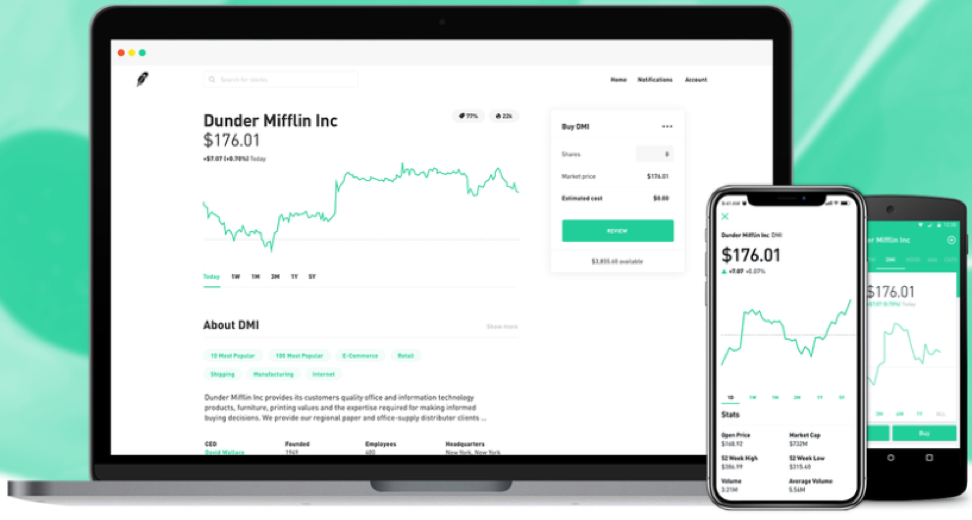
Robinhood is an online stock brokerage company based in Menlo Park, Calif., trading an assortment of asset classes including equities, options, and cryptocurrencies.
So, what's the catch?
Robinhood does not charge commission.
That's right, you can invest up until the $500,000 threshold protected by the Securities Investor Protection Corporation (SIPC) and you can go along with your merry day trading for free.
The online brokerage industry has been getting away with murder for years.
They got comfortable and stopped innovating - the death knell of any company in 2019.
Effectively, high execution costs reaping massive profits were the norm for brokers, and nobody questioned this philosophy until Robinhood exposed the ugly truth - unreasonably high rates.
Peeking at a monthly chart of brokerage costs will make your stomach churn.
For instance, a trader frequently executing trades with an account of $100,000 would hand over $1836 in commission in 2017 if their account was with Fidelity.
On the cheaper side, Interactive Brokers would charge $854 for its brokerage services to habitual traders per month.
The outlier was Tradier, a start-up brokerage founded in 2014 using the powerful tool of an Application Programming Interface (API) which charged $213 per month to trade frequently.
An API is described as a software intermediary allowing two applications to communicate with each other.
This model helped cut costs for the online brokerage because Tradier did not have to focus its funds on the trading platform that was delegated to various third-party platforms.
Tradier is largely responsible for the aggregation of data and charts thus employing an army of developers to meet their end of the business.
This model is truly the democratization of the online brokerage industry, which has been coming for years.
Costs are cut to a minimum with equity trades at Tradier costing investors $3.49 per order and options contracts costing $0.35 per contract with a $9 options assignment and exercise fee.
Technology has defeated the traditionalist again.
More than 80% of Robinhood's accounts are owned by millennials – as expected.
Trading cryptocurrencies act as a gateway asset to springboard into other asset classes such as equities and derivative contracts.
Vlad Tenev, co-CEO of Robinhood, indicated that Robinhood will have to modify its radical business model to monetize more of the business in the future, but he is comfortable with the current business model.
But Tenev has already seen fruit borne with the likes of Robinhood applying fierce pressure to the legacy brokerages' pricing models.
The traditionalists are locked in a vicious pricing war with each other slashing their commission rates to stay competitive.
The longer the likes of Charles Schwab (SCHW) feel it necessary to charge $4.95, down from the January 2017 cost of $8.95, the better the chances are that Robinhood can build its account base rapidly.
Charles Schwab has more than 10 million accounts, only double the number of Robinhood, after being founded in 1971.
The 42-year head start over Robinhood has not produced the desired effect, and it is ill-prepared to battle these tech companies that enter the fray.
Robinhood has been able to add a million new accounts per year. If Charles Schwab relatively performed at the same rate, it would have 47 million accounts open today.
It doesn't and that is a problem because the company can be caught up to.
The age of specialization is upon us with full force, and customer demand requires care and diligence that never existed before.
Robinhood continues to enhance its offerings of various products adding Litecoin and Bitcoin Cash to the crypto lineup.
Only Bitcoin and Ethereum were offered before.
And there is one more outrageous thing I forgot to tell you.
Robinhood hopes to snatch away the traditional savings account by offering checking and savings accounts with an interest rate almost 30 times larger than most brick and mortar banks – 3%.
These accounts would have no minimum balances or no fees that nickel and dime customers.
The service will conveniently sit alongside its trading app and this move into the industry led by JP Morgan could start to derail Wall Street.
As with most FinTech start-ups, the roll-out of this new service was slightly botched because Robinhood failed to get the go-ahead from regulators concerning ensuring the accounts properly.
All this does is delay the inevitable and by spring 2019, potential customers should be earning 3% in Robinhood’s checking and savings account.
Sign me up!
Mad Hedge Technology Letter
July 15, 2019
Fiat Lux
Featured Trade:
(HOW SOFTBANK IS TAKING OVER THE US VENTURE CAPITAL BUSINESS),
(SFTBY), (BABA), (GRUB), (WMT), (GM), (GS)


The man with the 300-year vision - Softbank’s Masayoshi Son.
He is the sole force exerting stultifying pressure on the venture capitalists of Silicon Valley.
What a ride it has been so far.
His $100 billion SoftBank Vision Fund has put the Sand Hill Road faithful in a tizzy – utterly revolutionizing an industry and showing who the true power resides with.
He has even gone so far as to double down on his exploits by claiming that he will raise additional $100 billion fund every few years and spend $50 billion per year.
This capital logically would flow into what he knows best – technology and the best technology money can buy.
Lately, Son said it best of the performance of the Vision Fund saying, “Results have actually been too good.”
So good that after this June, Son changed his schedule to spend 3% of his time on his telecom business down from 97% before June.
His telecommunications business in Japan has turned into a footnote.
It was just recently that Son’s tech investments eclipsed his legacy communications company.
Son vies to rinse and repeat this strategy to the horror of other venture capitalists.
The bottomless pit of capital he brings to the table predictably raises the prices for everyone in the tech investment world.
Son’s capital warfare strategy revolves around one main trope – Artificial Intelligence.
He also strictly selects industry leaders which have a high chance of dominating their field of expertise.
Geographically speaking, the fund has pinpointed America and China as the best sources of companies. India takes in the bronze medal.
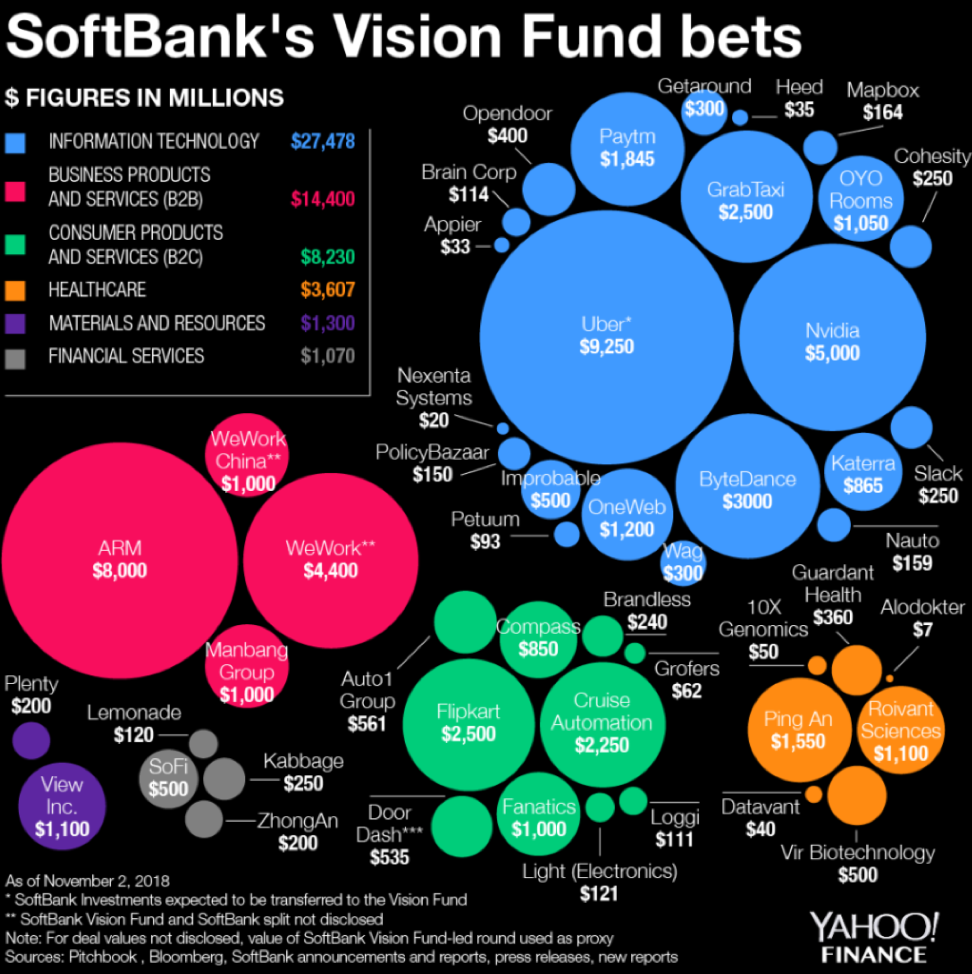
His eyes have been squarely set on Silicon Valley for quite some time and his record speaks for himself scooping up stakes in power players such as Uber, WeWork, Slack, and GM (GM) Cruise.
Other stakes in Chinese firms he’s picked up are China’s Uber Didi Chuxing, China’s GrubHub (GRUB) Ele.me and the first digital insurer in China named Zhongan International costing him $500 million.
Other notable deals done are its sale of Flipkart to Walmart (WMT) for $4 billion giving SoftBank a $1.5 billion or 60% profit on the $2.5 billion position.
In 2016, the entire venture capitalist industry registered $75.3 billion in capital allocation according to the National Venture Capital Association.
This one company is rivalling that same spending power by itself.
Its smallest deal isn’t even small at $100 million, baffling the local players forcing them to scurry back to the drawing board.
The reverberation has been intense and far-reaching in Silicon Valley with former stalwarts such as Kleiner Perkins Caufield & Byers breaking up, outmaneuvered by this fresh newcomer with unlimited capital.
Let me remind you that it was once considered standard to cautiously wade into investment with several millions.
Venture capitalists would take stock of the progress and reassess if they wanted to delve in some more.
There was no bazooka strategy then.
SoftBank has promised boatloads of capital up front even overpaying in some cases in order to set the new market price.
Conveniently, Son stations himself nearby at a nine-acre estate in Woodside, California complete with an Italianate mansion he bought for $117.5 million in 2012.
It was one of the most expensive properties ever purchased in the state of California, even topping Hostess Brands owner Daren Metropoulos, who bought the Playboy Mansion from Hugh Hefner in 2016 for $100 million.
If you think Son is posh – he is not. He only fits himself out in the Japanese budget clothing brand Uniqlo. He just needed a comfortable place to stay and he hates hotels.
SoftBank hopes to cash in on its $4.4 billion investment in WeWork, an American office space-share company, proclaiming that WeWork would be his “next Alibaba.”
The company plans to shortly go public.
Son continued to say that WeWork is “something completely new that uses technology to build and network communities.”
Other additions to SoftBank’s dazzling array of unicorns is Bytedance, a start-up whose algorithms have fueled shot form video content app TikTok.
The deal values the company at $75 billion.
They have been able to insulate themselves from local industry giants Tencent and Alibaba.
Son has revealed that the Vision Fund’s annual rate of return has been 44%.
Cherry-picking off the top of the heap from the best artificial intelligence companies in the world is the secret recipe to outperforming your competitors.
At the same time, aggressively throwing money at these companies has effectively frozen out any resemblance of competition. Once the competition is frozen out, the value of these investments explodes, swiftly super-charged by rapidly expanding growth drivers.
How can you compete with a man who is willing to pay $300 million for a dog walking app?
This genius strategy has made the founder of SoftBank the most powerful businessman in the world.
Son owns the future and will have the largest say on how the world and economies evolve going forward.
Global Market Comments
June 7, 2019
Fiat Lux
Featured Trade:
(SUNDAY, JUNE 30 MANILA, PHILIPPINES STRATEGY LUNCHEON)
(THE CONTINUING DEATH OF RETAIL),
(AMZN), (WMT), (M), (JWN),
(TESTIMONIAL)

Global Market Comments
June 5, 2019
Fiat Lux
Featured Trade:
(WEDNESDAY, JUNE 26 BRISBANE, AUSTRALIA STRATEGY LUNCHEON)
(WHY CONSUMER STAPLES ARE DYING),
(XLP), (PG), (KO), (PEP), (PM), (WMT), (AMZN),
(WHY YOUR OTHER INVESTMENT NEWSLETTER IS SO DANGEROUS)