
Mad Hedge Technology Letter
March 30, 2020
Fiat Lux
Featured Trade:
(THE NEW CROWN JEWELS OF SOCIAL DISTANCING)
(DOCU), (SIRI), (ZNGA), (NOK), (AMZN), (WORK), (MSFT), (ZM)
Mad Hedge Technology Letter
March 30, 2020
Fiat Lux
Featured Trade:
(THE NEW CROWN JEWELS OF SOCIAL DISTANCING)
(DOCU), (SIRI), (ZNGA), (NOK), (AMZN), (WORK), (MSFT), (ZM)
The second tier of social distancing tech stocks will do well in this brave new world in which digital lives have superseded physical ones.
Sure, most of you already know that Amazon (AMZN), Slack (WORK), Microsoft (MSFT), Zoom Communications (ZM), and Teladoc Health (TDOC) are the crown jewels of current social distancing tech stocks, but there is another group that should also outperform.
Here are 4 that you should take a look at with DocuSign being the best of the bunch:
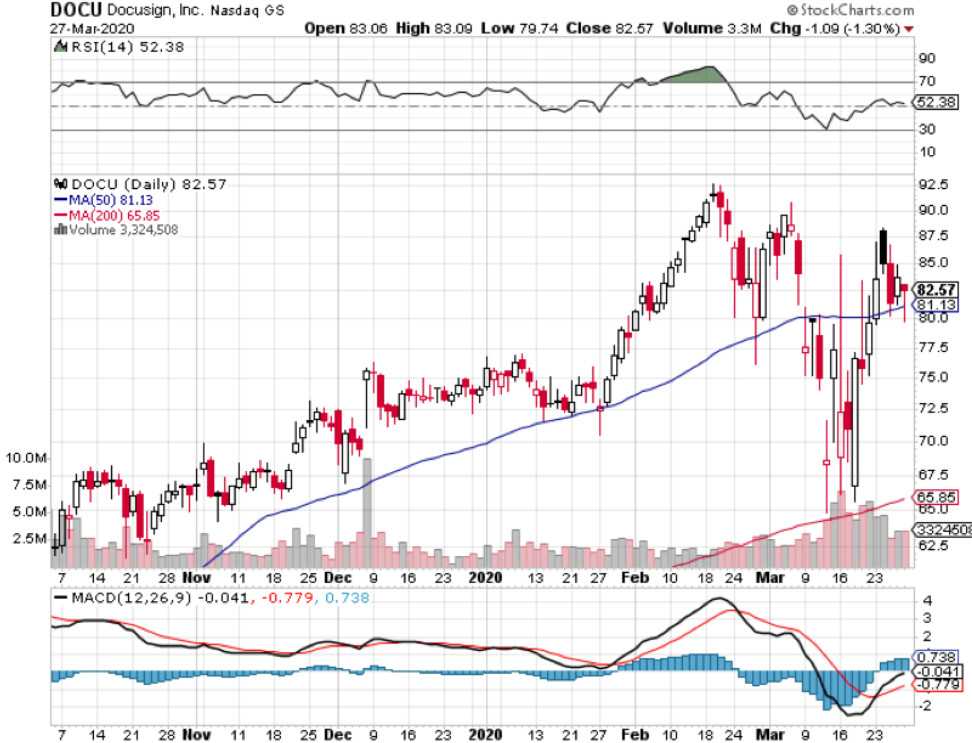
DocuSign (DOCU)
Teleconferencing and other niches have come front and center and consummating deals have migrated to one place since people cannot physically sign their name from pen to paper.
Electronic signatures were basically a cottage industry when it came out, but it is here to stay and this company has investors buzzing. Although the volume of business agreements being signed globally may temporarily slip, those that are continuing to work are enabled by DocuSign to close agreements without meeting eye to eye.
I expect resiliency in the type of products DocuSign provides and the remote implementation options.
DocuSign is well-positioned within the defensive category of digital transformation spend. Their recent acquisition of Seal Software will help boost DocuSign’s ability to leverage the power of artificial intelligence in the domain of contract analytics.
The opportunity to mitigate time spent on manual workflows through the addition of Seal to the portfolio can bolster the value proposition and drive ROI (return on investment) for customers.
The trajectory of the company was validated by DocuSign’s strong fourth-quarter earnings results with adjusted earnings increasing 12 cents per share which is a 100% increase year over year.
Just as impressive, DocuSign posted quarterly revenue of $274.9 million, an increase of 38%. As the data suggests, the signals all point to this company continuing its outperformance.
The e-document market has been monopolized by DocuSign with competition shut out, and as business goes 100% virtual in the current environment, this should have a positive network effect that will resonate when the world opens back up.
The next 3 stocks aren’t growth companies like DocuSign but are cheap stocks under $10 that might be worth a look.
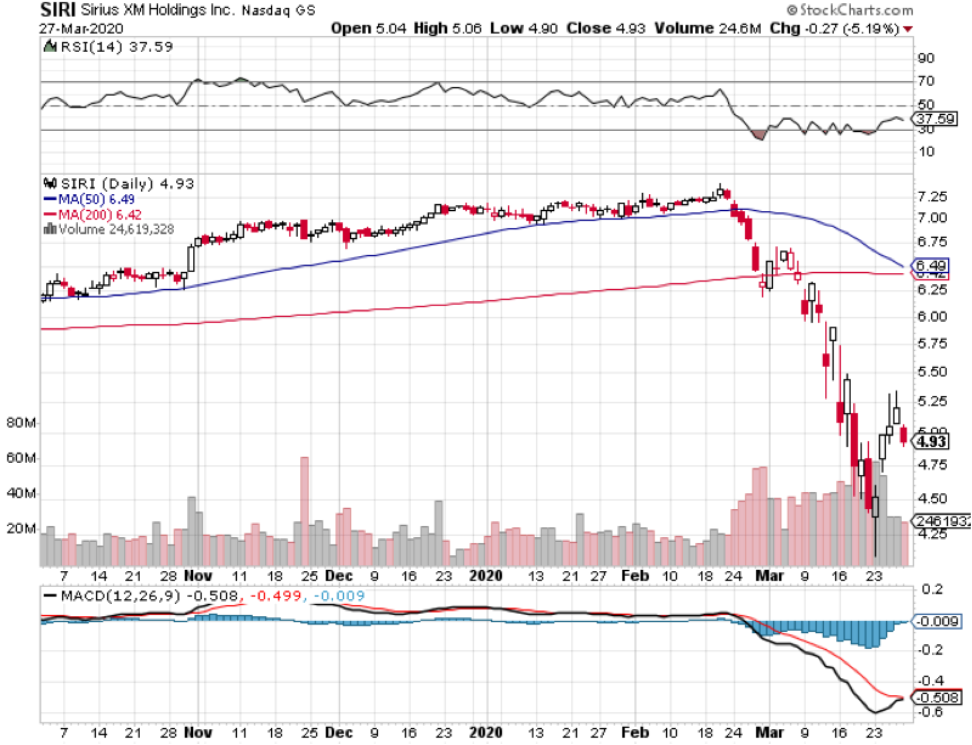
Sirius XM Holdings (SIRI)
With all the extra time at home, satellite radio has hit the jackpot, making their services much more appealing.
Since Sirius and XM Radio merged in 2008, the combined Sirius XM Holdings has enjoyed a near-monopoly on satellite radio.
Sirius built on that with the 2018 acquisition of Pandora, the music streaming product, helping to fill the sails again with rapid revenue growth; its audio products now reach more than 100 million people.
Sirius' situation is appearing healthy and added a further 1.1 million subscribers in 2019 alone, bringing its total paying subscribers to roughly 30 million. The company's audacious strategy of partnering with auto manufacturers to pre-install SiriusXM in new models should help steadily grow the business.
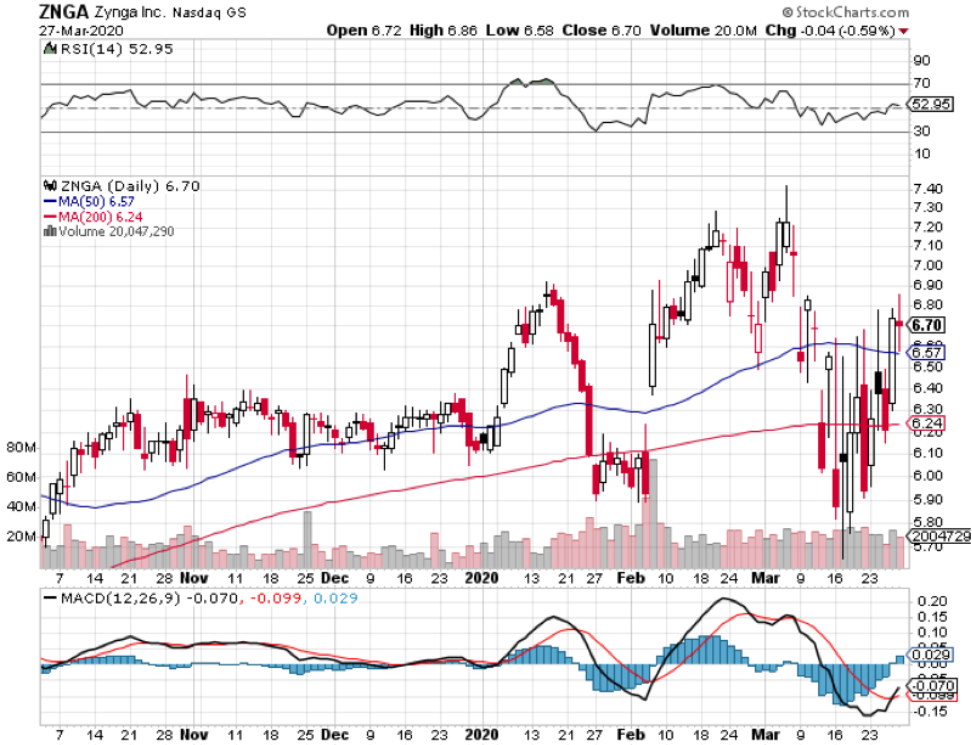
Zynga (ZNGA)
This video game stock is cheap and could be a beneficiary of the stay at home revolution.
Zynga's portfolio of popular games, combined with hyper-charged growth, makes it one of the best cheap stocks to buy under $10.
Last quarter, the social gaming developer behind franchises like Words With Friends, Zynga Poker, CSR Racing, and FarmVille set new company revenue records up 48%.
While growth is likely to decelerate quickly from such temporary coronavirus catalysts, I expect double-digit revenue growth in 2020.
Still, Zynga is holding up remarkably well, especially in the COVID-19 era, as people increasingly turn to mobile devices for entertainment.
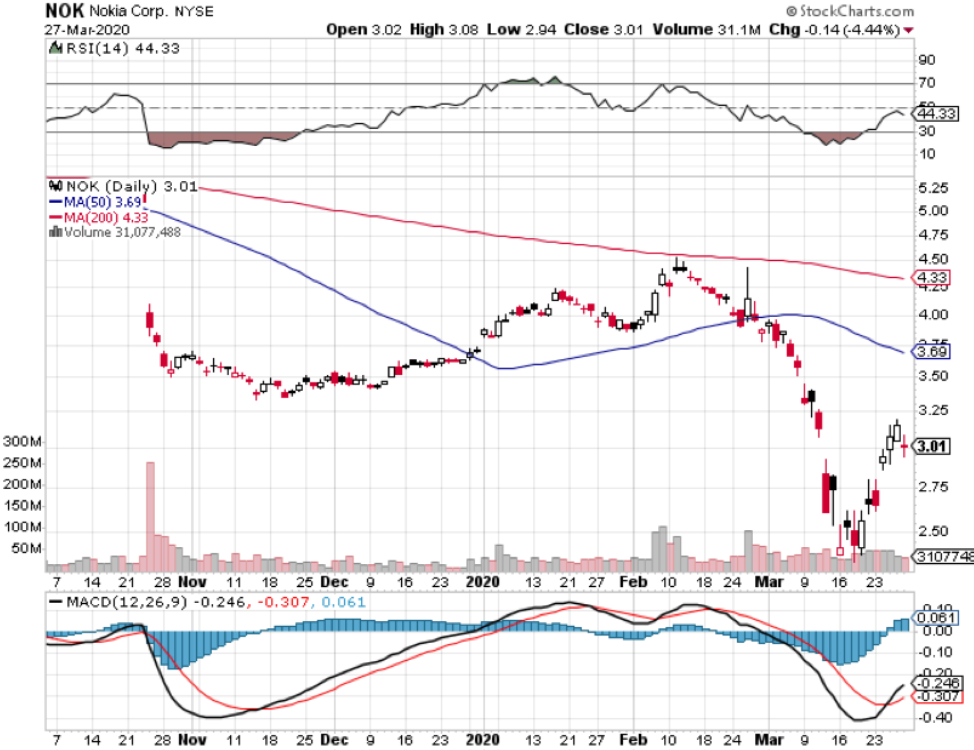
Nokia Corp. (NOK)
Nokia's expected earnings growth is impressive with Wall Street looking for an 8% bump in 2020 and roughly 30% profit growth in 2021.
Cheap stocks to invest in under $10 don't often come in the form of well-oiled global corporations valued at $15 billion.
The Finnish communication equipment telecom is one of the rare exceptions against the rule.
Sales have grown 14% annually for the last five years. Nokia may end up one of the 5G stocks to watch in the coming years because of the stigma of Huawei forcing many Europeans to go with brands closer to home.
Nokia pays a hefty 8% dividend as well and will never need a last-second bailout.
Mad Hedge Technology Letter
March 20, 2020
Fiat Lux
Featured Trade:
()
(AMZN), (W)
Social distancing signals the death of business in March and April 2020. Enter online shopping and E-commerce.
E-commerce’s greatest strength is pulling ahead of its competition while Millennials have also been the catalyst in turning the general shopping experience into a seamless digital affair.
And now that the world is at the mercy of an invisible virus, the use case for e-commerce business models has never been brighter, more appealing, and contactless.
That’s not to say that there are still net negatives from worker’s losing their jobs and being unable to buy goods, whether online or not. The overall damage to tech companies as a result of the pandemic cannot be ameliorated with a simple panacea.
The pain is just starting as the tech market searches for a bottom.
Covid-19 cases have mushroomed to over 11,200, and investors need to digest that continued underperformance lies ahead in the short-term.
But, the long-term migration towards digital models is looking better by the second.
Essentially, the e-commerce method is being supercharged by the coronavirus and the positive unintended consequences harvested by the e-commerce business models are directly correlated to increasing fatalities.
The health scare is ushering in a giant wave of new long-term customers who are just starting their digital experiences, making investing and e-commerce a topic worth discussing.
Astonishingly, the work environment has truly metamorphosized the past two weeks - any worker who can work at home is now working at home.
No longer do we have the hesitant boss who thinks working at home is all fantasy and no production.
Local policies have been so drastic in some cities that lockdowns of schools and restaurants have become commonplace.
People in those cities have also begun shunning public, crowded places in the name of health and survival.
How bad is it out there on the streets, and how poorly are U.S. tech firms doing?
The economic pain caused by the escalating coronavirus pandemic will be worse than the Great Financial Crisis of 2008.
The Chinese economy is contracting at a 15% annual rate, while the European economy is already in severe recession because of the drop off of China revenue.
In the U.S., they are shutting down restaurants, schools and major events; people are going to be without a paycheck, and this doesn’t set up nicely for consumers to pay for tech services that aren’t utilities.
Unless there are major policy moves soon, a downward spiral will usher in something akin to a global tech recession, and U.S. Secretary of the Treasury Steve Mnuchin is already ringing the alarm bells by saying unemployment could spike to 20%.
Tech won’t avoid the carnage in this drastic scenario, and it's still not “buy the dip” time.
Many industries are already queued up at Washington’s front door for a bailout and even though tech firms are better positioned than say, the oil industry, the overall slide in demand from consumers will hit come next earnings report which is just around the corner.
The bill Washington will need to foot appears upwards of $3 trillion and it’s easy to understand why when, according to a March 2020 YouGov survey, over a quarter (27%) of those in the US and 14% in the UK said they avoided public places and that number has to be closer to 80% now.
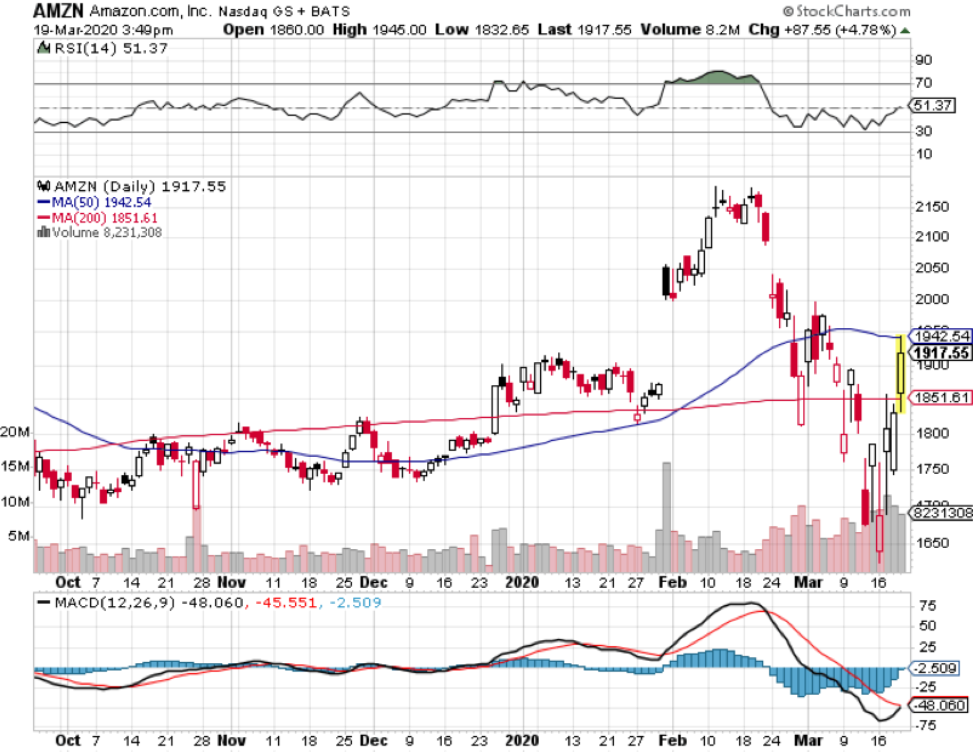
What's important to note when it comes to investing in e-commerce, is that some tech firms are a little bit luckier than others, such as Amazon, who can’t find enough workers and is raising wages and opening 100,000 new positions across the US to ensure its delivery network can service the coronavirus pandemic.
Not only do they need full-time positions but also part-time positions will be made available to meet historical seasonal labor demand in its fulfillment centers.
Management promised to inject $350 million to raising wages by $2 per hour in the US throughout April.
Amazon announced it would limit its warehouses to critical items such as medicine and household staples to ensure they meet demand.
Right now, investing in e-commerce means the companies that provide currently popular goods, such groceries, pet supplies, beauty and personal care products, health and household items, baby products, and industrial items.
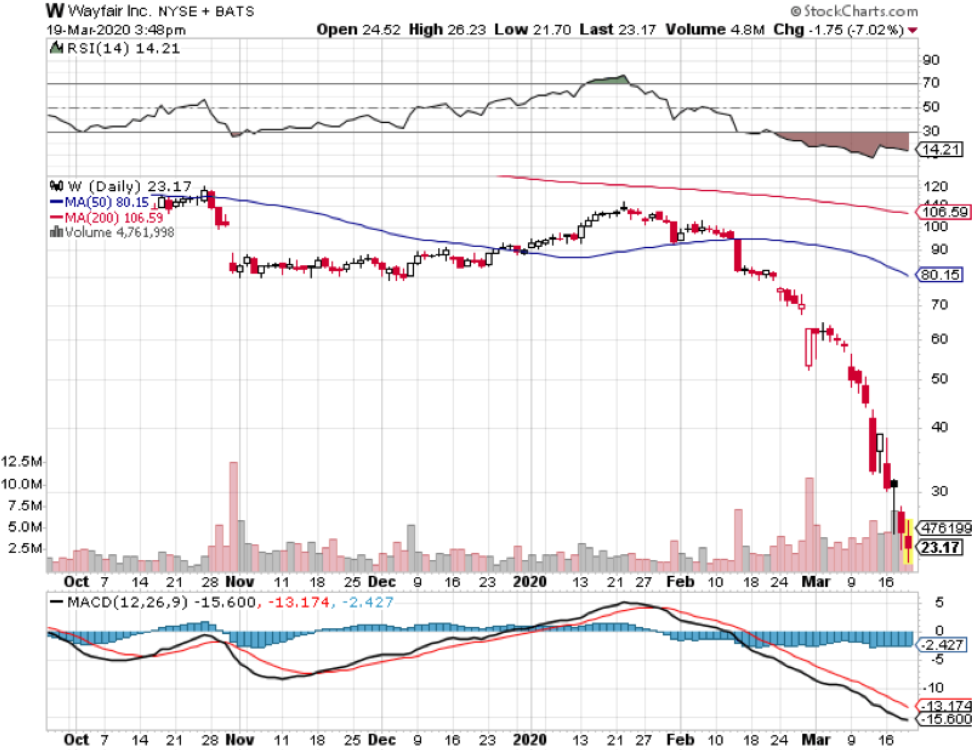
Other e-commerce companies haven’t fared as well as Amazon, such as furniture e-company Wayfair who reportedly relies on mainland China for half of its merchandise and sell only one type of product - furniture.
Wayfair’s supply chain disruptions are hurting the company’s ability to deliver furniture, but it also coincides with a massive drop off in demand as consumers shun furniture for household items and groceries.
Shares of Wayfair have dropped over 400% since January partly because the company has never been profitable and is now entering into a worsening climate to sell furniture which equated to an optimal signal for investors to dump the stock in bucketloads.
I have been bearish on Wayfair since last year and envisioned an imminent wealth-destroying effect for their business model, but I am shocked that shares dropped this rapidly.
Three weeks ago, the Boston-based company fired 500 people to help “lower costs,” validating my hypothesis.
The exorbitant cost of acquiring each additional customer was the reason I hated this company in the first place.
Uncertainty is the message of the day, and certain e-commerce companies will enjoy the turbocharging or discharging of their models.
Tech shares hate uncertainty and investors must brace themselves with regards to investing and e-commerce.
Global Market Comments
March 17, 2020
Fiat Lux
Featured Trade:
(LONG TERM ECONOMIC EFFECTS OF THE CORONAVIRUS),
(ZM), (LOGM), (AMZN)
(HOW TO HANDLE THE FRIDAY, MARCH 20 OPTIONS EXPIRATION),
(AAPL), (AMZN), (MSFT)
The world will never be the same again.
Not only is the old world rapidly disappearing before our eyes, the new one is breaking down the front door with alarming speed. In short: the future is happening fast, very fast, and with coronavirus, people are understanding wondering about economic effects long term.
To a large extent, long term economic trends already in place have been given a turbocharger. Quite simply, you just take out the people. Human contact of any kind will be minimized. I’ll tick off some of the more obvious.
You may think I’m nuts. But all San Francisco Bay Area counties have been given a “shelter in place” order. All travel is banned except to gain essential necessities. In any case, the grocery stores are now empty, unless you have a taste for chickpea-based pasta.
Let me clarify first that it is highly unlikely that you will get the Corona virus. If China peaks at the current 90,000 cases and 4,000 deaths, that means there is one chance in 325,000 you will die of the Corona virus. If the number of cases doubles, that drops to one chance in 175,000. In other words, you are more likely to win the lottery than die of Corona virus.
However, that is logic speaking. Fear is what is firmly in the driver’s seat right now. The only data point that counts now is the number of new Corona cases. You can find that figure here.
In the meantime, you better get used to your new life. You know that home office of yours? It is about to gain a full-time occupant, i.e. you. Most large companies already migrated to four, or even three-day work weeks, with the remainder to be spent at home.
One email, and that has suddenly become a five-day week at home. Many of these employees are never coming back, preferring to avoid horrendous commutes, lower costs, and yes, future pandemic viruses. We are already using GoToMeeting (LOGM) and Zoom (ZM) for many meetings. That simply becomes a full-time enterprise.
Commerce will change beyond all recognition. Did you do a lot of shopping on Amazon (AMZN) like I do? Now, you’re really going to pour it on. Amazon just announced the hiring of 100,000 new distribution and delivery people today to handle the surge in business. The pandemic is really going to be the death knell of the mall, where a potentially fatal disease is only a sneeze away. Avoid mall REITs (SPG) like the plague, no matter how much they promise to pay you in yield.
And how are you going to pay for that transaction? Guess what one of the most efficient transmitter of disease is? That would be US dollar bills. Take paper money in change and you are not only getting contact from the salesclerk, but the last dozen people who handled the money.
Contactless payments deal with this nicely. People may be swiping their iPhone wallet, or are simply scanned when they walk in the store, as with some Whole Foods shops owned by Amazon.
Conferences? A thing of the past. All of my public speaking events around the world over the next three months have been cancelled. In their place will be webinars. They offer lower conversion rates but include cheaper costs as well. At least I won’t have 18 hours of jet lag to deal with anymore. I’m sure Quantas will miss those first-class ticket purchases and I’ll miss the Champaign.
Entertainment is also morphing beyond all recognition. Comcast just announced that newly released movies will be available for a $20 rental. Clearly, they are assuming that theater attendance will go to zero. Again, this has been a long time coming and the other major movie producers will soon follow suit.
With the president banning assemblies of more than ten people today that’s a safe bet. Regal has announced that it is closing all 542 of its theaters. Stay away from AMC Entertainment Holdings (AMC), although its already almost gone to zero, down 75% this year.
Exercise is changing overnight. All gyms and health clubs are now closed, so working out will become a solo exercise far away on a high mountain. I have already been doing this for 30 years, so piece of cake here. Friends with yoga classes are now doing them in the living room, streaming their instructors online.
That's just a snapshot of some of the long term economic effects of coronavirus.
If you are having trouble getting your kids to comply with social distancing requirements, have a family movie night and watch Gwyneth Paltrow in Contagion. Is has been applauded by scientists as the most accurate presentation of the kind of out-of-control pandemic which we may now be facing.
It is bone-chilling.
As for me, I have my stockpile of food and will be self-quarantining for the foreseeable future.
Stay healthy.
Followers of the Global Trading Dispatch have the good fortune to own a deep in-the-money options position that expires on Friday, and I just want to explain to the newbies how to best maximize their profits on that March 20 expiration.
This involves the:
Apple (AAPL) March 2020 $220-$230 in-the-money vertical BULL CALL spread
Microsoft (MSFT) March 2020 $120-$125 in-the-money vertical BULL CALL spread
Amazon (AMZN) March 2020 $1,350-$1,400 in-the-money vertical BULL CALL spread
Provided that we don’t have another 3,000 point move down in the market this week, these positions should expire at their maximum profit points. So far, so good.
I’ll do the math for you on the Apple (AAPL) position. Your profit can be calculated as follows:
Profit: $10.00 - $8.80 = $1.20
(11 contracts X 100 contracts per option X $1.20 profit per options)
= $1,320 or 13.63% in 7 trading days.
Many of you have already emailed me asking what to do with these winning positions.
The answer is very simple. You take your left hand, grab your right wrist, pull it behind your neck, and pat yourself on the back for a job well done.
You don’t have to do anything.
Your broker (are they still called that?) will automatically use your long position to cover your short position, canceling out the total holdings.
The entire profit will be credited to your account on Monday morning March 23 and the margin freed up.
Some firms charge you a modest $10 or $15 fee for performing this service.
If you don’t see the cash show up in your account on Monday, get on the blower immediately and find it.
Although the expiration process is now supposed to be fully automated, occasionally mistakes do occur. Better to sort out any confusion before losses ensue.
If you want to wimp out and close the options position before the March 20 expiration, it may be expensive to do so. You can probably unload them pennies below their maximum expiration value.
Keep in mind that the liquidity in the options market disappears and the spreads substantially widen when a security has only hours, or minutes until expiration on Friday. So, if you plan to exit, do so well before the final expiration at the Friday market close.
This is known in the trade as the “expiration risk.”
One way or the other, I’m sure you’ll do OK, as long as I am looking over your shoulder, as I will be, always. Think of me as your trading guardian angel.
I am going to hang back and wait for good entry points before jumping back in. It’s all about keeping that “Buy low, sell high” thing going.
I’m looking to cherry-pick my new positions going into the next quarter end.
Take your winnings and go out and buy yourself a well-earned dinner. Or use it to put a down payment on a long cruise.
Well done and on to the next trade.
Mad Hedge Technology Letter
March 4, 2020
Fiat Lux
Featured Trade:
(THE BEST TECH STOCKS TO BUY AT THE BOTTOM)
(NFLX), (ZM), (PTON), (AMZN), (OKTA), (WORK), (ATVI), (EA), (TTWO)
Tech stocks that are begging to be picked up on the back of the coronavirus pandemic are Netflix (NFLX), Zoom Video Communications (ZM), workplace collaboration service Slack Technologies (WORK), and Peloton Interactive (PTON), the spin bike company.
Their short-term outperformance indicates that these stocks work well during mass pandemics shelving most outdoor activity and commerce.
The basket of 3 stocks has easily beat the S&P 500 since the coronavirus emerged as a threat in mid-January.
Home sitting doesn’t generate a net output of business activity unless that job is digital.
The majority of workers still commute in a physical car only to sit in an office, restaurant, or some other type of self-contained space.
That is the underlying problem that has no solution, and any rate cut by the Fed cannot ultimately solve consumers holed up in their house.
If the companies that could opt to go pure digital do take up the option, the number of remote workers would rise and digital products would be the ultimate beneficiary of this trend.
Companies that promote remote working such as Slack (WORK) and Google Hangouts are in pole position to reap the rewards.
These services include video conferencing software, logistical services, administrative services, network security services, ecommerce and any service that aids in generating digital content like Adobe and its umbrella of assets.
The trend was already transforming American culture, but the virus vigorously pulls forward a trend that was already in overdrive.
Enabling information workers to produce outside the traditional office environment is one of the lynchpins of the Silicon Valley model.
Companies will ultimately realize that spending big bucks on business travel to meet face to face for 30 minutes is probably not an optimal allocation of resources.
Business travel is getting cut with a cleaver such as Amazon.com (AMZN) who are forcing employees to avoid all nonessential travel for now, including within the U.S. Much of that travel could be replaced by video calls.
Other companies will get in on the action by directing their employees to work from home in the coming weeks.
Coronavirus mania has reached the U.S. shores with consumers stocking up on all the essentials at the local Costco.
If this gets worse, there is no solution unless a viable medical solution starts improving the health crisis.
There are still only 7 known fatalities from the coronavirus, all in the state of Washington, and limiting that number is critical to the health of the tech market.
Another company is Okta (OKTA), a leader in authentication security cloud software.
The company’s offering allows employees to use corporate applications on-site and remotely and protecting their access to their digital services is just as important as the work itself.
As consumer spurn movie theaters, concerts, and gyms, the entertainment space will give way to digital entertainment that includes Netflix (NFLX) and Roku (ROKU).
Roku is a great place to hide out in the world where Covid-19 meets daily consumers in the U.S. in a more meaningful way during 2020.
Netflix is a company that has defied gravity this year by bull-rushing its way through the competition and proving there is space for everyone.
The increase in incremental demand for digital content will only help Netflix claim a bigger part of the pie.
We can also lump the videogame industry into this cohort such as Activision Blizzard (ATVI), Electronic Arts (EA), and Take-Two Interactive Software (TTWO).
They have faced serious headwinds from gaming phenomenon Fortnite, but prolonged home sitting will even boost their shares.
The spine of digital services will receive a boost as well from the usual cast of characters such as Microsoft (MSFT), Apple (AAPL), Alphabet (GOOGL), and Facebook (FB).
As investors wait for the climax of the coronavirus and the Central Bank has indicated that they are open to more accommodative policy, we could be ripe for more volatility.
Chinese coronavirus cases have started to taper off and if the rest of the world trends in a similar fashion, this virus scare could be in the history books in 2-3 months.
However, the trajectory of the virus is still a massive unknown in the U.S. and winning the health battle is the only panacea to this dilemma.
Global Market Comments
March 4, 2020
Fiat Lux
Featured Trade:
(TEN LONG TERM LEAPS TO BUY AT THE BOTTOM)
(MSFT), (AAPL), (GOOGL), (QCOM), (AMZN),
(V), (AXP), (NVDA), (DIS), (TGT)
Legal Disclaimer
There is a very high degree of risk involved in trading. Past results are not indicative of future returns. MadHedgeFundTrader.com and all individuals affiliated with this site assume no responsibilities for your trading and investment results. The indicators, strategies, columns, articles and all other features are for educational purposes only and should not be construed as investment advice. Information for futures trading observations are obtained from sources believed to be reliable, but we do not warrant its completeness or accuracy, or warrant any results from the use of the information. Your use of the trading observations is entirely at your own risk and it is your sole responsibility to evaluate the accuracy, completeness and usefulness of the information. You must assess the risk of any trade with your broker and make your own independent decisions regarding any securities mentioned herein. Affiliates of MadHedgeFundTrader.com may have a position or effect transactions in the securities described herein (or options thereon) and/or otherwise employ trading strategies that may be consistent or inconsistent with the provided strategies.