
Mad Hedge Technology Letter
October 11, 2018
Fiat Lux
Featured Trade:
(WHY SNAPCHAT SNAPPED),
(SNAP), (FB), (AMZN), (NFLX)
Mad Hedge Technology Letter
October 11, 2018
Fiat Lux
Featured Trade:
(WHY SNAPCHAT SNAPPED),
(SNAP), (FB), (AMZN), (NFLX)
To the dismay of tech shares, the tech industry doesn’t operate in a bubble.
The broader landscape is experiencing a dose of volatility triggered by the ratcheting up in interest rates.
There’s not much tech can do to change the narrative.
The back and forth political saber rattling isn’t helping either.
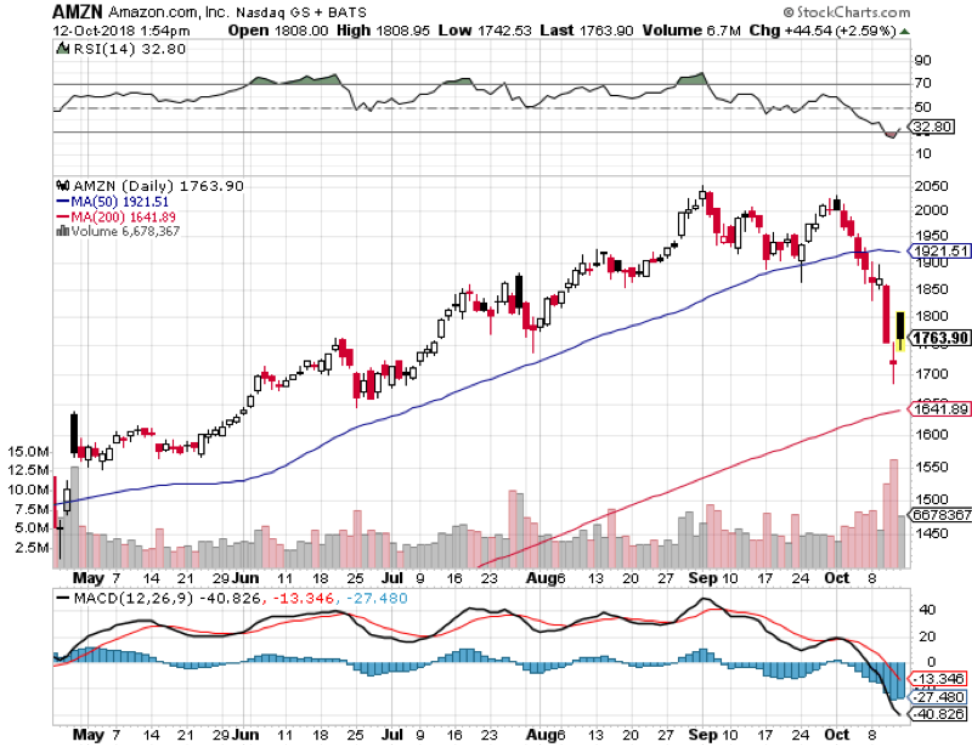
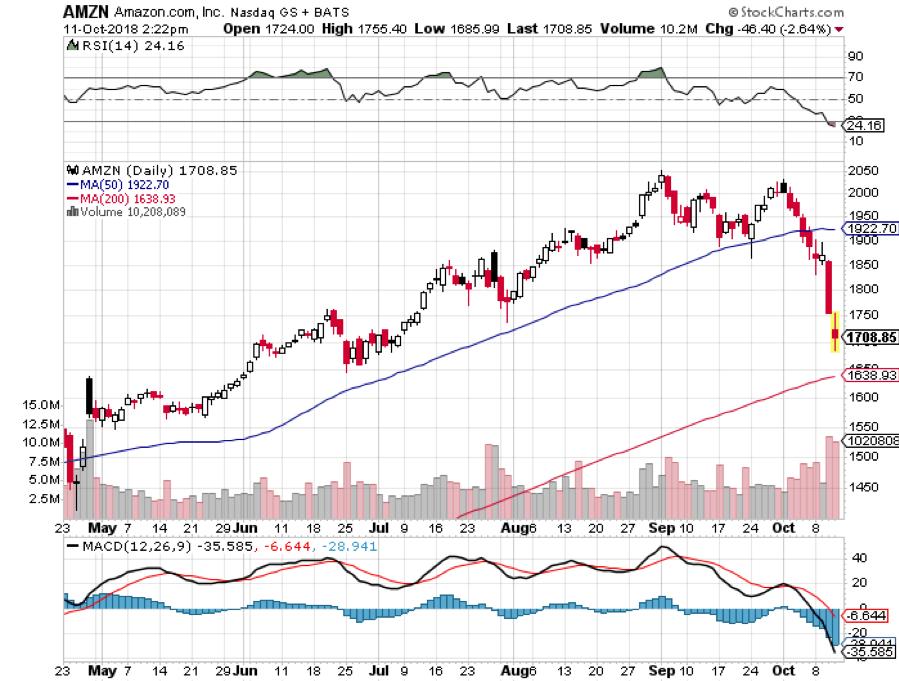
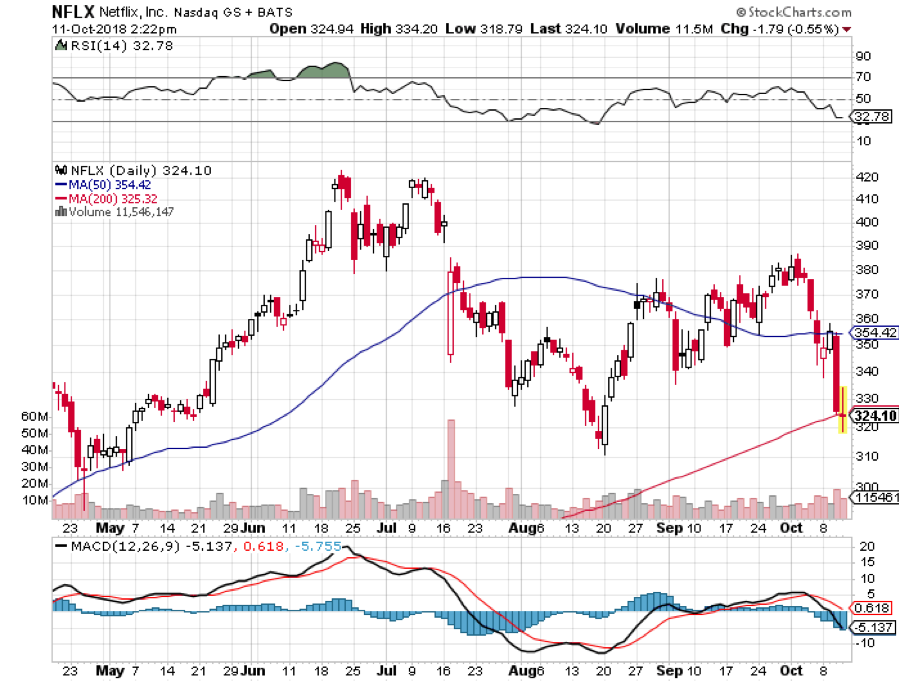
Tech is experiencing a swift rotation out of hyper-growth names such as Amazon (AMZN) and Netflix (NFLX) with investors taking profits on these names that have gone up in a straight line this year.
This does not mean you should fling these stocks into tech heaven yet.
The hardest hit names will be the marginal tech firms in the marginal tech spaces headed by dreadful management.
This narrow criterion conveniently perfectly fits one company I have written about extensively.
Enter Snapchat.
It’s been a year to forget or remember - depending on how you look at it for CEO of Snapchat Evan Spiegel.
Snapchat was one of my first recommendations of The Mad Hedge Technology Letter when I told readers to run for the hills.
To read my story on Snapchat, please click here.
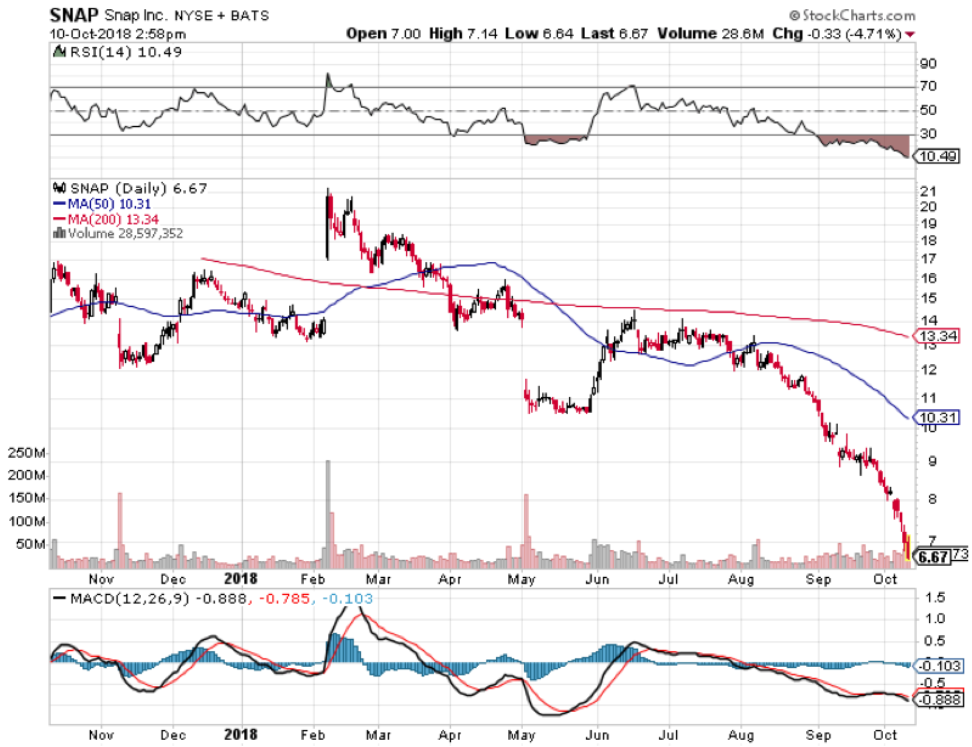
At that time, the stock was trading at a luxurious $19.
Lionizing this shoddy company would be a stretch as shares have parachuted down to the $6.60 level.
The latest word is that Snapchat is burning money fast.
The cash crunch will quickly force them to raise some capital and this is just one of the many litanies of spectacular misfortunes that have beset this Venice, California social media starlet.
Maybe management is spending too much time ripping the bong on Venice Beach because the decisions being made are of that ilk.
The first catastrophic move out of many was the botched redesign alienating the core base who were dazed and confused by the new interface and functionality.
Social media works poorly when you can’t find your friends on it.
Spiegel admitted the redesign was “rushed” and it behooves me to let readers know that the redesign was the worst redesign I have ever seen in my life as I tested it out in my office.
Snapchat quickly restored the previous interface calming their shrinking core audience.
The self-inflicted wound was deep, and earnings reflected the quicksand Snapchat quickly found itself in.
Snapchat announced that global daily active users (DAUs) shrank from 191 million to 188 million.
A company at this early stage in the growth cycle should be reeling in the users non-stop.
This is far from a mature company and if executed properly the company should have the ability to cast their net far and wide scooping up new users left and right.
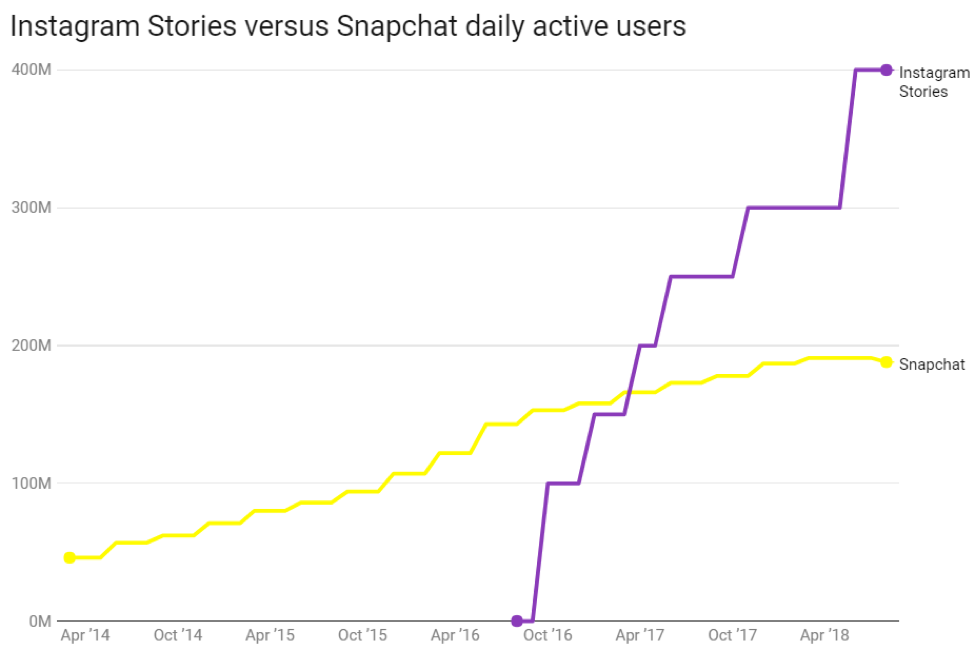
Let’s remember that Instagram, the Facebook (FB) owned direct competitor, is growing their user base parabolically.
Simply put, Snapchat has had no answer to Instagram’s rapid rise to fame, and that was the center of my thesis to turn my back to this rapidly deteriorating company.
Snapchat has offered no meaningful innovation to combat the terrorizing force of Instagram.
The dearth of innovation has caused the average time spent on the platform to dip from 33 minutes to 31 minutes per session.
Instagram has stretched the lead on Snapchat. In fact, it was Instagram that cleverly borrowed Snapchat’s best features and integrated them into their platform.
Sentiment has turned rotten as the stock sold off when Spiegel announced that he wants the company to turn profitable in 2019.
Investors don’t believe this one iota.
Snapchat is expected to burn through $1.5 billion in 2019, and Spiegel’s pipedream of scratching out a profit is implausible.
Snapchat is not executing on the digital ad front.
It was a year and a half ago when consensus believed Snapchat was able to churn out revenue of $540 million this quarter, but it looks more likely that Snapchat is set for revenue of just a shade over $280 million.
The severe underperformance is due to a lack of advertisers causing the eventual price of digital ads to fetch a lower price in an auction-based model.
Stinging as it might be, the lower costs of ads is also caused by the average age group of Snapchat’s core base.
Snapchatters are usually teenagers and have low purchasing power.
Targeting an older user base would improve margins significantly.
However, the conundrum is that the core user base might jump ship like they did to Facebook and shifted over to Facebook-owned Instagram.
Snap doesn’t have a Facebook posing an acute problem that could likely backfire.
General Data Protection Regulation (GDPR) in the European Union made the issue of securing personal data a national issue.
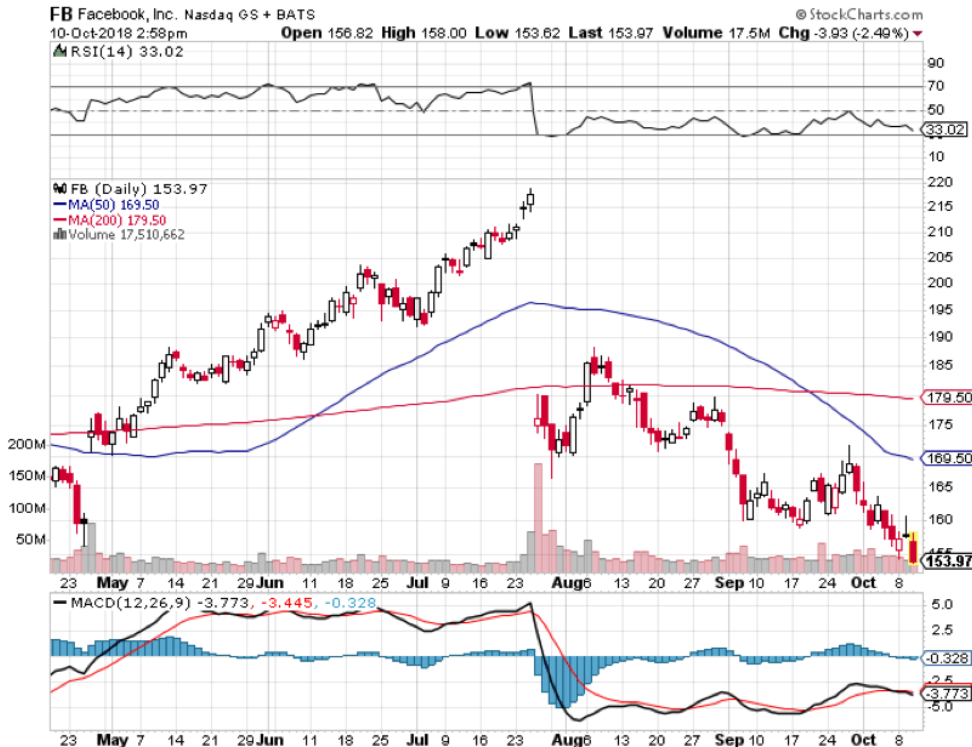
Facebook poured fuel on the fire when they disclosed several breaches clobbering their share price.
Mark Zuckerberg’s company is still reeling from the series of mishaps.
Ironically, Facebook debuted a smart speaker with prime access to user’s home when trust is at its lowest ebb around Facebook’s data collection practices.
Investors really need to ask themselves if Facebook’s management has any common sense at all.
Any decent company would have halted this project and I expect it to be a complete disaster.
Part of Snapchat’s turnaround strategy involves releasing scripted shows as short as five minutes long.
Entering into the original content wars is a tough sell. The competition is becoming fiercer and this move hardly will differentiate itself from ad buyers who already avoid Snapchat. In fact, it smells of desperation.
Snapchat has seen a brutal brain drain with management leaving in droves.
They have voted with their feet.
Chief Strategy Officer Imran Khan was the latest to announce his upcoming departure.
Others to jettison are the VP of product, VP of sales, VP of engineering, and its general counsel.
The high turnover rate will make it more complicated to execute a drastic reversal of fortune.
The only silver lining is if Zuckerberg manages to screw up Instagram after forcing the creators out with his behind-the-scenes meddling, giving a glimmer of hope to Snapchat.
A stellar performance from the execution team along with a Facebook mess of Instagram could resuscitate the user base if users start to flee Instagram in droves.
There aren’t many alternatives unless a user is inclined to quit social media.
Snapchat badly needs to build up its user base or else digital ad buyers will stay away.
I am still bearish on this stock and it would take a small miracle to spruce up the share price again.
Global Market Comments
October 9, 2018
Fiat Lux
SPECIAL REPORT ON GOLD
Featured Trade:
(TAKING A LOOK AT GOLD LEAPS),
(GLD), (ABX), (AMZN)
Mad Hedge Technology Letter
October 9, 2018
Fiat Lux
Featured Trade:
(LIVING ON THE EDGE),
(AMZN), (MSFT), (HPE), (GOOGL)
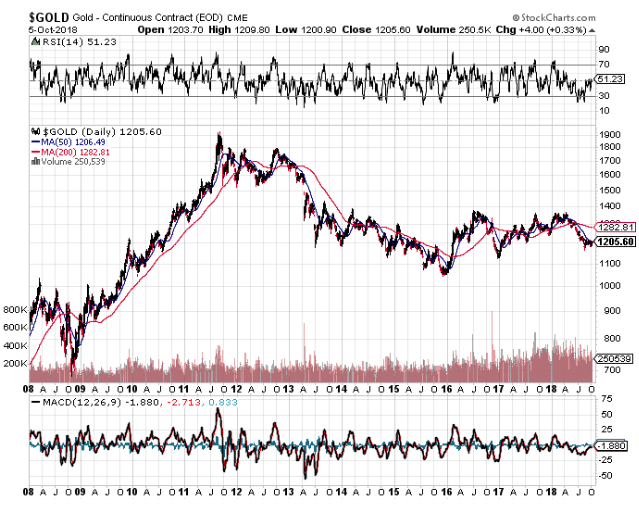
As incredible as it may sound, I’m starting to hear good things about gold. That’s amazing as the barbarous relic has been the red headed step child of the financial markets for the past six years. Not since the yellow metal peaked in 2011 have I heard the talk so bullish.
You can thank central banks which have become the principal buyers of gold in 2018. China is always the largest buyer. It has been joined by Russia, which is avoiding American trade sanction, and Kazakhstan. Now Poland has joined the fray. Central banks have accounted for a stunning 264 metric tonnes of purchases this year, or some 9.3 million ounces.
You can thank the coming return of inflation in the US economy, gold’s best friend. With a 4.2% GDP growth rate in Q2, the return of rapidly rising prices is just a matter of time. We here in Silicon Valley have grown inured to ever rising prices for everything. You in the rest of the country are about to get the bad news.
You can thank Amazon (AMZN) founder Jeff Bezos for pouring gasoline on the fire. By giving 250,000 US workers a 25% pay increase from $12 to $15, he has created a national short squeeze for minimum wage workers. If McDonald’s (MCD), Target (TGT), and Wal-Mart (WMT) join the fray, as they must or lose workers, wage inflation will go national.
Yes, you can remind me that rising interest rates are a terrible backdrop against which to own gold. The Federal Reserve has essentially promised us four more 25 basis point rate hikes by next summer. That would take the overnight rate to 3.25%, a historically "normalized” rate.
But what happens when the rate hikes stop? Gold takes off like a scalded chimp.
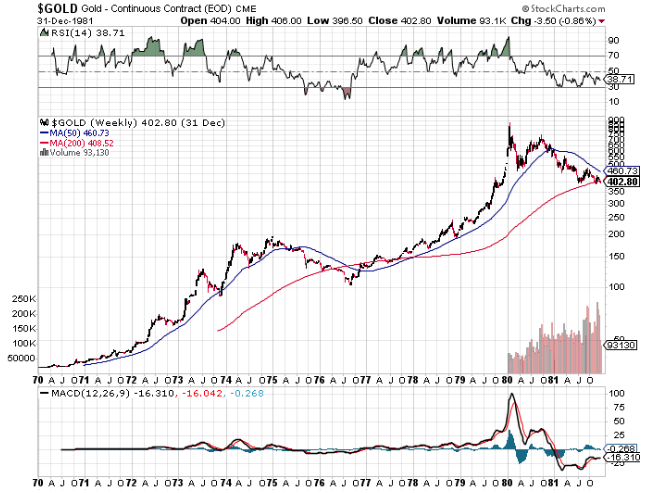
It is in fact a myth that gold can’t perform in a raising rate environment. When you look at gold’s “golden age” during the 1970’s when the barbarous relic rocketed from $34 to $900, a 24-fold increase, interest rates were rising almost as fast.
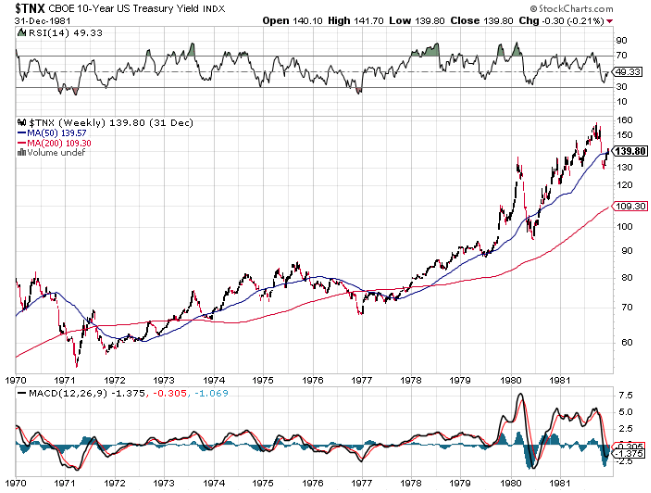
Over the same time period, the ten-year US Treasury yield soared from 5% to 16%. At the end of the day, investors fear inflation far more than high interest rates.
So when you believe that an oversold asset is about to turn but don’t know when, what is the best course of action?
Long Term Equity Anticipation Securities, or LEAPS, are a great way to play the market when you expect a substantial move up in a security over a long period of time. Get these right and the returns over 18 months can amount to several hundred percent.
At market bottoms these are a dollar a dozen. At all-time highs they are as scarce as hen’s teeth. However, scouring all asset classes there are a few sweet ones to be had.
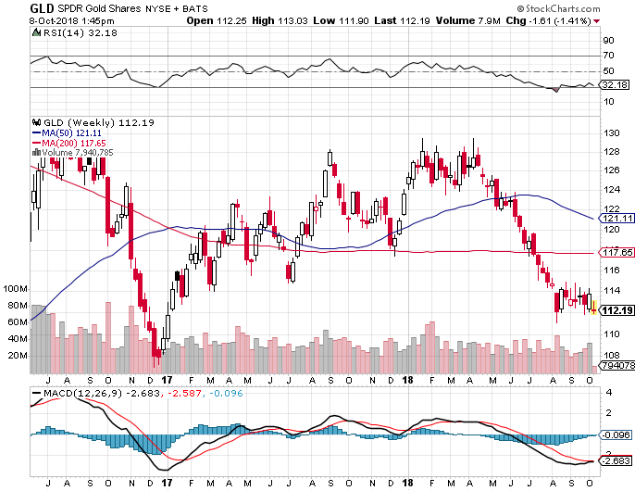
Today, you can buy the SPDR Gold Shares ETF (GLD) January 2020 $120-$125 call spread for $1.60. For those who are new to the Mad Hedge Fund Trader, that involves buying the January 2020 $120 call and selling short the January 2020 $125 call.
This has the attributes of reducing your cost and minimizing the cost of time decay while giving you highly leveraged upside exposure over a long period of time.
If the price of gold rises by $11.20, from $113.80 to $125, a mere 9.8% by the January 17 option expiration date, the profit on this trade will amount to 212.5%. In order words, a $1,000 investment will become worth $3,125 if gold simply returns back to where it was in April.
If you’re more aggressive than I am (unlikely), you can buy the SPDR Gold Shares ETF (GLD) January 2020 $125-$130 call spread for $1.00, That would give you a maximum potential profit of 400%. In order words, a $1,000 investment will become worth $5,000 if gold simply return back to its February 2018 high.
A number of other fundamental factors are coming into play that will have a long-term positive influence on the price of the barbarous relic.
The only question is not if, but when the next bull market in the yellow metal will accelerate.
All of the positive arguments in favor of gold all boil down to a single issue: they're not making it anymore.
Take a look at the chart below and you'll see that new gold discoveries are in free fall. That's because falling prices from 2011 to 2018 caused exploration budgets to fall off a cliff.
Gold production peaked in the fourth quarter of 2015 and is expected to decline by 20% in the following four years.
The industry average cost is thought to be around $1,400 an ounce, although some legacy mines such as at Barrack Gold (ABX) can produce it for as little as $600.
So why dig out more of the stuff if it means losing more money?
It all sets up a potential turn in the classic commodities cycle. Falling prices demolish production and wipe out investors. This inevitably leads to supply shortages.
When the buyers finally return for the usual cyclical macro-economic reasons, there is none to be had, and price spikes can occur which can continue for years.
In other words, the cure for low prices is low prices.
Worried about new supply quickly coming on-stream and killing the rally?
It can take ten years to get a new mine started from scratch by the time you include capital rising, permits, infrastructure construction, logistics and bribes.
It turns out that the brightest prospects for new gold mines are all in some of the world's most inaccessible, inhospitable, and expensive places.
Good luck recruiting for the Congo!
That's the great thing about commodities. You can't just turn on a printing press and create more, as you can with stocks and bonds.
Take all the gold mined in human history, from the time of the ancient pharaohs to today, and it could comprise a cube 63 feet on a side.
That includes the one-kilo ($38,720) Nazi gold bars with stamped German eagles upon them which I saw in Swiss bank vaults during the 1980's when I was a bank director there.
In short, there is not a lot to spread around.
The long-term argument in favor of gold never really went away.
That involves emerging nation central banks, especially those in China and India, raising gold bullion holdings to western levels. That would require them to purchase several thousand tonnes of the yellow metal!
Venezuela has also been a huge gold seller to head off an economic collapse, thanks to the disastrous domestic policies there.
When this selling abates, it also could well shatter the ceiling for the yellow metal.
Tally ho!

What is Edge Computing?
Edge computing is processing data at the edge of your network.
The data being generated will not only occur in a centralized data-processing storage server anymore, but at different decentralized locations closer to the point of data generation.
This is what everyone is talking about and is an epochal development for tech companies and the businesses they run.
The last generation of IT saw a massive migration to the cloud as centralized servers stored the sudden hoard of data that never existed before.
Edge computing bolsters data performance, boosts reliability, and cuts the costs of operating apps by curtailing the distance data must flow which effectively reduces latency and bandwidth headaches.
Edge computing is revolutionizing IT infrastructure as we know it.
No longer will we be forced to use these monolith-like giant server farms for all our data needs.
Epitomizing the Silicon Valley culture of becoming faster and more agile to disrupt, tech infrastructure is getting the same potent cocktail of performance enhancers underlying the same characteristics.
According to research firm Gartner, around 80% of enterprises will shutter legacy data servers by 2025, compared to 10% in 2018.
Keeping the data near the points of data creation is the logical step to enhance and optimize data processes.
Cloud computing depends on superior bandwidth to handle the data load.
This can create a severe bottleneck if bombarded with a heavy dose of devises all communicating with the centralized servers.
The edge computing industry already in the initial stages of ramping up will be worth $6.72 billion by 2022, up from $1.47 billion in 2017.
Underpinning this crucial IT is the imminent inauguration of 5G networks powering IoT devices.
Simply put, the amount of raw data which will need swift processing is about to explode. Relying on a slower, centralized servers is not the solution, and the edge offers a suitable solution to accommodate the new generation of technology.
And as technology starts to permeate every corner of the globe, data will need to be instantaneously processed locally in cutting-edge technology such as self-driving cars.
Waiting on communicating with a centralized server in another continent is just not plausible.
A self-driving car only has milliseconds to react in hazardous conditions.
Other critical and data heavy operations such as wind turbines, medical robots, airplanes, oil rigs, mining vehicles, and logistics infrastructure only function if operated at peak levels and an interruption to connectivity could be fatal.
Telecom companies and IT firms will experience the biggest sea of changes from edge computing in the next five years.
These two sectors are confronting a significant ramp up in network load and will find it challenging to deliver the results to operate the apps and services they are responsible to run.
This new IT technology is the answer.
The industry adopting edge computing the fastest is retail because of the troves of data collected by IoT sensors and cameras.
Companies will be able to analyze the performance of products and edge computing is the technology that will capture the data.
The adoption of edge computing will perfectly take advantage of the boom in IoT devices and uptick of internet speeds through 5G.
Sales of PC’s, tablets, and smartphones have matured, and aren’t seeing the same pop in growth rates like before.
However, the IoT industry will expand by 30% in the next five years boding well for the broad-based integration of edge computing.
In total, the number of connected devices in the next five years will balloon from 17.5 billion in 2017 to over 31 billion in 2023.
The first iteration of 5G IoT devices will be on the market in 2020 deploying industrial process monitoring and control.
This is not a flash in the plan technology and many firms already or are about to roll-out an edge computing strategy.
In a recent report, 72.7% of tech firms already possess a solid edge computing plan or it is in the works.
If you include all the tech firms who expect to invest in edge computing in the next year, the number catapults to 93.3%.
The same survey continued to delve into the mindset of edge computing for tech management by asking about the importance of the technology.
Over 70% of firms characterized edge computing as important, bifurcated into two categories with the first being “critically important” which 22.2% of respondent agreed with.
Another 49.6% of respondent described edge computing as “very important.”
Firms cited that improved application performance is the largest benefit of edge computing followed by real time data analytics and data streaming.
It is not the death of cloud computing yet.
Even though centralized, slower, and negatively affected by long distance, cloud computing still has a place in the future of IT.
About two-thirds of tech firms plan to utilize a hybrid centralized cloud – edge computing strategy.
Even if they did not combine this strategy, companies would most likely separate the operations responsible for two distinct set of tasks filtered by the level of time sensitivity.
The overwhelming and imminent adoption of IoT devices means IT departments are crafting a substantially higher budget for edge computing to satisfy their operational needs.
Large recipients of this technology will turn out to be companies related to manufacturing, smart cities and transportation as well as energy and healthcare.
This technology really cuts across the entire spectrum of global industries.
Data usually does not discriminate, and applications of new tech is fueling a rapid rise of performance optimization that no other sectors can claim.
Let’s do a quick rundown of the edge computing players.
The three cloud behemoths of Amazon Web Services (AWS), Microsoft (MSFT) Azure, and Google (GOOGL) Cloud are constructing edge gateways and edge analytics into their IoT offerings aiding workload distribution across edge and cloud services.
Microsoft has over 300 edge computing patents and launched its Azure IoT Edge service integrating container modules, an edge runtime, and a cloud-based management interface.
Amazon Web Services offers AWS CloudFront content delivery infrastructure and AWS Greengrass IoT service building on the momentum of pioneering centralized cloud technology.
Dell’s IoT division invested $1 billion in R&D to help drive Edge Gateways and VMware's Pulse IoT Center.
Hewlett Packard Enterprise (HPE) devoted $4 billion to its edge network portfolio. HPE operates edge services, mini-data centers, and smart routers.
These are just some of the initiatives from some of the main players in the field.
Expect companies to become a lot more connected while possessing the speed, high performance, and agility to optimally entertain this new-found connectivity.
Mad Hedge Technology Letter
October 8, 2018
Fiat Lux
Featured Trade:
(A LONG-AWAITED BREATHER IN TECHNOLOGY),
(AMZN), (TGT), (NVDA), (SQ), (AMD), (TLT)
Taking profits - it was finally time.
The Nasdaq has been hit in the mouth the last few days and rightly so.
It was the best quarter in equities for five years, and a quarter that saw tech comprise up to a quarter of the S&P demonstrating searing strength.
It would be an understatement to say that tech did its part to drive stocks higher.
Tech shares have pretty much gone up in a straight line this year aside from the February meltdown.
Even that blip only caused Amazon (AMZN) to slide around 10%.
After all the terrible macro news thrown on the market in spades – tech stocks held their own.
Not even a global trade war with the second biggest economy in the world which is critical to exporting products to America was able to knock tech shares off their perch.
At some point, 26% earnings growth cannot sustain itself, and even though the tech narrative is still intact, investors need to breathe.
Let’s get this straight – tech companies are doing great.
They benefit from a secular tailwind with every business pivoting to mobile and software services.
All that new business has infused and invigorated total revenue.
The negative reaction by technology stocks was based on two pieces of news.
Interest rates (TLT) surging to over 3.2% was the first piece of news.
The increase in rates reinforces that the economy is humming along at a breakneck speed.
Yields are going up for the right reasons and this economy is not a sick one indeed.
As rates rise, other asset classes become more attractive such as CD’s and bonds.
The whole world is looking at the pace of rate rises because this will affect the ability for tech behemoths to borrow money to invest in their expensive well-oiled machines.
Three things are certain - the economy is hot, the smart money is buying on the dip now, and Amazon will still take over your home.
Even in a rising rate environment, Amazon is fully positioned to outperform.
The second catalyst to this correction was Amazon’s decision to hike its minimum wage to $15 per hour.
This could lay the path for workers around the country to demand higher pay.
The move was a misnomer as it will eliminate stock awards and monthly bonuses lessening the burden that Amazon actually has to dole out.
Call this a push – the rise in expenses won’t be material and realistically, Amazon can afford to push the wage bill by another order of magnitude, even though they will not.
This was also a way for Amazon founder Jeff Bezos to keep Washington off his back for a few months, and his generous decision was praised by government officials.
The wage hike underscores the strength of the ebullient American economy, and the consumer will benefit by recycling their wages back into Amazon and the wider economy.
Amazon makes up 50% of American e-commerce sales, and when workers are buying goods online, a good chance its coming from Amazon.
In an environment of full employment, the natural direction of wages is up, and this was due to happen.
You can also look at wage inflation as employees gaining at the expense of the corporation.
However, the massive deflationary trends of technology will also make this wage hike quite irrelevant over time as Amazon will automate more of their supply chain to make up for any wage hike that could damage revenue.
Amazon’s economies of scale give the Seattle-based company enough levers and buttons to push and pull to dilute expenses to make this a non-issue.
Each earnings call usually involves CFO of Amazon Brian Olsavsky explaining the acceleration of efficiencies in fulfilment centers bolstering the bottom line.
The stellar innovation in operational expertise moves up a level each quarter if not two levels.
Ultimately, though expensive on the surface, this won’t affect Amazon’s numbers at all, but more critically please the lower tier of workers who fight and scratch for their daily crust of bread.
This win-win scenario casts a positive image of Bezos in the public eye at a crucial time when he plans to recruit another legion of Amazon workers, as Amazon will shortly announce the location of their second American-based headquarter.
In fact, this turns the screws on the smaller retailers who must match the $15 per hour wage or confront a potential disaster of an entire workforce walking out and joining Amazon.
The mysterious Amazon-effect works in many shapes and sizes.
Big retailers like Target (TGT) have griped that it’s near impossible to find seasonal workers for the upcoming holiday season.
Moreover, if inflation remains moderate but contained – technology will power on.
And it will take more than a few prints of rising inflation to impress the Fed enough to expedite the raising of rates.
But it is safe to say that investors cannot expect the 100% up moves like in Amazon and Advanced Micro Devices (AMD) in one calendar year moving forward.
Technology has a plate full of challenges facing its share price as we move into the latter part of the fiscal year.
The challenges are two-fold - mid-term elections and navigating a smooth year-end.
Earnings should be good which is already baked into the pie, and the benefits of the tax cut have already worked itself through the system.
The furious pace of share buybacks will eventually subside too.
Management might finally bring out the spin doctors claiming the stronger dollar and worsening trade war is the reason to guide down.
At least tech companies doing business in China might follow this playbook.
Either way, tech shares are demonstrably sensitive right now and while the market needs tech to lead the way, the sector is exhausted from the burden of carrying the bulk of the load.
Freak-outs on rate surges have been a common experience for those old hands presiding over markets for decades.
These are all the staples of a 9th year bull market.
Typical late stage topping action is normal in economic cycles.
After the dust settles, the overreaction will give way to great buying opportunities at great prices, albeit it in the higher quality names.
The chip sector is still one to avoid unless the names are Advanced Micro Devices or Nvidia (NVDA).
Legacy companies have always been a no-go.
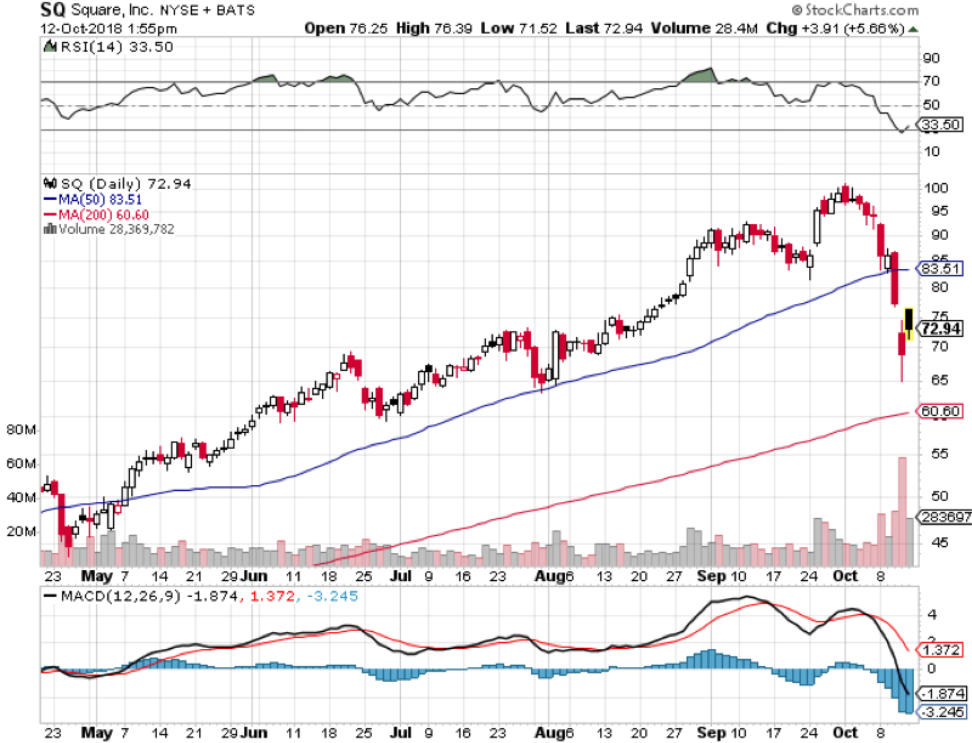
If you want hyper-growth, fin-tech name Square (SQ) would be an ideal candidate.
If buy and hold is your cup of tea, any 10% discount would be a great entry point in any of these quality companies.
Global Market Comments
October 3, 2018
Fiat Lux
Featured Trade:
(TAKING A LOOK AT GENERAL ELECTRIC LEAPS), (GE),
(TEN SURPRISES THAT WOULD DESTROY THIS MARKET),
(USO), (AMZN), (MCD), (WMT), (TGT)
Mad Hedge Technology Letter
October 3, 2018
Fiat Lux
Featured Trade:
(OUR HOME RUN ON SQUARE),
(SQ), (V), (AMZN), (GRUB), (SPOT), (MSFT), (CRM), (AAPL)
Legal Disclaimer
There is a very high degree of risk involved in trading. Past results are not indicative of future returns. MadHedgeFundTrader.com and all individuals affiliated with this site assume no responsibilities for your trading and investment results. The indicators, strategies, columns, articles and all other features are for educational purposes only and should not be construed as investment advice. Information for futures trading observations are obtained from sources believed to be reliable, but we do not warrant its completeness or accuracy, or warrant any results from the use of the information. Your use of the trading observations is entirely at your own risk and it is your sole responsibility to evaluate the accuracy, completeness and usefulness of the information. You must assess the risk of any trade with your broker and make your own independent decisions regarding any securities mentioned herein. Affiliates of MadHedgeFundTrader.com may have a position or effect transactions in the securities described herein (or options thereon) and/or otherwise employ trading strategies that may be consistent or inconsistent with the provided strategies.