Beyond cutting-edge technology, there's nothing that China WANTS OR NEEDS to buy from the U.S. China's largest imports are in energy and foodstuffs, both globally traded commodities.
China is playing the long game because it can.
Earlier this year, China altered its constitution to remove term limits and any obstacle that would hinder Chairman Xi to serve indefinitely.
If it's two, four, eight or 10 years, no problem, China will wait it out.
As it stands, China is enjoying the status quo, which is a robust economic trajectory of 6.7% economic growth YOY and at that rate will leapfrog America as the biggest economy in the world by 2030.
China does not need handouts.
It already has its mooncake and is eating it.
The Chinese are also betting that Donald Trump fades away with the passage of time, possibly soon, and that a vastly different administration will enter the fray with an entirely different strategy.
The indefinite "hold" pattern is a polite way to say we surrender.
ZTE Corporation is a Chinese telecommunications equipment manufacturer and low-end smartphone maker based in Shenzhen, China.
This seemingly innocuous company is ground zero for the U.S. vs China trade practice dispute.
The U.S. Department of Commerce banned American tech companies from selling components to ZTE for seven years, crippling its supply chain after violating sanctions against Iran and North Korea.
ZTE uses about 30% of American components to produce its smorgasbord of telecom equipment and down-market cell phones.
What most people do not know is that ZTE is the fourth most prevalent smartphone in America, only behind Apple, Samsung, and LG, commanding a 12.2% market share, and its phones require an array of American made silicon parts.
In 2017, the company shipped more than 20 million phones to the United States.
The ruling effectively put ZTE out of business because the lack of components shelved production.
Low-end smartphones account for almost one-third of total revenue.
ZTE could very well have survived with a direct hit to its consumer phone business, but the decision to ban components made the telecom equipment division inoperable.
This segment accounts for a heavy 58.2% of revenue. Therefore, disrupting ZTE's supply chain would effectively take down more than 91% of its business for a company that employs 75,000 employees in over 160 countries.
Upon news of ZTE's imminent demise, the administration made a U-turn on its initial decision stating "too many jobs in China lost."
The reversal made America look bad.
It shows that America is being dictated to and not the other way around.
When did it become the responsibility of the American administration to fill Chinese jobs for a company that is a threat to national security?
The Chinese refused to continue talks with the visiting delegation until the ZTE situation was addressed.
Treasury Secretary Steve Mnuchin and company were able to "continue" the talks then were politely shown the door.
Bending the rules for ZTE should have never been a prerequisite for talks, stressing the lack of firepower in the administration's holster.
However, stranding the delegation in Chinese hotel rooms for days waiting in limbo, without offering an audience, would have caused even more humiliation and anguish for the administration.
China is not interested in buying much from America, but one thing it needs -- and needs in droves -- are chips.
Long term, this ZTE ban is great for China.
I believe China will use this episode to rile up the nationalistic rhetoric and make it a point to wean itself from American chips.
However, for the time being, American chips are the most valuable import America can offer China, and that won't change for the foreseeable future.
The numbers back me up.
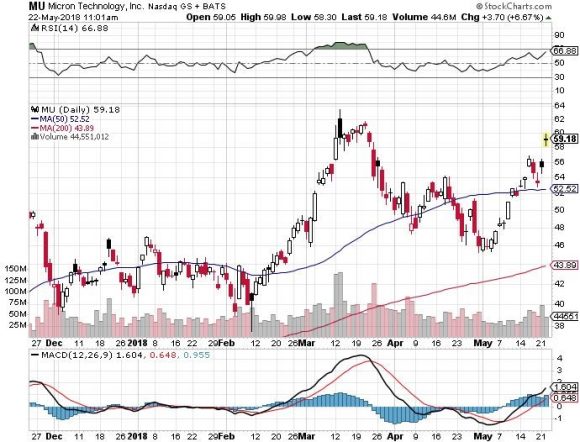
Micron (MU) earns more than $10 billion in revenue from China, which makes up over 51% of its total revenue.
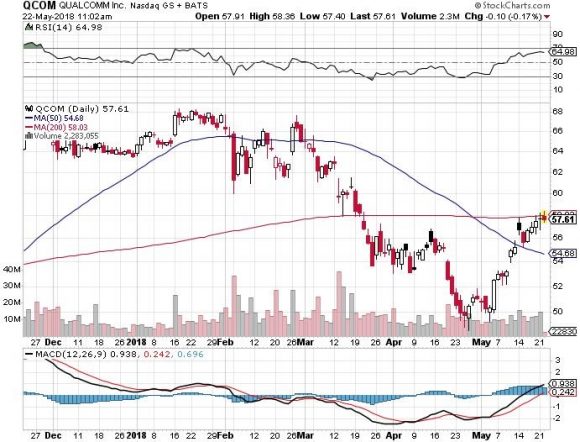
Qualcomm (QCOM), mainly through its lucrative licensing division, makes more than $14.5 billion from its Chinese revenue, which comprises over 65% of revenue.
Texas Instruments (TXN) earns more than 44% of revenue from China, and almost a quarter of Intel's (INTC) revenue is derived from its China operations.
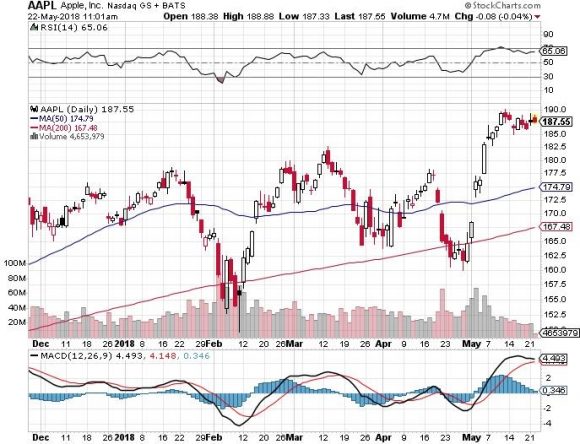
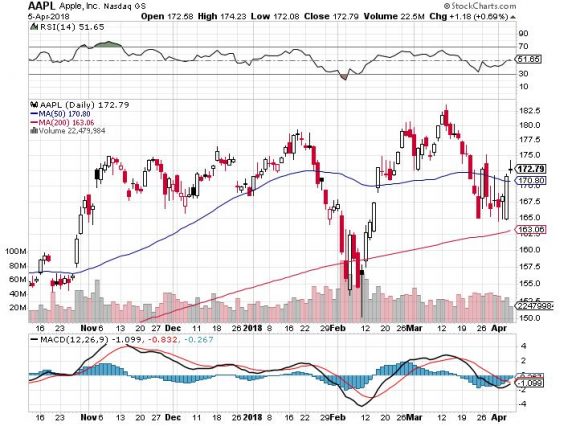
The biggest name embedded in China is Apple (AAPL), which earned almost $45 billion in sales last year. Its China revenue is three times larger than any other American company.
In less than a decade, China has caught up.
China now has adequate local smartphone substitutes through Huawei, Oppo, Vivo, and Xiaomi phones.
Skyworks Solutions (SWKS), a chip company reliant on iPhone contracts, is most levered toward the Chinese market capturing almost 83% of revenue from China.
You would think these chips would be the first on the chopping block in a trade war. However, you are wrong.
China needs all the chips it can get because there is no alternative.
Stopping the inflow of chips is another way of stopping China from doing business and developing technology.
The Chinese economy has been led by the powerful BATs of Baidu (BIDU), Tencent, and Alibaba (BABA) occupying the same prominent role the American FANGs hold in the American economy.
They are not interested in digging their own grave.
To execute the 2025 plan to become the world leaders in advanced technology, they need chips that power all modern electronic devices.
The most likely scenario is that China maintains development using American chips for the time being and slowly pivots to the Korean chip sector, which is vulnerable to Chinese political pressure.
Remember that South Koreans have two of the three biggest chip companies in the world in Samsung and SK Hynix. China has used economic coercion to get what it wants from Korea in the past or to prove a point.
Korean multinational companies, shortly after the Terminal High Altitude Area Defense (THAAD) installation on the Korean peninsula, were penalized by the Chinese government shutting down mainland Korean stores, temporarily banning Chinese tourism in South Korea, and blocking K-pop stars from performing in the lucrative Chinese market.
The Chinese communist government can turn the screws when it wants and how it wants.
Therefore, the next battleground for tech could migrate to South Korean chip companies as China is on a mission to suck up as much high-grade tech ingenuity as possible while it can.
China has some easy targets to whack down if the administration forces it into a corner with a knife to its throat.
Non-tech companies are ripe for massacre because they do not produce chips.
Companies such as Procter & Gamble, Starbucks, McDonald's, and Nike could be replaced by a Chinese imitation in a jiffy.
Apple is the 800-pound gorilla in the room.
An attack on Apple would hyper-accelerate tension between two leaders to the highest it's ever been and would be the straw that breaks the camel's back.
Technology has transformed the world.
Technology also has been adopted by nations as a critical component to national security.
Nothing has changed fundamentally, and nothing will.
China will become the biggest economy in the world by 2030.
China will kick the proverbial can down the road because it can. It never has to cooperate with America again.
Contrary to expectations, American chip companies are untouchable, and investors won't see Micron suddenly losing half its revenue over this trade war.
Until China can produce higher quality chips, it will lap up as much of Uncle Sam's chips until it can force transfer the chip technology from the Koreans.
American chip companies can breathe a sigh of relief.
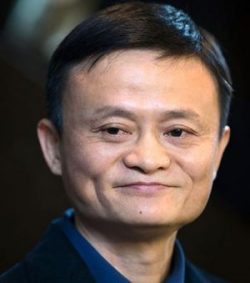
"If we go to work at 8 a.m. and go home at 5 p.m., this is not a high-tech company and Alibaba will never be successful. If we have that kind of 8-to-5 spirit, then we should just go and do something else." - said Alibaba founder and executive chairman Jack Ma.
https://madhedgefundtrader.com/wp-content/uploads/2019/05/cropped-mad-hedge-logo-transparent-192x192_f9578834168ba24df3eb53916a12c882.png00MHFTRhttps://madhedgefundtrader.com/wp-content/uploads/2019/05/cropped-mad-hedge-logo-transparent-192x192_f9578834168ba24df3eb53916a12c882.pngMHFTR2018-05-23 01:05:202018-05-23 01:05:20Why the Big Deal Over ZTE?
The supply side of the chip market is spectacularly volatile, rotating between supply constraints and times of overcapacity.
A good place to analyze the heartbeat of the chip market is across the Pacific on South Korean shores.
South Korea takes pride and joy in having given the world two first-rate semiconductor companies - Samsung and SK Hynix.
Samsung is just behind Intel (INTC) in total annual sales.
American consumers are more familiar with Samsung through its consumer electronics division that constructs Samsung smartphones and tablets.
Samsung's silicon business mirrors the elevated earnings results stateside, as muscular demand derived from global data center expansion devours more chips than Samsung can pump out.
Global data centers in the U.S. and Asia will sustain blistering growth levels into the second quarter.
Samsung has displayed resilience to seasonally shift in the consumer electronics segment by staunchly bolstering its relentless chip business.
Samsung is harvesting the benefits of bountiful investments from over the past decade when this overly cyclical industry was exposed to extreme shifts in worldwide appetite for consumer electronics devices.
More than 70 percent of revenue was generated by the chip division boasting quarterly revenue of $19.25 billion.
In the past, memory chip companies endured a ruthless market environment with a diverse set of players ratcheting up supply on a whim then finding demand crumbling before their eyes.
Restructuring has left the burden of supplying the next generation of technology a backbreaking burden.
Tight chip supply and the general shortage of hardware rears its ugly head in earnings reports with a slew of CEOs complaining about input prices rising worse than global warming sea levels.
In Samsung's earnings call, management groaned that "memory supply and demand fundamentals remain tight."
In SK Hynix's earnings call, it echoed that "demand and supply dynamics in the market will remain favorable."
As large cap tech expands data center initiatives and throws piles of money at autonomous cars, A.I. and cloud computing, Samsung's semiconductor division appears nearly immortal.
Chip prices skyrocketed in this sellers' market and the UBS downgrade of Micron (MU) was a headscratcher.
Analyst Timothy Arcuri turned bearish on Micron citing "cyclical memory concerns" and "big estimate cuts."
Sometimes it feels that analysts don't follow the industry they cover.
It is fair to say chip volume might face marginal cuts closer to 2019, but the pendulum hasn't even started to shift back over to that direction.
Suppliers and buyers both agree that capturing the appropriate volume of chips is the first order of the day.
In response to outsized demand, Samsung will double chip capital spending because of failing to match skyrocketing demand.
Fortifying the bull case, SK Hynix guesstimated DRAM demand for the rest of 2018 to be in the "low-20 percent" and even the injection of new funds for facility expansion is not a proper solution.
Samsung also hammered into investors that it is not in the business to drive the chip prices to zero, and the gross profit metric is more important to them than most people expect.
A goldilocks scenario could ensue with Samsung supplying enough to create price hikes and ploughing its cash back into more silicon expansion.
Korean memory chip producers are expected to enjoy a booming business during the remainder of this year as global DRAM chip demand will surpass supply.
SK Hynix also indicated that server products would supersede mobile products as data center related products are all the rage.
Korea's No. 2 said NAND demand would rise by "mid-40 percent" in 2018, which is double the rise in demand than DRAM products.
Instead of the estimate cuts on which UBS is waiting, the more likely scenario is an easing of chip constraints. The easing will last just long enough before the next massive wave of demand hits with a vengeance.
You read my thoughts - the generational paradigm shift due to hyper-accelerating technology has largely made the boom-bust cycle irrelevant.
Chip demand will go up in a straight line, and this is just the beginning.
Legend has it that demand weakness shows up every 15 years. The last one was the global financial crisis in 2008, and the one before that was the dot-com crash of 2001.
In both instances, the disappearance of demand contributed to massive oversupply. The declining prices set off a price war eradicating margins and revenue.
SK Hynix net profit was $2.89 billion last quarter, an increase of 64.4 percent YOY.
SK Hynix capital allocation layout includes a spanking new factory in Cheongju, a city in South Korea.
The insatiable demand brought on by China's quest for technological supremacy is the market the new Cheongju factory will serve.
International chip directors fret that a sudden breakthrough in local Chinese technology could ignite a supply bonanza of cut-rate semiconductors, forcing a recapitulation of the entire industry that encountered egregious oversupply issues about 10 years ago.
But China can't dump low-cost chips into the market due to technological frailties.
Notice that Chinese capital has been flirting with American chip companies for years without success.
The Chinese government even initiated an investigation at the tail end of last year because DRAM price spikes were indigestible for local Chinese companies.
The dearth of supply is not just restricted to one extraneous niche of the hardware industry, as the tightness is broad-based.
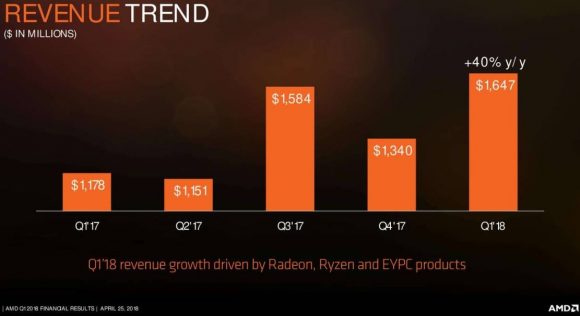
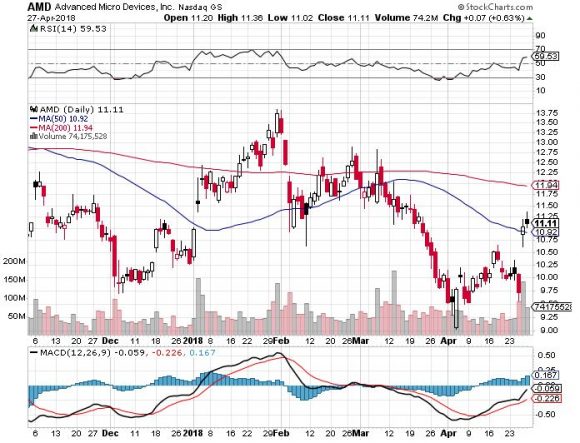
Don't look further than AMD (AMD), which specializes in GPU (graphics processing unit) products and has received glowing reviews for its Ryzen and EPYC CPU processors that boast higher-level performance than previous products.
The RX Vega series is the new line of GPUs from AMD that launched last August. Tech-enthusiast website techspot.com described finding these GPUs on sale in stores as "next to impossible."
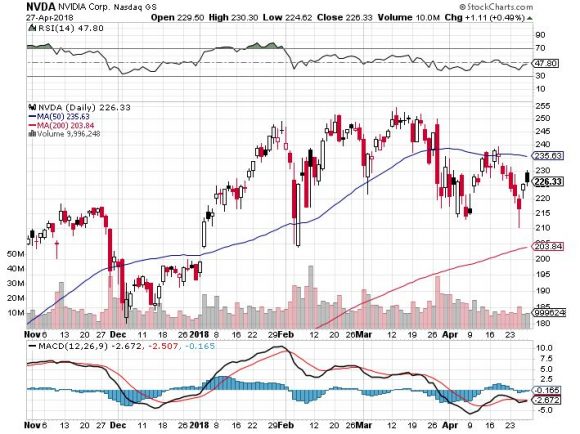
AMD is well informed of the market outlook and NVIDIA (NVDA) notes that hardware-intensive cryptocurrency mining is stoking excess marginal demand for its products.
AMD is boosting production, but manufacturing is set back by a component shortage in GDDR5 memory, which is needed in the RX 400 card.
The RX 500 card, part of the RX Vega line, is also having delays with a lack of HBM2 memory.
Crypto-fanatics aren't the only consumers clamoring for extra GPUs; gamers require GPUs to perform at top levels.
AMD has even urged retailers to advise gamers of any outlets where they can buy GPUs because of the dearth of supply.
Gamers are being outmaneuvered for GPUs as crypto-miners usually buy up every last unit to transport to mining farms in far-flung places with cheap energy.
Hardware products cannot be produced fast enough to meet demand.
Other industries vying for a portion of chips are military, aerospace, IoT (Internet of Things) products, and autonomous cars.
Incremental supply is accruing but often the supply is added slower than initially thought. Suppliers are hesitant to double down on new factories because of past, bitter experiences at the end of a cycle.
Management monitors inventory channels like a hawk eyeing its prey, and it's clear that organic demand is following through.
After running away with 22.2% growth in 2017, the semiconductor industry is due to take a quick breather expanding in the upper teens in 2018.
A year is an eternity in technology and calling for production "cuts" in a period of massive undersupply is premature.
The claim of "cyclical" headwinds comes at a time of a new-found immunity to cyclical demand and is dubious at best.
This secular story has legs. Don't believe every analyst that pushes out reports. They often have alternative motives.
Nvidia (NVDA) reports earnings on May 10, and CEO Jensen Huang does a great job explaining the development at the front-end of the tech revolution.
Earnings should be extraordinary. Imagine if the price of bitcoin stabilizes, GPU manufacturers will wrestle with continuous quarters of strained supply.
"Focus on the 20 percent that makes 80 percent of the difference." - said Salesforce CEO Marc Benioff when asked to explain the story of his cloud business.
https://www.madhedgefundtrader.com/wp-content/uploads/2018/04/Revenue-Trend-image-3-e1524864243813.jpg316580MHFTRhttps://madhedgefundtrader.com/wp-content/uploads/2019/05/cropped-mad-hedge-logo-transparent-192x192_f9578834168ba24df3eb53916a12c882.pngMHFTR2018-04-30 01:05:462018-04-30 01:05:46Riding the Chip Roller Coaster
There is plenty of turmoil in chip land these days.
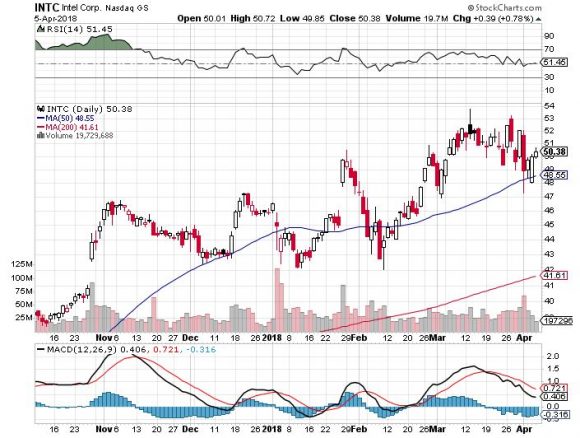
Investors should not freak out, or worse, dump their Intel (INTC) shares on pain of death.
Take a deep breath ... and I'll explain why Intel is still a great stock into which you should dip your toes.
Apple (AAPL) reportedly plans to replace Intel processors in Mac computers with its own proprietary chips starting around 2020. It is useless for investors to prognosticate the worst-case scenario playing out because this announcement will not put Intel out of business.
This is not the first phase of the death of Intel and represents a fabulous entry point into a beacon of tech stability.
Apple started placing Intel CPUs into its MacBook Pro and iMac in 2006 and have enjoyed a fruitful relationship since then.
As technology mutates at lightning speed, Apple justifiably desires more control over its chip design to create the innovative end product it envisions and provide a smoother experience between mobile and desktop devices.
Intel's engineers cannot match the pace of Apple's chip improvements that use ARM-based processors, which Apple has stuck into devices using the iOS system, including the Apple Watch and the Apple TV.
Apple's latest gadgets are more powerful than its past Macs, and its future is better served by tailor-making its chip architecture for its devices.
Security will be bolstered by procuring more control over design construction.
Intel still boasts the world's most popular CPU chip line for laptops and desktop computers, and hyper-increasing global demand for silicon chips will fail to disrupt Intel's growth trajectory.
Remember that the CPU chip line is Intel's legacy business, and this lump of the operation will slowly fade away into oblivion anyway.
Apple's top-end computers will still use Intel's chips such as the iMac Pro and Mac Pro revision until they can transition to in-house chips.
This trend has staying power with Apple designing its own iPhone chips partially due to removing its heavy reliance on Qualcomm (QCOM). It also has locked horns in court for years adding tension to the relationship.
On a relative basis, iMacs are just a fragment of the overall laptop market at 7.3% during the fourth quarter of 2017.
Apple's announcement could shed $1.8 billion in annual gross profit from Intel's earnings.
Intel accumulated $62.8 billion in sales in 2017, and losing Apple's business is only a small hiccup in the bigger scheme of things.
In late 2017, Intel poached the former head of AMD's (AMD) graphics business to head up a new high-end graphics division.
Raja Koduri, the new chief architect and senior vice president of the newly formed Core and Visual Computing division at Intel, will enable the company to directly compete with AMD and Nvidia (NVDA) in the GPU market.
The competition with AMD is a big deal because AMD has caught up with Intel and could steal CPU market share.
AMD has built its own comprehensive lineup of PC CPU chips while Intel unveiled its eighth generation Core processors on April 3.
Acquiring new segments with its cash hoard is another way to move forward.
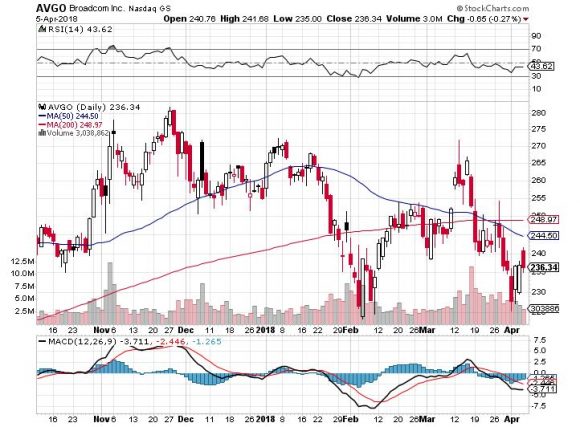
Rumors were rife with reports suggesting Intel would acquire Broadcom (AVGO) to create the biggest chip maker in the world.
This was a defensive maneuver to combat the possible combination of a Broadcom-Qualcomm merger that would damage Intel's market share in chips for mobile phones and cars.
By getting into bed with Broadcom, Intel could scrap the construction of the world's third-largest chipmaker, after Intel itself and Korea's Samsung.
Altera and Mobileye are companies Intel added to its lineup using its egregiously large cash hoard.
Mobileye, an Israeli company, provides advanced driver assistance software that prevents collisions. This purchase clearly bolsters its autonomous vehicle technology division.
Altera, a San Jose, Calif.-based company, manufactures integrated circuits.
Intel is likely to remain the dominant force at the very high end of computing.
It would be foolish to only analyze Intel based on its legacy business as it has veered into a different growth mode and is not just a chip company anymore.
Intel has been weaning itself from the secular downtrend of computer chips and strategically established an unmovable position in the massive cloud data center and server business.
The Data Center Group, Intel's second largest segment and most vital, grew 20% YOY, with $5.6 billion in revenue. Investors must keep close tabs on how this area performs because it is the lynchpin to emerging technologies such as artificial intelligence and 5G in terms of overall infrastructure.
Intel's data center performance represents the harbinger of success, and Intel is doubling down on this future growth driver.
Cloud capital expenditures will rise 30 percent in 2018 because chunks of money must be thrown at this segment to stay relevant from cutthroat competition.
Computing is at an inflection point in 2018. Priorities have rotated to the data-centric phase of development. And Intel's CEO Brian Krzanich, who just received a nice pay rise to $21.5 million per year, will fill us in at Intel's next earnings call on April 26.
"Quality is much better than quantity. One home run is much better than two doubles." - said former Apple CEO, Steve Jobs in 2006.
https://madhedgefundtrader.com/wp-content/uploads/2019/05/cropped-mad-hedge-logo-transparent-192x192_f9578834168ba24df3eb53916a12c882.png00MHFTRhttps://madhedgefundtrader.com/wp-content/uploads/2019/05/cropped-mad-hedge-logo-transparent-192x192_f9578834168ba24df3eb53916a12c882.pngMHFTR2018-04-06 01:05:132018-04-06 01:05:13The Implications of Intel's Lost Apple Contract
Featured Trade:
(MARKET OUTLOOK FOR THE WEEK AHEAD, or GOODBYE THE QUARTER FROM HELL),
(SPY), (INTC), (AMZN), (CSCO),
(MONDAY, JUNE 11, FORT WORTH, TEXAS, GLOBAL STRATEGY LUNCHEON),
(THE HARD/SOFT DATA CONUNDRUM)
Well, that was some quarter! Call it the quarter from hell.
For as long as most traders and investors can remember, they are losing money so far this year. And they promised us such a rose garden!
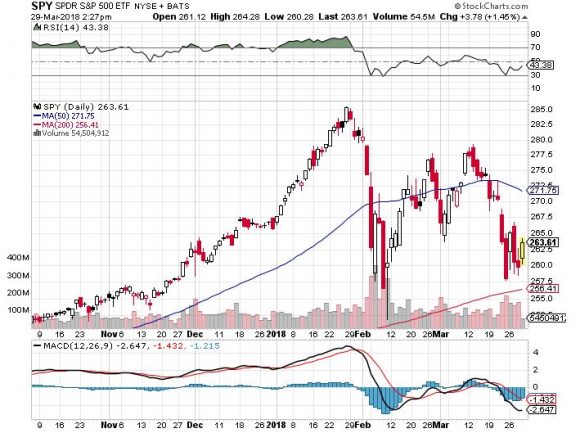
The S&P 500 made a valiant, and so far successful effort to hold at the 200-day moving average at $256. We saw an unprecedented four consecutive days of 2% moves.
Yet, with all that tearing of hair, banging of heads against walls, and ulcers multiplying like rabbits, the (SPY) dropped only 5 points since January, off 1.8%, a mere pittance. It's been a whole lot of work and stress for nothing.
So far, the (SPY) has been bracketed by the 50-day moving average on the upside at $272, and the 200-day moving average on the downside. It could continue like this for six more months, forming a very long triangle formation with a year-end upside breakout.
Is the market going to sleep pending the outcome of the November midterm congressional elections?
But here's the catch. We now live in the world of false breakouts and breakdowns, thanks to algorithms. It happened twice in February and March to the upside.
What follows false upside breakouts? How about false downside breakdowns, which may be on the menu for us in April.
My bet is that we'll see one of these soon, taking the (SPY) down as low as $246. Then we'll rocket back up to the middle of the range in another one of those up 100-point days.
What will cause such a catharsis? An escalation of the trade war would certainly do it. Or maybe just a random presidential tweet about anything.
That's why I have been holding fire so far on my volatility shorts and more aggressive longs in stocks.
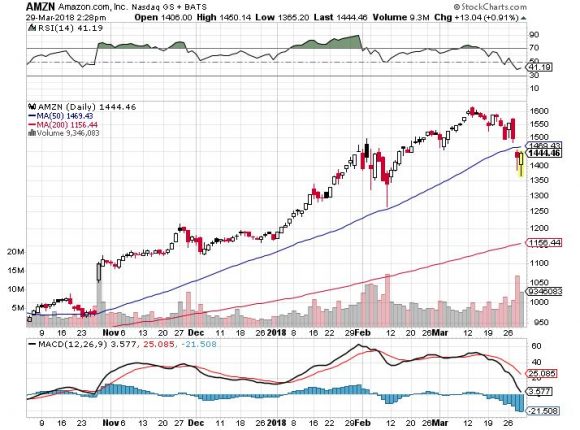
What will I be buying? Amazon (AMZN), which has essentially an unlimited future. Thank the president for creating a rare 16% selloff and unique buying opportunity with his nonsensical talk about antitrust action.
On what exactly does Amazon have a monopoly? Brilliance?
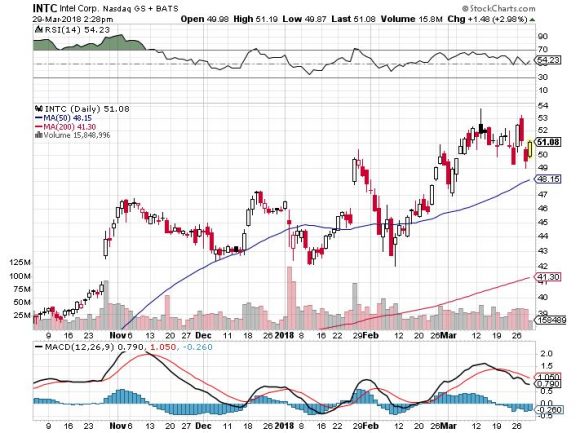
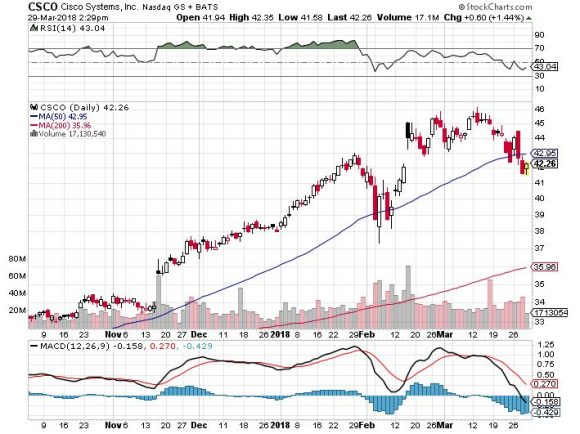
I also will be taking a look at laggard legacy old tech companies such as Intel (INTC) and Cisco Systems (CSCO). And how can you not like Microsoft here (MSFT)?
Of course, the mystery of the week was the strength in bonds (TLT) taking yields for the 10-year Treasury down to 2.75%. This is in the face of a Treasury auction on Wednesday that went over like a lead balloon.
I think it's all about quarter end positioning more than anything. Some hedge funds have big losses in stocks and volatility trading to cover, and what better way to do it than take profits on bond shorts through buying.
I already have started selling into the rally.
The scary thing about the bond action is that it has accelerated the flattening of the yield curve, with the two-year/10-year spread now only 50 basis points.
It also brings forward the inversion of the yield curve. And we all know what follows that with total certainty: a bear market in stocks and a recession.
The data flow for the coming week is all about jobs, jobs, jobs.
On Monday, April 2, at 9:45 AM, we get the March PMI Manufacturing Index.
On Tuesday morning, we receive March Motor Vehicle Sales, which have recently been weak at 17.1 million units.
On Wednesday, April 4, at 8:15 AM EST, the first of the trifecta of jobs reports comes out with the ADP Employment Report, a read on private sector high.
Thursday, April 5, leads with the Weekly Jobless Claims at 8:30 AM EST, which hit a new 49-year low last week at an amazing 210,000.
At 7:30 AM we get the March Challenger Job Cut Report.
On Friday, April 6, at 8:30 AM EST, we get the Big Kahuna with the March Nonfarm Payroll Report. Last month brought shockingly weak figures.
The week ends as usual with the Baker Hughes Rig Count at 1:00 PM EST. Last week brought a drop of 2.
As for me, I am headed up to Lake Tahoe, Nev., today for spring break to catch the last of the heavy snow. After a record 18 feet in March, Squaw Valley, Calif., has announced that it is keeping the ski lifts open until the end of May.
Good Luck and Good Trading.
https://www.madhedgefundtrader.com/wp-content/uploads/2018/04/john-story-1-image-6-e1522354823454.jpg225300MHFTRhttps://madhedgefundtrader.com/wp-content/uploads/2019/05/cropped-mad-hedge-logo-transparent-192x192_f9578834168ba24df3eb53916a12c882.pngMHFTR2018-04-02 01:08:242018-04-02 01:08:24Market Outlook for the Week Ahead, or Goodbye the Quarter from Hell
This is the most important research piece you will ever read, bar none. But you have to finish it to understand why. So, I will get on with the show.
I have been hammering away at my followers at investment conferences, webinars, and strategy luncheons this year about one recurring theme. Things are good, and about to get better, a whole lot better.
The driver will be the exploding rate of technological innovation in electronics, biotechnology, and energy. The 2020s are shaping up to be another roaring twenties, and asset prices are going to go through the roof.
To flesh out some hard numbers about growth rates that are realistically possible and which industries will be the leaders, I hooked up with my old friend, Ray Kurzweil, one of the most brilliant minds in computer science.
Ray is currently a director of Engineering at Alphabet (GOOG), heading up a team that is developing stronger artificial intelligence. He is an MIT grad, with a double major in computer science and creative writing. He was the principal inventor of the CCD flatbed scanner, first text-to-speech synthesizer, and the commercially marketed large-vocabulary speech recognition.
When he was still a teenager, Ray was personally awarded a science prize by President Lyndon Johnson. He has received 20 honorary doctorates and has authored 7 books. It was upon Ray?s shoulders that many of today?s technological miracles were built.
His most profound book to date, The Singularity Is Near: When Humans Transcend Biology, was a New York Times best seller. In it he makes hundreds of predictions about the next 100 years that will make you fall out of your chair.
I met Ray at one of my favorite San Francisco restaurants, Morton?s on Sutter Street. I ordered a dozen oysters, a filet mignon wrapped in bacon, and washed it all down with a fine bottle of Duckhorn Merlot. Ray had a wedge salad with no dressing, a giant handful of nutritional supplements, and a bottle of water. That?s Ray, one cheap date.
The Future of Man
A singularity is defined as a single event that has monumental consequences. Astrophysicists refer to the big bang and black holes in this way. Ray?s singularity has humans and machines merging to become single entities, partially by 2040 and completely by 2100.
All of our thought processes will include built in links to the cloud, making humans super smart. Skin that absorbs energy from the sun will eliminate the need to eat. Nanobots will replace blood cells, which are far more efficient at moving oxygen. A revolution in biotechnology will enable us to eliminate all medical causes of death.
Most organs can now be partially or completely replaced. Eventually they all will become renewable by taking one of your existing cells and cloning it into a completely new organ. We will become much more like machines, and machines will become more like us.
The first industrial revolution extended the reach of our bodies, and the second is extending the reach of our minds.
And, oh yes, prostitution will be legalized and move completely online. Sound like a turn off? How about virtually doing it with you favorite movie star? Your favorite investment advisor? Yikes!
Ironically, one of the great accelerants towards this singularity has been the war in Iraq. More than 50,000 young men and women came home missing arms and legs (in Vietnam these were all fatalities, thanks to the absence of modern carbon fiber body armor).
Generous government research budgets have delivered huge advances in titanium artificial limbs and the ability to control them with only our thoughts. Quadriplegics can now hit computer keystrokes merely by thinking about them.
Kurzweil argues that exponentially growing information technology is encompassing more and more things that we care about, like health care and medicine. Reprogramming of biology will be the next big thing and is a crucial part of his ?singularity.?
Our bodies are governed by obsolete genetic programs that evolved in a bygone era. For example, over millions of years our bodies developed genes to store fat cells to protect against a poor hunting season the following year. That gave us a great evolutionary advantage 10,000 years ago. But it is not so great now, with obesity becoming the country?s number one health problem.
We would love to turn off these genes through reprogramming, confident that the hunting at the supermarket next year will be good. We can do this in mice now, which in experiments can eat like crazy, but never gain weight.
The happy rodents enjoy the full benefits of no caloric restriction, with no hint of diabetes or heart disease. A product like this would be revolutionary, not just for us, health care providers, and the government, but, ironically, for fast food restaurants as well.
Within the last five years, we have learned how to reprogram stem cells to rebuild the hearts of people who have suffered heart attacks. The stem cells are harvested from skin cells, not human embryos, consequently circumventing the political and religious issues of the past.
If we can turn off genes, why not the ones in cancer cells that enable them to pursue unlimited reproduction, until they kill its host? That development would cure all cancers, and is probably only a decade away.
The Future of Computing
If this all sounds like science fiction, you?d be right. But Ray points out that humans have chronically underestimated the rate of technological innovation.
This is because humans evolved to become linear thinking animals. If a million years ago we saw a gazelle running from left to right, our brains calculated that one second later it would progress ten feet further to the right. That?s where we threw the spear. This gave us a huge advantage over other animals and is why we became the dominant species.
However, much of science, technology, and innovation grows at an exponential rate, and consequently is the reason we make our most egregious forecasting errors. Count to seven, and you get to seven. However, double something seven times and you get to a billion.
The history of the progress of communications is a good example of an exponential effect. Spoken language took hundreds of thousands of year to develop. Written language emerged in thousands of years, books in a 100 years, the telegraph in a century, and telephones 50 years later.
Some ten years after Steve Jobs brought out his Apple II personal computer, the growth of the Internet went hyperbolic. Within three years of the iPhone launch, social media exploded out of nowhere.
At? the beginning of the 20th century, $1,000 bought 10 X -5th power worth of calculations per second in our primitive adding machines. A hundred years later a grand got you 10 X 8th power calculations, a 10 trillion-fold improvement. The present century will see gains many times this.
The iPhone itself is several thousand times smaller, a million times cheaper, and billions of times more powerful than computers of 40 years ago. That increases price per performance by the trillions. More dramatic improvements will accelerate from here.
Moore?s law is another example of how fast this process works. Intel (INTC) founder Gordon Moore published a paper in 1965 predicting a doubling of the number of transistors on a printed circuit board every two years. Since electrons had shorter distances to travel, speeds would double as well.
Moore thought that theoretical limits imposed by the laws of physics would bring this doubling trend to an end by 2018, when the gates became too small for the electrons to pass through. For decades I have read research reports predicting that this immutable deadline would bring an end to innovation and technological growth, resulting in economic Armageddon.
Ray argues that nothing could be further fr
om the truth. A paradigm shift will simply allow us to leapfrog conventional silicon based semiconductor technologies and move on to bigger and better things. We did this when we jumped from vacuum tubes to transistors in 1949, and again in 1959, when Texas Instruments (TXN) invented the first integrated circuit.
Paradigm shifts occurred every ten years in the past century, every five years in the last decade, and will occur every couple of years in the 2020s. So fasten your seat belts!
Nanotechnology has already allowed manufacturers to extend the 2018 Moore?s Law limit to 2022. On the drawing board are much more advanced computing technologies, including calcium based systems, using the alternating direction of spinning electrons and nanotubes.
Perhaps the most promising is DNA based computing, a high research priority at IBM and several other major firms. I earned my own 15 minutes of fame in the scientific world 40 years ago as a member of the first team ever to sequence a piece of DNA which is why Ray knows who I am.
Deoxyribonucleic Acid (DNA) makes up the genes that contain the programming which makes us who we are. It is a fantastically efficient means of storing and transmitting information. And it is found in every single cell in our bodies, all 10 trillion of them.
The great thing about DNA is that it replicates itself. Just throw it some sugar. That eliminates the cost of building the giant $2 billion silicon based chip fabrication plants of today.
The entire human genome is a sequential binary code containing only 800 MB of information which, after you eliminate redundancies, has a mere 30-100 MB of useful information which is about the size of an off-the-shelf software program, like Word for Windows. Unwind a single DNA molecule, and it is only six feet long.
What this means is that, just when many believe that our computer power is peaking, it is in fact launching on an era of exponential growth. Super computers surpassed human brain computational ability in 2012, computing about 10 to the 16th power (ten quadrillion) calculations per second.
That power will be available on a low-end laptop by 2020. By 2050, this prospective single laptop will have the same computing power as the entire human race which is comprised of about 9 billion individuals. It will also be small enough to implant in our brains.
The Future of the Economy
Ray is not really that interested in financial markets or, for that matter, making money. Where technology will be in a half century and how to get us there are what get his juices flowing. However, I did manage to tease a few mind-boggling thoughts from him.
At the current rate of change, the 21st century will see 200 times the technological progress that we saw in the 20th century. Shouldn?t corporate profits and, therefore, share prices rise by as much?
Technology is rapidly increasing its share of the economy, and increasing its influence on other sectors. That?s why tech has been everyone?s favorite sector for the past 30 years, and will remain so for the foreseeable future. For two centuries, technology has been eliminating jobs at the bottom of the economy and creating new ones at the top.
Stock analysts and investors make a fatal error estimating future earnings based on the linear trends of the past, instead of the exceptional growth that will occur in the future.
In the last century, the Dow appreciated from 100 to 10,000, an increase of 100 times. If we grow at that rate in this century, the Dow should increase by 10,000% to 1 million by 2100. But so far, we are up only 8%, even though we are already 16 years into the new century.
The index is seriously lagging, but will play catch up in a major way during the 2020s, when economic growth jumps from 2% to 4% or more, thanks to the effects of massively accelerating technological change.
Some 100 years ago, one third of jobs were in farming, one third were in manufacturing, and one third in services. If you predicted then that in a century farming and manufacturing would each be 3% of total employment and that something else unknown would come along for the rest of us, people would have been horrified. But that?s exactly what's happened.
Solar energy use is also on an exponential path. It is now 1% of the world?s supply, but is only seven doublings away from becoming 100%. Then we will consume only one 10,000th of the sunlight hitting the earth. Geothermal energy offers the same opportunities.
We are only running out of energy if you limit yourself to 19th century methods. Energy costs will plummet. Eventually, energy will be essentially free when compared to today?s costs, further boosting corporate profits.
Hyper growth in technology means that we will be battling with deflation for the rest of the century, as the cost of production and the price of everything falls off a cliff. That makes our 10-year Treasury bonds a steal at a generous 2.60% yield, a full 460 basis points over the real long term inflation rate of negative 2% a year.
The upshot to all of this, these technologies will rapidly eliminate poverty, not just in the US, but around the world. Each industry will need to continuously reinvent its business model or it will disappear.
The takeaway for investors is that stocks, as well as other asset prices, are currently wildly undervalued given their spectacular future earnings potential. It also makes the Dow target of 1 million by 2100 absurdly low, and off by a factor of 10 or even 100. Will we be donning our ?Dow 100 Million? hats then?
Other Random Thoughts
As we ordered dessert, Ray launched into another stream of random thoughts. I asked for Morton?s exquisite double chocolate mousse. Ray had another handful of supplements. Yep, Mr. Cheap Date.
The number of college students has grown from 50,000 to 12 million since 1870s. A kid in Africa with a cell phone has more access to information than the president of the United States did 15 years ago.
The great superpower, the Soviet Union, was wiped out by a few fax machines distributing information in 1991.
Company offices will become entirely virtual by 2025.
Cows are very inefficient at producing meat. In the near future, cloned muscle tissue will be produced in factories, disease free, and at a fraction of the present cost, without the participation of the animal. PETA will be thrilled.
Use of nano materials to build ultra light, but ultra strong, cars will cut fuel consumption dramatically. Battery efficiencies will improve by 10 to 100 times. Imagine powering a Tesla Model S1 with a 10-pound battery! Advances in nanotube construction mean the weight of the vehicle will drop from the present 3 tons to just 100 pounds but will be far safer.
Ray is also on a scientific advisory panel for the US Army. Uncertain about my own security clearance, he was reluctant to go into detail. Suffice it to say that the weight of an M1 Abrams main battle tank will shrink from 70 tons to 1 ton, but will be 100 times stronger.
A zero tolerance policy towards biotechnology by the environmental movement exposes their intellectual and moral bankruptcy. Opposing a technology with so many positive benefits for humankind and the environment will inevitably alienate them from the media and the public who will see the insanity of their position.
Artificial intelligence is already far more prevalent than you understand. The advent of strong artificial intelligence will be the most significant development of this century. You can?t buy a book from Amazon, withdraw money from your bank, or book a flight, without relying on AI.
Ray finished up by saying that by 2100, humans will have the choice of living in a biological or, in a totally virtual, online form. In the end, we will all just be files.
Personally, I prefer the former, as the best th
ings in life are biological and free!
I walked over to the valet parking, stunned and disoriented by the mother load of insight I had just obtained, and it wasn?t just the merlot talking either! Imagine what they talk about at Alphabet all day.
To buy The Singularity Is Near at Amazon, please click here. It is worth purchasing the book just to read Ray?s single chapter on the future of the economy.
Did You Say ?BUY? or ?SELL?
The Future is Closer than You Think
https://www.madhedgefundtrader.com/wp-content/uploads/2014/05/Borg.jpg343442Mad Hedge Fund Traderhttps://madhedgefundtrader.com/wp-content/uploads/2019/05/cropped-mad-hedge-logo-transparent-192x192_f9578834168ba24df3eb53916a12c882.pngMad Hedge Fund Trader2016-12-27 01:06:452016-12-27 01:06:45Peeking into the Future with Ray Kurzweil
There is no doubt that old tech is back with a vengeance.
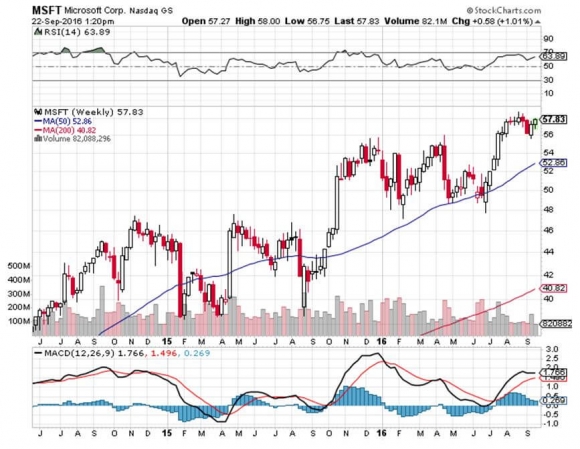
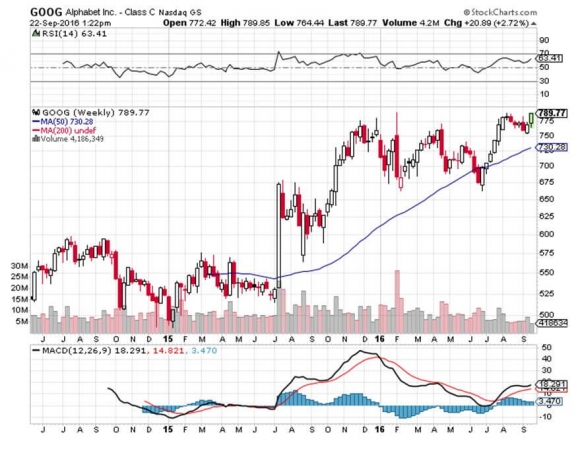
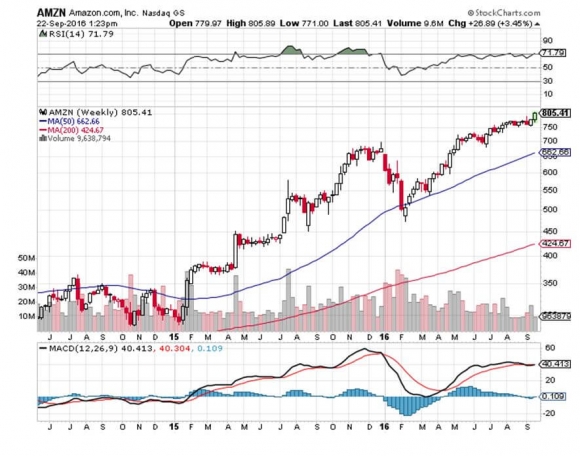
Look at the trifecta of blockbuster earnings reports from Microsoft (MSFT), Amazon (AMZN), and Alphabet (GOOGL) recently, and you can reach no other conclusion.
The Microsoft turnaround in particular has been amazing.
PCs, and the software to run them were so 1990s.
After the Dotcom bust in 2000, Microsoft was dead money for years.
Founder Bill Gates retired in 2008. CEO Steve Ballmer finally got the message in 2013, and retired to pay through the nose, some $2 billion, for the basketball team, the LA Clippers.
Succeeding operating systems offered little that was new, and they fell woefully behind the technology curve.
Even I gave away my own machines years ago to switch to Apple devices. These virus immune machines are perfect for a small business like mine, as they seamlessly integrate and all talk to each other.
When the company brought out the Windows Phone in 2010, three years after Apple, people in Silicon Valley laughed.
Long given up for dead as a trading and investment vehicle, the shares have been on a tear in 2015.
The stock is hitting a new all time high FOR THE FIRST TIME IN 15 YEARS!
Satya Nadella, who took over management of the company in 2014, clearly had other ideas. The challenge for Nadella from day one was to move boldly into new technologies, while preserving its legacy Windows business lines.
So far, so good.
The key to the company?s new found success was it?s dumping of its old ?Wintel? strategy of yore that focused entirely on the growth of the PC market.
The problem was that the PC market stopped growing, as the world moved onto the Cloud and mobile.
The company is now rivaling Apple with $100 billion in cash, almost all held tax-free overseas.
EPS growth will reach 10% next year, beating other big competitors.
Windows and servers, the (MSFT)?s core products, still account for 80% of the firm?s business.
But its cloud presence is being ramped up at a frenetic pace, where the future for the company lies, nearly doubling YOY. Mobile technologies, where it has lagged until now, are also on fire.
Rave reviews from its latest operating system upgrade, Windows 10, also helped.
On top of all of this, Microsoft is paying a generous 3% dividend. It?s earnings multiple at 15X makes it a bargain compared to other big tech companies and the rest of the market.
As I explained in my recent research piece ?Switching From Growth to Value? (click here?), Microsoft makes a perfect investment for a mature bull market.
It is not only at a multiple discount to the rest of the market, now at 18X, it is cheap when compared to the rest of its own sector as well.
This is when investors and traders bail from their high priced stocks to safer, lower multiple companies.
Obviously, I don?t want to pile into Microsoft, or any other of the big tech stocks on top of a furious 10% spike. But it is now safely in the ?buy on the dip? camp, along with the rest of big tech.
The party has only just stated.
To read my interview with Bill Gates? father, click here for ?An Evening With Bill Gates, Sr.?.
https://www.madhedgefundtrader.com/wp-content/uploads/2015/10/Microsoft-Logo-e1445631099676.jpg92400Mad Hedge Fund Traderhttps://madhedgefundtrader.com/wp-content/uploads/2019/05/cropped-mad-hedge-logo-transparent-192x192_f9578834168ba24df3eb53916a12c882.pngMad Hedge Fund Trader2016-09-23 01:07:492016-09-23 01:07:49Old Tech is Back!
Legal Disclaimer
There is a very high degree of risk involved in trading. Past results are not indicative of future returns. MadHedgeFundTrader.com and all individuals affiliated with this site assume no responsibilities for your trading and investment results. The indicators, strategies, columns, articles and all other features are for educational purposes only and should not be construed as investment advice. Information for futures trading observations are obtained from sources believed to be reliable, but we do not warrant its completeness or accuracy, or warrant any results from the use of the information. Your use of the trading observations is entirely at your own risk and it is your sole responsibility to evaluate the accuracy, completeness and usefulness of the information. You must assess the risk of any trade with your broker and make your own independent decisions regarding any securities mentioned herein. Affiliates of MadHedgeFundTrader.com may have a position or effect transactions in the securities described herein (or options thereon) and/or otherwise employ trading strategies that may be consistent or inconsistent with the provided strategies.