Below please find subscribers’ Q&A for the Mad Hedge Fund Trader September 18Global Strategy Webinar broadcast from Silicon Valley, CA with my guest and co-host Bill Davis of the Mad Day Trader. Keep those questions coming!
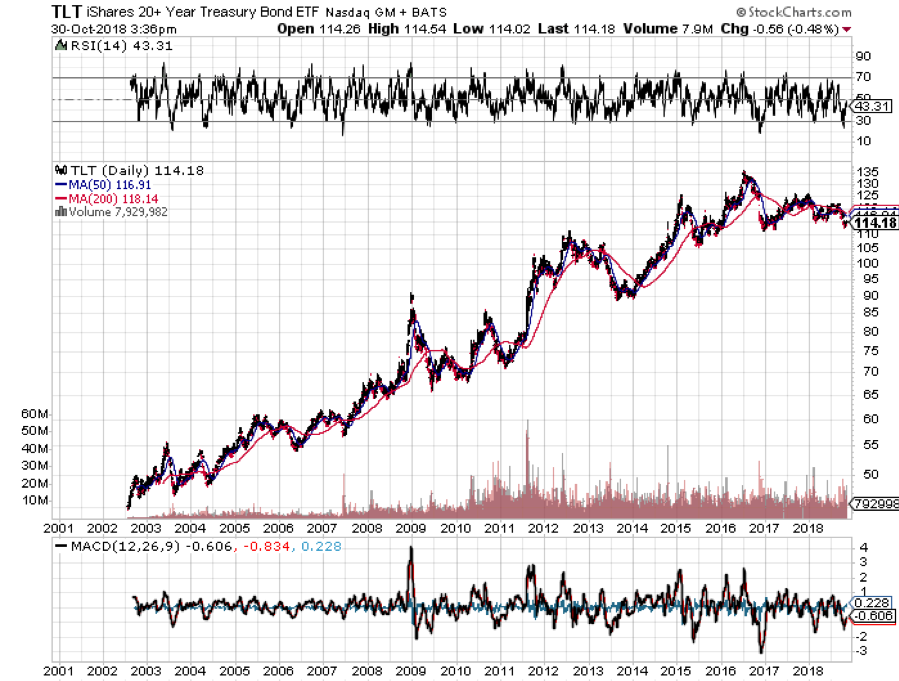
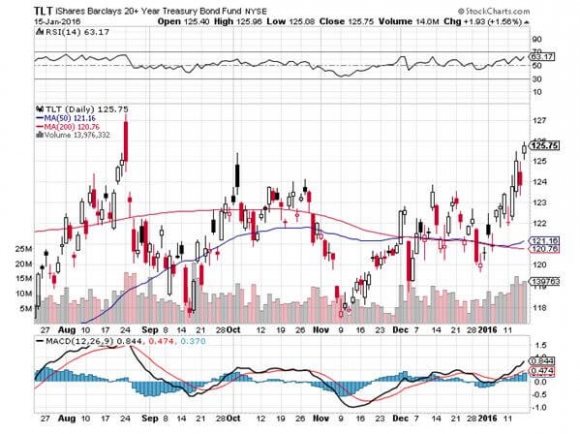
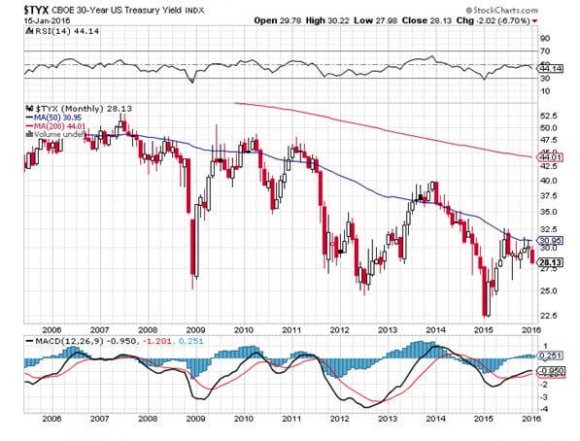
Q: What would happen to the United States Treasury Bond Fund (TLT) if the Fed does not lower rates?
A: My bet is that it would immediately have a selloff—probably several points—but after that, recession worries will take bond prices up again and yields down. I don’t think we have seen the final lows in interest rates by a long shot. That’s why I bought the (TLT) last week.
Q: Is it good to buy FedEx (FDX) considering the 13% fall today?
A: I use the 3-day rule on these situations. That's how long it takes for the dust to settle from an earnings shock like this and find the real price. The problem with FedEx is that it’s a great early recession predictor. When the number of delivered packages decreases, it’s always an indicator that the economy as a whole is slowing down, which we know has been happening. It’s one of the most cyclical stocks out there, therefore one of the most dangerous. I wouldn’t bother with FedEx right now. Go take a long nap instead.
Q: Would you be a buyer of Facebook (FB) here, given they seem to have weathered all the recent attacks from Washington?
A: Not here in particular, but I would buy it 20% down when it gets to the bottom edge of its upward channel—it still looks like it’s going crazy. They’re literally renting or buying buildings to hire an additional 50,000 people in San Francisco anticipating huge growth of their business, so that’s a better indicator of the future of Facebook than anything.
Q: Will junk bonds be more in demand now that rates are cratering?
A: Junk bonds (HYG), (JNK) are driven more by the stock market than the bond market, as you can see in the huge rally we just had. Junk bonds are great because their default ratios are usually far below that which the interest rate implies, but you really have to trade them like stocks. Think of them as preferred stocks with really high dividends. When the stock market tops, so will junk bonds. Remember in 2008, junk yields got all the way up to 15% compared to today’s 5.6%.
Q: What will happen to emerging markets (EEM) as rates lower?
A: If lower interest rates bring a weaker US dollar, that would be very positive for emerging markets over the long term and they would be a great buy. However, emerging markets will take the hardest hit if we actually do go into a recession. So, I would pass for now.
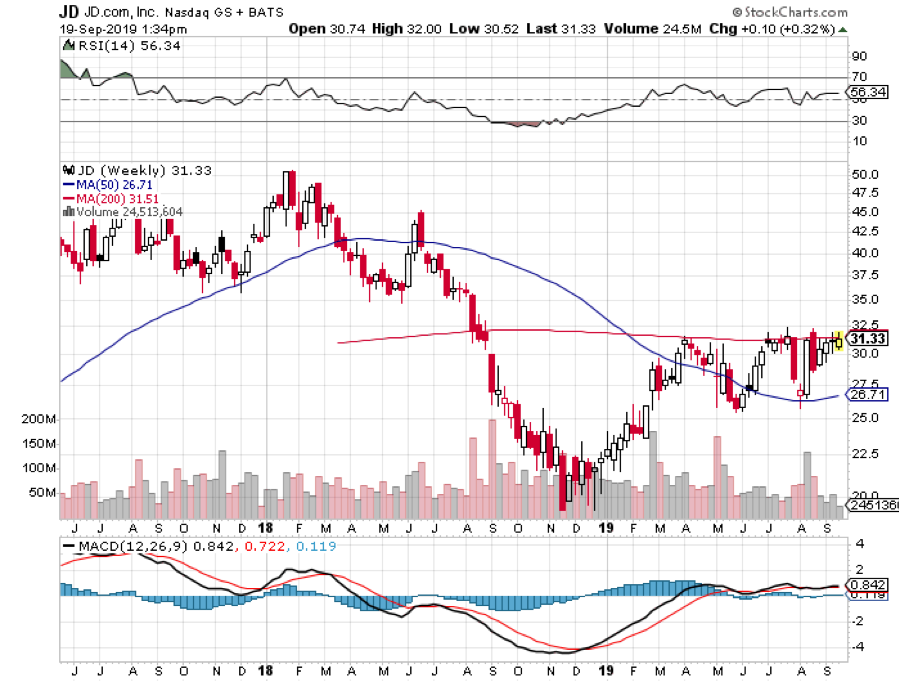
Q: What are your thoughts on Alibaba (BABA) and JD.com (JD)?
A: They are great for the long term. However, expect a lot of volatility in the short term. As long as the trade war is going on, these are going to be hard to trade until we get a settlement. (JD) is already up 50% this year but is still down 40% from pre trade war levels. These things will all be up 20-30% when that happens. If you can take the heat until then, they would probably be okay for a long-term portfolio globally diversified.
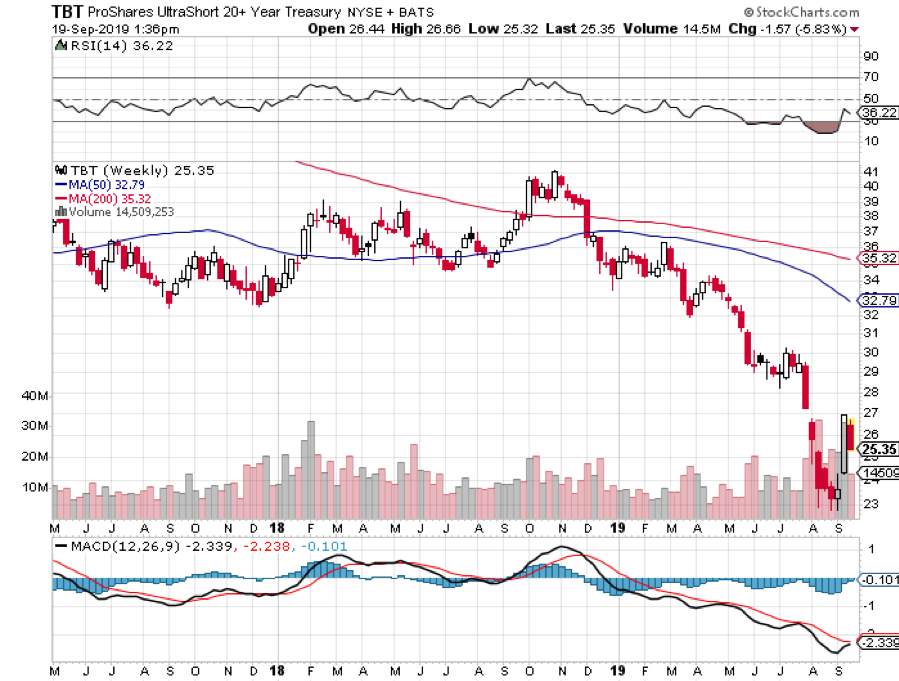
Q: What do you have to say about the ProShares Ultra Short 20+ Year Treasury ETF (TBT)—the short bond ETF?
A: If you have a position, I’d be selling now. We just had a massive 20%, 4-point rally from $22 to $27 and now would be a good time to take a profit, or at least get out closer to your cost. The zero interest rates story is not over yet.
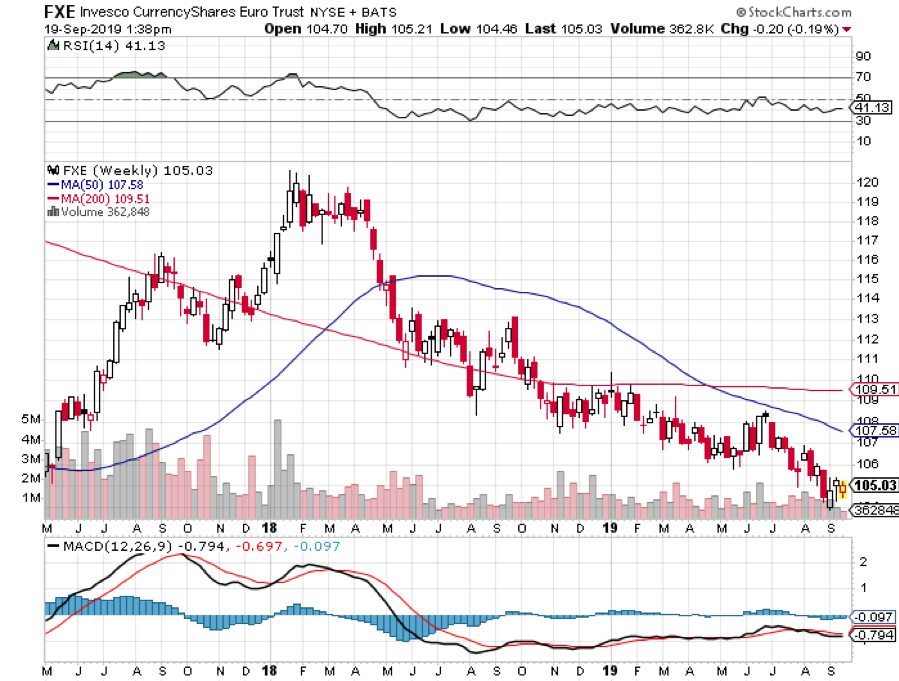
Q: Would you short the US dollar?
A: I would most likely short it against the euro (FXE), which now has a massive economic stimulus and quantitative easing program coming into play which should be positive for it and negative for the US dollar (UUP). That’s most likely why the euro has stabilized over the last couple of weeks. That said, the dollar has been unexpected high all year despite falling interest rates so I have been avoiding the entire foreign exchange space. I try to stay away from things I don’t understand.
Q: If all our big tech September vertical bull call spreads are in the money, what should we do?
A: You do nothing. They all expire at the Friday close in two trading days. Your broker should automatically use your long call position to cover your short call position and credit your account with the total profit on the following Monday, as well as release the margin for holding that position. After that, we’ll probably wait for another good entry point on all the same names, (AMZN), (FB), (DIS), (MSFT).
Q: If the US fires a cruise missile at Iran, how would the market react?
A: It would selloff pretty big—markets hate wars. And the US wouldn’t send one missile at Iran; it would be more like 100, probably aimed at what little nuclear facilities they have. I doubt that is going to happen. The world has figured out that Trump is a wimp. He talks big but there is never any action or follow through. Inviting the Taliban to Camp David while they were still blowing up our people? Really?
Q: Will the housing market turn on the turbochargers after this dip in rates?
A: It wouldn't turn on the turbochargers, but it might stabilize the market because money is available now at unprecedentedly low interest rates. However, we still have the loss of the SALT deductions—the state and local taxes and real estate taxes that came in with the Trump tax bill. Since then, real estate has been either unchanged or has fallen on both the East and West coast where the highest priced houses are. It’s the most expensive houses that take the loss of the SALT deduction the hardest. Don’t expect any movement in these markets until the SALT deduction comes back, probably in 16 months.
Q: What catalyst do you think would cause a 10% correction in the next 2-3 months?
A: Trump basically saying “screw you” to the Chinese—a tweet saying he’s going to bring another round of tariff increases. That’s worth a minimum of 2,000 points in the Dow Average (INDU), or about 7% percent. Either that or no move in Fed interest rates—that would also create a big selloff. My guess is that and adverse development in the trade war will be what does it. That’s why my positions are so small now.
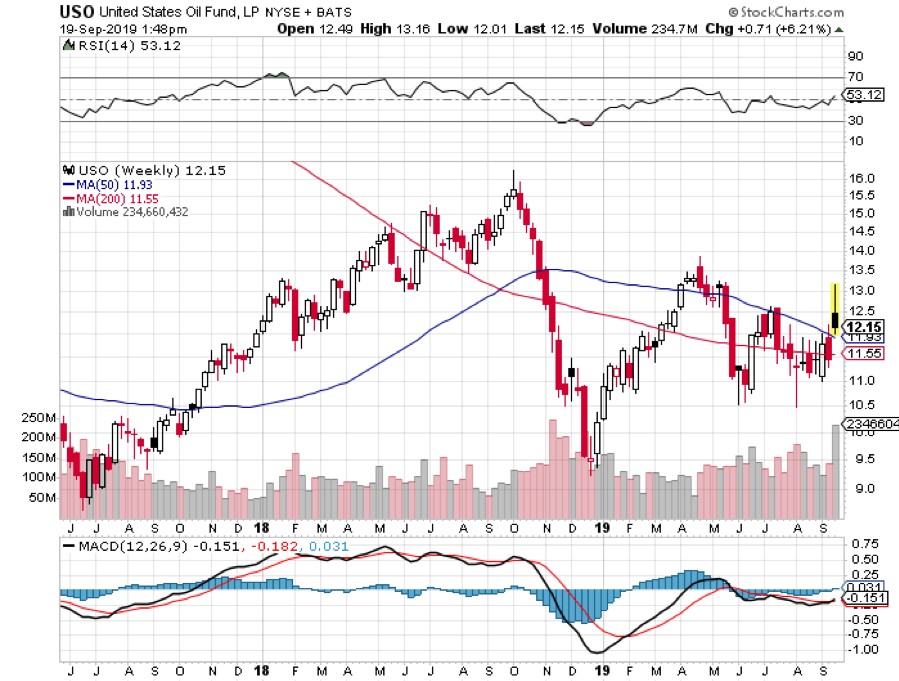
Q: We have a big short position in the United States Oil Fund (USO) now. Are you going to run this into expiration until October $18?
A: Even though oil has already collapsed by 10% since we put this position on last Friday, premiums in oil options are still close to record levels. So, it pays us to hang on for the time decay. The world is still massively oversupplied in oil and the Saudis were able to bring half of the lost production back on in a day. Oil will keep falling unless there is another attack and it is unlikely we will see one again on this scale. And, we only have 20 more days to go to capture the full 14.8% profit.
Good luck and good trading.
John Thomas
CEO & Publisher
Diary of a Mad Hedge Fund Trader
You Can’t Do Enough Research
https://www.madhedgefundtrader.com/wp-content/uploads/2019/09/john-and-girls.png322345Mad Hedge Fund Traderhttps://madhedgefundtrader.com/wp-content/uploads/2019/05/cropped-mad-hedge-logo-transparent-192x192_f9578834168ba24df3eb53916a12c882.pngMad Hedge Fund Trader2019-09-20 01:04:442019-12-09 12:38:46September 18 Biweekly Strategy Webinar Q&A
I am once again writing this report from a first-class sleeping cabin on Amtrak’s legendary California Zephyr.
By day, I have two comfortable seats facing each other next to a panoramic window. At night, they fold into two bunk beds, a single and a double. There is a shower, but only Houdini could get to navigate it.
I am not Houdini, so I go downstairs to use the larger public hot showers. They are divine.
We are now pulling away from Chicago’s Union Station, leaving its hurried commuters, buskers, panhandlers, and majestic great halls behind. I love this building as a monument to American exceptionalism.
I am headed for Emeryville, California, just across the bay from San Francisco, some 2,121.6 miles away. That gives me only 56 hours to complete this report.
I tip my porter, Raymond, $100 in advance to make sure everything goes well during the long adventure and to keep me up to date with the onboard gossip. The rolling and pitching of the car is causing my fingers to dance all over the keyboard. Microsoft’s Spellchecker can catch most of the mistakes, but not all of them.
As both broadband and cell phone coverage are unavailable along most of the route, I have to rely on frenzied Internet searches during stops at major stations along the way to Google search obscure data points and download the latest charts.
You know those cool maps in the Verizon stores that show the vast coverage of their cell phone networks? They are complete BS.
Who knew that 95% of America is off the grid? That explains so much about our country today.
I have posted many of my better photos from the trip below, although there is only so much you can do from a moving train and an iPhone 10x.
After making the rounds with strategists, portfolio managers, and hedge fund traders in the run-up to this trip, I can confirm that 2018 was one of the most brutal to trade for careers lasting 30, 40, or 50 years. This was the year that EVERYTHING went down, the first time that has happened since 1972. Comparisons with 1929, 1987, and 2008 were frequently made.
While my own 23.56% return for last year is the most modest in a decade, it beats the pants off of the Dow Average plunge of 8% and 99.9% of the other managers out there. That is a mere shadow of the spectacular 57.91% profit I took in during 2017. This keeps my ten-year average annualized return at 34.20%.
Our entire fourth-quarter loss came from a single trade, a far too early bet that the Volatility Index would fall from the high of the year at $30.
For a decade, all you had to do was throw a dart at the stock page of the Wall Street Journal and you made money, as long as it didn’t end on retail. No more.
For the first time in years, the passive index funds lost out to the better active managers. The Golden Age of the active manager is over. Most hedge funds did horribly, leveraged long technology stocks and oil and short bonds. None of it worked.
If you think I spend too much time absorbing conspiracy theories from the Internet, let me give you a list of the challenges I see financial markets facing in the coming year:
The Nine Key Variables for 2019
1) Will the Fed raise rates one, two, or three times, or not at all?
2) Will there be a recession this year or will we have to wait for 2020?
3) Is the tax bill fully priced into the economy or is there more stimulus to come?
4) Will the Middle East drag us into a new war?
5) Will technology stocks regain market leadership or will it be replaced by other sectors?
6) Will gold and other commodities finally make a long-awaited comeback?
7) Will rising interest rates (positive) or deficits (negative) drive the US dollar this year?
8) Will oil prices recover in 2019?
9) Will bitcoin ever recover?
Here are your answers to the above: 1) Two, 2) 2020, 3) Yes, 4) No, 5) Both, 6) Yes, 7) Yes, 8) Yes, 9) No.
There you go! That’s all the research you have to do for the coming year. Everything else is a piece of cake. You can go back to your vacation.
The Twelve Highlights of 2018
1) Stocks will finish lower in 2019. However, we aren’t going to collapse from here. We will take one more rush at the all-time highs that will take us up 10% to 15% from current levels, and then fail. That will set up the perfect “head and shoulders” top on the long-term charts that will finally bring to an end this ten-year bull market. This is when you want to sell everything. The May 10, 2019 end to the bull market forecast I made a year ago is looking pretty good.
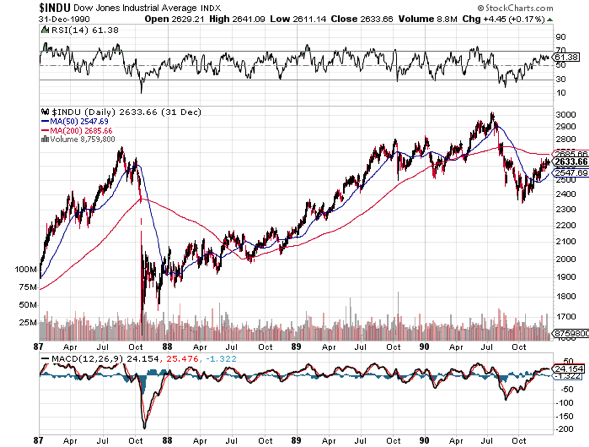
I think there is a lot to learn from the 1987 example when stocks crashed 20% in a single day, and 42% from their 1987 high, and then rallied for 28 more months until the next S&L crisis-induced recession in 1991.
Investors have just been put through a meat grinder. From here on, its all about trying to get out at a better price, except for the longest-term investors.
2) Stocks will rally from here because they are STILL receiving the greatest amount of stimulus in history. Energy prices have dropped by half, taxes are low, inflation is non-existent, and interest rates are still well below long term averages.
Corporate earnings will grow at a 6% rate, not the 26% we saw in 2018. But growing they are. At current prices, the stock market is assuming that companies will generate big losses in 2019, which they won’t. Just try to find a parking space at a shopping mall anywhere and you’ll see what I mean.
3) Technology stocks will lead any recovery. Love them or hate them, big tech accounts for 25% of stock market capitalization but 50% of US profits. That is where the money is. However, in 2019 they will be joined by biotech and health care companies as market leaders.
4) The next big rally in the market will be triggered by the end of the trade war with China. Don’t expect the US to get much out of the deal. It turns out that the Chinese can handle a 20% plunge in the stock market much better than we can.
5) The Treasury bond market will finally get the next leg down in its new 10-year bear market, but don’t expect Armageddon. The ten-year Treasury yield should hit at least 3.50%, and possibly 4.0%.
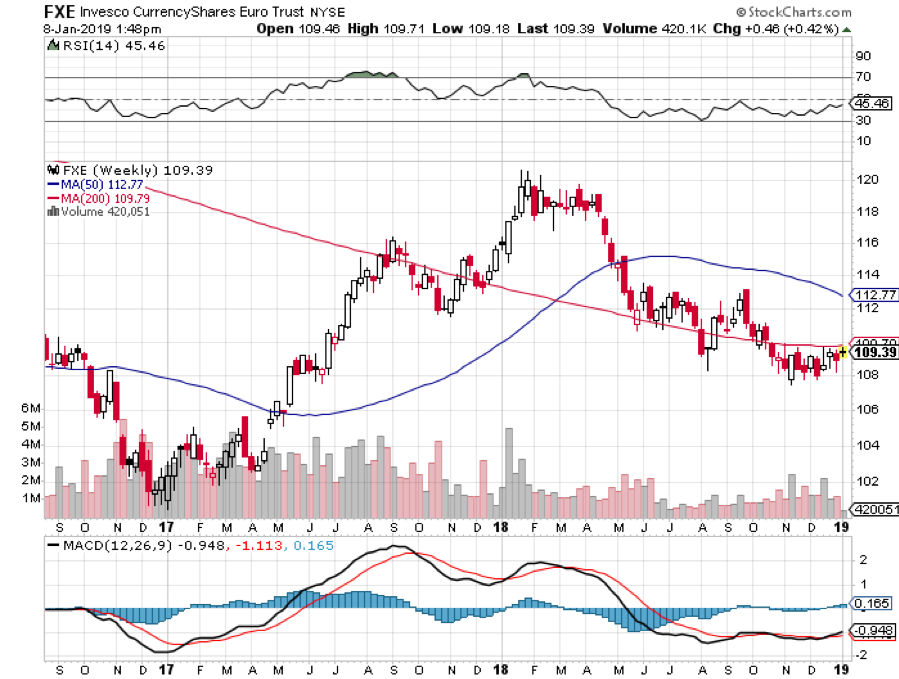
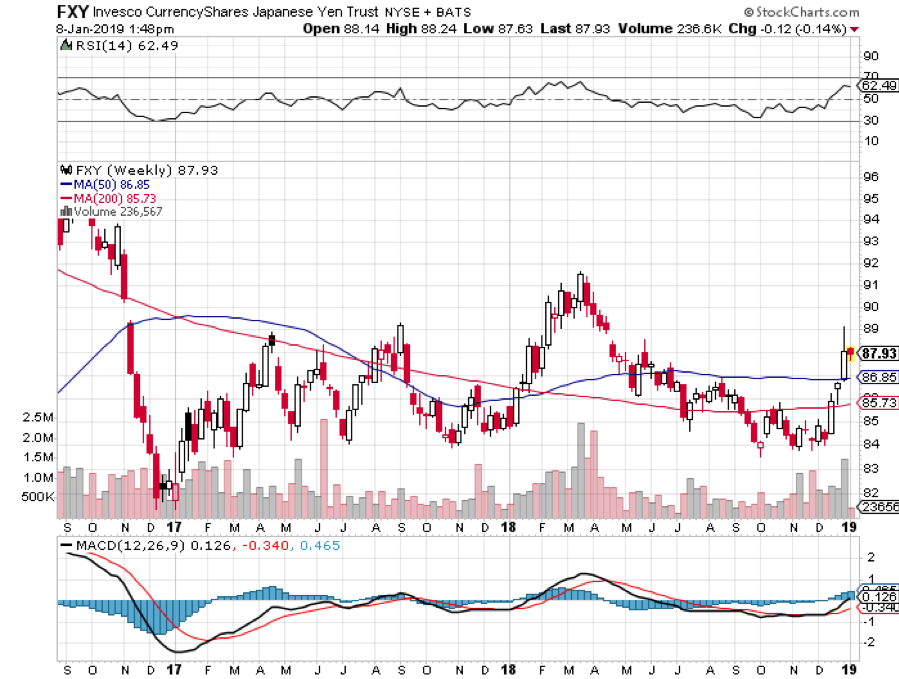
6) With slowing, US interest rate rises, the US dollar will have the wind knocked out of it. It’s already begun. The Euro and the Japanese yen will both gain about 10% against the greenback.
7) Political instability is a new unknown factor in making market predictions which most of us have not had to deal with since the Watergate crisis in 1974. It’s hard to imagine the upcoming Mueller Report not generating a large market impact, and presidential tweets are already giving us Dow 1,000-point range days. These are all out of the blue and totally unpredictable.
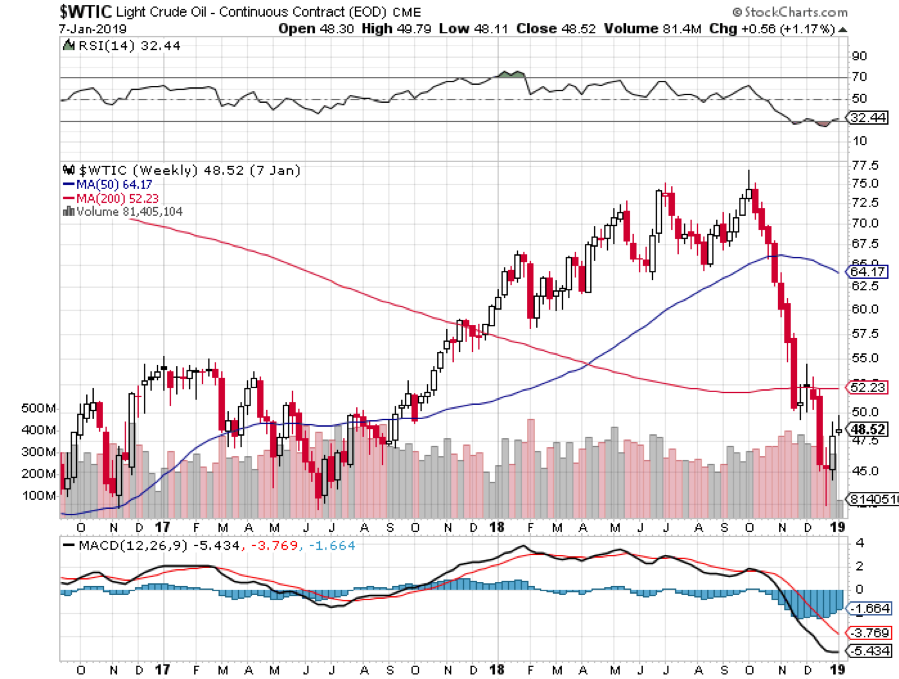
8) Oil at $42.50 a barrel has also fully discounted a full-on recession. So, if the economic slowdown doesn’t show, we can make it back up to $64 quickly, a 50% gain.
9) Gold continues its slow-motion bull market, gaining another 10% since the August low. It barely delivered in 2018 as a bear market hedge. But once inflation starts to pick up a head of steam, so should the price of the barbarous relic.
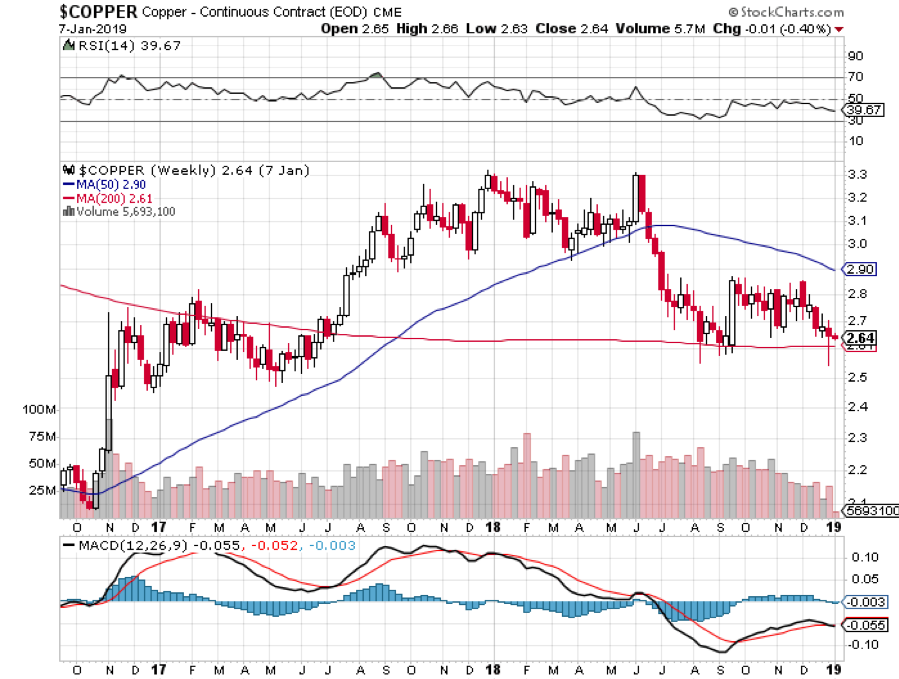
10) Commodities had a horrific year, pulled under by the trade war, rising rates, and strong dollar. Reverse all that and they should do better.
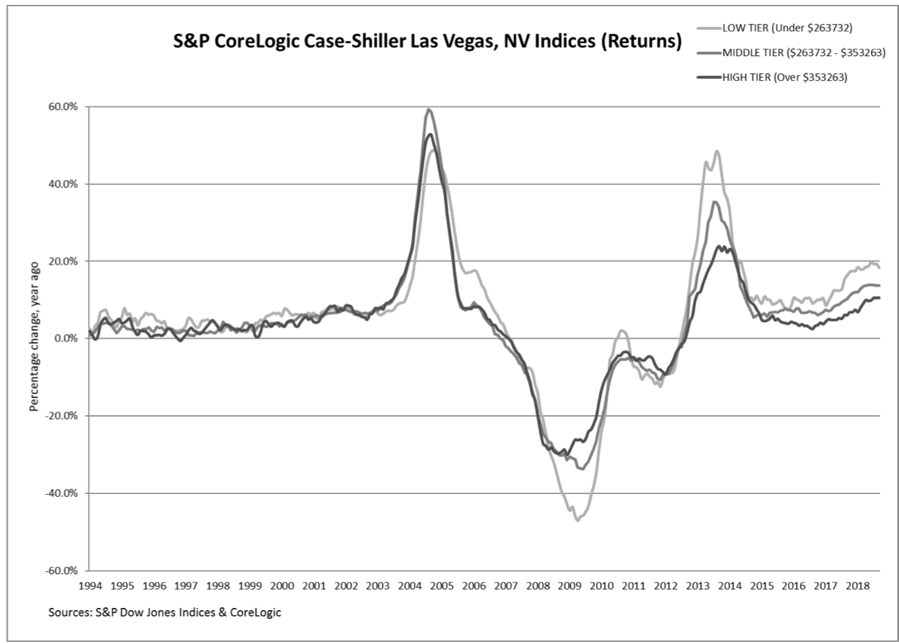
11) Residential real estate has been in a bear market since March. You’ll find out for sure if you try to sell your home. Rising interest rates and a slowing economy are not what housing bull markets are made of. However, prices will drop only slightly, like 10%, as there is still a structural shortage of housing in the US.
12) The new tax bill came and went with barely an impact on the economy. At best we got two-quarters of above-average growth and slightly higher capital spending before it returned to a 2%-2.5% mean. Unfortunately, it will cost us $4 trillion in new government debt to achieve this. It was probably the worst value for money spent in American history.
Dow Average 1987-90
The Thumbnail Portfolio
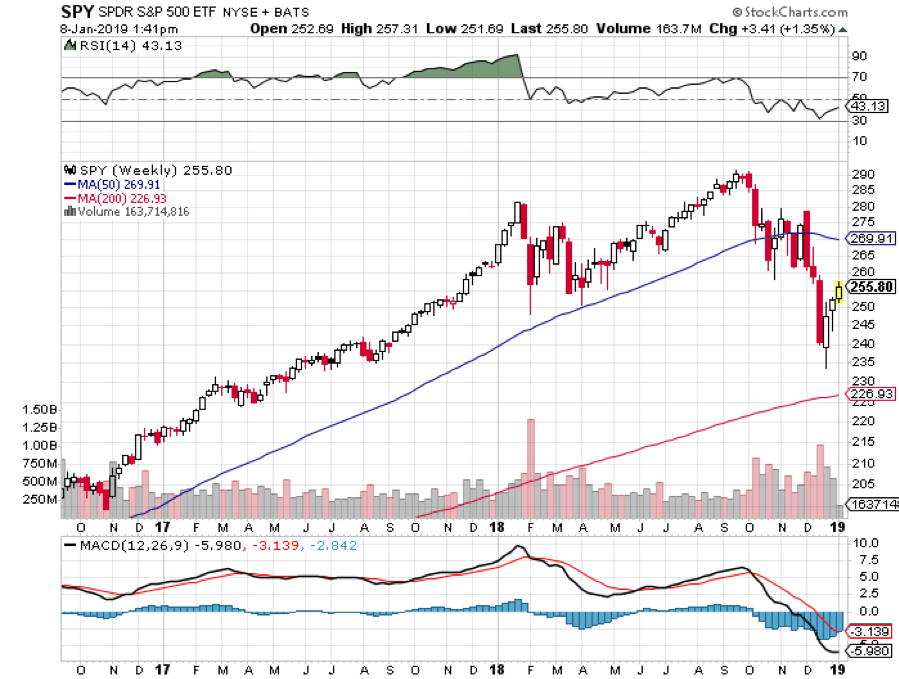
Equities - Go Long. The tenth year of the bull market takes the S&P 500 up 13% from $2,500 to $2,800 during the first half, and then down by more than that in the second half. This sets up the perfect “head and shoulders” top to the entire decade-long move that I have been talking about since the summer.
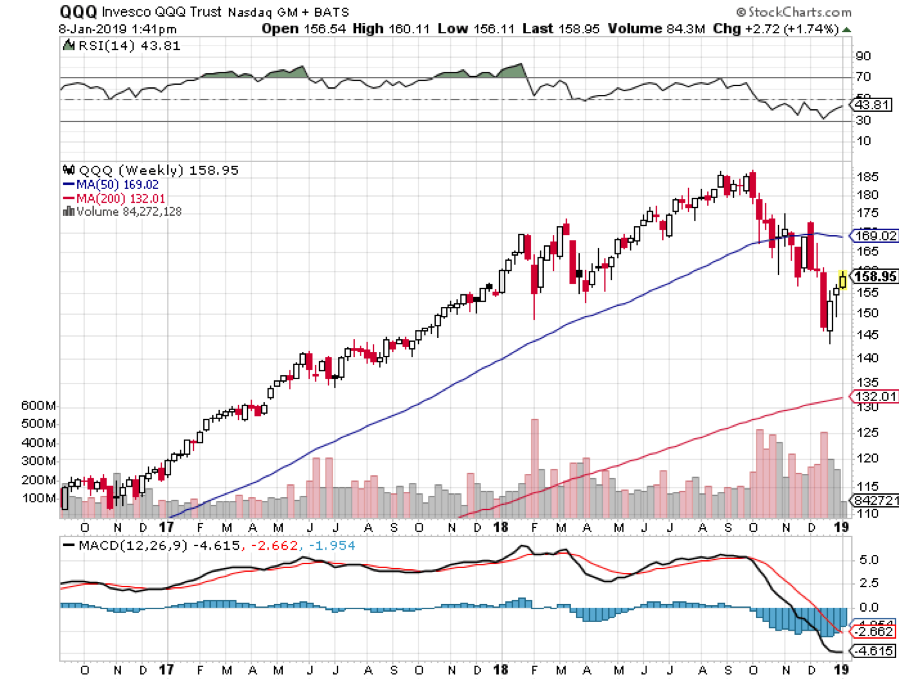
Technology, Pharmaceuticals, Healthcare, and Biotech will lead on the up moves and now is a great entry point for all of these. Buy low, sell high. Everyone talks about it but few ever actually execute like this.
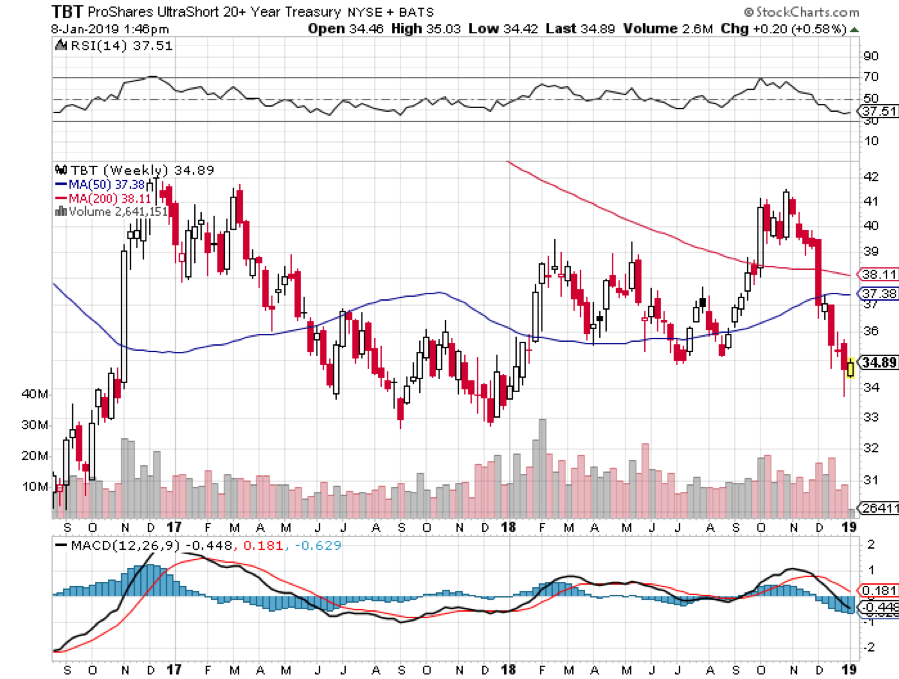
Bonds - Sell Short. Down for the entire year big time. Sell short every five-point rally in the ten-year Treasury bond. Did I mention that bonds have just had a ten-point rally? That’s why I am doubled up on the short side.
Foreign Currencies - Buy. The US dollar has just ended its five-year bull trend. Any pause in the Fed’s rate rising schedule will send the buck on a swan dive, and it’s looking like we may be about to get a six-month break.
Commodities - Go Long. Global synchronized recovery continues the new bull market.
Precious Metals - Buy. Emerging market central bank demand, accelerating inflation, and a pause in interest rate rises will keep the yellow slowly rising.
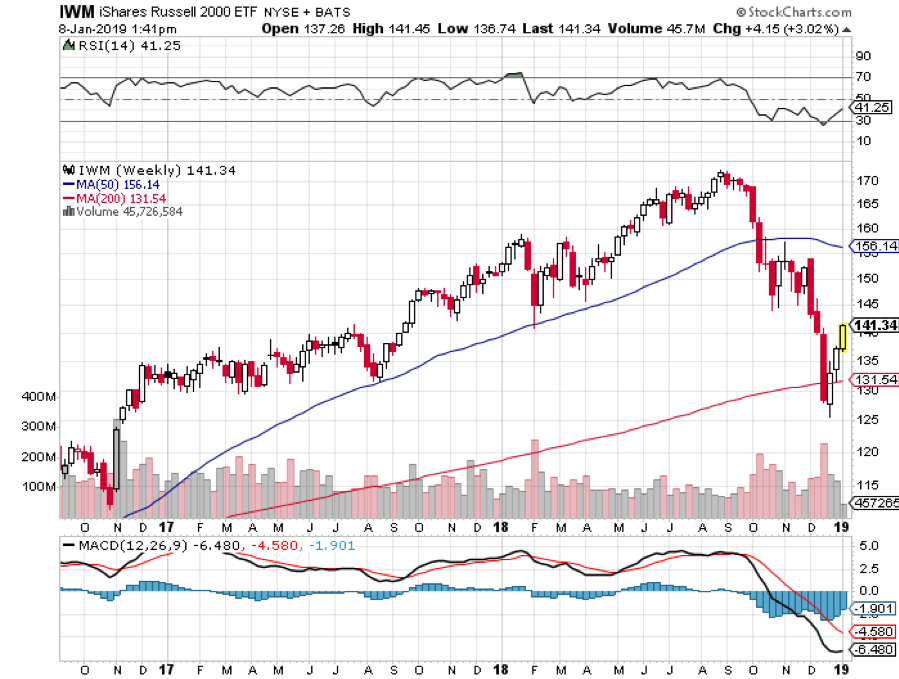
Real Estate – Stand Aside. Prices are falling but not enough to make it worth selling your home and buying one back later. A multi-decade demographic tailwind is just starting, and it is just a matter of time before prices come roaring back.
1) The Economy-Slowing
A major $1.5 trillion fiscal stimulus was a terrible idea in the ninth year of an economic recovery with employment at a decade high. Nevertheless, that’s what we got.
The certainty going forward is that the gains provided by lower taxes will be entirely offset by higher interest rates, higher labor costs, and rising commodity and oil prices.
Since most of the benefits accrued to the top 1% of income earners, the proceeds of these breaks entirely ended up share buybacks and the bond market. This is why interest rates are still so incredibly low, even though the Fed has been tightening for 4 ½ years (remember the 2014 taper tantrum?) and raising rates for three years.
And every corporate management views these cuts as temporary so don’t expect any major capital investment or hiring binges based on them.
The trade wars have shifted the global economy from a synchronized recovery to a US only recovery, to a globally-showing one. It turns out that damaging the economies of your biggest economies is bad for your own business. They are also a major weight on US growth. CEOs would rather wait to see how things play out before making ANY long-term decisions.
As a result, I expect real US economic growth will retreat from the 3.0% level of 2018 to a much more modest 1.5%-2.0% range in 2019.
The government shutdown, now in its third week (and second year), will also start to impact 2019 growth estimates. For every two weeks of closure, you can subtract 0.1% in annual growth.
Twenty weeks would cut a full 1%. And if you only have 2% growth to start with that means you don’t have much to throw away until you end up in a full-on recession.
Hyper-accelerating and cross-fertilizing technology will remain a long term and underestimated positive. But you have to live here next to Silicon Valley to realize that.
S&P 500 earnings will grow from the current $170 to $180 at a price earnings multiple at the current 14X, a gain of 6%. Unfortunately, these will start to fade in the second half from the weight of rising interest rates, inflation, and political certainty. Loss of confidence will be a big influence in valuing shares in 2019.
Whatever happened to the $2.5 trillion in offshore funds held by American companies expected to be repatriated back to the US? That was supposed to be a huge market stimulus last year. It’s still sitting out there. It turns out companies still won’t bring the money home even with a lowly 10% tax rate. They’d rather keep it abroad to finance growth there or borrow against it in the US.
Here is the one big impact of the tax bill that everyone is still missing. The 57% of the home-owning population are about to find out how much their loss of local tax deductions and mortgage deductions is going to cost them when they file their 2018 returns in April. They happen to be the country’s biggest spenders. That’s another immeasurable negative for the economy.
Take money out of the pockets of the spenders and give it to the savers and you can’t have anything but a weakening on the economy.
All in all, it will be one of the worst years of the decade for the economy. Maybe that’s what the nightmarish fourth quarter crash was trying to tell us.
The final move of a decade long bull market is upon us.
Corporate earnings are at record levels and are climbing at 6% a year. Cash on the balance sheet is at an all-time high as are profit margins. Interest rates are still near historic lows.
Yet, there is not a whiff of inflation anywhere except in now fading home costs and paper asset prices. Almost all other asset classes offer pitiful alternatives.
The golden age of passive index investing is over. This year, portfolio managers are going to have to earn their crust of bread through perfect market timing, sector selection, and individual name-picking. Good luck with that. But then, that’s why you read this newsletter.
I expect an inverse “V”, or Greek lambda type of year. Stocks will rally first, driven by delayed rate rises, a China war settlement, and the end of the government shut down. That will give the Fed the confidence to start raising rates again by mid-year because inflation is finally starting to show. This will deliver another gut-punching market selloff in the second half giving us a negative stock market return for the second year in a row. That hasn’t happened since the Dotcom Bust of 2001-2002.
How much money will I make this year? A lot more than last year’s middling 23.56% because now we have some reliable short selling opportunities for the first time in a decade. Short positions performed dreadfully when global liquidity is expanding. They do much better when it is shrinking, as it is now.
Amtrak needs to fill every seat in the dining car to get everyone fed, so you never know who you will share a table with for breakfast, lunch, and dinner.
There was the Vietnam vet Phantom jet pilot who now refused to fly because he was treated so badly at airports. A young couple desperate fleeing Omaha could only afford seats as far as Salt Lake City, sitting up all night. I paid for their breakfast.
A retired British couple was circumnavigating the entire US in a month on a “See America Pass.” Mennonites returning home by train because their religion forbade automobiles or airplanes.
This year is simply a numbers game for the bond market. The budget deficit should come in at a record $1.2 trillion. The Fed will take out another $600 billion through quantitative tightening. Some $1.8 trillion will be far too much for the bond market to soak up, meaning prices can only fall.
Except that this year is different for the following reasons.
1) The US government is now at war with the world’s largest bond buyer, the Chinese government.
2) A declining US dollar will frighten off foreign buyers to a large degree.
3) The tax cuts have come and gone with no real net benefit to the average American. Probably half of the country saw an actual tax increase from this tax cut, especially me.
All are HUGELY bond negative.
It all adds up to a massive crowding out of individual and corporate borrowers by the federal government, which will be forced to bid up for funds. You are already seeing this in exploding credit spreads. This will be a global problem. There are going to be a heck of a lot of government bonds out there for sale.
That 2.54% yield for the ten-year Treasury bond you saw on your screen in early January? You will laugh at that figure in a year as it hits 3.50% to 4.0%.
Bond investors today get an unbelievably bad deal. If they hang on to the longer maturities, they will get back only 90 cents worth of purchasing power at maturity for every dollar they invest a decade down the road at best.
The only short-term positive for bonds was Fed governor Jay Powell’s statement last week that our central bank will be sensitive to the level of the stock market when considering rate rises. That translates into the reality that rates won’t go up AT ALL as long as markets are in crash mode.
It all means that we are now only two and a half years into a bear market that could last for ten or twenty years.
The IShares 20+ Year Treasury Bond ETF (TLT) trading today at $123 could drop below $100. The 2X ProShares 20+ Short Treasury Bond Fund (TBT) now at $31 is headed for $50 or more.
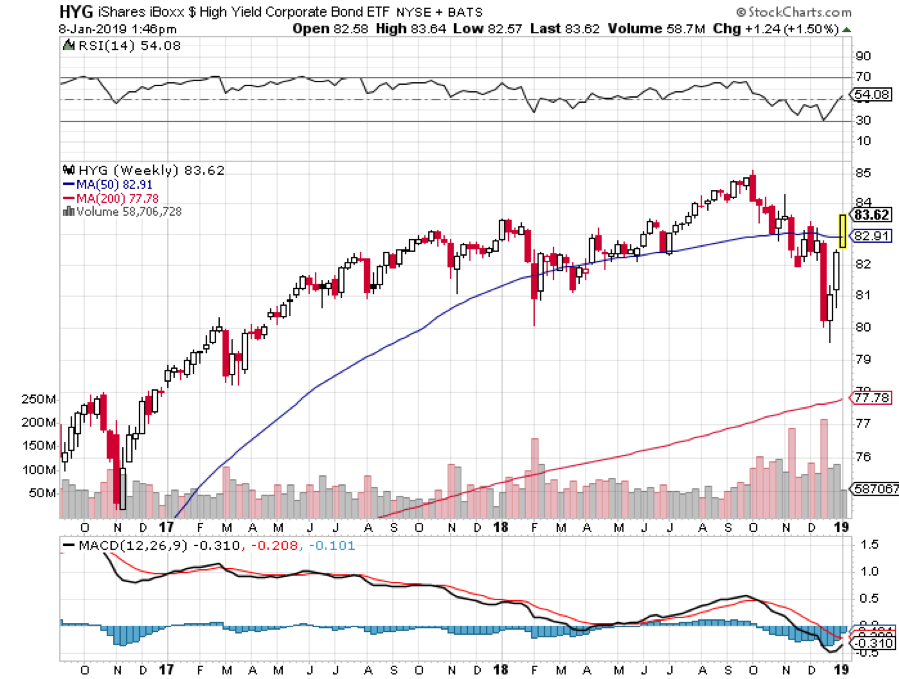
Junk Bonds (HYG) are already reading the writing on the wall taking a shellacking during the Q4 stock market meltdown. This lackluster return ALWAYS presages an inverted yield curve by a year where short term interest rates are higher than long term ones. This in turn reliably predicts a full-scale recession by 2020 at the latest.
I have pounded away at you for years that interest rate differentials are far and away the biggest decider of the direction in currencies.
This year will prove that concept once again.
With overnight rates now at 2.50% and ten-year Treasury bonds at 2.54%, the US now has the highest interest rates of any major industrialized economy.
However, pause interest rate rises for six months or a year and the dollar loses its mojo very quickly.
Compounding the problem is that a weak dollar begets selling from foreign investors. They are in a mood to do so anyway, as they see rising political instability in the US a burgeoning threat to the value of the greenback.
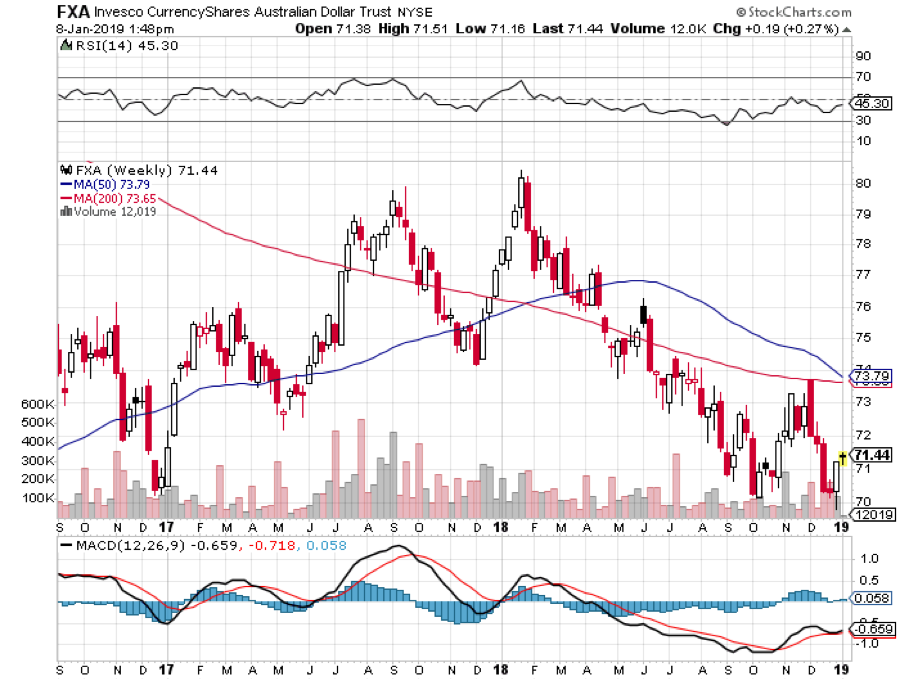
So the dollar will turn weak against all major currencies, especially the Japanese yen (FXY), and the Australian (FXA) and Canadian (FXC) dollars.
A global synchronized economic slowdown can mean only one thing and that is sustainably lower commodity prices.
Industrial commodities, like copper, iron ore, performed abysmally in 2018, dope slapped by the twin evils of a strong dollar and the China trade war.
We aren’t returning to the heady days of the last commodity bubble top anytime soon. Investors are already front running that move now.
However, once this sector gets the whiff of a weak dollar or higher inflation, it will take off like a scalded chimp.
Now that their infrastructure is largely built out, the Middle Kingdom will change drivers of its economy. This is world-changing.
The shift will be from foreign exports to domestic consumption. This will be a multi-decade process, and they have $3.1 trillion in foreign exchange reserves to finance it.
It will still demand prodigious amounts of imported commodities but not as much as in the past.
This trend ran head-on into a decade-long expansion of capacity by the commodities industry, delivering the five-year bear market that we are only just crawling out of.
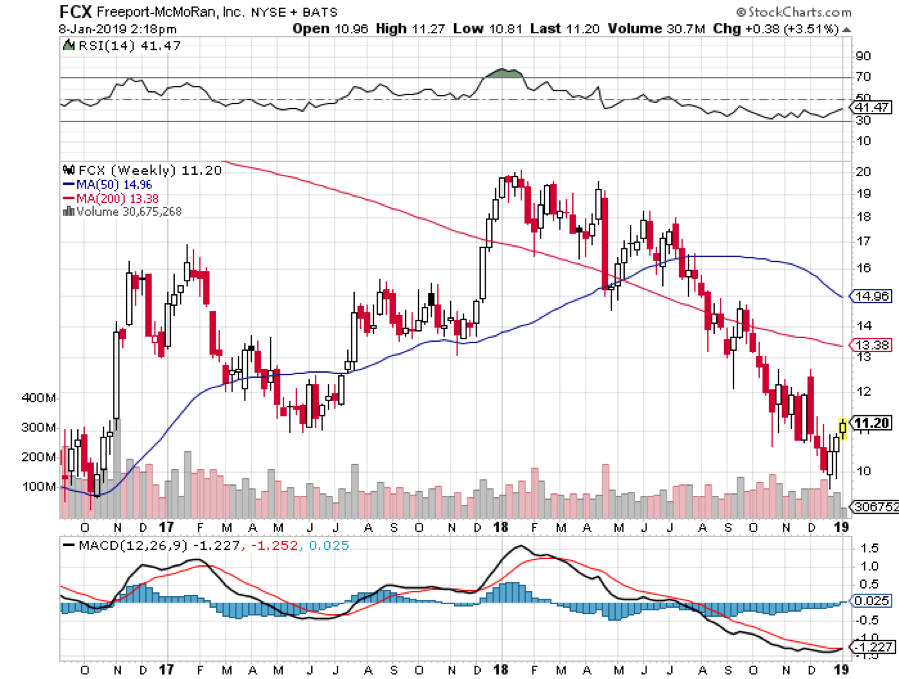
The derivative equity plays here, Freeport McMoRan (FCX) and Companhia Vale do Rio Doce (VALE) have all been some of the best-performing assets of 2017.
If you expect a trade war-induced global economic slowdown, the last thing in the world you want to own is an energy investment.
And so it was in Q4 when the price of oil got hammered doing a swan dive from $68 to $42 a barrel, an incredible 38% hickey.
All eyes will be focused on OPEC production looking for new evidence of quota cheating which is slated to expire at the end of 2018. Their latest production cut looked great on paper but proved awful in practice. Welcome to the Middle East.
The only saving grace is that with crude at these subterranean levels, new investment in fracking production has virtually ceased. No matter, US pipelines are operating at full capacity anyway.
OPEC production versus American frackers will create the constant tension in the marketplace for all of 2019.
My argument in favor of commodities and emerging markets applies to Texas tea as well. A weaker US dollar, trade war end, interest rate halt are all big positives for any oil investment. The cure for low oil prices is low prices.
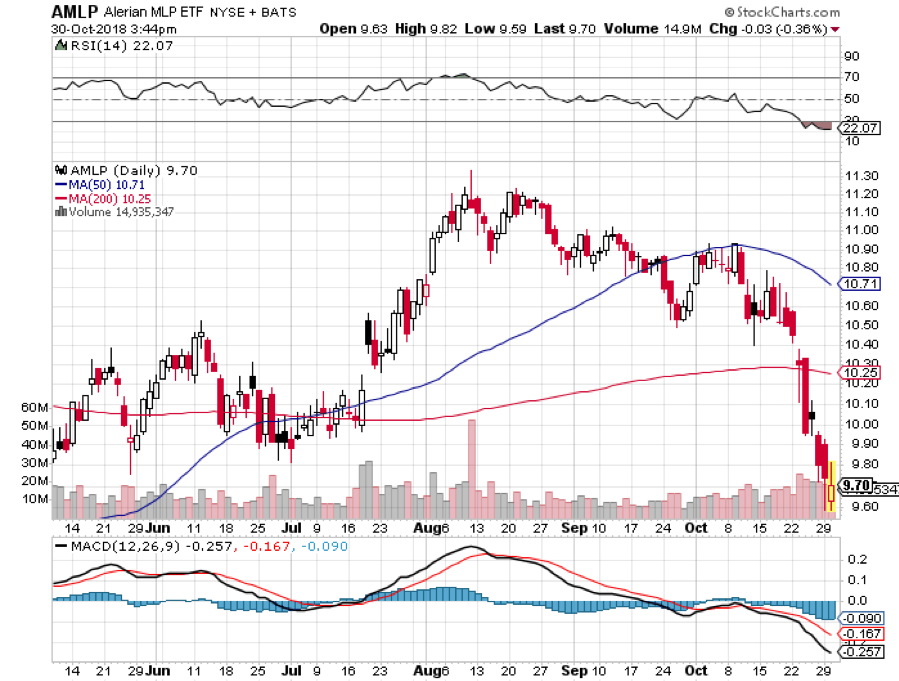
That makes energy Master Limited Partnerships, now yielding 6-10%, especially interesting in this low yield world. Since no one in the industry knows which issuers are going bankrupt, you have to take a basket approach and buy all of them.
The Alerian MLP ETF (AMLP) does this for you in an ETF format. Our train has moved over to a siding to permit a freight train to pass, as it has priority on the Amtrak system.
Three Burlington Northern engines are heaving to pull over 100 black, spanking brand new tank cars, each carrying 30,000 gallons of oil from the fracking fields in North Dakota.
There is another tank car train right behind it. No wonder Warren Buffett tap dances to work every day as he owns the railroad.
We are also seeing relentless improvements on the energy conservation front with more electric vehicles, high mileage conventional cars, and newly efficient building.
Anyone of these inputs is miniscule on its own. But add them all together and you have a game changer.
As is always the case, the cure for low prices is low prices. But we may never see $100/barrel crude again. In fact, the coming peak in oil prices may be the last one we ever see. The word is that leasing companies will stop offering five-year leases in five years because cars with internal combustion engines will become worthless in ten.
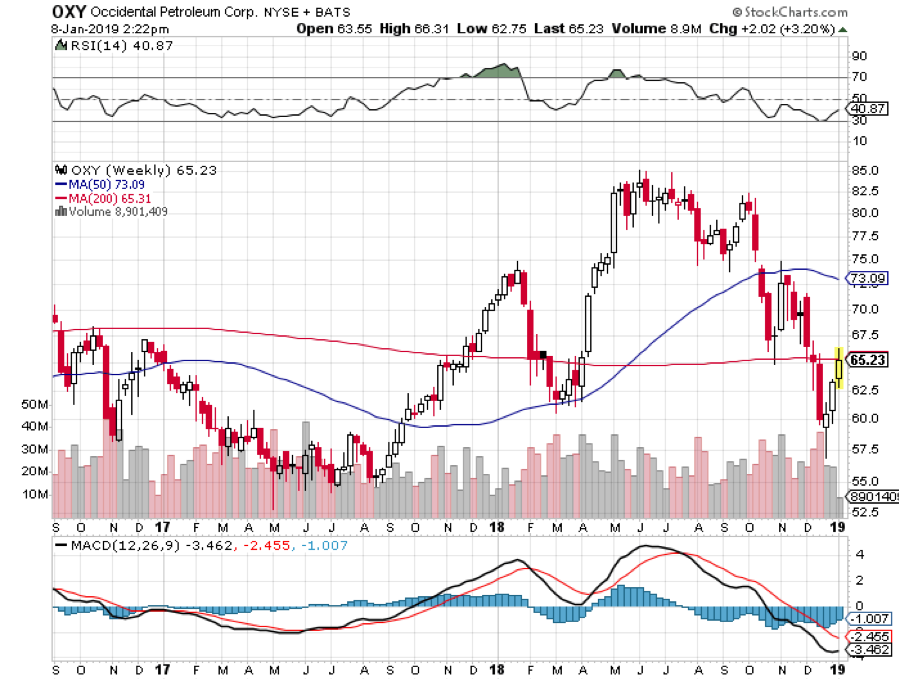
Add to your long-term portfolio (DIG), ExxonMobile (XOM), Cheniere Energy (LNG), the energy sector ETF (XLE), Conoco Phillips (COP), and Occidental Petroleum (OXY). But date these stocks, don’t marry them.
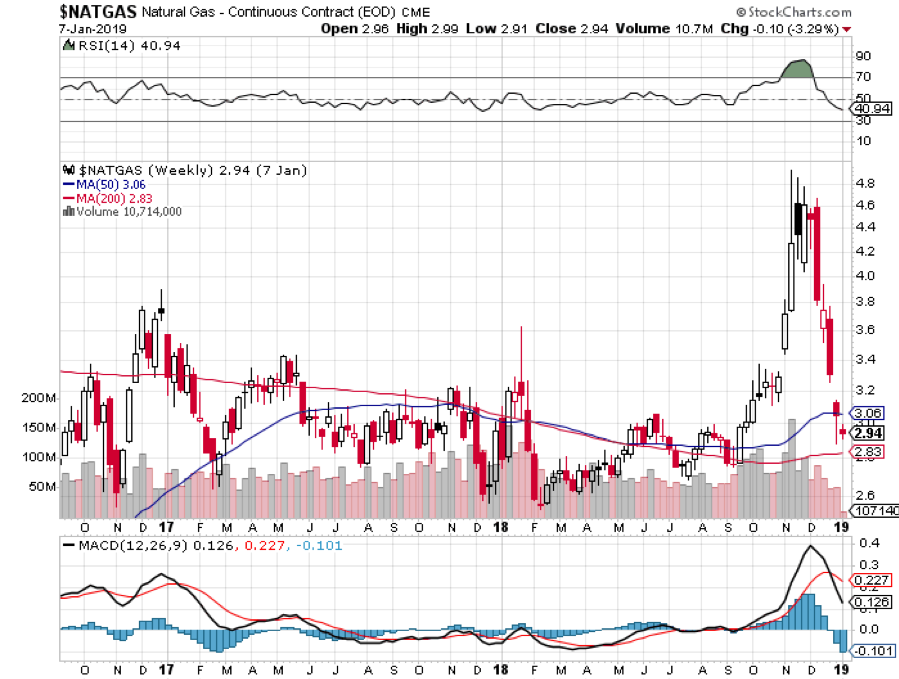
Skip natural gas (UNG) price plays and only go after volume plays because the discovery of a new 100-year supply from “fracking” and horizontal drilling in shale formations is going to overhang this subsector for a very long time, like the rest of our lives.
It is a basic law of economics that cheaper prices bring greater demand and growing volumes which have to be transported. Any increase in fracking creates more supply of natural gas.
The train has added extra engines at Denver, so now we may begin the long laboring climb up the Eastern slope of the Rocky Mountains.
On a steep curve, we pass along an antiquated freight train of hopper cars filled with large boulders.
The porter tells me this train is welded to the tracks to create a windbreak. Once, a gust howled out of the pass so swiftly that it blew a train over on to its side.
In the snow-filled canyons, we sight a family of three moose, a huge herd of elk, and another group of wild mustangs. The engineer informs us that a rare bald eagle is flying along the left side of the train. It’s a good omen for the coming year.
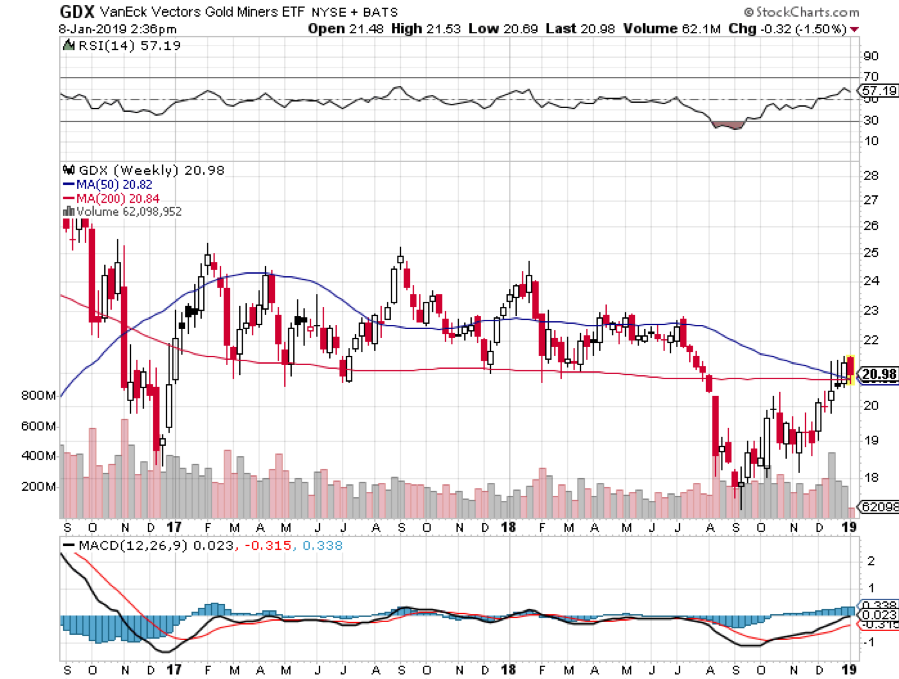
We also see countless abandoned 19th century gold mines and the broken-down wooden trestles leading to them, relics of previous precious metals booms. So, it is timely here to speak about the future of precious metals.
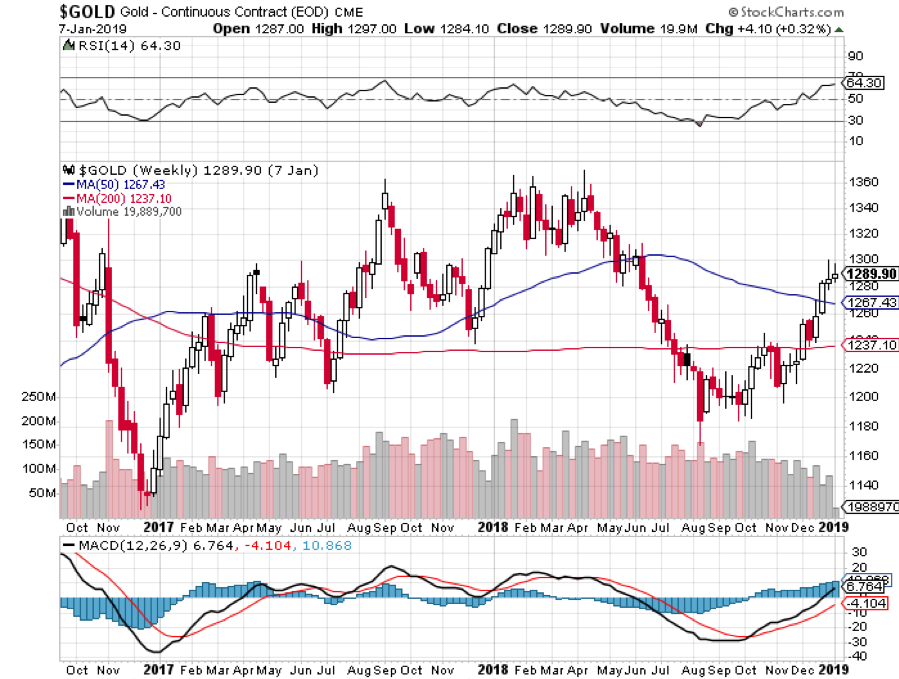
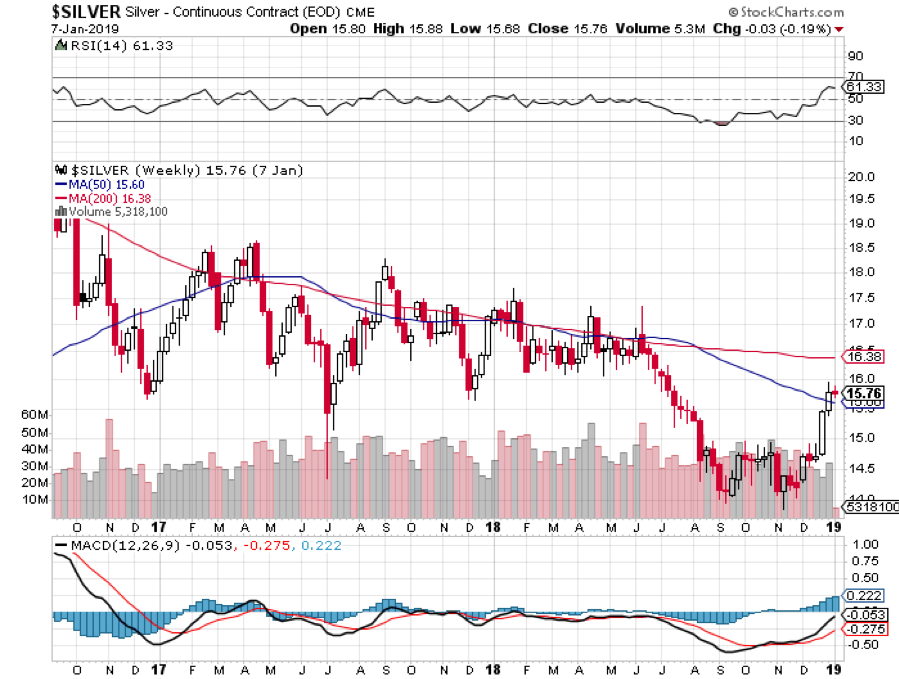
Gold (GLD) lost money in 2018, off 2.4%. More volatile silver (SLV) shed 12%.
This was expected, as non-yielding assets like precious metals do terribly during times of rising interest rates.
In 2019, gold will finally be coming out of a long dark age. As long as the world was clamoring for paper assets like stocks, gold was just another shiny rock. After all, who needs an insurance policy if you are going to live forever?
But the long-term bull case is still there. Gold is not dead; it is just resting.
If you forgot to buy gold at $35, $300, or $800, another entry point here up for those who, so far, have missed the gravy train.
To a certain extent, the belief that high-interest rates are bad for gold is a myth. Wealth creation is a far bigger driver. To see what I mean, take a look at a gold chart for the 1970s when interest rates were rising sharply.
Remember, this is the asset class that takes the escalator up and the elevator down, and sometimes the window.
If the institutional world devotes just 5% of their assets to a weighting in gold, and an emerging market central bank bidding war for gold reserves continues, it has to fly to at least $2,300, the inflation-adjusted all-time high, or more.
This is why emerging market central banks step in as large buyers every time we probe lower prices. China and India emerged as major buyers of gold in the final quarters of 2018.
They were joined by Russia which was looking for non-dollar investments to dodge US economic and banking sanctions.
That means it’s just a matter of time before gold breaks out to a new multiyear high above $1,300 an ounce. ETF players can look at the 1X (GLD) or the 2X leveraged gold (DGP).
I would also be using the next bout of weakness to pick up the high beta, more volatile precious metal, silver (SLV) which I think could rise from the present $14 and hit $50 once more, and eventually $100.
The turbocharger for gold will hit sometime in 2019 with the return of inflation. Hello stagflation, it’s been a long time.
Would You Believe This is a Purple State?
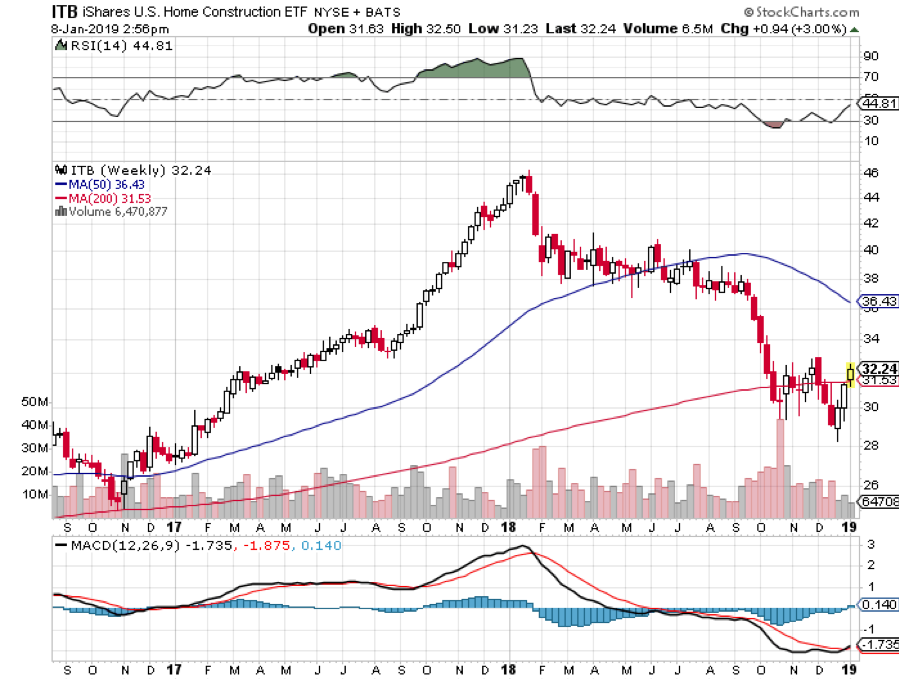
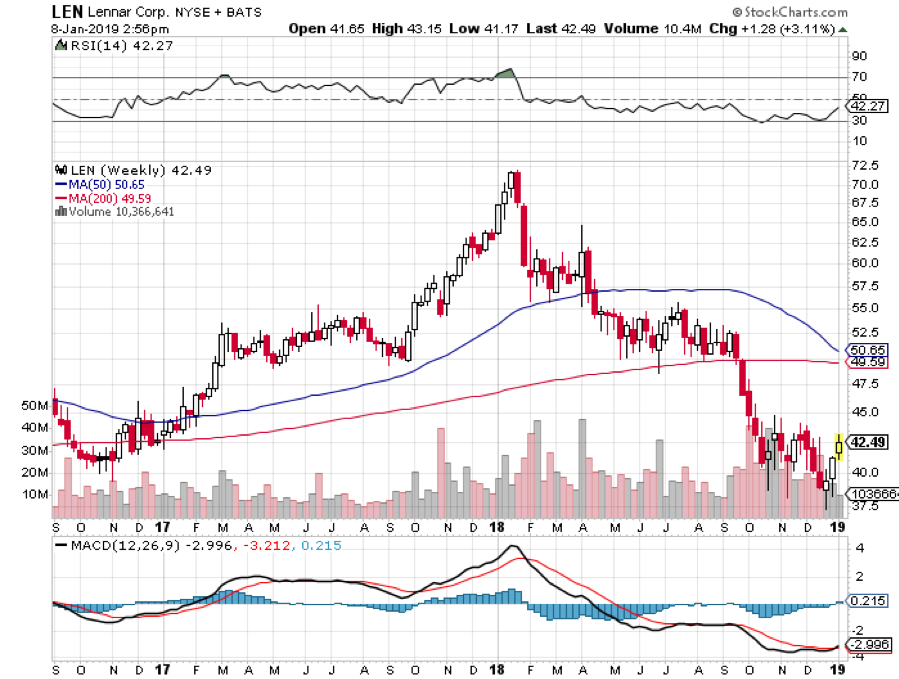
8) Real Estate (ITB), (LEN),
The majestic snow-covered Rocky Mountains are behind me. There is now a paucity of scenery with the endless ocean of sagebrush and salt flats of Northern Nevada outside my window, so there is nothing else to do but write.
My apologies in advance to readers in Wells, Elko, Battle Mountain, and Winnemucca, Nevada.
It is a route long traversed by roving bands of Indians, itinerant fur traders, the Pony Express, my own immigrant forebears in wagon trains, the transcontinental railroad, the Lincoln Highway, and finally US Interstate 80.
Passing by shantytowns and the forlorn communities of the high desert, I am prompted to comment on the state of the US real estate market.
There is no doubt a long-term bull market in real estate is taking a major break. If you didn’t sell your house by March last year you’re screwed and stuck for the duration.
And you’re doubly screwed if you’re trying to sell your home now during the government shutdown. With the IRS closed, tax return transcripts are unobtainable making any loan approval impossible. And no one at Fannie Mae or Freddie Mac, the ultimate buyers of 70% of US home loans, has answered their phone this year.
The good news is that we will not see a 2008 repeat when home values cratered by 50%-70%. There is just not enough leverage in the system to do any real damage. That has gone elsewhere, like in exchange-traded funds. You can thank Dodd/Frank for that which imposed capital rules so strict that it is almost impossible for banks to commit suicide.
And no matter how dire conditions may appear now, you are not going to see serious damage in a market where there is a generational structural shortage of supply.
We are probably seven years into a 17-year run at the next peak in 2028. What we are suffering now is a brief two-year pause to catch our breath. Those bidding wars were getting tiresome anyway.
There are only three numbers you need to know in the housing market for the next 20 years: there are 80 million baby boomers, 65 million Generation Xers who follow them, and 86 million in the generation after that, the Millennials.
The boomers have been unloading dwellings to the Gen Xers since prices peaked in 2007. But there is not enough of the latter, and three decades of falling real incomes mean that they only earn a fraction of what their parents made. That’s what caused the financial crisis.
If they have prospered, banks won’t lend to them. Brokers used to say that their market was all about “location, location, location.” Now it is “financing, financing, financing.” Imminent deregulation is about to deep-six that problem.
There is a happy ending to this story.
Millennials now aged 23-38 are already starting to kick in as the dominant buyers in the market. They are just starting to transition from 30% to 70% of all new buyers in this market.
The Great Millennial Migration to the suburbs has just begun.
As a result, the price of single-family homes should rocket tenfold during the 2020s as they did during the 1970s and the 1990s when similar demographic forces were at play.
This will happen in the context of a coming labor shortfall, soaring wages, and rising standards of living.
Rising rents are accelerating this trend. Renters now pay 35% of the gross income, compared to only 18% for owners, and less when multiple deductions and tax subsidies are taken into account.
Remember too that, by then, the US will not have built any new houses in large numbers in 12 years.
We are still operating at only a half of the peak rate. Thanks to the Great Recession, the construction of five million new homes has gone missing in action.
That makes a home purchase now particularly attractive for the long term, to live in, and not to speculate with. And now that it is temporarily a buyer’s market, it is a good time to step in for investment purposes.
You will boast to your grandchildren how little you paid for your house as my grandparents once did to me ($3,000 for a four-bedroom brownstone in Brooklyn in 1922), or I do to my kids ($180,000 for an Upper East Side high rise in 1983).
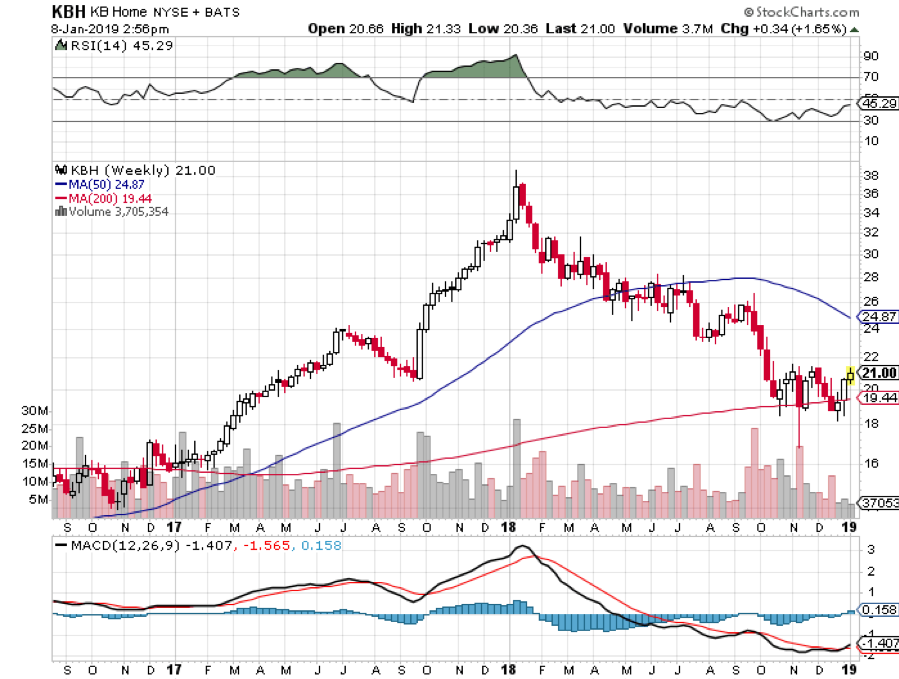
That means the major homebuilders like Lennar (LEN), Pulte Homes (PHM), and KB Homes (KBH) may finally be a buy on the dip.
Quite honestly, of all the asset classes mentioned in this report, purchasing your abode is probably the single best investment you can make now.
If you borrow at a 4% 5/1 ARM rate, and the long-term inflation rate is 3%, then over time you will get your house nearly for free.
How hard is that to figure out?
Crossing the Bridge to Home Sweet Home
9) Postscript
We have pulled into the station at Truckee in the midst of a howling blizzard.
My loyal staff has made the ten-mile treck from my beachfront estate at Incline Village to welcome me to California with a couple of hot breakfast burritos and a chilled bottle of Dom Perignon Champagne which has been resting in a nearby snowbank. I am thankfully spared from taking my last meal with Amtrak.
After that, it was over legendary Donner Pass, and then all downhill from the Sierras, across the Central Valley, and into the Sacramento River Delta.
Well, that’s all for now. We’ve just passed the Pacific mothball fleet moored near the Benicia Bridge. The pressure increase caused by a 7,200-foot descent from Donner Pass has crushed my water bottle.
The Golden Gate Bridge and the soaring spire of Salesforce Tower are just around the next bend across San Francisco Bay.
A storm has blown through, leaving the air crystal clear and the bay as flat as glass. It is time for me to unplug my MacBook Pro and iPhone X, pick up my various adapters, and pack up.
We arrive in Emeryville 45 minutes early. With any luck, I can squeeze in a ten-mile night hike up Grizzly Peak and still get home in time to watch the ball drop in New York’s Times Square.
I reach the ridge just in time to catch a spectacular pastel sunset over the Pacific Ocean. The omens are there. It is going to be another good year.
I’ll shoot you a Trade Alert whenever I see a window open at a sweet spot on any of the dozens of trades described above.
Good trading in 2019!
John Thomas
The Mad Hedge Fund Trader
https://madhedgefundtrader.com/wp-content/uploads/2019/05/cropped-mad-hedge-logo-transparent-192x192_f9578834168ba24df3eb53916a12c882.png00Mad Hedge Fund Traderhttps://madhedgefundtrader.com/wp-content/uploads/2019/05/cropped-mad-hedge-logo-transparent-192x192_f9578834168ba24df3eb53916a12c882.pngMad Hedge Fund Trader2019-01-09 01:05:052019-01-08 21:01:382019 Annual Asset Class Review: A Global Vision
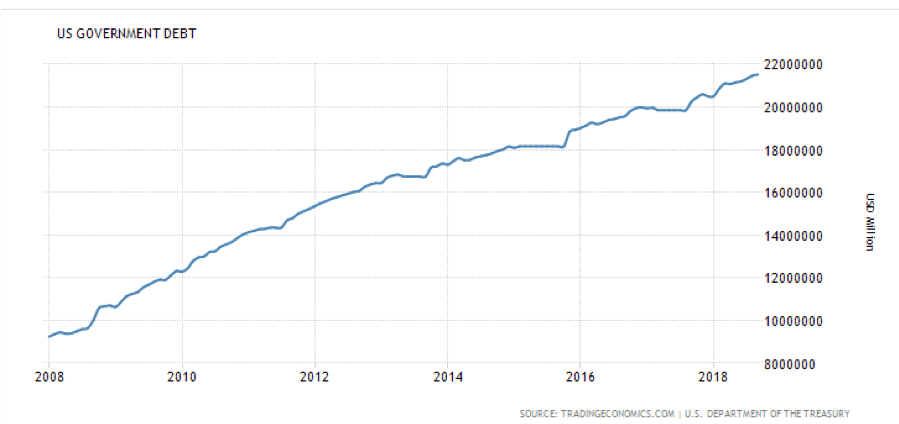
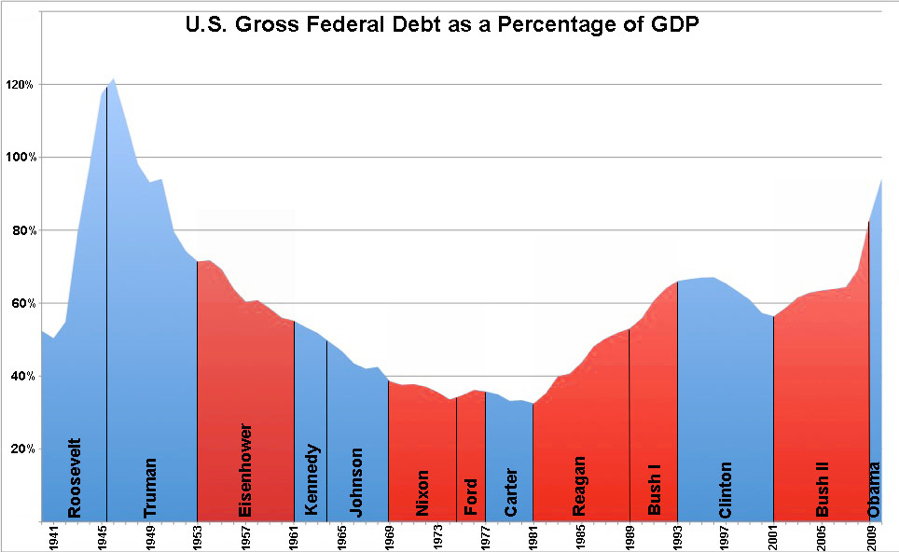
Not a day goes by without someone carping about the national debt to me which now stands at $21.6 trillion.
Since President Obama came into office on January 20, 2010, it skyrocketed.
Are we all going to hell in a handbasket? Eventually, yes.
While it is true that the national debt has increased by some $10 trillion over the past ten years, there is less than meets the eye.
Much less.
That includes the $4 trillion purchased by the Federal Reserve as part of its aggressive five-year monetary policy known as “quantitative easing”.
It also includes another $1 trillion of Treasury holdings by dozens of other federal agencies such as Fannie Mae, Freddie Mac, and Sallie Mae.
So, the net federal debt actually issued during Obama’s two terms is not $9 trillion, but $4 trillion.
That’s a big difference.
These numbers would make Obama one of the most fiscally conservative presidents in US history (see tables below).
And he pulled off this neat trick despite US tax revenues utterly collapsing in the aftermath of the Great Recession.
What the Treasury has in effect done is taken one dollar out of one pocket and put it in the other, 5 trillion times.
There has been no change in the nation’s true indebtedness or net worth as a result of these transactions.
In fact, these bonds were never even really issued. They only exist on a spreadsheet, on a server, on a mainframe, somewhere at 1500 Pennsylvania Avenue, NW, Washington DC.
And here is the real shocker.
The Treasury can cancel this debt at any time.
They can just decide to use one set of figures on the plus side of the balance sheet to offset an equal amount on the negative side, and poof, the debt is gone forever, and the national debt is suddenly only $16 trillion.
It wouldn’t even require an act of Congress. It could simply be carried out through a presidential order.
And we have seen a lot of those lately.
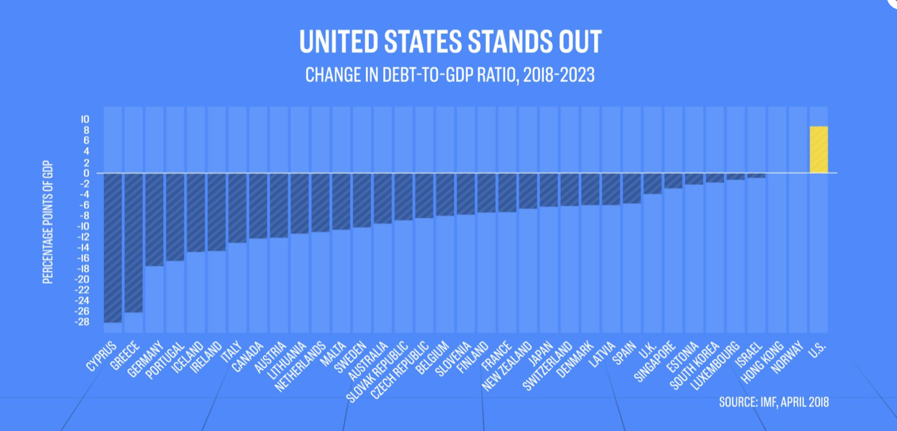
That would give America one of the lowest debt to GDP ratios in the industrialized world.
I actually recommended that the White House use this ploy to get around the last debt ceiling crisis.
All of this sounds nice in theory. But how would markets respond if this were the true state of affairs in the debt markets?
Ten-year US Treasury bond yields would stay stubbornly low around $3.10%.
Prices for marginal debt securities in emerging markets (ELD) would boom.
Am I ringing any bells here people? Do these sound like debt markets you know and love?
A half-century of trading has taught me to never argue with Mr. Market. He is always right.
By keeping its bonds, the Fed has a valuable tool to employ if it ever senses that real inflation is about to make a comeback without having to raise the overnight deposit rate.
It simply can raise bond market rates by selling some of its still considerable holdings.
“FED SELLS BOND HOARD.”
How do you think risk markets would take that headline? Not well, not well at all.
There are other reasons to keep the $5 trillion in phantom Treasury bonds around.
It assures that the secondary market maintains the breadth and depth to accommodate future large-scale borrowing demanded by another financial crisis, Great Recession, or war.
Yes, believe it or not, governments think like this.
I remember that these were the issues that were discussed the last time closing the bond market was considered.
That was at the end of the Clinton administration in 1999 when paying off the entire national debt was only a few years off.
But close down the bond market and fire the few hundred thousand people who work there, and it could take decades to restart.
This is what Japan learned in the 1960’s.
It took the Japanese nearly a half-century to build the bond infrastructure needed to accommodate their massive borrowings of today.
The Chinese are learning the same thing as they strive to construct modern debt markets from whole cloth. It is not an overnight job.
One of the most common questions I get from foreign governments, institutional investors, and wealthy individuals in my international travels is “What will come of America’s debt problem?”
The answer is easy. It will all go to debt heaven. It will disappear.
US government finances are now worsening at a pretty dramatic pace (see more charts and tables below).
The budget deficit has doubled from the Obama low of $450 billion to $900 billion in only two years. Debt has exceeded GDP for the first time since WWII. New government bond issuance is rocketing and will crush the market any day now.
However, there is a way out of the looming financial disaster.
A massive demographic tailwind kicks in during the 2020s as 85 million Millennials grow up to become big-time taxpayers.
In the meantime, the last of the benefit-hungry baby boomers finally die off, eliminating an enormous fiscal drag.
“Depends” and “Ensure” prices will crater.
The national debt should disappear by 2030, or 2035 at the latest. The same is true for the Social Security deficit. That’s when we next have to consider firing the entire bond market once more.
That is what happened to the gargantuan debt run up by the Great Depression, the Civil War, and the Revolutionary War.
Government debt always goes to debt Heaven either through repayment during the period of demographic expansion and economic strength, or via diminution of purchasing power caused by inflation.
That’s why we have governments to pull forward economic growth during the soft periods in order to even out economic growth and job creation over the very long term to accommodate population growth. Pulling forward growth during strong economies as the administration is now doing only ends in tears.
The French were the first to figure all this out in the 17th century. They were not the last.
History doesn’t repeat itself, but it certainly rhymes.
https://madhedgefundtrader.com/wp-content/uploads/2019/05/cropped-mad-hedge-logo-transparent-192x192_f9578834168ba24df3eb53916a12c882.png00MHFTFhttps://madhedgefundtrader.com/wp-content/uploads/2019/05/cropped-mad-hedge-logo-transparent-192x192_f9578834168ba24df3eb53916a12c882.pngMHFTF2018-10-31 01:07:002018-10-30 19:21:26What is America’s True National Debt?
Below please find subscribers’ Q&A for the Mad Hedge Fund Trader September 5 Global Strategy Webinar with my guest and co-host Bill Davis of the Mad Day Trader.
As usual, every asset class long and short was covered. You are certainly an inquisitive lot, and keep those questions coming!
Q: Do you think the collapse of commodity prices in the U.S. will affect the U.S. election?
A: Absolutely, it will if you count agricultural products as commodities, which they are. We have thousands of subscribers in the Midwest and many are farmers up to their eyeballs in corn, wheat, and soybeans. It won’t swing the entire farm vote to the Democratic party because a lot of farmers are simply lifetime Republicans, but it will chip away at the edges. So, instead of winning some of these states by 15 points, they may win by 5 or 3 or 1, or not at all. That’s what all of the by-elections have told us so far.
Q: What will be the first company to go to 2 trillion?
A: Amazon, for sure (AMZN). They have so many major business lines that are now growing gangbusters; I think they will be the first to double again from here. After having doubled twice within the last three years, it would really just be a continuation of the existing trend, except now we can see the business lines that will actually take Amazon to a much bigger company.
Q: Is this a good entry point for Micron Technology (MU)?
A: No, the good entry point was in the middle of August. We are at an absolute double bottom here. Wait for the tech washout to burn out before considering a re-entry. Also, you want to buy Micron the day before the trade war with China ends, since it is far and away its largest customer.
Q: Is Micron Technology a value trap?
A: Absolutely not, this is a high growth stock. A value trap is a term that typically applies to low price, low book to value, low earning or money losing companies in the hope of a turnaround.
Q: I didn’t get the Microsoft (MSFT) call spread when the alert went out — should I add it on here?
A: No, I am generally risk-averse this month; let’s wait for that 4% correction in the main market before we consider putting any kind of longs on, especially in technology stocks which have had great runs.
Q: How do you see Lam Research (LRCX)?
A: Long term it’s another double. The demand from China to build out their own semiconductor industry is exponential. Short term, it’s a victim of the China trade war. So, I would hold back for now, or take short-term profits.
Q: Is this a good entry point for Google (GOOGL)?
A: No, wait for a better sell-off. Again, it’s the main market influencing my risk aversion, not the activity of individual stocks. It also may not be a bad idea to wait for talk of a government investigation over censorship to die down.
Q: Would you buy Tesla (TSLA)?
A: No, buy the car, not the stock. There are just too many black swans out there circling around Tesla. It seems to be a disaster a week, but then every time you sell off it runs right back up again. Eventually, on a 10-year view I would be buying Tesla here as I believe they will eventually become the world’s largest car company. That is the view of the big long-term value players, like T. Rowe Price and Fidelity, who are sticking with it. But regarding short term, it’s almost untradable because of the constant titanic battle between the shorts and the longs. At 26% Tesla has the largest short interest in the market.
Q: I’m long Microsoft; is it time to buy more?
A: No, I would wait for a bit more of a sell-off unless you’re a very short-term trader.
Q: What would you do with the TBT (TBT) calls?
A: I would buy more, actually; preferably at the next revisit by the ProShares Ultra Short 20 Year Plus Treasury ETF (TBT) to $33. If we don’t get there, I would just wait.
Q: What’s your suggestion on our existing (TLT) 9/$123-$126 vertical bear put spread?
A: It expires in 12 days, so I would run it into expiration. That way the spread you bought at $2.60 will expire worth $3.00. We’re 80% cash now, so there is no opportunity cost of missing out with other positions.
Q: Do you like emerging markets (EEM)?
A: Only for the very long term; it’s too early to get in there now. (EEM) really needs a weak dollar and strong commodities to really get going, and right now we have the opposite. However, once they turn there will be a screaming “BUY” because historically emerging nations have double the growth rate of developed ones.
Q: Do you like the Invesco India ETF (PIN)?
A: Yes, I do; India is the leading emerging market ETF right now and I would stick with it. India is the next China. It has the next major infrastructure build-out to do, once they get politics, regulation, and corruption out of the way.
Q: Do you trade junk bonds (JNK), (HYG)?
A: Only at market tops and market bottoms, and we are at neither point. When the markets top out, a great short-selling opportunity will present itself. But I am hiding my research on this for now because I don’t want subscribers to sell short too early.
Q: With the (VXX), I bought the ETF outright instead of the options, what should I do here?
A: Sell for the short term. The iPath S&P 500 VIX Short-Term Futures ETN (VXX) has a huge contango that runs against it, which makes long-term holds a terrible idea. In this respect it is similar to oil and natural gas ETFs. Contango is when long-term futures sell at a big premium to short-term ones.
Q: How much higher for Apple (AAPL)?
A: It’s already unbelievably high, we hit $228 yesterday. Today it’s $228.73, a new all-time high. When it was at $150, my 2018 target was initially $200. Then I raised it to $220. I think it is now overbought territory, and you would be crazy to initiate a new entry here. We could be setting up for another situation where the day they bring out all their new phones in September, the stock peaks for the year and sells off shortly after.
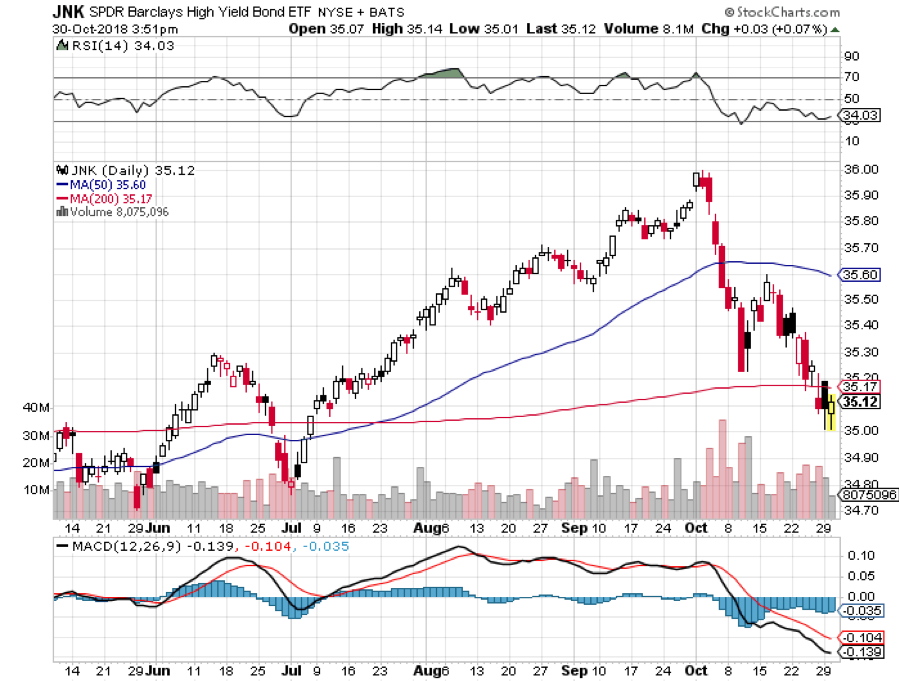
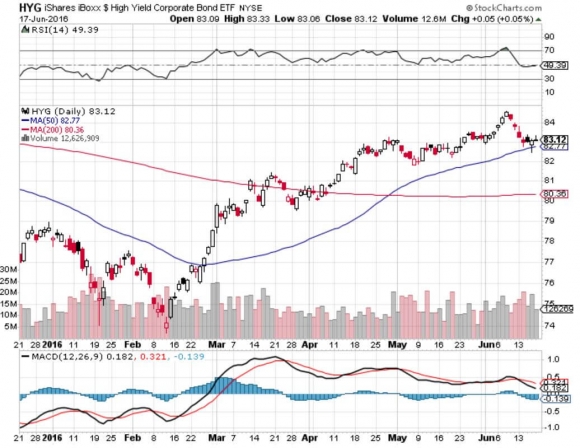
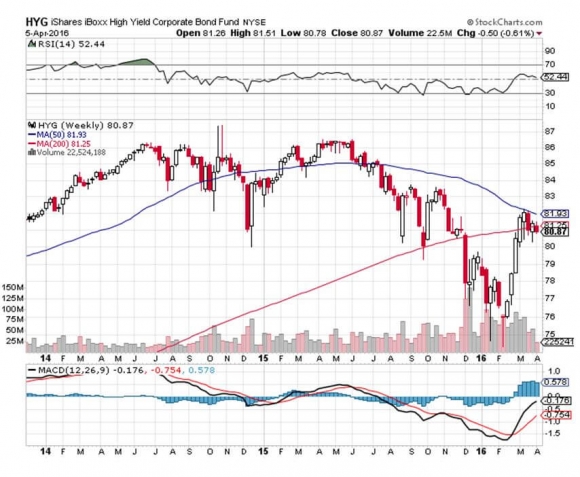
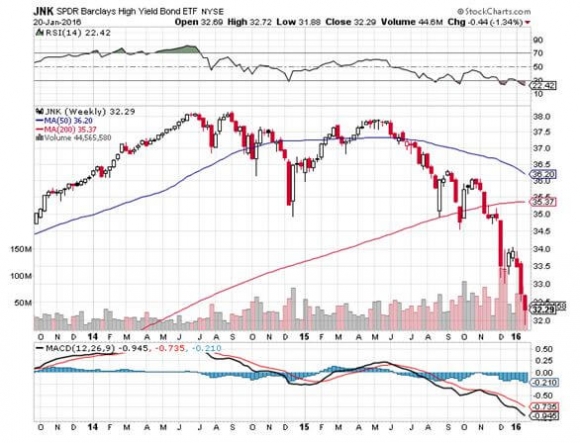
There is no happier corner of the fixed income universe than junk bonds (JNK), (HYG), which have been soaring like a bat out of hell recently.
Average yields for the bond class most sensitive to the economy have collapsed from 18% to near an all-time low of 6.68%, a scant 483 basis points over ten year Treasury bonds (TLT).
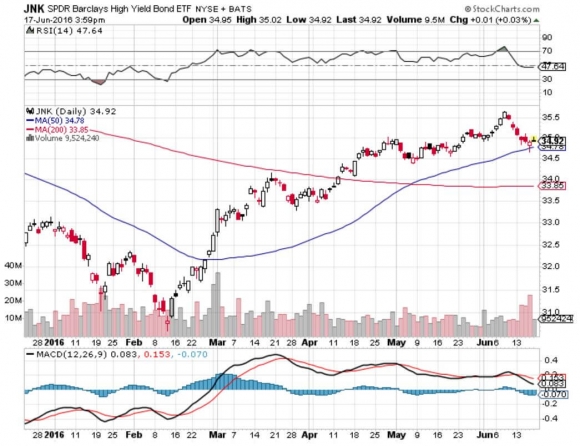
If you look at the chart for (JNK) it virtually tracks the S&P 500 one for one, with less volatility, and therein lies the problem. When bonds act like stocks, what happens to bonds when stocks go down?
That is a particularly pertinent question these days as stocks have more than doubled from the bottom, and are approaching grotesquely overbought levels. After a move in the S&P 500 Index?s average multiple from 9 to 19, with 20 a possible top, are junk bonds peaking out here as well?
?A 483 basis point premium does not sound like much compared to the historical range. It is pricing in the near absence of risk in this paper, as if they will live forever? When did I last see this movie? 2006? 2007? Alas, how short memories have become.
It might be worth taking some money off the table here, and taking the hit in the cash flow in your portfolio.
Lowering your beta is prudent, especially if we are about to move from a 'RISK ON' to a 'RISK OFF' world for more than a day.
Do you really want to wait for the music to stop playing before you grab a chair?
Time to Grab a Chair Before the Music Stops Playing?
https://www.madhedgefundtrader.com/wp-content/uploads/2013/03/Childrens-Game.jpg311327Mad Hedge Fund Traderhttps://madhedgefundtrader.com/wp-content/uploads/2019/05/cropped-mad-hedge-logo-transparent-192x192_f9578834168ba24df3eb53916a12c882.pngMad Hedge Fund Trader2016-06-20 01:07:092016-06-20 01:07:09Are Junk Bonds Peaking?
When you look at the profusion of new ETF?s being launched today, you find that they almost always correspond with market tops.
The higher the market, the greater the demand for the underlying, and the more leverage traders pay for it. The resulting returns for investors are disastrous.
But occasionally a blind squirrel finds an acorn, and if you fire buckshot long enough, you hit a barn.
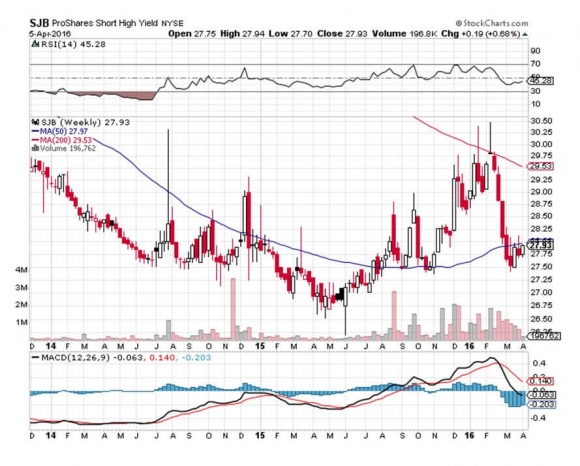
That?s why I am getting interested in the ProShares Short High Yield ETF (SJB). After riding the bull move in junk all the way up with (JNK), (HYG), I have recently turned negative on the sector.
Junk bonds have moved too far too fast. Current spreads for junk paper are now only 200 basis points over equivalent term Treasury bonds, and investors at these levels are in no way being compensated for their risk.
If the stock market starts to roll over this summer, then the junk bond market will follow it in the elevator going down to the ladies underwear department in the basement.
Keep in mind that when shorting the junk market, you run into the same problem you have with the (TBT), a leveraged short ETF for the Treasury bond market.
Buy the (SJB) and you are short a 6.74% coupon, which works out to a monthly costs of more than 50 basis points. That is a big nut to cover. So timing for entry into this fund will be crucial.
Is Shorting Junk Bonds the Way to Go??
https://www.madhedgefundtrader.com/wp-content/uploads/2013/05/Car-Junk.jpg225322Mad Hedge Fund Traderhttps://madhedgefundtrader.com/wp-content/uploads/2019/05/cropped-mad-hedge-logo-transparent-192x192_f9578834168ba24df3eb53916a12c882.pngMad Hedge Fund Trader2016-04-22 01:07:422016-04-22 01:07:42Take a Ride in the Short Junk ETF
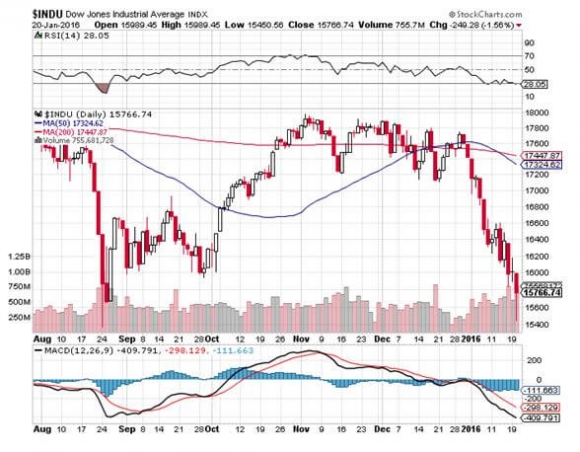
Suddenly, the consolidation turned into a correction and maybe even a bear market.
A crucial part of trading a crash is knowing what to do at the bottom. Don?t worry. You?ll receive a flurry of text alerts from me right when that happens.
Many individual investors simply run to the bathroom and lock the door, hoping nobody knocks on the door for a couple of days.
Worse, they dump every stock they have. That?s what makes market bottoms.
Trades that once seemed impossible can now get done, provided you use limit orders.
Let me get this right. Stocks are crashing because:
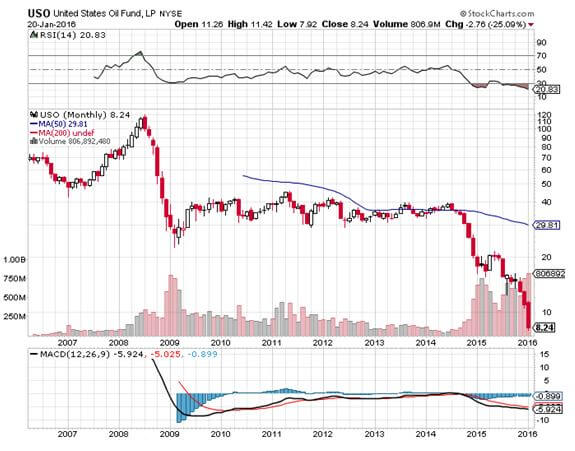
1) The Federal Reserve isn?t going to raise interest rates anymore. 2) The price of oil has dropped 84% in five years. 3) Commodities have reached multi-decade lows. 4) The US dollar has suddenly stabilized. 5) Investors are yanking money from abroad and pouring it into the US on a flight to safety trade because it is the only place they can obtain a positive return, especially in stocks.
May I point out the screamingly obvious right here?
These are all reasons for 90% of US companies that borrow money and consume energy and commodities to increase earnings and to boost their share prices.
Only the 10% that derive revenues from ripping oil and commodities out of the ground should get hurt here.
Of course the market doesn?t know that. It is anything but rational when we hit big triple digit declines. There was only one direction on, and that was OUT.
And that is where you make your money
Margin clerks rule supreme, squeezing every bit of leverage out of their clients they can find.
The Dow and (SPY) are already posting large negative numbers for 2016.
Of course, I saw all of this coming a mile off.
I have been banging drums, pulling fire alarms, shooting off flare guns, and otherwise warning readers that the technical situation for the market was terrible ever since I went 100% into cash in December.
When the breakdown appeared imminent, I shot out Trade Alerts to sell short the S&P 500 (SPY) in size as fast as I could write them. And I started buying outright (SPY) puts for the first time in ages.
As a result of these sudden tactical moves, my model-trading portfolio has been keeping its head above water all month, up 2%. The Dow Average is off by a nausea inducing -10.7% at today?s low.
Yes, yes! All the hard work and research is paying off!
Ignore my musings at your peril!
What is even more stunning is that these declines are occurring in the face of US macro economic numbers that are going from strength to strength. The blockbuster December nonfarm payroll report of 292,000 is the real writing on the wall.
Housing, which accounts for about one third of the US economy, has been on fire. I?m sorry, but if you can?t find a parking space at Target, there is no recession.
Another crucial leg of the US economy, auto manufacturing, has been in overdrive. Auto sales are at a record 18 million annual rate, and some summer production shut downs have been cancelled.
That is, everywhere except Volkswagen.
With two of the most important legs firing on all cylinders, it?s clearly not about the economy, stupid!
There certainly hasn?t been a geopolitical event to justify moves of this magnitude.
As far as I can tell, Hitler has not invaded Poland, nor have the Japanese attacked Pearl Harbor.
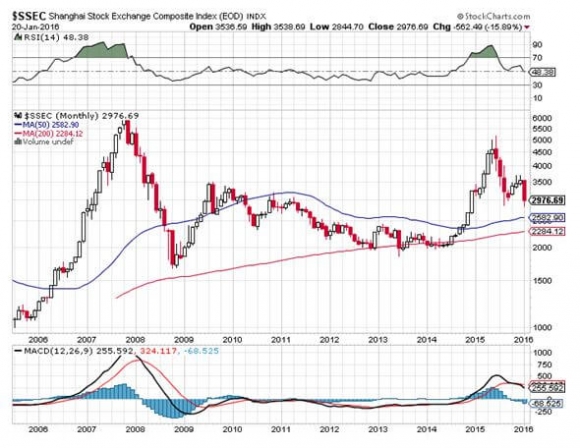
Sure, there is whining about China, which has the Shanghai Index approaching the 2,900 level once again, down 40% from the top.?
Which leads me to believe that all of this is nothing more than a temporary hiccup. A BIG Hofbrauhouse kind of hiccup, but a hiccup nonetheless.
In a zero interest rate world, stocks only have to fall back from a price earnings multiple of 18 to 15 to flush out a ton of buying, and they will have done just that when the (SPY) hits $174.
THAT IS MY LINE IN THE SAND.
If nothing else, corporate buybacks should reaccelerate here, which could reach $1 trillion in 2016. Some 75% companies exit their quiet period by February 5 and can resume buying.
That could signal an interim market bottom.
The great thing about this selloff is that the best quality companies have fallen the most. This has been a function of the heavy sovereign wealth fund selling the bridge oil deficits.
After all, when share prices are in free fall, you have to sell what you can, not what you want to. It is only human to realize profits rather than incur losses, so quality has been trashed.
I am therefore going to give you a list of ten of my favorite stocks to buy at the bottom, highlighting the sectors that will lead us into a yearend rally.
The themes here are home builders, consumer discretionary, autos, solar, old technology, and international. I?m sorry, but the entire interest sensitive sector is on hold for the rest of the year, thanks to likely Fed inaction.
Watch out, because when I sense that the market has burned itself out on the downside, the Trade Alerts are going to be coming hot and heavy.
You have been forewarned!
Read ?em and weep with joy!
10 Stocks to Buy at the Bottom
Lennar Homes (LEN) Home Depot (HD) Microsoft (MSFT) General Electric (GE) Tesla (TSLA) Apple (AAPL) First Solar (FSLR) Palo Alto Networks (PANW) Wisdom Tree Japan Hedged Equity (DXJ) Wisdom Tree Europe Hedged Equity (HEDJ)
Finally, All the Hard Work is Paying Off
https://www.madhedgefundtrader.com/wp-content/uploads/2015/07/John-Thomas5-e1437678792272.jpg299400Mad Hedge Fund Traderhttps://madhedgefundtrader.com/wp-content/uploads/2019/05/cropped-mad-hedge-logo-transparent-192x192_f9578834168ba24df3eb53916a12c882.pngMad Hedge Fund Trader2016-01-21 01:06:152016-01-21 01:06:15Ten Stocks to Buy at the Bottom
With the bond market confounding forecasters and prognosticators once again, I thought I?d delve into one of the more mysterious reasons why the bond market keeps going from strength to strength.
To a man, hedge fund traders expected bond prices to take a dive in 2014 and 2015 and for yields to soar. Isn?t that what?s supposed to happen in recovering economies?
Instead, we got the opposite, and yields have plunged, from 3.05% for the ten-year Treasury to as low as 2.80% this week.
There are many important lessons to be learned here. This is not your father?s bond market.
The internal dynamics of the fixed income markets have changed so much in the last three decades that it has become unrecognizable to long term practitioners, like myself.
A big factor has been the takeover of the bond market by the 1%, the richest segment of the US population and, indeed, the global economy. As wealth concentrates at the top, its character changes.
Let me stop here and tell you that the ultra rich are different from you and me, and not just because they have more money.
I have learned this after nearly half-century-long relationships with the planet?s wealthiest families, including the Rockefellers, Rothschilds, DuPonts, Morgans, and Pritzkers, first as important contacts of mine at The Economist, then as clients of mine at Morgan Stanley, then as investors in my hedge fund, and now as subscribers to The Diary of a Mad Hedge Fund Trader.
The wealthier families become the more conservative they get in their investment choices. Their goal shifts from capital appreciation to asset protection.
They lose interest in return on capital and become obsessed with return of capital. This is how the rich stay rich, sometimes for centuries. I have even noticed this among my newly minted billionaire hedge fund buddies.
What this means for the bond market is that they never sell. When they buy a 30-year Treasury bond, it is with the expectation of keeping it for the full 30 years until maturity.
That way they can avoid capital gains taxes and only have to pay taxes on the coupon interest. When they die, spouses get the step up in the cost basis, and then the wealth passes from one generation to the next. Taxes are never paid.
Back in the 1980s, when wealth was more evenly distributed, the top 1% only accounted for 1% of Treasury bond ownership. Today, that figure is closer to 25%.
Add this to the 50% of our national debt that is owned by foreign investors, primarily central banks, who also tend to hold paper for its full life. Central banks don?t pay taxes either.
China and Japan are the biggest holders with around $1 trillion each. This means that 75% or more of bonds are owned by investors who won?t sell. What does that mean for the rest of us? Bond prices that never go down.
With bonds very close to 30-year highs, keeping your bonds has been the right thing to do. I can?t tell you how many investment advisors I know who have distilled their practices down to managing fixed income instruments only.
This involves the entire coupon clipping space, including municipal bonds (MUB), corporates (LQD), junk (JNK), and even emerging market debt (ELD).
This is driven by customer demand, the 1%ers, not from any great insights or epiphanies they achieved on their own.
Of course, there is a certain amount of "driving with your eyes firmly fixed on the rear view mirror" going on here. Maybe the rich will finally sell their bonds once prices fall hard, stay down and then go down some more.
Inflation rearing its ugly head might also do the trick since it is always bad for bond prices as it reduces the purchasing power of money. Selling is certainly what they were doing in the early eighties, when the ten-year yield hit 12%.
Again, the rear view mirror effect, when bond were called ?certificates of wealth confiscation.?
There are other matters to consider with the 1% owning so much of the bond market and keeping it there.
This money is not getting invested in new start ups and creating jobs. It is money that is not being used to engender new economic growth. One of the fantasies of the last election was the claim that the 1% were creating so many jobs. They weren?t, not as long as their money was parked in a risk free bond market.
Instead, it is just stagnating. This is one reason why economic growth is so flaccid this decade and will remain so. This is fine for the 1%, but not so good for the rest of us.
The bottom line here is that while bonds are overbought and due for a pullback, they are not by any means going to crash. We could be living in the 2.60%-3.50% range for the 30-year for quite some time, maybe for years.
That is if the new Federal Reserve governor and my friend, ultra dove Janet Yellen, has anything to say about it. She has only just started and could be with us for another eight years.
Personally, I don?t foresee any appreciable rise in interest rates until we get well into the 2020s, when real inflation finally returns from the dead.
That is when bonds will become the asset class you don?t want to know, whether you?re in the 1% or not.
Bonds Will Stay Up Until Inflation Returns from the Dead
https://www.madhedgefundtrader.com/wp-content/uploads/2013/05/Dracula.jpg268337Mad Hedge Fund Traderhttps://madhedgefundtrader.com/wp-content/uploads/2019/05/cropped-mad-hedge-logo-transparent-192x192_f9578834168ba24df3eb53916a12c882.pngMad Hedge Fund Trader2016-01-20 01:06:342016-01-20 01:06:34The 1% and the Bond Market
Legal Disclaimer
There is a very high degree of risk involved in trading. Past results are not indicative of future returns. MadHedgeFundTrader.com and all individuals affiliated with this site assume no responsibilities for your trading and investment results. The indicators, strategies, columns, articles and all other features are for educational purposes only and should not be construed as investment advice. Information for futures trading observations are obtained from sources believed to be reliable, but we do not warrant its completeness or accuracy, or warrant any results from the use of the information. Your use of the trading observations is entirely at your own risk and it is your sole responsibility to evaluate the accuracy, completeness and usefulness of the information. You must assess the risk of any trade with your broker and make your own independent decisions regarding any securities mentioned herein. Affiliates of MadHedgeFundTrader.com may have a position or effect transactions in the securities described herein (or options thereon) and/or otherwise employ trading strategies that may be consistent or inconsistent with the provided strategies.









 Dow Average 1987-90


 Frozen Headwaters of the Colorado River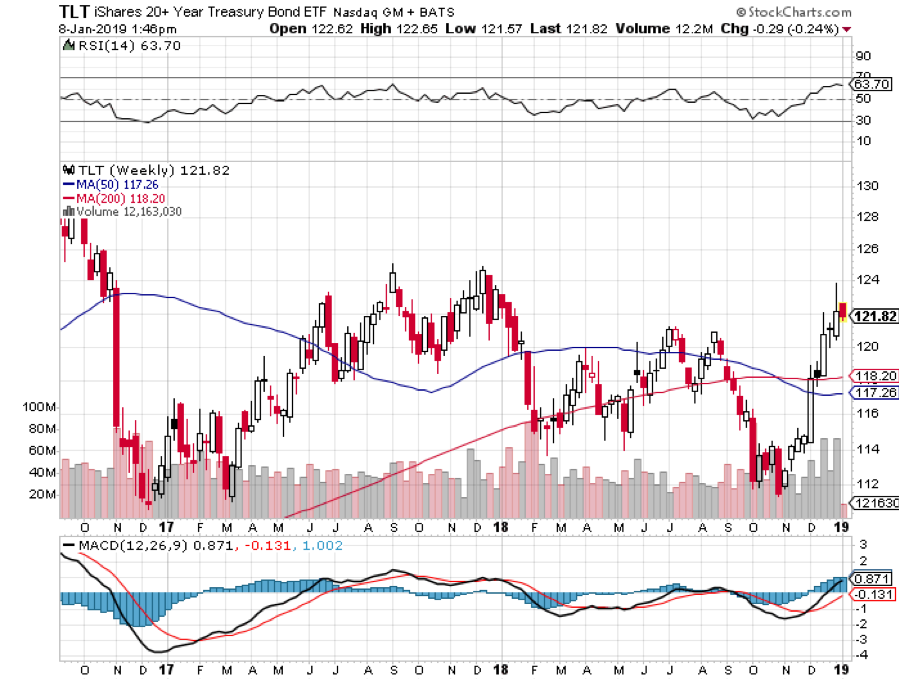





 Crossing the Bridge to Home Sweet Home