Mad Hedge Technology Letter
May 8, 2020
Fiat Lux
Featured Trade:
(WHY TECH IS THE BIG BAILOUT WINNER)
(EA), (ATVI), (TWLO), (UBER), (LYFT)


Mad Hedge Technology Letter
May 8, 2020
Fiat Lux
Featured Trade:
(WHY TECH IS THE BIG BAILOUT WINNER)
(EA), (ATVI), (TWLO), (UBER), (LYFT)
Today, we got a convincing signal that trillions of stimulus dollars are being diverted into one asset class – tech shares.
That’s right, even though main street has not participated in the V-shaped recovery that tech shares have basked in, tech’s profit engines have gotten through largely unscathed.
The earnings that have streamed out this week validate the big buying into tech shares and today’s price action was mouthwatering.
We had names like cloud communications platform Twilio (TWLO) rise 40% in one day, ride-sharing platform Lyft (LYFT) was up 21%, and Uber (UBER) another 11%.
Outperformance of 5% seemed pitiful today in an asset class that has gone truly parabolic.
Another sub-sector that can’t be held down is video games.
The rampant usage of video games dovetails nicely with the theme of tech companies who have triumphed the coronavirus.
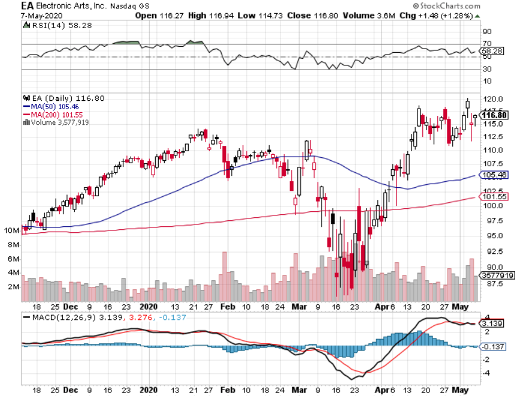
There is nothing more like a stay-at-home stock than video game maker Electronic Arts (EA) who beat expectations during its March quarter.
The company reported adjusted earnings of $1.31 per share during its fiscal fourth quarter, topping consensus estimates at 97 cents a share.
Revenue also beat totaling $1.21 billion surpassing estimates by $.03 billion.
EA Sports has identified Apex Legends as their new growth asset and this free game is having a Fortnite-like growth effect.
Apex Legends was the most downloaded free-to-play game in 2019 on the PlayStation 4 system.
The full ramifications of Covid-19’s impact on EA’s business, operations, and financial results is hard to quantify for the long term and this has been a broad trend with many tech companies pulling annual guidance.
I can definitely say that the year 2020 is experiencing a video games renaissance.
On the downside, EA is heavy into sports video games, and cancellations of sports seasons and sporting events could impact results, given its popular sport simulation titles like FIFA and Madden NFL.
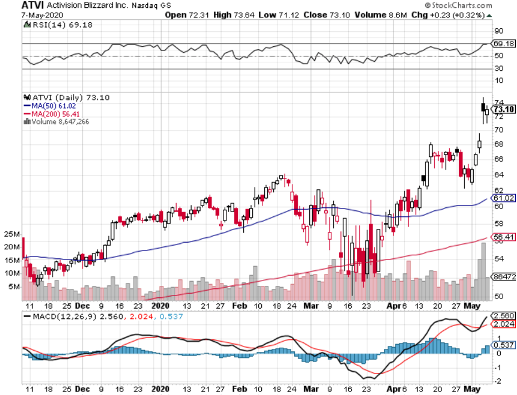
EA Sport’s competitor Activision Blizzard (ATVI) is positioned to reap the benefits by reimagining mainstay title Call of Duty Warzone and users have already hit 60 million players in just 2 months.
The result is accelerating momentum entering the second quarter from the dual tailwinds of strong execution and premium franchises following last year's increased investment.
With physical entertainment venues like movie theaters, live sports, and music venues closed, home entertainment services have pocketed the increased engagement.
Nintendo is another gaming company whose fourth-quarter profit soared 200% due to surging demand for its Switch game console, and that title Animal Crossing: New Horizons shifted a record 13.4 million units in its first six weeks.
Activision is riding other hit game franchises like World of Warcraft, Overwatch, and Candy Crush – to visit their roster of blockbuster games, please click here.
These blockbuster titles are carrying this subsector at a time when the magnifying glass is on them to provide the entertainment people crave at home.
Shares of EA and Activision Blizzard are overextended after huge run-ups and another gap up from better than expected earnings reports.
If there is a dip, then that would serve as an optimal entry point.
The lack of vaccine means that gaming will see elevated attention until there is a real health solution.
If there is a second wave that hits this fall, then pull the trigger on these video game stocks.
To visit Electronic Art’s website, please click here.
Mad Hedge Technology Letter
May 6, 2020
Fiat Lux
Featured Trade:
(THE GOLDEN AGE OF BIG TECH HAS ONLY JUST BEGUN)
(AMZN), (MSFT), (AAPL), (FB), (GOOGL), (ZM)

The tech market is telling us that the effects of coronavirus on the U.S. economy have accelerated the Golden Age of Big Tech pulling it forward to 2021.
You know, Big Tech is having their time in the sun when unscrupulous personal data seller Facebook is experiencing 10 times growth with its live camera product Portal video during the health crisis.
That is the type of clout big tech has accumulated in the era of Covid-19 and investors will need to focus on these companies first when putting together a high-quality tech portfolio.
Every investor needs upside exposure to a group of assets that is locked into the smartphone ecosphere.
There are no excuses.
Smartphones, although not a new technology, is now a utility, and the further away from the smartphone revenue stream you get, business is nothing short of catastrophic minus healthcare.
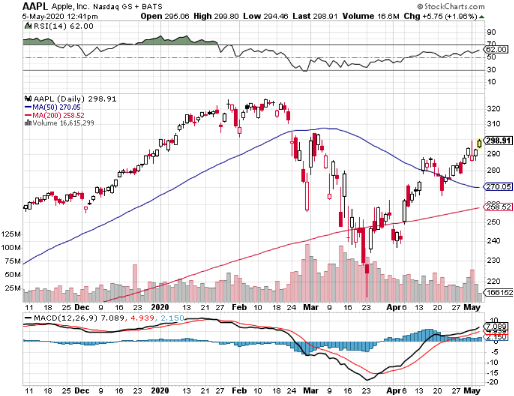
The health scare has ultimately justified the mammoth valuations of over $1 trillion that Apple, Microsoft, and Amazon command.
The next stop is easily $2 trillion and then some.
Consumers are so much more digitized in this day and age weaving in a tapestry of assets such as the iPhone at Apple, advertising at Facebook, and search ads at Google.
Can the coronavirus keep the digital economy down?
Green shoots are certainly popping up with regular consistency.
Facebook and Google have said that digital advertising has “stabilized.”
Apple, Amazon, Netflix, Facebook, and Google each reported financial results in the past week with profits and revenue that, while hit by the closure of the economy, still outperformed relative to the broader market.
Investors already priced in that Apple's iPhone sales temporarily disappeared, that Google's and Facebook's advertising revenue dropped and that Amazon is spending big to keep warehouse workers safe.
Forward expectations can only go north at this point reflecting a giant bull wave of buying that has benefited tech stocks.
Other top tier companies not in the FANG bracket have also gone gangbusters.
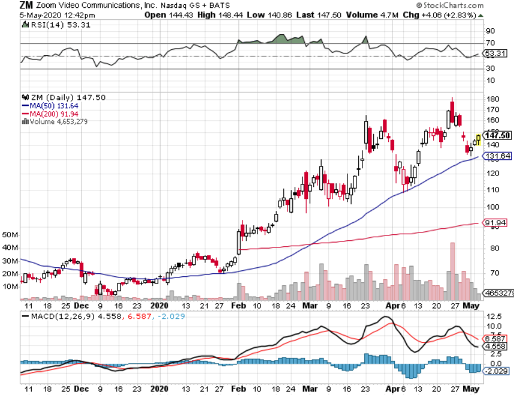
Zoom has turned into an overnight sensation now replacing all face-to-face meetings, sparking competition with Microsoft's Teams video chat and Google Meet.
The market grab that big tech has partaken in will position them as the major revenue accumulators for the next 25 years.
Unsurprisingly, Apple was the canary in the coal mine by calling out a dip in iPhone sales and manufacturing in China earlier in the year.
While iPhone's sales did fall, down nearly 7%, to $28.9 billion, its revenues from services and wearables, two categories that have been rising steadily for years, jumped 16.5% and 22.5% respectively.
Chip giant Qualcomm said phone shipments will likely drop about 30% around the globe in the June quarter while Apple rival Samsung, said phone and TV sales will "decline significantly" because of the coronavirus.
Google’s YouTube has grown 33% while the video giant keeps us entertained and Microsoft’s Xbox Game Pass subscription service notched more than 10 million subscribers.
Facebook said nearly 3 billion people use its collection of chat apps representing an 11% jump from a year ago.
Everywhere we turn, relative outperformance is evident which in turn minimizes the absolute underperformance in year to year growth.
The market is looking through and putting a premium on the relative outperformance.
Many are coming to the realization that the economy and population will live with the virus until there is a proper vaccine, meaning an elongated period of time where consumers are overloading big tech with higher than average usage.
President Trump’s chief economic adviser Larry Kudlow is projecting that the U.S. economy next year could see “one of the greatest economic growth rates.”
I would adjust that comment to say that big tech is tipped to be the largest winner of this monster rebound in 2021 putting the rest of the broader market on its back.
This is quickly turning into two economies – tech and everybody else.
The eyeballs won’t necessarily translate into a waterfall of revenue right away because of the nature of all the free services that they provide.
But at the beginning of 2021, a higher incremental portion of consumer’s salaries will be directed towards big tech and the fabulous paid services they offer.
Actions speak louder than words and Berkshire Hathaway’s Warren Buffett unloading billions in airline stocks is an ominous sign indicating that parts of the U.S. economy won’t come back to pre-virus levels.
The biggest takeaway in Buffet’s commentary is that he elected to not sell tech stocks like his big position in Apple validating my thesis that any investor not already in big tech will flood big tech with even more capital after being burnt in retail, energy, hotels, and airlines.
Then, when you consider the ironclad nature of tech’s balance sheets, even in the apocalyptical conditions, they will profit and rip away even market share from the weak.
It’s to the point where any financial advisor who doesn’t recommend big tech as the nucleus of their portfolios is most likely underperforming the wider market.
As the U.S. economy triggers the reopening mechanisms and we enter into the real meat and bones of the reopening, data will recover significantly signaling yet another leg up in tech shares.
Hold onto your hat!
Mad Hedge Technology Letter
April 29, 2020
Fiat Lux
Featured Trade:
(TAKING A LOOK AT RINGCENTRAL)
(RNG), (ZM)
Tech stakeholders have won out by corporate American extracting a King’s ransom in the form of a favorable stimulus and unwavering government support for the next lucrative explosion upwards in tech shares.
We have moved into a post-industrial capitalistic apocalyptic world for better or worse and I will give you another hot tip - RingCentral, Inc. (RNG).
The company is poised to rise with all corporate tech boats moving forward.
Inside the deep underbelly of U.S. Capitalism 2.0, the financial fallout and response to it mirrors the last crisis of 2008 signaling to investors to buy tech growth stocks and lots of it.
That might be a cynical take of how the cookie is crumbling but just look at the Teflon tech market that shrugs off the unemployed who are standing in food lines.
Then consider that many of the small business loans were front run by the corporate crowd by hijacking almost $900 million in funds allocated to the small business relief program that was meant to go to main street.
It’s a sign of the pecking order of the future and investors must input the new data into their models going forward.
Corporate America value and its economic extraction machine are powering ahead leaving main street behind offering opportunities for tech-savvy investors.
What does this mean? This is demonstrably bullish for the tech sector and could initiate the Golden Age of 5G investing.
Big tech will get bigger and corporate America will lurch out of the coronavirus epidemic positioned the strongest precisely because they have been best, fully funded, and the strongest tech companies have the country’s best balance sheets.
I advise investors to look at tech growth and RingCentral is one of the leaders in this field.
RingCentral is a robust cloud communications company that is at the vanguard of the Unified Communications as a Service (UCaaS) space.
RingCentral has about 2 million users on its platform and according to management is “the last service to be turned off” in this wonky economy that is mostly shut down.
The knock-on effect of the coronavirus is that RingCentral app downloads are up 400% month over month, online meetings on the platform are up over 200%, and messaging is up over 90%.
RingCentral is regarded as one of the originators of the UCaaS market, which projects to grow at a double-digit pace for the next ten years.
Unified Communications as a service (UCaaS) is the concept of integrating enterprise communication services, such as messaging, voice, and video, into one platform and ecosystem.
The company is brilliantly placed to turn rising demand for UCaaS services into real revenues in Q2 and Q3.
RingCentral (RNG) has launched its highly effective RC Video product for meeting applications.
RingCentral Video is bundled across the entire RC Office portfolio for free and preliminary analysis indicates that the product outperforms for basic multi-user video conferencing requirements via the Chrome browser, including screen sharing.
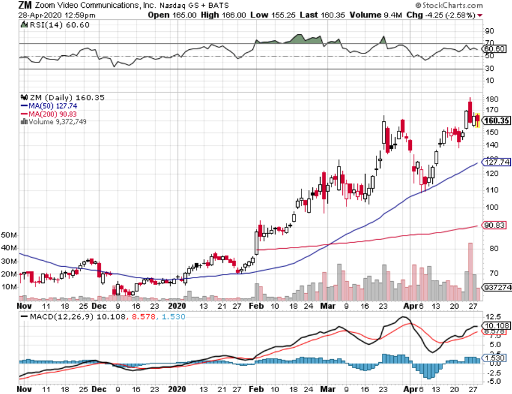
RingCentral is fighting with Zoom to be at the top of the food chain.
The company’s robust cloud communication platform ties together message, call, and video.
The open platform nature allows for easy integrations and strong brand equity.
The stats don’t lie with RingCentral reporting 30%-plus revenue growth in each of the past three years.
The company is growing out of their ears and when you add in a favorable margin profile, this robust revenue growth will lead into equally robust profit growth cycle.
I will assume in my model that the company will grow 20% over the next 10 years with several hundred basis points of gross margin expansion.
If the company can hit these moderate performance targets, I can’t imagine anything other than the stock being much higher than it is today in the future.
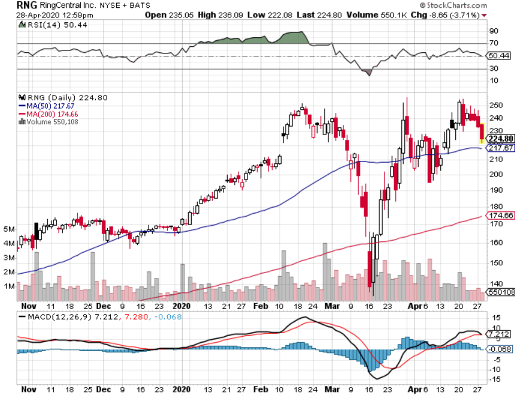
Secular tailwinds cannot be understated as the stock is on the verge of surpassing its prior high of $245, making a perfect V-shaped recovery from the nadir of $139, and breaking out as the rest of the economy comes back online.
The almost doubling of the stock can be extrapolated to many other tech growth stocks that have experienced similar price action in the past 45 days.
Slip this one into your portfolio as tech goes from strength to strength.
Global Market Comments
April 20, 2020
Fiat Lux
Featured Trade:
(MARKET OUTLOOK FOR THE WEEK AHEAD, or WHAT’S A FED PUT WORTH?),
(INDU), (SPX), (TLT), (ZM), (TDOC),
(NFLX), (UAL), (WYNN), (CCL)


What is a Fed put worth?
That the question that traders and investors alike are pondering.
If the government had taken no action whatsoever in the face of the Corona pandemic the Dow average would easily be at 15,000 today, if not 12,000.
After all, the economic collapse we have seen has been even greater than the Great Depression. More than 22 million unemployed in four weeks? Back then, the Dow Average fell by 90%.
Enter the Feds.
Throw in $6 trillion in expected fiscal spending and $8-$0 trillion in Federal Reserve stabilization of the money markets and quantitative easing, and it makes a heck of a difference. As a result, the national debt will rocket from $23 trillion to at least $32 trillion by next year, a far faster increase than seen after Pearl Harbor.
Stocks love this.
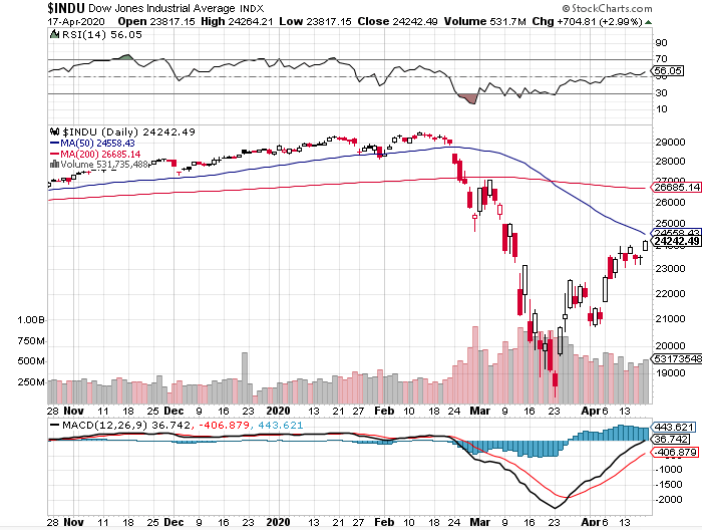
In the past three weeks, the Dow Average has jumped an eye-popping 35% from 18,000 to over 24,000. We are likely trading at 25 X 2020 earnings, but that is just a guess at best. Nobody knows, with essentially all companies withdrawing guidance. On a valuation basis, stocks are now more expensive than at any time since 1929.
You can be excused for being confused, befuddled, and gob-sacked.
All of this adds up to a value of the Fed put of 9,000 in Dow Average terms, 17,000 in a worst-case scenario, and 27,000 if you want to go back to 1933 share valuations.
Stocks here are now priced for perfection. To buy shares here, you are making the following rosy assumptions:
1) The Corona epidemic is peaking and it is clear sailing from here.
2) Shelters-in-place ends in two weeks.
3) Critical shortages of medical supplies end.
4) US Deaths top out at 60,000 from the current 40,000, the most optimistic White House forecast.
4) Business will immediately bounce back to pre-epidemic levels
5) Domestic and international travel resume immediately
If all of the above take place, then at a stretch, shares are justified at maintaining current levels and will churn sideways from here.
Here is what is more likely:
1) We are nowhere close to a peak, especially in states that never sheltered-in-place, and there could be a secondary peak in the fall. At 2,000 a day, US deaths will easily top 100,000 in a month.
2) Shelters-in-place will extend to June in the most populous states.
3) Medical supply shortages will continue for the indefinite future, with 50 states bidding against each other to buy fake masks from China.
4) Dozens of large companies and perhaps a quarter of the country’s 30 million small businesses will go bankrupt before the recovery begins.
5) There is no sign that domestic and international travels are getting off the runway anytime soon.
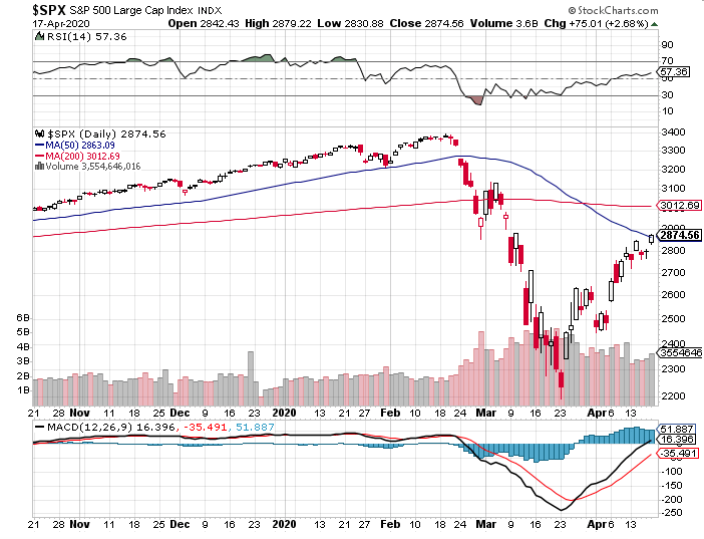
If that is the case, then stocks here that are wildly overpriced are due for a retest of the Dow 18,000 and (SPX) 2,400 lows.
No matter what happens, traders should be cognizant of an enormous bifurcation of the market that has taken place.
Stay at Home stocks, like Zoom (ZM), Teladoc (TDOC), and Netflix (NFLX), have spectacularly outperformed the market. Many of these had already been recommended by the Mad Hedge Technology letter and the Mad Hedge Biotech & Healthcare letter because they were leaders in their own technologies (click here).
The problem with these companies is that they are all expensive, in some cases trading at hundreds of times their earnings.
Then there are the Reopening Stocks that will deliver outsized returns once we make it to the downslope of the epidemic. These include United Airlines (UAL), Wynn Hotels (WYNN), and Carnival Cruise Lines (CCL), which we heavily sold short near the market top, and led the recovery of the last three weeks.
The problem with these companies is that they may have to go bankrupt first, or at least accept a heavy government ownership and dilution of existing shareholders before they return to normal.
It’s a quandary that would vex Solomon.
I always tell people, if you want to make an easy, reliable, and safe living, get a job at the Post Office. Avoid the stock market.
OPEC cut oil production by 10 million barrels/day, for two months, and then 8 million barrels a day for the rest of the year. Oil prices plunged anyway to a 20-year low at $18.50 a barrel, as it only puts a small dent in the 34 million barrel a day oversupply. It only postpones the day when many energy companies go bankrupt.
The Economy could be turning on and off for 18 months, believes Fed governor Neil Kashkari. He may be partly right. I am expecting two Coronavirus waves to lead to two shutdowns in the spring and fall, and the stock market may reflect the same. If so, stocks are wildly overpriced here, and the bear market could last another year. Sell shorts, or at least add hedges, and buy the (SDS).
US Budget Deficit to top $3.8 trillion this year, the most since WWII. We were already headed for a monster $1.5 trillion in red ink before the virus hit. Now we are pouring gasoline on the fire. It'sis my worst-case scenario, I had the national debt rising from $23 trillion today to $30 trillion in a decade. It looks like that will happen by next year.
Only 90,000 cleared US airport security in one day, down from a typical 2.2 million, or down 95%. It appears that 90,000 people a day don’t care if they get Covid-19 or have already had it. Some 80% of all flights globally are grounded, with many countries now stranded. With massive debt loads, it is only a question of how soon the big US airlines go bankrupt and how much the government gets to own on the way back up. Don’t buy any airlines no matter how cheap they get.
US Retails Sales collapsed by 8.7% as the paycheck-free economics takes hold. The March Empire State Manufacturing Index crashed to a record low of 78% and March Industrial Production is off 5.4%, the lowest since 1946. The parade of the worst economic data in history has begun. And we go into this with stocks at record high valuations, more expensive than they were in January.
Goldman Sachs says this depression will be four times worse than the Great Recession of 2008-2009, likely falling 35% annualized in Q2. Unemployment will hit 15% or higher, but stocks will not retest the March lows. The bounce back in H2 will be bigger than any seen. It more or less corresponds to my view. They must have some smart people at (GS).
March Homebuilder Confidence brings the biggest crash in history, down 42 points to a reading of only 30. It's the greatest decline since the 35-year history of the index. The last time we were this low was in June 2012. Some 21% of builders are reporting virus disruption.
Housing Starts collapsed a stunning 22.3% in March, the worst one-month figure ever recorded. Social distancing makes open houses impossible. But this will be one sector that leads us out of the depression. There is still a chronic generational housing shortage.
Weekly Jobless Claims topped 5.1 million, taking the grim four-week tally to a staggering 21 million. Out of the frying pan, into the fire.
Gilead Sciences (GILD) drug sent stocks soaring, up 900 points overnight. Its Remdesivir brought rapid recovery in already infected patients at the University of Chicago in a phase three trial. The market is hypersensitive to any good Corona news. Sell into the rally.
China GDP took a 6.8% hit in Q1 as the Corona pandemic takes its toll. Services are recovering faster than manufacturing, which is why the smog has not come back yet. And international trade has ground down to zero. Public transit has been abandoned for private cars. It could be a preview to our own recovery.
When we come out on the other side of this, we will be perfectly poised to launch into my new American Golden Age, or the next Roaring Twenties. With interest rates at zero, oil at $18 a barrel, and many stocks down by three quarters, there will be no reason not to. The Dow Average will rise by 400% or more in the coming decade.
My Global Trading Dispatch performance recovered nicely this week, thanks to some frenetic trading. I used the Monday 700-point dive in the market to cover most of my bearish positions and add short-dated longs in Apple (AAPL) and Facebook (FB).
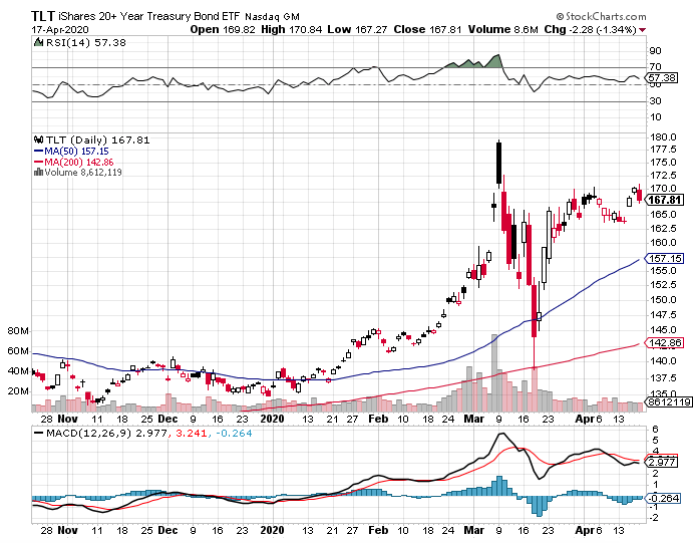
Finally, I dove back into selling short the US bond market on the assumption that unprecedented borrowing will destroy prices.
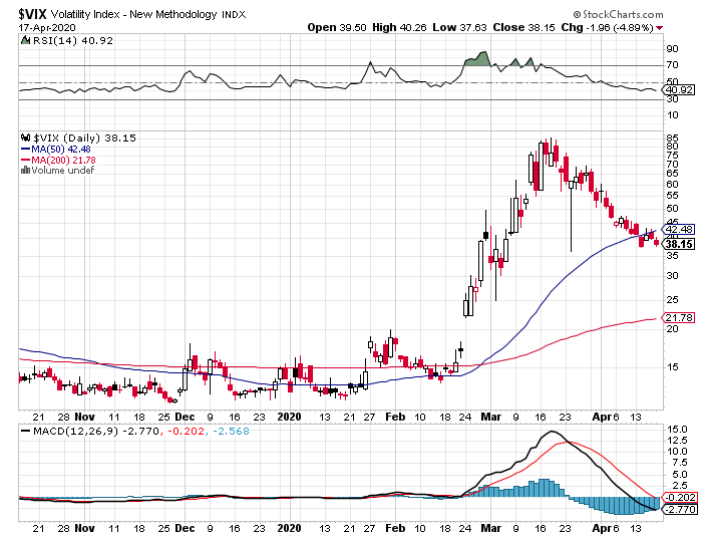
My short volatility positions (VXX) were hammered again, even though volatility declined on the week. There seems to be heavy short selling of deep out-of-the-money puts on the assumption that the Volatility Index (VIX) won’t rise above $50 again.
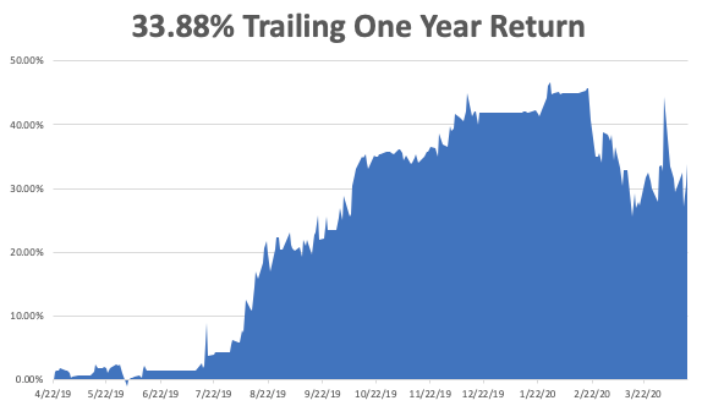
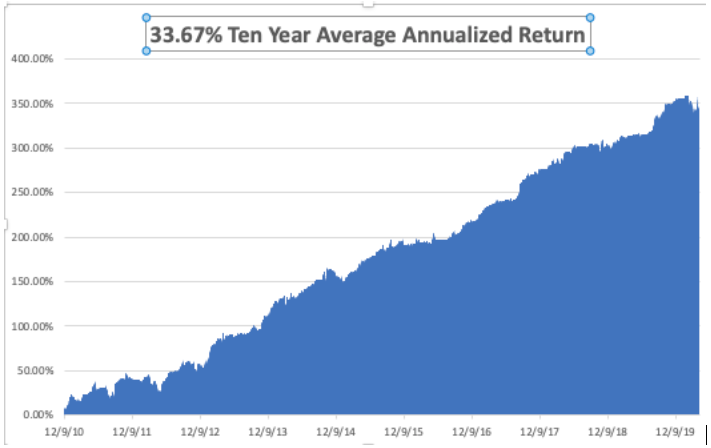
We are now up +0.45% in April, taking my 2020 YTD return down to -7.97%. That compares to a loss for the Dow Average of -15% from the February top. My trailing one-year return returned to 33.88%. My ten-year average annualized profit returned to +33.67%.
This week, Q1 earnings reports continue, and so far, they are coming in much worse than the most dire forecasts. The only numbers that count for the market are the number of US Coronavirus cases and deaths, which you can find here.
On Monday, April 20 at 7:30 AM, the Chicago Fed National Activity Index comes out.
On Tuesday, April 21 at 9:00 AM, the March Existing Homes Sales are released.
On Wednesday, April 22, at 9:30 AM, the Cushing Crude Oil Stocks are announced.
On Thursday, April 23 at 8:30 AM, Weekly Jobless Claims will announce another blockbuster number.
On Friday, April 24 at 7:30 AM, US Durable Goods for March are printed. The Baker Hughes Rig Count follows at 2:00 PM. Expect these figures to crash as well.
As for me, I am sitting here eating a pineapple upside-down cake that my daughter just whipped up. It's my favorite cake made by my mother, which I always got on my birthday.
Of course, I have to wash the dishes. If anyone wants to supplement their trading income, housekeeper and domestic and wants to live in mansions at Lake Tahoe and San Francisco, please contact customer support immediately.
Stay healthy.
John Thomas
CEO & Publisher
The Diary of a Mad Hedge Fund Trader

Global Market Comments
April 15, 2020
Fiat Lux
Featured Trade:
(GOODBYE TO THE OLD WORLD, HELLO TO THE NEW)
(TGT), (WMT), (ZM), (NFLX), (PYPL), (SQ), (AMZN), (MSFT)


With the ongoing impacts of coronavirus, our world is suddenly changing beyond all recognition.
The WWII comparisons here are valid. Just as technological innovation accelerated tenfold from 1941-1945, bringing us computers, penicillin, jet engines, and the atomic bomb, the same kind of great leaps forward are happening now.
The end result will be a faster rate of innovation and economic growth, greater corporate profits in the right industries, and a hugely performing stock market. It perfectly sets up my coming Golden Age and the next Roaring Twenties.
Living in Silicon Valley for the last 25 years, I have gotten pretty used to change. But what is happening now is mind-boggling.
The bottom line for the impacts of the coronavirus pandemic has been to greatly accelerate all existing trends. The biggest one of these has been the movement of the economy online, which has been taking place since the eighties. Except that it is now happening lightning fast. Business models are hyper-evolving.
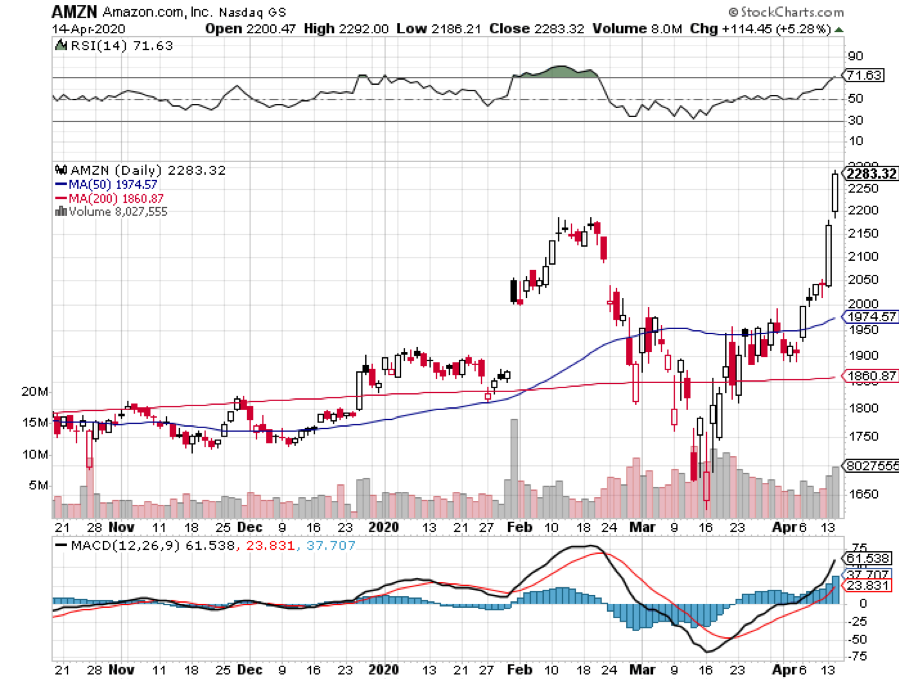
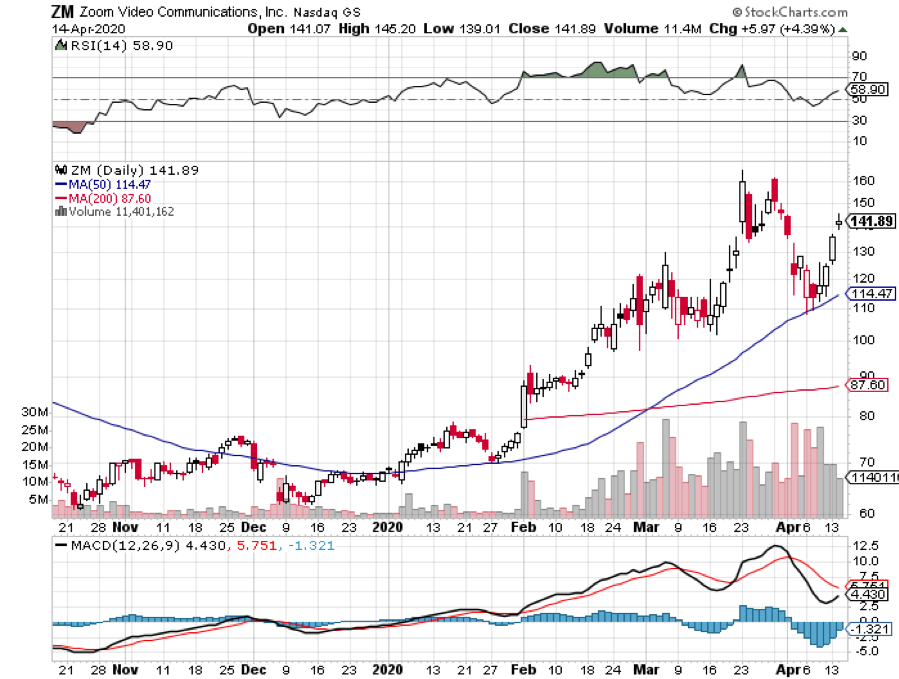
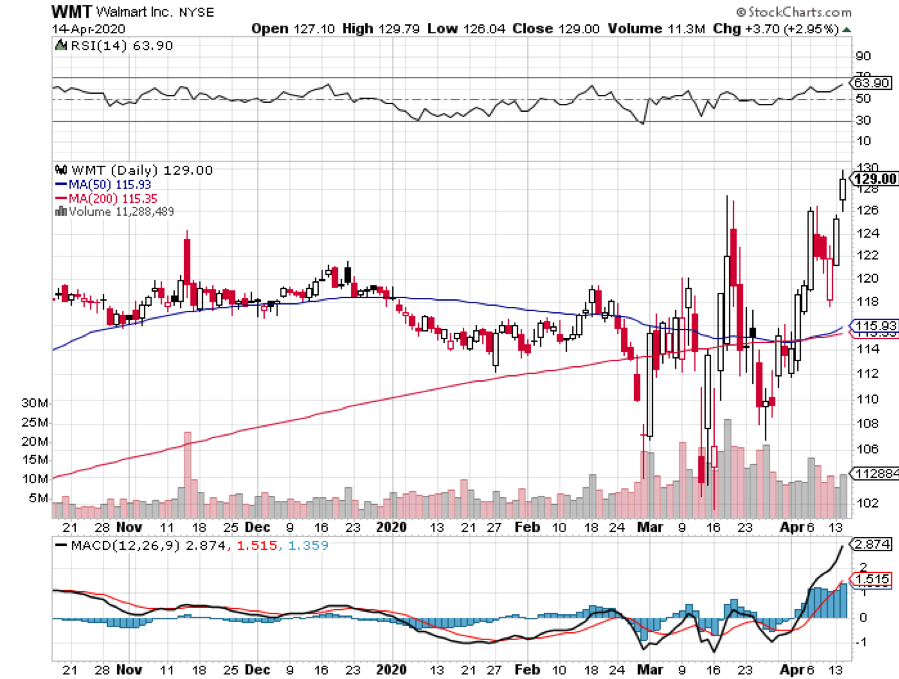
Legacy brick and mortar companies must move online or perish, as much of the restaurant business is now doing. Target (TGT) and Walmart (WMT) have accomplished this. Those with feet in both worlds are closing down their physical presence and going entirely digital. Pure digital companies, like Zoom (ZM), Netflix (NFLX), PayPal (PYPL), and Square (SQ) are booming.
The side effect of the virus may be to move an even greater share of America’s business activity to the San Francisco Bay area and Seattle. Almost all tech companies here are hiring like crazy. Amazon has announced plans for hiring a staggering 175,000 since the epidemic started, as millions shift to home delivery of everything.
The productivity of tech is also growing by leaps and bounds. Since everyone is working at home, no one wastes two hours a day commuting. Meetings in person are a thing of the past. Everything now happens on Zoom.
The whole mental health industry is now conducted on Zoom. So is much of non-Corona related medicine. And I haven’t seen my accountant in years. I think he died, replaced by a younger, cheaper clone.
Even my own Boy Scout troop has gone virtual. The National Council is offering 58 online merit badges, including Railroading, Stamp Collecting, and Genealogy (click here for the full list).
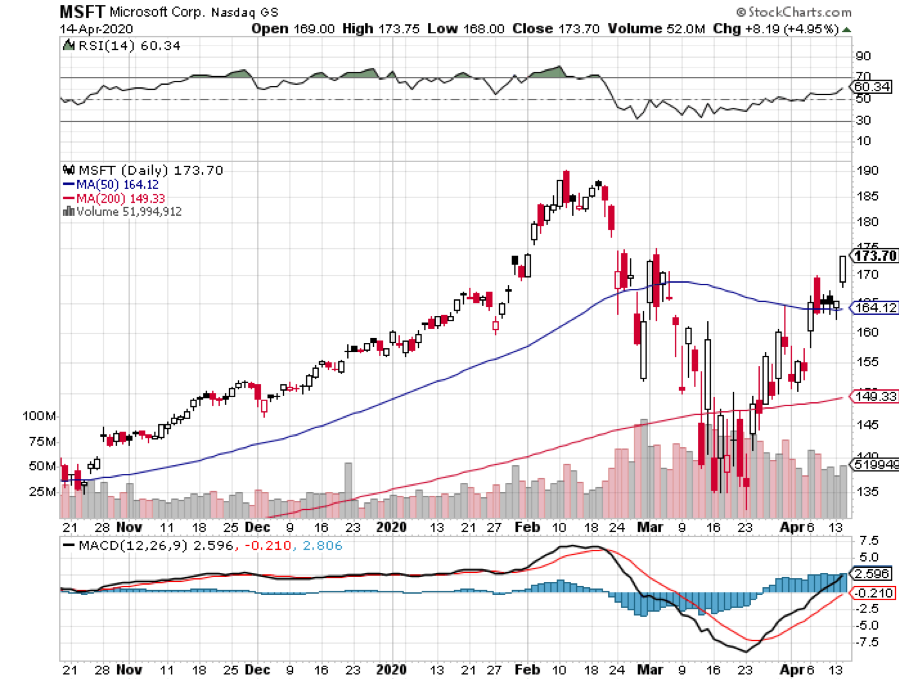
The stock market has noticed and several tech companies like Microsoft (MSFT) and Amazon are showing positive gains for 2020. Many legacy companies see share prices still down 80% or more. Sector selection for portfolio mangers has essentially shrunk from 100 to only 2: tech/biotech and healthcare.
Business models are evolving at an astonishing rate. Who knew the yoga instructor in Chicago was much better than the one down the street, thanks to Skype.
Education is now entirely online and much of it may never go back to school. My kids are totally comfortable in this new world. They have been social distancing since I bought them their own iPhones five years ago.
Now, if I can only figure out how to do my own haircut, the third most searched term on Google. It’s longer than at any time since the summer of love in 1967.
These are just a few of the practical impacts of coronavirus. The social changes are equally eye-popping.
While death rates are soaring, crime has fallen by up to 75%. So have deaths from car accidents. Alcohol and domestic abuse have gone through the roof. Drug addiction is plummeting because dealers are afraid to go out on the street.
There are many lessons to be learned from this crash. Too many companies drank the Kool-Aid and assumed business conditions would remain perfect forever.
Let's call a spade a spade. The year 2019 and the first two months of 2020 were the bubble top. All the growth in stock prices then were pure fluff.
That means you didn’t need costly reserves ran on thin margins, borrowed like crazy at artificially low-interest rates, and kept endlessly buying back your own stock and paying generous dividends.
Manufacturers didn’t need inventories, counting on a seamless, global supply chain to keep assembly lines running. “Just in time” has switched to “just-in-case.” Companies are going to have to keep enough inventories in the warehouse to guard against future disease-driven disruptions. This will raise costs and shrink profits.
It’s really hard to see how entire industries are going to come back. Cruise ships were packing guests onboard like sardines in a can to make money. I bet it will be a while before you sit at a crowded casino blackjack table. Want to stand in line at a popular chain restaurant?
Airlines have become the poster boy for the evils of bubblicious management. They flew full most of the time, seating their customers shoulder to shoulder, yet their net profit per fight depended on selling that last economy class seat.
The industry spent $50 billion in dividends and the buyback of shares that are now largely worthless, while senior management laughed all the way to the bank. They were the only industry to actually list a global pandemic as a major risk to their business in their SEC filings.
Now they want a government bailout at your expense.
As for me, I am looking forward to this brave new world. Until then, I’ll be spending my afternoons getting in shape hiking in the High Sierras, long hair and all. I’m the only one up here. Maybe it will scare the mountain lions away.