Vaccines have long been shoved to a sleepy little corner of the biopharmaceutical world, ruled over by a handful of companies that cater to billions of dollars’ worth of demand for vaccines every year, undisturbed by newcomers.
However, the COVID-19 pandemic has made this particular corner of the industry a tad more crowded.
While there’s still no clear picture of how the next stage of the efforts to vaccinate the majority of the human population against COVID-19 will work out, what’s evident is that the dominance of the “big four” publicly-traded vaccine developers will be challenged.
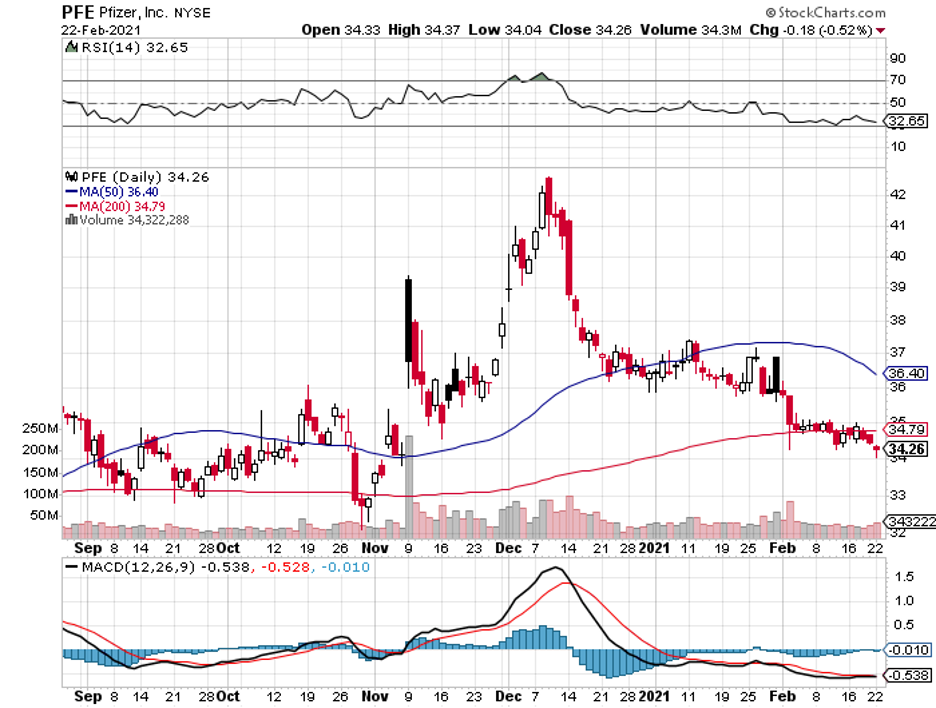
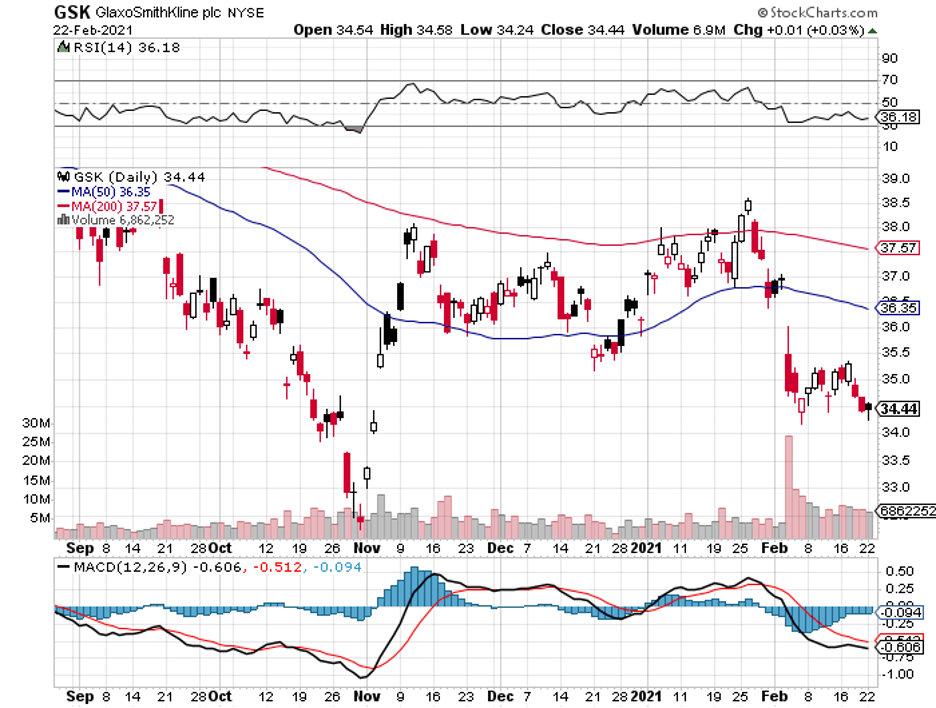
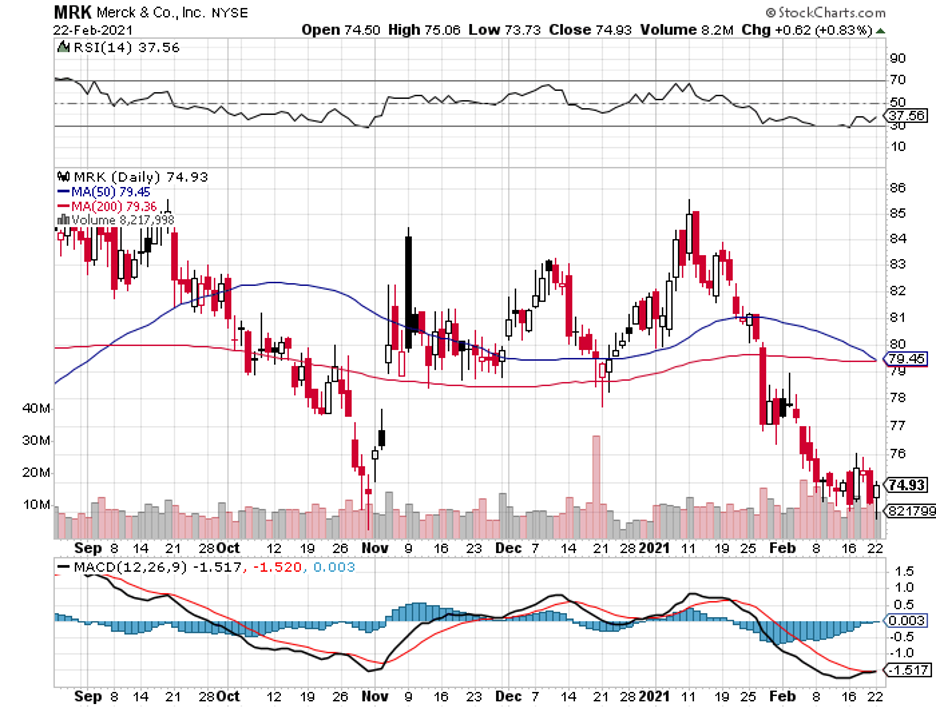
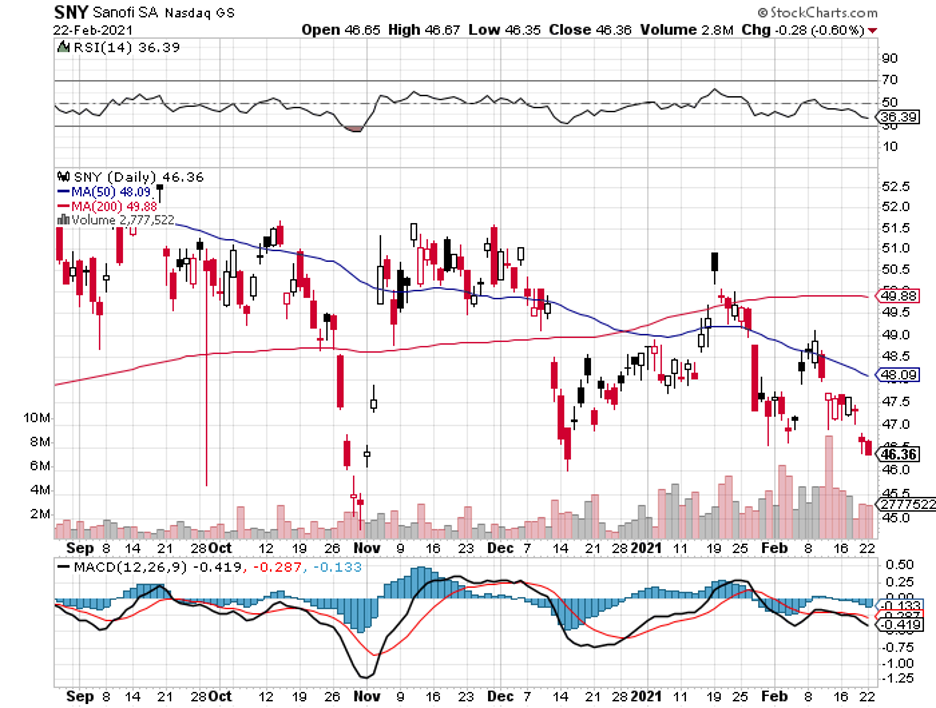
That means the battle for supremacy in the vaccine market will no longer be confined within Pfizer (PFE), GlaxoSmithKline (GSK), Merck (MRK), and Sanofi (SNY).
As we’ve witnessed, the COVID-19 pandemic has provided entry points for new names in the industry, such as Moderna (MRNA), BioNTech (BNTX), and Novavax (NVAX).
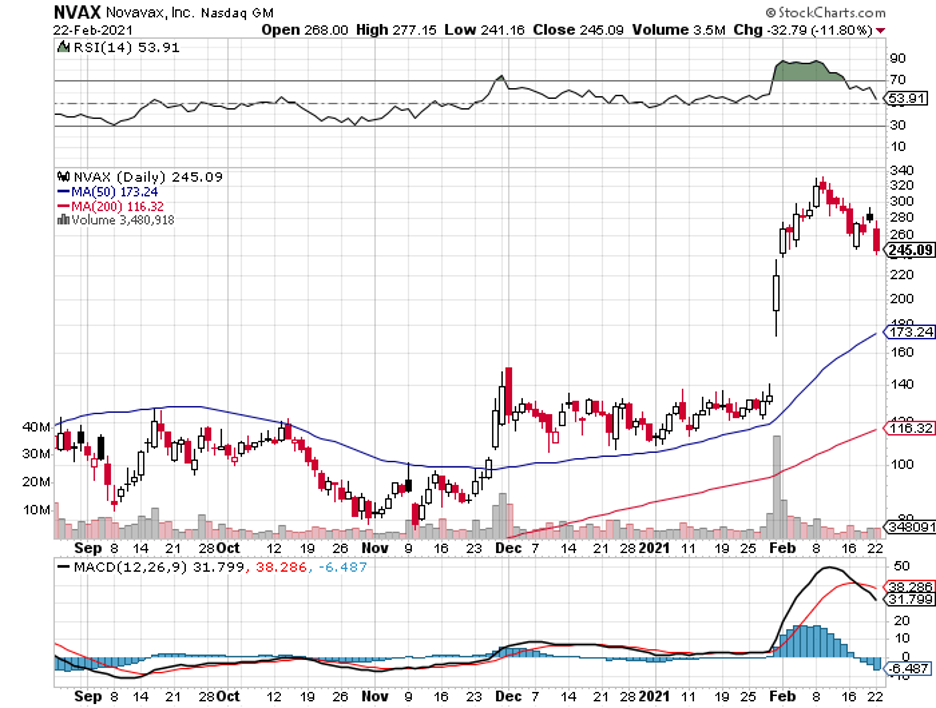
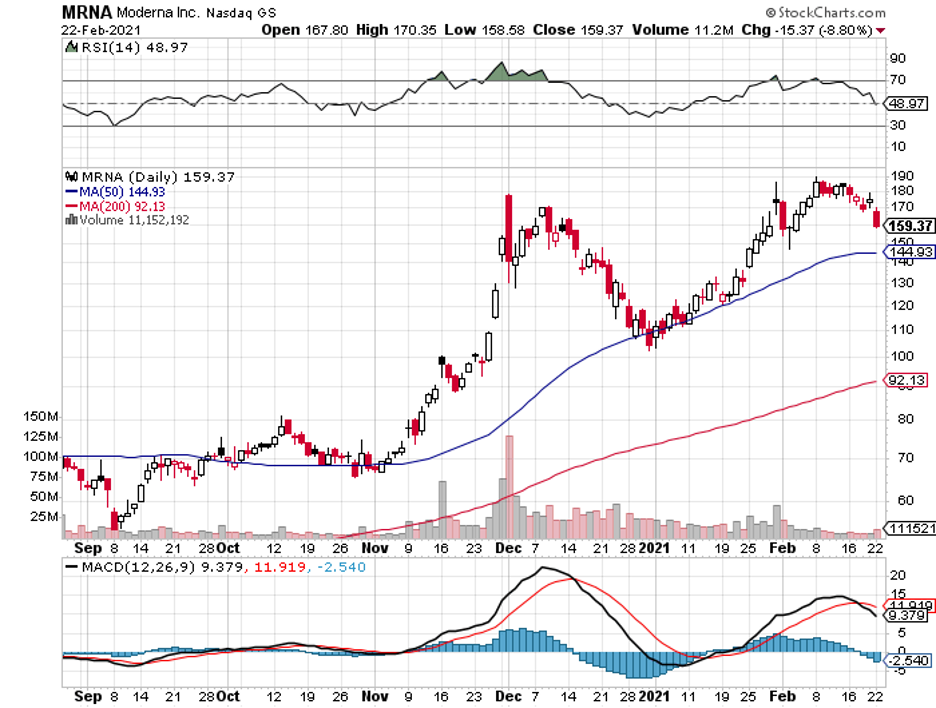
By the second half of 2021, Novavax and its partners are targeting to supply 150 million doses of their vaccine, while Moderna says it would be distributing at least 600 million doses this year alone—a number that could reach a billion given the right partners in the future.
Those numbers are on par with global-level vaccine production—with Novavax and Moderna quickly gaining steam and catching up with the big players in the industry.
For context, Sanofi made 250 million doses of its own flu vaccine for the 2021 flu season.
Given that Novavax also plans to release its own flu vaccine combined with the smaller company’s momentum, Sanofi is looking at a long-term rival in this sector.
Aside from offering these smaller biotechs opportunities for growth in terms of business, the pandemic has fast-tracked the advent of next-generation technologies in the industry.
Both Pfizer and Moderna have been approved to use the pioneering messenger RNA technology to develop their COVID-19 vaccine candidates.
Apart from mRNA technology, a similarly revolutionary approach is being explored by Johnson & Johnson (JNJ): viral vector technology.
Meanwhile, AstraZeneca (AZN) and its partner Oxford University came up with their own viral vector vaccine, which has been approved in Europe.
As for Novavax, this Maryland-based company has decided to use the more conventional approach utilizing a protein subunit vaccine.
Although the exact size of the COVID-19 market is difficult to predict, it’s safe to say that it will be massive.
In terms of who could eventually get the lion’s share of the market, Pfizer is currently leading at the moment based on the government contracts the company managed to secure.
Pfizer estimates $15 billion in revenue from the COVID-19 vaccine in 2021—a number that’s two and a half times higher than its best-selling drug in 2020.
Moderna projects at least $10 billion in COVID-19 vaccine sales, while Novavax anticipates roughly $3.4 billion this year.
In the future though, there’s strong indication that AstraZeneca and JNJ will be vying for dominance for mass-market contracts. This is primarily because of their one-dose vaccine promise and the convenient storage requirements their candidates offer.
Another massive growth prospect for this vaccine is if the need for yearly boosters sticks around. This market would not only be lucrative for smaller companies like Novavax and Moderna, but even for the bigger vaccine players.
Considering the potential of this market, the current leaders of the COVID-19 vaccine race shouldn’t get too comfortable.
In fact, Sanofi and GlaxoSmithKline have already joined forces to create their own COVID-19 vaccine candidate.
So while Pfizer, Moderna, and AstraZeneca already have their products out the door, other vaccine developers still consider themselves in the running to topple them from their perch.
https://madhedgefundtrader.com/wp-content/uploads/2019/05/cropped-mad-hedge-logo-transparent-192x192_f9578834168ba24df3eb53916a12c882.png00Mad Hedge Fund Traderhttps://madhedgefundtrader.com/wp-content/uploads/2019/05/cropped-mad-hedge-logo-transparent-192x192_f9578834168ba24df3eb53916a12c882.pngMad Hedge Fund Trader2021-02-23 14:00:512021-03-02 13:44:43Is This the Year of Biotech Upstarts?
The fuss over GameStop (GME) has aimed the spotlight on several small- and even mid-cap stocks that hold a high level of short interest.
For quite some time now, retail investors have been identifying others with similar qualities as GME: a short interest standing at more than 20% of the total float, a market capitalization above $1 billion, and a stock price of roughly $20 per share or even less.
Now, these traders have turned their attention to the biotech industry and one stock that caught their attention is Sorrento Therapeutics (SRNE).
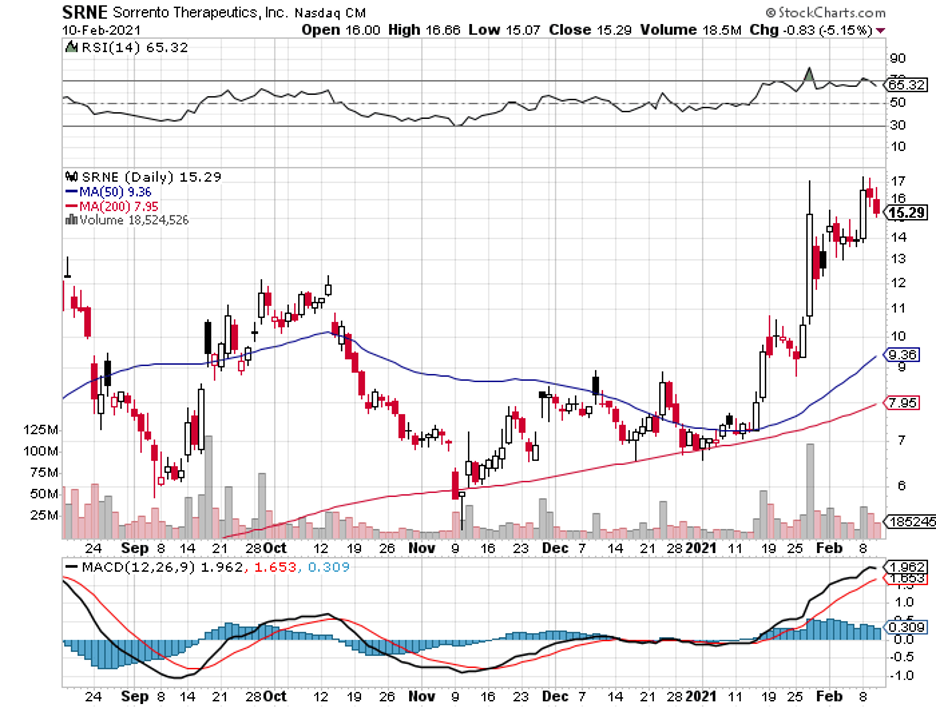
In 2020, Sorrento was hailed as one of the hottest COVID-19 stocks as it jumped an impressive 135% since the year started.
However, the hype dissipated quickly, with the stock falling almost 50% by August that same year.
The company’s volatility was expected considering Sorrento’s early entry, but delayed progress in the COVID-19 race.
As 2020 rolled out, investors started ditching the stock in favor of other developers like Moderna (MRNA), Pfizer (PFE), BioNTech (BNTX), Novavax (NVAX), and AstraZeneca (AZN).
Come 2021, however, the stock seems to bounce back.
Sorrento’s shares have been climbing since the year started following the company’s encouraging data on COVI-MSC, which is its entry in the race to find a potent COVID-19 treatment.
COVI-MSC works as a stem cell treatment developed for COVID-19 patients suffering from acute respiratory distress.
Based on its report in January, Sorrento disclosed that the first three individuals who went through their COVI-MSC treatment were discharged from the hospital within only a week.
Meanwhile, the fourth patient, the one who needed mechanical ventilation due to deteriorating respiratory condition, experienced rapid improvement of his condition and was discharged from the hospital the night of his third COVI-MSC infusion.
On a more promising note, none of the patients experienced any adverse effect following their COVI-MSC treatment.
Outside its COVID-19 treatment program, this San Diego-based biotechnology company has been working on therapies for cancer, neurodegenerative, autoimmune, and inflammatory conditions.
It has multiple “shots on goal” particularly in the oncology department, with its non-small cell lung cancer treatment Abivertinib as the leading candidate to date.
Sorrento’s pain management pipeline, which is headlined by Ztildo, is ripe for expansion thanks to its strategic collaboration with SCILEX.
The company also has its hands in other high-growth sectors in the biotech world, paying particular attention to non-opioid pain relief and immunotherapy.
These projects indicate that Sorrento is no one-trick pony.
In fact, even if its COVID-19 program falls flat – a very real possibility considering that COVI-MSC still needs to go through multiple trials – Sorrento has several initiatives to fall back on.
With three shots on goal, namely, its COVID-19 program, its oncology platform, and non-opioid pain treatment, Sorrento has ensured that it’s well-positioned for success.
If approved, Sorrento’s current pipeline comprising diagnostic kits and therapies could generate over $2 billion in short-term sales.
At the moment though, Sorrento’s $4.02 billion market capitalization makes it a tiny biotechnology company compared to its competitors.
Given its robust pipeline, it’s evident that Sorrento still needs to boost its capitalization to push through with all the plans.
For context, its most dominant rival in the COVID-19 treatment market is Gilead Sciences (GILD), which has $84.38 billion in market capitalization, rakes in $800 million each quarter from sales of Remdesivir.
Let’s say Sorrento expands to the vaccine market, it still cannot catch up with the leader in that arena, Moderna (MRNA), which has $70.97 billion in market capitalization.
Looking at Sorrento’s performance, this company remains an underappreciated stock loaded with potential.
From a business perspective, Sorrento offers a solid pipeline of candidates that could present promising results to push the stock price up.
At this point, the positive updates on its COVID-19 program can cause the stock price to rise exponentially, putting short sellers looking in an unfortunate position.
Overall, Sorrento has the potential to double in value. However, bear in mind that it still has a long way to go. Hence, this company is best as a long-term investment.
https://madhedgefundtrader.com/wp-content/uploads/2019/05/cropped-mad-hedge-logo-transparent-192x192_f9578834168ba24df3eb53916a12c882.png00Mad Hedge Fund Traderhttps://madhedgefundtrader.com/wp-content/uploads/2019/05/cropped-mad-hedge-logo-transparent-192x192_f9578834168ba24df3eb53916a12c882.pngMad Hedge Fund Trader2021-02-16 15:00:562021-02-18 22:07:52Short-Squeeze Drama: Biotech Edition
Thanks to COVID-19, a new generation of biotechnology players are gaining more traction in the market these days.
For decades, the biotech industry has been notoriously difficult to break into.
However, the pandemic has served to level the playing field—and the small-cap biotechs are definitely taking advantage of the opening.
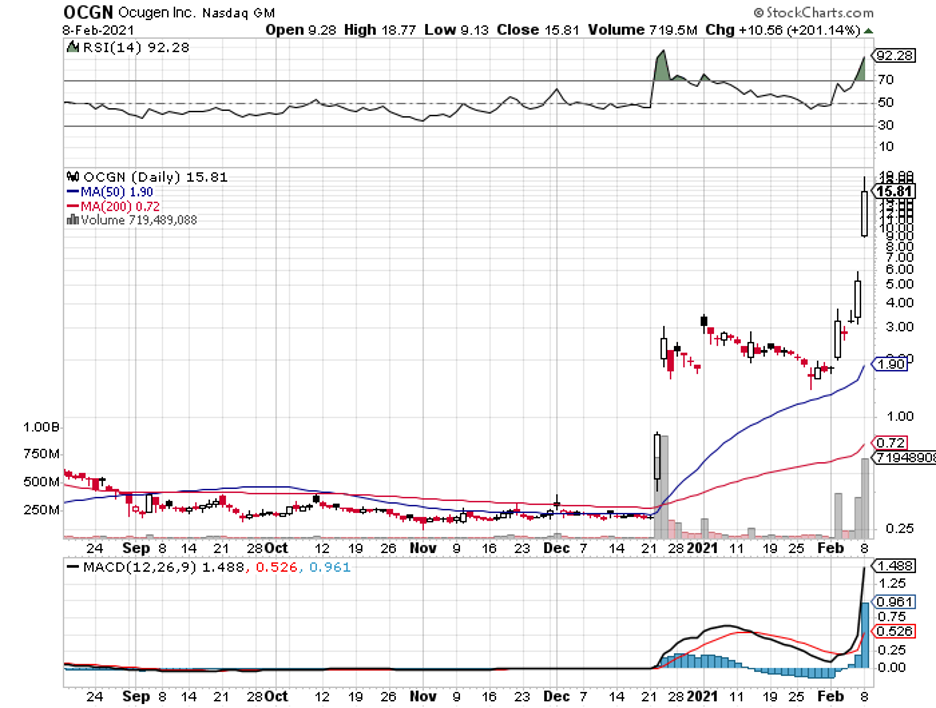
The latest to cash in on the opportunity is Ocugen (OCGN).
Founded in 2013, this Pennsylvania-based biotechnology company attracted media attention when it announced its partnership with India’s Bharat Biotech earlier this month.
The agreement between the two companies centered on Bharat’s COVID-19 vaccine candidate, Covaxin, which Ocugen plans to bring to the United States as soon as possible.
Ocugen will hold the US rights to Covaxin and be in charge of the development, regulation, and even commercialization within that market.
Even without any upfront payment, Ocugen will get 45% of the profits from the US markets in return.
While the news only broke this year, the partnership between the two has been months in the making, with Ocugen reaching a tipping point in December 2020 when it recorded a jaw-dropping 800% rise.
When this deal was announced, Ocugen shares were projected to rise from $4.50 to $8, showing off an already impressive increase from its measly 29 cents valuation less than a year ago.
Ocugen blew past those projections though as it’s now trading at $15 per share.
The kicker? The stock still has room to grow.
Realistically speaking, Ocugen shares can reach $20 to $25 after FDA approval this year. If its other candidates in the pipeline work out, then we can even see it hit $50 at some point.
Considering that Ocugen was able to sell 3 million common shares at a price that’s 46% higher than where the stock was when it closed last Friday, it’s clear that there’s a lot of optimism on the company these days.
The next question is this: Will Covaxin even gain approval in the US?
It can.
If it’s any indication, Covaxin has already been granted emergency use authorization in India.
Moreover, Covaxin was developed by Bharat, which is a highly reputable biotechnology company in India with 25 years of experience in the vaccine-making industry.
In fact, Bharat has developed over 16 vaccines and four bio-therapeutics, so it’s safe to say that the company knows its way around the business.
More than that, Bharat is confident that Covaxin can be effective against the new UK and South African variants of the coronavirus, making this vaccine candidate more potent than the other products under development today.
Unlike the vaccines of Pfizer (PFE) and Moderna (MRNA), Covaxin does not need ultra-cold freezers for storage. It can simply be stored at room temperature, making it a convenient option for a lot of distributors.
Prior to its deal with Bharat, Ocugen has been focused on its gene therapy which carries the potential to treat multiple retinal diseases with just one drug.
They call their breakthrough technology “one to many,” meaning the product could be the answer to several eye-related diseases.
Some of the rare conditions Ocugen has been working on are wet age-related macular degeneration, diabetic macular edema, and diabetic retinopathy.
Ocugen’s growth prospects, especially in 2021, heavily relies on the company’s ability to get an emergency use authorization for Covaxin in the US.
This means that investors should brace themselves for volatility in the next months as the vaccine candidate moves forward with the clinical trials.
In terms of long-term prospects, it remains to be seen how Ocugen will take advantage of the momentum it gained from the COVID-19 partnership with Bharat.
https://madhedgefundtrader.com/wp-content/uploads/2019/05/cropped-mad-hedge-logo-transparent-192x192_f9578834168ba24df3eb53916a12c882.png00Mad Hedge Fund Traderhttps://madhedgefundtrader.com/wp-content/uploads/2019/05/cropped-mad-hedge-logo-transparent-192x192_f9578834168ba24df3eb53916a12c882.pngMad Hedge Fund Trader2021-02-09 14:00:112021-02-14 15:05:09New Generation of Biotech Players
Below please find subscribers’ Q&A for the February 3 Mad Hedge Fund TraderGlobal Strategy Webinar broadcast from Incline Village, NV.
Q: Is there a big difference between COVID-19 vaccines?
A: The best vaccine is the one you can get. It’s better than being dead. But there are important differences. The Pfizer (PFE) and Moderna (MRNA) vaccines are RNA vaccines, they’re very safe, and getting similar results. But the evidence shows that about 15% of Moderna recipients are coming down with flu-like symptoms on their second shot. Nobody knows why, as the two are almost biochemically identical. AstraZeneca is a killed virus type vaccine, which means if they have a manufacturing error, you end up giving the disease to people by accident, as with the original polio vaccine. So that's the less safe vaccine. So far, that one has only been used in Europe and Australia, as it is made in England. There isn’t enough data about the John & Johnson (JNJ) single-shot vaccine.
Q: Is Moderna (MRNA) a long term buy?
A: The trouble with all the vaccine plays is that we’re heading for a global vaccine glut in about 4 months when we’ll have something like 12 companies around the world making them. The rush for everyone to get a vaccination as soon as possible is leading to inevitable overproduction and falling stock prices. Moderna is already a 12 bagger for us. I’m not really looking to overstay my welcome, so to speak. Time to cash in and say, “Thank you very much, Mr. Market.” There will be another cycle down the road for (MRNA) as its technology is used to cure cancer, but not yet.
Q: Would you recommend a silver (SLV) LEAP?
A: Yes, silver was run up 35% for a day by the GameStop (GME) crowd and crashed the next day, which was to be expected because there are no short positions in silver. Everything was just hedged to look like there were short positions because the big banks had huge open short options positions that were public and hedges in the futures and silver bars that were private. The (GME) people only saw the public short positions. Long term, I would go for a $30-$32 vertical call spread expiring in 2023. Go out 2 years, and I think you could get silver at $50. So, a good LEAP might get you a 1000% return in two years. Those are the kinds of trades I like to do.
Q: What do you think of Amazon now that Jeff Bezos is retiring?
A: Buy the daylights out of it. That was the great unknown overhanging the stock for years, Jeff’s potential retirement. Now it's no longer unknown, you want to buy (AMZN). Even before the retirement, I was targeting $5,000 a share in two years. Now we have everybody under the sun raising their targets to $5,000 or more— we even had one upgrade today to $5,200. There are at least half a dozen businesses that Amazon can expand into, like healthcare, which will be multibillion-dollar earners. And then if you break it up because of antitrust, it doubles in value again, so that's a screaming buy here. We have flatlined for six months, so this could be a trigger for a long-term breakout.
Q: Is there anything else left after GameStop? Another short play?
A: Well, this was the worst short squeeze in 25 years, and everyone else covered their other shorts because they don't want to get wiped out like the one Melvin Capital. There were only around a dozen potential single-digit heavily shorted stocks out there, and those are mostly gone. So, the GameStop crowd will have to roll up their sleeves and do some hard work finding stocks the old fashion way—by doing research. I’m guessing that GameStop was a one-hit-wonder; we probably won’t be surprised again. At the same time, you should never underestimate the stupidity of other investors.
Q: What do you think of the cloud plays like Cloudera and Snowflake?
A: I love cloud plays and there will be more coming. The entire US economy is moving on to the cloud. But everyone else loves them too. Snowflake (SNOW) doubled on its first day, and Cloudera (CLDR) doubled over the last three months, so they're incredibly expensive and high risk. But you can't argue with their business models going forward—the cloud is here to stay.
Q: Would you buy LEAPS in financials?
A: Absolutely yes; go out two years for your maturity and 30% on your strike prices, you will get a ten bagger on the trade. If I’m wrong, it only goes to zero.
Q: Is US Steel (X) a buy?
A: Yes. They are being dragged up by the global commodity boom triggered by the global synchronized recovery. (X) took a hit today because they just priced a $700 million secondary share issue which the flippers dumped like a hot potato. If given the choice, I’d rather do a copper play with Freeport McMoRan (FCX) which is seeing much more buying from China. I bought it on Monday.
Q: Any chance you can include one-, three-, and five-year price targets?
A: No chance whatsoever. I’ve never heard of a fund manager that could do that and be right. Stocks are just too imprecise an instrument with all the emotion that’s involved. But for the better stocks, you can with confidence predict at least a double. And by the way, all my predictions for the last 13 years have been way, way on the low side, so I tend to be conservative. Like, remember when Amazon was at $10? I said it would go to $20. Boy was I right!
Q: How can you say the next four years will be good for the stock market?
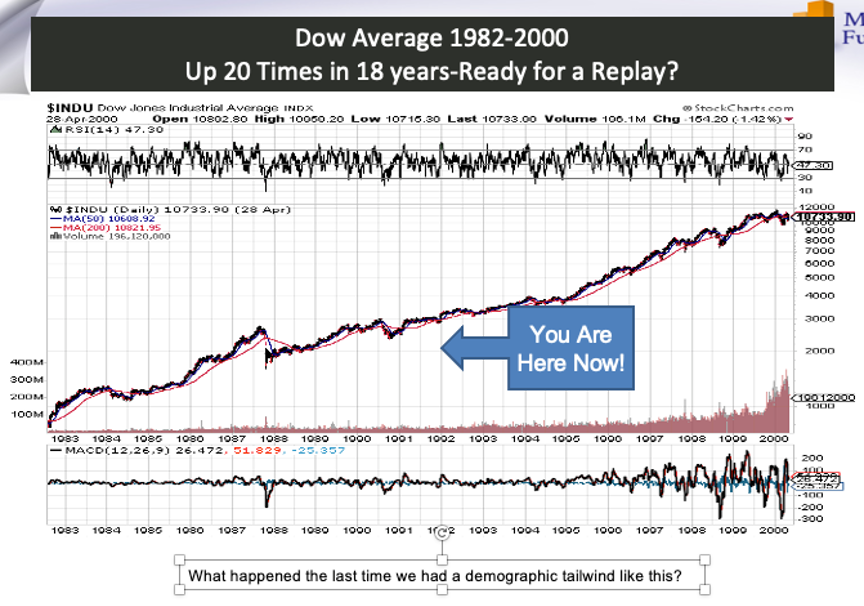
A: Well, $10 trillion in fiscal stimulus, $10 trillion in QE; stocks tend to like that. Oh, and technology exponentially accelerating on all fronts and far more broadly than what we saw in the 1990s. Also, there is a certain person who is no longer president, so add about 10-20% on top of all stock valuations. Companies can finally do long term planning again, after being unable to do so for four years because policies were anti-trade, anti-business, and flip-flopping every other day. So yes, I think that's enough to make the next 4 four years good; and actually, I think the next 8 years could be good—I'm predicting Dow 120,000 by 2030, if you recall.
Q: When do you expect the next 5% correction if there is one? February is always very volatile.
A: With an unlimited liquidity market like we have, it is really tough to see negatives of any kind. What kind of negatives are out there? The pandemic doesn’t stop—that's the main one. There’s another one people aren't talking about: the reason we got all these vaccines so fast is they took all regulation and threw it out the window. What if one of these vaccines kill off a million people? That would be pretty negative for the market. Interest rates could rocket faster than expected. But I’m always short there so that would be a moneymaker. But these are pretty out there possibilities, and that is why the market is not backing off, and when it does, it only gives us 5%.
Q: Is the Fed stimulating the economy too much?
A: The bond market says no with a ten-year yield of 1.10%, and the bond market is always the ultimate arbiter of when the stimulus ends. That’s because the Fed can’t directly control bond market interest rates, only overnight rates. But when we get bonds up to, say, a 3% yield (which is probably 2 or 3 years off), that’s when we’re getting too much stimulus, and we’ll probably take our foot off the pedal way before then. I know Janet Yellen and she agrees with me on this point. She’ll be throttling back well before we see a 3% yield in the Treasury market.
Q: Do you manage other people’s money?
A: No, because it costs a million dollars in legal fees to set up even a small fund these days. When I set up my hedge fund 30 years ago, there were no regulatory costs because no one knew what a hedge fund was; they all thought they were doing something illegal, so they didn't have to register for anything. That’s why it’s changed now.
Q: What is your target on NVIDIA (NVDA), and will it split?
A: It’s an easy double, with a global chip shortage running rampant. They make the best graphics cards in the world, bar none. These big tech companies tend not to split until they get share prices into the thousands, which is what Apple (AAPL) and what Tesla (TSLA) did three or four times.
Q: If we get 3.25% in bonds, is that going to hurt gold?
A: Yes, and that’s one of the reasons I bailed on my gold positions a couple of weeks ago. It effectively turned into a bond long. A sharp rise in interest rates is bad for gold because we all know that gold yields to zero.
Q: What about Fireye (FEYE)?
A: Yes, we also love Fireye in addition to Palo Alto Networks (PANW) because there is a near-monopoly—there are only about six players in the entire cybersecurity industry and hacking is getting worse by the day. Look at the Solar Winds (SWI) fiasco and the national Russian hack there.
Q: What about copper as a recovery play?
A: Well, I voted with my feet on Monday when I bought a position in Freeport McMoRan, after it just sold off 15%. I think (FCX) could double at some point in the coming economic recovery. So, copper is an absolute winner, and when having to choose between copper and steel, I’ll pick copper all day long.
Q: What do you recommend for gold (GLD)?
A: Gold is a trading range for the time being. Buy the dips, sell the rallies; you won’t get more than about 10% or 15% range on that. And there are just better fish to fry right now, like financials, which benefit from rising interest rates as opposed to being punished. Bitcoin is stealing gold’s thunder and the markets keep creating more Bitcoins.
Q: Should high-frequency trading be banned?
A: I don’t think it should be. It does create liquidity; the effect on the market is wildly overexaggerated. They’re basically trading for pennies or tenths of pennies, so they do provide buying on selloffs and selling at huge price spikes. They do have a positive effect and they’re probably only taking about $10 or $20 billion in profit a year out of the market.
Q: Should I buy Wynn Resorts (WYNN) here?
A: Buy the dips for sure; this is a major recovery play. We here in Nevada are expecting an absolute tidal wave of people to hit the casinos once the pandemic ends, and (WYNN), (MGM), and (LVS) would be a great play in those areas.
Good Luck and Stay Healthy.
John Thomas
CEO & Publisher
The Diary of a Mad Hedge Fund Trader
https://www.madhedgefundtrader.com/wp-content/uploads/2021/02/lake-tahoe-sunrise.png460612Mad Hedge Fund Traderhttps://madhedgefundtrader.com/wp-content/uploads/2019/05/cropped-mad-hedge-logo-transparent-192x192_f9578834168ba24df3eb53916a12c882.pngMad Hedge Fund Trader2021-02-05 09:34:282021-02-05 08:16:16February 3 Biweekly Strategy Webinar Q&A
If you were given the chance to choose, how would you prefer to get vaccinated against COVID-19: by getting an injection or by taking a pill?
For a lot of people, it’s a no-brainer to choose the pill—and one biotechnology company has been working hard to turn that into a reality: Vaxart (VXRT).
Last January 2020, Vaxart was only a micro-cap stock focused on developing a lineup of oral-tablet vaccines as treatments for viral infections.
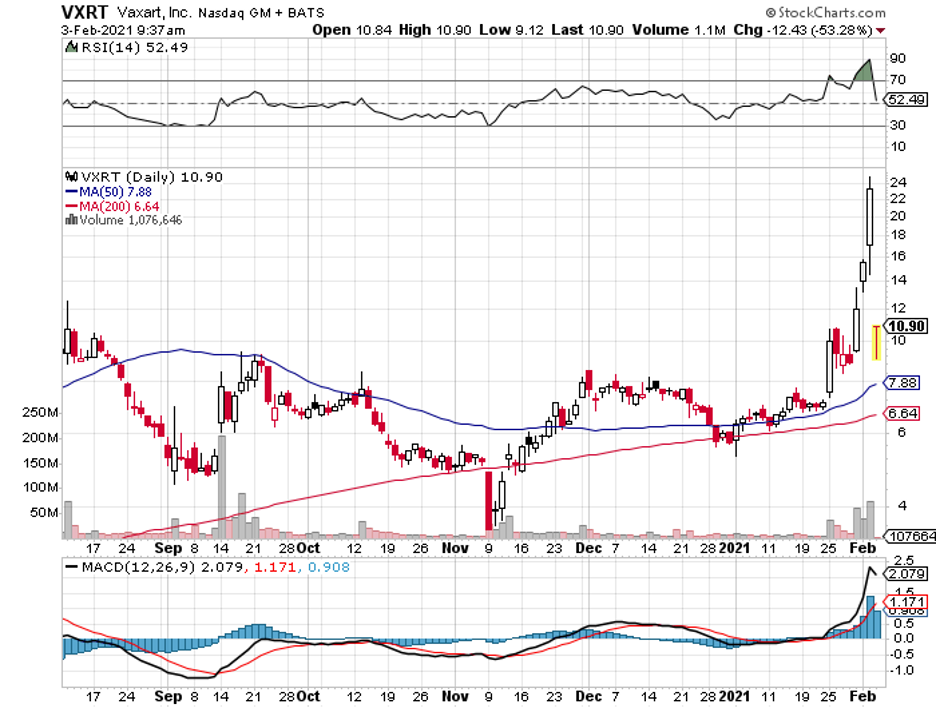
When news broke that the company has been developing a COVID-19 vaccine in the form of a pill, its shares rocketed by over 1,250% in the past 12 months.
From a micro-cap stock trading for as little as $0.70 last year, Vaxart has been trading somewhere between $21 to $23 per share since 2021 started.
In fact, Vaxart even managed to outpace other biotechs already leading in the coronavirus market like Pfizer’s (PFE) partner BioNTech (BNTX), and Moderna (MRNA).
If Vaxart’s vaccine, VXA-CoV2-1, receives regulatory approval, then its COVID-19 vaccine candidate offers key advantages over its rivals.
The first is that VXA-CoV2-1 comes in the form of pills, making it a more convenient and generally preferable option for a lot of patients.
The second is that VXA-CoV2-1 can be stored at room temperature, which eliminates any type of special handling unlike the vaccines of Pfizer-BioNTech, Moderna, and even AstraZeneca (AZN).
The third is that you can take VXA-CoV2-1 on your own. Since these are pills, there is no need for a healthcare worker to administer the COVID-19 vaccine.
This means that VXA-CoV2-1 can be delivered for at-home use.
These advantages effectively eliminate barriers in the healthcare systems, making it easier and more convenient to purchase and deploy VXA-CoV2-1.
Looking at all potential markets, Vaxart could find a niche in underdeveloped regions.
On top of all these conveniences, the technology used to develop VXA-CoV2-1 can also be utilized in creating an oral vaccine against other diseases.
So far, VXA-CoV2-1 is only in Phase 1 of its clinical trials, with new data expected to be released this February.
Prior to this, results showed that VXA-CoV2-1 eased lung viral load and alleviated lung inflammation in hamsters that were infected with COVID-19.
While all these definitely sound amazing, everything is still in very early stages. Plus, results from hamster studies are a far cry from showing efficacy in human beings.
This makes the Phase 1 data release a sort of make-or-break event for Vaxart.
Other than its COVID-19 vaccine candidate, Vaxart has been working on an oral vaccine for influenza as well.
This product is currently undergoing Phase 2 clinical trials and has so far surpassed the efficacy of Sanofi’s (SNY) Fluzone by 8%.
So, is Vaxart the new darling of the biotech world?
It definitely has the potential.
However, its success hinges on everything aligning perfectly. But as a certain guy named Murphy has pointed out, that oftentimes does not happen.
Vaxart is subject to forces beyond its control.
There’s no absolute guarantee that its COVID-19 vaccine candidate will fare well in all the clinical trials.
Vaxart has a viable path of delivering humongous gains this year. However, this path is also riddled with lots of risks.
It is a highly risky stock and is best left to aggressive investors.
Moreover, Vaxart is in a precarious position right now, wherein a failed clinical result in human studies would be devastating for the shares.
On the other side, a positive human data readout would send the shares soaring in the next months.
Truth be told, sky would be the limit for Vaxart’s stock price if FDA actually approves its oral vaccine candidate.
Undoubtedly, Vaxart will be at the center of debates between short-sellers and passionate bulls throughout 2021. The bottom line is that will always be a trade-off of risk and reward in any type of investing.
If you have faith in Vaxart’s science and are confident that you have the stomach for a crazy roller-coaster ride, then you can give this biotech stock a chance.
https://madhedgefundtrader.com/wp-content/uploads/2019/05/cropped-mad-hedge-logo-transparent-192x192_f9578834168ba24df3eb53916a12c882.png00Mad Hedge Fund Traderhttps://madhedgefundtrader.com/wp-content/uploads/2019/05/cropped-mad-hedge-logo-transparent-192x192_f9578834168ba24df3eb53916a12c882.pngMad Hedge Fund Trader2021-02-04 14:00:582021-02-08 15:27:03Is This the Next Biotech Darling?
(MARKET OUTLOOK FOR THE WEEK AHEAD, or GAMBLERS HAVE ENTERED THE MARKET),
($INDU), (TSLA), (TLT), (BA), (JPM), (MS), (GME), (STBX), (GE), (MRNA)
https://madhedgefundtrader.com/wp-content/uploads/2019/05/cropped-mad-hedge-logo-transparent-192x192_f9578834168ba24df3eb53916a12c882.png00Mad Hedge Fund Traderhttps://madhedgefundtrader.com/wp-content/uploads/2019/05/cropped-mad-hedge-logo-transparent-192x192_f9578834168ba24df3eb53916a12c882.pngMad Hedge Fund Trader2021-02-01 11:04:012021-02-01 11:14:29February 1, 2021
Legal Disclaimer
There is a very high degree of risk involved in trading. Past results are not indicative of future returns. MadHedgeFundTrader.com and all individuals affiliated with this site assume no responsibilities for your trading and investment results. The indicators, strategies, columns, articles and all other features are for educational purposes only and should not be construed as investment advice. Information for futures trading observations are obtained from sources believed to be reliable, but we do not warrant its completeness or accuracy, or warrant any results from the use of the information. Your use of the trading observations is entirely at your own risk and it is your sole responsibility to evaluate the accuracy, completeness and usefulness of the information. You must assess the risk of any trade with your broker and make your own independent decisions regarding any securities mentioned herein. Affiliates of MadHedgeFundTrader.com may have a position or effect transactions in the securities described herein (or options thereon) and/or otherwise employ trading strategies that may be consistent or inconsistent with the provided strategies.