Global Market Comments
April 16, 2021
Fiat Lux
Featured Trade:
(APRIL 14 BIWEEKLY STRATEGY WEBINAR Q&A),
(TSLA), (JPM), (ROM), (AAPL), (MSFT), (FB) (CRSP), (TLT), (VIX), (DIS), (NVDA), (MU), (AMD), (AMAT) (PLTR), (WYNN), (MGM)

Global Market Comments
April 16, 2021
Fiat Lux
Featured Trade:
(APRIL 14 BIWEEKLY STRATEGY WEBINAR Q&A),
(TSLA), (JPM), (ROM), (AAPL), (MSFT), (FB) (CRSP), (TLT), (VIX), (DIS), (NVDA), (MU), (AMD), (AMAT) (PLTR), (WYNN), (MGM)

Below please find subscribers’ Q&A for the April 14 Mad Hedge Fund Trader Global Strategy Webinar broadcast from Silicon Valley, CA.
Q: How do you choose your buy areas?
A: It’s very simple; I read the Diary of a Mad Hedge Fund Trader. Beyond that, there are two main themes in the market right now: domestic recovery and tech; and I try to own both of those 50/50. It's impossible to know which one will be active and which one will be dead, and some of that rotation will happen on a day-by-day basis. As for single names, I tend to pick the ones I have been following the longest.
Q: In my 401k, should I continue placing my money in growth or move to something like emerging markets or value?
A: It depends on your age. The younger you are, the more aggressive you should be and the more tech stocks you should own. Because if you’re young, you still have time to earn the money back if you lose it. If you’re old like me, you basically only want to be in value stocks because if you lose all the money or we have a recession, there's not enough time to go earn the money back; you’re in spending mode. That is classic financial advisor advice.
Q: When you say “Buy on dips”, what percentage do you mean? 5% or 10%
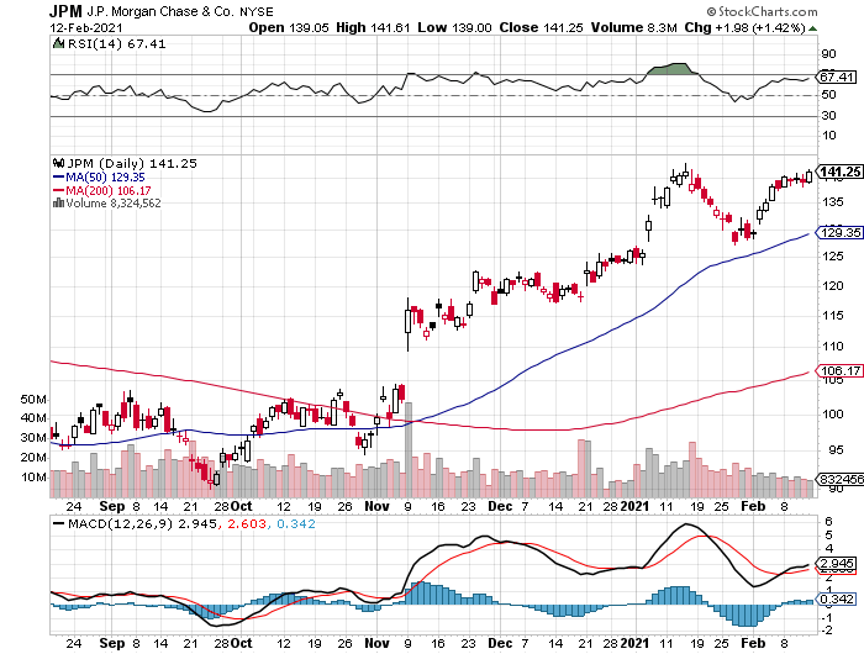
A: It depends on the volatility of the stock. For highly volatile stocks, 10% is a piece of cake. Some of the more boring ones with lower volatility you may have to buy after only a 2% correction; a classic example of that is the banks, like JP Morgan (JPM).
Q: Even though you’re not a fan of cryptocurrency, what do you think of Coinbase?
A: It’ll come out vastly overvalued because of the IPO push. Eventually, it may fall to a lower level. And Coinbase isn’t necessarily a business model dependent on bitcoin; it is a business model based on other people believing in bitcoin, and as long as there’s enough of those creating two-way transactions, they will make money. But all of these things these days are coming out super hyped; and you never want to touch an IPO—wait for it to drop 50%, as I once did with Tesla (TSLA).
Q: Please explain the barbell portfolio.
A: The barbell works when you have half tech, half domestic recovery. That way you always have something going up, because the market tends to rotate back and forth between the two sectors. But over the long term everything goes up, and that is exactly what has been happening.
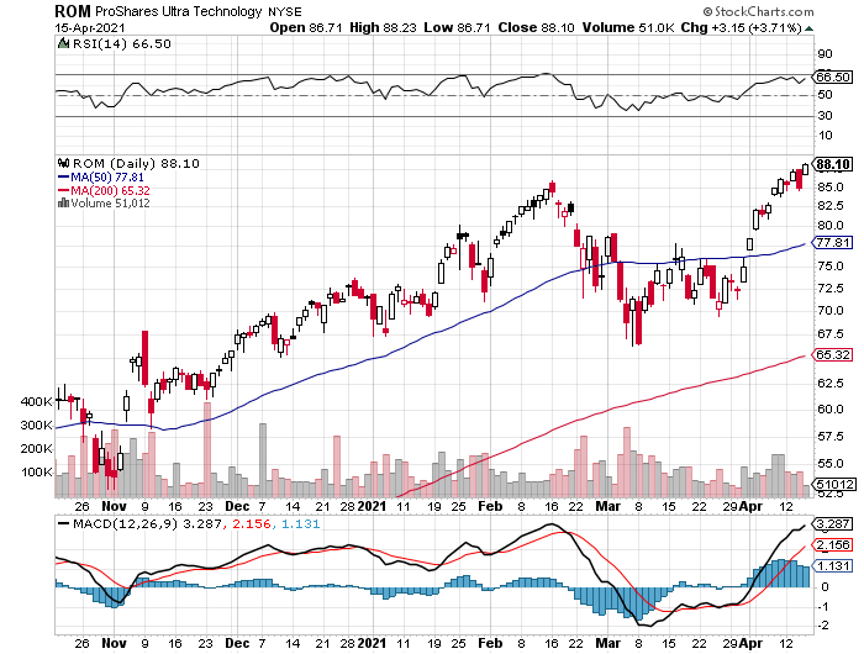
Q: Is the ProShares Ultra Technology Fund (ROM) an ETF?
A: Yes, it is an ETF issuer with $53 billion worth of funds based in Bethesda, MD. (ROM) is a 2x long technology ETF, and their largest holdings include all the biggest tech stocks like Apple (AAPL), Microsoft (MSFT), Facebook (FB), and so on.
Q: Will all this government spending affect the market?
A: Yes, it will make it go up. All we’re waiting to see now is how fast the government can spend the money.
Q: What is the target for ROM?
A: $150 this year, and a lot more on the bull call spread. The only shortcoming of (ROM) is you can only go out six months on the expiration. Even then, you have a good shot at making a 500% return on the farthest out of the money LEAPS, the November $130-$135 vertical bull call spread. That's because market makers just don’t want to take the risk being short technology two years out. It’s just too difficult to hedge.
Q: There have been many comments about hyperinflation around the corner. Will we be seeing hyperinflation?
A: No, the people who have been predicting hyperinflation have been predicting it for at least 20 years, and instead we got deflation, so don’t pay attention to those people. My view is that technology is accelerating so fast, thanks to the pandemic, that we will see either zero inflation or we will see deflation. That has been the pattern for the last 40 years and I like betting on 40-year trends.
Q: When we get called away on our short options, is it easier to close the trade than to exercise your option?
A: No, any action you take in the market costs money, costs commissions, costs dealing spreads. And it's much easier just to exercise the option if you have to cover your short, which is either free or will cost you $15.
Q: Are you worried about overspending?
A: No, the proof in that is we have a 1.53% ten-year US Treasury yield, and $20 trillion in QE and government spending is already known, it’s already baked in the price. So don’t listen to me, listen to Mr. Market; and it says we haven't come close to reaching the limit yet on borrowing. Look at the markets, they're the ones who have the knowledge.
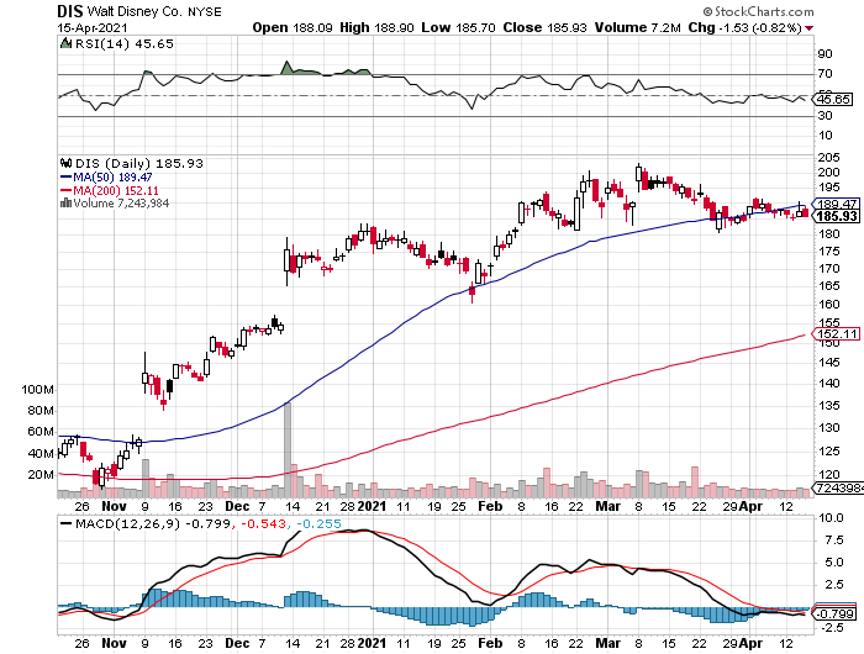
Q: My Walt Disney (DIS) LEAPs are getting killed. I don't understand why my LEAPS go down even on green days for the stock.
A: The answer is that the Volatility Index (VIX) has been going down as well. Remember, if you’re long volatility through LEAPS, and volatility goes down, you take a hit. That said, we’re getting close to the lows of the year for volatility here, so any further stock gains and your LEAPS should really take off. And remember when you buy LEAPS, you’re doing multiple bets; one is that volatility stays high and goes higher, and one is that your stock is high and goes higher. If both those things don’t happen, and you can lose money.
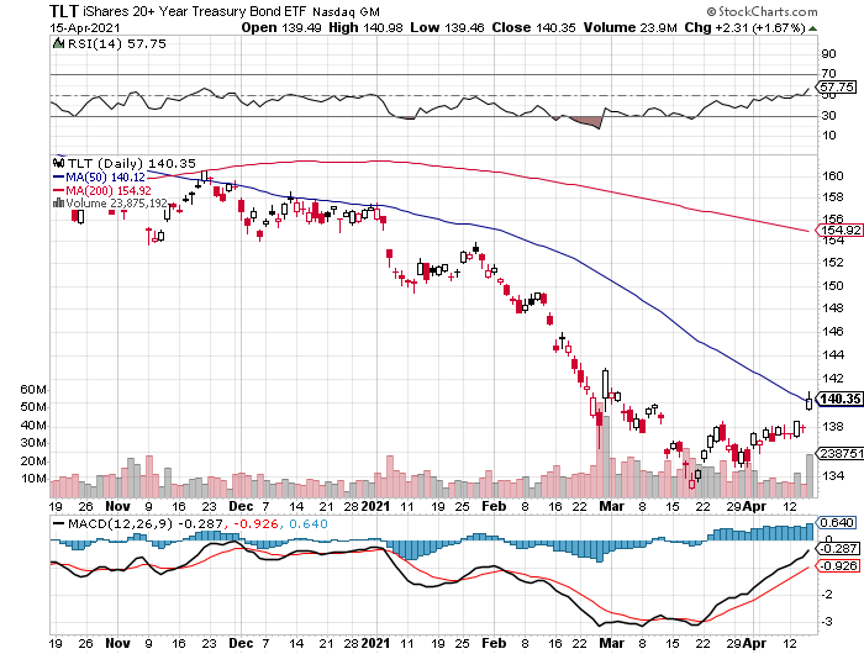
Q: How do you best short the (TLT)?
A: If you can do the futures market, Treasury bonds are always your best short there because you have 10 to 1 leverage.
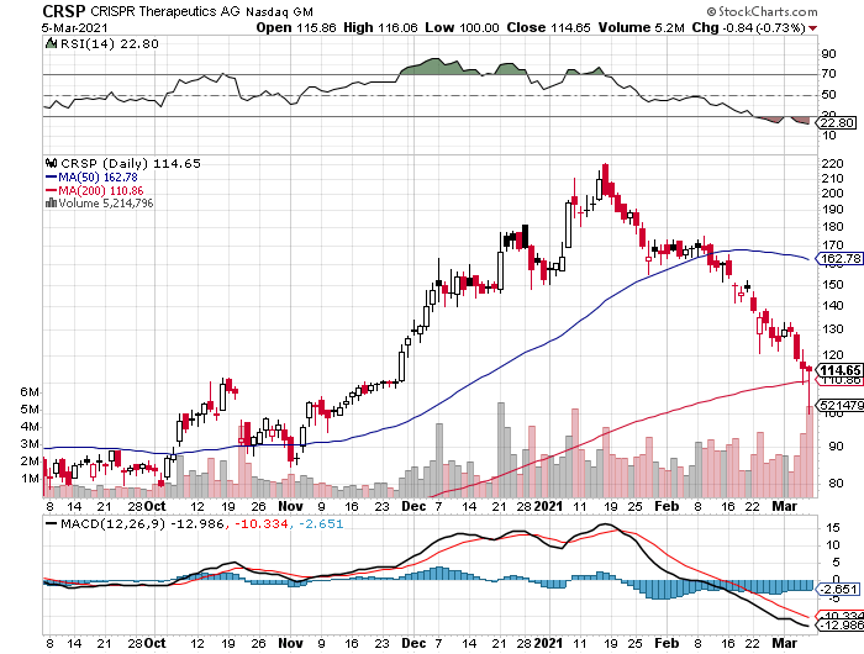
Q: How would you do a spread on Crisper Technology (CRSP)?
A: We have a recommendation in the Mad Hedge Biotech & Healthcare service to be long the two-year LEAP on Crisper, the $160-$170 vertical bull call spread.
Q: When do you see the largest dip this year?
A: Probably over the summer, but it likely won’t be over 10%. Too much cash in the market, too much government spending, too much QE. People will be in “buy the dips” mode for years.
Q: Is the SPAC mania running out of steam?
A: Yes, you can only get so many SPACS promising to buy the same theme at a discount. I think eventually, 80% of these SPACS go out of business or return the money to investors uninvested because they are promising to buy things at great bargains in one of the most expensive markets in history, which can’t be done.
Q: What do you think about Joe Biden’s attempt to tame the semiconductor chip shortage?
A: Most people don't know that all chips for military weapons systems are already made in the US by chip factories owned by the military. And the pandemic showed that a just-in-time model is high risk because all of a sudden when the planes stop flying, you couldn't get chips from China anymore. Instead, they had to come by ship which takes six weeks, or never. So a lot of companies are moving production back to the US anyway because it is a good risk control measure. And of course, doing that in the midst of the worst semiconductor shortage in history shows the importance of this. Even Tesla has had to delay their semi truck because of chip shortages. Keep buying NVIDIA (NVDA), Micron Technology (MU), Advanced Micro Devices (AMD), and Applied Materials (AMAT) on dips.
Q: Do you see a sell the news type of event for upcoming earnings?
A: Yes, but not by much. We got that in the first quarter, and stocks sold off a little bit after they announced great earnings, and then raced back up to new highs. You could get a repeat of that, as people are just sitting on monster profits these days and you can’t blame them for wanting to pull out a little bit of money to spend on their summer vacation.
Q: Has the stock market gotten complacent about COVID risk?
A: No, I would say COVID is actually disappearing. Some 100 million Americans have been vaccinated, 5 million more a day getting vaccinated, this thing does actually go away by June. So after that, you only have to worry about the anti-vaxxers infecting the rest of the population before they die.
Q: Do you see any imminent foreign policy disasters in Asia, the Middle East, or Europe that could derail the stock market?
A: I don’t, but then you never see these things coming. They always come out of the blue, they're always black swans, and for the last 40 years, they have been buying opportunities. So pray for a geopolitical disaster of some sort, take the 5-10% selloff and buy because at the end of the day, American stockholders really don't care what’s going on in the rest of the world. They do care, however, about increasing their positions in long-term bull markets. I don't worry about politics at all; I don’t say that lightly because it’s taking 50 years of my own geopolitical experience and throwing it down the toilet because nobody cares.
Q: Would you buy Coinbase?
A: Absolutely not, not even with your money. These things always come out overpriced. If you do want to get in, wait for the 50% selloff first.
Q: Is Canada a play on the dollar?
A: Absolutely yes. If they get a weaker dollar, it increases Canadian pricing power and is good for their economy. Canada is also a great commodities play.
Q: The IRS is using Palantir (PLTR) software to find US citizens avoiding taxes with Bitcoin.
A: Yes, absolutely they are. Anybody who thinks this is tax-free money is delusional. And this is one reason to buy Palantir; they’re involved in all sorts of these government black ops type things and we have a very strong buy recommendation on Palantir and their 2-year LEAPS.
Q: Are NFTs, or Non-Fundable Tokens, another Ponzi scheme?
A: Absolutely, if you want to pay millions of dollars for Paris Hilton’s music collection, go ahead; I'd rather buy more Tesla.
Q: When do you think you can go to Guadalcanal again?
A: Well, I’m kind of thinking next winter. Guadalcanal is one of the only places you can go and get more diseases than you can here in the US. Last year, I went there and picked up a bunch of dog tags from marines who died in the 1942 battle there, sent them back to Washington DC, and had them traced and returned to the families. And I happen to know where there are literally hundreds of more dog tags I can do this with. It’s not an easy place to visit and it’s very far away though. Watch out for malaria. My dad got it there.
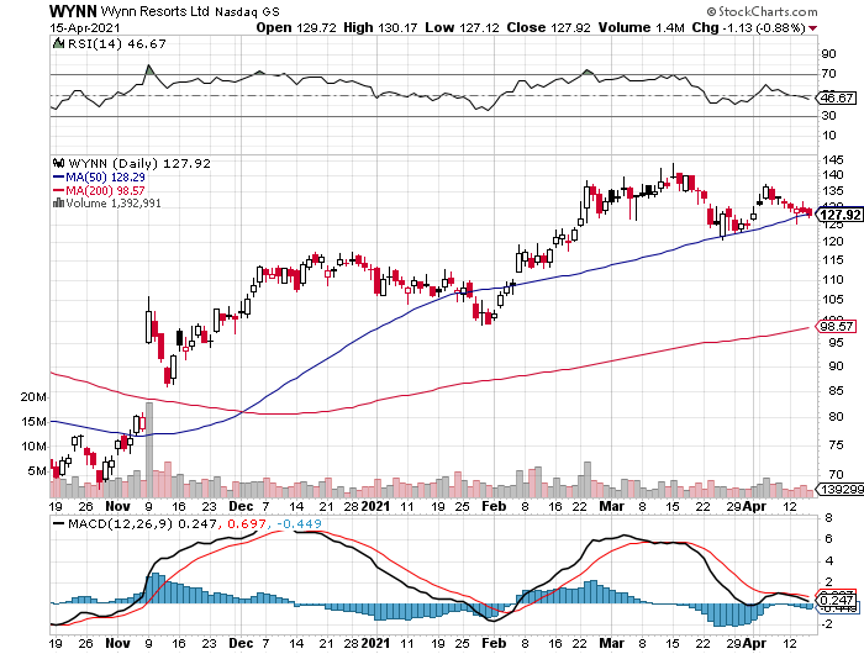
Q: Walt Disney is already above the pre-pandemic price. Do you suggest any other hotel company name at this time?
A: Go with the Las Vegas casinos, Wynn (WYNN) and MGM (MGM) would be really good ones. Las Vegas is absolutely exploding right now, and we haven't seen that yet in the earnings yet, so buy Las Vegas for sure.
Q: Is the upcoming Roaring Twenties priced into the stock market already?
A: Absolutely not. You didn't want to sell the last Roaring Twenties in 1921 as it still had another eight years to go. You could easily have eight years on this bull market as well. We have historic amounts of money set up to spend, but none of it has been actually spent yet. That didn’t exist in 1921. I think that when they do start hitting the economy with that money, that we get multiple legs up in stock prices.
To watch a replay of this webinar just log in to www.madhedgefundtrader.com, go to MY ACCOUNT, click on GLOBAL TRADING DISPATCH, then WEBINARS, and all the webinars from the last ten years are there in all their glory.
Good Luck and Stay Healthy.
John Thomas
CEO & Publisher
The Diary of a Mad Hedge Fund Trader

Global Market Comments
March 8, 2021
Fiat Lux
Featured Trade:
(MARKET OUTLOOK FOR THE WEEK AHEAD, or WHAT’S UP WITH TECH?),
(MSFT), (TSLA), (AAPL), (QQQ), (NVDA), (MU), (AMD), (BRKB), (ARRK), (ROM), (VIX), (FCX), (TLT), (BRKB), (TSLA), (JPM), (SPY), (QQQ), (SPX)

That great wellspring of personal wealth, technology stocks, has suddenly run dry.
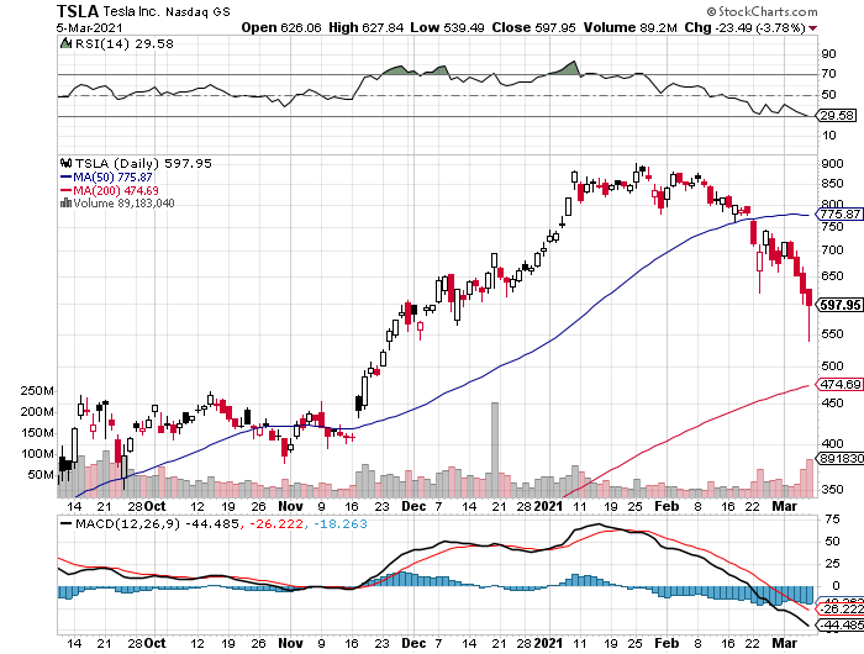
The leading stock market sector for the past decade took some major hits last week. More stable stocks like Microsoft (MSFT) only shed 8%. Some of the highest beta stocks, like Tesla (TSLA), took a heart-palpitating 39% haircut in a mere two months.
Have tech stocks had it for good? Has the greatest investment miracle of all times ground to a halt? Is it time to panic and sell everything?
Fortunately, I have seen this happen many times before.
Technology is a sector that is prone to extremes. Most of the time it is a hero, but occasionally it is a goat. When too many short-term traders sit in one end of the canoe, we all end up in the drink.
This is one of those times.
Technology stocks undeniably need a periodic shaking out. You need to get rid of the day traders, the hot money, the excessively leveraged, and find out who has been swimming without a swimsuit. The sector rotates between being ridiculously cheap to wildly overvalued. We are currently suffering the latter.
During the past 12 years, Apple’s (AAPL) price earnings multiple has traded from 9X to 36X. It was a value play for the longest time, all the way up to 2016. Nobody believed in it. It is currently at a 33X multiple. While the stock has gone nowhere since August, its earnings have increased by more than 10%, and better is yet to come.
After trading tech stocks for more than 50 years, I can tell you one thing with certainty.
They always come back.
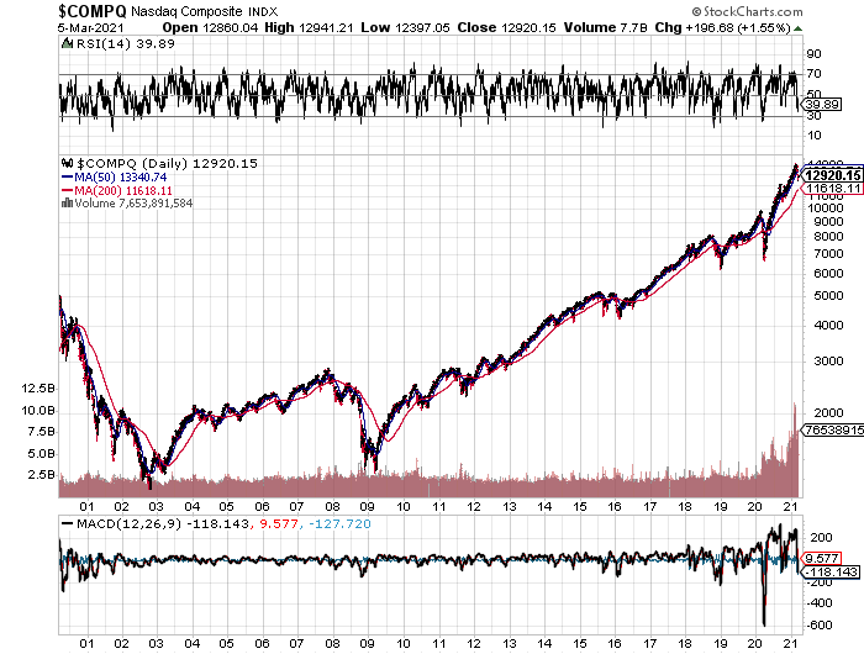
And this time, they are in position to come back sooner, faster, and bigger than ever before. Remember the Great Dotcom Bust of 2000-2003? It lasted two years and nine months and saw NASDAQ (QQQ) crater by 82%, from 5,000 to 1,000. This time, it’s only dropped by 13%, by 1,850 from 14,250 to 12,400.
I don’t see the selloff lasting much longer or lower, no more than another 5%-10% until September. For these are not your father’s technology stocks.
There are only three numbers you need to know. Technology now accounts for a mere 2% of the US workforce, but a massive 27% of stock market capitalization and 37% of total us company earnings. A sector with such an impressive earnings output won’t fall for very long, or very far.
The pandemic accelerated technological innovation tenfold. Companies now have mountains of cash with which to bring forward their futures.
This is no more true than for biotech stocks. The technologies used to create Covid-19 vaccines can be applied to cure all human diseases. And they now have mountains of cash to implement this.
So, I’ll be taking my time with tech stocks. But they are setting up the best long side entry point since the March 20, 2020 pandemic low.
The biggest call remaining for 2021 is when to take profits and sell domestic recovery value stocks and rotate back into tech. But if you are running the barbell strategy I have been harping about since the presidential election, the work is already being done for you.
Nonfarm Payroll comes in at a blockbuster 379,000 in February, far better than expected. It a preview of explosive numbers to comes as the US economy crawls out of the pandemic. That’s with a huge drag from terrible winter weather. The headline Unemployment rate is 6.2%. The U-6 “discouraged worker” rate is still a sky-high 11%, those who have been jobless more than six months. Leisure & Hospitality were up an incredible 355,000 and Retail was up 41,000. Government lost 86,000 jobs. We are still 12 million jobs short of the year-ago trend. See what employers are willing to do when they see $20 trillion about to hit the economy?
Will US GDP Growth hit 10% this year? That is the sky-high number that is being mooted by the Atlanta Fed for the first three months of 2021. The vaccine is working! They do tend to be high in the home of Gone with the Wind. This Yankee would be happy at 7.5% growth. Manufacturing just hit a three-year high as companies try to front-run imminent explosive growth. The only weak spot is employment, which is still at recessionary highs.
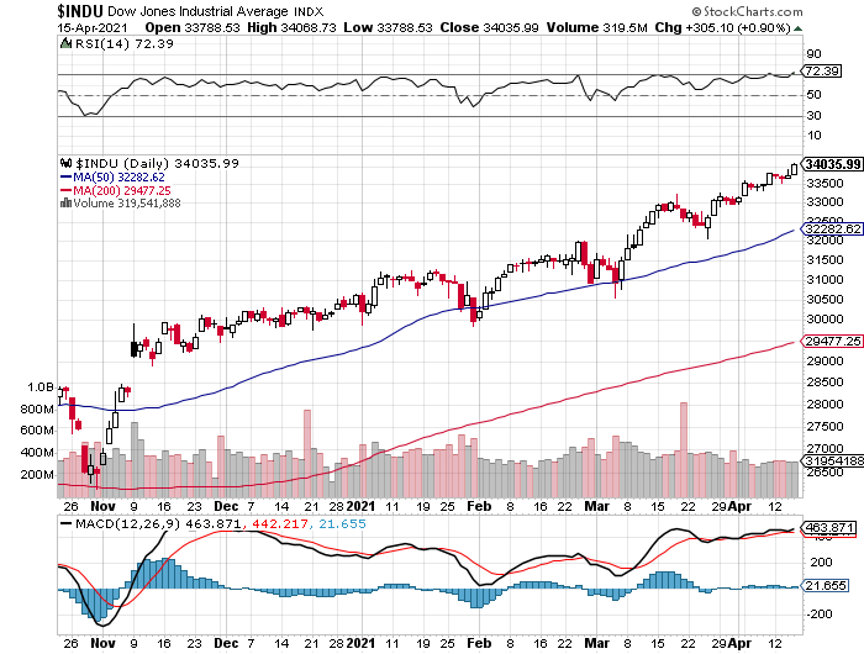
Herd Immunity is here or says the latest numbers from Johns Hopkins University. New cases have plunged from 250,000 to 46,000 in a month, the fastest disease rollback in human history. We may be seeing new science at work here, where mass vaccinations combine with mass infections to obliterate the pandemic practically overnight. If true, the Dow has another 8,000 points in it….this year. Buy everything on dips. The economic data is about to get superheated.
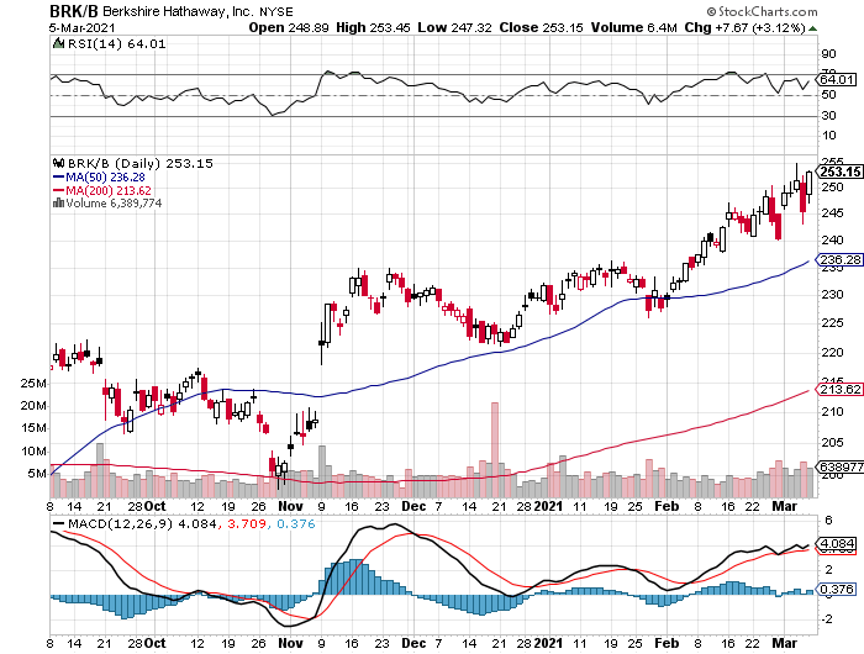
Warren Buffet’s Berkshire Hathaway blows it away, buying back a staggering $25 billion worth of his own stock in 2020, including $9 billion in the most recent quarter. It’s what I’m always looking for, buying quality at a discount. Warren pulled in $5 billion in profits during the last quarter of 2020, up 13.6% over a year earlier. Net earnings were up 23%. If Buffet, a long time Mad Hedge reader, is buying his stock, you should too. Buy (BRKB) on dips. It's also a great LEAP candidate as the best domestic recovery play out there.
Rising rates have yet to hurt Real Estate, as the structural shortage of housing is so severe. Historically speaking, interest rates are still very low, even though the ten-year yield has soared by 82% in two months. Cash is still pouring into REITs coming off the bottom. Home prices always see their fastest moves up at the beginning of a new rate cycle as everyone rushes to beat unaffordable mortgages.
The Chip Shortage worsens, with Tesla shutting down its Fremont factory for two days. The Texas deep freeze made matters much worse, where many US fabs are located, like Samsung, NXP Semiconductors, and Infineon Technologies. Buy (NVDA), (MU), and (AMD) on dips.
Jay Powell lays an egg at a Wall Street Journal conference. He said it would take some time to return to a normal economy. The speed of the interest rate rise was “notable.” We are unlikely to return to maximum employment in a year. We couldn’t have heard of more dovish speech. But all that traders heard was that inflation was set to return, but will be “temporary.” That was worth a 600-point dive in the stock market and a 5-basis point pop in bond yields. My 10% correction is finally here!
Here today, gone tomorrow. Cathie Wood was far and away the best fund manager of 2020. She, value investor Ron Baron, and I, were alone in the darkness four years ago saying that Tesla (TSLA) could rise 100-fold. Cathie’s flagship fund The Ark Innovation ETF (ARKK) rose a staggering 433% off the March 2020 bottom. Alas, it has since given up a gut-punching 30% since the February high, exactly when ten-year US Treasury bonds started to crash. Watch (ARKK) carefully. This is the one you want to own when rates stabilize. It’s like another (ROM).
When we come out the other side of pandemic, we will be perfectly poised to launch into my new American Golden Age, or the next Roaring Twenties. With interest rates still at zero, oil cheap, there will be no reason not to. The Dow Average will rise by 400% to 120,000 or more in the coming decade. The American coming out the other side of the pandemic will be far more efficient and profitable than the old. Dow 120,000 here we come!
It’s amazing how well selling tops and buying bottoms can help your performance. My Mad Hedge Global Trading Dispatch reached a super-hot 11.61% during the first five days in March on the heels of a spectacular 13.28% profit in February. The Dow Average is up a miniscule 4.00% so far in 2021.
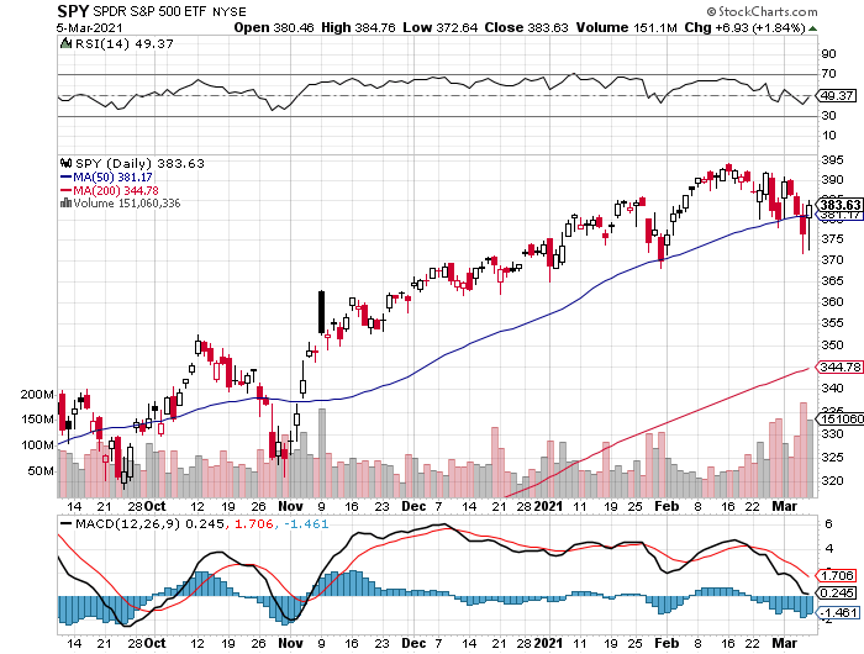
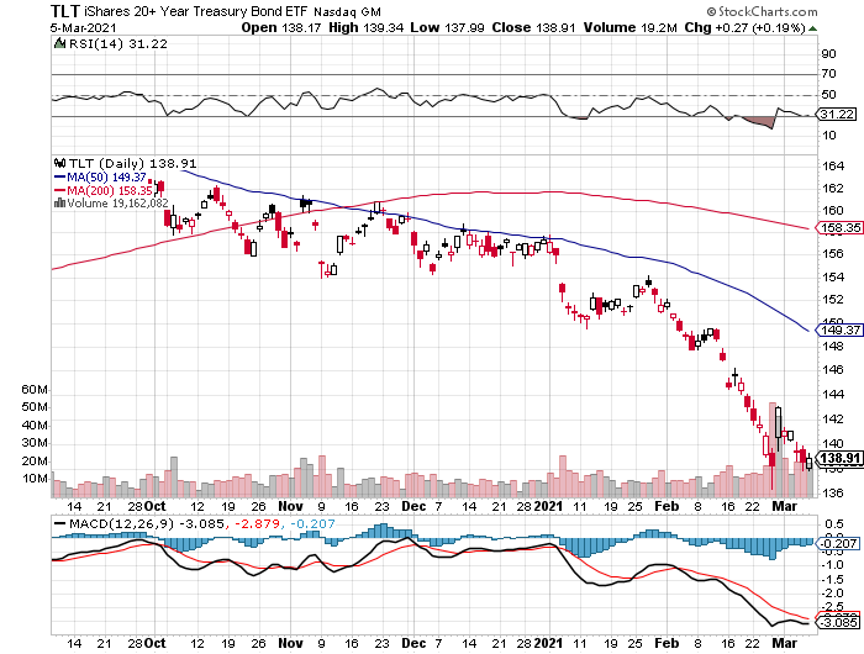
It was a week of frenetic trading, with the Volatility Index (VIX) all over the map. I took profits in Freeport McMoRan (FCX) and my short in US Treasury bonds (TLT) and buying Berkshire Hathaway (BRKB), Tesla (TSLA), JP Morgan (JPM). I opened new shorts in the S&P 500 (SPY) and the NASDAQ (QQQ).
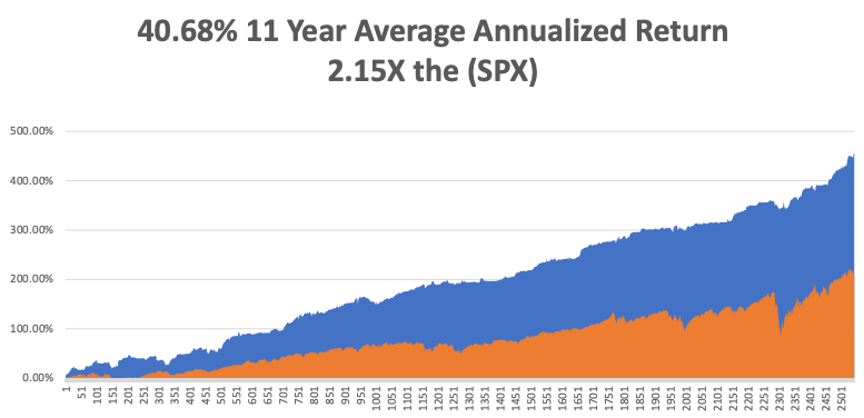
This is my fifth double digit month in a row. My 2021 year-to-date performance soared to 35.10%. That brings my 11-year total return to 457.65%, some 2.12 times the S&P 500 (SPX) over the same period. My 11-year average annualized return now stands at an unbelievable 40.68%.
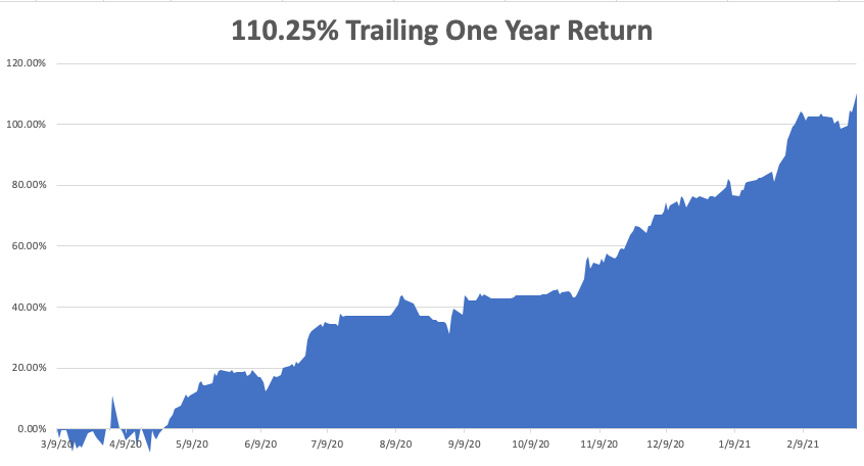
My trailing one-year return exploded to 110.25%, the highest in the 13-year history of the Mad Hedge Fund Trader.
We need to keep an eye on the number of US Coronavirus cases at 29 million and deaths topping 525,000, which you can find here.
The coming week will be a boring one on the data front.
On Monday, March 8, at 11:00 AM EST, Consumer Inflation Expectations for February are out.
On Tuesday, March 9, at 7:00 AM, The NFIB Business Optimism Index for February is published.
On Wednesday, March 10 at 8:30 AM, the US Inflation Rate for February is printed.
On Thursday, March 11 at 8:30 AM, Weekly Jobless Claims are out.
On Friday, March 12 at 8:30 AM, the Producer Price Index for February is disclosed.
At 2:00 PM, we learn the Baker-Hughes Rig Count.
As for me, it was with great sadness that I learned of the passing of my old friend, Sheikh Zaki Yamani, the great Saudi Oil Minister. Yamani was a true genius, a self-taught attorney, and one of the most brilliant men of his generation.
It was Yamani who triggered the first oil crisis in 1973, raising the price from $3 to $12 a barrel in a matter of weeks. Until then, cheap Saudi oil had been powering the global economy for decades.
During the crisis, I relentlessly pestered the Saudi embassy in London for an interview for The Economist magazine. Then, out of the blue, I received a call and was told to report to a nearby Royal Air Force base….and to bring my passport.
There on the tarmac was a brand-new Boeing 747 with “Kingdom of Saudi Arabia” emblazoned on the side in bold green lettering. Yamani was the sole passenger, and I was the other. He then gave me an interview that lasted the entire seven-hour flight to Riyadh. We covered every conceivable economic, business, and political subject. It led to me capturing one of the blockbuster scoops of the decade for The Economist.
When Yamani debarked from the plane, I asked him “why me.” He said he saw a lot of me in himself and wanted to give me a good push along my career. The plane then turned around and flew me back to London. I was the only passenger on the plane.
When the pilot heard I’d recently been flying Pilatus Porters for Air America, he even let me fly it for a few minutes while he slept on the cockpit floor.
Yamani later became the head of OPEC. At one point, he was kidnapped by Carlos the Jackal and held for ransom, which the king readily paid.
And if you wonder where I acquired my deep knowledge of the oil and energy markets, this is where it started. Today, the Saudis are among the biggest investors in alternative energy in California.
We stayed in touch ever since.
Stay healthy.
John Thomas
CEO & Publisher
The Diary of a Mad Hedge Fund Trader

Mad Hedge Technology Letter
March 3, 2021
Fiat Lux
Featured Trade:
(U.S. CHIP SHORTAGE IS REAL)
(WDC), (AMD), (MU)
Yes, the price is going up. And no, I am not talking about monthly grocery bills, but the price of semiconductor chips that help operate iPhones and will power autonomous driving vehicles.
The situation is so dire that US President Joe Biden signed an executive order calling for a supply chain review of semiconductors and IT technologies.
Yes, it’s that bad.
The drastic and imminent chip shortage is impacting a wide swath of tech firms we cover here at the Mad Hedge Technology Letter.
The order will also “facilitate needed investments to maintain America’s competitive edge and strengthen U.S. national security.”
Biden’s proactive decision to sign the executive order comes on the heels of several top U.S. semiconductor executives persuading US President Joe Biden earlier this month to resuscitate domestic chip manufacturing with “substantial funding” as part of the White House’s economic recovery and infrastructure plan.
In the fact sheet for the executive order, the White House said supply chains for semiconductors and advanced chip packaging technologies will be among four key areas where federal agencies will be directed to commence a 100-day review.
The White House acknowledged a massive underinvestment in semiconductor production that has caused manufacturing to shift abroad.
The critical issue was emphasized by U.S. semiconductor executives in a recent joint letter to Biden.
The US has leaned on foreign manufacturing for many products in the past 50 years, but semiconductor chips are the ones that could force US tech companies into a losing position and offer a pathway for Chinese tech firms to seize their chance as top dog.
The 100-day supply chain review will also look at critical minerals, including rare earths that are used for a variety of products, as well as large-capacity batteries and active pharmaceutical ingredients.
The shortages of chips and other components are a very real issue that can have a material impact on several adjacent industries, including bioinformatics companies and mechanical parts manufacturers that rely on simulation and modeling applications.
How does this affect chip companies?
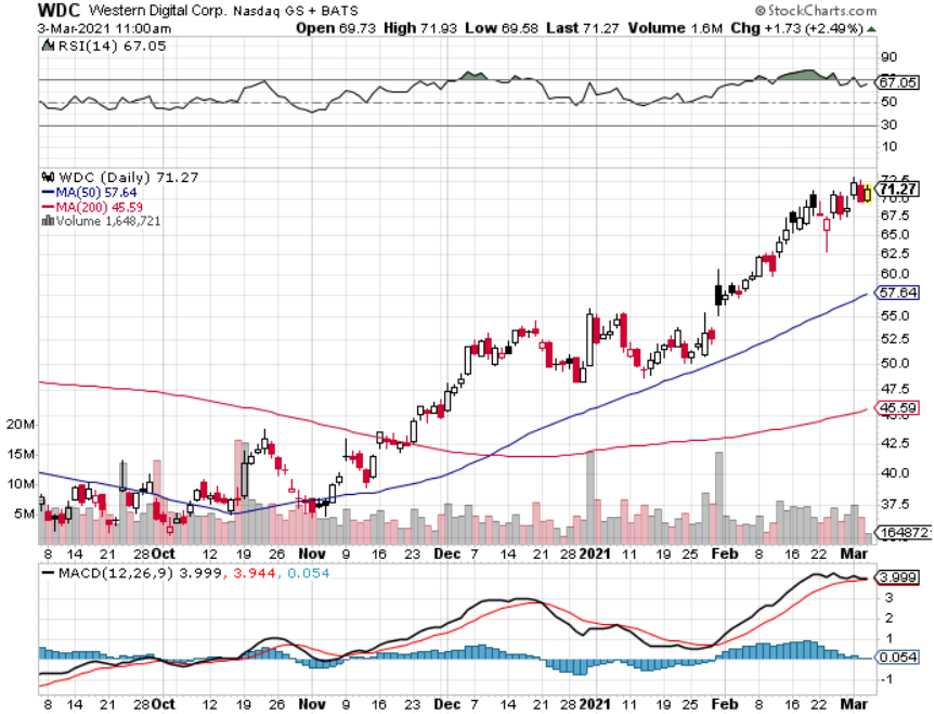
Let’s take a look at one, Western Digital (WDC).
Shares are trading higher on signs of improving pricing in the flash-memory market.
I am short-term bullish on Western shares because a meaningful memory-chip price rise is in the cards for both flash NAND and DRAM.
A blast from the past Silicon Valley dinosaur that began as a disk-drive manufacturer, Western diversified into flash-memory products via its 2016 acquisition of SanDisk.
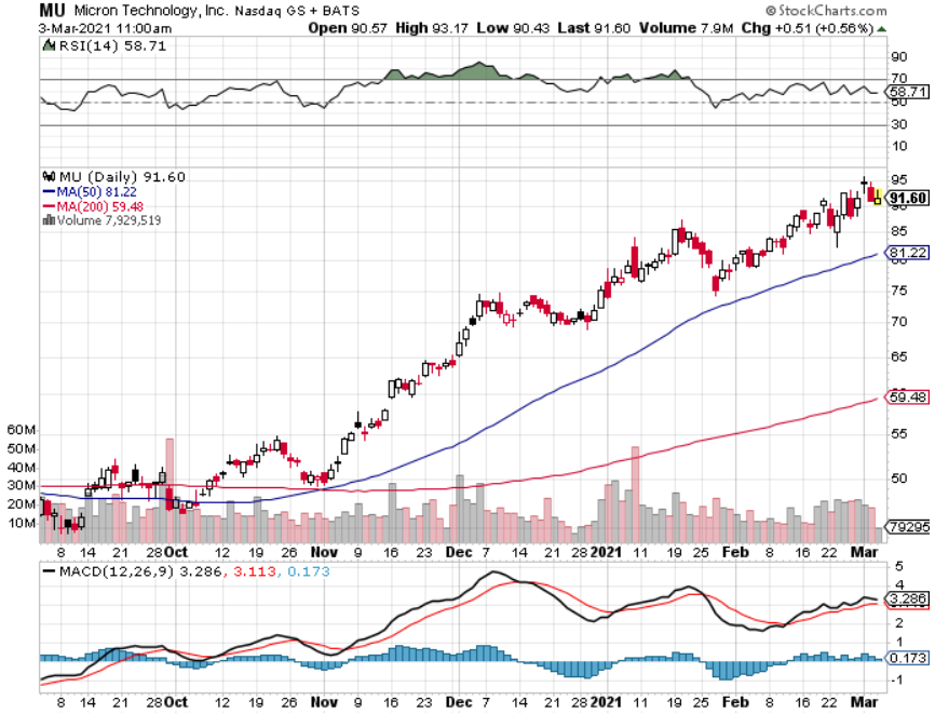
Encouraging NAND pricing also benefits Micron Technology (MU), which makes both NAND and DRAM chips.
The most important takeaway from my channel checks is that despite increased attempts by cloud and enterprise customers to lock in prices for second-half delivery, end contract numbers aren’t reflecting any good deals for the end buyer.
Manufacturers are convinced with their newfound pricing power and will wield it to full effect.
Expect significant price increases until the shortage is cured, and this could result in many end projects being shelved because of funding issues.
For semi chip firms, a bountiful harvest will make 2021 earnings report glisten in the form of meaningful expansion in margins, which have been under pressure since 2018.
My initial prediction is that prices will rise 5% to 10% from the fourth quarter—and that pricing for the second quarter is tracking up another 10% or more sequentially making it a 20% rise in less than half a year.
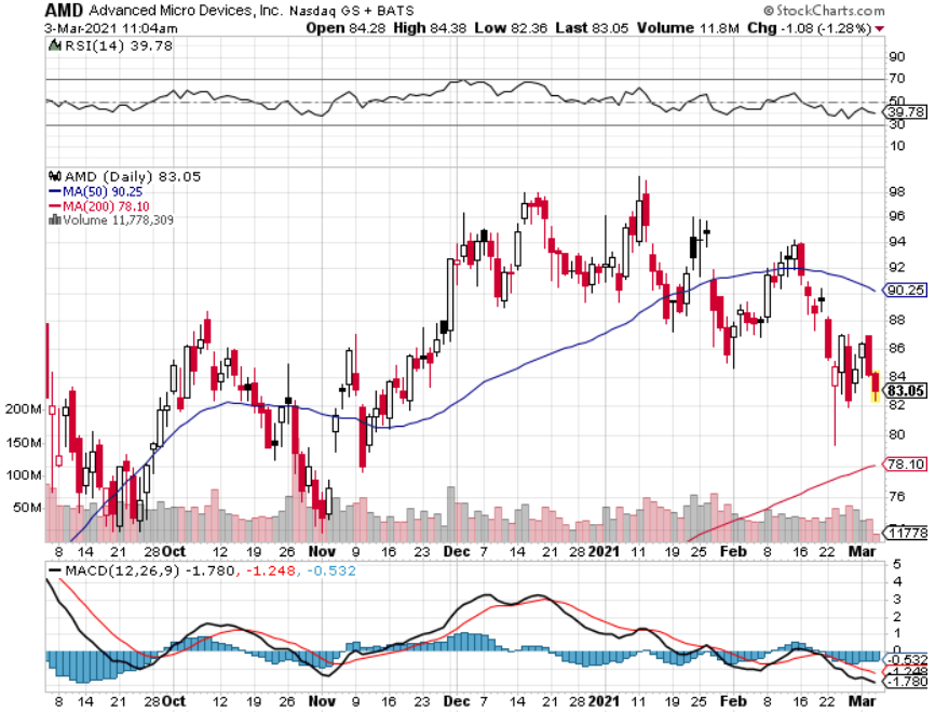
Memory manufacturers like Micron (MU), AMD (AMD), Samsung, and Western Digital (WDC) are in line to overperform in 2021.
Global Market Comments
February 16, 2021
Fiat Lux
Featured Trade:
(MARKET OUTLOOK FOR THE WEEK AHEAD, or A RETURN TO IRRATIONAL EXHUBERANCE)
(PLBY), (SPX), ($INDU), (NVDA), (AMD), (MU), (USO)
Playboy is going public.
Its flagship magazine was wiped out by free internet porn last year after a storied 66-year run. During the 1970s, an invitation to a new club opening was the hottest ticket in town.
Of course, I bought the magazine only to read the articles.
Melania Trump as a centerfold? The business possibilities boggle the mind. Of course, it’s going public through a SPAC. Nobody else would touch this with a ten-foot pole. The ticker symbol will be (PLBY).
What this IPO does tell me is how overheated the markets are getting. In 1996, former Fed governor, saxophone player, and Ayn Rand acolyte, the gnomish Alan Greenspan warned the stock market of “irrational exuberance.” Since then, the Dow Average has risen by 5.2 times in 23 years, revisiting the 6,000 low once in 2009.
In fact, let me explain to you why stocks are so cheap.
At the 2000 Dotcom Bubble top, ten-year US Treasury yields stood at 6%. Stocks would have to rise five times more from today’s paltry 1.20% to reach the same relative valuation.
Dow 163,000 anyone?
Similarly, the big FANG stocks would have to triple in value to get us to the 100X price earnings multiple that prevailed in 2000. That gets us at least to Dow 94,500.
And this is what people don’t get about liquidity-driven bull markets. They go on far, far longer than anyone imagines possible. You had to be in Tokyo in 1989 to understand this.
If you’re really and truly worried about stocks, take a look at the chart below and how they reacted to the last catastrophic selloff that took place during 2007-2009.
After an initial, frenetic move, they rose by, you guessed it, 5.2 times.
The Global Chip Shortage is spreading beyond cars to phones and electronics. High prices beckon across the board. Could this be the black swan that heads off the recovery? It’s all a screaming BUY for (NVDA), (AMD), and (MU). I can’t believe these haven’t moved yet.
Biden created a Bull Market in Oil (USO) when he banned new leases on federal lands. The move took 3 million barrels a day off the market, taking a bite out of the 10 million barrels a day oversupply. And economic recovery should soak up the remaining 7 million barrels, 2021 forecasts for Texas tea are now reaching as high as $80.
Space X is taking pre-orders for Starlink, Elon Musk’s Global satellite WIFI network. Another industry disrupted. For a $99 deposit, you can access 500 megabytes a second, faster than available for most of the US. The goal is to launch 11,943 satellites by 2024. If it works, AT&T (T), Comcast (CMCSA), and Verizon (V) could be in big trouble. When you own your own rocket company, it’s easy to undercut the competition.
Weekly Jobless Claims are still weak, at 793,000, far higher than expected, but less than last week. Total jobless claims have it an unbelievable 20.44 million, just short of the 1930’s Great Depression high. Perhaps 20% of the country is living on government handouts.
The Pandemic Property Boom continues, posting the hottest numbers since 2005. The National Association of Realtors says the price of a single-family home rose by a staggering 14.9% in Q4. The Northeast was the leader at a 21% gain. The market keeps going from strength to strength.
Will the Dow double in a year? We only have 4,500 points to go for a 100% gain from the last March 20 low. We have already seen the sharpest gain in history, beginning when Biden took the lead in the primaries. Will passage of the $1.9 trillion rescue package take us over the finish line? And are we setting up for a “Buy the rumor, sell the news? We’ll know in a month. I bet you’ve just made more money in stocks than you’ve ever imagined possible. Take short-term profits in everything.
Bonds hit new lows, taking the ten-year US Treasury yield up to 1.20%. The Feds hit the markets for a massive $120 million in debt this week and buyers are obviously glutted. Keep selling those rallies in the (TLT). Maybe you should start selling dips, too. Use bond selloffs for your stock market timing. They’re about to become “certificates of confiscation” again.
No hint of rising rates soon, hints Fed governor Jay Powell. Recovery is the only goal, damn the inflation torpedoes.
When we come out the other side of pandemic, we will be perfectly poised to launch into my new American Golden Age, or the next Roaring Twenties. With interest rates still at zero, oil cheap, there will be no reason not to. The Dow Average will rise by 400% to 120,000 or more in the coming decade. The American coming out the other side of the pandemic will be far more efficient and profitable than the old. Dow 120,000 here we come!
My Mad Hedge Global Trading Dispatch earned an amazing 16.48% so far in February after a blockbuster 10.21% in January. The Dow Average is up a trifling 2.80% so far in 2021.
This is my fourth double-digit month in a row. My 2021 year-to-date performance soared to 26.69%. There are only four trading days left until the February 19 option expiration, when I automatically go into 80% cash. That’s convenient!
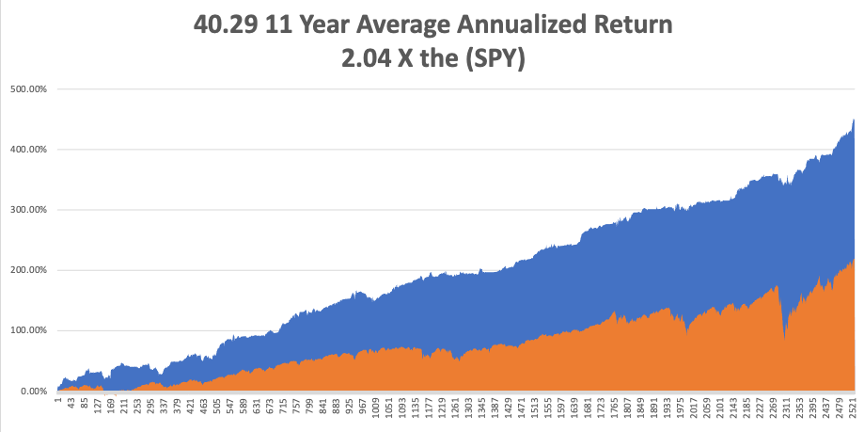
That brings my 11-year total return to 449.24%, some 2.04 times the S&P 500 (SPX) over the same period. My 11-year average annualized return now stands at an Everest-like new high of 40.29%.
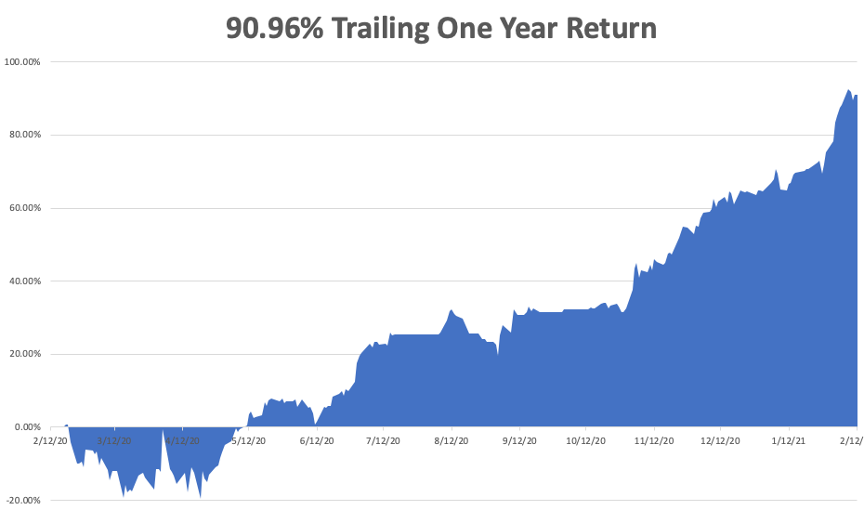
My trailing one-year return exploded to 90.96%, the highest in the 13-year history of the Mad Hedge Fund Trader. We have earned 108.63% since the March 20, 2020 low.
We need to keep an eye on the number of US Coronavirus cases at 27.7 million and deaths approaching 500,000, which you can find here. We are now running at a heartbreaking 3,000 deaths a day. But that is down 35% from the recent high.
The coming week will be a boring one on the data front.
On Monday, February 15, markets are closed for Presidents Day.
On Tuesday, February 16 at 8:30 AM EST, the NY Empire State Manufacturing Index is out. CVS (CVS) and Zoetis report.
On Wednesday, February 17 at 8:30 AM, US Retail Sales for January are published. At 2;00 PM, we learn the Fed Open Market Committee minutes from the last meeting. Shopify and Twilio report.
On Thursday, February 18 at 9:30 AM, Weekly Jobless Claims are printed. Barrick Gold (GOLD) and Roku (ROKU) report.
On Friday, February 19 at 10:00 AM, Existing Home Sales for January are released. We learn the Baker-Hughes Rig Count. As we have a three-day weekend following, option volatility should collapse. John Deere (DE) reports.
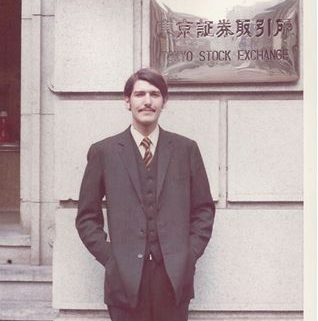
As for me, let me tell you what the last weeks of the great Japanese bull market were like at the end of 1989.
The big thing then was to eat sushi salted with flecks of pure gold. Any foreigner who could speak Japanese was worth hundreds of thousands of dollars a year.
The brokers would hire anyone. Kids went from running sandwich shops to trading desks at Morgan Stanley. Others upgraded from bicycles to Porsche Carrera’s and used to race on Tokyo’s abandoned freeway system in the middle of the night.
And you know what? Someone offered me a piece of gold-flecked sushi just the other day!
Stay healthy.
John Thomas
CEO & Publisher
The Diary of a Mad Hedge Fund Trader

Global Market Comments
January 22, 2021
Fiat Lux
Featured Trade:
(JANUARY 20 BIWEEKLY STRATEGY WEBINAR Q&A),
(QQQ), (IWM), (SPY), (ROM), (BRK/A), (AMZN), NVDA), (MU), (AMD), (UNG), (USO), (SLV), (GLD), ($SOX), CHIX), (BIDU), (BABA), (NFLX), (CHIX), ($INDU), (SPY), (TLT)

Below please find subscribers’ Q&A for the January 20 Mad Hedge Fund Trader Global Strategy Webinar broadcast from Incline Village, NV.
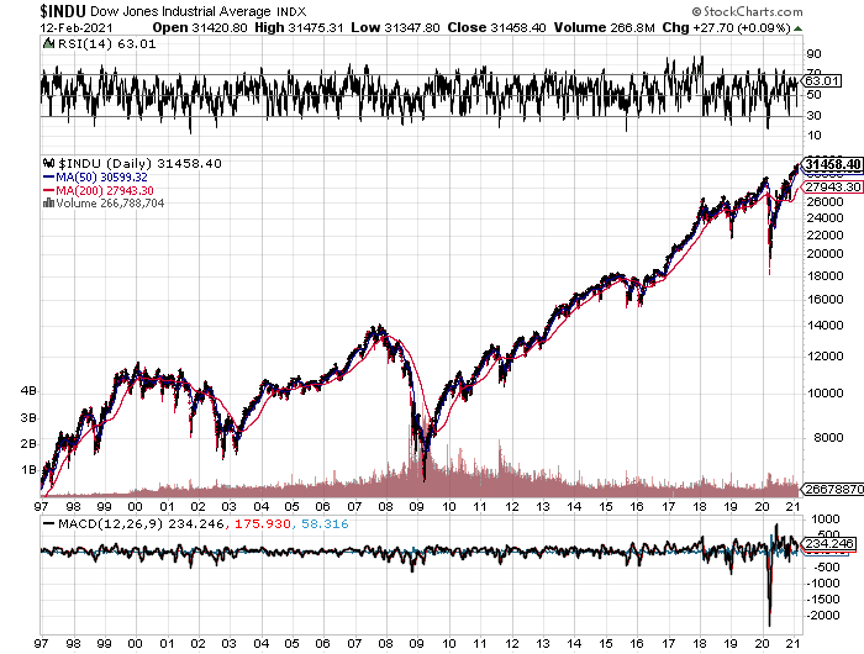
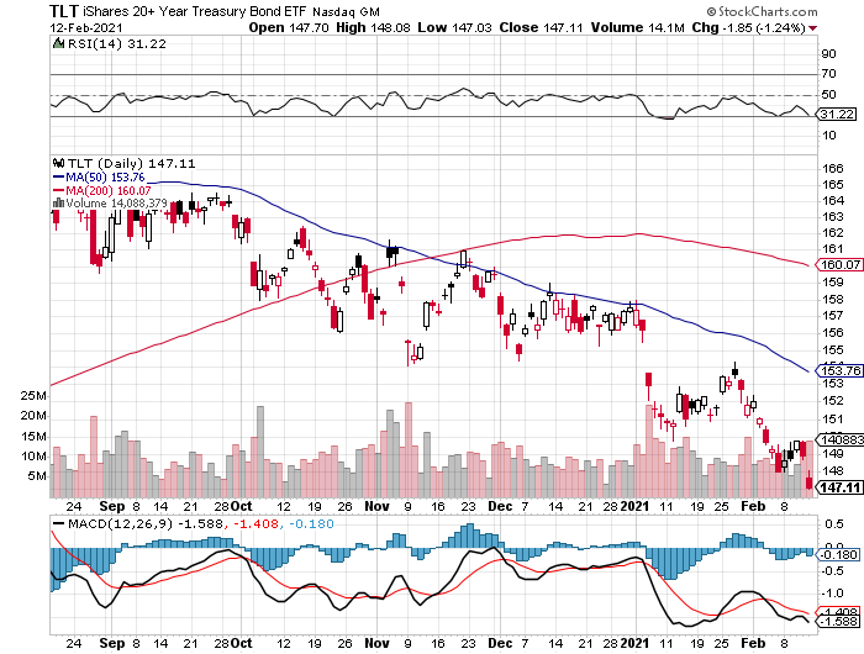
Q: What will a significant rise in long term bond yields (TLT) do to PE ratios in general, and high tech specifically?
A: Well, the key question here is: what is “significant”. Is “significant” a move in a 10-year from 120 to 150, which may be only months off? I don’t think that will have any impact whatsoever on the stock market. I think to really give us a good scare on interest rates, you need to get the 10-year up to 3.0%, and that might be two years off. We’re also going to be testing some new ground here: how high can bond interest rates go while the Fed keeps overnight rates at 25 basis points? They can go up more, but not enough to hurt the stock market. So, I think we essentially have a free run on stocks for two more years.
Q: What about the Shiller price earnings ratio?
A: Currently, it’s 34.5X and you want to completely ignore anything from Shiller on stock prices. He’s been bearish on stocks for 6 years now and ignoring him is the best thing you can do for your portfolio. If you had listed to him, you would have missed the last 15,000 Dow ($INDU) points. Someday, he’ll be right, but it may be when the market goes from 50,000 to 40,000, so again, I haven't found the Shiller price earnings ratio to be useful. It’s one of those academic things that looks great on paper but is terrible in practice.
Q: Do you see any opportunity in China financials with the change of administration, like the (CHIX)?
A: I always avoid financials in China because everyone knows they have massive, defaulted loans on their books that the government refuses to force them to recognize like we do here. So, it’s one of those things where they look good on paper, but you dig deeper and find out why they’re really so cheap. Better to go with the big online companies like Baidu (BIDU) and Alibaba (BABA).
Q: Is it too late to enter copper?
A: No, the high in the last cycle for Freeport McMoRan (FCX) was $50 dollars and I think we’re only in the mid $ ’20s now, so you could get another double. Remember, these commodity stocks have discounted recovery that hasn’t even started yet. Once you do get an actual recovery, you could get another enormous move and that's what could take the Dow to 120,000.
Q: Do you see the FANGs coming back to life with the earnings results?
A: I think it'll take more than just Netflix to do that. By the way, Netflix (NFLX) is starting to look like the Tesla of the media industry, so I’d get into Netflix on the next dip. You could get a surprise, out-of-nowhere double out of that anytime. But yes, FANGs will come to life. They've been in a correction for five months now, and we’ll see—it may be the end of the pandemic that causes these stocks to really take off. So that's why I'm running the barbell portfolio and buying the FANGs on weakness.
Q: Are you recommending LEAPS on gold (GLD) and silver (SLV)?
A: Absolutely yes, go out two years with your maturity, you might buy 120% out of the money. That's where you get your leverage on the LEAPS. Something like a (GLD) January 2023 $210-$220 in-the-money vertical bull call spread and generate a 500% profit by expiration.
Q: Do you foresee a cool off for semiconductors ($SOX) even though there's been recent news of shortages?
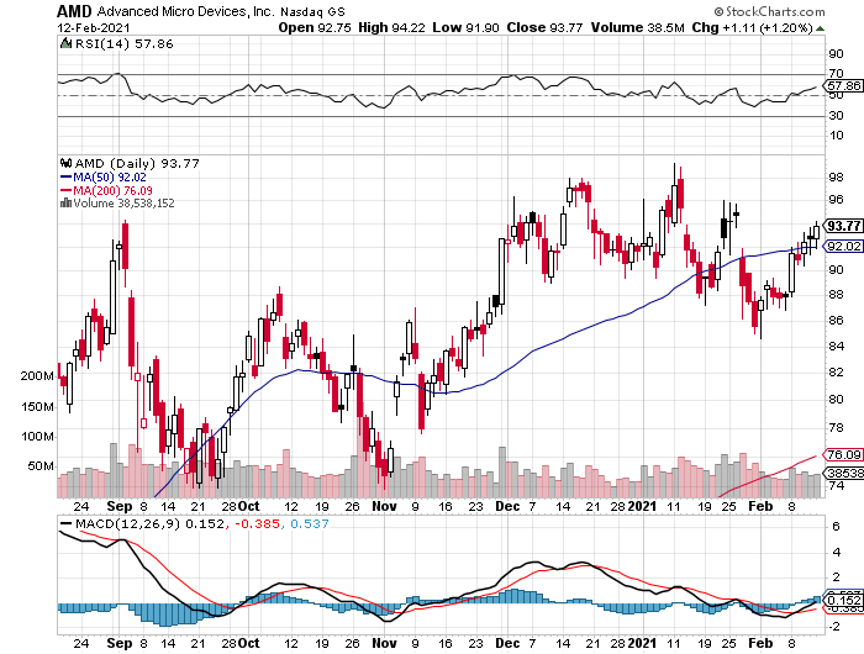
A: No, not really. There are so many people trying to get into these it’s incredible. And again, we may get a time correction where we sideline at the top and then break out again to the upside. This is classic in liquidity-driven markets, which is what we have in spades right now. Thanks to 5G, the number of chips in your everyday devices is about to increase tenfold, and it takes at least two years to build a new chip factory. So, keep buying (NVDA), (MU), and (AMD) on dips.
Q: Where are the best LEAPS prospects (Long Term Equity Participation Securities)?
A: That would have to be in technology—that's where the earnings growth is. If you go 20% out of the money on just about any big tech LEAPs two years out, to 2023 those will be worth 500% more at expiration.
Q: What about SPACs (Special Purpose Acquisition Company) now, as we’re getting up to five new SPACs a day?
A: My belief is that a SPAC is a vehicle that allows a manager to take out a 20% a year management fee instead of only 1%. And it's another aspect of the current mania we’re in that a lot of these SPACs are doubling on the first day—especially the electric vehicle-related SPACs. Also, a lot of these SPACs will never invest in anything, but just take the money and give it back to you in two years with no return when they can't find any good investments…. If you’re lucky. There's not a lot of bargains to be found out there by anyone, including SPAC managers.
Q: Does natural gas (UNG) fall into the same “avoid energy” narrative as oil?
A: Absolutely, yes. The only benefit of natural gas is it produces 50% less carbon dioxide than oil. However, you can't get gas without also getting oil (USO), as the two come out of the pipe at the same time; so I would avoid natural gas also. Gas and oil are also about to lose a large chunk, if not all, of their tax incentives, like the oil depletion allowance, which has basically allowed the entire oil industry to operate tax-free since the 1930s.
Q: What about hydrogen cars?
A: I don't really believe in the technology myself, and when you burn hydrogen, that also produces CO2. The problem with hydrogen is that it’s not a scalable technology. It’s like gasoline—you have to build stations all over the US to fuel the cars. Of course, it produces far less carbon than gas or natural gas, but it is hard to compete against electric power, which is scalable and there's already a massive electric grid in place.
Q: If you inherited $4 million today, would you cost average into (QQQ), (IWM), or (SPY)?
A: I would go into the ProShares Ultra Technology ETF (ROM), which is double the (QQQ); and if you really want to be conservative, put half your money into (QQQ) or (ROM), and then half into Berkshire Hathaway (BRK/A), which is basically a call option on the industrial and recovery economy. I know plenty of smart people who are doing exactly that.
Q: Is it weird to see oil, as well as green energy stocks, moving up?
A: No, that's actually how it works. The higher oil and gas prices go, the more economical it is to switch over to green energy. So, they always move in sync with each other.
Q: I heard rumors that Amazon (AMZN) is likely to raise Prime’s annual fee by $10-20 a year in 2021. Will that be a catalyst for the stock to go higher?
A: Yes. For every $10 dollars per person in Prime revenue, Amazon makes $2 billion more in net profit. I would say that's a very strong argument for the stock going up and maybe what breaks it out of its current 6-month range. By the way, Amazon is wildly undervalued, and my long-term target is $5,000.
Q: Do you think that the spike in Apple (AAPL) MacBook purchases means that computers will overtake iPhones as the revenue driver for Apple in 2021, or is the phone business too big?
A: The phone business is too big, and 5G will cause iPhone sales to grow exponentially. Remember, the iPhones themselves are getting better. I just bought the 12G Pro, and the performance over the old phone is incredible. So yeah, iPhones get bigger and better, while laptops only grow to the extent that people need an actual laptop to work on in a fixed office. Is that a supercomputer in your pocket, or are you just glad to see me?
Q: Share buybacks dried up because of revenue headwinds; do you think they will come back in a massive wave, giving more life to equities?
A: Absolutely, yes. Banks, which have been banned from buybacks for the past year, are about to go back into the share buyback business. Netflix has also announced that they will go buy their shares for the first time in 10 years, and of course, Apple is still plodding away with about $100 or $200 million a year in share buybacks, so all of that accelerates. The only ones you won't see doing buybacks are airlines and Boeing (BA) because they have such a mountain of debt to crawl out from before they can get back into aggressive buybacks.
Q: Interest rates are at historic lows; the smartest thing we can do is act big.
A: That’s absolutely right; you want to go big now when we’re all suffering so we can go small later and run a balanced budget or even pay down national debt if the economy grows strong enough. The last person to do that was Bill Clinton, who paid down national debt in small quantities in ‘98 and ‘99.
Q: What do you think about General Motors (GM)?
A: They really seem to be making a big effort to get into electric cars. They said they're going to bring out 25 new electric car models by 2025, and the problem is that GM is your classic “hour late, dollar short” company; always behind the curve because they have this immense bureaucracy which operates as if it is stuck in a barrel of molasses. I don’t see them ever competing against Tesla (TSLA) because the whole business model there seems like it’s stuck in molasses, whereas Tesla is moving forward with new technology at warp speed. I think when Tesla brings out the solid-state battery, which could be in two years, they essentially wipe out the entire global car industry, and everybody will have to either make Tesla cars under license from Tesla—which they said they are happy to do—or go out of business. Having said that, you could get another double in (GM) before everyone figures out what the game is.
Q: Will you update the long-term portfolio?
A: Yes, I promise to update it next week, as long as you promise me that there won’t be another insurrection next week. It’s strictly a time issue. After last year being the most exhausting year in history, this year is proving to be even more exhausting!
Q: Do you see a February pullback?
A: Either a small pullback or a time correction sideways.
Q: Do you think the Zoom (ZM) selloff will continue, or is it done now that the pandemic is hopefully ending?
A: It’s natural for a tech stock to give up one third after a 10X move. It might sell off a little bit more, but like it or not, Zoom is here to stay; it’s now a permanent part of our lives. They’re trying to grow their business as fast as they can, they’re hiring like crazy, so they’re going to be a big factor in our lives. The stock will eventually reflect that.
Good Luck and Stay Healthy.
John Thomas
CEO & Publisher
The Diary of a Mad Hedge Fund Trader