• support@madhedgefundtrader.com
  • Member Login
Mad Hedge Fund Trader
  • Home
  • About
  • Store
  • Luncheons
  • Testimonials
  • Contact Us
  • Click to open the search input field Click to open the search input field Search
  • Menu Menu
Mad Hedge Fund Trader

September 10, 2019

Diary, Newsletter, Summary

Global Market Comments
September 10, 2019
Fiat Lux

SPECIAL ARTIFICIAL INTELLIGENCE ISSUE

Featured Trade:
(NEW PLAYS IN ARTIFICIAL INTELLIGENCE),
(NVDA), (AMD), (ADI), (AMAT), (AVGO), (CRUS),
 (CY), (INTC), (LRCX), (MU), (TSM)

https://madhedgefundtrader.com/wp-content/uploads/2019/05/cropped-mad-hedge-logo-transparent-192x192_f9578834168ba24df3eb53916a12c882.png 0 0 Mad Hedge Fund Trader https://madhedgefundtrader.com/wp-content/uploads/2019/05/cropped-mad-hedge-logo-transparent-192x192_f9578834168ba24df3eb53916a12c882.png Mad Hedge Fund Trader2019-09-10 01:04:492019-09-09 17:09:22September 10, 2019
MHFTR

New Plays in Artificial Intelligence

Diary, Newsletter

It’s been three years since I published my first Special Report on artificial intelligence and urged readers to buy the processor maker NVIDIA (NVDA) at $68.80.

The stock quadrupled, readers are understandably asking me for my next act in the sector.

The good news is that I have one.

For a start, you could go out and buy NVIDIA again.

With an explosive 50% annual earnings growth, a near-monopoly in super fast processors, and a huge lead over the competition, I think there is another double in the shares that could take the price up to a stratospheric $300. Its newest super-fast graphics card, the Turing, promises to be a real barn burner and dominate the industry yet again.

But I can do better than that.

The good news if you are new to this sector is that the entire AI space has started to broaden out to offer a host of investment opportunities beyond the tiny handful I first mentioned in 2016.

These include legacy chipmakers, survivors of the great Dotcom bust, whose shares have barely moved in years.

Yes, there is such a thing as a cheap AI stock. To find out who they are, read on.

The reason for the expansion of the AI sector is that practically overnight these ultra-sophisticated algorithms have become essential to any company that wants to survive in online commerce or stay in business….period.

Those of us who have been in this business for more than 15 minutes have seen this pattern before, and the resulting impact on share prices: the Boeing 707, the personal computer, Windows, the Internet, and the smart cell phone.

AI is everywhere.

In the old days, visiting a website and window-shopping their products was easy. You just clicked around a few times and then moved on to the next site.

Now if you click on a product once, that site will follow you around relentlessly for months, appearing in the margins of your emails, offering you endless discounts and special deals.

I bought a Dell computer six months ago, and it is still pounding away at me with better offers. I feel like such a dummy buying a machine at the first price asked.

That is all AI.

The auto industry is now a major growth industry for AI. Even a simple garden-variety vehicle needs 100 chips just to operate.

The gull-wing doors on my new Tesla Model X each has its own learning program. They never open the same way twice.

In fact, when I first picked up the car last year, the salesman warned by saying it would be “stupid” for the first 3,000 miles.

It had to “learn” how to drive before I let it attempt any sophisticated self-driving maneuvers, like backing into a parking space on a crowded street.

I let it park itself in my garage now. I have only had a heart attack once.

With US annual auto production at 16.7 million units annualized, and global car and commercial vehicle production at a record 94.64 million, that is a lot of processors.

I have been covering Silicon Valley since it was a verdant, sun-kissed peach orchard in Northern California.

I have to say that in the half-century that I have followed the technology industry, I have never seen the principals, gurus, and visionaries so excited about a major new trend like AI.

Asking if AI is relevant now is like pondering the future of Thomas Edison’s new electricity invention in 1890.

If you think that AI still belongs in the realm of science fiction, you obviously didn’t get the memo. It is all around us all the time, 24/7. You just don’t know it yet.

And here’s the rub.

It is impossible to invest purely in AI.

All-new AI startups comprise small teams of experts from private labs and universities financed by big venture capital firms like Sequoia Capital, Kleiner Perkins, and Andreeson Horowitz.

After developing software for a year or two, they are sold on to major technology firms at huge premiums. They never see the light of day in the form of a public listing.

Alphabet (GOOGL) acquired Britain-based Deep Mind in 2014. Later that year, Google’s AlphaGo program defeated the world’s top-ranked Go player.

In 2016, Microsoft (MSFT) purchased Equivio, a small firm that applies AI to advanced document searches on the Internet.

Amazon (AMZN) recently bought out Orbeus, a startup known for machine learning tools for image recognition.

Amazon’s Jeff Bezos now says that his Amazon Fresh home food delivery service is using AI to grade strawberries.

Really!

We’re not talking small potatoes here.

The global artificial intelligence market is expected to grow at an annual rate of 44.3% a year to $23.5 billion by 2025.

Nearly half of all applications now use some form of AI that by 2020 will earn businesses an extra $60 billion a year in profits.

And from what I have learned from speaking to the major players over the last few weeks, I am convinced that these are low numbers by an order of magnitude.

I have been following developments in artificial intelligence since the 1960s.

There were those feeble computer dating attempts in the early seventies where we all had to prepare IBM punch cards.

I was matched with an annoyingly aggressive bleach blonde real estate agent. (Really?). Her only real qualification was that she was female.

It took decades and tens of thousands of programming man-hours before IBM’s Deep Blue could become a chess grandmaster in 1996, defeating Gary Kasparov.

Big Blue’s latest effort came to us with Watson in 2007, an 85,000-watt behemoth with 90 servers and 15 terabytes of data, or three quarters of the content of the entire Library of Congress.

The machine can read a staggering 1 million books a second. IBM has so far poured $15 billion into the project.

In 2011, Watson defeated the top-rated Jeopardy game show contestant by answering the question “What city’s national museum lost the “Lion of Nimrod.” The answer was “What is Baghdad” (I knew that!).

Today, Watson is on loan to the University of North Carolina at Chapel Hill where it has been deployed to cure cancer.

It took scientists a week to teach Watson how to read medical literature. In the second week, it read every paper published on cancer, some 25 million.

By the third week, it was proposing customized cures for advanced cancer patients, which achieved a 33% success rate.

After all, it can read all of the 8,000 cancer papers that are published every day from around the world IN SECONDS!

Scientists say that Watson has so far reached only 1% of its true potential.

It gets better than that.

A clinic can now biopsy your tumor, sequence its DNA, design a custom protein that will target and destroy your personal tumor, mass-produce it, inject it in your tumor, and cure you of cancer in a month.

This is being done with human volunteers in clinical trials NOW.

Expect this procedure to go retail and be made available to you in about five years. And by that, I mean cheap, locally available, and covered by your health insurance policy.

I believe that Watson and its future offspring will cure the major human maladies within a decade. My generation will probably be the last to suffer serious disease.

It isn’t just Watson that will take us the great leap forward in computing. By 2020, you will be able to buy a low-end laptop for $500 that can hold ALL KNOWLEDGE ACCUMULATED IN HUMAN HISTORY!

They better hurry. That body of knowledge is doubling every 18 months!

It is a key part of my argument that the US will enjoy a Golden Age and see a return of the “Roaring Twenties” during the 2020s.

If you have in any way been involved in the stock market for the past five years, AI has invaded your life.

High frequency trading and hedge funds now account for 70% of the daily trading volume on the major stock exchanges, and almost all of this is AI-driven.

Having spent my entire life trading stocks, I can confirm that in recent years the market’s character has dramatically changed, and not for the better. Call it trading untouched by human hands.

Algorithms are trading against algorithms, and whoever wins the nuclear arms race brings home the big bucks.

You used to need degrees in Finance and Economics, or perhaps an MBA, to become a professional fund manager. Now it’s a Ph.D. in Computer Science.

Remember the May 2010 flash crash when the Dow Average plunged 1,100 points in minutes wiping out $4.1 billion in equity value? AI’s fingerprints were all over that.

In 2016, the British pound lost 6% of its value in a mere two minutes, a move unprecedented in the history of foreign exchange markets. The culprit was AI.

Don’t expect the path forward to AI to be an easy one.

Indeed, the machines already have the power of life and death over all of us.

No less figures than Nobel Prize winner Dr. Stephen Hawking and Tesla’s Elon Musk have warned that computers and the Internet may have the power to pose a threat to human existence within a decade.

They are especially concerned about the militarization of powerful robots, something I know the US Defense Department is hell-bent on developing.

As I write this, the only thing preventing a drone attacking a village in Afghanistan is an Army corporal hitting a red button on a console in Nevada.

In the future, antivirus software won’t be needed to protect your computer. It will be essential to protect you FROM your computer.

You know that massive denial of service attack that hit the United States on October 21, 2016?

I asked one of my friends at security giant Palo Alto Networks (PANW) if it was the Russians again. He replied, “You better hope it’s the Russians.”

The implication is that the Internet may have launched the attack itself.

Now, about that stock recommendation.

Since we aren’t venture capitalists, we can’t buy into pure AI firms in their early stages. And I’m too old to get a Ph.D. in computer science.

We, therefore, have to be sneaky and get in through the back door via an indirect play which still has plenty of upside leverage.

My current favorite among the AI alternative stocks is Advanced Micro Devices (AMD).

If Intel only piques your appetite for AI stocks and you feel you need another serving, I have listed below ten names that will benefit mightily from this once-a-century opportunity.

AI Stock to BUY

Advanced Micro Devices (AMD)
Analogue Devices Communication (ADI)
Applied Materials (AMAT)
Broadcom (AVGO)
Cirrus Logic (CRUS)
Cypress Semiconductor (CY)
Intel (INTC)
Lam Research (LRCX)
Micron Technology (MU)
Taiwan Semiconductor (TSM)

If you’re really lazy, you can just buy a basket of semiconductor stocks through an industry-specific ETF.

The largest is the VanEck Vectors Semiconductor ETF (SMH), with $1.3 billion in assets under management. For a prospectus on the fund, please click here.

Or you could just stick with NVIDIA.

No matter how you want to slice and dice it, AI should be a dominant factor in your IRA, 401k, or benefit plan.

And you are a trader by nature, this will be a great sector to trade around.

As for your computer, you better start leaving it unplugged at night.

You never know.


She’s Smarter Than You Think

https://madhedgefundtrader.com/wp-content/uploads/2019/05/cropped-mad-hedge-logo-transparent-192x192_f9578834168ba24df3eb53916a12c882.png 0 0 MHFTR https://madhedgefundtrader.com/wp-content/uploads/2019/05/cropped-mad-hedge-logo-transparent-192x192_f9578834168ba24df3eb53916a12c882.png MHFTR2019-09-10 01:02:192019-10-14 09:46:52New Plays in Artificial Intelligence
Mad Hedge Fund Trader

September 9, 2019

Diary, Newsletter, Summary

Global Market Comments
September 9, 2019
Fiat Lux

Featured Trade:

(MARKET OUTLOOK FOR THE WEEK AHEAD, or SAVED BY A HURRICANE)
(FXB), (M), (XOM), (BAC), (FB), (AAPL),
 (AMZN), (ROKU), (VIX), (GS), (MS),


https://madhedgefundtrader.com/wp-content/uploads/2019/05/cropped-mad-hedge-logo-transparent-192x192_f9578834168ba24df3eb53916a12c882.png 0 0 Mad Hedge Fund Trader https://madhedgefundtrader.com/wp-content/uploads/2019/05/cropped-mad-hedge-logo-transparent-192x192_f9578834168ba24df3eb53916a12c882.png Mad Hedge Fund Trader2019-09-09 04:04:402019-09-09 04:18:21September 9, 2019
Mad Hedge Fund Trader

The Market Outlook for the Week Ahead, or Saved by a Hurricane

Diary, Newsletter

This was the week when the stock market was saved by Hurricane Dorian.

Why a hurricane?

Because it gave President Trump something else to Tweet about beside China and Jay Powell. The White House went totally silent, at least on matters concerning the stock market. There, the focus instead turned on whether Trump predicted Dorian was going to hit Alabama (it didn’t).

Thank goodness for small favors.

Instead, investors got to hear about progress was purported to be made on the China trade talks with a possible October meeting.

It all reminds me of the 1968 Paris peace talks, which I visited, where I remember Ambassador Avril Harriman storming out of the Majestic Hotel with a very stern expression on his face. They had just spent a year arguing with the North Vietnamese over the shape of the table (they finally settled on an oval).

Brexit finally started lurching towards its inevitable demise. Hard Brexit failed in Parliament, a disaster for Prime Minister Boris Johnson, whose own party and even his own brother voted against him.

Elections will follow which will finally plunge a dagger through the heart of Britain’s attempt to leave the European Community. If this happens, it will be a huge positive for risk markets globally. This is the beginning of the end. Get ready to buy the pound (FXB).

The bad news? Don’t count on this happening again this week, unless we get another hurricane. When a stock market rally is led by sectors with the worst fundamentals, like retail (M), energy (XOM), and banks (BAC), you want to run a mile. It means the rally was driven by short-covering, we are now at a market high, and the short players have a ton of cash.

I have been pounded with questions all week if the bottom is in and if it’s time to load the boat with tech stocks yet again. I have to answer with a firm “Not yet!” We still have three weeks to go in September with plenty of time for more volatility.

If the Fed cuts interest rates by 25 basis points, the Dow average could crater by 1,000 points. If they don’t cut, which I give a 50/50 chance, it will be down by 2,000 points.

They will be encouraged to cut by an August Nonfarm Payroll Report that came in at a tepid 130,000. The headline Unemployment Rate remained unchanged at 3.7%, a 50-year low. Average Hourly Earnings were an inflationary 0.4%, or 3.2% YOY. June and July were revised down.

The 2020 census was a big factor in August, where the US government hired 25,000 workers to prepare for next year. Without this, August would have come in at a weak 105,000 jobs.

Manufacturing hiring amounted to only 3,000, while Retail lost 11,000 jobs for the seventh consecutive monthly decline. The broader U-6 “discouraged worker” unemployment rate rose from 7.0% to 7.2%.

To demonstrate how much value you are gaining with this service, I generated the chart below. Since January 26, 2018 when the S&P 500 peaked, the total return has been zero, with a lot of heart-stopping volatility, including one 20% drawdown.

That has been the cost to the stock market of the trade war, which started only a few days later. The profit created by the Mad Hedge Fund Trader during the same period has been 58.97%.

You couldn’t even beat the Mad Hedge Fund Trader by pouring all your money into big technology stocks. Over the same time, Facebook (FB) fell 4.1%, Apple (AAPL) rose 21.7%, and Amazon (AMZN) by 22.2%.

The only way you could have topped my performance was to pour your life savings into Roku (ROKU), right when Amazon was about to put it out of business. Jeff Bezos partnered with Roku instead of delivering a 225% pop in the shares.

You might think such a performance is blown out of proportion, exaggerated, and fake. However, it is perfectly consistent with the numbers generated for the in-house trading books by senior traders at Goldman Sachs (GS) and Morgan Stanley (MS) where I come from.

In fact, during my day, if a trader earned less than 30% a year on his capital, he got fired or transferred over to covering retail accounts because the firm had so many better places to invest. They are also consistent with the performance of the top-end hedge managers, of which I used to be one.

Chinese Manufacturing Activity fell for four consecutive months taking the Purchasing Managers Index below a recessionary 50. If you wreck the economy of the world’s largest customer, the rest of the world goes into recession.

US Manufacturing hit a three-year low, the ISM Manufacturing PMI diving from an average 56.5 to 49.1 in August. Anything below 50 is a recession indicator. Hoping that China will bleed worse than us in a trade war is not a winning strategy. Stocks dove 300 points and the Volatility Index (VIX) shot up to $21 on the news. Avoid risk, as this is going to be a terrible month.

The prospect of a China meeting popped stocks 400 points, with an agreement to meet in October, citing progress on a phone call. Boy, I’m getting tired of this. When can we go back to looking at earnings, dividends, and book value?

The European Central Bank will almost certainly ease this week. It hasn’t worked for ten years so let’s try it again. They’re obviously not printing enough Euros. Overnight rates will fall from -0.4% to -0.6%. Some 30 billion euros a month will hit the economy in a new QE.

The Atlanta Fed downgraded the economy, cutting its Q3 GDP growth forecast from 2.0% to 1.5%. Expect a string of poor data points in the coming months as the delayed effect of an escalated trade war. However, the non-manufacturing service economy remains strong. That’s me, and probably you too.

The Mad Hedge Trader Alert Service has posted its best month in two years. Some 22 or the last 23 round trips, or 95.6%, have been profitable, generating one of the biggest performance jumps in our 12-year history.

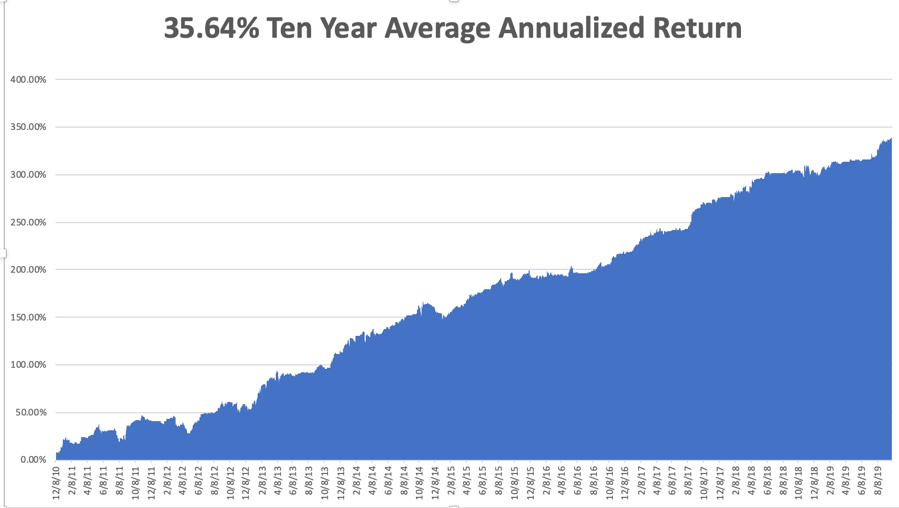
My Global Trading Dispatch has hit a new all-time high of 334.48% and my year-to-date shot up to +34.35%. My ten-year average annualized profit bobbed up to +34.30%. 

Better yet, since July 31, we generated a 20% profit for the trade alert service while the gain in the Dow Average was absolutely zero!

I raked in an envious 16.01% in August. All of you people who just subscribed in June and July are looking like geniuses. My staff and I have been working to the point of exhaustion, but it’s worth it if I can print these kinds of numbers.

As long as the Volatility Index (VIX) stays above $20, deep in-the-money options spreads are offering free money. I am now 40% long big tech. It rarely gets this easy.

The coming week will be a snore, as it always is after the jobs data.

On Monday, September 9 at 11:00 AM, August Consumer Inflation Expectations are out.

On Tuesday, September 10 at 12:00 PM, the NFIB Business Optimism Index for August is released.

On Wednesday, September 11, at 8:30 AM, the US Producer Price Index is announced.

On Thursday, September 12 at 8:30 AM, the Weekly Jobless Claims are printed. At the same time, the US Inflation Rate is published.

On Friday, September 13 at 8:30 AM, the US Retails Sales are printed. The Baker Hughes Rig Count follows at 2:00 PM.

As for me, I’ll be driving up to Lake Tahoe to make final preparations for the October 25-26 Mad Hedge Lake Tahoe Conference. A record number of black bears have been breaking into homes this summer and I just want to make sure my lakefront estate is OK.

It seems that Airbnb tenants have been leaving trails of cookies to their front doors and painting their refrigerators with peanut butter so they can get better selfies with their ursine neighbors.

Not a good idea.

I’ll be avoiding Interstate 80. A truck carrying 1,000 live chickens crashed there yesterday and the California Highway Patrol was last seen chasing them down the freeway.

Good luck and good trading.

John Thomas
CEO & Publisher
The Diary of a Mad Hedge Fund Trader


https://www.madhedgefundtrader.com/wp-content/uploads/2018/05/John-Thomas-on-USS-Missouri-story-1-image-4-e1525209087753.jpg 259 250 Mad Hedge Fund Trader https://madhedgefundtrader.com/wp-content/uploads/2019/05/cropped-mad-hedge-logo-transparent-192x192_f9578834168ba24df3eb53916a12c882.png Mad Hedge Fund Trader2019-09-09 04:02:262019-10-14 09:46:41The Market Outlook for the Week Ahead, or Saved by a Hurricane
Mad Hedge Fund Trader

September 6, 2019

Diary, Newsletter, Summary

Global Market Comments
September 6, 2019
Fiat Lux

Featured Trade:

(SEPTEMBER 4 BIWEEKLY STRATEGY WEBINAR Q&A),
(INDU), (FXY), (FXB), (USO), (XLE), (TLT), (TBT),
(FB), (AMZN), (MSFT), (DIS), (WMT), (IWM), (TSLA), (ROKU), (UBER), (LYFT), (SLV), (SIL)

https://madhedgefundtrader.com/wp-content/uploads/2019/05/cropped-mad-hedge-logo-transparent-192x192_f9578834168ba24df3eb53916a12c882.png 0 0 Mad Hedge Fund Trader https://madhedgefundtrader.com/wp-content/uploads/2019/05/cropped-mad-hedge-logo-transparent-192x192_f9578834168ba24df3eb53916a12c882.png Mad Hedge Fund Trader2019-09-06 04:04:392019-09-06 03:28:40September 6, 2019
Mad Hedge Fund Trader

September 4 Biweekly Strategy Webinar Q&A

Diary, Newsletter

Below please find subscribers’ Q&A for the Mad Hedge Fund Trader September 4 Global Strategy Webinar broadcast from Silicon Valley with my guest and co-host Bill Davis of the Mad Day Trader. Keep those questions coming!


Q: If Trump figures out the trade war will lose him the election; will he stop it?

A: Yes, and that is a risk that hovers over all short positions in the market at all times these days because stocks will soar (INDU) when the trade war ends. We now have 18 months of share appreciation that has been frustrated or deferred by the dispute with China. The problem is that the US economy is already sliding into recession and it may already be too late to turn it around.

Q: Do you see the British pound (FXB) dropping more on the Brexit turmoil? Do you think the UK will stay in the EU?

A: If the UK ends Brexit through an election, then the pound should recover from $1.19 all the way back up to $1.65 where it was before Brexit happened four years ago. If that does happen, it will be one of the biggest trades of the year anywhere in the world, going long the British pound. This is how I always anticipated it would end. I was in England for the Brexit vote and I was convinced that if they held the election the next day, it would have lost. The only reason it won was because nobody thought it would— a lot like our own 2016 election. That brings Britain back into the EEC, saves Europe, and has a positive impact on markets globally. So, this is a big deal. Not to do so would be economic suicide for Britain, and I think wiser heads will prevail.

Q: Do you think it’s a good idea for Saudi ARAMCO to go public in Japan as reports suggest?

A: When the Arabs want to get out of the oil business (USO), (XLE), you want to also. That’s what the sale of ARAMCO is all about. They’re going to get a $1 trillion or more valuation, raising $100 billion in cash. And guess who the biggest investors in alternative energy in California are? It’s Saudi Arabia. They see no future in oil, nor should you. This is why we’ve been negative on the sector all year. By the way, bankruptcies by frackers in the U.S. are at an all-time high, another indicator that low oil prices can’t be tolerated by the US industry for long.

Q: Is it time to buy the ProShares Ultra Short 20 year Plus Treasury Bond Fund (TBT)?

A: No, not yet; I think we’re going to break 1.33% — the all-time low yield for the (TLT) will probably be somewhere just below 1.00%. We probably won’t go to absolute zero because we still have a growing economy. The countries that already have negative interest rates have shrinking economies or are already in recession, like Germany or Great Britain can justify zero rates.

Q: Are you going to run all your existing positions into expiration?

A: I’m going to try to—it’s only 12 days to expiration, and we get to keep the full profit if we do. As long as the market is dead in the middle here, there are no other positions to put on, no extreme low to buy into or extreme high to sell into. It’s a question of letting this sort of nowhere-trend play out, but also there's nothing else to buy, so there is no need to raise cash. So, we’re 60% invested now and we’re going to try running as many of those into expiration as we can. Looks like all the long technology positions are safe (FB), (AMZN), (MSFT), (DIS). The only thing we’re pressing here are the shorts in Walmart (WMT) and Russell 2000 (IWM).

Q: Do you think it’s a good idea for Tesla (TSLA) to build another Gigafactory in Shanghai, China during a trade war? Will this blow up in Elon’s face?

A: I don’t think so because the Chinese are desperate for the Tesla technology and they just gave Tesla an exemption on import duties on all parts that need to go there to build the cars. So, that’s a very positive development for Tesla and I believe the stock is up about $10 since that news came out.

Q: Will Roku (ROKU) ever pull back? Would you buy it up here?

A: No, we recommended this thing last year at $40; it’s now up to $165, and up here it’s just wildly overbought, in chase territory. Of course, the reason that’s happening is that the big concern last year was Amazon wiping out Roku, yet they ultimately ended up partnering with Roku, and that’s worth about a 400% gain in the stock. You know the second you get into this, it’s over. There are just too many better fish to fry in the technology area.

Q: What happens if our existing Russell 2000 (IWM) September 2019 $153-$156 in-the-money vertical BEAR PUT spread Russell 2000 position closes between $156 and $153?

A: You lose money. You will get the Russell 2000 shares put to you, or sold to you at $153.00, which means you now own them, and you’ll get a big margin call from your broker for owning the extra shares. If ever it looks like we’re getting close to the strike price going into expiration, I come out precisely because of that risk. You don’t want random chance dictating whether you’re going to make money in your position or not going into expiration. If you’re worried about that, I would get out now and you can still come out with a nice profit. Or, you can always wait for another down day tomorrow.

Q: Is it time to get super aggressive shorting Lyft (LYFT) or Uber (UBER) when they openly admit that they won’t make a profit anytime in the near future?

A: The time to short Uber (UBER) and Lyft was at the IPO when the shares became available to sell. Down here I don’t really want to do very much. It’s late in the game and Uber’s down about one third from its IPO price. We begged people to stay away from this. It’s another example where they waited for the company to go ex-growth before it went public, but it didn’t leave anything for the public. It was a very badly mishandled IPO—it’s now at $31 against a $45 IPO price and was at a new all-time low just 2 days ago. You knew when they offered the drivers shares, the thing was in trouble. Sometime this will be a buy, but not yet. Go take a long nap first.

Q: Is the fact that rich people are hoarding cash a good indicator that a recession is approaching?

A: Yes, absolutely. Bonds yielding 1.45% is also an indication that the wealthy are hoarding cash from other investment and parking it in US treasury bonds. I went to the Pebble Beach Concourse d’ Elegance vintage car show a few weeks ago and all of the $10 million plus cars didn’t sell, only those priced below $100,000. That is always a good indicator that the wealthy are bailing ahead of a recession. If you can’t get a premium price for your vintage Ferrari, trouble is coming.

Q: Argentina just implemented currency controls; is this the start of a rolling currency crisis among emerging nations?

A: No, I believe the problems are unique to Argentina. They’ve adopted what is known as Modern Momentary Theory—i.e. borrowing and printing money like crazy. Unfortunately, this is unsustainable and results in a devalued currency, general instability, and the eventual hanging of their leaders from the nearest lamppost. This is exactly the same monetary policy that the Trump administration has been pursuing since he came into office. Eventually, it will lead to tears, ours, not his.

Q: Is the new all-electric Porsche Taycan a threat to Tesla?

A: No, it’s not. Their cheapest car is $150,000 and it gets one third less range than Tesla does. It’s really aimed at Porsche fanatics, and I doubt they will get outside their core market. In the meantime, Tesla has taken over the middle part of the electric market with the Model 3 at $37,000 a car. That’s where the money is, and Porsche will never get there.

Q: How will the US pull out of recession if the interest rates are at or below zero?

A: It won’t—that’s what a lot of economists are concerned about these days. With interest rates below zero, the Fed has lost its primary means to stimulate the economy. The only thing left to do is use creative means like feeding the economy with currency, which Europe has been doing for 10 years, and Japan for 30, with no results. That’s another reason to not allow rates to get back to zero—so we have tools to use when we go into a recession 12-24 months from now.

Q: What’s the best way to buy silver?

A: The ETF iShares Silver Trust (SLV) and, if you want to be aggressive, the silver miners with the Global X Silver Miners ETF (SIL).

Q: Have global central banks ruined the western economic system as we know it for future generations?

A: They may have—mostly by printing too much money in the last 10 years in order to get us out of recession. This hasn’t really worked for Europe or Japan, mind you, though who knows how much worse off they would be if they hadn’t. What it did do here is head off a Great Depression. If we go back to money printing in a big way, however, and it doesn’t work, we will not have prevented a Great Depression so much as pushed it back 10 or 15 years. That’s the great debate ongoing among economists, and it will eventually be settled by the marketplace.


https://www.madhedgefundtrader.com/wp-content/uploads/2018/08/JT-with-snorkel-story-1-image-6-e1535059927176.jpg 267 350 Mad Hedge Fund Trader https://madhedgefundtrader.com/wp-content/uploads/2019/05/cropped-mad-hedge-logo-transparent-192x192_f9578834168ba24df3eb53916a12c882.png Mad Hedge Fund Trader2019-09-06 04:02:202019-10-14 09:46:34September 4 Biweekly Strategy Webinar Q&A
Mad Hedge Fund Trader

September 5, 2019

Diary, Newsletter, Summary

Global Market Comments
September 5, 2019
Fiat Lux

SPECIAL VOLATILITY ISSUE

Featured Trade:

(SHOPPING FOR FIRE INSURANCE IN A HURRICANE),
(VIX), (VXX), (XIV),
(THE ABCs OF THE VIX),
(VIX), (VXX), (SVXY),

https://madhedgefundtrader.com/wp-content/uploads/2019/05/cropped-mad-hedge-logo-transparent-192x192_f9578834168ba24df3eb53916a12c882.png 0 0 Mad Hedge Fund Trader https://madhedgefundtrader.com/wp-content/uploads/2019/05/cropped-mad-hedge-logo-transparent-192x192_f9578834168ba24df3eb53916a12c882.png Mad Hedge Fund Trader2019-09-05 04:06:302019-09-05 03:34:40September 5, 2019
MHFTF

The ABCs of the VIX

Diary, Newsletter

I am one of those cheapskates who buy Christmas ornaments by the bucketload from Costco in January for ten cents on the dollar because my 11-month theoretical return on capital comes close to 1,000%. 

I also like buying flood insurance in the middle of the summer drought when the forecast in California is for endless days of sunshine. That is what we had at the end of July when the (VIX) was plumbing the depths of $12.

Get this one right, and the profits you can realize are spectacular.

It gets better. 

If the bottom in volatility exactly coincides with the peak in the stock market that it measures, volatility could be headed back up to the 30% handle, and maybe more. 

I double dare you to look at the charts below and tell me this isn’t happening.

Watch carefully for other confirming trends to affirm this trade is unfolding. Those would include a strong dollar, and a weak Japanese yen, Euro, and rising fixed income instruments of any kind.

Notice that every one of these is happening this week!

Reversion to the mean, anyone?

You may know of this from the many clueless talking heads, beginners, and newbies who call (VIX) the “Fear Index”. 

For those of you who have a Ph.D. in higher mathematics from MIT, the (VIX) is simply a weighted blend of prices for a range of option contracts on the S&P 500 index (SPX).

The formula uses a kernel-smoothed estimator that takes as inputs the current market prices for all out-of-the-money calls and puts for the front-month and second-month expirations. 

The (VIX) is the square root of the par variance swap rate for a 30-day term initiated today. To get into the pricing of the individual options, please go look up your handy dandy and ever-useful Black-Scholes equation. 

You will recall that this is the equation that derives from the Brownian motion of heat transference in metals. Got all that?

For the rest of you who do not possess a Ph.D. in higher mathematics from MIT, and maybe scored a 450 on your math SAT test, or who don’t know what an SAT test is, this is what you need to know. 

When the market goes up, the (VIX) goes down. When the market goes down, the (VIX) goes up. Period. End of story. Class dismissed.

The (VIX) is expressed in terms of the annualized monthly movement in the S&P 500 (SPX) which, with the (VIX) today at $10, is at $72.54. 

So for example, a (VIX) of $10 means that the market expects the index to move 2.89%, or $72.54 S&P 500 points, over the next 30 days. 

You get this by calculating $10/3.46 = 2.89%, where the square root of 12 months is 3.46. 

The volatility index doesn’t really care which way the stock index moves. If the S&P 500 moves more than the projected 2.89% in ANY direction, you make a profit on your long (VIX) positions. 

I am going into this detail because I always get a million questions whenever I raise this subject with volatility-deprived investors.

It gets better. 

Futures contracts began trading on the (VIX) in 2004 and options on the futures since 2006. 

Since then, these instruments have provided a vital means through which hedge funds control risk in their portfolios, thus providing the “hedge” in hedge fund.


https://www.madhedgefundtrader.com/wp-content/uploads/2018/09/Screen-Shot-2018-09-20-at-5.02.05-AM-e1537390982806.png 400 229 MHFTF https://madhedgefundtrader.com/wp-content/uploads/2019/05/cropped-mad-hedge-logo-transparent-192x192_f9578834168ba24df3eb53916a12c882.png MHFTF2019-09-05 04:02:582019-10-14 09:46:09The ABCs of the VIX
Mad Hedge Fund Trader

September 4, 2019

Diary, Newsletter, Summary

Global Market Comments
September 4, 2019
Fiat Lux

Featured Trade:

(HOW FREE ENERGY WILL POWER THE COMING ROARING TWENTIES),
(SPWR), (TSLA)

(ARE YOU IN THE 1%?),
(SNE), (HMC), (TLT)

https://madhedgefundtrader.com/wp-content/uploads/2019/05/cropped-mad-hedge-logo-transparent-192x192_f9578834168ba24df3eb53916a12c882.png 0 0 Mad Hedge Fund Trader https://madhedgefundtrader.com/wp-content/uploads/2019/05/cropped-mad-hedge-logo-transparent-192x192_f9578834168ba24df3eb53916a12c882.png Mad Hedge Fund Trader2019-09-04 04:06:182019-09-04 03:45:24September 4, 2019
MHFTR

Are You in the 1%?

Diary, Newsletter

I have been in the much-talked-about and often despised 1% for most of my adult life.

I started my relentless march towards wealth and financial independence when I was 11 years old and landed a job delivering newspapers for the Los Angeles Herald Examiner, an old Hearst rag, earning $30 a month.

I’ll never forget the weight of 30 pounds of newsprint on my shoulders as I delivered them around my neighborhood in the dark on my Schwinn bicycle.

I eventually got fired because I found the stock pages so enthralling that I was always late delivering the papers. The Herald was run out of business by the Los Angeles Times in 1989.

My next step towards success came with a job in the snack bar at the May Company, a Los Angeles department store that also no longer exists, earning the untold sum of $1 an hour, then the minimum wage.

The really smart thing I did there was that whenever a customer paid for a hot dog with a 40% pure Kennedy silver half dollar, which in 1967 was still in widespread circulation, I would switch it for paper money.

Eventually, I accumulated 100 of these half dollars.

At age 15, I was willing to bet that someday the US would go off the gold standard and all precious metals would rise in value.

President Nixon did exactly that in 1971, and the value of my stash rose 100-fold to $5,000.

I still have those silver half dollars. I understand that Texas hedge fund manager Kyle Bass owns the rest.

I finally made it into the 1% when I was 33, after spending two years at Morgan Stanley. By then, my pay there had rocketed from an entry level $45,000 to $300,000 a year.

It helped that I won the betting pool for picking the best performing stock in the world two years running.

Back then, nobody had ever heard of an obscure electronics company in Japan called Sony (SNE) which rose in value 85-fold in dollar terms over the following seven years.

Nor had they heard of Honda Motors (HMC). When the other traders saw their little eggshell shaped cars for the first time, they laughed.

The pitiful vehicles had to make a high-speed run to make it to the top of an American freeway onramp. Its shares rose 45 times in dollar terms.

This was back when $300,000 could buy you a luxury two-bedroom condo on the 34th floor on the upper east side of Manhattan. That is exactly what I did, right next door to corporate raider Carl Icahn, and across the street from Henry Kissinger and Ginger Rogers.

A London mansion followed, located between other homes owned by Jacob Rothschild and Sir Richard Branson.

After a few more years at Morgan Stanley, and then founding the first-ever dedicated international hedge fund, I soon found myself in the much-vaunted 1/10th of the top 1% of American earners.

I stayed there for quite a while.

However, I recently got the bad news from the New York Times that I have been kicked out of the top tier.

According to their research, to prove I have grabbed the brass ring, I have to have an average annual income of $9,446,793. Only 115,000 taxpayers can meet this elevated standard.

I am still in the top 1%, where I only need to earn $2,107,531 to qualify and can remain with my 1,128,000 friends.

My Brioni suits, Turnbull & Asser Sea Island Silk shirts, and Bruno Magli shoes will not be found for sale on eBay anytime soon.

Which left me to ponder why I had lost my position at the apex of US earning power.

It turns out that the concentration of wealth at the top has vastly accelerated since the stock market bottomed in March 2009.

Risk takers, like those who owned stocks, bonds, and real estate, were tremendously rewarded by the recovery of asset prices.

Those who don’t own any assets, about 40% of the country, were left behind in the dust.

So, the low tax leveraged longs, like those running big hedge and private equity funds, started to greatly outpace my own earning power.

Concentrating so much wealth at the top is a problem for the United States. As any financial advisor can tell you, the richer people become, the more conservative they get with their investments.

Eventually, it all ends up in the bond market, where positions are never sold to avoid paying taxes. In other words, it stagnates and is one of the causes of our present low 2.5% GDP growth rate.

It is also where the 1.46% ten-year Treasury bond (TLT) comes from.

It is usually NOT placed with higher risk, job-creating, equity type investments. For more on this, click here for “The Bond Market and the 1%”.

This always happens when you have a big bulge generation retire all at once, like the 85 million baby boomers.

Another reason I lost my guarantee of the best table in every restaurant I walk into is that I am paying a lot more in taxes than I used to.

This is because I shifted careers from the hedge fund business, where I paid a bargain 15% tax rate on my realized carried interest, to the newsletter game where I am tagged for a heart-rending 43.4%, including the Obamacare add on.

As a result, I pay more in taxes in a single year than most people earn in a lifetime. In other words, for the first time in my life, I am paying taxes like everyone else.

Ouch, and double ouch!

Want to know why I am so interested in what happens in Washington? BECAUSE IT’S MY MONEY THEY’RE SPENDING!

It is also why I have come to learn so much about our arcane and abstruse tax system, and how I am able to periodically pass on insights to you.

I have to pay my accountants tens of thousands of dollars to ferret this stuff out, for your benefit.

When I had dinner with former Federal Reserve Chairman Ben Bernanke, he told me that “rising income inequality is the biggest structural problem we face.”

To find out where you stand in the country’s multi-tiered income structure, I have reproduced the New York Times data below.

Who has seen the greatest accumulation of wealth since the 2009 low? The Koch Brothers, whose combined net worth has soared from $26 billion to $90 billion since then.

Go Figure.

For one more piece on the 1%, please click here for “Mixing With the 1% at Pebble Beach”.

These days, I get to download my papers on my iPad every morning no matter where I am in the world, which then update themselves throughout the day.

I now get up even earlier than when I delivered the papers by bike.

Come to think of it, that “Horatio Alger Effect” that Ben Bernanke mentioned to me over dinner the other day applies to me as well.

I bet it has worked for a lot of you too.


Being a Hedge Fund Manager Did Have Its Advantages

https://www.madhedgefundtrader.com/wp-content/uploads/2015/10/Man-Money.jpg 393 330 MHFTR https://madhedgefundtrader.com/wp-content/uploads/2019/05/cropped-mad-hedge-logo-transparent-192x192_f9578834168ba24df3eb53916a12c882.png MHFTR2019-09-04 04:04:202019-10-14 09:46:01Are You in the 1%?
Page 310 of 686«‹308309310311312›»

Legal Disclaimer

There is a very high degree of risk involved in trading. Past results are not indicative of future returns. MadHedgeFundTrader.com and all individuals affiliated with this site assume no responsibilities for your trading and investment results. The indicators, strategies, columns, articles and all other features are for educational purposes only and should not be construed as investment advice. Information for futures trading observations are obtained from sources believed to be reliable, but we do not warrant its completeness or accuracy, or warrant any results from the use of the information. Your use of the trading observations is entirely at your own risk and it is your sole responsibility to evaluate the accuracy, completeness and usefulness of the information. You must assess the risk of any trade with your broker and make your own independent decisions regarding any securities mentioned herein. Affiliates of MadHedgeFundTrader.com may have a position or effect transactions in the securities described herein (or options thereon) and/or otherwise employ trading strategies that may be consistent or inconsistent with the provided strategies.

Copyright © 2025. Mad Hedge Fund Trader. All Rights Reserved. support@madhedgefundtrader.com
Scroll to top