For years, I have been predicting that a new Golden Age was setting up for America, a repeat of the Roaring Twenties. The response I received was that I was a permabull, a nut job, or a conman simply trying to sell more newsletters.
Now some strategists are finally starting to agree with me. They too are recognizing that a ganging up of three generations of investment preferences will combine to drive markets higher during the 2020s, much higher.
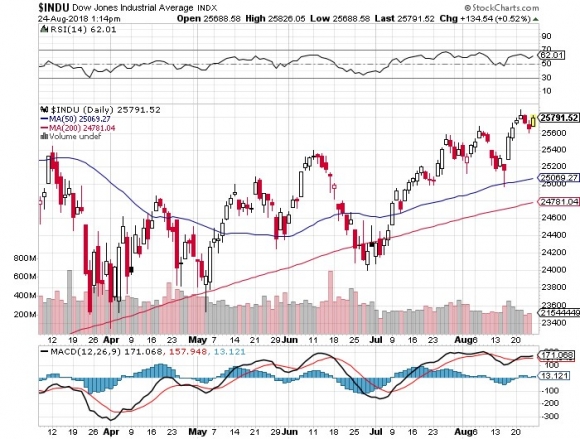
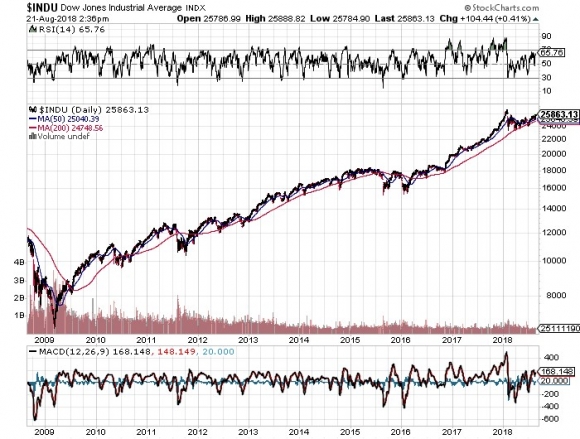
How high are we talking? How about a Dow Average of 120,000 by 2030, up another 465% from here? That is a 20-fold gain from the March 2009 bottom.
It’s all about demographics, which are creating an epic structural shortage of stocks. I’m talking about the 80 million Baby Boomers, 65 million from Generation X, and now 85 million Millennials. Add the three generations together and you end up with a staggering 230 million investors chasing stocks, the most in history, perhaps by a factor of two.
Oh, and by the way, the number of shares out there to buy is actually shrinking, thanks to a record $1 trillion in corporate stock buybacks.
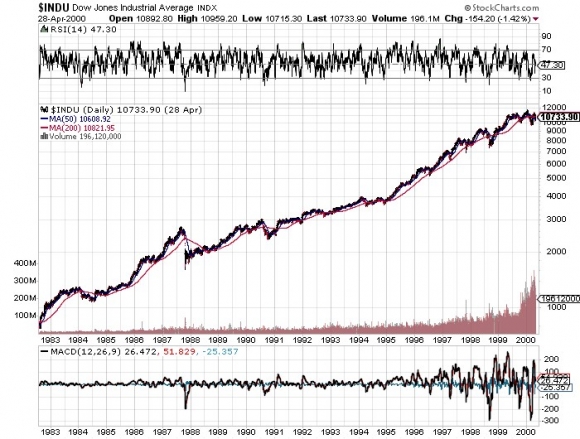
I’m not talking pie in the sky stuff here. Such ballistic moves have happened many times in history. And I am not talking about the 17th century tulip bubble. They have happened in my lifetime. From August 1982 until April 2000 the Dow Average rose, you guessed it, exactly 20 times, from 600 to 12,000, when the Dotcom bubble popped.
What have the Millennials been buying? I know many, like my kids, their friends, and the many new Millennials who have recently been subscribing to the Diary of a Mad Hedge Fund Trader. Yes, it seems you can learn new tricks from an old dog. But they are a different kind of investor.
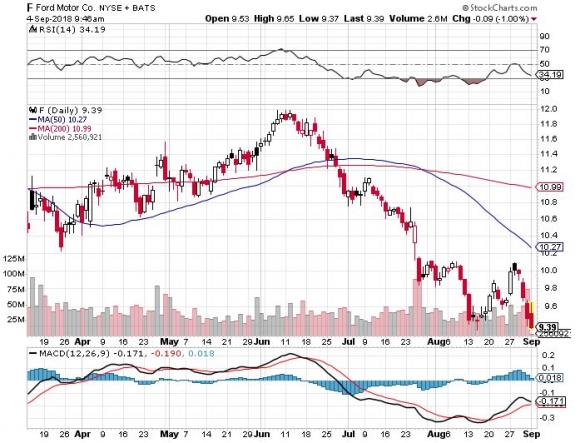
Like all of us, they buy companies they know, work for, and are comfortable with. During my Dad’s generation that meant loading your portfolio with U.S. Steel (X), IBM (IBM), and General Motors (GM).
For my generation that meant buying Microsoft (MSFT), Intel (INTC), and Dell Computer (DELL).
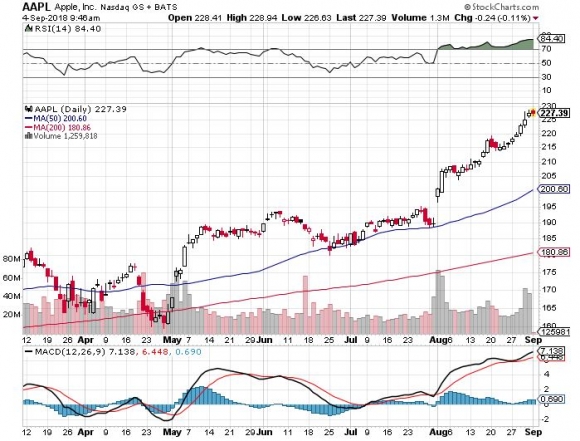
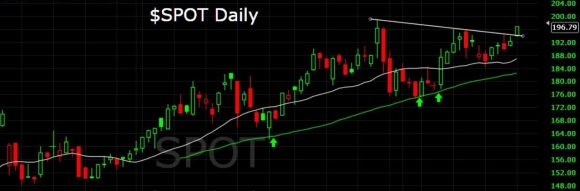
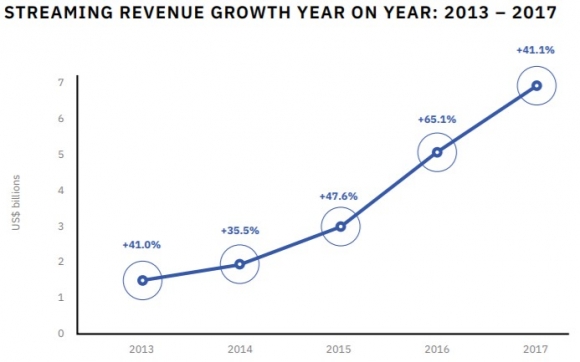
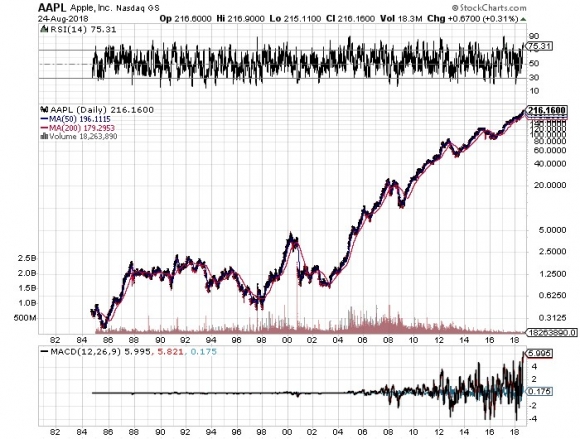
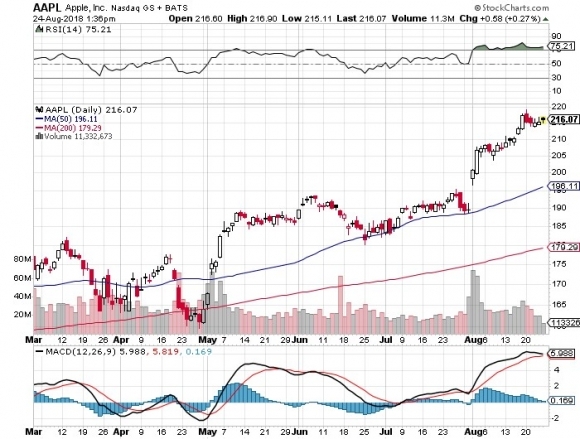
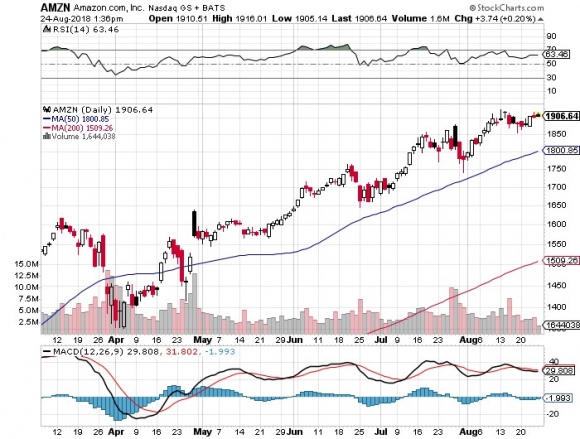
For Millennials that means focusing on Netflix (NFLX), Amazon (AMZN), Apple (AAPL), and Alphabet (GOOGL).
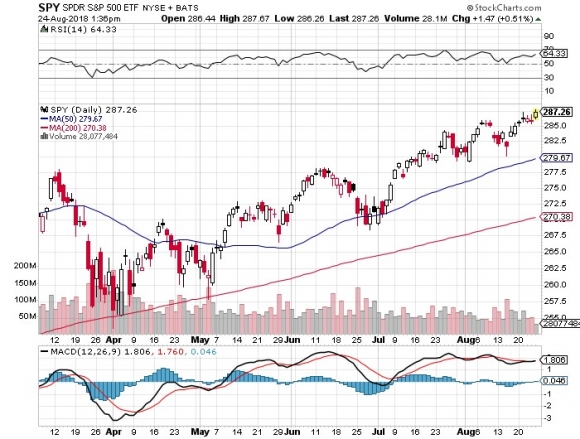
That’s why these four stocks account for some 40% of this year’s 7% gain. Oh yes, and they bought a few Bitcoin along the way too, to their eternal grief.
There is one catch to this hyper-bullish scenario. Somewhere on the way to the next market apex at Dow 120,000 in 2030 we need to squeeze in a recession. That is increasingly becoming a topic of market discussion.
The consensus now is that an impending inverted yield curve will force a recession sometime between August 2019 to August 2020. Throwing fat on the fire will be a one-time only tax break and deficit spending that burns out sometime in 2019. These will be a major factor in U.S. corporate earnings growth dramatically slowing down from 26% today to 5% next year.
Bear markets in stocks historically precede recessions by an average of seven months so that puts the next peak in top prices taking place between February 2019 to February 2020.
When I get a better read on precise dates and market levels, you’ll be the first to know.
To read my full research piece on the topic please click here to read “Get Ready for the Coming Golden Age.”
Dow 1982-2000 Up 20 Times in 18 Years
Dow 2009-Today Up 4.3 Times in 9 Years So Far
https://www.madhedgefundtrader.com/wp-content/uploads/2018/08/John-on-mechanical-bull-story-1-image-3-e1534972073238.jpg313250MHFTRhttps://madhedgefundtrader.com/wp-content/uploads/2019/05/cropped-mad-hedge-logo-transparent-192x192_f9578834168ba24df3eb53916a12c882.pngMHFTR2018-08-23 01:08:052018-08-22 21:23:50Why the Dow is Going to 120,000
Mad Hedge Technology Letter August 22, 2018 Fiat Lux
Featured Trade: (WHAT’S IN STORE FOR TECH IN THE SECOND HALF OF 2018?), (GOOGL), (AMZN), (FB), (UTX), (UBER), (LYFT), (MSFT), (MU), (NVDA), (AAPL), (SMH)
Tech margins could be under pressure the second half of the year as headwinds from a multitude of sides could crimp profitability.
It has truly been a year to remember for the tech sector with companies enjoying all-time high probability and revenue.
The tech industries’ best of breed are surpassing and approaching the trillion-dollar valuation mark highlighting the potency of these unstoppable businesses.
Sadly, it can’t go on forever and periods of rest are needed to consolidate before shares relaunch to higher highs.
This could shift the narrative from the global trade war, which is perceived as the biggest risk to the current tech market to a domestic growth issue.
Healthy revenue beats and margin growth have been essential pillars in an era of easy money, non-existent tech regulation, and insatiable demand for everything tech.
Tech has enjoyed this nine-year bull market dominating other industries and taking over the S&P on a relative basis.
The lion’s share of growth in the overall market, by and large, has been derived from the tech sector, namely the most powerful names in Silicon Valley.
Late-stage bull markets are fraught with canaries in the coal mine offering clues for the short-term future.
Therefore, it is a good time to reassess the market risks going forward as we stampede into the tail end of the financial year.
The shortage of Silicon Valley workers is not a new phenomenon, but the dearth of talent is going from bad to worse.
Proof can be found in the controversial H-1B visa program used to hire foreign tech workers mainly to Silicon Valley.
A few examples are Alphabet (GOOGL), which was granted 1,213 H-1B approvals in 2017, a 31% YOY rise.
Alphabet’s competitor Facebook (FB) based in Menlo Park, Calif., was granted 720 H-1B approvals in 2017, a 53% YOY jump from 2016.
This lottery-based visa for highly skilled foreign workers underscores the difficulty in finding local American talent suitable for a role at one of these tech stalwarts.
Amazon (AMZN) made one of the biggest jumps in H-1B approvals with 2,515 in 2017, a 78% YOY surge.
The vote of non-confidence in hiring Americans shines an ugly light on American youth who are not applying themselves to the domestic higher education system as are foreigners.
For the lucky ones that do make it into the hallways of Silicon Valley, a great salary is waiting for them as they walk through the front door.
Reportedly, the average salary at Facebook is about $250,000 and Alphabet workers take home around $200,000 now.
Pay packages will continue to rise in Silicon Valley as tech companies vie for the same talent pool and have boatloads of capital to wield to hire them.
This is terrible for margins as wages are the costliest input to operate tech companies.
United Technologies Corp. (UTX) chief executive Gregory Hayes chimed in citing a horrid “labor shortage in the U.S. and in Europe.”
He followed that up by saying the company will have to grapple with this additional cost pressure.
Certain commodity prices are spiraling out of control and will dampen profits for some tech companies.
Uber and Lyft, ridesharing app companies, are sensitive to the price of oil, and a spike could hurt the attractiveness to recruit potential drivers.
The perpetually volatile oil market has been trending higher since January, from $47 per barrel and another spike could damage Uber’s path to its IPO next year.
Will Uber be able to lure drivers into its ecosystem if $100 per barrel becomes the new normal?
Probably not unless every potential driver rolls around in a Toyota Prius.
If oil slides because of a global recession instigated by the current administration aim to rein in trade partners, then Uber will be hard hit abroad because it boasts major operations in many foreign megacities.
A recession means less spending on Uber.
Either result will be negative for Uber and ridesharing companies won’t be the only companies to be hit.
Other victims will be tech companies incorporating transport as part of their business model, such as Amazon which will have to pass on more delivery costs to the customer or absorb the blows themselves.
Logistics is a massive expense for them transporting goods to and from fulfillment centers. And they have a freshly integrated Whole Foods business offering two-hour free delivery.
Higher transport costs will bite into the bottom line, which is always a contentious issue for Amazon shareholders.
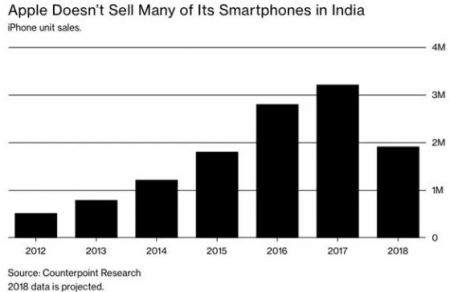
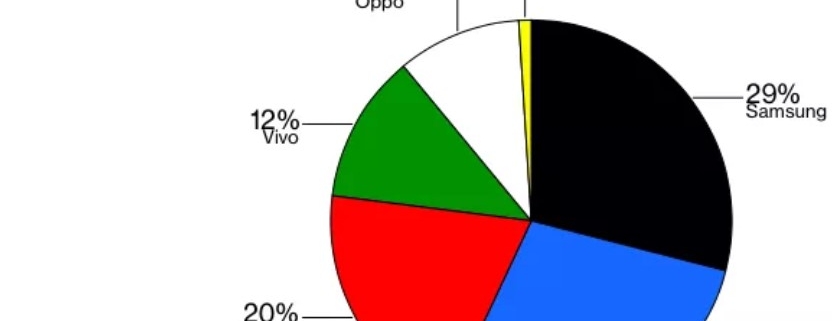
Another red flag is the deceleration of the global smartphone market evident in the lackluster Samsung earnings reflecting a massive loss of market share to Chinese foes who will tear apart profit margins.
Even though Samsung has a stranglehold on the chip market, mobile shipments have fell off a cliff.
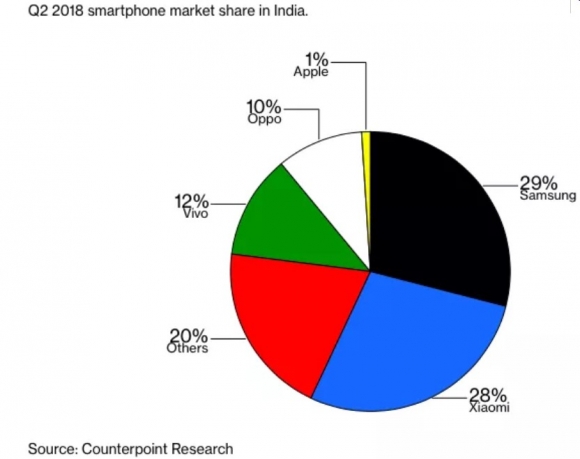
Damaging market share loss to Chinese smartphone makers Xiaomi and Huawei are undercutting Samsung products. Chinese companies offer better value for money and are scoring big in the emerging world where incomes are lower making Chinese phones more viable.
The same trend is happening to Samsung’s screen business and there could be no way back competing against cheaper, lower quality but good enough Chinese imitations.
Pouring gasoline on the fire is the Chinese investigation charging Micron (MU), SK Hynix, and Samsung for colluding together to prop up chip prices.
These three companies control more than 90% of the global DRAM chip market and China is its biggest customer.
The golden days are over for smartphone growth as customers are not flooding into stores to buy incremental improvements on new models.
Customers are staying away.
The smartphone market is turning into the American used car market with people holding on to their models longer and only upgrading if it makes practical sense.
Chinese smartphone makers will continue to grab global smartphone market share with their cheaper premium versions that western companies rather avoid.
Battling against Chinese companies almost always means slashing margins to the bone and highlights the importance of companies such as Apple (AAPL), which are great innovators and produce the best of the best justifying lofty pricing.
The stagnating smartphone market will hurt chip and component company revenues that have already been hit by the protectionist measures from the trade war.
They could turn into political bargaining chips and short-term pressures will slam these stocks.
This quarter’s earnings season has seen a slew of weak guidance from Facebook, Nvidia (NVDA) mixed in with great numbers from Alphabet and Amazon.
Beating these soaring estimates is not a guarantee anymore as we move into the latter part of the year.
Migrating into the highest quality names such as Amazon and Microsoft (MSFT) with bulletproof revenue drivers would be the sensible strategy if tech’s lofty valuations do not scare you off.
Tech has had its own cake and ate it too for years. But on the near horizon, overdelivering on earnings results will be an arduous chore if outside pressures do not relent.
It’s been fashionable in the past for market insiders to call the top of the tech market, but precisely calling the top is impossible.
The long-term tech story is still intact but be prepared for short-term turbulence.
“By giving people the power to share, we're making the world more transparent,” – said cofounder and CEO of Facebook Mark Zuckerberg.
https://madhedgefundtrader.com/wp-content/uploads/2019/05/cropped-mad-hedge-logo-transparent-192x192_f9578834168ba24df3eb53916a12c882.png00MHFTRhttps://madhedgefundtrader.com/wp-content/uploads/2019/05/cropped-mad-hedge-logo-transparent-192x192_f9578834168ba24df3eb53916a12c882.pngMHFTR2018-08-22 03:05:032018-08-22 06:23:58What’s in Store for Tech in the Second Half of 2018?
I first spoke to Steve Wozniak via HAM radio when I was 12 years old and he was the 14-year-old president of the Homestead High School Radio Club in Cupertino, California.
With seven children, my dad was pretty stingy with allowance money. But when it came to electronic parts, I had an unlimited budget, as that is where he saw the future.
So, while other kids collected baseball cards, I stocked up on tubes, resistors, capacitors, and rheostats. This was back when you could buy WWII surplus parts from Radio Shack for pennies a pound.
Then the transistor came out, and building projects, like simple computers programmed with basic '1's' and '0's' suddenly became possible.
By junior high school, I had gained my radio license, learning Morse code at the required five words per minute, and a path opened that eventually led me to Woz.
Whenever I had a design problem, Woz always had a solution. He seemed to know everything about electronics.
I planned to attend De Anza College in the San Francisco Bay Area to collaborate with Woz, but then the State of California dropped a big fat scholarship to the University of Southern California in my lap, and we parted ways.
That's government for you. The state thought I was smarter than Woz. Ha!
The last thing he taught me was this really cool way to make long distance phone calls for free with something called a 'blue box.'
I later heard that Woz went to work for some kind of fruit company designing computers, which sounded stupid to me at the time, but Woz was always a guy who marched to a different drummer.
A decade later, I was an ambitious young vice president at Morgan Stanley, and ran into Woz again while escorting Steve Jobs around to big institutional investors hawking an Apple (AAPL) shares back when they were $1 on a split adjusted basis.
By then he had gained a lot of weight. He fascinated me with stories about how he had gone from scrounging around for a bootleg $12 chip, to making $100 million on the Apple IPO in just three years.
The phrase "only in America" has to come to mind.
We bought our planes at the same time, me a Cessna 340 twin, and he a Beechcraft Bonanza. When I heard he totaled his in a crash in Santa Cruz a few years later, I sent flowers to his hospital room, even though he was in a coma and wasn't expected to live.
In later years we moved into the same philanthropic circles at the San Francisco Ballet, the Computer Museum, and local art museums. To me, Woz always stood out at the social events as the only one who was not an inveterate social climber, the kind of which I tired of long ago.
That was vintage Woz. He just didn't care.
When I finally stumbled across his autobiography, iWoz, I grabbed it and devoured the pages in a couple of days.
The tome filled in the holes about what I knew about the man: the wives, the rock concerts, his universal remote-control idea, and the early days at Apple.
You also learn a lot about electronics and basic computer hardware and software design.
While there are a lot of fifth-grade science teachers who wish they were billionaires, there is only one billionaire who aspired to teach fifth-grade science. That is what Woz did for 10 years after he left Apple.
Despite the billions, Steve is still an all-right guy. With Apple stock having touched $218 last week he must be worth an unimaginable amount. He won’t tell anyone how much he still owns, and he doesn’t even have his own rocket program. To buy the book of his engaging and entertaining story, please click here at click here.
https://www.madhedgefundtrader.com/wp-content/uploads/2013/02/Steve-Wozniak.jpg301382MHFTRhttps://madhedgefundtrader.com/wp-content/uploads/2019/05/cropped-mad-hedge-logo-transparent-192x192_f9578834168ba24df3eb53916a12c882.pngMHFTR2018-08-22 01:06:322018-08-22 04:41:51Hanging Out With the Woz
Featured Trade:
(THE MARKET OUTLOOK FOR THE WEEK AHEAD, or
IS THE TRADE WAR ON OR OFF?),
(AAPL), (UUP), (EEM), (NFLX), (TSLA), (GOOGL), (SOYB),
(SOME SAGE ADVICE ABOUT ASSET ALLOCATION)
Is the trade war on or off? Trillions of dollars in cash flow and investment depend on the answer to the question.
Traders and investors can be forgiven for being confused. It was only a week ago that a doubling of duties on Turkish imports were threatened because of an American pastor locked up there two years ago, triggering a stock meltdown.
Then, on Wednesday night presidential economic advisor Larry Kudlow hinted that he would meet with a Chinese trade delegation, prompting a 400-point Dow melt-up. Please note that except for Apple (AAPL), technology stocks did not participate in the rally one iota.
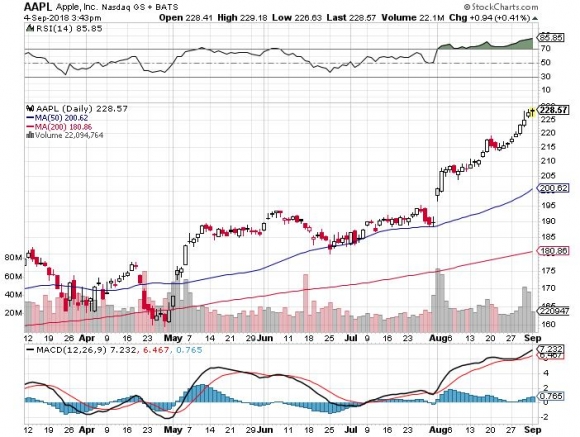
In the meantime, Apple continued its relentless march to my $220 target for $2018, so you might think about taking some money off the table. The market capitalization now stands at a staggering $1.05 trillion, the largest in the world.
It vindicates my call that at any time the administration could suddenly declare victory in the trade war, prompting a major stock market rally, regardless of the outcome.
So what happens next. Expect the trade talks to fail, or not happen at all. Market meltdowns will be followed by melt-up, then meltdowns again. Certainly, that's what the soybean (SOYB) market believes, that new canary in the coal mine for our global trade wars. It barely moved this week.
Hey, if trading were easy it would pay the federal minimum wage rate of $7.25 an hour, so quit your complaining!
As if trade wars were the only thing to worry about these days.
There is a mass protest underway at Alphabet (GOOGL) over the company's proposal to re-enter the China market. No one wants to assist the Middle Kingdom's harsh censorship regime, and some 1,000 employees have already signed a petition to this effect.
Emerging markets (EEM) continue to get pounded by trade wars and a strong U.S. dollar (UUP), which has the effect of increasing their companies' local currency debt.
Elon Musk continues his slow motion public nervous breakdown, cutting Tesla's stock at the knees down to $305. I hope you all took my advice last week to unload the stock at $380.
Netflix (NFLX) shares are undergoing a serious pullback now that it is in between upgrade launches, and the trade wars and strong dollar eat into international subscriber growth, about 80% of the total. Don't forget to buy this dip.
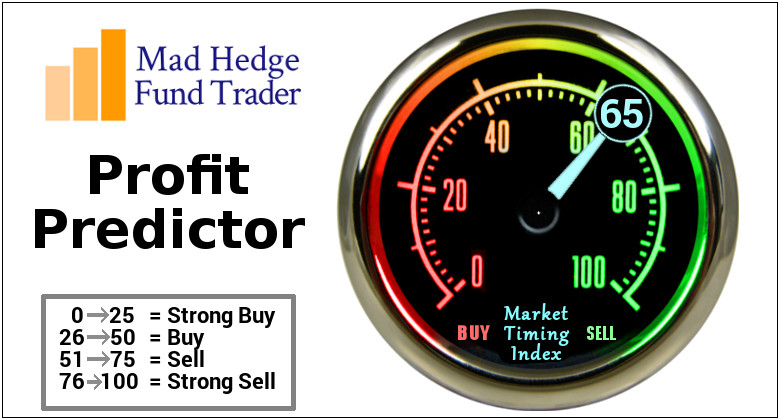
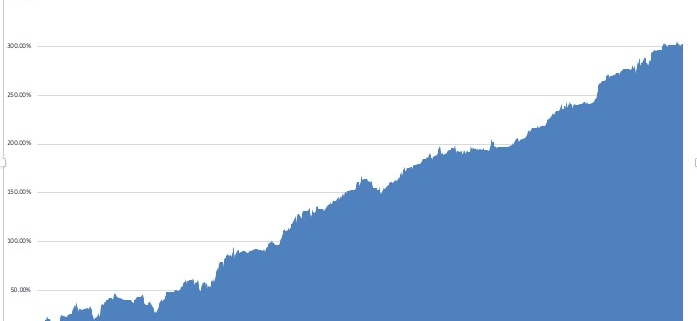
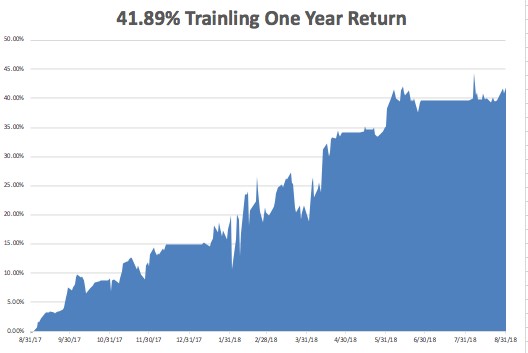
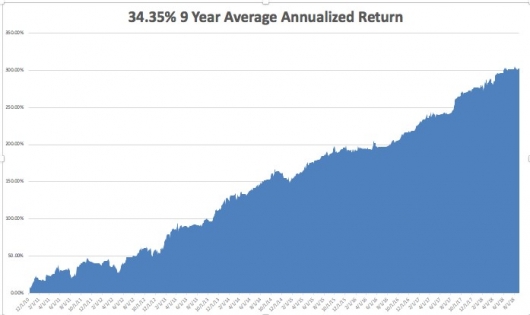
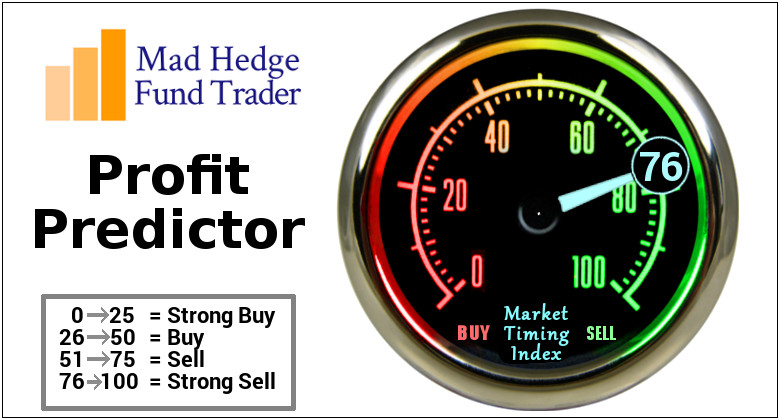
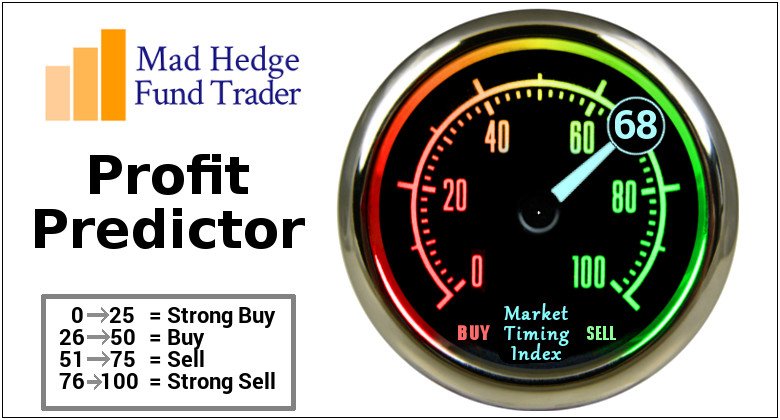
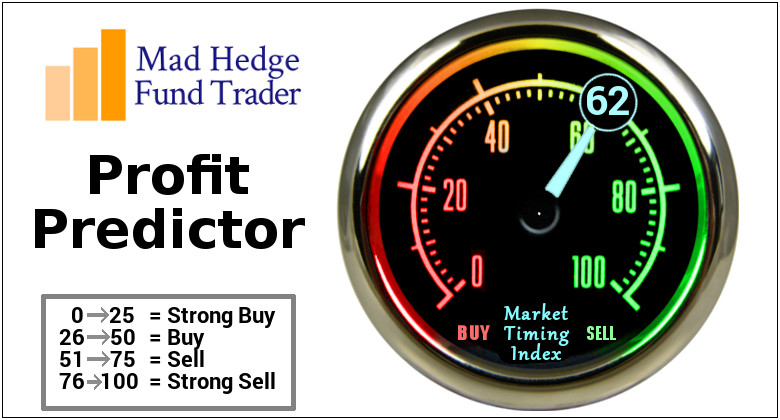
With the Mad Hedge Market Timing Index stuck dead on 50, I am not inclined to reach for trades here. A reading of 50 gives you the perfect "do nothing" indicator. As is always the case when I return from vacation my first few trades are a rude awakening. August is now showing a modest return of 0.23%. My 2018 year-to-date performance has clawed its way up to 25.03% and my nine-year return appreciated to 302.61%. The Averaged Annualized Return stands at 34.91%. The more narrowly focused Mad Hedge Technology Fund Trade Alert performance is annualizing now at an impressive 32.24%.
This coming week housing statistics will give the most important insights on the state of the economy. On Monday, August 20, there will be nothing of note to report. It will just be another boring summer day.
On Tuesday, August 21, same thing.
On Wednesday, August 22 at 9:15 AM, we learn July Existing Home Sales. Will the rot continue? Weekly EIA Petroleum Inventory Statistics are out at 10:30 AM. The Fed Minutes from the meeting six weeks ago are out at 2:00 PM EST.
Thursday, August 23 leads with the Weekly Jobless Claims at 8:30 AM EST, which saw a fall of 12,000 last week to 212,000. Also announced are July New Home Sales. The two-day Jackson Hole Symposium of central bankers starts in the morning.
On Friday, August 24 at 8:30 AM EST, we get July Durable Goods. Then the Baker Hughes Rig Count is announced at 1:00 PM EST.
As for me, it is back to school week for me, so I will be making the rounds with the new teachers at two schools. I have to confess that at my age I have trouble distinguishing between the students and the teachers.
Finally, a sad farewell to Aretha Franklin, the Queen of soul, who provided me with a half century of listening pleasure. When I was young, I couldn't afford to go see her, and when I got old I didn't have the time. Isn't life lived backward?
Good luck and good trading.
UP, DOWN, UP, DOWN!
https://madhedgefundtrader.com/wp-content/uploads/2019/05/cropped-mad-hedge-logo-transparent-192x192_f9578834168ba24df3eb53916a12c882.png00MHFTRhttps://madhedgefundtrader.com/wp-content/uploads/2019/05/cropped-mad-hedge-logo-transparent-192x192_f9578834168ba24df3eb53916a12c882.pngMHFTR2018-08-20 01:07:242018-08-20 01:07:24The Market Outlook for the Week Ahead, or Is the Trade War on or Off?
Featured Trade:
(WHY BONDS CAN'T GO DOWN),
(TLT), (TBT), ($TNX), (TUR), (TSLA),
(HOW TO MAKE MORE MONEY THAN I DO),
(AMZN), (LRCX), (ABX), (AAPL), (TSLA), (NVDA)
By now, most of you have figured out that I love calling readers every day and milking them for ideas on how to improve my service.
Often, they think I am an imposter, a telephone salesman, a machine, or an algorithm. It's only after listening for a few seconds that they recognize my voice from the biweekly strategy webinars and realize that it's the real me.
I don't do this to get renewals, because everyone renews anyway. Where else do you get a 62% annual return with no serious drawdowns?
No, I do it because the information I pick up from subscribers is golden. Some of my best Trade Alerts are inspired by reader questions.
One of my favorite Einstein quotes is that "There are no stupid questions, only stupid answers."
In fact, I have discovered that a lot of subscribers are making much more money from my service than I do.
I'll tell you how they do it.
First, let me remind readers that every Trade Alert I send out includes recommendation for a call or put option spread, a single stock, or an ETF.
The trading performance charts that we published are based on the options spread positions only.
WARNING: What worked swimmingly over the past 10 years is no guarantee that it will work next year, but I thought you'd like to know anyway.
1) Raise the Strike Prices
Move the strike prices up by a dollar. So instead of buying the Barrick Gold (ABX) September $15-$16 deep in-the-money vertical bull call spread, you pick up the $16-$17 call spread instead.
Generally, you make a profit that is 50% greater on this higher spread than with the original recommendation. But you are also taking on higher risk.
When 90% or more of our Trade Alerts are successful this has been a pretty good bet to make.
2) Buy the Call Options Only
Instead of buying the call spread, you buy the call option only in half the size.
When it works, your upside is unlimited. When it doesn't, you just write off the total value of your investment.
This is a great approach when the stocks I recommend take off like a rocket and double or more, as have Apple (AAPL), Amazon, (AMZN), Tesla (TSLA), Lam Research (LRCX), and NVIDIA (NVDA).
Option spread buyers leave a lot of money on the table with this scenario, but get lower performance volatility.
I have observed that many of my Australia readers pursue this approach, as they are fighting a 14-hour time zone disadvantage with the New York Stock Exchange. Not many civilians want to trade at 4:00 AM no matter how much it pays.
The payoff is that they earn about double what I do trading the same stocks.
3) Buy a 2X or 3X Leveraged ETF
This is moving out even further off the risk curve.
Almost every one of the 101 S&P 500 sectors have listed for them 2X and 3X bull and bear ETF's. In theory, the best-case scenario for one of these funds is that they will rise three times as fast as the underlying basket.
In theory, I said.
By the time you take out management fees, tracking error, and execution costs, and wide spreads, you are more likely to get 2.5 times the basket appreciation, if not 2X.
I normally steer investors away from 3X funds. But 401k traders, who are not allowed to deal in stock options, swear by them.
4) Trade Futures
This is a favorite of foreign exchange, precious metals, and bond traders. A futures contract can deliver up to 100 times the performance of the underlying currency, metal, or Treasury bond.
Get a good entry point, run a tight stop loss, and the potential gains can be astronomical.
Every year we get a couple of followers who earn 1,000% profits using our market timing for entry and exit point, and they always do it through the futures markets. Yes, that is a 10X return.
This is also a much higher risk, but higher return strategy. Your broker will present greater disclosure requirements and need a higher clearance level.
But potentially retiring in a year is ample bait for many professionals to go through with this.
5) Read the Research
I know a lot of you only buy this service only for our industry beating Trade Alert service.
But my decade-long experience in watching readers succeed, or fail, in their executions is that the more research they read, the more money they make.
Don't try to skim though with a minimal effort.
It's really very simple. The more work you put into this, the more profit you take out.
Understanding fully what is happening in the markets, indeed the entire global economy, will give you the confidence you need to take on bigger positions and make A LOT more money.
There is no free lunch. There is no Holy Grail.
Having said all that, good luck and good trading.
Looks Like I Got Another One
https://madhedgefundtrader.com/wp-content/uploads/2019/05/cropped-mad-hedge-logo-transparent-192x192_f9578834168ba24df3eb53916a12c882.png00MHFTRhttps://madhedgefundtrader.com/wp-content/uploads/2019/05/cropped-mad-hedge-logo-transparent-192x192_f9578834168ba24df3eb53916a12c882.pngMHFTR2018-08-15 01:06:012018-08-15 01:06:01How to Make More Money Than I Do
Legal Disclaimer
There is a very high degree of risk involved in trading. Past results are not indicative of future returns. MadHedgeFundTrader.com and all individuals affiliated with this site assume no responsibilities for your trading and investment results. The indicators, strategies, columns, articles and all other features are for educational purposes only and should not be construed as investment advice. Information for futures trading observations are obtained from sources believed to be reliable, but we do not warrant its completeness or accuracy, or warrant any results from the use of the information. Your use of the trading observations is entirely at your own risk and it is your sole responsibility to evaluate the accuracy, completeness and usefulness of the information. You must assess the risk of any trade with your broker and make your own independent decisions regarding any securities mentioned herein. Affiliates of MadHedgeFundTrader.com may have a position or effect transactions in the securities described herein (or options thereon) and/or otherwise employ trading strategies that may be consistent or inconsistent with the provided strategies.