Mad Hedge Biotech and Healthcare Letter
October 28, 2021
Fiat Lux
Featured Trade:
(AN ANYTIME, ANYWHERE HEALTHCARE STOCK)
(TDOC), (AMZN), (AMWL), (WMT), (HIM)


Mad Hedge Biotech and Healthcare Letter
October 28, 2021
Fiat Lux
Featured Trade:
(AN ANYTIME, ANYWHERE HEALTHCARE STOCK)
(TDOC), (AMZN), (AMWL), (WMT), (HIM)
Following massive gains at the onset of the COVID-19 pandemic, several healthcare growth stocks have fallen a long way from their highs.
In fact, some high-quality names have become potential bargains due to the market's recent negative turn.
In this situation, we can apply Warren Buffett’s advice: "We simply attempt to be fearful when others are greedy and to be greedy only when others are fearful."
That is, I think it might just be the time to be a bit greedy.
One of the companies affected by the massive pullback is Teladoc (TDOC).
Over the past 1.5 years, Teladoc has been on a rollercoaster ride when it comes to its price action.
Initially, the stock was regarded as merely a COVID-19 pandemic play with limited growth in the future.
Because of that perception, Teladoc's price started to drop the moment the people got their vaccine shots.
Some investors believe that when things go back to normal, the whole telehealth industry will become pointless.
I don't think that's the case.
I believe that digital medicine and the presence of virtual health services will become mainstays in our lives—and Teladoc is in an enviable position as one of the pioneers in this disruptive industry that's only starting to take on the healthcare system by storm.
When the pandemic started, it was nearly impossible for most people to gain access to healthcare.
Most patients were scared to travel to the doctor for consultations, causing them to cancel and postpone appointments.
What Teladoc offered is to turn the impossible possible for several patients who needed access to their healthcare providers—and its efforts were rewarded in spades.
In 2019, Teladoc reported $553 million in total revenue, increasing by 32% from its 2018 earnings.
By 2020, the business exploded to reach a whopping $1.09 billion, showing a massive 98% growth year-over-year. Moreover, visits and consultations skyrocketed by 206%.
To hold on to its lead, Teladoc has been working hard to bolster its competitive positioning. It seized a blockbuster acquisition and bought Livongo for $18.5 billion in cash and stock.
Adding Livongo to its portfolio means cornering the market on remote monitoring for patients suffering from chronic diseases.
This addition to its business not only expands Teladoc's business, but also opens a massive addressable market worth $50 billion to the company.
Teladoc can leverage this vast network through cross-selling products and services, thereby creating the Amazon (AMZN) of the healthcare world—a platform with an unbeatable ecosystem and an irresistible value proposition.
Since the merger, the two companies have developed a full-person digital healthcare platform called Primary360.
Meanwhile, Teladoc's growth story carries on, with the total revenue for 2021 already approaching the $2 billion mark.
This signifies an impressive 84% increase on top of the company's COVID-19-induced spurt.
As for 2022, Teladoc is projected to grow at a conservative 29%.
Despite the impressive growth of Teladoc, the company has barely scraped the surface.
Overall, the virtual care market is estimated to be worth $250 billion annually. Although Teladoc holds the most significant share thus far, it's evident that it has less than 1% of the market share.
In fact, the telemedicine industry is projected to be valued at half a trillion dollars globally by 2030.
Considering that Teladoc's yearly revenue thus far is sitting at only $2 billion, the company definitely has a lucrative growth runway in the coming 9 years.
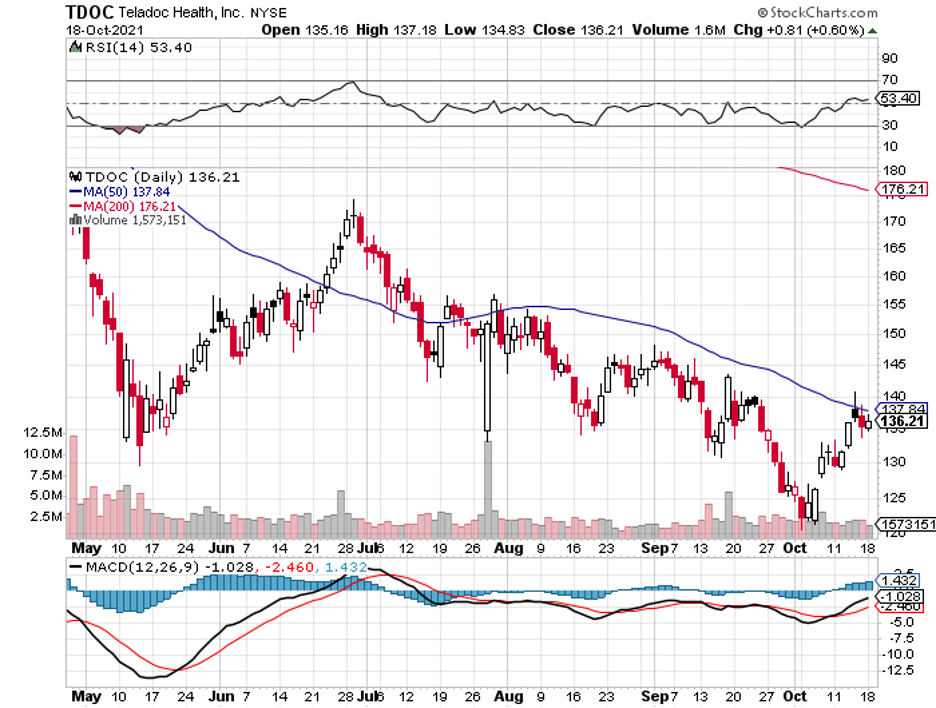
In 2020, its stock price roughly tripled from being under $100 to reaching $300. Recently, though, Teladoc's price has gone down to approximately $130.
Given its obvious room for growth, I say this stock is undervalued. So, investors are granted the chance to add this company to their portfolio at a relatively low price.
With the massive market potential of this industry, it comes as no surprise that Teladoc now faces intense competition in the field.
The strongest rivals of the company in the telehealth segment include Amwell (AMWL), Walmart (WMT), Hims and Hers Health (HIM), and even Amazon.
With the market's sheer size, though, the situation doesn't seem to be a winner-takes-all type.
The space is definitely massive enough to support more than one telehealth company.
However, Teladoc does have the advantage as the first mover. It also has its impeccable partnership with Livongo, making it an anytime-anywhere-healthcare service.
So far, I can say that Teladoc is off to an excellent start in a rapid growth segment. I especially appreciate the company's goal to disrupt the medicine and healthcare space—a field that is in dire need of a revolution to eliminate the debilitating costs and crippling inefficiencies.
More than that, I think Teladoc is becoming instrumental in boosting the reach of the most effective medical professionals and offering a remarkable platform to promote artificial intelligence innovation in healthcare.
Ultimately, this will help enhance the quality of healthcare received by patients.
When looking at disruptive technologies, I always say that it's best to invest in companies working to shape the future.
This goal is typically a surefire way to make money in the long run, and Teladoc perfectly suits the description.
Mad Hedge Technology Letter
July 26, 2021
Fiat Lux
Featured Trade:
(YOUR NEW FULFILLMENT CENTERS)
(AMZN), (WMT), (TGT)

Mad Hedge Biotech & Healthcare Letter
June 22, 2021
Fiat Lux
FEATURED TRADE:
(PRIMED FOR DOMINANCE)
(TDOC), (AMZN), (AMWL), (WMT), (CVS), (ARKK), (TSLA)

While growth stocks have already begun clawing their way back following the losses they suffered earlier this year, there are still former market favorites struggling to bounce back.
One of them is Teladoc Health (TDOC).
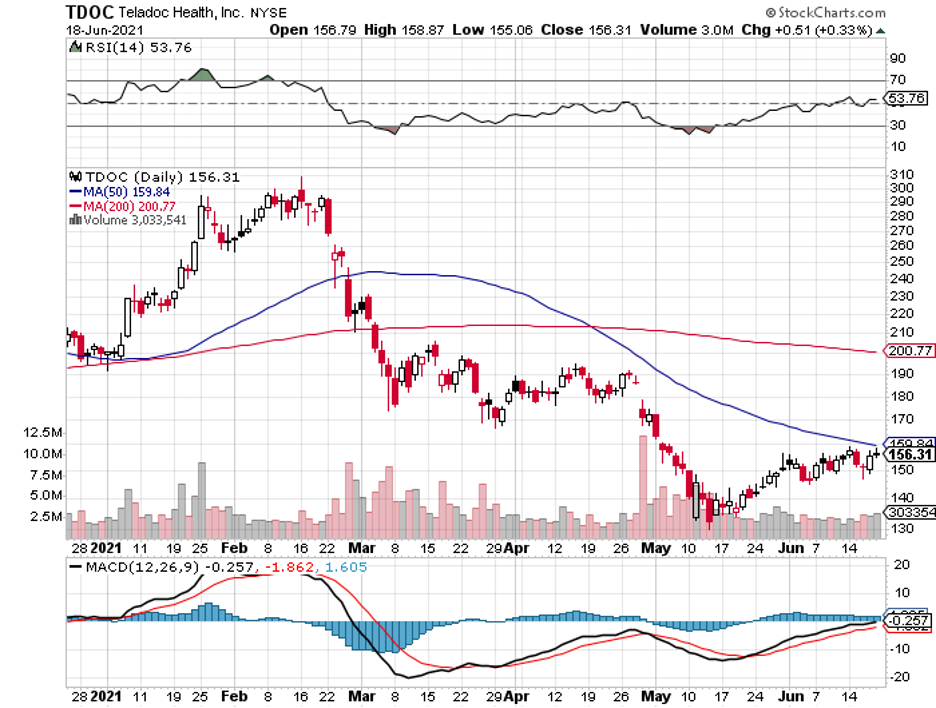
To date, Teladoc is still trading at roughly 40% below its previous highs.
While this can be frustrating for its investors, the current situation might just be an opportune time to add this stock to your portfolio.
Teladoc emerged as the leader in virtual care in 2020 by being at the right place at the right time when the pandemic struck. That year, the company’s revenue rose by a whopping 145% compared to its 2019 performance.
These days though, the stock has lost half of its value. Although that’s definitely a head-scratcher, Teladoc’s 51.5 million paid memberships in the United States alone still make it the most dominant force in this industry.
For a long-term investor, the situation presents a compelling opportunity.
Teladoc is a growing business that’s expanding both in the US and globally. While penetrating more markets would happen over time, the basic footprint has been established. This offers Teladoc much-needed exposure to a massive addressable market.
The global market for telemedicine is estimated to expand from $49.9 billion in 2019 to a jaw-dropping $459.8 billion by 2030.
In North America, which holds roughly 34.4% of the market share in 2020, the telemedicine market generated $19.23 billion during the pandemic.
Taking into consideration Teladoc’s revenue of $967.4 million for its US segments in 2020, it becomes clear that the company is only getting started, as this comprised only 5% of the market size.
If the company maintains its momentum, then the next 10 years would be an incredible journey for Teladoc investors.
Despite the disappointing share price performance of Teladoc in the past months, the company’s actual business has sustained its growth.
Revenue continues to rapidly rise, showing off a 151% growth in the first quarter of 2021.
This impressive growth has prompted Teladoc to boost its full-year revenue guidance to $2 billion, which indicates an 80% year-over-year gain.
Impressive growth has been observed all around, with access fee revenue going up 183% while visit fees climbed 24%.
Considering the size of the market, it no longer comes as a surprise that Teladoc is facing competitive threats.
Amazon (AMZN) and Amwell (AMWL) have recently entered the virtual care market. Even Walmart (WMT) and CVS (CVS) have been working on toppling Teladoc as well.
Despite the competition, Teladoc remains ahead of the pact thanks to its continuous efforts to innovate.
For example, the latest innovation from Teladoc is Primary360.
This product is designed to take virtual healthcare to the next level. It offers personalized service at the patient level. Here’s a preview of how it works.
Traditionally, patients go to their doctors when they discover a health problem. This is a reactive way of dealing with health. In contrast, Primary360 is proactive.
That is, the product monitors the patients individually from annual checkups to ongoing treatments to manage chronic conditions. Through closely monitoring the patients, Teladoc is able to perform earlier diagnoses of potential diseases and help doctors reach better outcomes for treatments.
To better picture the long-term rewards of this company, it’s good to keep in mind that Teladoc is actually the second biggest holding of Cathie Wood’s ARK Innovation ETF (ARKK), next only to Tesla (TSLA).
Teladoc Health emerged as one of the most popular pandemic plays in 2020.
While the stock tumbled when vaccines hit the market, its projected growth trajectory remains promising. In fact, Teladoc’s revenue growth is anticipated to skyrocket over the remainder of this decade, with telemedicine estimated to reach roughly half a trillion dollars by 2030.
For investors on the lookout for long-term plays, Teladoc Health's tumble has presented a good opportunity to add it to your portfolio.
Mad Hedge Technology Letter
May 19, 2021
Fiat Lux
Featured Trade:
(THE CURRENT STATE OF U.S. ECOMMERCE)
(AMZN), (WMT), (KR), (COST)

Was 2020 a one-hit-wonder for U.S. ecommerce sales?
Hardly so.
US retail ecommerce sales grew 33.6% in 2020, reaching $799.18 billion.
As the public health situation fizzles out, in-store shopping will refresh itself, and a share of consumer spending will revert away from retail and toward services like travel and live entertainment.
Consensus has it that U.S. ecommerce will grow 13.7% this year, reaching $908.73 billion, and although that would be a great year under normal circumstances, annualized growth of 13% appears pitiful compared to the pandemic numbers.
It was only at the beginning of 2020 that ecommerce was expected to grow 13.2% from 2019, but the health crisis ignited ecommerce sales to $799.18 billion.
Ecommerce growth from a much higher base is a hard endeavor as all the low-hanging fruit has been harvested and it’s just harder to push the needle higher.
What does this all mean?
Ecommerce represents a larger piece of the pie than ever before and that comes with greater influence.
I now expect ecommerce sales will account for 15.5% of the $5.856 trillion in total retail sales this year.
Ecommerce sales will surpass $1 trillion next year.
It also means that digital commerce has never been so strong in terms of a percentage growth basis, net total basis, and clout.
However, growth rates will need to moderate first before they can reaccelerate.
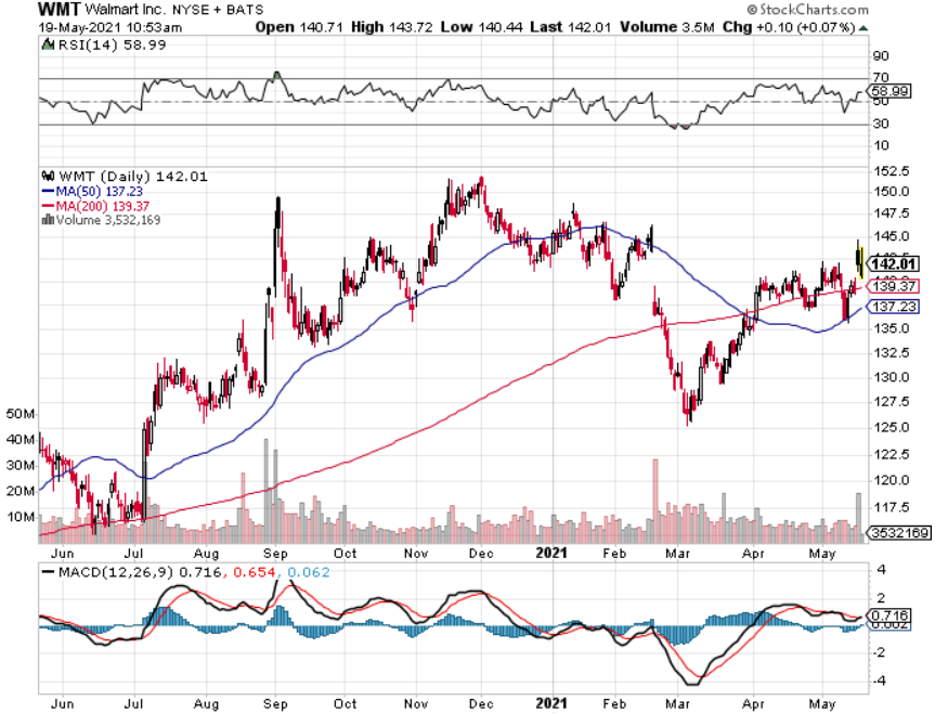
Looking at the financial year, look for sales to rise by a low single for the big-box retailer Walmart (WMT) showing that numbers are getting ahead of themselves.
Walmart is an accurate bellwether stock that gives us deep insight into the state of ecommerce, and they said it sees earnings rising by a high single-digit percent.
Guidance aside, Walmart had a great quarter.
Every segment performed well, and I am encouraged by traffic and grocery market share trends.
But customers clearly want to get out and shop which is why growth rates will most likely drop around 13% for ecommerce instead of staying north of 30%.
Walmart’s ecommerce continues to grow and stimulus in the U.S. had an outsized impact, and the second half has more uncertainty than a typical year because the reopening is a once-in-a-lifetime phenomenon and it’s hard to pinpoint the shake out.
Remember, there most likely will not be any broad-based stimulus payments in the 2nd half of 2021 and 2022 that will be rolled into Walmart ecommerce sales.
Walmart is clearly chasing the leader of the pack Amazon.
Amazon is on track to become the largest retailer in the United States within the next four years, followed by the aforementioned Walmart and Kroger.
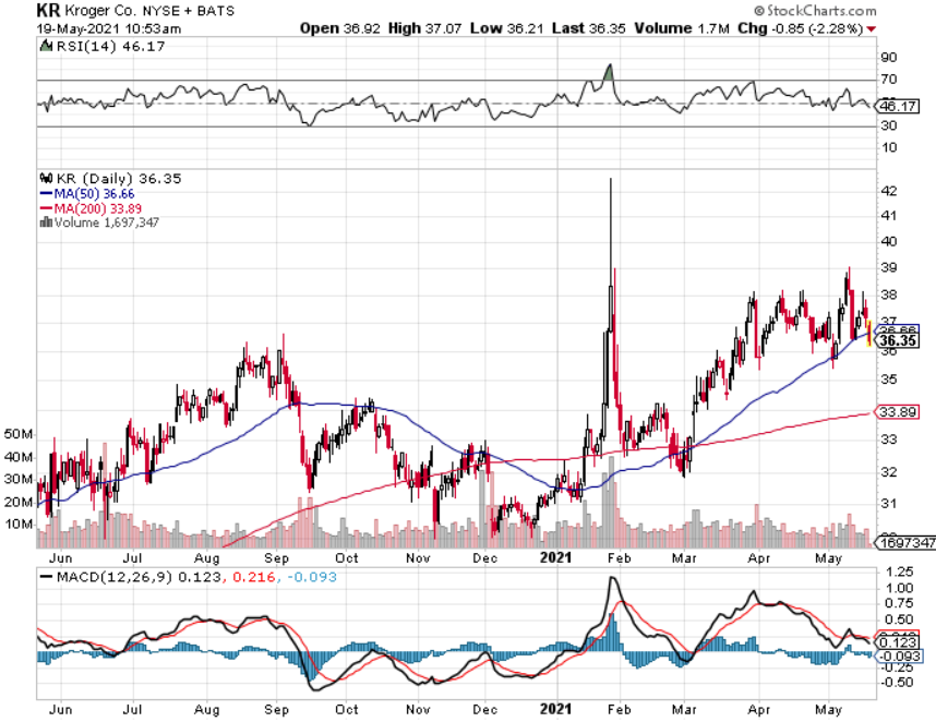
Kroger has been a fashionable pick amongst hedge fund managers in the beginning of 2021.
Amazon (AMZN) gross merchandise value sales (GMV) will top $631.6 billion by 2025, representing a compound annual growth rate of 14% between 2020 and 2025.
The same report showed us that Walmart’s ecommerce sales are set to grow at a five-year CAGR of 14.9% from $43.6 billion in 2020 to $87.5 billion in 2025, accounting for 16.7% of total retailer sales in 2025.
Ecommerce is the only channel that will grow in the next 5 years, everything else, such as offline retail will contract or go sideways at best.
It’s a death by a thousand cuts type of dilemma for anyone that isn’t in ecommerce.
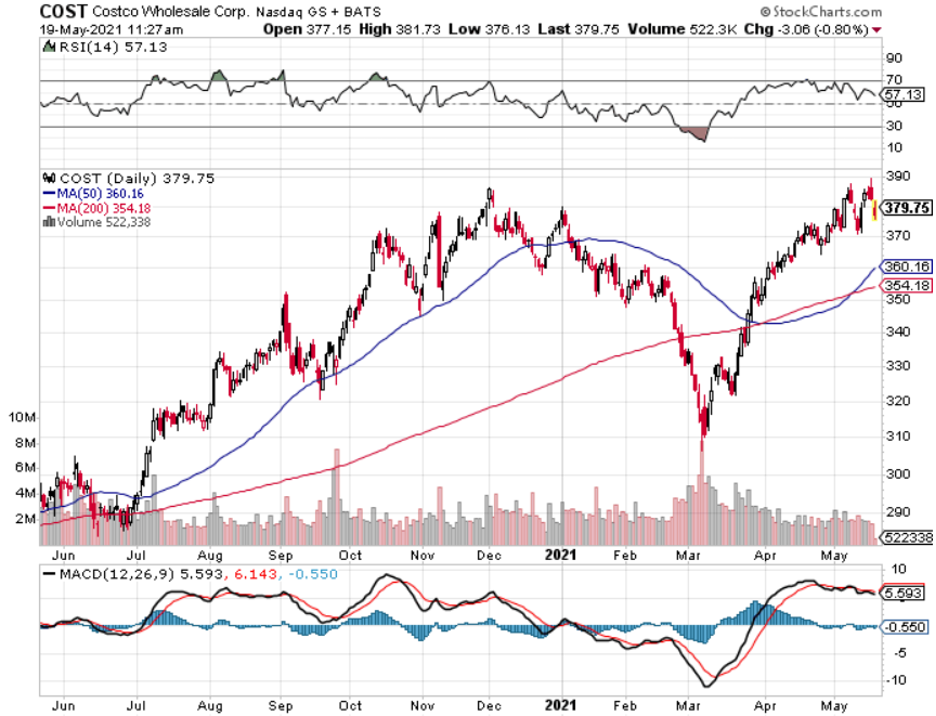
Costco (COST), the fourth largest U.S. retailer, is expected to invest heavily in its digital business, with its online sales set to increase by 47% over the same period, reaching $15.3bn in 2025.
Over the next few years, Generation Z will age into adulthood and bring with them a digital wallet and firms will need to focus investment online and engage with the digital ecosystem in order to win market share.
Gen Z doesn’t use cash.
Online grocery is set to stay even in healthy times, but the pace of growth for online grocery will level off after the 2020 explosion.
Fresh grocery ecommerce is still expected to grow at 13.3% CAGR between now and 2025 which is why you see many retailers like Walmart investing in the fresh foods’ delivery business.
Habits are hard to break and it’s clear that digital add-ons are here to stay, and brands must cultivate digital platforms to win.
Global Market Comments
April 2, 2021
Fiat Lux
Featured Trade:
(WHY CONSUMER STAPLES ARE PEAKING),
(XLP), (PG), (PEP), (PM), (WMT), (AMZN),
(WHY YOUR OTHER INVESTMENT NEWSLETTER IS SO DANGEROUS)

Everyone always needs toilet paper, right?
Wrong. At least stock investors don’t.
Once considered one the safest stock market sectors in which to hide out during bear markets and more recently pandemics, Consumer Staples no longer offer the hideout they once did.
Who needs a hideout anyway now that the Roaring Twenties are on and may make another decade to run.
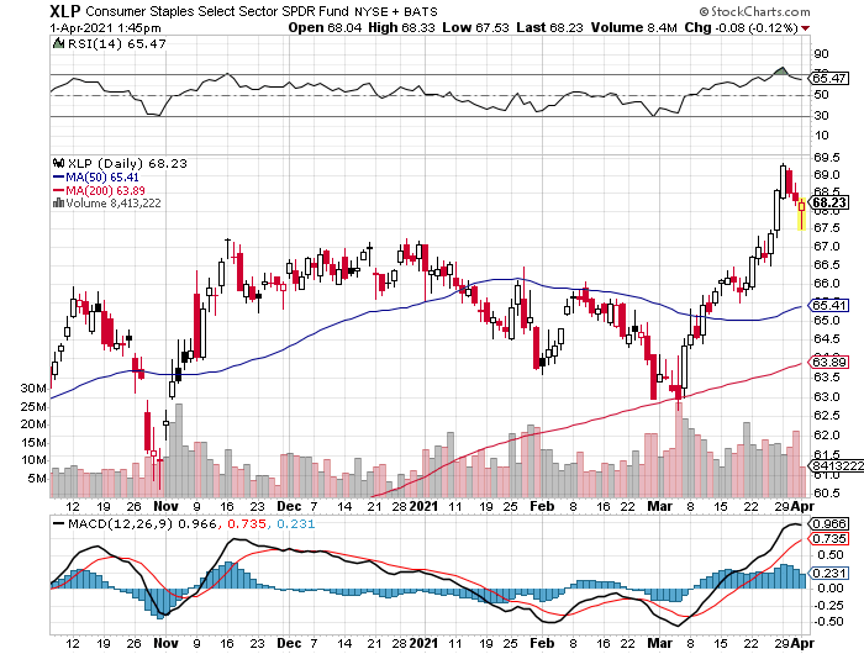
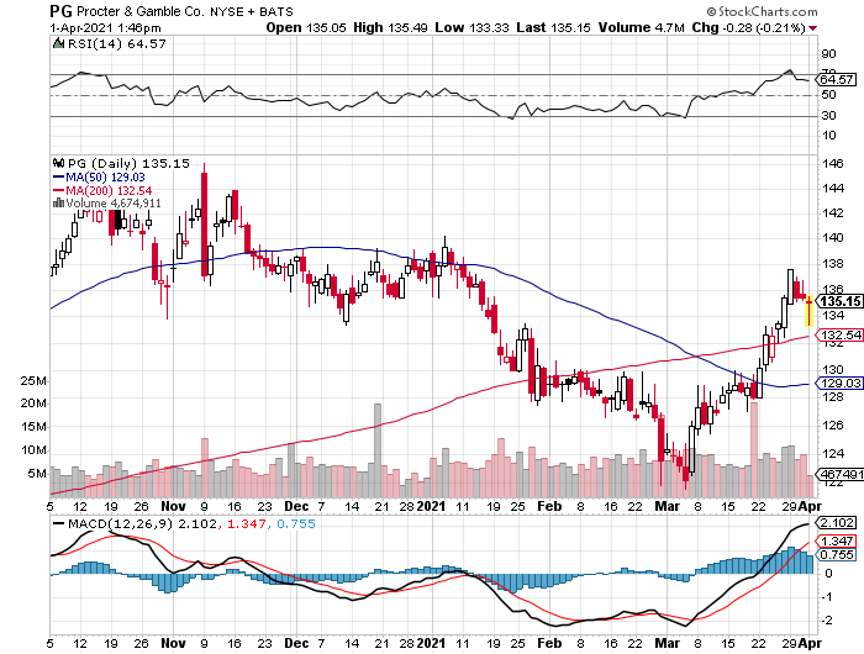
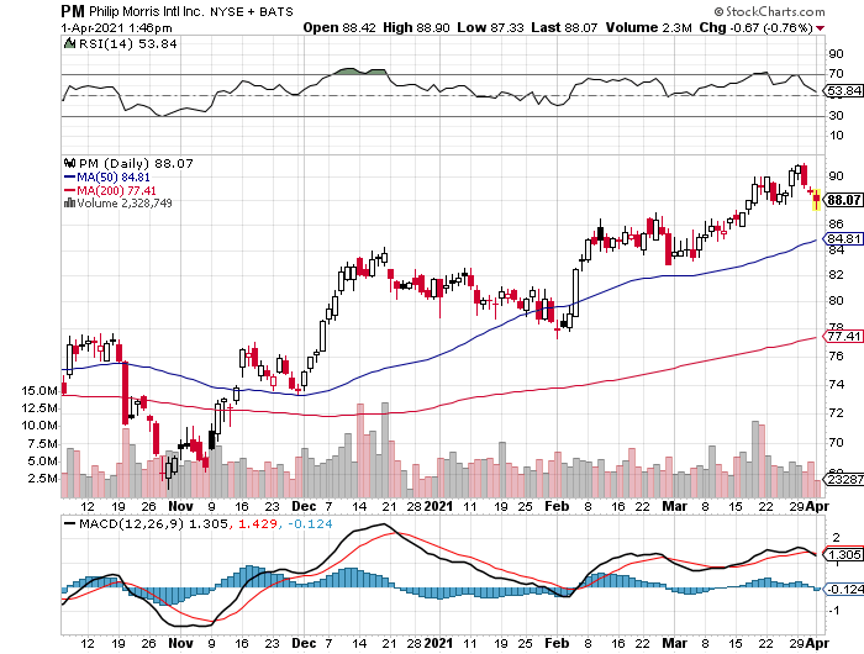
Take a look at the Consumer Staples Select Sector SPDR ETF (XLP). It’s top five holdings include Proctor & Gamble (PG) (11.13%), Coca-Cola (KO) (10.07%), PepsiCo, Inc. (PEP) (8.7%), Philip Morris (7.80%) (PM), and Walmart (WMT).
Its only remaining attraction is that it has a 30-day SEC yield of 2.67%.
The (XLP) has recently been one of the best performing ETFs. However, costs are rising dramatically, and the bloom is coming off the rose.
In short, the industry is caught in a vice.
In the meantime, ferocious online competition from the likes of Amazon (AMZN) makes it impossible for consumer staples to pass costs on to consumers as they did in past economic cycles.
In fact, the prices for many consumer staples are falling thanks to the world’s most efficient distribution network. And if you are an Amazon Prime member, they will deliver it to your door for free. I just bought a pair of Head Kore 93 skis in Vermont, and they were delivered in two days.
It gets worse. The largest sector of the consumer staples market, the poor and working middle class are seeing the smallest wage gains, the worst layoffs, and the slowest pandemic recovery. Almost all pay increases are now taking place at the top of the wage ladder.
AI specialists and online marketing experts, yes, Safeway checkout clerks and fast food workers, no.
This also will get a lot worse as some 50% of all jobs will disappear over the next 20 years, mostly at the low end.
Blame technology. There is even a robot now that can assemble Ikea furniture. And there goes my side gig!
So, if your friend at the country club locker room tells you it’s time to load up on Consumer Staples because they are cheap, safe, and high-yielding, ignore him, delete his phone number from your contact list, and unfriend him on Facebook.
If anything, the sector is a great “sell short on rallies” candidate.
As I never tire of telling followers, never confuse “gone down a lot” with “cheap.”
Eventually, the sector will fall enough to where it offers value. But that point is not now. There has to be a bottom somewhere.
After all, everyone needs toilet paper, right? Or will a robot soon take over that function as well? They already have in Japan.

Global Market Comments
February 24, 2021
Fiat Lux
Featured Trade:
(LONG TERM ECONOMIC EFFECTS OF THE CORONA VIRUS),
(ZM), (LOGM), (AMZN), (PYPL), (SQ), CNK), (AMC), (IMAX), (CCL), (RCL), (NCLH), (CVS), (RAD), (WMT)